
Walk into an outdoor sauna and the first question is almost always the same. How hot should it be, and how long should I stay in? The thermometer on the wall gives you a number, but that number only helps if you know where it was measured, what it means for your body, and how it pairs with session length.
This guide covers the ideal temperature range for a traditional outdoor sauna, where to place the thermometer, how long to stay in, and how to adjust for winter, beginners, and older bathers. Your body is the final judge, and it outranks any dial.
Please read first: This article is general information, not medical advice. Saunas are wellness tools, not treatments. If you are pregnant, live with a heart or circulation condition or low blood pressure, or take medication that affects heat tolerance, check with a doctor before using a sauna. Drink water before and after each session, start short, and leave immediately if you feel dizzy, nauseous, or unwell. Never drink alcohol before or during a sauna session.


#Paid Links
The Short Answer: What Temperature Should an Outdoor Sauna Be?
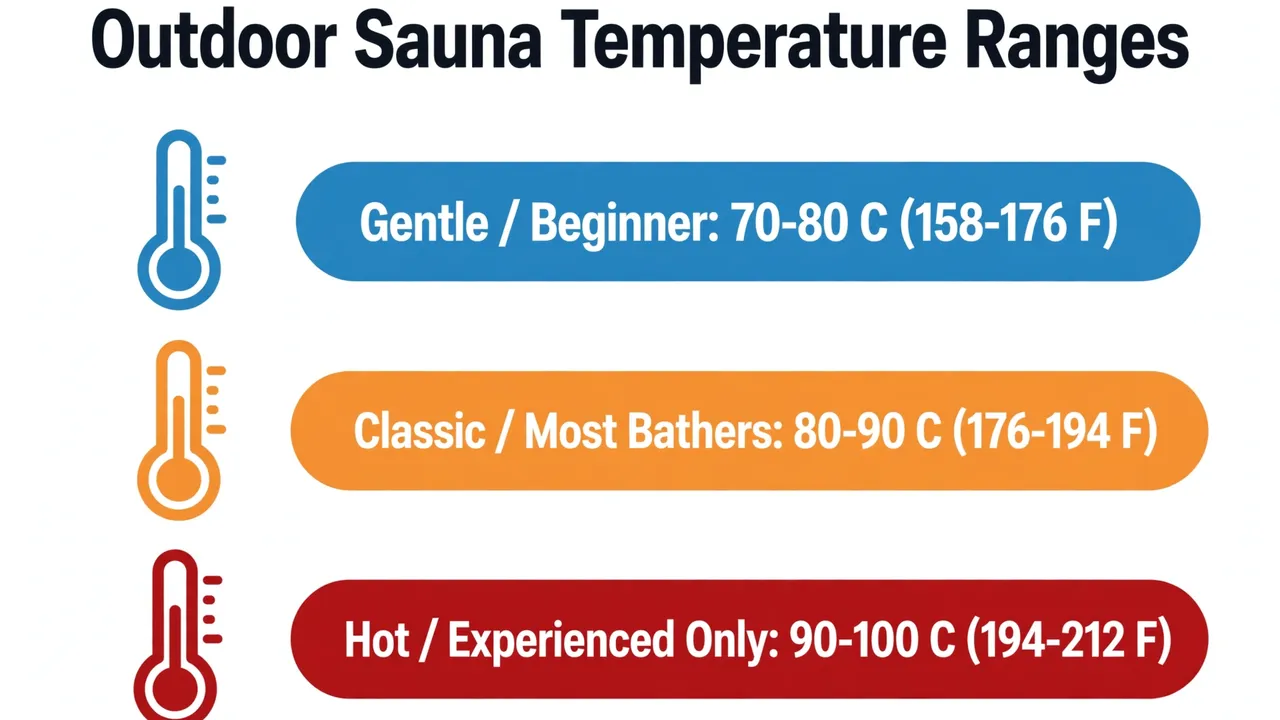
Most traditional outdoor saunas run best between 70 and 90 degrees Celsius, which is 158 to 194 degrees Fahrenheit. That range covers the classic Finnish style of sauna bathing, the style outdoor saunas are built around. Beginners usually feel comfortable at the lower end, around 70 to 80 degrees. Regular bathers often settle around 80 to 90 degrees.
Temperatures above 90 degrees are for experienced bathers only, and even then only in short sessions. There is no prize for the hottest sauna. The goal is a deep, even sweat that leaves you relaxed, not a test of endurance.
Ideal Outdoor Sauna Temperature Ranges
The table below gives the ranges most sauna makers and Finnish bathing guides describe as typical for a traditional dry sauna. Treat them as starting points, not prescriptions. Your comfort, your health, and the day itself all shift the right number up or down.
| Bather | Typical range | What it feels like |
|---|---|---|
| First timer | 70 to 75 C (158 to 167 F) | Gentle warmth, easy breathing, light sweat after a few minutes |
| Beginner, a few sessions in | 75 to 80 C (167 to 176 F) | Comfortable heat, steady sweat, good place to learn your limits |
| Regular bather | 80 to 90 C (176 to 194 F) | Classic sauna heat, strong sweat, the range most people settle into |
| Experienced bather | 90 to 100 C (194 to 212 F) | Very hot, short sessions only, only if you know your tolerance well |
| Children and older adults | 60 to 70 C (140 to 158 F) | Mild heat, short sessions, always supervised, see the section below |
Why 70 to 90 Degrees Is the Sweet Spot
Below 70 degrees, most people find the room pleasant but not quite sauna-like. You will warm up and may sweat lightly, but the deep heat that defines a sauna session is missing. That is fine for a gentle session or for someone easing back in after a break, but it is not the classic experience.
Between 70 and 90 degrees, the body sweats freely, muscles relax, and breathing stays comfortable for most healthy adults. This is also the range used in the Finnish sauna studies that get quoted most often, including the long running KIHD cohort research from eastern Finland. That research is observational, which means it found an association between regular sauna use and certain health outcomes, not proof that sauna use causes them. Still, the temperature range in those studies lines up with what experienced bathers describe as normal.
Above 90 degrees, the margin for error shrinks fast. Sweating increases, heart rate climbs, and the time you can stay in safely drops sharply. A few minutes at 95 degrees can feel far more intense than fifteen minutes at 80 degrees. If you want to try hotter sessions, build up to them over weeks, keep them short, and cool down fully between rounds.


#Paid Links
Temperature Is a Range, Not a Single Number
Chasing an exact number on the thermometer is a common beginner mistake. Outdoor saunas are not ovens with precise thermostats. A wood-fired stove swings up and down as the fire burns, and even an electric heater cycles on and off. A reading of 82 degrees one minute and 86 the next is normal.
Think in bands instead. If the thermometer reads somewhere in your target band and your body feels comfortable, you are in the right place. If you are straining to breathe or counting the seconds until you can leave, the room is too hot for you today, whatever the dial says. The same temperature can feel different on different days depending on sleep, hydration, and how hot the weather is outside.
Wood-Fired vs Electric: Does the Heater Change the Ideal Temperature?
The ideal temperature range is the same for both heater types. What changes is how the heat feels and how steady it is. A wood-fired stove gives a softer, more humid heat when water is thrown on the stones, and the temperature rises and falls with the fire. An electric heater holds a steadier temperature and recovers faster after the door opens.
Wood-fired sauna owners often run the room a little cooler, around 75 to 85 degrees, because the bursts of steam from the stones make the heat feel stronger. At 85 degrees with a good splash of water, the room can feel hotter than a dry 90 degree electric sauna.
Electric heater owners often run slightly hotter, around 80 to 90 degrees, because the heat is drier and more even. The thermostat keeps the room near the set point, which makes it easier to hold a steady session. If your electric heater has a timer and a temperature dial, set the dial to your target band and let the thermostat do the work rather than adjusting it every few minutes.
Neither type is better. The right choice depends on your site, your power supply, and how you like to sauna. If you are still deciding, our comparison of wood-fired vs electric outdoor sauna heaters walks through cost, heat style, and practical trade-offs. For stove care, including chimney cleaning and ash handling, see our guide to wood-fired sauna stove care, chimney cleaning, and ash safety.
Fire Safety Basics for Wood-Fired Saunas
A wood-fired stove needs respect every time it is lit. Never leave a burning stove unattended, and keep the area around it clear of towels, wood, and anything flammable. Follow the clearances in your stove and sauna manufacturer instructions, since the safe distance depends on the model and on whether heat shields are fitted.
Clean ash out regularly and store it in a metal container with a lid, away from the building, because ash can hold live embers for a surprisingly long time. Have the chimney swept on the schedule your stove maker recommends, and check the flue for creosote buildup. A clean chimney draws better, heats faster, and is far safer.
Where to Put Your Sauna Thermometer
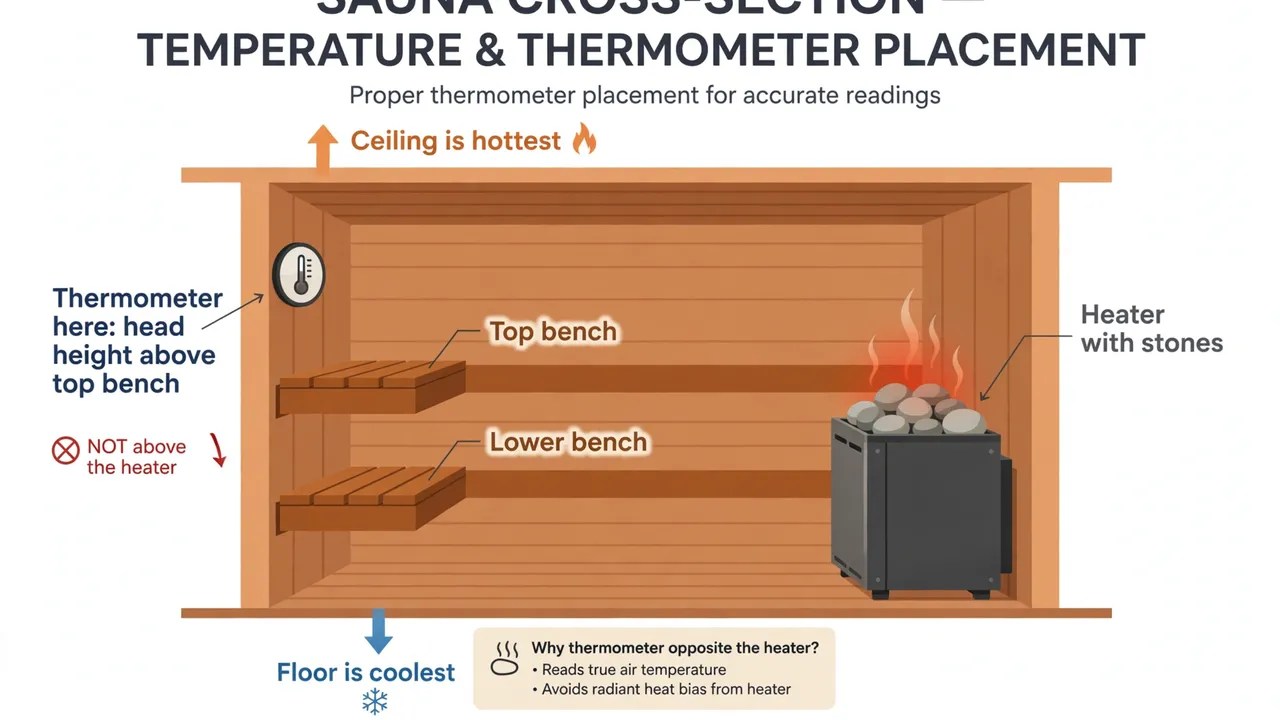
A thermometer in the wrong spot can mislead you by 10 degrees or more. That is enough to turn a comfortable session into an overheated one, or to leave you wondering why a room that reads 90 degrees feels mild. Placement matters as much as the thermometer itself.
The Three Placement Rules
- Opposite the heater. Mount the thermometer on the wall facing the heater, not above it or beside it. Directly above the heater, the reading is skewed by rising hot air and radiant heat from the stones.
- At head height above the top bench. The thermometer should sit roughly at the head height of a person sitting on the highest bench. That is the air you actually breathe, so it is the reading that matters most.
- Where you can read it from the bench. Place it where a seated bather can glance at it without standing up or leaning across the room. If you have to get up to check it, you will check it less often.
Places You Should Never Put a Thermometer
- Directly above the heater. This is the hottest spot in the room. The reading will run high and tell you nothing about the air at bench level.
- Near the door or vent. Cool air enters here, so the reading will run low and the heater will seem weaker than it is.
- At floor level. The floor can be 20 to 30 degrees cooler than the ceiling. A floor level thermometer makes a hot sauna look mild.
- On the ceiling. This is the hottest air in the room. It will read high and may push you to run the sauna cooler than you need to.
How Accurate Is Your Thermometer?
Most sauna thermometers are simple bimetal or alcohol filled dials, and they are approximate instruments. A cheap dial can be off by several degrees, and steam can fog the face. Digital thermometers with a remote probe are usually more precise, but the probe still has to sit in the right spot to give a useful reading.
What the Thermometer Reading Really Means
The air in a sauna is layered. Hot air rises, so the temperature climbs steadily from floor to ceiling. In a typical outdoor sauna running at 85 degrees at head height, the air near the ceiling might be close to 100 degrees while the floor sits near 55 or 60 degrees. That spread is normal, and it is why bench height is a temperature control in itself.
Heat layers in a typical outdoor sauna (thermometer at head height reads 85 C / 185 F)
Figures are typical layering for a two bench sauna, not a measurement of any one model. Your room will differ.
This layering gives you a simple way to adjust the heat without touching the heater. Feeling too hot on the top bench? Move down to the lower bench and the air around you drops by roughly 10 to 15 degrees. Feeling chilly? Move up. Many experienced bathers start low, warm up gently, and move to the top bench for the last few minutes.
Steam changes the picture again. When you throw water on the stones, humidity spikes and the heat feels far more intense, even though the thermometer barely moves. That is why a sauna at 80 degrees with regular splashes can feel hotter than a dry sauna at 90 degrees. Add water a little at a time, wait for the wave of heat to pass, and only add more once you are comfortable again.
How Long Should You Stay In?
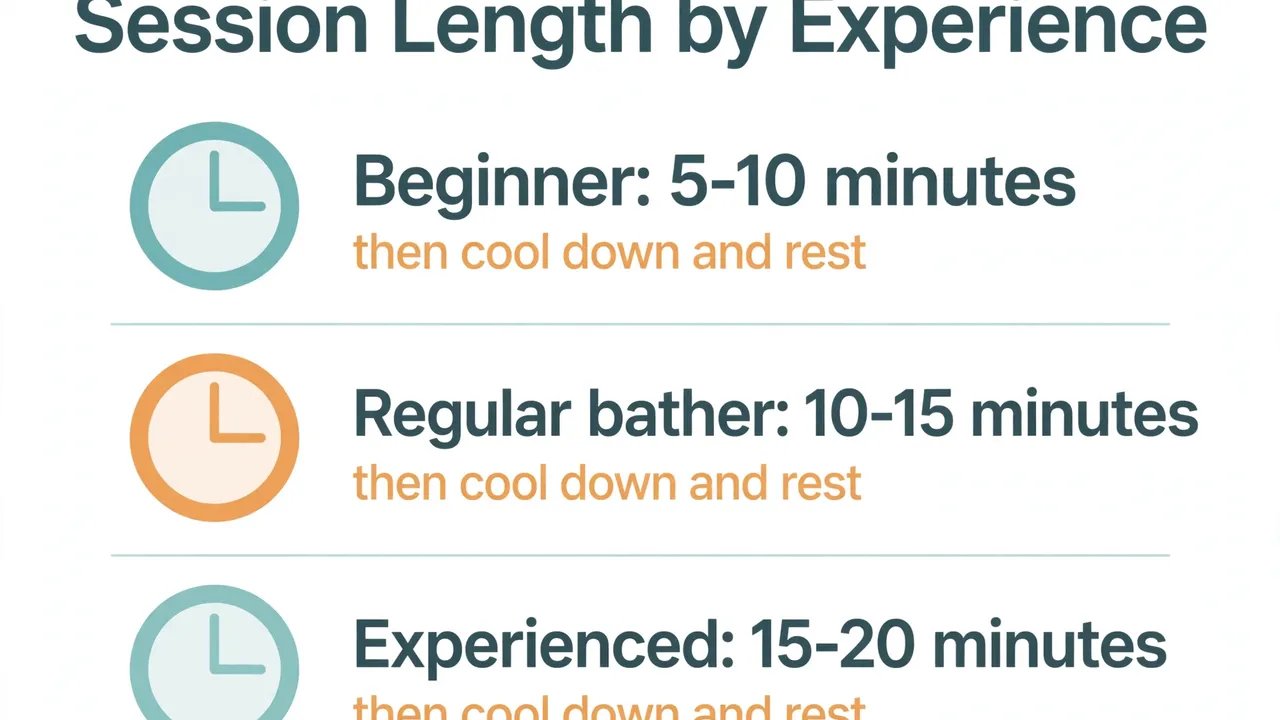
Session length and temperature are a pair. Hotter rooms mean shorter sessions, and cooler rooms allow longer ones. There is no single correct session length, only a range that fits your experience and the temperature you are sitting in.
| Bather | One round | Rounds per visit | Rest between rounds |
|---|---|---|---|
| First timer | 5 to 10 minutes | 1 to 2 | 10 to 15 minutes |
| Beginner | 8 to 12 minutes | 2 | 10 to 15 minutes |
| Regular bather | 10 to 15 minutes | 2 to 3 | 10 to 20 minutes |
| Experienced bather | 15 to 20 minutes | 2 to 3 | 10 to 20 minutes |
| Children | 5 minutes or less | 1 | Full cool down, supervised |
A Simple Session Structure That Works
Most sauna visits follow the same rhythm, and it has stayed the same for generations in Finland. Heat up, cool down, rest, and repeat if you feel like it. A typical visit lasts 45 to 60 minutes in total, including rests, even though the time actually spent inside the hot room is only 20 to 40 minutes.
- Warm up in the sauna. Sit on the lower bench first for a minute or two, then move up if you like. Stay for 5 to 15 minutes depending on your experience and the temperature.
- Cool down outside. Step out into fresh air, take a cool shower, or use a cold plunge if you have one. Cool down for at least as long as you heated up. Our guide to backyard contrast therapy with an outdoor sauna and cold plunge explains how to pair the two safely.
- Rest and drink water. Sit or lie down in the changing room or outdoors, sip water, and let your body temperature settle. This rest is part of the session, not wasted time.
- Repeat once or twice if you feel good. Most people do two or three rounds. Stop after one round if that feels right. There is no need to push for more.
Beginners: Start Short, Even If the Room Feels Mild
If this is your first month of sauna use, keep rounds to 5 to 10 minutes at 70 to 75 degrees. That may feel cautious, but your body needs time to learn how to sweat efficiently and how to handle the heat. Many first timers are surprised by how tiring even a short session feels.
Add a few minutes or a few degrees at a time over several weeks, not all in one visit. If you feel lightheaded at any point, leave at once and cool down. There is no benefit in staying in to prove something, and the session you cut short today is the one that lets you enjoy the next one.
How Temperature and Session Length Work Together
The simplest rule is this: as temperature rises, session time falls. A room at 70 degrees can be enjoyed for 15 to 20 minutes by a regular bather. The same person at 95 degrees may be ready to step out after 8 to 10 minutes. Both sessions can be equally satisfying.
Cooler and longer
70 to 75 C for 15 to 20 minutes. Gentle, relaxing, good for beginners and for long slow evenings.
Classic balance
80 to 85 C for 10 to 15 minutes. The standard session most regular bathers aim for.
Hotter and shorter
90 to 95 C for 5 to 10 minutes. Intense heat, experienced bathers only, with a full cool down after.
Humidity plays into this balance too. A dry 85 degree room and a steamy 85 degree room are different experiences. Each splash of water raises the perceived heat, so shorten the round or sit lower when you use a lot of water. The same applies on a hot summer day, when your body is already warm before you step inside. Our tips for outdoor sauna use in summer heat, shade, and ventilation cover warm weather sessions in more detail.
Signs You Are Overheating
Overheating usually gives warnings before it becomes serious. Learn them, and act on the first one rather than waiting to see if it passes.
- Dizziness or lightheadedness. Leave the sauna at once, sit or lie down somewhere cool, and drink water.
- Nausea or a sudden headache. Step out, cool down slowly, and do not go back in that day.
- Heart racing or pounding. A faster heartbeat is normal in the heat, but a pounding or irregular feeling is a signal to stop.
- Stopped sweating while still hot. If your skin goes dry while you still feel very hot, leave immediately and cool down.
- Confusion or trouble thinking clearly. Get out, get cool, and get help if the feeling does not pass quickly.
- Muscle cramps. Often a sign of fluid and salt loss. Cool down, drink water, and rest.
If symptoms do not ease within a few minutes of cooling down, or if someone faints or cannot think clearly, seek medical help right away. Heat illness can develop quickly, and it is always better to call for help early than to wait.
Never sauna alone if you have a health condition that affects heat tolerance, and tell someone you are going in. A quick word to a family member costs nothing and matters a lot if something goes wrong.
Adjusting for Winter and Cold Weather
Winter is when an outdoor sauna shines, and also when temperature management gets trickier. Cold air outside means the room loses heat faster, the heater works harder, and the contrast between the hot room and the cold air is much sharper.
Allow extra preheat time in winter. A sauna that reaches 80 degrees in 30 minutes in summer may need 45 to 60 minutes when it is freezing outside. The exact time depends on your heater size, insulation, and how cold it is, so check the thermometer rather than the clock. Our guide to how long an outdoor sauna takes to heat up covers preheat times by heater type and season. For winter routines, snow, and heating tips, see our outdoor sauna in winter guide.
Winter Temperature Tips
- Preheat a little hotter. Aim for the top of your usual band before the first round, because the room cools a few degrees each time the door opens to cold air.
- Keep the door closed between rounds. Every opening lets in a blast of cold air and drops the room temperature noticeably.
- Warm up before you go in. Step into the sauna already warm, not chilled to the bone. A cold body takes longer to start sweating, and the session feels less comfortable.
- Cool down gradually. The jump from 85 degrees to freezing air is a shock to the body. Spend a minute or two in the changing room or under a lukewarm shower before stepping into snow or a cold plunge.
- Watch the floor and path. Water tracked out of the sauna freezes fast. Keep the path clear and wear slip resistant footwear outside.
Good insulation makes winter sessions far easier. If your sauna struggles to hold temperature in cold weather, the insulation and vapour barrier may need attention. Our guide to outdoor sauna insulation, foil, rockwool, and vapour barriers explains what to check. Ventilation matters in every season too, and our outdoor sauna ventilation guide covers inlet and outlet placement.
Children, Older Adults, and First Timers
Children and older adults can enjoy saunas, but the guidance is more conservative for both groups. Their bodies handle heat differently, and the margin for error is smaller. When in doubt, go cooler and shorter.
Children
Children heat up faster than adults because they have a larger skin surface relative to body weight and sweat less efficiently. Keep the room at 60 to 70 degrees, limit sessions to about 5 minutes, and always supervise directly. Let the child sit on the lower bench, where it is cooler. If a child says they feel too hot, dizzy, or uncomfortable, bring them out at once and cool them down.
Very young children should not use a hot sauna at all. Check with your family doctor before bringing a child into a sauna, especially if the child has any health condition. Never leave a child alone in a sauna, even for a moment.
Older Adults
Older adults often have a lower tolerance for heat, and many take medication that affects blood pressure or heat regulation. Start at 60 to 70 degrees for short sessions of 5 to 10 minutes, and build up slowly over weeks if sessions feel comfortable. Sit on the lower bench, stay hydrated, and stand up slowly when leaving, because blood pressure can dip when moving from heat to cool air.
Anyone with a heart condition, low blood pressure, or a history of fainting should talk to a doctor before using a sauna. The same applies to anyone recovering from illness or surgery. A short, gentle session is far better than a long one that ends badly.
Pregnancy
Pregnant readers should check with their doctor before using a sauna. Many doctors advise avoiding high temperatures during pregnancy, particularly in the first trimester. If a doctor does approve sauna use, keep sessions short, temperatures low, and leave at the first sign of discomfort.
Choosing and Caring for Your Heater and Stones
The heater and stones set the quality of the heat, so they deserve a little attention. The right heater size for your room volume matters more than the brand. An undersized heater will struggle to reach temperature, especially in winter, and will run constantly. An oversized heater will overshoot the target and cycle on and off, making the temperature jumpy. Check the manufacturer rating for your room size before buying.
If you are shopping for a heater, our guides to electric sauna stoves and HUUM wood-burning sauna stoves cover popular options and what to look for. For electrical work, always use a licensed electrician and follow local code. Our guide to outdoor sauna electrical hookup explains the general requirements and why professional installation matters.
Quick Checklist Before Every Session
- Drink a glass of water before you go in, and keep water nearby for after.
- Check the thermometer at head height above the top bench and confirm the room is in your target band.
- Shower or rinse off before entering, and dry off lightly.
- Sit on the lower bench first, then move up once you are warm.
- Set a timer or keep an eye on the clock so rounds stay within your planned length.
- Step out at the first sign of dizziness, nausea, or discomfort, no exceptions.
- Cool down fully, rest, and drink water before the next round.
Frequently Asked Questions
What is the best temperature for an outdoor sauna?
For most people, 70 to 90 degrees Celsius (158 to 194 Fahrenheit) is the best range. Beginners should start at 70 to 80 degrees, regular bathers usually settle at 80 to 90 degrees, and temperatures above 90 degrees are for experienced bathers in short sessions only.
Where should I put the thermometer in my outdoor sauna?
Mount it on the wall opposite the heater, at head height above the top bench, where you can read it while seated. Never place it directly above the heater, near the door or vent, or at floor level, because each of those spots gives a misleading reading.
How long should I stay in an outdoor sauna?
Beginners should stay 5 to 10 minutes per round, regular bathers 10 to 15 minutes, and experienced bathers up to 15 to 20 minutes. Do two or three rounds with a full cool down and rest between each one. Shorter sessions at higher temperatures work just as well as longer sessions at lower temperatures.
Is 100 degrees Celsius too hot for a sauna?
One hundred degrees is the upper limit most heater makers set, and it is very hot. Only experienced bathers should use it, and only for a few minutes at a time, with a full cool down afterwards. Most people enjoy their sauna far more at 80 to 90 degrees.
Why does my sauna feel hotter than the thermometer says?
Humidity is the usual reason. Throwing water on the stones raises the perceived heat sharply even though the air temperature barely changes. Your bench height matters too. The top bench can be 10 to 15 degrees hotter than the lower bench, so move down if the heat feels too strong.
Can children use an outdoor sauna?
Older children can use a sauna with direct adult supervision, at a mild 60 to 70 degrees, for about 5 minutes on the lower bench. Very young children should not use a hot sauna. Check with your family doctor first, and bring the child out at once if they feel uncomfortable.
Sources and Further Reading
Temperature ranges in this guide follow the widely published guidance for traditional Finnish sauna bathing, including the ranges used in the Finnish KIHD cohort studies of regular sauna users. Those studies are observational, so they show an association between sauna habits and health outcomes rather than proof of cause. For heater specific limits, always follow your own heater and sauna manufacturer instructions, since maximum temperatures and clearances vary by model.
For more on running an outdoor sauna through the year, see our outdoor sauna maintenance calendar, and for the bigger picture on outdoor versus indoor setups, see outdoor sauna vs indoor sauna.