
An outdoor sauna feels simple once it is standing in the garden. Four walls, a bench, a heater, and steam rising on a cold evening. The part most people underestimate is the wire that makes it all work.
Unlike an indoor sauna, an outdoor sauna sits away from the house. Power has to travel across the garden, survive rain and frost, and feed a heater that draws far more current than a household appliance. That is why the electrical hookup deserves its own plan, made before the sauna kit arrives.
This guide explains the outdoor sauna electrical hookup in plain language. You will learn what a dedicated circuit is, why GFCI protection matters outdoors, when a subpanel makes sense, and how cable, conduit and disconnects fit together. It also gives you a list of questions to ask your electrician, so you can have a useful conversation instead of guessing.


Paid Links - As an Amazon Associate, I earn from qualifying purchases.
Important: This article is general guidance only. It is not a substitute for your local electrical code or a licensed electrician. Electrical rules, permit requirements and inspection steps vary by area. Always check with your local permit or code office, and have all installation work done by a licensed electrician.
Key Takeaways
- An outdoor sauna almost always needs its own dedicated circuit, sized by a licensed electrician from the heater manufacturer’s specifications.
- GFCI protection is a key safety layer outdoors, where water, damp ground and bare feet are part of everyday use.
- Power usually runs from the house panel through outdoor-rated cable or conduit to a disconnect switch near the sauna, and sometimes to a small subpanel.
- Distance from the house, the heater type and your existing panel capacity all shape the plan, so get the electrician involved before you order the sauna.
- Never run a sauna heater from an extension lead or a shared household circuit, and never do the wiring yourself unless you are a licensed electrician.
Why an Outdoor Sauna Needs a Different Electrical Plan
A sauna heater is not like a kettle or a hair dryer. It runs at high power for a long time, and it does so in a small wooden room where people sit with bare skin on hot benches. The wiring has to be built for that job, not borrowed from whatever socket happens to be nearby.
An indoor sauna at least sits close to the house panel. An outdoor sauna adds distance, weather and a separate structure to the problem.
Rain can reach every fitting. Frost can move the ground. A cable that would be fine inside a dry hallway may fail quickly when it is buried in a wet garden.
Distance changes everything
The further the sauna sits from the house, the more the electrician has to think about the cable run. Long runs need careful sizing so the heater still gets the power it needs. The route also matters: a straight line across a lawn is simple, while a route past patios, trees and driveways needs more planning.
This is one reason to fix the sauna’s position early. If you already know where the sauna will stand, your electrician can plan the shortest sensible route and tell you whether trenching, conduit or a subpanel is needed. Moving the sauna later can mean redoing the whole cable run.



Paid Links - As an Amazon Associate, I earn from qualifying purchases.
Weather is part of the wiring
Every outdoor fitting has to cope with rain, snow, sun and temperature swings. That is why electricians use outdoor-rated cable, weatherproof boxes and fittings, and sealed connections for sauna work. Indoor parts left outside will corrode, crack or let water in.
Good weatherproofing is not only about keeping the sauna working. Water and electricity are a dangerous mix, and a sauna is a place where people are wet, barefoot and relaxed. Sealed, properly installed outdoor wiring is a safety matter, not a cosmetic one.
The Electrical Path: From Your House Panel to the Sauna
Most outdoor sauna hookups follow the same basic path. Power leaves the main panel in the house, travels through a dedicated circuit to the garden, and arrives at a disconnect switch close to the sauna. From there it feeds the heater, and sometimes the lights and controls too.
The details vary from home to home. Some saunas need a subpanel near the building. Others run on a single circuit. Your electrician will decide the layout after looking at your panel, the heater’s requirements and the distance involved.
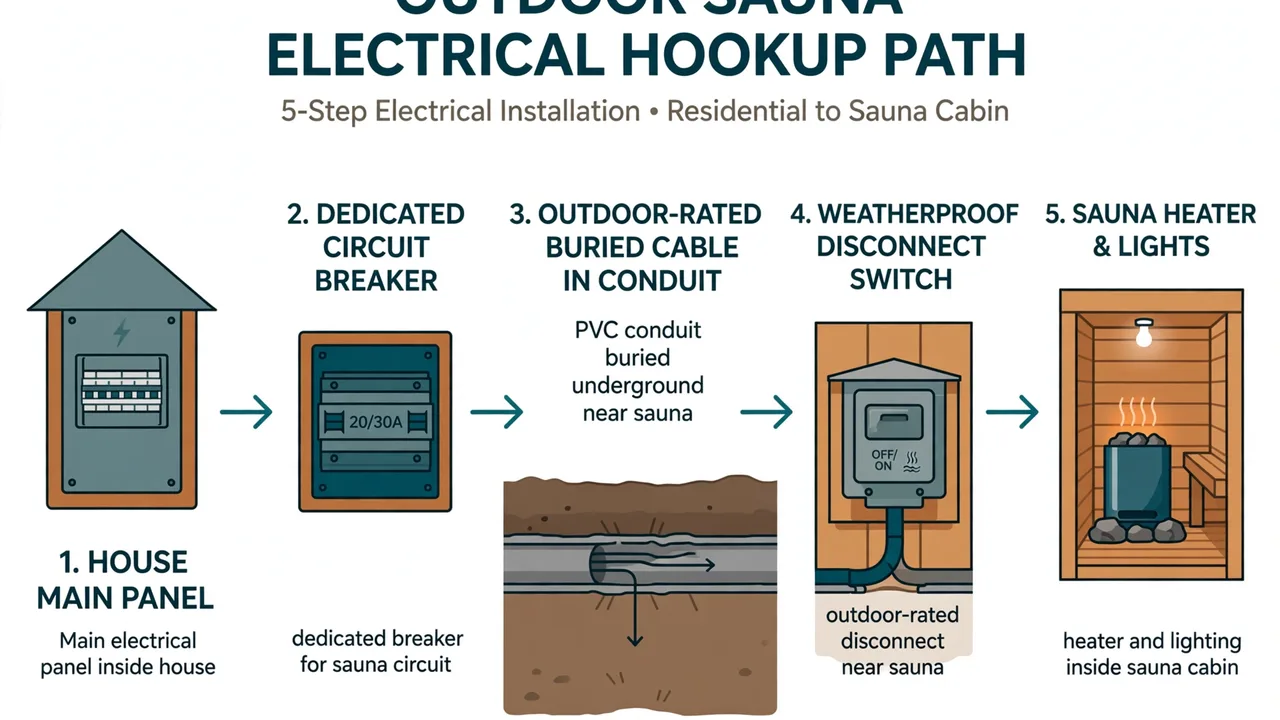
Thinking of the hookup as a chain helps when you talk to your electrician. If any link in the chain is weak, the whole system suffers. A strong panel with a poor cable run is no better than a good cable run fed by an overloaded panel.
Dedicated Circuits: What They Are and Why They Matter
A dedicated circuit is a circuit that serves one thing only. In this case, that one thing is the sauna heater. Nothing else shares it: no garden lights, no sockets, no other appliance. The circuit runs from its own breaker in the panel straight to the sauna.
Electricians commonly recommend a dedicated circuit for electric sauna heaters. The reason is simple. A heater draws a heavy, steady load for the whole session. Sharing that circuit with other loads risks nuisance tripping, overheating and a heater that never reaches temperature properly.
The size of the circuit is not something to guess. It depends on the heater’s power rating, which the manufacturer states in the manual. Your electrician will read that rating and size the breaker and cable to suit, following local code. If the manual and the electrician disagree, the electrician and the code win.
What happens if the heater shares a circuit
A shared circuit can seem fine on a quiet day and fail on a busy one. Someone switches on a garden tool or a patio heater while the sauna is heating, and the breaker trips. At best, that is annoying. At worst, repeated overloading heats up wiring that was never meant to carry that load.
A dedicated circuit also makes faults easier to find. If something trips, the electrician knows exactly which circuit to check. That saves time and keeps the rest of the house running while the sauna circuit is investigated.
Does a wood-fired sauna need a circuit at all
A wood-fired sauna needs no power for its heater, since the fire does the work. Many owners still want electricity for lights, a small fan or a phone charger. Those loads are small, but they still need proper outdoor wiring and protection.
If you are torn between heater types, the choice shapes the whole electrical plan. Our comparison of wood-fired vs electric outdoor sauna heaters explains the practical differences, including what each one asks of your garden and your budget.
GFCI Protection: Your Safety Net Outdoors
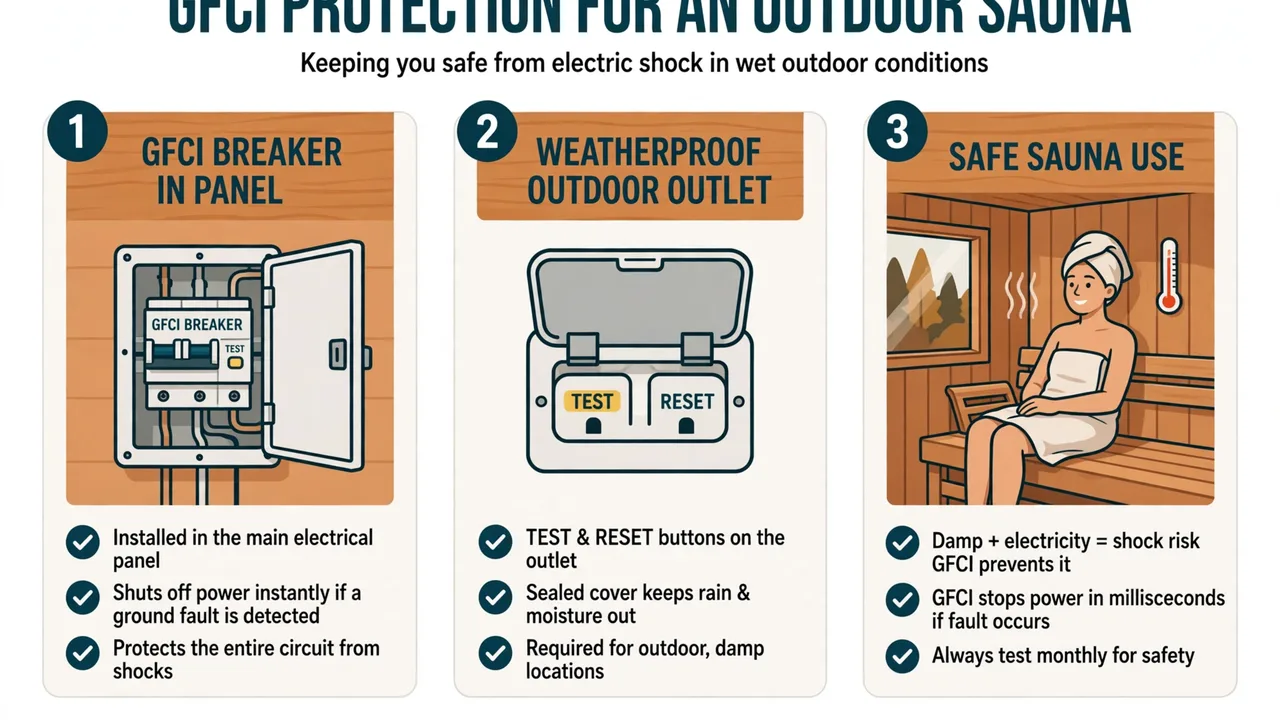
GFCI protection is one of the most important safety features in any outdoor electrical installation. A ground fault circuit interrupter watches the current flowing out and back, and it cuts the power very quickly if it detects a leak. That leak could be current finding an unintended path, for example through water or a person.
Outdoors, the case for GFCI protection is stronger than indoors. People step out of a sauna wet and barefoot, and the ground is damp.
Hoses, buckets and cold plunge tubs add more water to the area. GFCI protection is designed for exactly these conditions.
Where GFCI protection is used
GFCI protection can sit in the breaker at the panel, in a device near the sauna, or in both places, depending on the design and local code. Your electrician will decide the arrangement. What matters is that the sauna circuit and any outdoor sockets near it are covered.
Ask your electrician where the GFCI devices are and how to test them. Most have a test button, and regular testing is part of keeping the protection working. If a GFCI trips often, do not just reset it and carry on. Frequent tripping is a warning that something needs checking.
GFCI tripping: what to do and what not to do
- Press the reset button once and see if it holds. If it trips again straight away, stop and call your electrician.
- Never bypass, remove or replace a GFCI device with a standard one to stop the tripping.
- Keep the area around outdoor sockets and the disconnect dry and clear of stored items.
- Note when the tripping happens. After rain, during heating or when lights switch on are all useful clues for the electrician.
Subpanels: When One Circuit Is Not Enough
A subpanel is a small secondary panel installed near the sauna, fed from the main house panel. It gives the sauna its own local breakers for the heater, lights and any extra circuits. Think of it as a small branch of your main panel, placed where the power is used.
Subpanels are common when the sauna is far from the house. Running one larger feed to a subpanel can be simpler than running several separate circuits across the garden. A subpanel also makes future additions easier, such as garden lighting or a cold plunge pump, though each addition still needs its own assessment.
Not every sauna needs a subpanel. A small sauna close to the house may work well on a single dedicated circuit. The decision depends on distance, the heater size, what else you want powered near the sauna, and the capacity of your main panel. This is a design choice for your electrician, not a shopping decision.
Signs a subpanel may be worth discussing
- The sauna sits a long way from the house panel.
- You want lights, a fan or sockets at the sauna as well as the heater.
- You plan garden lighting, a cold plunge or other outdoor power nearby.
- Your electrician says the main panel is nearly full and a single feed is cleaner.
Cable, Conduit and Burial: Getting Power Across the Yard
The cable run is the least visible part of the hookup and one of the most important. It has to survive being buried, walked over, rained on and frozen. The wrong cable, or the right cable installed badly, can fail years before it should.
Underground or overhead
Most homeowners choose an underground run. It looks tidier, avoids overhead wires crossing the garden, and is less exposed to storms and falling branches. An overhead run is sometimes possible, but it brings its own rules about height, supports and clearance that your electrician and local code office will need to approve.
Underground cable is usually buried in conduit, a protective tube that shields the cable from digging, roots and ground movement. The cable type, conduit type and burial depth are all set by local code and the electrician’s judgement. Never assume a depth or cable type you read online applies in your area.
Planning the route
Walk the route with your electrician before any digging starts. Look for tree roots, existing pipes, drains, patios and driveways. A route that crosses a future patio or a planned flower bed will cause trouble later, so plan around the garden you want in five years, not just the garden you have today.
Marking the route matters too. Ask your electrician how the buried cable is marked or recorded, so nobody digs through it later. A simple sketch kept with your house papers can save a costly accident when you plant a tree or build a fence.
Weatherproofing the whole run
Every joint, box and entry point on the run needs to be weatherproof. Cable should enter the sauna through a sealed fitting, not a rough hole in the wall. Junction boxes should be rated for outdoor use and fitted with proper covers. Water finding its way into a connection is a slow failure that shows up as tripping, corrosion or worse.
The sauna building itself needs the same care. Good insulation and vapour barriers keep moisture under control inside the cabin, while sealed cable entries keep rain out. Electrical work and building work should be planned together, not as two separate jobs.
The Disconnect Switch Near the Sauna
A disconnect switch is a switch near the sauna that cuts all power to it. It lets you, or an electrician, isolate the sauna quickly for maintenance, cleaning or an emergency. Many areas require one for outdoor structures, and even where it is not required, it is good practice.
The disconnect usually sits on the outside wall of the sauna or on a nearby post, within sight of the building. It should be easy to reach, clearly labelled and weatherproof. Ask your electrician to show you how it works and where it is before the job is finished.
Knowing the disconnect location is useful in everyday life too. If the heater behaves strangely, if you smell burning, or if water gets into an outdoor fitting, switching off at the disconnect is the safe first step. Then call your electrician. Do not open the heater or the wiring yourself.
Inside the Sauna: Heater Wiring, Lighting and Controls
Inside the cabin, the heater needs its own proper connection, made to the manufacturer’s instructions. Heater wiring runs through heat-resistant cable or conduit, kept clear of the hottest surfaces. This is not a place for improvisation: the area around a sauna heater gets very hot, and ordinary household cable does not belong there.
Lighting deserves the same care. Sauna lights should be rated for high temperatures and, where they sit near steam or splashes, for damp conditions. Low-voltage lighting is common in saunas, and it still needs a proper transformer and wiring. Ask your electrician which lights are suitable rather than fitting standard indoor lights.
Controls, timers and smart features
Many modern sauna heaters come with digital controls, timers or remote start. These are convenient, but they add wiring and need to be installed as the manufacturer directs. A timer that switches the heater on while nobody is home should only be used exactly as the manufacturer allows, and never with towels, clothes or anything else left on or near the heater.
If you are planning smart controls, tell your electrician early. Some systems need a network connection or a separate low-voltage supply at the sauna. Sorting that out during the build is far cheaper than adding it afterwards.
Ventilation and the electrical plan
Electrical work and ventilation are linked more closely than most people expect. A well-ventilated sauna dries out between sessions, which protects both the wood and the wiring from damp. Poor ventilation leaves moisture sitting in the cabin, and moisture is the enemy of every electrical connection.
Plan the vents and the wiring together. Our guide to outdoor sauna ventilation explains how fresh air should move through the cabin and why it matters for comfort and for the life of the building.
What to Ask Your Electrician
The best time to ask questions is before work starts, not after the trench is filled in. A good electrician will welcome a homeowner who has done some homework. These questions help you compare quotes fairly and spot a contractor who is guessing.
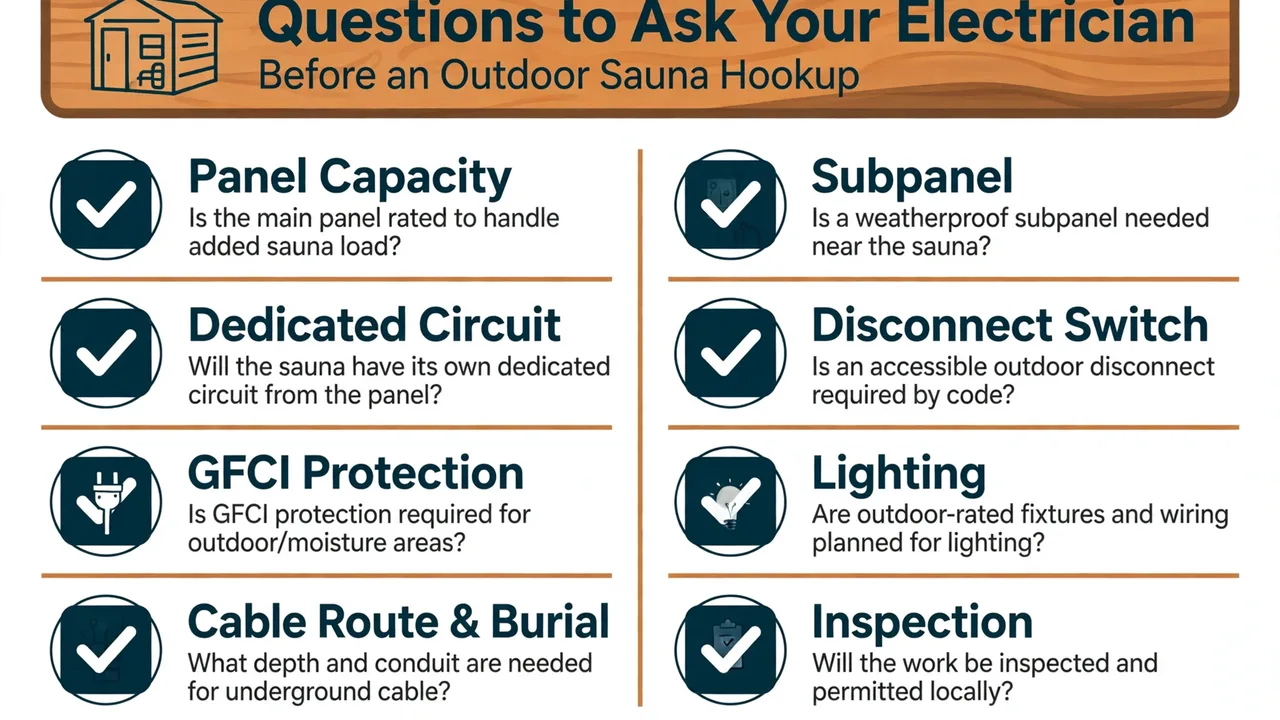
| Question to ask | Why it matters |
|---|---|
| Can my main panel handle the sauna heater, and is there space for the new breaker? | A full or overloaded panel may need an upgrade or a subpanel before the sauna can be connected safely. |
| What size dedicated circuit does this heater need? | The answer should come from the heater manual and local code, not from a guess. |
| Where will the GFCI protection sit, and how do I test it? | You need to know where the protection is and how to check it is still working. |
| What cable and conduit will you use, and how will it be buried? | Outdoor-rated materials and proper burial protect the cable for years. |
| Do I need a subpanel at the sauna? | A subpanel may be cleaner for a distant sauna or one with lights and extras. |
| Where will the disconnect switch go? | It should be easy to reach, clearly labelled and weatherproof. |
| Do I need a permit or an inspection for this work? | Permit and inspection rules vary by area, and the work may need to be signed off. |
| What will the work cost, and what is included? | Get the trenching, materials, permit fees and inspection in writing so quotes can be compared fairly. |
Getting quotes you can compare
Ask at least two licensed electricians to visit the site. A quote given without seeing the garden, the panel and the sauna position is only a rough guess. A site visit lets the electrician measure the cable run, open the panel and spot problems early.
Make sure each quote covers the same work: the breaker, cable, conduit, trenching, disconnect, subpanel if needed, heater connection, lights and any permit or inspection fees. Quotes that leave out trenching or permits look cheaper on paper and cost more in the end.
Permits, Inspections and Timing
Electrical work on a detached structure often needs a permit, an inspection, or both. The rules depend on where you live and on the size of the job. Your electrician should know the local process, but the responsibility for checking sits with you as the homeowner.
Start the permit conversation early. Some areas need a few weeks to process an application, and inspection slots can be booked out. Building the sauna first and asking about permits later can mean uncovering finished work for inspection, which is expensive and frustrating.
Permits cover more than the wiring. The sauna building itself may need permission depending on its size and position. Our guide on whether you need a permit for an outdoor sauna explains the questions to ask your local office before you build.
A sensible order of work
- Choose the sauna size and heater type, and read the heater manual for its electrical requirements.
- Fix the sauna’s position and check the foundation. Our guide to the best foundation for an outdoor sauna helps you pick a base that suits the ground and the building.
- Invite electricians for a site visit and get written quotes for the same scope of work.
- Check permits with your local office and book the work in good time.
- Have the cable run and disconnect installed before or during the sauna build, not after it.
- Get the work inspected if your area requires it, and keep the paperwork with your house records.
Running Costs: What the Hookup Does and Does Not Decide
The electrical hookup decides whether your sauna works safely. It does not decide what each session costs to run. That depends on the heater, the size of the cabin, how well it is insulated, the weather, and how long you heat it for.
Size matters here. A cabin that is too large for its heater takes longer to warm up, while a well-matched heater and cabin reach temperature more efficiently. Our guide on how to size an outdoor sauna walks through matching cabin size to heater and to the number of people who will use it.
For a clear picture of session costs, see our breakdown of outdoor sauna running costs per session. It explains the factors that push costs up or down, so you can plan your usage rather than guessing from a single bill.
Common Mistakes to Avoid
- Using an extension lead. A sauna heater must never run from an extension lead or a long domestic cable. It needs a fixed, dedicated circuit installed by a licensed electrician.
- Sharing the heater circuit. Putting garden sockets or lights on the heater circuit risks tripping and overloading. Keep the heater on its own circuit.
- Ordering the sauna before checking the panel. Some homes need a panel upgrade first. Finding that out after the sauna arrives wastes time and money.
- Using indoor cable or fittings outside. Outdoor work needs outdoor-rated cable, boxes and fittings. Indoor parts fail quickly in rain and frost.
- Skipping the disconnect. Without a nearby disconnect, isolating the sauna for maintenance or an emergency is slow and awkward.
- Forgetting the lights and controls. Plan lighting, timers and any smart controls at the start, so their wiring is part of the job rather than an afterthought.
- Doing the wiring as a DIY job. Sauna wiring is not a beginner project. Poor connections in a hot, damp wooden room are a fire and shock risk. Hire a licensed electrician.
Sauna Safety Basics
Safe wiring is only half the story. How you use the sauna matters too. Hydrate before and after your session, start with short sessions while you learn how your body responds, and leave immediately if you feel dizzy or unwell. Do not drink alcohol before or during a session.
Saunas are wellness tools, not treatments. If you are pregnant, live with a heart or circulation condition or low blood pressure, or take medication that affects heat tolerance, check with your doctor first. Children and elderly users should follow conservative, source-based guidance and keep sessions short.
Frequently Asked Questions
Does an outdoor sauna need a dedicated circuit?
In most cases, yes. Electricians commonly recommend a dedicated circuit for an electric sauna heater, because the heater draws a heavy, steady load for the whole session. Your electrician will confirm the arrangement for your heater and your local code.
What is GFCI protection, and does my outdoor sauna need it?
GFCI protection cuts the power very quickly if it detects current leaking where it should not go, for example through water or a person. It is an important safety layer outdoors, where people are wet and barefoot and the ground is damp. Your electrician will decide where the GFCI devices sit and confirm what local code requires.
Can I run an outdoor sauna from a normal garden socket?
No. A standard garden socket and an extension lead are not suitable for a sauna heater. The heater needs a fixed, dedicated circuit installed by a licensed electrician, with cable and protection suited to the load and the outdoor setting.
How far can an outdoor sauna be from the house?
There is no single distance that suits every home. Longer runs need more careful cable sizing and planning, and very long runs may call for a subpanel near the sauna. Your electrician will assess the distance, the route and the heater’s requirements before giving you an answer.
Do I need a subpanel for my outdoor sauna?
Not always. A small sauna close to the house may work well on a single dedicated circuit. A subpanel is worth discussing when the sauna is far from the house, when you want lights and sockets at the sauna as well, or when your main panel is nearly full.
Should the power cable be buried or run overhead?
Most homeowners choose a buried run in conduit, which looks tidier and is less exposed to weather and falling branches. Overhead runs are sometimes possible but bring their own rules about height and clearance. Your electrician and local code office will advise which suits your garden.
Do I need a permit for the electrical work?
It depends on where you live and the size of the job. Electrical work on a detached structure often needs a permit, an inspection, or both. Check with your local permit or code office early, and ask your electrician what the local process involves.
Can I do the sauna wiring myself?
No, unless you are a licensed electrician. Sauna wiring involves high loads, heat-resistant connections and outdoor protection, all in a hot, damp wooden room. Poor wiring is a fire and shock risk. Always hire a licensed electrician for installation work.
Conclusion
An outdoor sauna electrical hookup is not complicated once you understand the parts: a dedicated circuit from the house panel, GFCI protection for safety, outdoor-rated cable and conduit across the garden, a disconnect switch near the sauna, and proper connections inside the cabin. Each part has a job, and each one matters.
The most valuable step is also the simplest. Bring a licensed electrician into the project early, before you order the sauna or dig the first trench. Share the heater manual, walk the garden together, and ask the questions in this guide. A well-planned hookup is safe, tidy and ready for years of evening sessions.