
If you live with high blood pressure, low blood pressure, or a reading that sits somewhere in between, a steam sauna raises a fair question. Does the heat help your blood pressure, hurt it, or not matter much either way? The honest answer is that steam sauna and blood pressure have a real relationship, but it is not the simple one that many headlines suggest. Heat changes how your blood vessels behave during a session, and that change can push your pressure down for a while, yet it can also leave you lightheaded.
This guide looks at what happens to blood pressure before, during, and after a steam session. It covers high and low blood pressure separately, gives a practical session plan, lists the warning signs, and explains when skipping the steam room is the right call.
Please note: This article is for general information only and is not medical advice. A steam sauna is a wellness tool, not a treatment for blood pressure. If you are pregnant, live with a heart or circulation condition or low blood pressure, or take medication that affects how you handle heat, check with your doctor before using a steam sauna.


#Paid Links
The Short Answer on Steam Saunas and Blood Pressure
During a steam session, blood pressure usually falls. The heat widens the blood vessels near your skin so your body can shed heat, and wider vessels mean less resistance for blood to push against. At the same time, your heart rate climbs, so your heart works harder even while the pressure reading drops. A lower number on the monitor does not mean your cardiovascular system is resting.


#Paid Links
After the session, blood pressure typically stays a little lower than your starting point for a while, then drifts back toward its usual level. How far it falls and how long it stays down varies a lot from person to person. Your starting pressure, fitness, room temperature, session length, and hydration all play a part. A single session is not a treatment, and the drop you see after one visit does not mean your resting blood pressure will be lower next month.
Over the long term, the picture is more interesting but less certain. A large Finnish study that followed middle-aged men for about 25 years found that men who used a sauna four to seven times a week were less likely to develop high blood pressure than men who went once a week. That study was observational, which means it found an association rather than proof of cause, and it studied traditional dry sauna, not steam sauna.
For most healthy adults with normal blood pressure, a short steam session is a low-risk pleasure. For people with controlled high blood pressure, short sessions are usually tolerated once a doctor has said it is fine. For people with low blood pressure, a history of fainting, or uncontrolled high blood pressure, much more caution is needed, and sometimes the right answer is to stay out until a doctor clears you.
What Blood Pressure Is, and Why Heat Changes It
Blood pressure is the force of blood pushing against the walls of your arteries. It is written as two numbers, for example 120 over 80, and measured in millimetres of mercury, written as mm Hg. The top number is systolic pressure, the force when your heart beats. The bottom number is diastolic pressure, the force when your heart rests between beats.
The Blood Pressure Categories You Will See on Your Readings
The American Heart Association groups adult blood pressure readings into five categories. Knowing your usual category helps you talk with your doctor. Categories are based on the average of readings taken over time.
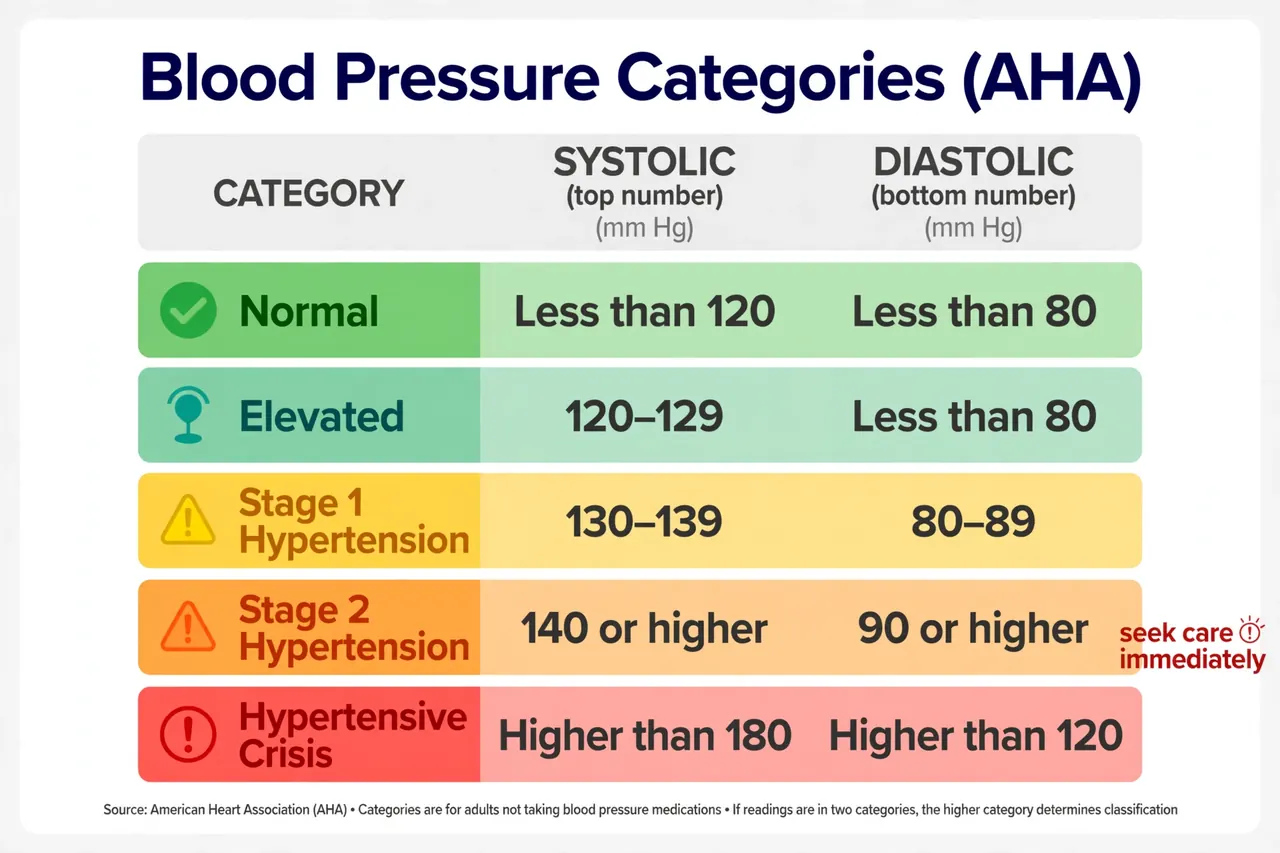
| Category | Systolic (top number) | Diastolic (bottom number) | What it means for sauna use |
|---|---|---|---|
| Normal | Less than 120 | Less than 80 | Short sessions are generally low risk. |
| Elevated | 120 to 129 | Less than 80 | Keep sessions short. |
| Stage 1 hypertension | 130 to 139 | 80 to 89 | Ask your doctor first. Start very short. |
| Stage 2 hypertension | 140 or higher | 90 or higher | Doctor clearance is essential. |
| Hypertensive crisis | Higher than 180 | Higher than 120 | Do not use a steam sauna. Seek care promptly. |
If your readings fall into two different categories, the higher category is the one that counts. For example, a reading of 135 over 92 is stage 2, not stage 1, because the diastolic number of 92 sits in the stage 2 range.


#Paid Links
What Steam Heat Does to Your Blood Vessels
When you sit in a steam room, your body has one urgent job, and that is to stop your core temperature from climbing too far. It does this mainly by widening the blood vessels close to your skin, a process called vasodilation. More warm blood flows to the surface, where heat can escape, and you start to sweat heavily. Because the steam room air is already full of moisture, that sweat evaporates slowly, so the cooling effect is weaker than in dry heat, and your body keeps pumping blood to the skin anyway.
Wider vessels mean lower resistance, and lower resistance usually means a lower pressure reading. That is the main reason blood pressure dips during a session. At the same time, your heart rate rises, often into the range you would see during moderate exercise.
Humidity is what makes a steam sauna different from a dry sauna. In a dry sauna, the air is hot but relatively dry, so sweat evaporates and cools you. In a steam sauna, the air temperature is lower, often around 40 to 45 degrees Celsius, but the humidity is close to 100 percent. Studies comparing the two have found that humid heat can raise heart rate and core temperature more than dry heat at a higher air temperature.
Fluid loss adds a second effect. You can lose a noticeable amount of water through sweat in a single session, and losing fluid reduces blood volume, which can push pressure down further. That is one reason hydration matters so much, and why standing up quickly afterwards can make you feel dizzy. Our steam sauna hydration guide explains how much to drink before and after a session.
What Happens to Blood Pressure During a Steam Session
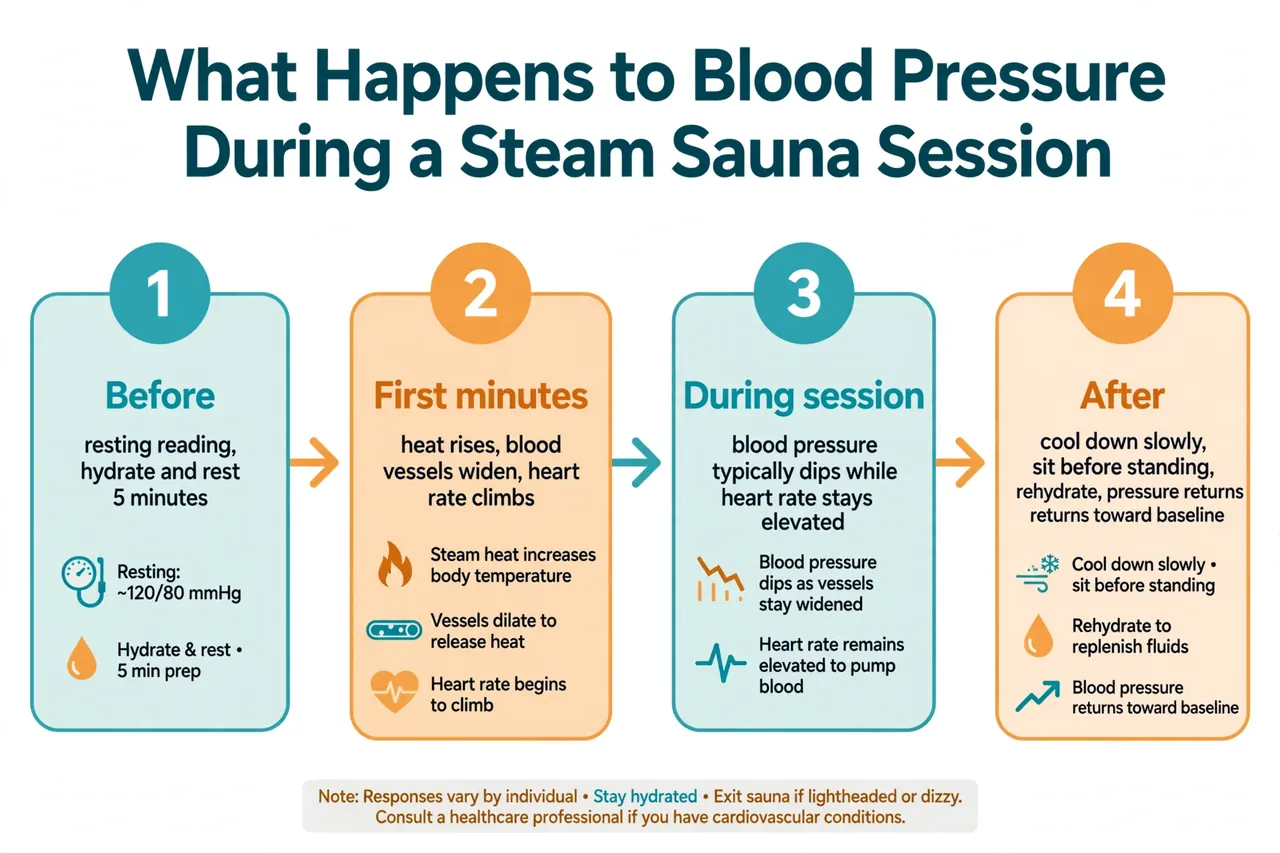
A steam session is not one steady state. Your blood pressure moves through distinct phases, and knowing them helps you spot the risky moments. If you take blood pressure medication, your pattern may look different.
The First Few Minutes: Heart Rate Climbs First
In the first few minutes, your body reacts to the heat before your blood pressure has much chance to fall. Blood vessels near the skin widen, your heart rate climbs, and you start to sweat. Blood pressure may dip slightly at this stage, or it may hold steady while the heart works harder.
Sit on a lower bench for your first sessions, because heat rises and the top bench is always the hottest seat in the room. You can move up on a later visit if the lower bench feels easy.
Mid-Session: Pressure Dips While the Heart Works Harder
As the session continues, blood pressure typically falls below its starting point. In one small experimental study of sauna bathing, systolic pressure fell from around 137 to around 130 mm Hg during a 30-minute session, while diastolic pressure fell from around 82 to around 75 mm Hg. Those numbers come from a single dry sauna study, so treat them as an illustration, not a promise.
What matters more than the size of the drop is what is happening alongside it. Your heart rate stays elevated for the whole session, your body keeps losing fluid through sweat, and your blood vessels stay wide open. That is why the moment you stand up to leave is the risky part.
Session length is the main lever you control here. Most safety guidance for sauna use in general points to sessions of 5 to 20 minutes, with beginners starting at the short end. For people with blood pressure concerns, 5 to 10 minutes is a sensible starting point. See our guide on how long to stay in a steam sauna for more detail.
After You Step Out: The Cool-Down Matters as Much as the Session
When you leave the steam room, your blood pressure does not snap back to normal in seconds. It usually stays a little lower than your starting point for a period afterwards, then returns toward its usual level as your body cools and you rehydrate. That is why the minutes after a session deserve as much attention as the session.
A slow cool-down is the simplest protection. Sit down outside the steam room for a few minutes before you stand and walk around, and drink water to replace what you sweated out. Avoid alcohol completely around a steam session, because it widens blood vessels further and raises the risk of fainting and heart problems.
A cool or lukewarm shower helps you recover, but a sudden cold plunge is a different matter. Cold water makes blood vessels constrict quickly, which can push blood pressure up sharply for a short time. People with high blood pressure or heart disease should be especially careful with cold plunges, and a gentle cool shower is a safer finish.
What the Evidence Actually Says About Sauna and Blood Pressure
The evidence comes from three kinds of research, and they do not all say the same thing. Long-term observational studies link frequent sauna use with a lower chance of developing high blood pressure. Short-term experiments show that a single session lowers blood pressure for a while. Controlled trials of heat therapy give mixed results, with modest average effects and plenty of uncertainty.
The Finnish Cohort Studies: A Strong Association, Not Proof
The best-known evidence comes from the Kuopio Ischaemic Heart Disease Study, known as KIHD, which followed middle-aged men in eastern Finland for decades. In a 2017 analysis of 1,621 men who did not have high blood pressure at the start, researchers tracked who went on to develop hypertension over a median follow-up of 24.7 years. Men who used a sauna four to seven times a week had about half the rate of new hypertension compared with men who went once a week, with a hazard ratio of 0.53 after adjusting for other risk factors.
These are striking numbers, but they come with limits that matter for a steam sauna reader. First, the study was observational, so it found an association, not proof that sauna use caused the lower risk. Frequent users may have differed in ways the researchers could not fully measure. Second, the participants were Finnish men aged 42 to 60, so the results may not apply in the same way to women, younger or older adults, or people outside Finland. Third, the study looked at traditional Finnish dry sauna, not steam sauna, so its results cannot be applied directly to a steam room.
Heat Therapy Trials: Modest Average Drops, Mixed Results
A systematic review and meta-analysis published in 2021 pooled studies of heat therapy, including sauna, hot water immersion, and heated rooms. It found that heat therapy reduced systolic blood pressure by an average of 3.94 mm Hg and diastolic pressure by 3.88 mm Hg compared with control conditions, and mean arterial pressure fell by 5.86 mm Hg on average. The authors rated the certainty of the evidence as moderate.
More recent trial-only reviews have been less encouraging. One 2025 meta-analysis limited to randomised controlled trials found an average systolic change of minus 2.46 mm Hg and a diastolic change of minus 1.08 mm Hg, neither of which reached statistical significance. Some trials showed larger effects when sauna use was combined with exercise.
What should a reader take from this? A drop of a few points is real for some people, and small average reductions matter at a population level, since they are linked with lower stroke and heart disease risk across large groups. But a steam session is not a substitute for medication. If your doctor has prescribed blood pressure medicine, keep taking it exactly as directed, and never stop or change a dose because of something you read about saunas.
What We Still Do Not Know About Steam Saunas Specifically
Almost all of the long-term sauna research was done in dry Finnish saunas, and there is no large long-term study of steam sauna use and blood pressure. The short-term physiology almost certainly applies in a steam room, and probably more strongly because of the humidity, but the long-term link with lower hypertension risk has not been shown for steam sauna use. Most research also involved middle-aged men, and far less is known about steam heat and blood pressure in women, older adults, or people who already take blood pressure medication.
| Study or review | What it looked at | Key finding on blood pressure | Limit to keep in mind |
|---|---|---|---|
| Zaccardi and colleagues, 2017, KIHD cohort | 1,621 Finnish men without hypertension, followed 24.7 years | 4 to 7 sessions a week linked with about half the rate of new hypertension versus once a week (hazard ratio 0.53) | Observational, not proof of cause. Finnish men only. Dry sauna, not steam. |
| Laukkanen and colleagues, 2018, Mayo Clinic Proceedings review | Review of research on Finnish sauna bathing | Sauna bathing linked with lower blood pressure and better blood vessel function | Mixed study types, mostly dry sauna. Associations, not proof. |
| Heat therapy meta-analysis, 2021 | Pooled trials of heat therapy | Average systolic fall of 3.94 mm Hg and diastolic fall of 3.88 mm Hg | Mixed heat methods, not steam only. Moderate certainty. |
| Randomised trial-only meta-analysis, 2025 | 20 randomised trials of heat therapy | Average systolic change of minus 2.46 mm Hg and diastolic change of minus 1.08 mm Hg, neither significant | Small average effect. Whole-body heating showed a larger fall. |
| Hannuksela and colleagues, 2001, American Journal of Medicine | Benefits and risks of sauna bathing | Long-term sauna use may help lower blood pressure in hypertension, but more data were needed | An older review. Also lists contraindications, including unstable angina and recent heart attack. |
Steam Sauna With High Blood Pressure (Hypertension)
High blood pressure is the most common reason people ask about sauna safety, and it is also the situation where the answer depends most on the details. Controlled, stable, medicated high blood pressure is very different from uncontrolled or very high blood pressure. Your doctor knows which one applies to you, and that distinction should drive the decision.
If Your Blood Pressure Is Controlled and Stable
If your blood pressure is controlled with medication, your readings have been steady, and you have no other unstable heart condition, short steam sessions are usually tolerated. Safety reviews of sauna bathing have found that sauna use is generally well tolerated by people with stable, treated hypertension, as long as the condition is medicated and stable. That is reassuring, but still follow the precautions here.
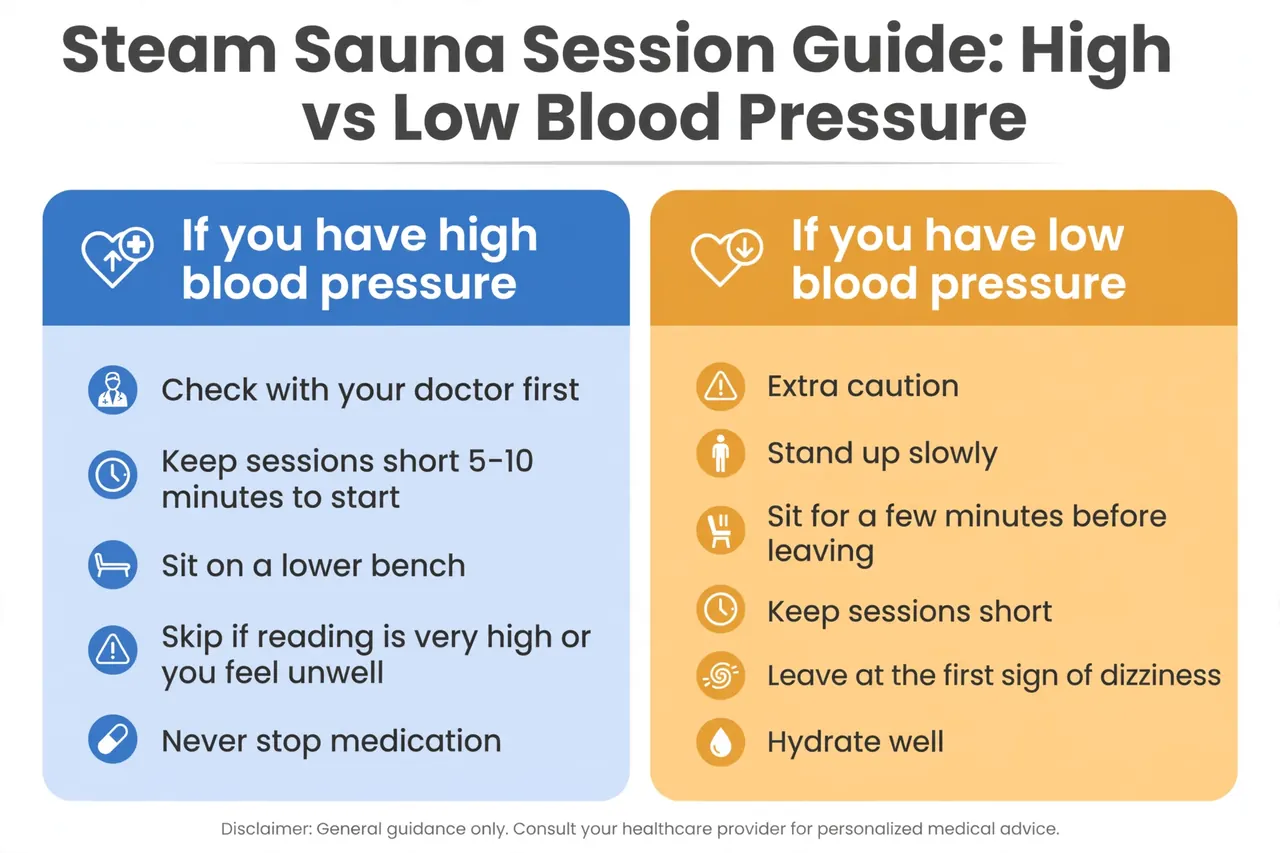
Start with sessions of 5 to 10 minutes on a lower bench, and see how you feel during the session and in the hour afterwards. Keep a simple log for your first few visits, with the session length and how you felt, and note your blood pressure before and after the session if you have a home monitor. Bring that log to your next doctor visit.
If Your Blood Pressure Is Uncontrolled or Very High
If your blood pressure is uncontrolled, meaning it stays high despite medication or you are not yet on treatment, the steam room is a different question. The same applies if your readings are very high or you have had a recent change in medication. In these situations, get your blood pressure under control first and ask your doctor specifically about sauna use before you go back in.
A reading above 180 over 120 is a hypertensive crisis, so skip the steam sauna entirely. If you feel fine but your reading is that high, contact your doctor promptly. If you have symptoms such as chest pain, shortness of breath, back pain, numbness or weakness, a change in vision, or difficulty speaking, call emergency services immediately.
Blood Pressure Medicines and Heat: What to Know
Several common blood pressure medicines change how your body handles heat. Diuretics, often called water pills, make you pass more urine, so you start a session with less fluid and lose more through sweat, which raises the risk of dehydration and a sharp pressure drop on standing. Beta blockers slow the heart rate, which can blunt the heart’s normal response to heat. Some other medicines reduce sweating or thirst.
None of this means you cannot use a steam sauna while taking these medicines. Many people do, with their doctor’s agreement. It does mean you should tell your doctor or pharmacist that you use a steam sauna, and ask whether any of your medicines affect heat tolerance. Never stop or skip a blood pressure medicine to make a sauna session easier, since stopping suddenly can cause your pressure to rebound sharply.
Steam Sauna With Low Blood Pressure (Hypotension)
Low blood pressure gets far less attention than high blood pressure, but in a steam room it is often the bigger immediate risk. If your resting pressure already runs low, or you have a history of feeling faint when you stand up, the extra drop that heat causes can push you into dizziness or fainting. Fainting in a hot, wet room is dangerous, because a fall on a hard surface can cause serious injury.
Why Low Blood Pressure Needs Extra Care in the Heat
Low blood pressure is usually defined as a reading below 90 over 60, though what counts as low depends on the person. Some people live happily with readings in that range and never feel a symptom, while others feel tired or dizzy. What matters is not the number alone, but whether you have symptoms and whether you have fainted before.
Heat makes the problem worse in two ways. First, widened vessels let blood pool in your legs and skin, which lowers the pressure further. Second, sweating reduces your blood volume, which leaves less fluid to keep the pressure up. Both effects peak at the end of a session and just after you step out.
Fainting Risk and How to Lower It
The single most useful habit for low blood pressure is to move slowly at the end of a session. Sit on the bench for a minute or two before you stand, then stand up slowly while holding onto something stable, and pause before you walk. Sit down again outside the steam room for several minutes while you cool down and drink water. If you feel dizzy, sit or lie down right away.
Hydration matters even more for you than for the average user. Drink a glass of water before your session and again afterwards. Some people with low blood pressure find that a salty snack or an electrolyte drink after a session helps them feel steadier, but check with your doctor before changing your salt intake, especially if you take medication. A light meal before your session helps too.
Keep your sessions short, and consider using the steam room with a companion rather than alone, so someone can help if you feel faint. If you have fainted in a sauna or steam room before, talk with your doctor before going back in at all.
A Safer Steam Session, Step by Step
The steps below are written for someone whose doctor has already said that steam sauna use is reasonable for them.
- Check how you feel today. Skip the session if you feel unwell, have a fever, or your reading is far from its usual range. A session is never urgent.
- Hydrate before you start and eat something light. Drink a glass of water in the hour before your session, and avoid alcohol entirely on sauna days. Do not go in on an empty stomach.
- Take your medication as usual. Do not skip or delay a dose to suit the sauna. If you are unsure about timing, ask your doctor or pharmacist.
- Start on a lower bench and keep it short. Five to ten minutes is enough for a first session. You can build up slowly over weeks.
- Listen to your body, not the clock. Leave immediately if you feel dizzy, nauseous, short of breath, or unusually hot.
- Stand up slowly when you finish. Sit on the bench for a minute, then stand up slowly while holding something stable. Sit down again if you feel lightheaded.
- Cool down gradually. Sit in a cooler room for a few minutes, then take a lukewarm shower. Avoid a sudden cold plunge if you have a blood pressure or heart condition.
- Rehydrate and rest. Drink water after your session, and rest for at least 15 to 20 minutes before driving. If you still feel unwell, seek medical advice.
If you use a home steam room, the same routine applies, with one addition. Make sure someone in the household knows you are in the steam room. Keep the room ventilated and dry it out after use, since a steam room that stays damp can grow mould.
Warning Signs: Leave the Steam Room Right Away
Some warning signs mean you should leave the steam room immediately, sit down somewhere cool, and get help if they do not pass. Do not wait to see if they improve while you stay in the heat.
- Dizziness, lightheadedness, or feeling as if you might faint
- Chest pain, pressure, or tightness, or pain spreading to your arm, jaw, or back
- Shortness of breath that feels out of proportion to the heat
- A racing, fluttering, or irregular heartbeat that does not settle when you sit down
- Nausea, confusion, or trouble thinking clearly
- A severe headache that starts during or just after the session
- Unusual sweating that stops suddenly, or skin that feels very hot and dry
- Weakness, numbness, or difficulty speaking
- Leg cramps or muscle weakness that does not ease with rest and fluids
Chest pain, shortness of breath, weakness, numbness, or difficulty speaking are emergency symptoms. Call emergency services immediately if you notice them, whether you are still in the steam room or have stepped out. Do not drive yourself to a hospital. Sit or lie down, keep cool, and wait for help.
Less dramatic signs still deserve attention. If you feel dizzy after every visit, or tiredness lasts for hours, discuss it with your doctor before your next session. A steam session should leave you feeling relaxed, not drained.
When to Skip a Session Entirely
There are days when the right decision is not a shorter session or a lower bench, but no session at all. The table below lists when staying out is the sensible choice.
| Situation | What to do | Why it matters |
|---|---|---|
| Blood pressure above 180 over 120, with or without symptoms | Do not use the steam room. Seek care promptly, or call emergency services if you have symptoms. | A hypertensive crisis needs medical attention. |
| Uncontrolled high blood pressure, or a recent change in medication | Wait until your readings are stable and your doctor clears sauna use. | An unstable baseline makes the heat response unpredictable. |
| Chest pain, unstable angina, or a recent heart attack | Do not use a sauna or steam room. These are listed contraindications. | Heat raises heart rate when the heart is already vulnerable. |
| Severe aortic stenosis, or a heart condition your doctor has flagged | Do not use a steam room unless your cardiologist has cleared it. | A narrowed valve limits how the heart responds to heat. |
| Fever, acute illness, or feeling unwell | Wait until you have fully recovered. | Fever already raises your core temperature. |
| You have been drinking alcohol, or have taken sedating drugs | Do not use the steam room that day. | Alcohol and sedatives raise the risk of fainting and sudden death in the heat. |
| You fainted during a previous sauna or steam session | Do not go back in until you have talked with your doctor. | A previous faint warns it may happen again. |
| Pregnancy, without your doctor’s agreement | Ask your doctor or midwife first. | Overheating in pregnancy needs professional judgement. |
| You feel dizzy, unwell, or unusually tired today | Skip the session and try another day. | An unwell body does not need extra heat stress. |
| You take medication that affects heat tolerance and have not discussed sauna use with your prescriber | Ask your doctor or pharmacist first. | Some medicines change how your body responds to heat. |
Older adults deserve a special note here. Blood pressure control tends to become less steady with age, and the body responds to heat less efficiently. Older users are more likely to feel dizzy on standing, more likely to take several medicines at once, and more likely to be dehydrated without realising it. Shorter sessions, lower benches, a companion nearby, and a slow cool-down all matter more with age. Our guide to steam sauna use for seniors covers safe temperatures and session lengths for older users.
For a fuller picture of who should be cautious in a steam room, including children, pregnancy, and other health conditions, see our steam sauna safety guide for children, pregnancy, and health conditions. Our steam sauna temperature guide explains the temperatures you will meet in the room.
Frequently Asked Questions About Steam Saunas and Blood Pressure
Can a steam sauna lower high blood pressure?
A steam session usually lowers blood pressure for a while, because heat widens your blood vessels. Pooled trial results suggest an average fall of around 4 mm Hg systolic and 4 mm Hg diastolic, but the effect is temporary and varies a lot between people. A steam sauna is not a treatment for high blood pressure.
Is a steam sauna safe if I take blood pressure medication?
Many people who take blood pressure medication use steam saunas safely, but you should check with your doctor or pharmacist first. Diuretics and beta blockers in particular can make a pressure drop or dizziness more likely. Keep taking your medication exactly as prescribed, keep your sessions short, and tell your doctor that you use a steam sauna.
Can I use a steam sauna if I have low blood pressure?
You need to be extra careful, because heat lowers blood pressure further and raises the risk of dizziness and fainting. Keep sessions short, hydrate well, sit on a lower bench, and stand up very slowly at the end. If you have fainted before, or you feel dizzy every time you use a steam room, talk with your doctor before going back in, and consider using the steam room with a companion rather than alone.
How long should a steam sauna session last if I have high blood pressure?
Five to ten minutes is a sensible starting point if your blood pressure is controlled and your doctor has agreed that steam sauna use is reasonable for you. Build up slowly over weeks if you feel well and your readings stay steady. The usual range in safety guidance is 5 to 20 minutes, but start at the shorter end. Leave immediately if you feel unwell.
Why do I feel dizzy after a steam sauna?
Dizziness after a steam session is usually caused by the drop in blood pressure that heat brings on, combined with fluid lost through sweat. When you stand up, blood pools in your legs and your brain briefly gets less blood than it needs. Standing up slowly and drinking water help. If dizziness happens every time, or you have actually fainted, stop using the steam room until you have talked with your doctor.
Should I check my blood pressure before or after a steam sauna?
Checking both is useful. Take a reading after sitting quietly for five minutes before your session, and take another one after you have cooled down and rested for 15 to 20 minutes. Do not measure while you are still hot and standing. A simple log of these readings helps your doctor see how your body responds.
The Bottom Line on Steam Sauna and Blood Pressure
Steam heat and blood pressure are linked in a way that is both simple and easy to misunderstand. The heat widens your blood vessels, your pressure falls for a while, and your heart works harder at the same time. That temporary fall is real, and trials show average drops of a few points. The long-term picture is more hopeful but far less certain, resting on observational studies of dry sauna in Finnish men, not on steam sauna trials. A steam room is a pleasant wellness habit, not a blood pressure treatment, and no session should ever replace medication or a doctor’s advice.
The practical rules are straightforward. Talk with your doctor first if you live with high or low blood pressure, a heart condition, or medication that affects heat tolerance. Keep sessions short, sit low, hydrate well, and stand up slowly. Leave immediately if you feel dizzy or unwell, and skip the session on days when your readings are very high, you feel ill, or you have been drinking.
If you want to learn more about using a steam sauna safely, start with our steam sauna safety guide and our steam sauna hydration guide. Both cover the basics that make every session safer, whatever your blood pressure.
References
- Zaccardi F, Laukkanen T, Willeit P, Kunutsor SK, Kauhanen J, Laukkanen JA. Sauna Bathing and Incident Hypertension: A Prospective Cohort Study. American Journal of Hypertension. 2017. PubMed
- Laukkanen T, Kunutsor SK, Khan H, Zaccardi F, Laukkanen JA. Cardiovascular and Other Health Benefits of Sauna Bathing: A Review of the Evidence. Mayo Clinic Proceedings. 2018, volume 93, pages 1111 to 1121. DOI
- Heat therapy and blood pressure: a systematic review and meta-analysis. Experimental Physiology. 2021. PubMed
- Hannuksela ML, Ellahham S. Benefits and risks of sauna bathing. American Journal of Medicine. 2001. PubMed
- American Heart Association. Blood Pressure Categories. American Heart Association
- Verywell Health. What Happens to Your Blood Pressure When You Try Heat Therapy. Verywell Health