
Your wearable already knows more about your recovery than your calendar does. It notices the restless night before you do, the resting heart rate that creeps up after a hard week, and the slow drift back to normal after a few good nights. Pair that quiet record-keeping with a regular infrared sauna routine, and you get something genuinely useful: a before-and-after picture of how heat sessions fit into your recovery, rather than a guess.
There is a catch, and it matters more than most sauna guides admit. The numbers your ring or band shows you during a hot session are not reliable. Heat, sweat, and movement all distort the optical sensors these devices rely on. The smart way to combine saunas and wearables is not to watch your heart rate climb in real time — it is to track the trend the morning after.
This guide explains what heart rate variability (HRV), resting heart rate, sleep, and recovery scores actually measure, why in-sauna readings mislead, and how to build a simple before-and-after routine with Oura or Whoop that keeps your scores honest.
Disclaimer — please read first. This article is not medical advice. Saunas are wellness tools, not treatments, and they do not cure, prevent, or treat any condition. Wearable scores are estimates from consumer sensors, not medical measurements. If you are pregnant, live with a heart or circulation condition or low blood pressure, or take medication that affects heat tolerance, check with a doctor before using a sauna.


Paid Links - As an Amazon Associate, I earn from qualifying purchases.
What Your Wearable Actually Measures
Before you can read a score, you need to know what sits behind it. Oura and Whoop both start from the same raw material — your heartbeat — and then turn it into very different summaries. Neither device measures recovery directly. Both infer it from patterns in your heart rate, sleep, and movement.
Heart rate variability (HRV)
HRV is the variation in time between consecutive heartbeats, usually measured overnight while you sleep. A healthy heart does not tick like a metronome; the gaps between beats lengthen and shorten as your nervous system shifts between its “rest and recover” and “alert and active” modes.


Paid Links - As an Amazon Associate, I earn from qualifying purchases.
In consumer apps, a higher overnight HRV generally lines up with better recovery, and a lower one with stress, illness, poor sleep, or heavy training load. That is a pattern, not a diagnosis. A single low night can mean a late meal, a glass of wine, a warm bedroom, or an oncoming cold — and your wearable cannot tell you which.
Resting heart rate (RHR)
Resting heart rate is your heart rate at complete rest, again usually taken overnight. It is the simplest trend in your wearable’s toolkit, and often the most honest. When your resting heart rate drifts upward for several nights, something is loading your system: hard training, poor sleep, stress, or illness.
Unlike HRV, resting heart rate is easy to sanity-check. If your band says 58 and your morning pulse check says something wildly different, trust the manual check and treat the sensor reading with suspicion that day.
Sleep: duration, stages, and quality
Both Oura and Whoop estimate total sleep time, time in bed, sleep efficiency, and rough sleep stages (light, deep, and REM). These stage estimates come from movement and heart-rate patterns, not brain-wave measurement, so treat the stage breakdown as an approximation.

Paid Links - As an Amazon Associate, I earn from qualifying purchases.
The most useful sleep numbers are the boring ones: how long you slept, how consistent your bedtime was, and whether you woke up often. Those three move the needle on recovery far more than any single night’s REM percentage.
Recovery and strain scores
Recovery scores (Oura’s Readiness, Whoop’s Recovery) combine overnight HRV, resting heart rate, sleep, and sometimes temperature trends into one colour-coded verdict: green means go, yellow means proceed with care, red means rest. Whoop adds a Strain score, which totals up how hard your body worked during the day.
Think of a recovery score as a weather forecast, not a blood test. It is a useful summary of several signals, but it is still an estimate — and it can be wrong, especially after an unusual day like a long sauna session, a late workout, or a night in a hot room.
Why In-Sauna Readings Are Unreliable
It is tempting to keep your ring or band on during a session and watch your heart rate rise. Resist that temptation for two separate reasons: the reading is unreliable, and the heat may not be good for the device.
Most wearables measure heart rate with green-light optical sensors that watch blood flow through the skin. In a sauna, three things work against that method at once. Your skin blood flow surges as your body tries to cool itself, sweat changes how light reflects off the skin, and any shifting, towelling off, or adjusting the band breaks the sensor’s contact. The result is a heart-rate trace full of gaps and spikes that looks dramatic and means very little.
Movement matters more than people expect. Even a small wrist movement while you reach for water can throw an optical reading off for a minute or more. Add heat-driven changes in circulation, and an in-session reading becomes a rough guess at best.
The device question is separate and simpler: do not wear a ring or band inside a hot sauna unless the maker of your exact model says it is safe to do so. Heat can damage batteries, adhesives, and sensors over time, and a metal ring conducts heat against the skin. Check the maker’s guidance for your model before any session, and when in doubt, leave the device outside the sauna on the bench. You lose nothing — the useful data comes from the night before and the morning after, not from inside the heat.
One more honest note: a heart rate that rises during a sauna session is expected. Heat is a cardiovascular load, much like light exercise. That rise is not a sign that the sauna is “working better” or “detoxing” anything. It is simply your body coping with heat, and it is one more reason not to chase in-session numbers.
Oura vs Whoop for Sauna Users: What Each One Tracks
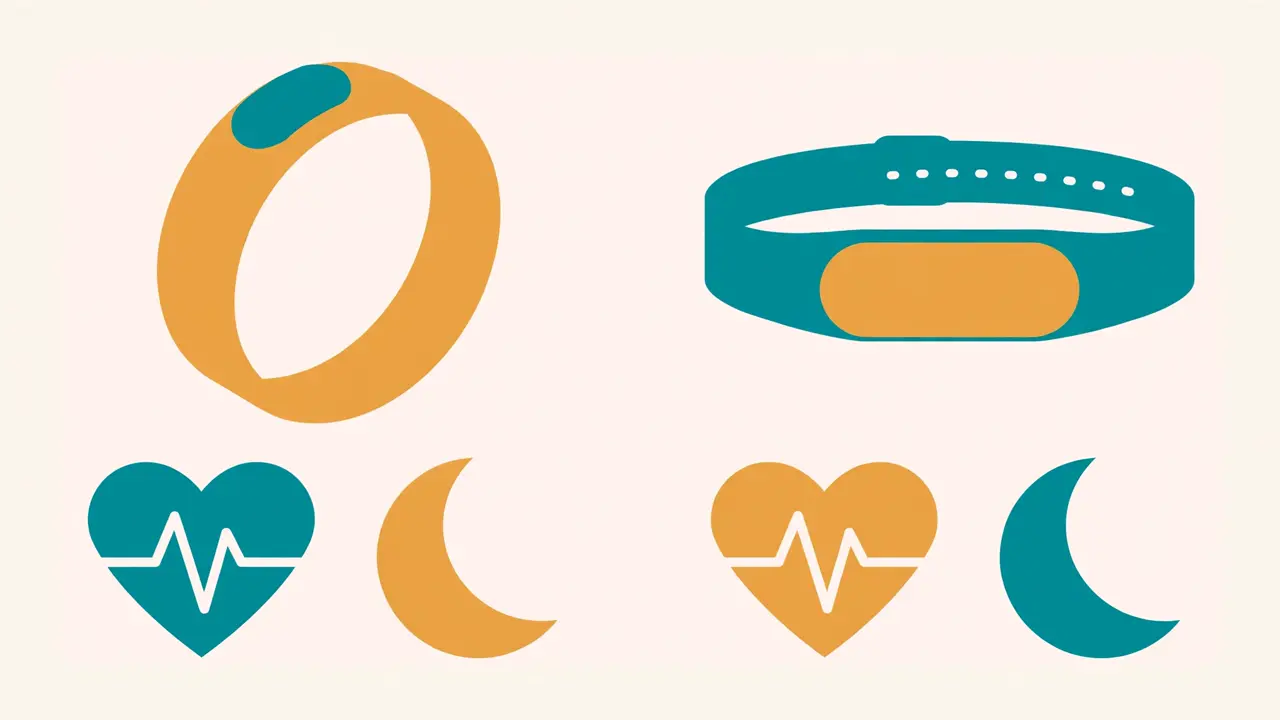
Oura and Whoop approach the same job from opposite directions. Oura is a ring you wear day and night, built around sleep and readiness. Whoop is a wrist band built around strain and recovery, with a coaching layer that tells you how much sleep you need and how hard you can push. For a sauna user, the differences that matter are practical, not technical.
The table below compares what each device generally tracks, based on widely documented capabilities. Features, sensors, and subscription requirements vary by model and change over time, so verify the current details on the maker’s site before buying. Nothing below is a price, a specification guarantee, or a medical claim.
| What it tracks | Oura Ring (general capabilities) | Whoop band (general capabilities) |
|---|---|---|
| Overnight HRV | Yes — nightly HRV trend feeds the Readiness score | Yes — nightly HRV trend feeds the Recovery score |
| Resting heart rate | Yes — overnight resting heart rate trend | Yes — overnight resting heart rate trend |
| Sleep stages and duration | Yes — sleep stages, total sleep, efficiency, timing | Yes — sleep stages, sleep debt, and a sleep-need target |
| Daily readiness verdict | Readiness score each morning | Recovery score each morning (green / yellow / red) |
| Daytime exertion | Activity tracking, but exertion is not its headline metric | Strain score totals daily cardiovascular load, including workouts |
| Temperature trends | Yes — nightly skin-temperature trend, useful for spotting illness onset | Skin temperature is tracked on newer models; check your model’s specs |
| Best sauna-user strength | Sleep-first view: ideal if your main question is “did the sauna help me sleep?” | Load-first view: ideal if your main question is “can I train hard and sauna today?” |
| Sauna-session handling | Leave the ring outside the sauna; log the session manually or as a workout tag | Leave the band outside the sauna; log the session manually and check maker heat guidance |
Neither device is “better” for sauna users in any absolute sense. If you care most about sleep, Oura’s sleep-first presentation fits naturally. If you juggle training, work stress, and sauna sessions, Whoop’s strain-versus-recovery framing answers the daily question more directly. What matters far more than the brand is wearing the device consistently, at night, for weeks — because trends, not single nights, are where the insight lives.
And one rule applies to both: never compare scores across devices. An Oura Readiness of 78 and a Whoop Recovery of 78 are not the same thing, computed from different inputs on different scales. Pick one device, learn its language, and stick with it.
The Before-and-After Routine That Actually Works
The routine below is deliberately simple. It has three phases — baseline, session logging, and morning check — and it works with either device. The goal is not to optimise a number. It is to learn, over a few weeks, how sauna sessions relate to your sleep and recovery.
Step 1: Take a baseline week (no changes)
Wear your device every night for seven nights before changing anything about your sauna habit. Keep your sessions, bedtime, workouts, and alcohol intake as normal. At the end of the week, note your average resting heart rate, your typical HRV range, and your usual sleep duration.
This baseline is your reference line. Without it, every later reading is just a number with no context, and you will be tempted to read meaning into normal nightly variation.
Step 2: Log every session the same way
After each sauna session, record four things: the time of day, the length of the session, how you felt afterwards (energised, relaxed, drained, headachy), and anything else unusual that day (a hard workout, a late meal, alcohol, poor sleep the night before). Most wearables let you tag an activity or add a journal entry; a paper note works just as well.
Time of day deserves its own note. A sauna session at 7 a.m. and one at 9 p.m. are different experiments. Evening sessions close to bedtime are the ones most likely to show up in your sleep data, for better or worse, so keep the timing consistent while you are learning.
If you are new to infrared saunas, start with short sessions and build up gradually. The safety basics still apply every time: hydrate before and after, leave immediately if you feel dizzy or unwell, and never drink alcohol before or during a session. If you are deciding whether a sauna fits before or after training, our guide to infrared sauna timing around workouts walks through the trade-offs.
Step 3: Check the next morning, not the same night
The morning after a session, look at three numbers: resting heart rate, HRV trend direction, and sleep duration and quality. Compare them with your baseline week, not with yesterday alone. A single night’s dip after a sauna session is normal noise; a pattern across several sessions is information.
Also note how you actually feel. A green recovery score on a morning you feel exhausted is a reminder that the sensor is guessing. A yellow score on a morning you feel great is the same reminder in reverse. Your own sense of energy, soreness, and mood belongs in the log alongside the numbers.
A Sample 7-Night Tracking Log (Illustrative Template)
The table below is an illustrative example template — invented sample entries showing how a reader could lay out a tracking week. It is not study data, not real user data, and not a promised outcome. Your own numbers will differ, and that is the point: the template is a format to copy, not a result to expect.
| Night | Sauna session that day | Resting heart rate trend | HRV trend direction | Sleep | Recovery score direction |
|---|---|---|---|---|---|
| Night 1 (baseline, no sauna) | None | At baseline | Flat | Usual duration | Typical for this reader |
| Night 2 (evening sauna) | Evening, short session | Slightly above baseline | Slightly down | Fell asleep a little faster, usual duration | Slightly down |
| Night 3 (no sauna) | None | Back to baseline | Back up | Usual duration | Back to typical |
| Night 4 (morning sauna) | Morning, short session | At baseline | Flat | Usual duration | Typical |
| Night 5 (evening sauna + hard workout) | Evening session after training | Above baseline | Down | Shorter, more restless | Down (yellow zone) |
| Night 6 (rest day, no sauna) | None | Falling back toward baseline | Recovering upward | Longer than usual | Recovering upward |
| Night 7 (evening sauna, rest day) | Evening, short session | At baseline | Flat to slightly up | Usual duration, felt rested on waking | Typical |
Read that sample week the way you should read your own data: as a story, not a verdict. Night 2 shows a small, temporary dip after an evening session — the kind of one-night wobble that means nothing on its own. Night 5 is the interesting one, but the hard workout is at least as likely a cause as the sauna. Only if evening sessions repeatedly preceded dips, while morning sessions did not, would you have a pattern worth acting on — for example, by moving sessions earlier in the day.
How to Read a Dip vs a Trend
Wearable data is noisy by nature, and the single most common mistake is overreacting to one night. A useful rule of thumb: one night is noise, three nights is a signal worth watching, and two weeks is a trend worth acting on.
- One low night after a sauna session: note it and move on. Check for confounders first — alcohol, a late meal, a hard workout, a stressful day, a warm bedroom. Any of these can move HRV and resting heart rate more than a sauna session does.
- Three low nights in a row: look for a common thread. If all three followed evening sessions, try shifting sessions earlier. If all three followed hard training days, the training load is the likelier culprit.
- A two-week drift: if resting heart rate climbs steadily or HRV falls steadily over two weeks of regular sauna use, that is a real pattern. It may mean your total load — training plus heat plus life stress — is too high, and a lighter week is worth trying.
- A single great night: enjoy it, but do not credit the sauna alone. Sleep scores bounce upward for many reasons, and chasing a repeat of one great night is how people end up overdoing sessions.
Also remember what the research can and cannot say here. Long-running observational studies, such as the Finnish cohort studies often cited for sauna use, show associations between frequent sauna use and certain health outcomes — but those studies were on traditional dry saunas, not infrared models, and association is not proof of cause. Your wearable trend is personal data, not a clinical trial, and it should guide small, reversible decisions like session timing — not big health conclusions.
When a Low Recovery Score Means Skip or Shorten a Session
A red recovery morning is your wearable’s way of saying your body is already loaded. Heat adds load. Stacking a sauna session on top of a red morning is sometimes fine — a gentle, short session can feel restorative — but it is a decision to make deliberately, not on autopilot.
A practical decision rule:
- Green recovery: sauna as normal, at your usual length and time of day.
- Yellow recovery: keep the session, but shorten it and keep it gentle. Skip the session if you also feel unwell, slept badly, or trained very hard the day before.
- Red recovery: skip the sauna, or take a very short, mild session only if you feel well and want it for relaxation. Prioritise sleep, hydration, and a lighter day instead.
- Red recovery plus feeling ill, dizzy, or feverish: skip the sauna entirely and rest. If symptoms persist or worry you, speak to a doctor rather than checking your wearable again.
Two cautions belong here. First, a low score never overrides how you feel: if you feel unwell, skip the session even on a green morning. Second, a wearable score never replaces medical advice — if you live with a heart condition, low blood pressure, or anything that affects heat tolerance, your doctor’s guidance comes first, every time.
Common Mistakes Sauna Wearable Users Make
Most of these mistakes come from treating the device as more precise than it is, or from treating the sauna as something to maximise rather than enjoy.
- Chasing single-night scores. One red night after a sauna does not mean saunas harm your recovery, and one green night does not mean they help it. Judge weeks, not nights.
- Wearing the device inside the sauna. The reading will be unreliable, and heat may damage the device. Leave it outside and check the maker’s guidance for your model.
- Comparing scores across devices. Oura and Whoop compute their scores differently. Switching devices mid-experiment resets your baseline and makes old data incomparable.
- Changing three things at once. Starting a sauna routine, a new training plan, and a new diet in the same week makes it impossible to say what moved your numbers. Change one variable at a time.
- Sauna-stacking on red days. Adding heat stress to an already stressed system and then blaming the sauna for the next morning’s red score misses the real lesson: total load matters.
- Ignoring sleep timing. A late evening session that pushes bedtime later can hurt sleep duration even if it feels relaxing. Consistent bedtime beats almost every other sleep variable.
- Treating the score as a medical result. Wearable scores are estimates from consumer sensors. They are not diagnoses, and a persistent pattern of low scores alongside symptoms deserves a doctor, not a new device.
One related habit is worth building alongside tracking: if you combine sauna sessions with cold exposure, keep the two experiments separate in your log. Our beginner guide to an infrared sauna and cold plunge routine explains why contrast sessions deserve their own notes, since cold plunges move heart rate and HRV in the opposite direction to heat.
The Simple Weekly Review (15 Minutes)
Once a week — Sunday evening works well — sit down with your wearable app and your session log and answer five questions. Fifteen minutes is plenty.
- How many sauna sessions did I take, and at what times of day?
- Did my average resting heart rate move up, down, or stay flat versus the previous week?
- Did my HRV trend up, down, or stay flat — and did the dips line up with sessions, workouts, or something else?
- Did my sleep duration or bedtime consistency change, and did evening sessions play a part?
- What one small change will I test next week — session timing, session length, or a rest day?
Write the answers down, even briefly. A one-line note per week (“3 evening sessions, RHR flat, HRV dipped after late sessions, testing morning sessions next week”) is worth more than a month of unreviewed graphs. Over four to six weeks, those notes become a genuinely personal answer to the question this whole guide is about: how do sauna sessions fit into your recovery?
If you are choosing between sauna formats while setting up your routine, the comparison of infrared sauna domes, cabins, and blankets matters here too, because session comfort and consistency differ by format — and the format you actually use three times a week beats the one you use once a month. For the tech side, our guide to smart infrared saunas with Wi-Fi and app control covers remote-start safety, which pairs naturally with a wearable routine: start the sauna from your phone, leave the wearable outside, and let the session be screen-free.
Frequently Asked Questions
Should I wear my Oura Ring or Whoop band inside the sauna?
No, unless the maker of your exact model explicitly says it is safe. Heat, sweat, and movement make in-session readings unreliable, and heat can damage the device over time. Leave it outside the sauna and track the night before and the morning after instead.
Why did my HRV drop the night after a sauna session?
A one-night dip is usually noise. Heat is a cardiovascular load, so a small temporary dip can follow a session, especially an evening one. Check for confounders first — alcohol, a hard workout, a late meal, or poor sleep — and only treat repeated dips after similar sessions as a pattern worth acting on.
Can a wearable tell me whether saunas improve my sleep?
It can show you a trend, not proof. If your sleep duration and consistency improve over several weeks of regular sauna use, with other habits held steady, that is useful personal evidence. It is not a clinical finding, and it does not prove the sauna caused the change.
Should I skip the sauna on a red recovery day?
Usually yes, or at least shorten the session and keep it gentle. A red score means your body is already loaded, and heat adds load. Skip entirely if you feel unwell, dizzy, or feverish, and prioritise sleep and hydration instead.
Do Oura and Whoop measure sauna sessions automatically?
Not reliably. Because the device is best left outside the sauna, automatic workout detection will often miss the session or record it badly. Log sessions manually with the time of day, length, and how you felt — that manual note is what makes the trend data interpretable later.
How long before I can trust my wearable’s sauna trends?
Allow at least a one-week baseline plus two to three weeks of logged sessions before drawing conclusions. Single nights are noise, three nights are a signal worth watching, and two weeks of consistent data is a trend worth acting on.
The Bottom Line
Wearables and infrared saunas pair well, but only when each is used for what it is good at. The sauna is for heat, relaxation, and routine. The wearable is for the overnight record — resting heart rate, HRV trend, sleep, and a morning recovery verdict. Keep the device out of the heat, log your sessions honestly, judge weeks rather than nights, and let a red morning be a reason to rest rather than a puzzle to solve.
Done that way, your wearable stops being a source of nightly anxiety and becomes what it was meant to be: a quiet logbook that, over a few weeks, tells you something no single session ever could — how sauna fits into your recovery.