
If you train regularly and own or use an infrared sauna, one question comes up again and again: is it better to step into the heat before you train, or after you finish? The honest answer is that both timings can work, but they do different jobs, and the right choice depends on the kind of workout you are doing, how hard you trained, and how your body handles heat.
Infrared saunas are different from traditional saunas in an important way. Instead of heating the air to very high temperatures, infrared panels warm your body more directly, so the air usually feels milder — often around 120–140°F — and many people find longer sessions easier to tolerate. That gentler feel does not make heat harmless, though, and it does not turn a sauna session into a treatment or a guaranteed recovery tool.
Please note: this article is not medical advice. Infrared saunas are wellness tools, not treatments. If you are pregnant, live with a heart or circulation condition or low blood pressure, or take medication that affects heat tolerance, check with a doctor before combining sauna use with training.
The Short Answer Up Front
For most people, after a workout is the more useful default timing. A post-workout session fits naturally into a cool-down routine, gives you a calm place to relax after training, and avoids the risk of starting a workout already warm, tired, or dehydrated from the heat.


Paid Links - As an Amazon Associate, I earn from qualifying purchases.
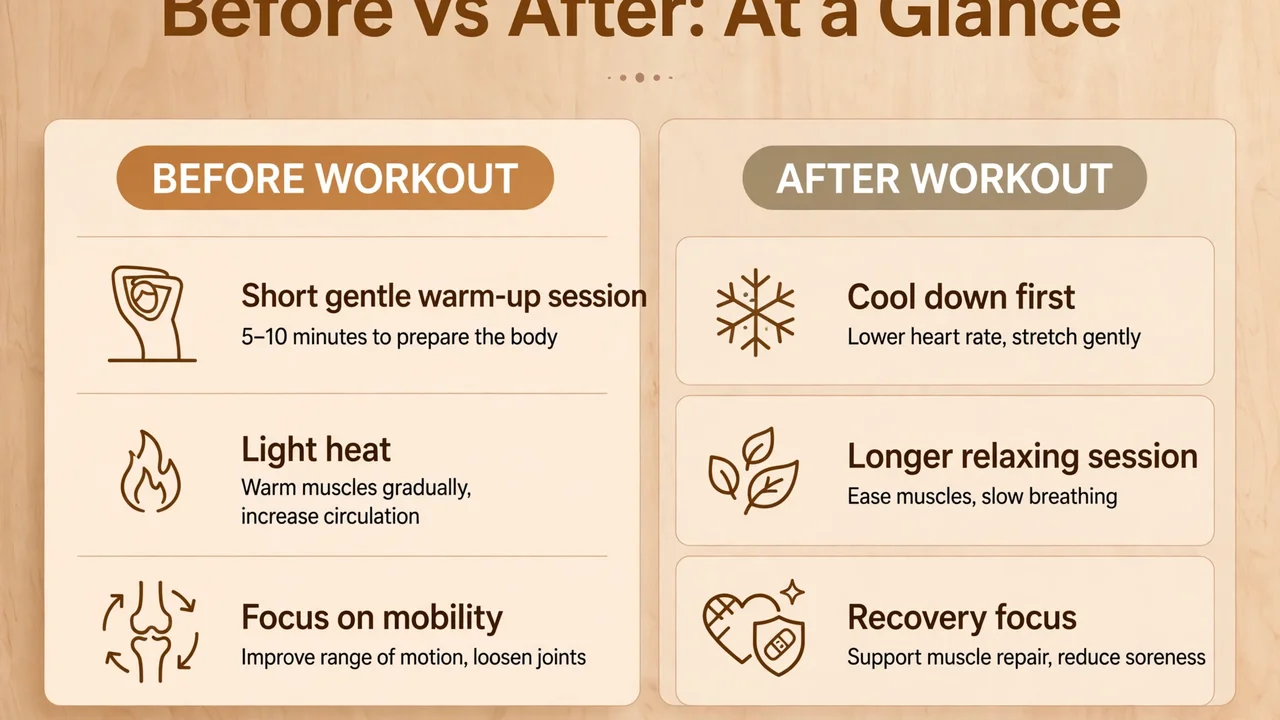
Before a workout, an infrared sauna can sometimes help you feel looser and more warmed up, especially on a cold day or before gentle mobility work. But it is not a substitute for a proper warm-up, and a long or very hot pre-workout session can leave you fatigued before you have even started.
If you only remember one rule, make it this: use the sauna to support your training, not to compete with it. Short, comfortable sessions placed thoughtfully around your workout will serve you better than long, draining sessions squeezed in at the wrong moment.



Paid Links - As an Amazon Associate, I earn from qualifying purchases.
Why Timing Matters More Than You Might Think
Exercise and heat both place demands on your body. Training raises your heart rate, body temperature, and fluid loss through sweat, and sitting in a sauna does much the same thing, albeit in a gentler, resting way. Stacking the two without a gap can therefore add up to more strain than either one alone.
That is why the order and the gap between sauna and workout matter. A well-placed session can feel like a pleasant wind-down. A poorly placed one can leave you dizzy, unusually tired, or simply less able to train well, which defeats the purpose of doing both.
Your own tolerance matters a great deal here. Age, fitness, hydration, sleep, illness, medication, and even a hot day can all change how heat feels on a given day. A routine that felt easy last week may feel too much this week, so treat every session as its own decision rather than a fixed habit.
Using an Infrared Sauna Before a Workout
A short pre-workout sauna session is best thought of as a warm-up aid, not as the warm-up itself. A few minutes of gentle heat may help you feel looser, particularly if you are stiff in the morning or training in a cold room. Some people also find that a brief warm-up in the sauna helps them settle mentally before a session.



Paid Links - As an Amazon Associate, I earn from qualifying purchases.
Keep it short and mild if you try this timing. A brief session at a comfortable temperature, followed by water and then your normal dynamic warm-up — light movement, mobility drills, and gradual build-up to working effort — is a sensible pattern. If you feel drained, light-headed, or unusually sweaty before training starts, you have almost certainly done too much.
When a Pre-Workout Session May Help
- You feel stiff or cold and want gentle warmth before mobility work.
- Your workout is light or moderate, such as easy mobility, gentle yoga, or a relaxed technique session.
- You have plenty of time, water, and energy, and you can keep the session short.
- You have tried it before and know you recover quickly from brief heat exposure.
When to Skip the Pre-Workout Sauna
- You are about to do a hard strength, sprint, or high-intensity session where performance matters.
- You are already dehydrated, unwell, sleep-deprived, or training in heat.
- You feel dizzy, nauseous, or unusually fatigued after heat in the past.
- You would have to rush straight from the sauna into intense exercise with no time to drink and cool down.
There is also a practical point worth remembering. Sweating heavily before a workout means you start that workout with less fluid in reserve. Drinking water before, during, and after both activities helps, but it does not fully undo a long, draining pre-workout heat session.
Using an Infrared Sauna After a Workout
Post-workout is the timing most regular sauna users settle on, and for good reason. After training, your muscles are warm, your mind is often still buzzing, and a calm, warm room can be a pleasant way to transition out of effort and into rest. Many people use this time simply to relax, breathe, and let their heart rate settle.
It is important to be clear about what a post-workout sauna can and cannot do. It may help you feel relaxed and may form part of a recovery routine you enjoy. It is not a proven treatment for soreness, injury, or muscle damage, and it does not replace sleep, food, hydration, or sensible training load.
If you want to read more about recovery specifically, our guide to infrared sauna for muscle recovery looks at that topic in more depth, including the limits of what the research can currently show.
How Long to Wait After Training
Give yourself a proper cool-down first. Walk, stretch gently, let your breathing return toward normal, and drink some water before you step into the sauna. Jumping straight from a hard effort into a hot room, while still gasping and dripping with sweat, adds heat on top of heat.
For most people, a gap of at least 10–20 minutes after finishing exercise is a sensible minimum, and longer after a very hard or long session. Use that time to rehydrate, change out of soaked clothing if you can, and check how you feel. If you still feel dizzy, nauseous, or overheated, wait longer or skip the sauna that day.
Session Length and Temperature After a Workout
Start short, especially if you are new to combining sauna use with training. A first post-workout session of around 10–15 minutes at a comfortable temperature is a cautious starting point for many adults, and you can build up gradually over weeks if it feels good. Experienced users often enjoy longer sessions, but longer is not automatically better.
Temperature guidance works the same way. Infrared saunas often run around 120–140°F, but the number on the display matters less than how you feel. Choose a setting where you can breathe comfortably, sit relaxed, and leave feeling refreshed rather than drained. If you need to lie down, feel faint, or struggle to breathe comfortably, leave straight away.
For more detail on session length in general, see how long you should stay in an infrared sauna, and for temperature settings, see how hot an infrared sauna should be. Both guides stress the same principle: comfort and gradual build-up beat chasing a maximum.
A Simple Post-Workout Sauna Routine
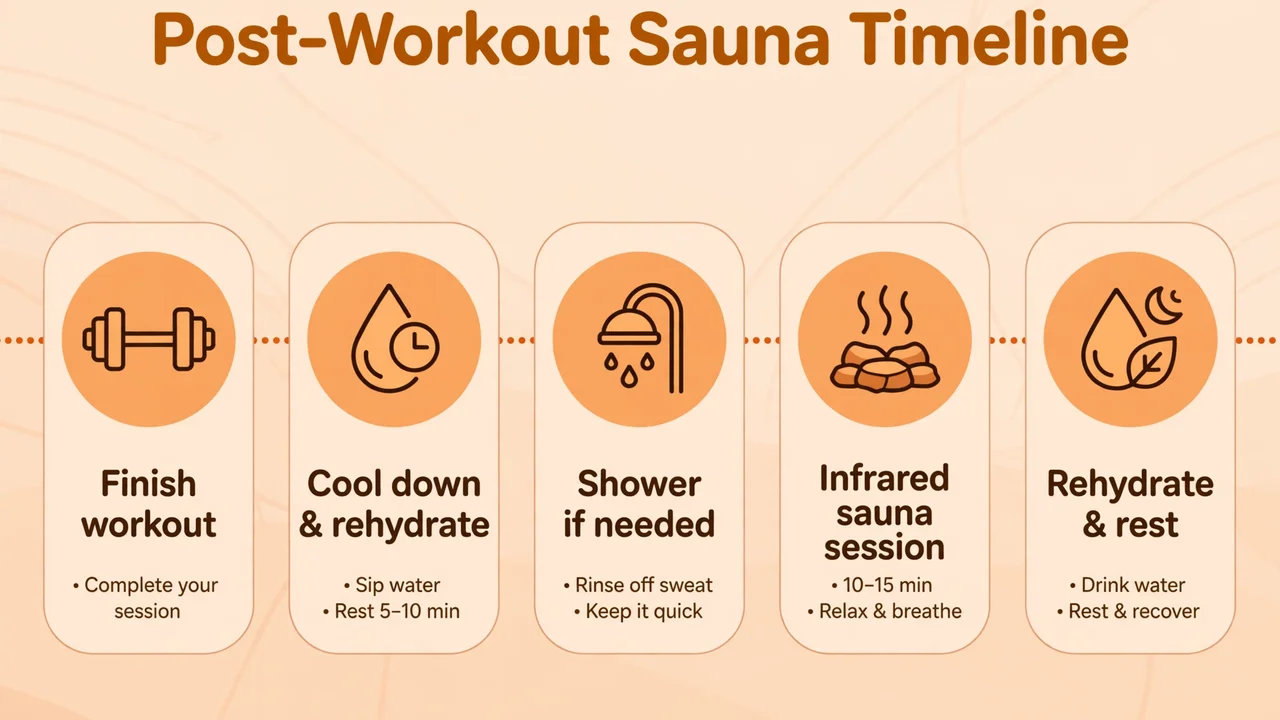
- Finish your workout and cool down with easy movement for several minutes.
- Drink water and let your heart rate and breathing settle.
- Shower or towel off if you prefer, then enter the sauna at a comfortable temperature.
- Sit for a short, comfortable session and leave immediately if you feel dizzy or unwell.
- Drink water again afterwards, eat normally, and rest. Rehydration matters after both exercise and heat.
Same-Day Scheduling and Separate-Day Options
You do not have to use the sauna on a training day at all. In fact, putting your sauna session on a rest day is one of the simplest ways to enjoy it without worrying about timing, fatigue, or performance. On a rest day, you can take your time, choose a comfortable session length, and treat it purely as relaxation.
If you do combine sauna and training on the same day, spacing matters. A morning workout followed by an evening sauna session, for example, gives your body hours to eat, drink, and recover in between. That kind of gap is often easier to manage than back-to-back exercise and heat.
It also helps to think about the week as a whole rather than a single day. If you train hard four or five days a week, you do not need a sauna session after every workout. Two or three well-placed sessions a week may be plenty, and you can adjust frequency based on how you feel. Our guide to how often you should use an infrared sauna covers frequency in more detail.
Time of day is a separate question from before-or-after, but it is worth a mention. Some people sleep better after an evening sauna session, while others feel too warm or alert to settle. If sleep is a priority, earlier sessions may suit you better, and our guide to the best time to use an infrared sauna explores that trade-off.
Strength Training and the Hypertrophy Question
This is the area where readers most often worry, and where careful wording matters. A few small studies on heat exposure after resistance training have raised questions about whether heat applied soon after lifting could blunt some muscle-growth signalling, while other research on heat and muscle has pointed in more encouraging directions. The honest summary is that the evidence is limited, mixed, and mostly not based on large, long-term trials in regular gym-goers using infrared saunas specifically.
That distinction matters. Much of the often-quoted sauna research was done with traditional Finnish-style saunas at higher air temperatures, not with infrared saunas at lower ambient temperatures. Results from one type of heat exposure cannot simply be transferred to another, and observational findings — where sauna users happen to have better outcomes — show association, not proof that the sauna caused the outcome.
So what should a strength trainee do in practice? If building muscle is your main goal and you want to be cautious, the simplest approach is to separate heat from your hardest lifting. Use the sauna later in the day, or on a rest day, rather than immediately after a heavy session. That way you are not adding a possible unknown on top of the training stimulus you care most about.
If you enjoy a post-workout sauna and your progress is going well, there is no need to panic about an occasional short session. Training consistency, progressive overload, sleep, and nutrition have far larger and better-established effects on muscle growth than sauna timing. Keep the sauna comfortable and brief if you use it after lifting, and pay attention to your recovery over weeks, not a single session.
Anyone training for a competition, recovering from injury, or managing a medical condition should talk to a coach or clinician about their own situation rather than relying on general articles. The interference question is interesting, but it is not settled science, and it should not override personal medical advice.
Cardio and Endurance Angles
For cardio and endurance athletes, the timing question has a slightly different shape. Heat acclimation — gradually getting used to exercising or sitting in heat — is a real and studied concept in endurance sport, but it is usually built up carefully over days and weeks, under coaching, and not by adding a long sauna session straight after an exhausting run.
After an easy or moderate cardio session, a short, comfortable infrared sauna session is a common and generally pleasant choice, provided you have cooled down and rehydrated first. After a long run, a hard interval session, or training in hot weather, the case for skipping the sauna that day is stronger. You have already lost a lot of fluid and your core temperature is already high.
Before cardio, the same caution as before strength training applies, with one extra note: endurance sessions already challenge fluid balance and temperature regulation. Starting a run or ride already warm and sweaty from a sauna session can make the first miles feel harder than they need to. A proper dynamic warm-up is almost always the better pre-cardio choice.
If you are training for an event in the heat, discuss heat strategies with a coach rather than improvising with sauna sessions. Structured heat acclimation, hydration planning, and pacing matter far more than any single sauna habit.
A Sample Weekly Timing Plan
The plans below are starting points, not prescriptions. Adjust session length, frequency, and timing to your fitness, your schedule, and how you feel. If any pattern leaves you consistently tired, sore, or sleeping badly, scale it back.
If You Mostly Lift Weights
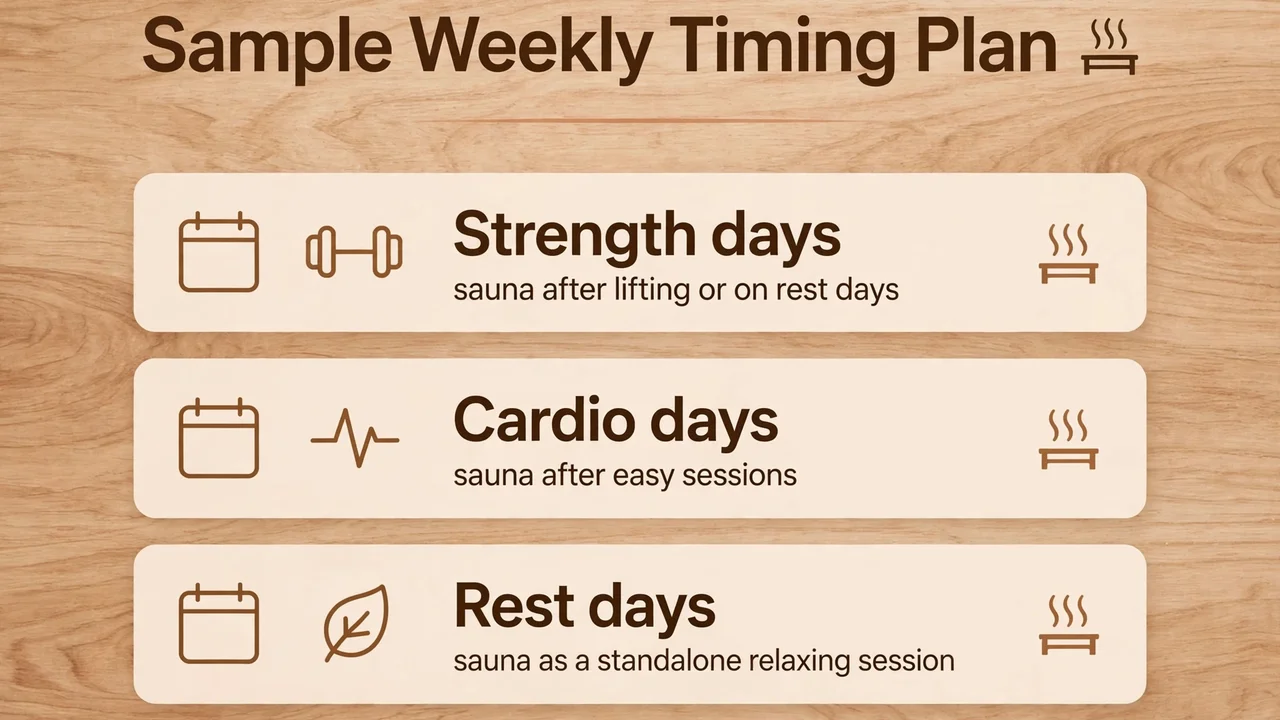
- Monday (lift): train, cool down, eat and hydrate. Sauna later in the evening or skip it.
- Wednesday (lift): same pattern, or move the sauna to a rest day if you prefer.
- Saturday (rest day): a relaxed standalone sauna session at a comfortable temperature.
If You Mix Cardio and Strength
- After easy cardio or moderate mixed sessions: cool down, rehydrate, then a short sauna session if you feel good.
- After hard or long sessions: skip the sauna, prioritise food, fluids, and sleep.
- Rest days: use the sauna as a standalone relaxation session, separate from training stress.
If You Train Mainly for General Fitness
- Two or three sessions per week, mostly after workouts or on rest days.
- Keep sessions comfortable and consistent rather than long and draining.
- Use the time to relax: leave your phone outside, breathe slowly, and finish with water.
For practical preparation, our checklist of what to do before and after an infrared sauna is a useful companion to this guide. It covers hydration, towels, clothing, and cooling down in plain steps. If you are curious about combining heat with cold exposure, read our infrared sauna cold plunge beginner protocol before trying contrast sessions, as cold plunging adds its own demands.
Mistakes to Avoid
- Going straight from hard training into the sauna. Cool down and rehydrate first, every time.
- Starting long. New users should build up gradually rather than aiming for a maximum session on day one.
- Training dehydrated. Sweating in a sauna before a workout leaves you with less fluid reserve for that workout.
- Drinking alcohol before or during a sauna session. Alcohol impairs judgement and heat tolerance and increases risk.
- Ignoring warning signs. Dizziness, nausea, chest discomfort, confusion, or feeling faint mean leave immediately and seek help if symptoms persist.
- Using the sauna to “sweat out” a bad workout or a heavy meal. Saunas are not a punishment or a shortcut, and they do not detox the body in the way that word is often marketed.
- Assuming more is always better. Daily use may suit some experienced users, but frequency should follow how you feel, not a streak.
Frequently Asked Questions
Is it better to use an infrared sauna before or after a workout?
For most people, after a workout is the better default. A post-workout session fits a cool-down routine and avoids starting training already warm, tired, or dehydrated. A short pre-workout session can help some people feel looser, but it is not a substitute for a proper warm-up.
How long should I wait after a workout before using an infrared sauna?
Cool down first and let your breathing and heart rate settle, then drink some water. For most people, a gap of at least 10–20 minutes after exercise is a sensible minimum, and longer after a very hard or long session. If you still feel dizzy or overheated, wait longer or skip the sauna that day.
How long should an infrared sauna session be after training?
Start short, especially when you are new to combining sauna use with training. Around 10–15 minutes at a comfortable temperature is a cautious starting point for many adults, building up gradually over weeks if it feels good. Longer is not automatically better, and you should leave immediately if you feel dizzy or unwell.
Can an infrared sauna after lifting hurt muscle growth?
The evidence is limited and mixed, and much of it comes from traditional saunas rather than infrared saunas specifically. If muscle growth is your main goal and you want to be cautious, use the sauna later in the day or on a rest day rather than immediately after heavy lifting. Training consistency, sleep, and nutrition matter far more than sauna timing.
Should I use an infrared sauna before cardio?
Usually not as a main warm-up. A dynamic warm-up with light movement is almost always the better pre-cardio choice. A very short, gentle sauna session may help some people feel looser, but starting cardio already warm and dehydrated can make the session feel harder than it needs to.
Can I use an infrared sauna on rest days instead?
Yes, and for many people this is the simplest option. A rest-day session avoids timing worries altogether, lets you relax without training fatigue in the mix, and still gives you the calm, warm experience you enjoy. It is a good choice if you lift heavy or train hard most days.
The bottom line is simple: let your workout come first on hard training days, cool down and rehydrate, and then enjoy a short, comfortable infrared sauna session — or save it for a rest day entirely. That approach keeps the sauna as a pleasant part of your routine, rather than an extra strain competing with the training itself.