
Steam saunas feel hotter than their thermostat number suggests, and that surprises almost every first-time owner. A steam room set to 110°F can feel more intense than a dry sauna running twenty degrees hotter, because humid air transfers heat to your skin far more efficiently than dry air does. That single fact shapes every sensible temperature choice in a steam sauna.
This guide gives you the numbers that actually matter: the ideal temperature ranges for different goals, realistic heat-up times for different room and generator sizes, and thermostat settings you can use from your very first session. Every figure below is a well-established range used across manufacturer guidance, not a laboratory promise, and where figures vary by model or installation, that is stated plainly.
Not medical advice: A steam sauna is a wellness tool, not a treatment. If you are pregnant, live with a heart or circulation condition or low blood pressure, or take medication that affects heat tolerance, check with your doctor before using a steam sauna. Hydrate before and after, keep sessions short, leave immediately if you feel dizzy or unwell, and never use a steam sauna after drinking alcohol.


Paid Links - As an Amazon Associate, I earn from qualifying purchases.
The Short Answer: Ideal Steam Sauna Temperature
Most home steam saunas are designed to run between 100°F and 120°F (about 38°C to 49°C), with near-100% humidity. That is the range most manufacturers build their generators and controls around, and it is where most users feel comfortably warm without being overwhelmed.


Paid Links - As an Amazon Associate, I earn from qualifying purchases.
Within that range, your ideal setting depends on what you want from the session. Beginners and anyone sensitive to heat should start at the low end. Experienced users who want a deeper sweat often settle around 115°F. Settings above 120°F are rarely necessary, and they shorten comfortable session time sharply rather than adding benefit.
One important caveat: the number on the thermostat is the air temperature at the sensor, not the temperature your body experiences. In a steam room, humidity makes the perceived heat higher, so small changes on the dial feel bigger than they would in a dry sauna. Adjust in steps of 2°F to 3°F, and give the room a few minutes to settle before judging a new setting.
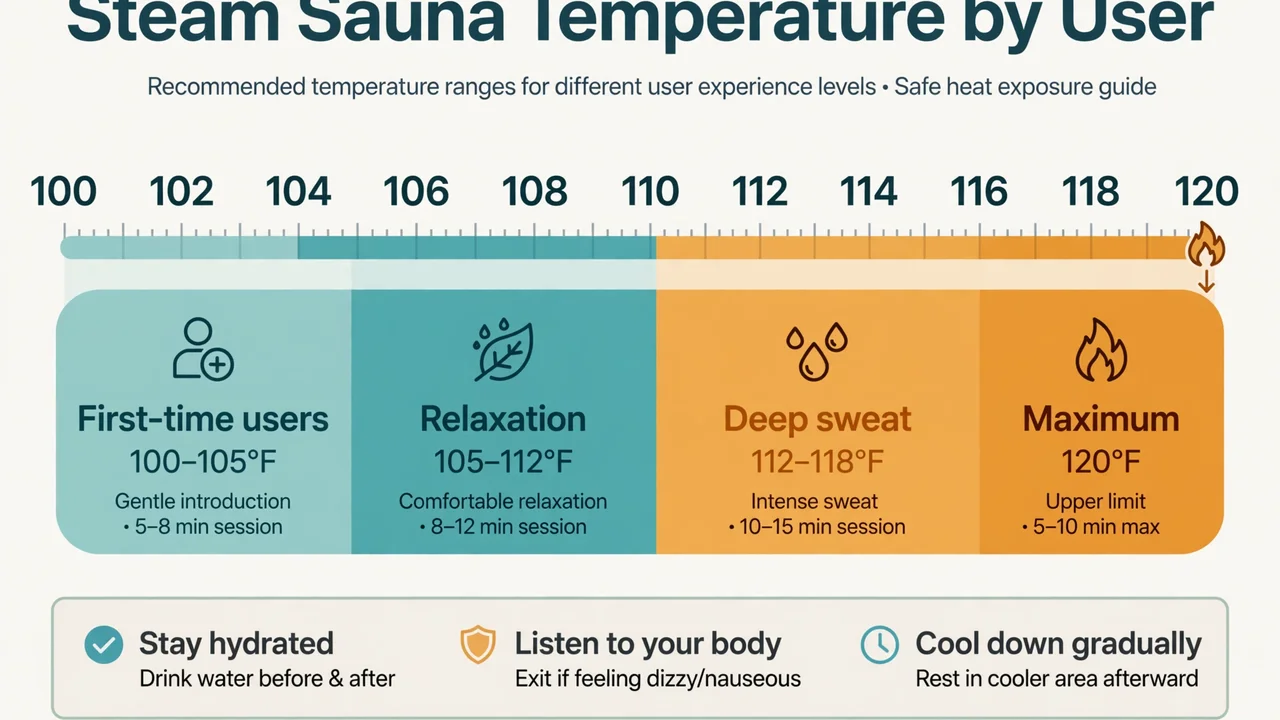
| User or goal | Suggested temperature | Typical session length | Notes |
|---|---|---|---|
| First-time user | 100–105°F (38–41°C) | 5–10 minutes | Learn how your body responds before going hotter. |
| Relaxation and unwinding | 105–112°F (41–44°C) | 10–15 minutes | Comfortable warmth without strain for most adults. |
| Deep sweat session | 112–118°F (44–48°C) | 10–20 minutes | For regular users; exit early if you feel light-headed. |
| Maximum manufacturer range | Up to 120°F (49°C) | Short sessions only | Most controls top out here; hotter adds strain, not benefit. |
| Children, older adults, or anyone heat-sensitive | 100°F or below, if at all | Very short, supervised | Check with a doctor first; never leave children unsupervised. |
Why Steam Feels Hotter Than the Number on the Dial
Dry air is a poor conductor of heat. Humid air is not. When steam fills a room, the moisture in the air transfers heat to your skin much faster, and sweat evaporates far more slowly because the air is already saturated. That combination is why 110°F in a steam room can feel as demanding as 140°F or more in a dry sauna.
This also explains why steam sauna temperatures look low compared with other sauna types. A traditional Finnish sauna typically runs at 150°F to 195°F, and an infrared sauna usually runs at 110°F to 140°F, yet both feel milder per degree than a steam room at the same number. Comparing the numbers across sauna types without accounting for humidity is misleading, and it is the most common reason new steam owners set their thermostat too high on day one.
The practical lesson is simple: trust your body over the dial. If you feel uncomfortably hot, dizzy, or short of breath, the room is too hot for you at that moment regardless of what the display says. Step out, cool down, drink water, and try a lower setting next time.
How a Steam Sauna Thermostat Actually Works
A steam sauna thermostat is not like a home heating thermostat that holds a steady temperature all day. It works with the steam generator in cycles. When the room temperature drops below your set point, the generator heats water and pushes steam into the room. When the sensor reads the set temperature, the generator pauses or reduces output until the temperature falls again.


Paid Links - As an Amazon Associate, I earn from qualifying purchases.
The sensor, usually a small probe mounted on the wall inside the steam room, is the thermostat’s only source of truth. Its placement matters enormously. A sensor mounted too close to the steam head reads hot too early and shuts the generator off before the rest of the room warms up. A sensor mounted too far away, or in a cold draught near the door, reads cool and lets the generator run longer than needed.
Most manufacturers specify a sensor height and distance from the steam head, commonly around head height when seated and away from direct steam flow. Follow your model’s manual on this point rather than guessing, because sensor placement is the single most common cause of “my thermostat says one thing and the room feels like another” complaints.
Thermostat Settings: A Practical Starting Guide
Start low and work up over several sessions, not within a single session. Your body adapts to regular heat exposure over days and weeks, and a setting that feels mild after a month of use may feel intense on your first visit. Patience here is not caution for its own sake; it is how you find a setting you will actually enjoy using several times a week.
For your first session, set the thermostat to 100°F and plan for no more than ten minutes. If that felt easy, try 105°F next time. Most regular users eventually settle somewhere between 105°F and 115°F, and many never feel the need to go higher. There is no prize for using the maximum setting, and hotter sessions are shorter sessions by necessity.
Use the timer as well as the thermostat. Most digital controls let you set a session length, commonly up to 60 minutes, with an automatic shut-off. Set it every time, even if you expect to finish sooner. The timer is a backstop, not a target, and it protects you if you lose track of time in the heat.
| Situation | Suggested thermostat setting | Why |
|---|---|---|
| First session ever | 100°F (38°C) | Learn your tolerance at the gentle end. |
| Regular relaxation session | 105–112°F (41–44°C) | Comfortable for most adults for 10–15 minutes. |
| After exercise | 100–110°F (38–43°C) | Your core temperature is already raised; go lower, not higher. |
| Cold room or winter start | Same target, longer preheat | Raise the preheat time, not the set temperature. |
| Sharing with a heat-sensitive guest | 100–105°F (38–41°C) | Set for the most sensitive person in the room. |
| Testing a new generator or sensor position | 105°F (41°C) | A mid-range setting makes uneven heating easiest to spot. |
Heat-Up Time: How Long Before You Can Step In
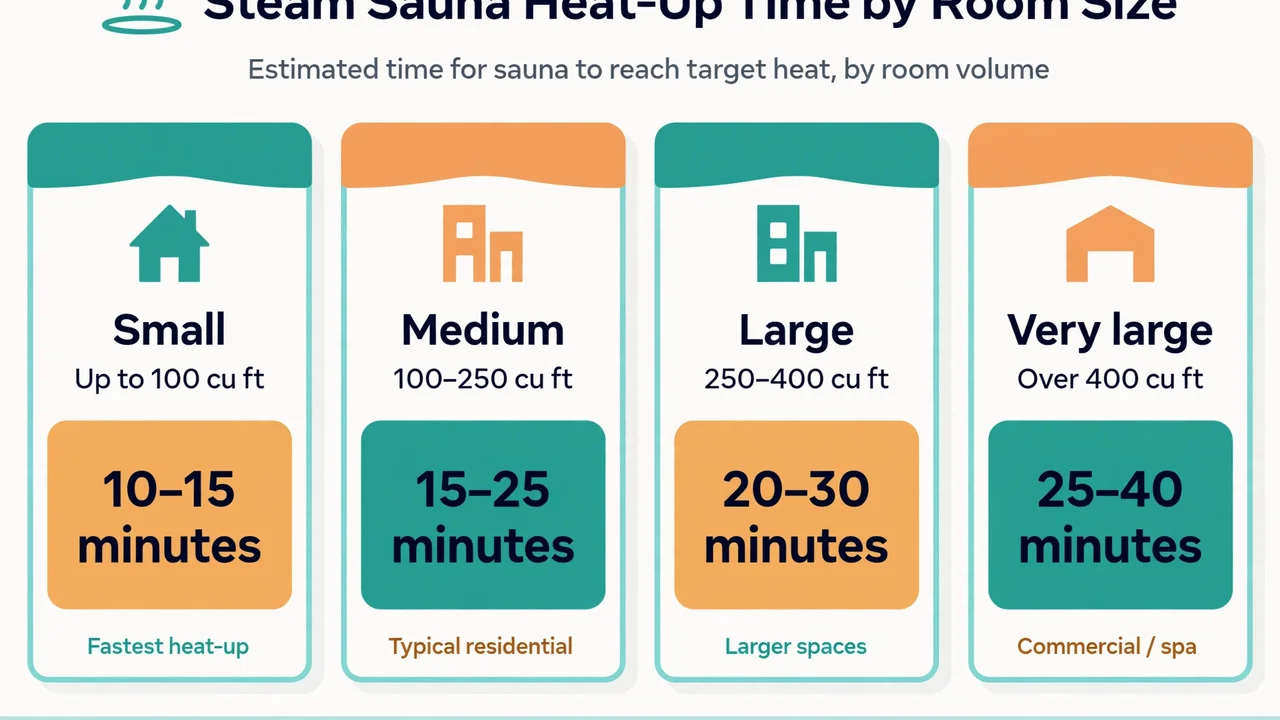
Heat-up time is the gap between switching the generator on and the room reaching your set temperature. For a typical home steam room, that is usually somewhere between 10 and 30 minutes, but the spread is wide because room size, generator power, insulation, and starting temperature all push the number in different directions.
Generator power is the biggest single factor. A generator that is correctly sized for the room heats steadily and reaches temperature without straining. An undersized generator may take far longer and struggle to hold temperature at all, especially in a larger or poorly insulated room. An oversized generator heats faster but cycles on and off more often, which can make temperature feel uneven.
Room construction matters just as much. A small, well-sealed room with tiled walls, a low ceiling, and a tight door heats quickly and holds steam well. A large room with a high ceiling, a leaky door, or uninsulated walls loses heat and steam constantly, so the generator works harder for longer. If your heat-up times are much longer than the table below suggests, air leaks and insulation are the first things to check, not the thermostat setting.
| Room size (approx.) | Typical generator size | Estimated heat-up time to 110°F | What stretches the time |
|---|---|---|---|
| Small: up to ~100 cu ft | 4.5–6 kW | 10–15 minutes | Cold tile, draughty door. |
| Medium: ~100–250 cu ft | 7.5–10 kW | 15–25 minutes | High ceiling, large glass panel. |
| Large: ~250–400 cu ft | 12–15 kW | 20–30 minutes | Poor insulation, oversized room for the generator. |
| Very large: over 400 cu ft | 15 kW and up | 25–40 minutes | Commercial-scale rooms; check manufacturer sizing tables. |
The figures in Table 3 assume a reasonably sealed room starting at normal indoor temperature. A room that starts cold in winter, or one with a door that does not seal, can take noticeably longer. Conversely, pre-warming the room, for example by running the generator a few minutes early on a timer, can make the first minutes of your session feel warmer without changing the thermostat at all.
For more detail on matching power to room volume, see our guide on how to size a steam generator. Getting that match right at installation time does more for heat-up time and temperature stability than any thermostat trick later.
What Affects Heat-Up Time Most
Ceiling height is an underrated factor. Steam rises, so a tall ceiling collects a layer of warm air above head height while the seated zone stays cooler. Rooms with ceilings above about 8 feet take longer to feel warm at bench level, and a sloped ceiling that directs steam downward helps noticeably. If you are planning a build, keeping the ceiling modest is one of the cheapest ways to improve heat-up performance.
Door seals and vents are the next check. A steam room needs controlled ventilation, not accidental leakage. Gaps around the door let steam escape continuously, which forces the generator to run longer and makes temperature swing. A well-sealed door with a small, intentional vent near the floor gives you control instead of constant loss.
Wall and ceiling materials play a role too. Tile and stone absorb heat slowly at first and then radiate it back, which can make the first session of the day feel slower but later sessions feel steadier. Acrylic or fiberglass enclosures warm faster but cool faster. Neither is wrong; they simply behave differently, and your heat-up expectations should match your room’s materials.
Finally, generator location and steam line length matter. A generator mounted far from the room, with a long steam line, loses some heat along the way. Manufacturers specify maximum steam line lengths and insulation guidance for a reason. If heat-up is slow and the room is well sealed, a long or uninsulated steam line is worth investigating with your installer.
Temperature Too Low or Too High? Troubleshooting
If the room never reaches your set temperature, work through the causes in order before assuming the generator is faulty. Check the door seal first, then the sensor position, then whether the generator is correctly sized for the room. A generator that runs constantly without reaching temperature is usually fighting heat loss or undersizing, not a thermostat fault.
If the room overshoots and feels hotter than the setting, suspect sensor placement. A sensor in a cool draught or far from the seating area lets the generator run too long. A sensor splashed with water or coated in scale can also read inaccurately. Both are cheap fixes compared with replacing a control unit, so rule them out first.
If temperature swings wildly, rising and falling by ten degrees or more, the generator may be oversized for the room, cycling hard on and off. Some digital controls offer a “soft start” or proportional mode that smooths cycling. Check your manual for that option before concluding the equipment is mismatched.
| Symptom | Likely cause | First check |
|---|---|---|
| Room never reaches set temperature | Heat loss or undersized generator | Door seal, vents, generator sizing chart. |
| Room feels hotter than the display | Sensor in a cool spot or draught | Sensor position per manufacturer manual. |
| Temperature swings up and down | Oversized generator or aggressive cycling | Control’s soft-start or proportional mode. |
| Slow heat-up that gets worse over months | Scale build-up in the generator | Descaling and water quality; see our maintenance guide. |
| Steam feels weak despite correct temperature | Blocked steam head or low water flow | Steam head cleaning and water supply. |
Scale deserves a special mention because it creeps up slowly. In hard-water areas, mineral build-up inside the generator reduces heating efficiency over months, and heat-up times stretch gradually. Regular descaling, covered in our guide to steam generator maintenance and descaling, keeps heat-up times close to the day-one figures.
Digital vs Analog Controls: What Changes
Analog controls, usually a simple dial, are reliable and easy to use, but they offer coarse adjustment and no display of the actual room temperature. You set a position on the dial and judge by feel. That is fine for a single regular user who has found their setting, but it makes troubleshooting harder because you cannot see what the sensor is reading.
Digital controls show both the set temperature and, on many models, the current room temperature. That visibility makes the learning curve much shorter: you can see how long heat-up takes, how stable the temperature is, and whether the room overshoots. Many digital controls also add a timer, delayed start, and preset programs, which are genuinely useful for preheating before you get home.
Smart controls that connect to an app add remote start, which solves the heat-up waiting problem neatly: start the generator from your phone twenty minutes before you plan to use the room. The temperature guidance does not change with a smarter control, though. A remote start set to 118°F for a first-time user is no safer than a manual dial set the same way.
Session Length, Temperature, and Safety Together
Temperature and session length are linked, and they should be adjusted together. A hotter room demands a shorter session. A good rule of thumb is that as temperature rises above 112°F, comfortable session time falls, and above 118°F most people should plan on ten minutes or less. Beginners should stay at the low end of both scales until they know their response.
Hydration is part of temperature safety, not an optional extra. Drink water before you step in and again after you step out. Avoid alcohol before and during sessions entirely, because alcohol impairs your body’s ability to regulate temperature and to notice warning signs like dizziness. If you feel dizzy, nauseous, or unusually uncomfortable at any point, leave immediately and cool down; do not try to push through it.
For a fuller look at how long to stay in, see our guide on how long to stay in a steam sauna. Temperature and duration work as a pair, and getting both right is what turns a steam room from an endurance test into a genuinely relaxing habit.
Steam Temperature Through the Seasons
Your ideal thermostat setting barely changes with the seasons, but your heat-up routine should. In winter, a cold room and cold tile absorb more heat at the start, so allow extra preheat time rather than raising the set temperature. Raising the setting to compensate for a cold room usually overshoots once the room warms up, leaving you with a hotter session than you intended.
In summer, the opposite applies. A warm room reaches temperature faster, and your body may already be warm, so a slightly lower setting often feels the same as your winter setting. If your summer sessions feel harsher than your winter ones at the same number, this is why: the starting conditions changed, not the thermostat.
If your steam room is outdoors or in an unheated space, insulation and door sealing matter even more. Heat loss in cold weather can be large enough that a generator sized for a mild climate struggles. That is an installation and sizing question, best checked against the manufacturer’s guidance for your climate, not something to fix by turning the dial to maximum.
Moisture, Ventilation, and Temperature Honesty
A steam room is a wet room by design, and no temperature setting removes the maintenance that comes with that. After each session, leave the door ajar or run ventilation so the room dries. Wipe down seats and walls periodically, and check grout and seals for mould, especially in corners and around the door frame.
Temperature interacts with this honestly: a room that is used hot and then shut tight while still wet stays damp longer, which encourages mould. A short drying period after every session does more for the room’s lifespan than any cleaning product used once a month. Never present a home steam room, to yourself or anyone else, as maintenance-free; it is not, and pretending otherwise is how small moisture problems become expensive repairs.
Ventilation also affects how temperature feels. A room with no air movement can feel stuffy even at a moderate temperature, while a gentle, controlled vent keeps the air fresher without dumping your heat. If your room feels oppressive at 108°F, try improving air movement before concluding that the temperature itself is wrong.
Common Mistakes to Avoid
The most common mistake is starting at maximum. New owners often set 120°F for their first session, find it overwhelming, and conclude they dislike steam saunas. Starting at 100°F and rising gradually would have given them a completely different first impression.
The second mistake is chasing the number instead of the feeling. Thermostat displays vary between models, sensors drift, and rooms differ. Two rooms both reading 110°F can feel different. Use the display as a guide and your body as the judge, and do not worry if your comfortable number is lower than someone else’s.
The third mistake is ignoring heat-up time in daily planning. Switching the generator on and stepping in two minutes later, then complaining the room is cold, is a planning error, not an equipment failure. Build the preheat into your routine, use a timer or delayed start if your control offers one, and judge the room only once it has reached temperature.
The fourth mistake is treating the thermostat as a one-time setting. Your comfortable temperature changes with fitness, season, time of day, and whether you have just exercised. Revisiting the setting occasionally is normal, not a sign that something is wrong.
Quick-Start Checklist for Your Next Session
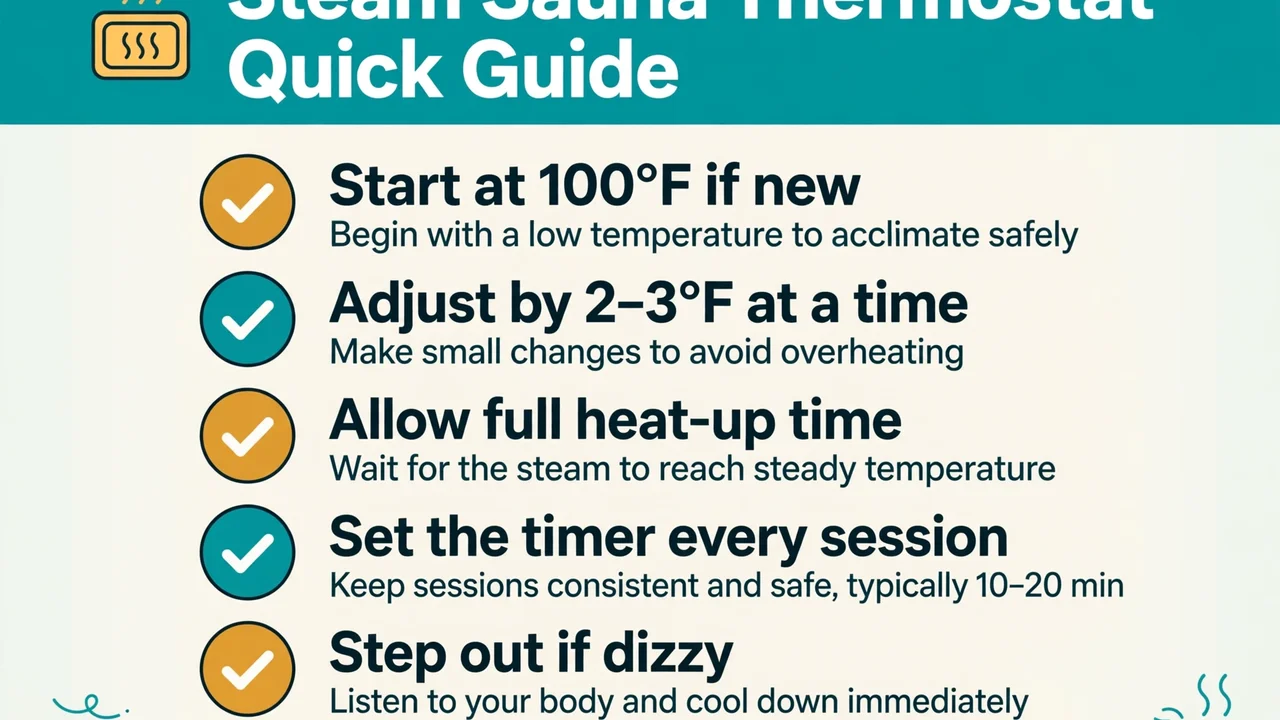
- Set the thermostat to your known comfortable temperature, or 100°F if you are new.
- Allow the full heat-up time for your room size; do not judge the room early.
- Set the session timer every time, even for short sessions.
- Drink water before stepping in and keep water nearby for afterwards.
- Step out immediately if you feel dizzy, nauseous, or unwell.
- Afterwards, ventilate the room and leave the door ajar until it dries.
- Adjust your next setting by 2°F to 3°F at a time, never in big jumps.
If you are still planning the room itself, it is worth reading the basics first: what a steam sauna is and the electrical and plumbing requirements that shape any installation. And when the session is over, regular cleaning, covered in how to clean a steam sauna, keeps the room pleasant and mould-free. For timing your sessions across the week, see also the best time to use a steam sauna.
Frequently Asked Questions
What is the ideal temperature for a steam sauna?
Most users find 105°F to 115°F (41°C to 46°C) ideal, within the usual manufacturer range of 100°F to 120°F. Beginners should start at 100°F to 105°F and adjust upward slowly over several sessions.
Why does a steam sauna feel hotter than a dry sauna at the same temperature?
Because the air is near 100% humidity. Humid air transfers heat to your skin faster than dry air, and sweat evaporates more slowly, so the same thermometer reading feels much more intense in a steam room.
How long does a steam sauna take to heat up?
Typically 10 to 30 minutes for a home steam room, depending on room size, generator power, insulation, and starting temperature. Small rooms with correctly sized generators heat in about 10 to 15 minutes, while large rooms can take 25 to 40 minutes.
Should I set my steam sauna thermostat to the maximum?
No, not routinely. Most controls top out around 120°F, but most users are comfortable well below that, and hotter settings shorten safe session time sharply. Use the lowest setting that feels pleasantly warm.
What temperature should beginners use?
Start at 100°F to 105°F for 5 to 10 minutes. Increase by 2°F to 3°F at a time over later sessions as you learn how your body responds to humid heat.
Where should the temperature sensor be placed?
Follow your generator manufacturer’s manual, but generally the sensor sits at about seated head height, away from direct steam flow from the steam head and away from draughts near the door. Wrong placement is the most common cause of inaccurate readings.
Can I leave the steam sauna running at temperature all day?
You should not. Running a generator continuously wastes energy, accelerates scale build-up, and keeps the room wet for hours, which encourages mould. Use the timer or delayed start and heat the room only when you plan to use it.
Why is my steam sauna slow to heat up?
The usual causes are a draughty door, poor insulation, a high ceiling, a generator undersized for the room, or scale build-up in hard-water areas. Check door seals and generator sizing first, then descaling.
Is it safe to use a steam sauna every day?
Many healthy adults use steam saunas regularly, but daily use is a personal health decision. Keep sessions short, hydrate well, and check with your doctor first if you are pregnant, have a heart or circulation condition or low blood pressure, or take medication affecting heat tolerance.
Does a higher temperature mean a better session?
No. A higher temperature mainly means a shorter comfortable session and more strain. The best temperature is the one that lets you relax for a full session and step out feeling refreshed, not drained.