
There are many big claims that come with Infrared Sauna Health Benefits: heart health, pain relief, detoxification, weight loss, glowing skin. Some of that stands up to research. Some of it doesn’t — at least not yet.
Here’s the short version: infrared saunas heat your body directly with light, rather than heating the air around you. That creates the same effect as moderate exercise: sweating, elevated heart rate and dilated blood vessels.
The most supported Infrared Sauna Health Benefits are cardiovascular. Evidence of pain relief, relaxation and sleep is reasonably strong, but less voluminous. The term “detox” is used in numerous claims to remove heavy metals or melt fat, but very little of this is actually medicine.
Here’s a complete rundown of what works, what shows promise, and what’s simply a claim — and how to use one safely if you choose to try it.


Paid Links - As an Amazon Associate, I earn from qualifying purchases.
What Is an Infrared Sauna, and How Is It Different From a Regular One?

A traditional sauna raises the temperature of the air around you, typically between 150°F and 195°F. An infrared sauna bypasses that. It applies infrared light panels to heat your skin and tissue directly, so it can operate at a much lower air temperature (usually 110°F to 135°F).
The key attraction of that lower temperature is. This is part of the reason infrared saunas have become popular with those who find traditional saunas too intense, as you get a similar sweat response and heart-rate increase without feeling like you’re sitting inside an oven.



Paid Links - As an Amazon Associate, I earn from qualifying purchases.
There are three types of infrared wavelengths used in these devices: near, mid, and Far-infrared. Most consumer saunas and most of the research use far-infrared because it goes just a little deeper into the soft tissue.
What Happens to Your Body Inside an Infrared Sauna
Your body reacts to an infrared sauna as if you were doing mild to moderate exercise, within a few minutes of sitting in it. Your blood vessels dilate. Your heart rate goes up. You start to sweat.
Scientists who have examined the literature on far infrared saunas reported that the cardiovascular stress this places on the body is comparable to moderate walking. Think of it this way: your body is working out lightly, but instead of moving, it’s heating.
This is also why infrared saunas have been explored as a way to exercise for those who cannot do so easily, such as with some joint, mobility or cardiovascular restrictions, under a doctor’s supervision.



Paid Links - As an Amazon Associate, I earn from qualifying purchases.
Infrared Sauna Health Benefits: Graded by Evidence Strength
Not every claimed benefit has the same level of proof behind it. Here’s how the research actually breaks down.
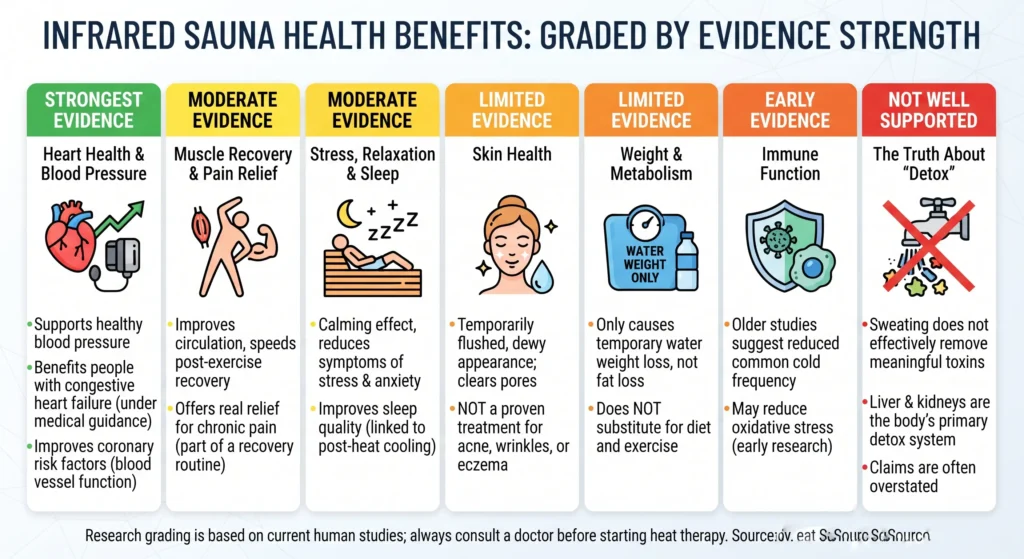
Heart Health and Blood Pressure — Strongest Evidence
This is where infrared sauna research is most developed. A 2009 review published in Canadian Family Physician examined the available human studies on far-infrared saunas and found real support for two things: benefit for people with congestive heart failure, and improvement in coronary risk factors like blood pressure and blood vessel function.
Mayo Clinic similarly points to studies on infrared and traditional sauna use showing potential benefit for high blood pressure and heart failure, while noting that larger, more rigorous trials are still needed to confirm the size of the effect.
One small study in people with type 2 diabetes found that 20-minute infrared sauna sessions, three times a week for three months, were associated with lower blood pressure and reduced waist circumference — encouraging, but based on a small sample.
It’s worth flagging a common mix-up: some of the largest and most-cited sauna studies — including long-term Finnish research linking frequent sauna bathing to lower cardiovascular death rates — were done on traditional saunas, not infrared ones. The physiological mechanism (heat stress, vasodilation, increased heart rate) likely overlaps, but it’s not the same as direct infrared-specific proof.
Key takeaway: Regular infrared sauna use appears to support healthy blood pressure and may benefit people with certain heart conditions, but always under medical guidance — heat therapy is not a replacement for prescribed heart treatment.
Muscle Recovery and Pain Relief — Moderate Evidence
Improved blood circulation is the likely mechanism here. More blood flow to sore or fatigued muscles can help clear metabolic waste and deliver oxygen faster, which may speed up recovery after exercise.
For chronic pain specifically, a multi-year study on infrared sauna therapy found it showed promise as a treatment approach, with participants reporting improved outcomes over time. This lines up with why infrared saunas are used in some physical therapy and sports recovery settings.
Key takeaway: If you deal with muscle soreness or certain types of chronic pain, infrared sauna sessions may offer real relief — but they work best as part of a broader recovery routine, not a standalone fix.
Stress, Relaxation, and Sleep — Moderate Evidence
Heat exposure has a documented calming effect. Research has associated regular sauna use with reduced symptoms of stress and anxiety, and separate research has linked sauna use with improved sleep quality.
Part of this is likely physiological (the drop in core body temperature after you leave the heat can help trigger sleepiness, similar to the effect of a warm bath before bed) and part is simply the effect of setting aside quiet, screen-free time.
Key takeaway: Even without other benefits, many people find infrared sauna sessions genuinely relaxing — and that’s a legitimate wellness benefit on its own.
Skin Health — Limited Evidence
Increased blood flow to the skin during a sauna session can temporarily give skin a flushed, dewy appearance, and sweating helps clear pores. But there isn’t strong, high-quality research proving infrared saunas meaningfully improve skin conditions like acne, wrinkles, or eczema over the long term. Treat any skin-related claims as a possible side benefit, not a proven treatment.
Weight and Metabolism — Limited, Often Overstated
You will lose water weight through sweating during a session — sometimes a pound or more — but that’s fluid, not fat, and it comes right back once you rehydrate (which you should do). There is no strong evidence that infrared sauna use burns meaningful fat or substitutes for diet and exercise in weight management. Be skeptical of any source claiming otherwise.
Immune Function — Early Evidence
Some earlier research has linked regular sauna use to a reduced frequency of the common cold, though the studies are older and not infrared-specific. Sauna use has also been associated with reduced oxidative stress, which plays a role in several chronic diseases. This is a promising area, but it’s early, and more infrared-specific research would help confirm it.
The Truth About “Detox” Claims — Not Well Supported
This is the biggest gap between marketing and science. The idea that sweating in an infrared sauna flushes out heavy metals or toxins is a common selling point, but it is not well established. Even Cleveland Clinic’s own functional medicine team describes this research as still in its early stages. Sweat does contain trace amounts of certain substances, but there’s no solid evidence that this amounts to a meaningful “detox” effect. Your liver and kidneys remain your body’s primary detox system.
Who Should Avoid Infrared Saunas
Sauna use is generally considered safe, but it isn’t right for everyone. Talk to your doctor first — and consider skipping sauna sessions altogether — if any of the following apply to you:
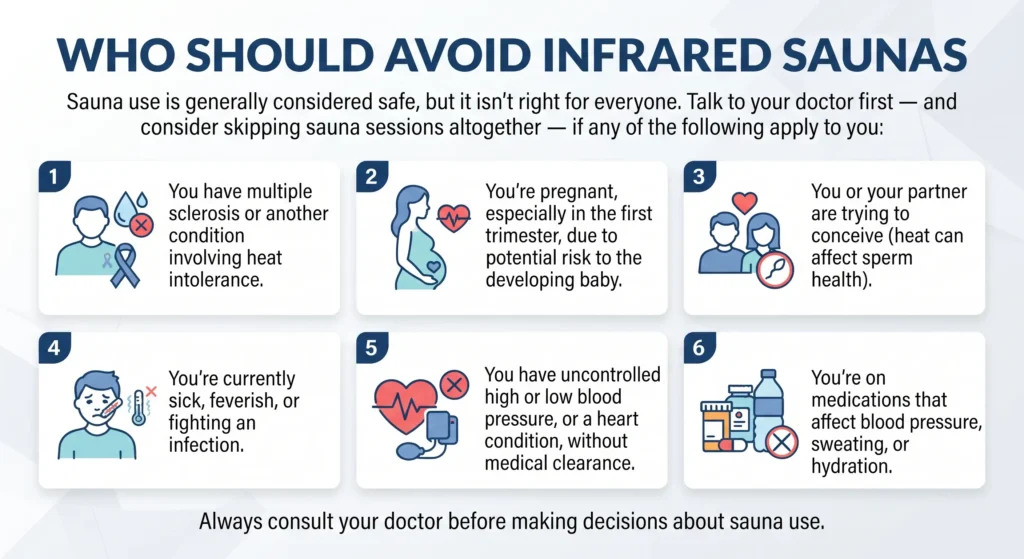
- You have multiple sclerosis or another condition involving heat intolerance
- You’re pregnant, especially in the first trimester, due to potential risk to the developing baby
- You or your partner are trying to conceive (heat can affect sperm health)
- You’re currently sick, feverish, or fighting an infection
- You have uncontrolled high or low blood pressure, or a heart condition, without medical clearance
- You’re on medications that affect blood pressure, sweating, or hydration
How to Use an Infrared Sauna Safely
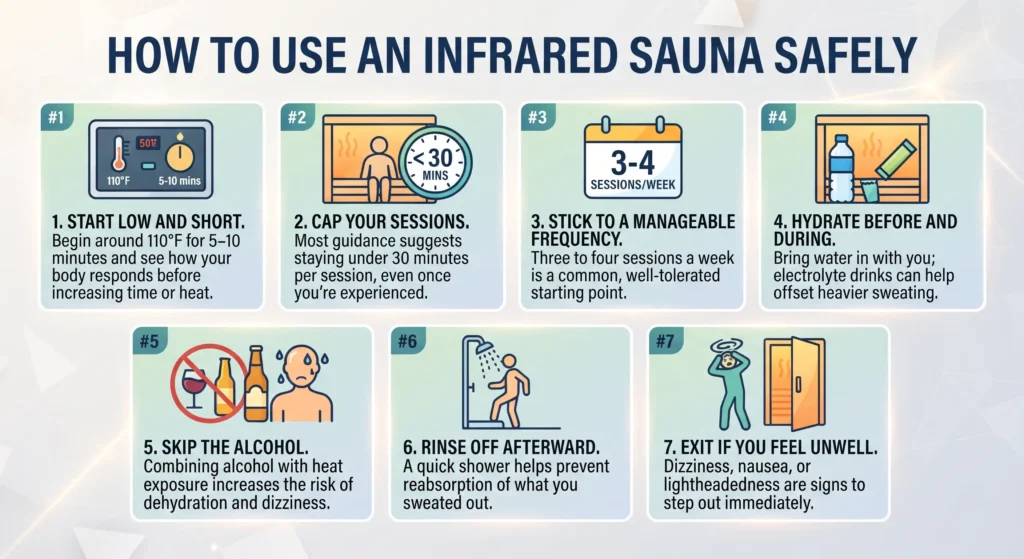
- Start low and short. Begin around 110°F for 5–10 minutes and see how your body responds before increasing time or heat.
- Cap your sessions. Most guidance suggests staying under 30 minutes per session, even once you’re experienced.
- Stick to a manageable frequency. Three to four sessions a week is a common, well-tolerated starting point.
- Hydrate before and during. Bring water in with you; electrolyte drinks can help offset heavier sweating.
- Skip the alcohol. Combining alcohol with heat exposure increases the risk of dehydration and dizziness.
- Rinse off afterward. A quick shower helps prevent reabsorption of what you sweated out.
- Exit if you feel unwell. Dizziness, nausea, or lightheadedness are signs to step out immediately.
How Often Should You Use an Infrared Sauna?
Most of the research showing measurable benefit used sessions in the range of three to four times per week, at 20–45 minutes each. That’s a reasonable target if your doctor has cleared you for regular use. There’s no strong evidence that more frequent or longer sessions produce proportionally greater benefits, and pushing session length or heat too far raises the risk of dehydration without added payoff.
Myth vs. Fact
| Myth | Fact |
|---|---|
| Infrared saunas “detox” heavy metals from your body | Not well supported by current evidence; your liver and kidneys do the real detox work |
| Sweating in a sauna burns significant fat | You mainly lose water weight, which returns once you rehydate |
| Infrared saunas are proven to treat anxiety and depression | Some research links sauna use to reduced stress and anxiety symptoms, but it’s not a replacement for treatment |
| Infrared saunas are risk-free for everyone | Certain groups — including pregnant people and those with MS — should avoid them |
| More heat and longer sessions always mean more benefit | Most positive research used moderate settings (110–135°F, 20–45 minutes); pushing further adds risk, not proven benefit |
FAQs
Are infrared saunas safe to use every day?
For many healthy people, occasional daily use may be fine, but most research protocols used 3–4 sessions weekly rather than daily. Check with your doctor, especially if you have any cardiovascular condition.
Are infrared sauna health benefits backed by real research?
Some are. Cardiovascular benefits, such as healthy blood pressure support, are the most supported by research. There is moderate support for pain relief, relaxation, and sleep. Detox and big weight loss claims are not strongly substantiated.
What is the difference between an infrared sauna and a regular sauna?
A regular sauna warms the air (usually 150-195°F), while an infrared sauna warms the body directly with light (110-135°F), creating the same sweat and heart-rate response but with less heat.
Can infrared saunas help with high blood pressure?
In some studies, infrared sauna use has been linked to better blood pressure and blood vessel function, but more studies are required. Consult your physician before using one to treat a diagnosed condition.
Are infrared saunas effective for detoxing?
Not in the way it’s often marketed. The notion that sweating can expel significant amounts of toxins or heavy metals is not well supported by science. Your liver and kidneys are still your main detox organs.
Can infrared saunas help you lose weight?
Not permanently. Sweating will result in a loss of water weight, which will be restored on rehydration. Infrared saunas are not proven to burn significant amounts of fat.
What’s the recommended time to spend in an infrared sauna?
Most advice is to begin with 5–10 minutes and gradually increase to a max of around 30 minutes per session.
Are infrared saunas good for sleep?
Some studies have associated frequent sauna use with improved sleep quality, which may be due to the relaxation effect and the cooling down that occurs after using the sauna.
Do infrared saunas relieve muscle pain?
Yes, probably by better circulation. This extra blood flow can help to carry oxygen and remove waste from fatigued muscles, promoting quicker recovery.
Does infrared sauna decrease the risk of heart disease?
Although these are intriguing long-term studies on how often people use saunas and how it relates to lower cardiovascular death rates, the majority of this large-scale, long-term data is from the traditional Finnish sauna studies, not from infrared saunas specifically. The mechanisms likely overlap, but it isn’t identical evidence.
Final Thoughts
Infrared saunas aren’t a miracle cure, and they aren’t snake oil either. The honest picture, based on the actual research, lands in the middle: there’s solid evidence for cardiovascular benefits and reasonable evidence for pain relief, relaxation, and sleep support. The detox and dramatic weight-loss claims you’ll see on wellness blogs don’t hold up nearly as well.
If you’re healthy and curious, a short, moderate-temperature session a few times a week is a low-risk way to find out if it helps you personally — just start slow, stay hydrated, and check with your doctor first if you have any heart condition, are pregnant, or fall into one of the higher-risk groups above. The research will keep evolving, but for now, that’s what the evidence actually supports.