
Dry Sauna vs Steam Sauna is a decision most people have to make standing between two unmarked doors at the gym — one leading to a dry, wood-lined room, the other to a cloud of steam. Both make you sweat and feel great afterward, but they work on your body in genuinely different ways, and the “better” one depends entirely on what you’re after.
Here’s the short answer: a dry sauna uses hot air with low humidity (usually 150–195°F, 5–20% humidity), while a steam sauna uses much lower air temperature but near-100% humidity, which is why it can feel just as intense at 110–120°F. Dry heat tends to be better for cardiovascular conditioning and deep, efficient sweating. Steam tends to be better for congestion, sinus relief, and skin hydration. Below, we’ll break down exactly why — and help you figure out which one fits you.
What Is a Dry Sauna?
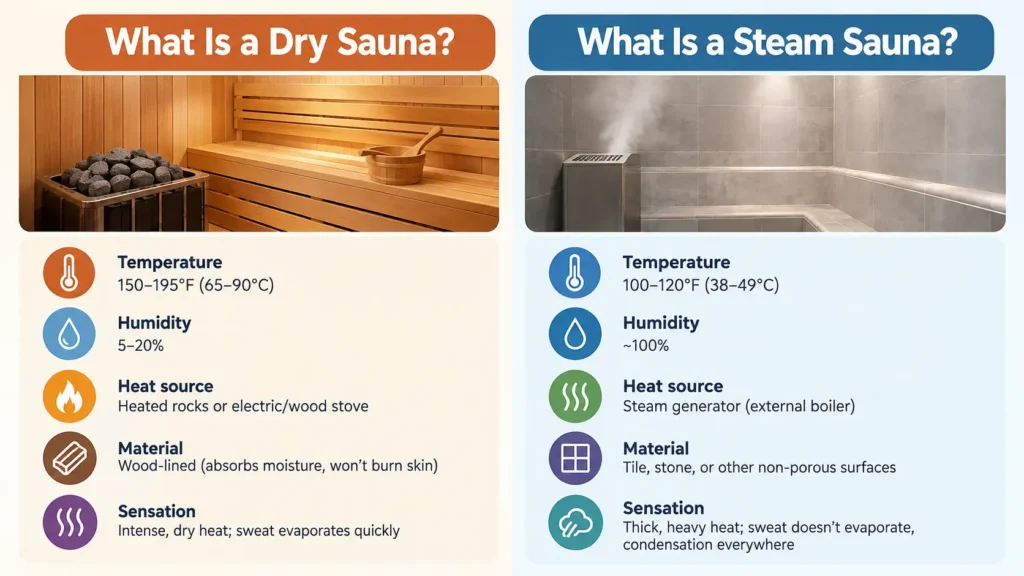
A dry sauna is a room heated by an electric heater or wood stove that heats a pile of rocks and is usually lined with wood, most commonly a traditional Finnish sauna. Those rocks emit heat into the air, raising the temperature of the room to 150-195° Fahrenheit and maintaining low humidity levels, usually between 5-20%. Some dry saunas allow you to pour water on the hot stones to create short bursts of steam (known as löyly in Finnish), but the low-humidity environment is restored in minutes by the built-in ventilation system.


Paid Links - As an Amazon Associate, I earn from qualifying purchases.
Infrared saunas are a related but distinct category. Instead of heating the air, infrared panels heat your body directly using infrared light, at lower air temperatures (roughly 120–150°F) with minimal humidity. They’re often grouped with dry saunas because both rely on low-moisture environments, but it’s worth reading up on what an infrared sauna actually is before assuming it behaves the same way.


Paid Links - As an Amazon Associate, I earn from qualifying purchases.
Key features of a dry sauna:
- Temperature: 150–195°F (65–90°C)
- Humidity: 5–20%
- Heat source: heated rocks or an electric/wood-burning heater
- Material: wood-lined (wood absorbs moisture and doesn’t burn skin on contact)
- Sensation: intense, dry heat; sweat evaporates quickly
What Is a Steam Sauna (Steam Room)?
A steam sauna, also known as a steam room, is a room equipped with a steam generator that boils water and pumps the resulting vapor into a closed, tile-lined chamber. The room is very close to being airtight, so the air can’t absorb any more water and humidity levels rise to almost 100%. When you reach that saturation point, your sweat will not evaporate, but rather just bead up on your skin and combine with condensation from the walls and ceiling.
That’s also why steam rooms run at a much lower air temperature: 100–120°F. If a steam room ran as hot as a dry sauna, the combination of high heat and zero evaporative cooling would make it dangerous to breathe. Understanding what a steam sauna does to your body makes it easier to see why the experience feels so different from a dry sauna, even though both are technically “hot rooms.”
Key features of a steam sauna:
- Temperature: 100–120°F (38–49°C)
- Humidity: ~100%
- Heat source: steam generator (external boiler)
- Material: tile, stone, or other non-porous, waterproof surfaces
- Sensation: thick, heavy heat; sweat doesn’t evaporate, condensation everywhere
Dry Sauna vs. Steam Sauna: Side-by-Side Comparison
| Feature | Dry Sauna | Steam Sauna (Steam Room) |
|---|---|---|
| Air temperature | 150–195°F (65–90°C) | 100–120°F (38–49°C) |
| Humidity | 5–20% | Near 100% |
| Heat source | Heated rocks / electric or wood heater | Steam generator |
| Room material | Wood | Tile, stone, or other waterproof surface |
| Sweat evaporation | Fast — cools the body efficiently | Blocked — sweat stays on skin |
| Best known for | Deep sweating, cardiovascular workout, relaxation | Sinus/congestion relief, skin hydration |
| Typical session length | 10–20 minutes | 10–20 minutes |
| Maintenance | Lower (dry wood resists mold) | Higher (moisture invites mold/mildew if not cleaned) |
| Feel | Crisp, radiant heat | Heavy, enveloping heat |
Why the Same Heat Feels So Different
This is the one thing that most articles fail to mention, and it’s the most important to understand in the entire comparison: Humidity determines how well your body can cool itself.
When you sweat in dry air, the sweat evaporates from your skin almost immediately, and evaporation is a very efficient cooling process (the same that makes you feel cold when you step out of a pool on a windy day). This is why a dry sauna can be very hot at 195°F and yet still be comfortable for a 15-20 minute session: your cooling system is on full blast throughout.


Paid Links - As an Amazon Associate, I earn from qualifying purchases.
Sweat is unable to evaporate in a steam room because the air is already saturated. If there is no evaporative cooling, then your body’s heat transfer is primarily from the warm and moist air that is in direct contact with it, which is a slower but more constant process. That’s why steam rooms feel heavier and more intense despite the lower thermometer reading.
Health Benefits: What’s Shared and What’s Unique
The best scientific evidence regarding the use of sauna and long-term health is from the traditional Finnish (dry) sauna. The studies of Dr. Jari Laukkanen, a cardiologist at the University of Eastern Finland, stand out.
That study tracked 2,315 middle-aged Finnish men for about 20 years, and found that men who used a sauna two to three times a week had a lower risk of dying from cardiovascular disease than men who used a sauna only once a week, and an even lower risk for men who used a sauna four to seven times a week. It was published in the Journal of the American Medical Association (JAMA) Internal Medicine.
A subsequent study replicated the results for women. The exact biological mechanism remains unclear, and the researchers from Laukkanen have pointed out that the Finnish sauna is different from steam rooms and other types of saunas, so the cardiovascular results should not be interpreted as applying to steam bathing. There is no similar long-term mortality data for steam rooms, but steam does have its own well established more immediate benefits.
Benefits of Dry Saunas
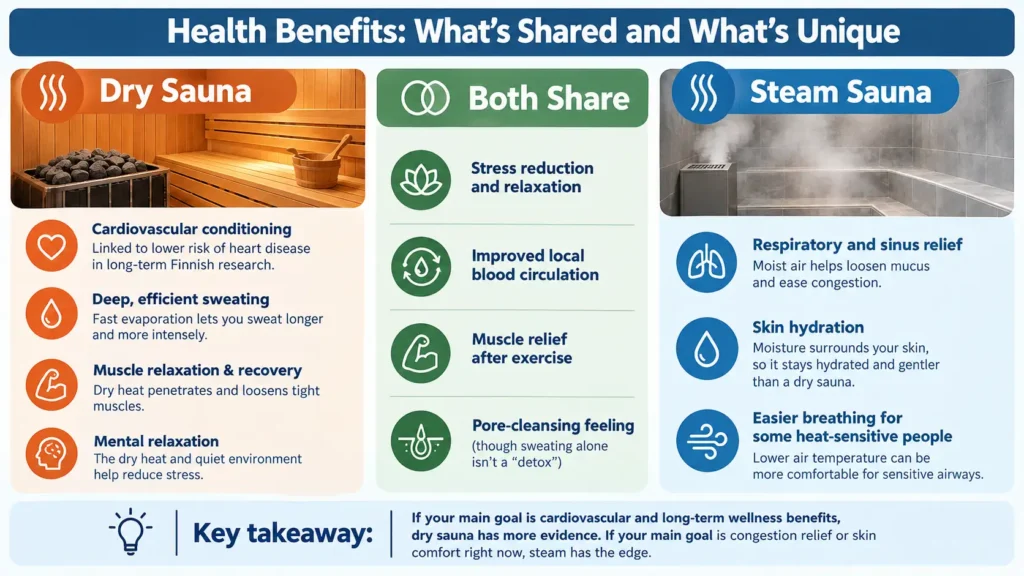
- Cardiovascular conditioning. Regular sauna use has been linked to lower rates of fatal heart disease in long-term Finnish research, likely because the heat raises heart rate and mimics some effects of moderate cardio exercise.
- Deep, efficient sweating. Fast evaporation means you can sustain a longer, more intense sweat session without the room feeling suffocating.
- Muscle relaxation and recovery. Dry heat penetrates and loosens tight muscles, which many people use post-workout.
- Mental relaxation. The dry, radiant heat and quiet environment are widely used for stress relief.
Benefits of Steam Saunas
- Respiratory and sinus relief. The moist air can help loosen mucus and ease congestion — the most consistently cited advantage of steam over dry heat.
- Skin hydration. Because moisture surrounds your skin instead of evaporating off it, steam rooms are generally gentler and more hydrating than a dry sauna.
- Easier breathing for some heat-sensitive people. The lower air temperature means some people who find dry heat harsh on their airways tolerate steam more comfortably.
Benefits Both Share
- Temporary stress reduction and relaxation
- Improved local blood circulation
- A sense of muscle relief after exercise
- A pore-cleansing feeling, though sweating alone isn’t a “detox”
Key takeaway: If your main goal is cardiovascular and long-term wellness benefits backed by the strongest research, dry sauna has more evidence behind it. If your main goal is congestion relief or skin comfort right now, steam has the edge.
Dry Sauna vs. Steam Sauna for Specific Goals
| Your Goal | Better Choice | Why |
|---|---|---|
| Cardiovascular health / long-term wellness | Dry sauna | Backed by the largest body of long-term research |
| Cold/sinus congestion | Steam sauna | Moist air loosens mucus and eases sinus pressure |
| Dry or sensitive skin | Steam sauna | Hydrating, non-drying moist heat |
| Post-workout muscle soreness | Either (tie) | Both promote circulation and relaxation |
| Weight loss | Neither, directly | Both cause water-weight loss via sweat, not fat loss |
| Sensitive respiratory system | Depends on the person | Steam helps some but can irritate airways in others |
| Beginners / heat sensitivity | Steam sauna or short dry sessions | Lower thermometer reading feels more approachable |
Who Should Choose a Dry Sauna vs. a Steam Sauna
Choose a dry sauna if you want the heat therapy most closely linked to cardiovascular research, prefer a crisp, less humid feeling, or want lower home maintenance.
Choose a steam sauna if you have chest or sinus congestion, want a more hydrating heat experience, or don’t mind the extra cleaning a moisture-heavy room requires.
For most people this comes down to preference — neither is objectively “better” across the board, and many spas let you try both to see which your body responds to best.
Safety, Risks, and Who Should Avoid Each
Both dry saunas and steam rooms raise your core body temperature and heart rate, so the same core safety rules apply to both. It’s worth reading up on steam sauna side effects before your first session, since overheating and dehydration can show up faster in high humidity than most people expect.

General safety guidelines:
- Limit sessions to 10–20 minutes at a time
- Stay hydrated — drink water before and after, not during
- Cool down gradually rather than jumping straight into cold water
- Never use alone if you have health concerns, and exit immediately if you feel dizzy, nauseated, or your heart races uncomfortably
- Avoid alcohol before or during use, since it worsens dehydration
Who should talk to a doctor first, or avoid both altogether:
- Pregnant women, since a steep rise in body temperature (especially in the first trimester) has been linked to a higher risk of birth defects
- People with uncontrolled blood pressure, heart disease, a fever, or an active infection
- Young children — many facilities restrict use under 12–16, and infants under one shouldn’t be exposed to steam rooms
- People on medications that affect blood pressure, cause drowsiness, or impair heat response, or anyone with epilepsy, without medical clearance
If you have a chronic health condition, it’s worth a quick conversation with your doctor before making either a regular habit — the cardiovascular stress from both is real, even though it’s also what may deliver the benefits.
How to Use a Dry Sauna or Steam Sauna Properly
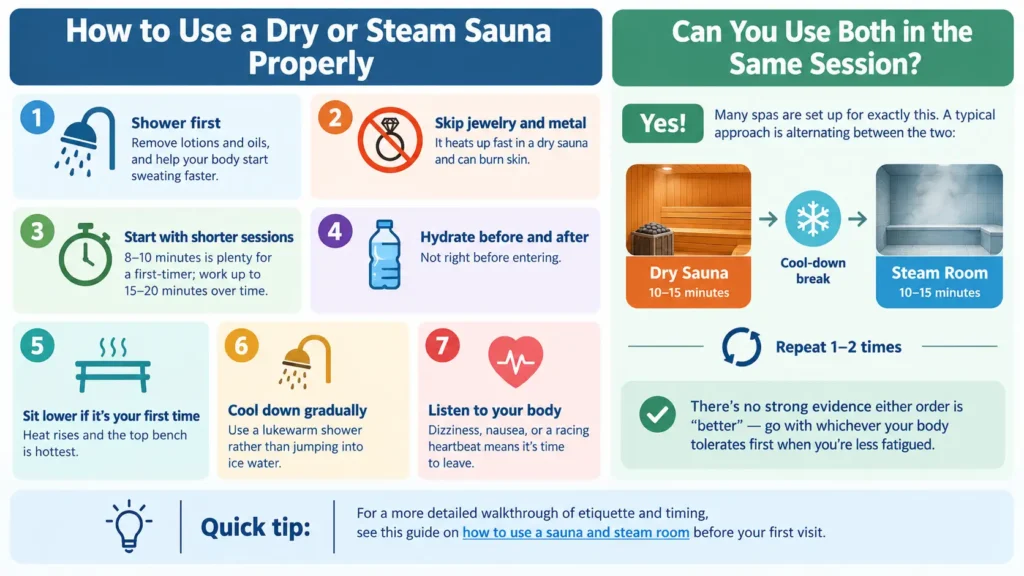
- Shower first to remove lotions and oils, and help your body start sweating faster.
- Skip jewelry and metal — it heats up fast in a dry sauna and can burn skin.
- Start with shorter sessions. 8–10 minutes is plenty for a first-timer; work up to 15–20 minutes over time.
- Hydrate before and after, not right before entering.
- Sit lower if it’s your first time, since heat rises and the top bench is hottest.
- Cool down gradually with a lukewarm shower rather than jumping into ice water.
- Listen to your body. Dizziness, nausea, or a racing heartbeat means it’s time to leave.
For a more detailed walkthrough of etiquette and timing, see this guide on how to use a sauna and steam room before your first visit.
Can You Use Both in the Same Session?
Yes, many spas are set up for exactly this. A typical approach is alternating: 10–15 minutes in the dry sauna, a cool-down break, then 10–15 minutes in the steam room, repeated once or twice. There’s no strong evidence either order is “better” — go with whichever your body tolerates first when you’re less fatigued. If your facility also has a cold plunge or jacuzzi, it’s worth learning the best order for sauna, steam room, jacuzzi, and cold plunge so you’re not stacking extreme temperature changes without a proper cooldown.
Cost, Installation, and Maintenance (Home Use)
If you’re comparing the two for home installation rather than gym use, the practical differences matter:
- Dry saunas are generally simpler and less expensive to install. They don’t require full waterproofing, and wood is forgiving in a low-humidity environment.
- Steam rooms require a fully waterproofed enclosure — non-porous tile or stone on every surface, proper drainage, and a dedicated steam generator installed outside the room. This costs more upfront and needs more regular cleaning to prevent mold and mildew.
If budget and simplicity are priorities, a dry sauna is usually the easier home addition. If you specifically want steam’s respiratory and skin benefits, budget for the extra waterproofing and generator cost.
Myth vs. Fact
| Myth | Fact |
|---|---|
| “Sweating a lot detoxifies your body.” | Your liver and kidneys handle detoxification. Sweating removes water and a bit of salt, not meaningful toxins. |
| “You’ll lose real weight from a session.” | You lose water weight temporarily. It returns once you rehydrate — this isn’t fat loss. |
| “Steam rooms are always gentler than dry saunas.” | The humidity makes steam rooms feel just as intense despite the lower thermometer reading. |
| “One is objectively healthier than the other.” | The strongest cardiovascular research covers dry saunas specifically; steam just has different, shorter-term benefits. |
Frequently Asked Questions
What is the difference between a dry sauna and steam sauna?
A dry sauna is a sauna that is heated by hot air and has a low humidity level (150-195°F, 5-20%), while a steam sauna is heated by cooler air and a high humidity level (100-120°F). The intensity of each one depends on the humidity, not the thermometer reading.
Which is better for a cold, a dry sauna or a steam room?
A steam room is more effective, as the moisture in the air helps to loosen up the mucus and relieves congestion in the sinuses and chest.
Which is better for weight loss, a sauna or a steam room?
Both are ineffective at burning fat. Both cause you to lose water weight that will be recovered after rehydration.
Is it OK to use a sauna and steam room in the same day?
Yes — alternating is common practice at many spas. Cool down between sessions and drink cool beverages to stay hydrated.
Which is better for skin, a steam room or a sauna?
Steam rooms are more hydrating because moisture is around the skin rather than evaporating off the skin. Dry Saunas may be more drying in the long run.
How long should you stay in a dry sauna vs. a steam room?
Most guidelines suggest 10-20 minutes per session, one or both, with shorter sessions if you are new to heat therapy.
Is it safe for pregnant women to use a dry sauna or steam room?
Both are discouraged during pregnancy as an elevated core temperature has been associated with an increased risk of birth defects.
Why is a steam room hotter than a dry sauna, even though the temperature is lower?
When the humidity is almost 100%, sweat is not able to evaporate and your body’s primary cooling mechanism is lost.
Final Thoughts
Dry Sauna vs Steam Sauna, one is not necessarily better than the other, they are simply two different tools that both involve sweating in a hot room. Dry saunas have the most robust long term cardiovascular studies and are best for those who prefer a more intense and efficient sweat with minimal home maintenance. That moist air in steam saunas is great for congestion and keeping the skin hydrated.
If you’re not sure which is right for you, try both, pay attention to how your body responds, and check with your doctor first if you have any heart, blood pressure, respiratory, or pregnancy-related concerns. For a deeper breakdown by health goal, it’s worth checking which type of sauna is best for your health before committing to one at home. Whichever you choose, keep sessions to 10–20 minutes, stay hydrated, and cool down gradually — that’s what makes either option genuinely beneficial rather than just intense.