
A steam generator is the quiet workhorse of a home steam shower. It sits out of sight in a closet or vanity, boils water on demand, and fills your shower with steam in minutes. Because you rarely see it, it is easy to forget about it until the day the steam turns weak, the unit starts tripping, or it stops altogether.
So how long does a steam generator last? The honest answer is that it depends on the brand, your water, how often you steam, and how well the unit has been looked after. A well-cared-for residential generator often runs for 15 to 20 years, while a neglected one on very hard water can fail in under a decade. This guide explains what wears out first, the warning signs to watch for, and how to decide between a repair and a full replacement.
The Short Answer: How Long Does a Steam Generator Last?
Most well-maintained residential steam generators last 15 to 20 years. That range comes from what owners and reviewers commonly report for established brands, and from the way manufacturers back their products. No major maker publishes a single lifespan number, so warranties are the closest official statement you will find.


#Paid Links
MrSteam, for example, covers its standard residential generators with a limited lifetime warranty, with free in-home parts and labor for the first two years and parts covered for life after that. ThermaSol offers two years of in-home cover on its PRO Series generators, then lifetime factory parts. Amerec offers a limited lifetime generator warranty with parts covered for five years and in-home labor for two years. These warranties are not a promise of a set lifespan, but they show that makers expect a good unit to last well over a decade when it is installed and maintained properly.


#Paid Links
At the other end of the scale, a generator on very hard water with no filter and no descaling can fail much sooner. Mineral scale is the main enemy. It coats the heating element, makes it run hotter than it should, and can cause early burnout. That is why two identical generators can have very different lives in two different homes.
What “Lifespan” Actually Means for a Steam Generator
A steam generator is not one part. It is a small system, and its parts age at different speeds. The stainless steel tank is built to last decades. The heating element works harder and wears out sooner. The control panel, steam head, seals and filter cartridge all have their own replacement clocks.
That matters because “my generator died” can mean very different things. A worn steam head or a tired control board is a repair, not a funeral. A leaking or badly scaled tank is usually the end of the road. Knowing which part has failed is the first step in deciding what to do next.
How Long Each Part of a Steam Generator Lasts
The table below gives realistic planning ranges for each major part in a home steam generator. These are typical ranges reported by owners, installers and reviewers, not manufacturer guarantees. Your own results will vary with water hardness, usage and maintenance, so treat the low end as the hard-water, heavy-use case and the high end as the well-maintained case.
| Part | Typical lifespan | What usually ends its life |
|---|---|---|
| Generator tank | 15 to 20 years or more | Corrosion, heavy scale, leaks at seams |
| Heating element | 10 to 15 years | Mineral scale buildup and overheating |
| Control panel | 8 to 12 years | Moisture damage, worn buttons, electronics failure |
| Steam head | 5 to 10 years | Scale clogging, finish wear, aroma reservoir damage |
| Water filter cartridge | About 6 months | Regular replacement, per maker instructions |
| Gaskets and seals | 3 to 5 years | Heat cycling, drying out, mineral deposits |
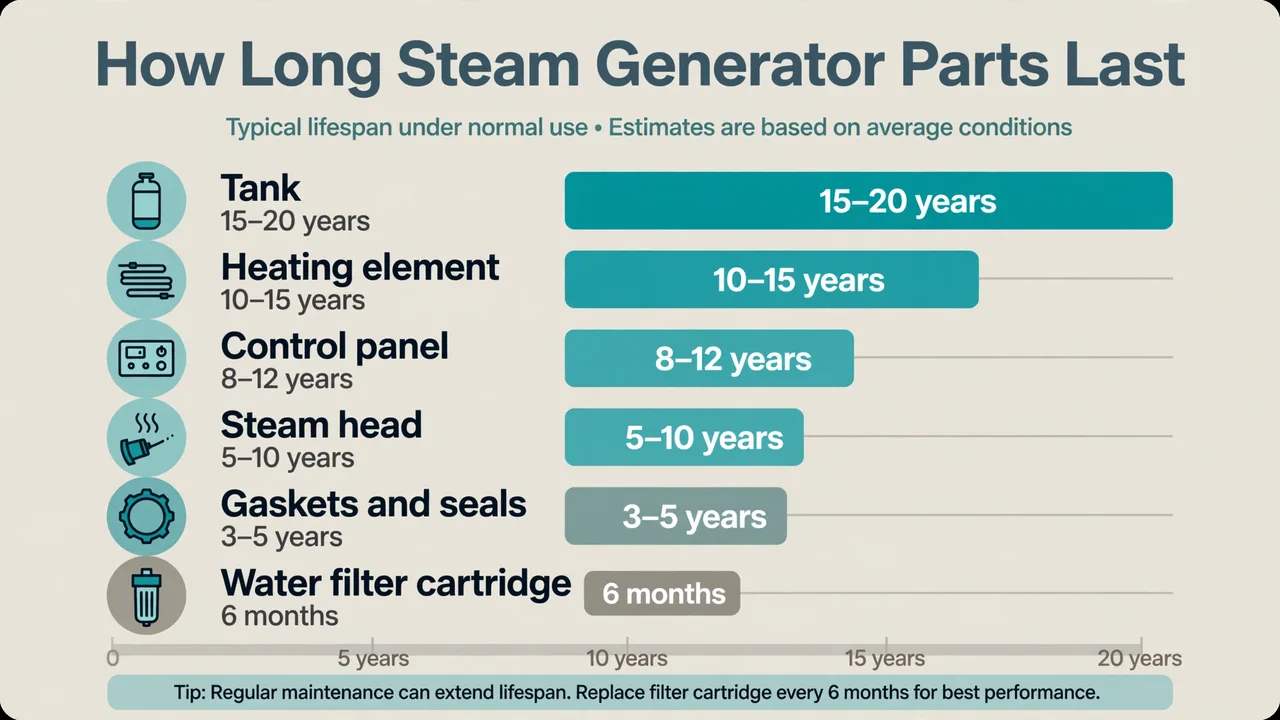
Two points stand out from that table. First, the tank usually outlives everything else, which is good news, because the tank is the part you cannot sensibly replace on its own. Second, the small consumable parts wear out first, and replacing them on time is what protects the expensive parts. A fresh filter cartridge every six months costs little, and it is often a condition of the lifetime warranty on some brands.
Five Factors That Decide Whether Yours Lasts 8 Years or 20
Lifespan is not luck. Five factors explain most of the difference between a generator that fails early and one that runs for two decades. You control four of them, and you can plan around the fifth.


#Paid Links
1. Water hardness
Hard water is the single biggest threat to a steam generator. Calcium and magnesium in the water settle on the heating element and inside the tank as scale. Scale acts like insulation, so the element has to work harder and hotter to boil the same water, and that extra heat shortens its life. In very hard water areas, an unfiltered generator can need descaling every few months.
An inline water filter is the first line of defence, and some makers require one to keep the warranty valid. If your tap water leaves white crust on kettles and shower heads, your generator is fighting the same battle. For a full guide to filters and descaling, see our steam generator maintenance and descaling guide.
2. How often you use it
A generator used twice a week will last longer than the same model used twice a day. Every heating cycle expands and contracts the metal, stresses the seals, and deposits a little more scale. Commercial units in gyms and spas work far harder than home units, which is why their warranties are shorter, often around 18 months for commercial generators.
That does not mean you should ration your steam sessions. A home generator is built for regular home use. It simply means that a household of five daily steamers should expect parts to wear sooner than a household where one person steams on weekends.
3. Maintenance habits
Regular maintenance is the cheapest way to add years to a generator. Descaling on schedule, changing the filter cartridge, and letting the tank drain after use all slow scale buildup. Generators with an auto-flush or auto-drain cycle do part of this work for you by purging leftover water after each session, which keeps standing water from leaving deposits behind.
Skipped maintenance does not cause a sudden failure. It causes a slow decline that is easy to miss until the element burns out or the tank starts leaking. A simple yearly routine, plus a filter change every six months, covers most of what a home unit needs.
4. Build quality and brand
Not all generators are built the same. Established brands tend to use thicker stainless steel tanks, larger industrial-grade copper heating elements, and better seals. Budget units can still serve well, but they often carry shorter warranties, sometimes only one year on entry-level lines, and their parts may be harder to source years later.
When you compare brands, look past the headline price and check the warranty terms, the availability of spare parts, and whether the maker requires professional installation and a water filter. Our brand comparison of MrSteam, ThermaSol, Kohler and Amerec explains how the main makers differ on those points.
5. Installation quality
A generator that was installed well starts life with an advantage. Correct sizing, a level mount, a proper drain line, and a dedicated electrical circuit all reduce strain on the unit. An oversized generator short-cycles, while an undersized one runs flat out every session, and both patterns wear parts faster.
Electrical and plumbing work should be done by licensed professionals. Most residential generators need a dedicated 240 volt circuit, often rated at 30 to 60 amps depending on size, and the work must suit local code. If you are unsure how your unit was installed, a licensed electrician or plumber can check it during a service visit.
7 Signs Your Steam Generator Is Nearing the End
Generators rarely fail without warning. They usually give several small hints first, and catching those hints early can mean the difference between a simple part swap and a full replacement. Work through the list below, and pay attention when more than one sign shows up at the same time.
- Steam takes much longer to arrive. A healthy generator usually fills the room with steam within a few minutes of startup. If heat-up times keep getting longer, the heating element may be coated in scale and struggling to transfer heat.
- Steam output is weak or thin. If the room never quite fills with steam the way it used to, even after descaling, the element or the tank may be losing capacity. Check the steam head for clogging first, since a blocked head causes the same symptom.
- Unusual noises. Loud banging, knocking or rumbling during heat-up can point to heavy scale inside the tank. A new buzzing or humming sound can point to an electrical fault. Either way, switch the unit off and get it checked rather than running it until it fails.
- Water leaks around the unit. A drip from a fitting or a seal can often be fixed. A leak from the tank itself, or rust and staining on the tank body, is a much more serious sign and often means the tank is failing.
- Repeated tripping or error codes. A breaker that trips once after a power cut is one thing. Repeated tripping, or error codes that return after a reset, point to a failing element, a faulty sensor, or a control board problem. For step-by-step checks, see our guide to a steam generator not producing steam.
- Rust, corrosion or mineral crust on the outside. Heavy crust around fittings and visible corrosion on the tank or pipes suggest that scale and moisture have been working on the unit for a long time. Internal damage is usually worse than what you can see.
- Repairs keep coming. One repair in ten years is normal wear. Two major repairs within a year, or a repair bill that keeps climbing, is a sign that the whole system is wearing out together. At that point, further repairs often buy only a short stretch of use.
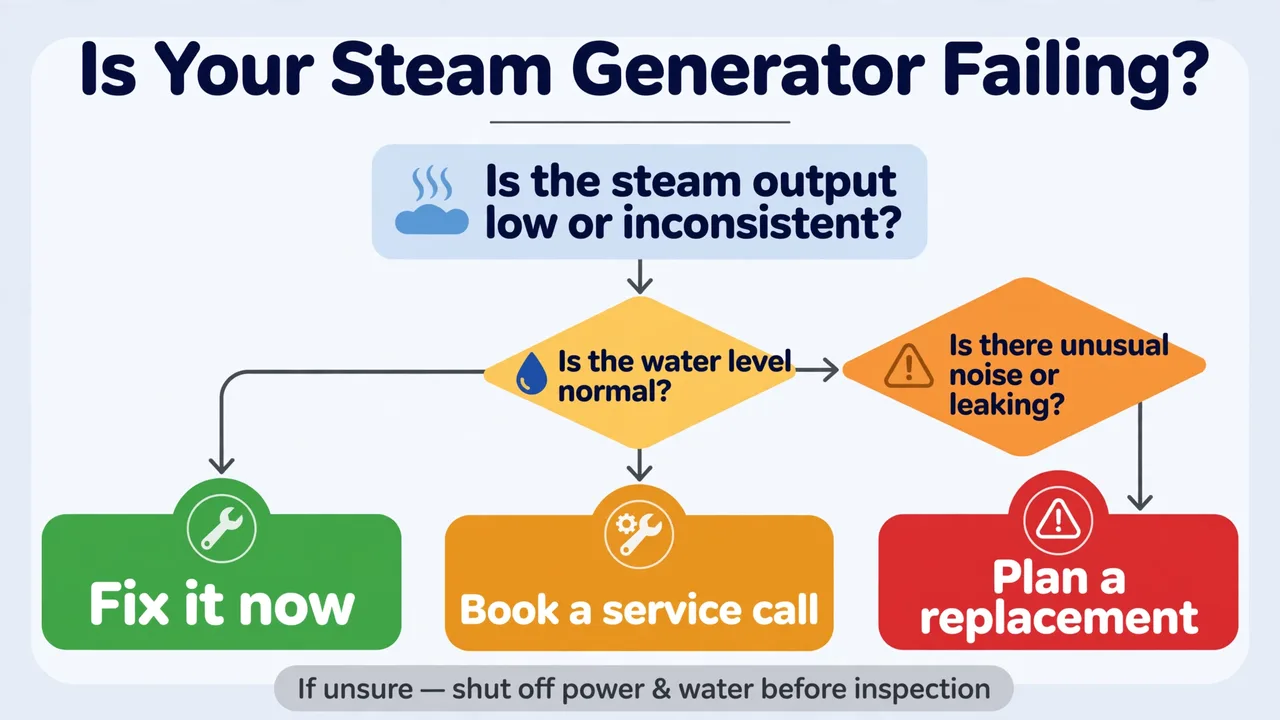
One warning sign on its own is rarely a reason to replace the whole unit. Two or three together, especially on a generator that is already past 12 to 15 years old, usually mean it is time to start planning. The flowchart above gives a quick way to sort a small fix from a replacement decision.
Repair or Replace? A Simple Decision Guide
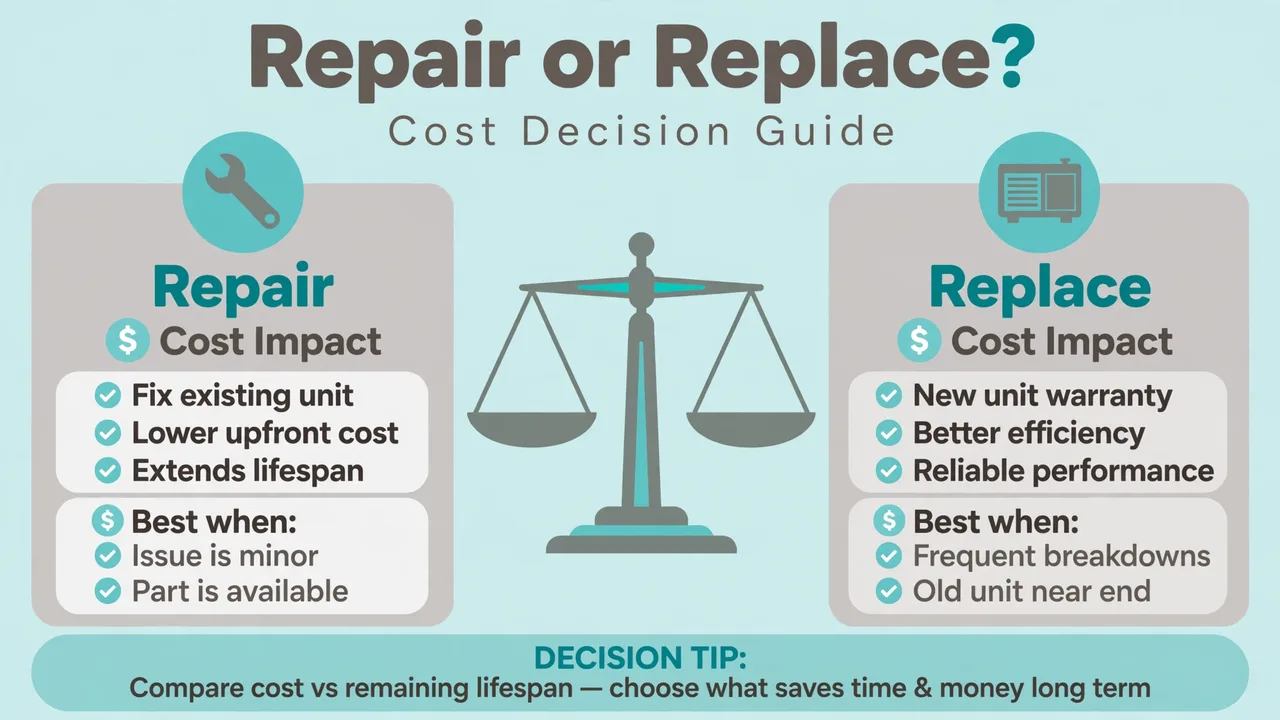
The repair-or-replace question comes down to three things: the age of the unit, the cost of the fix, and whether the tank is sound. A young generator with a sound tank is almost always worth repairing. An old generator with a leaking tank almost never is.
| Your situation | Usually the better call | Why |
|---|---|---|
| Under 8 years old, one failed part, tank sound | Repair | Plenty of life left, and the part may still be under warranty |
| 8 to 12 years old, single part failure | Repair, if the quote is modest | The tank often has years left, so a part swap is good value |
| Over 15 years old, first major failure | Get quotes for both | A repair may buy a few years, but a new unit brings a fresh warranty |
| Any age, tank leaking or badly corroded | Replace | Tank damage is not a sensible repair, and it will only get worse |
| Two major repairs within a year | Replace | Parts are failing together, which signals end of life |
| Repair quote above half the cost of a new unit | Replace | The extra money buys a new warranty and modern efficiency |
What a Replacement Costs
All figures below are planning estimates for the United States in 2026, not quotes. Prices vary by brand, size, region and installer, so get local quotes and verify current listings before you buy. The generator itself is only part of the total, since installation, a new control or steam head, and any electrical or plumbing changes add to the bill.
| Option | Typical price range, 2026 | Notes |
|---|---|---|
| Budget generator, generator only | About 600 to 2,500 dollars | National cost guide range for the generator alone |
| SteamSpa package, generator plus control and steam head | About 1,559 to 3,129 dollars | Brand store prices, October 2026 |
| MrSteam generator only, list price | About 3,075 to 4,975 dollars | Manufacturer list prices, before controls and installation |
| ThermaSol PRO Series III, generator only | About 4,435 to 8,270 dollars | Generator only, control and steam head extra |
| New dedicated electrical circuit | About 250 to 900 dollars | Only if your existing circuit cannot serve the new unit |
As a rough rule, if a repair quote comes in above half the price of a comparable new generator, replacement usually makes more sense. The new unit brings a fresh warranty, modern controls, and often an auto-flush feature that the old one lacked. If the repair is a single part and the tank is sound, repairing is usually the better value, especially while the unit is still inside its warranty period.
Also check your warranty before you pay for anything. A generator fault inside the first two years is often covered for free in-home service, parts and labor with the major brands. Even after that, parts may still be covered for life, with you paying only for labor or shipping. Keep your proof of purchase and your registration details somewhere safe, since makers ask for them on every warranty claim.
How to Make Your Steam Generator Last Longer
Most of the habits that extend a generator’s life are small and cheap. They add up to years of extra service, and they cost far less than a single repair call. Build them into a simple routine and the generator mostly looks after itself.
- Fit and maintain an inline water filter. Change the cartridge at least every six months, or as often as your maker instructs. This is the single most effective step on hard water.
- Descale on schedule. Follow your maker’s descaling intervals, and descale more often if your water is hard. Our maintenance guide covers descaling and hard water care in detail.
- Use the auto-flush or auto-drain cycle. If your unit has one, leave it switched on. Draining the tank after each session stops standing water from leaving scale behind.
- Keep the area around the unit dry and ventilated. Damp, airless cupboards speed up corrosion on the outside of the tank and on electrical connections. Make sure the space can dry out between sessions.
- Book a yearly check. A yearly service visit can catch a tired seal, a scaled element or a worn sensor before it turns into a breakdown. Ask the technician to check the tank, the element, the drain line and the safety controls.
- Do not ignore small changes. Longer heat-up times, weaker steam or a new noise are early warnings. Acting on them early usually means a cheap fix instead of a major one.
Steam rooms also need care beyond the generator itself. Ventilate and dry the room after every session so moisture does not feed mould in grout and sealant. A steam room is never maintenance-free, and the drying habit protects both the room and the equipment inside it.
What to Do When It Is Time to Replace
Replacing a steam generator is a good moment to fix the things that shortened the old one’s life. A like-for-like swap is the simplest option, but a short planning step now can add years to the new unit.
- Confirm the right size. Size the new generator to your room using the maker’s own sizing chart, not the old unit’s label. Room changes, new tile or extra glass can change the size you need. Our steam generator buying guide explains how sizing works.
- Check compatibility. Make sure the new generator works with your existing control panel and steam head, or budget for new ones. Controls usually carry shorter warranties than generators, so a new control is often worth fitting at the same time.
- Plan the water treatment. Fit a new inline filter and, if your water is hard, consider a water softener or treatment that suits your home. This is the best money you can spend on the new unit’s lifespan.
- Use licensed professionals for the swap. Electrical and plumbing connections, the drain line and the steam line all need to be right. A licensed electrician and plumber can also confirm that the circuit and the installation suit local code.
- Register the warranty on day one. Many lifetime warranties need registration within a set time after installation, sometimes 60 or 90 days. Register straight away and keep the paperwork.
Please note: this guide gives general information only. It is not a substitute for local code or a licensed professional. Check with your local permit or code office before starting electrical or plumbing work, and use licensed electricians and plumbers for installation and repairs. If you are unsure about any part of a replacement, ask a professional rather than guessing.
As with any steam session, look after yourself too. Hydrate before and after, keep sessions short when you are new to steam, and leave the room at once if you feel dizzy or unwell. Do not use steam after drinking alcohol, and check with a doctor first if you are pregnant, live with a heart or circulation condition, or take medication that affects how you handle heat.
Frequently Asked Questions
How long does a steam generator last?
A well-maintained residential steam generator typically lasts 15 to 20 years. The tank and heating element usually last longest, while controls, steam heads and seals wear out sooner. Hard water, heavy use and skipped maintenance can shorten that range a lot.
What is the first part of a steam generator to fail?
The heating element is usually the first major part to fail, because mineral scale coats it and makes it overheat. Gaskets, seals and the water filter cartridge wear out even sooner, but those are cheap and easy to replace.
Is it worth repairing a 15-year-old steam generator?
It depends on the fault and the quote. A single part such as a heating element or control board can be worth replacing if the tank is sound. If the tank leaks or the unit needs a second major repair within a year, replacement usually makes more sense.
Does hard water shorten a steam generator’s life?
Yes. Hard water leaves mineral scale on the heating element and inside the tank, which cuts efficiency and can cause early burnout. An inline water filter, regular descaling and an auto-flush or auto-drain cycle slow that damage down.
How much does it cost to replace a steam generator?
As a 2026 planning estimate in the United States, a replacement residential generator alone typically runs about 600 to 8,000 dollars depending on brand and size, before installation. Get local quotes before you buy, because prices vary by brand, region and installer.