
A garage or a basement can be the best place in a home for a steam sauna. Both offer space that a bathroom often cannot, and both keep steam, heat and moisture away from bedrooms and living rooms. A spare corner of a garage or a quiet basement room can become a proper steam room with a bench, a tiled enclosure and a generator that is sized for the space.
The same two rooms can also be the worst place for a steam sauna if the conversion is rushed. Steam is water in the air, and a garage or basement that cannot drain, ventilate and dry out will collect moisture in the walls, the floor and the ceiling. This guide is written fully for steam saunas in garages and basements. It covers the conversion decisions, the drainage options, the ventilation that keeps the room healthy, and the honest differences between a garage and a basement, so you can plan the build properly before any tile goes up.
Please note: This article is general guidance only, not a substitute for local building code or a licensed professional. Steam sauna conversions involve plumbing, drainage, ventilation and electrical work. Check your local permit and code office before you build, and use licensed electricians and plumbers for installation work. Cost figures in this guide are planning estimates, not quotes. This article is also general wellness information, not medical advice. If you are pregnant, live with a heart or circulation condition or low blood pressure, or take medication that affects heat tolerance, check with your doctor before using a steam sauna.


#Paid Links
Is a Garage or Basement Right for a Steam Sauna?
A steam sauna needs four things from its room. It needs a floor that can get wet and drain, walls and a ceiling that can hold steam without soaking it up, air that can be exchanged and dried after a session, and a generator that can reach the room without long, heat-losing pipe runs. Garages and basements can offer all four, but they do it in different ways, and each one brings its own weak point.


#Paid Links
A garage usually wins on access and ventilation. It often sits at ground level, it may already have a floor drain or a door to the outside, and running an exhaust vent through an external wall is usually straightforward. Its weakness is temperature swing. A garage can be cold in winter and hot in summer, so the room needs good insulation and a generator that can cope with a cold start.
A basement usually wins on temperature stability and privacy. The ground around it keeps it cooler in summer and less exposed in winter, and it is naturally quiet and out of the way. Its weakness is drainage and moisture. A basement floor often sits below the sewer line, so water cannot simply run downhill to a drain, and the room already lives in the dampest part of the house. That does not rule a basement out. It means drainage and ventilation must be planned first, not added as an afterthought.
Before you commit, ask three honest questions. Can water leave the room easily after a session. Can moist air leave and dry air come in. And can the room be sealed so steam stays inside the sauna. If any answer is no, the room needs work first. Our general guide to how to build a steam sauna at home covers the overall build sequence, and this article fills in the garage and basement details.
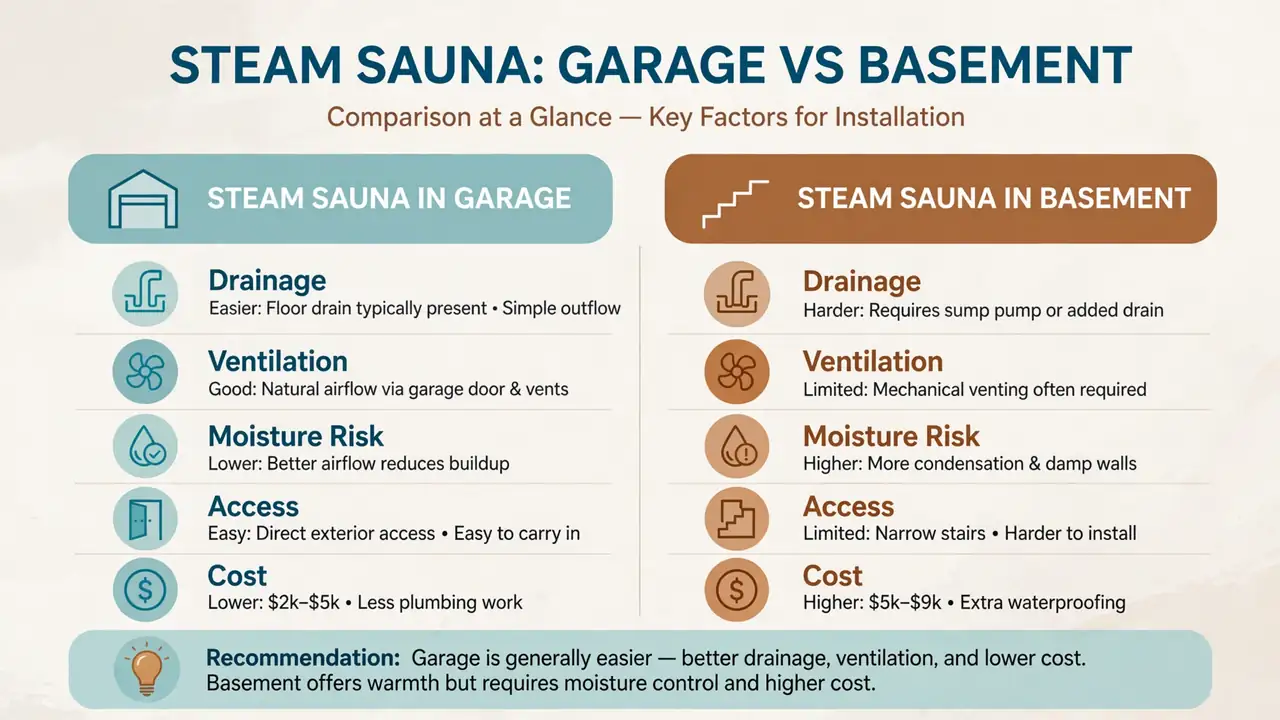
Garage vs Basement at a Glance
The table below sums up the practical differences. Use it to shortlist your room, then read the drainage and ventilation sections to test whether your shortlist actually works in your home.
| Factor | Garage steam sauna | Basement steam sauna |
|---|---|---|
| Drainage | Often easier, floor may already drain or sit above sewer level | Often needs a pump, floor usually sits below sewer level |
| Ventilation | External wall usually close by, exhaust vent is simpler | May need a longer duct run to reach outside air |
| Temperature stability | Swings with the seasons, needs more insulation | More stable year round, cooler in summer |
| Moisture risk | Lower if the garage is dry, higher if the garage leaks | Higher, basements are the dampest part of most homes |
| Access and privacy | Easy access, less private, may share space with cars and tools | Private and quiet, stairs may limit access for some users |
| Generator placement | Often close to the room, in a dry garage corner or cupboard | Needs a dry spot above any flood risk, check the floor level |
| Best suited to | Homeowners who want simple venting and easy drainage | Homeowners who want a stable, private, year round steam room |
What a Conversion Really Involves
Converting a garage or basement corner into a steam sauna is not the same as dropping a prefabricated cabin into a spare room. A steam room is a wet room. Every surface inside it gets wet, the air inside it is close to saturated with moisture, and the room must dry out fully between sessions. The conversion is therefore a waterproofing job first and a sauna job second.
Start with the shell, not the generator
The shell is the sealed box that holds the steam. In a garage, that usually means framing a new room inside the garage, insulating it, and lining it with a waterproof membrane before any tile goes on. In a basement, it often means building the same sealed box against concrete or block walls, with a vapour barrier that keeps ground moisture out of the structure. In both cases, the membrane, the seals and the slope of the floor matter more than the look of the tile.


#Paid Links
The door and the ceiling set the steam level
A steam room needs a door that seals. A loose door lets steam drift into the garage or basement, where it condenses on cold surfaces and feeds mould. Choose a door made for wet rooms, with a proper seal and a handle that works with wet hands. Glass doors are common and they work well, provided the seal is tight and the frame is built for steam. Check the seal regularly once the sauna is in use, and replace it at the first sign of wear. Our guide to fixing a leaking steam room explains the door seals, grout and drain checks that catch small leaks early.
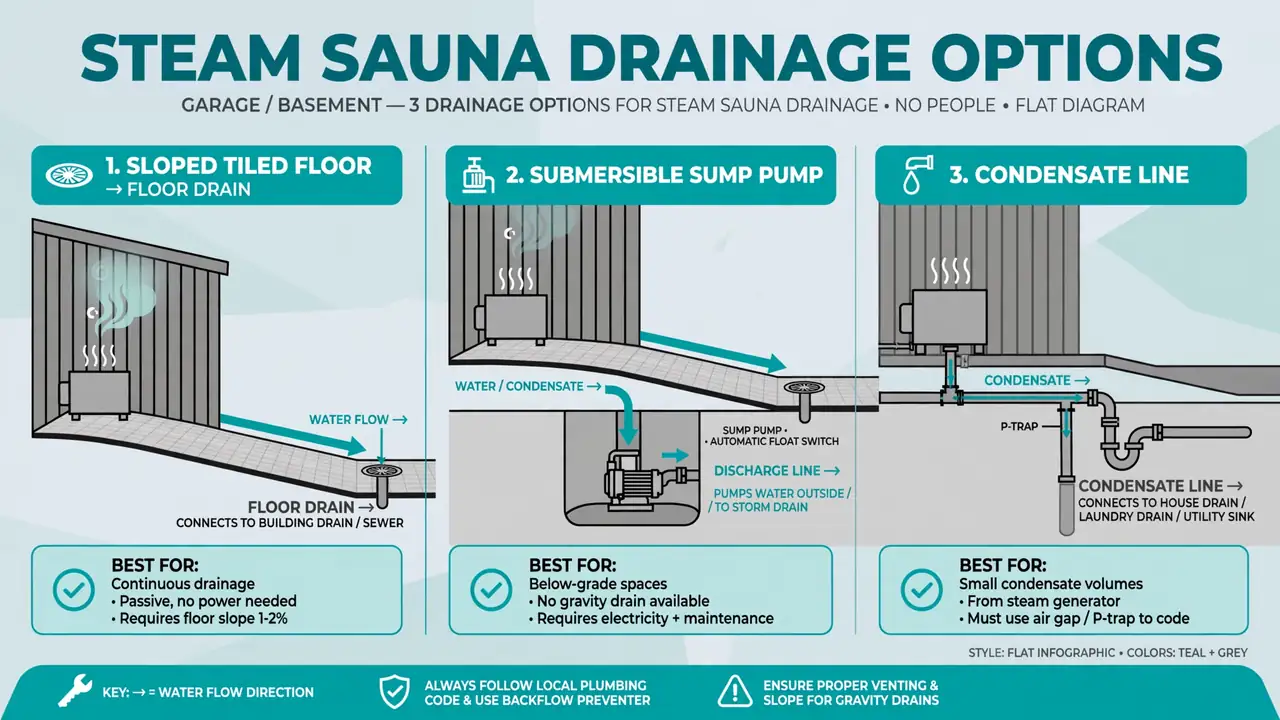
Drainage: The Decision That Shapes Everything
Drainage is the first thing to settle, because it decides where the room can go and how much work the build needs. A steam room produces water in three ways. Steam condenses on the walls, the ceiling and the bench and runs down to the floor. People bring water in on their feet and bodies. And the generator itself produces condensate and needs a drain for its own flushing and descaling routine. All of that water needs somewhere to go, every single session.
A bathroom already has a floor drain, a waste stack and a waterproof floor in place. A garage or basement conversion has to create those things, and our guide to steam shower drain and ventilation is useful background on the bathroom case.
Option one: a sloped floor to a gravity drain
This is the simplest option when it is available. The steam room floor is built with a gentle slope toward a floor drain, and the drain connects by gravity to the house waste system. It works best in a garage at ground level, where the floor sits above the sewer line and a drain can be cut in without pumping. It also works in a walkout basement where the floor is close to ground level on one side.
Option two: a sump pump for below grade floors
Most basements sit below the sewer line, so water cannot flow away by gravity. In that case the steam room floor drains to a sump pit, and a pump lifts the water up to the waste system. This is a proven approach, and many basement bathrooms already work this way, but it adds parts that need care. The pump needs power, it needs a check valve so water does not flow back, and it needs an alarm or a regular check so you know if it stops working.
Option three: a condensate line and a small collection point
| Drainage option | Best for | What it needs | Watch out for |
|---|---|---|---|
| Sloped floor to gravity drain | Garages and walkout basements above sewer level | Consistent floor slope, floor drain, waste connection | Floor must be regraded if it is level now |
| Floor drain to sump pump | Basements below sewer level | Sump pit, pump, check valve, power supply | Pump failure leaves standing water, test it often |
| Condensate line plus small gully | Small rooms with light use | Waterproof floor, slope, condensate route | Not enough for frequent or shared use |
| Generator drain only | No option on its own | A floor drain as well, for condensation and washdown | Never rely on the generator drain for room water |
Ventilation and Moisture Control
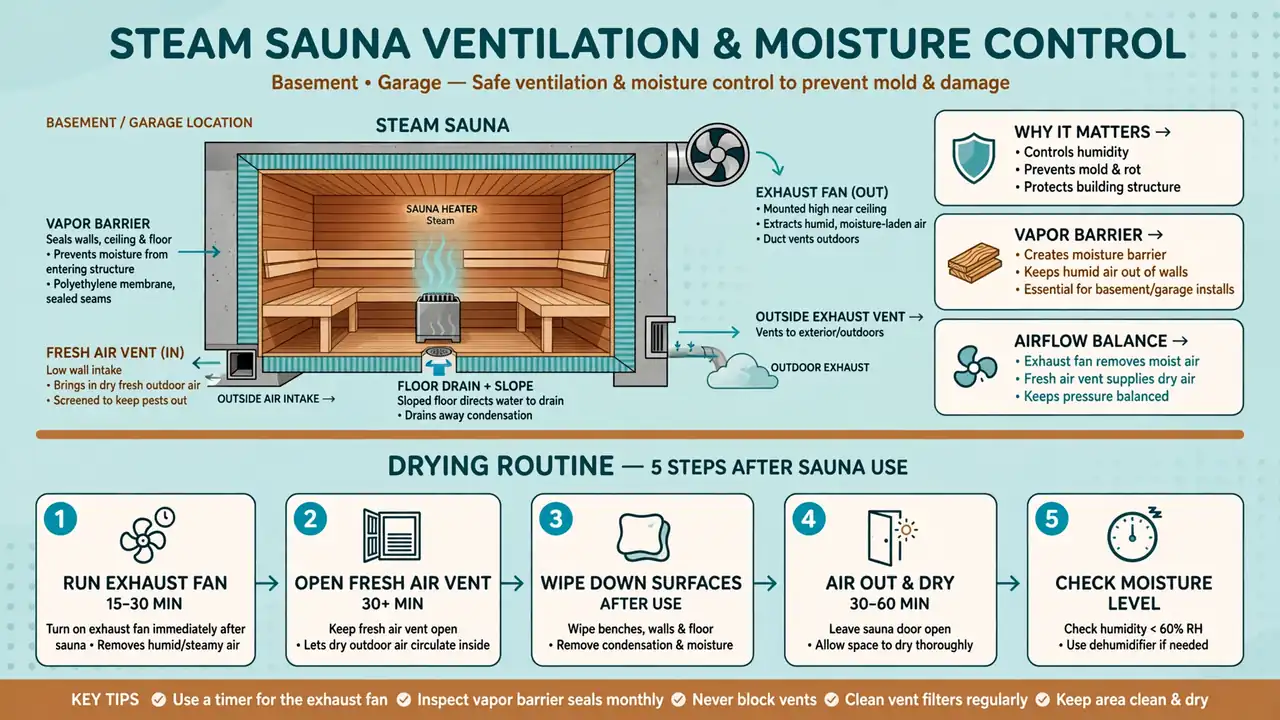
Ventilation is the second half of the moisture story. Drainage removes liquid water. Ventilation removes moist air. A steam room that drains well but never ventilates will still grow mould, because the air inside it stays damp long after the water has run away. A steam room that ventilates well but drains badly will still leave puddles. Both systems must work together.
Exhaust air after the session, not during it
During a session, the room should stay sealed so the steam stays thick and the temperature stays even. Ventilation during the session lets the steam escape and makes the generator work harder for no benefit. The time to ventilate is after the session. Open the door, run the exhaust fan, and let dry air move through the room until the surfaces feel dry to the touch.
An exhaust fan that vents to the outside is the standard answer, and it matters where that air goes. Venting into the garage, the basement, or a roof space simply moves the moisture to another part of the house, where it condenses on the next cold surface. The exhaust must go outside, through a proper duct and vent cap. In a garage this is usually a short run through an external wall. In a basement it may be a longer run, and the duct may need insulation so moist air does not condense inside it on the way out.
Fresh air in, moist air out
An exhaust fan can only work if replacement air can get in. A steam room with no fresh air inlet will pull air through gaps in the door and the walls, which is uneven and can pull in dusty garage air or damp basement air. Plan a small fresh air inlet, ideally low on the wall opposite the exhaust, so air moves across the room. In a garage, that inlet should come from outside or from a clean indoor space, not from beside a car or a chemical store. In a basement, it should come from a dry part of the house or from outside, not from a damp corner.
The drying routine is part of the build
A steam sauna in a garage or basement is never maintenance free, and anyone who tells you otherwise is selling you a problem. After every session, wipe the bench and the walls, leave the door open, and run the fan until the room is dry. Once a week, check the grout, the sealant and the ceiling for dark patches or soft spots. Once a month, check the drain, the fan and the door seal. This routine takes a few minutes and it is the difference between a steam room that lasts for years and one that smells of mould within a season.
Waterproofing, Tiling and Materials
The inside of a steam room should be treated like a shower that never stops being wet. That means a waterproof membrane behind the tile, not just waterproof grout on top of it. Grout is not waterproof on its own. Water passes through it slowly, and if there is no membrane behind it, that water reaches the framing and the insulation. Our guide to steam room waterproofing, tiling and ceiling materials covers the membrane and tile choices in detail, and it is worth reading before you buy materials.
Choose tile and stone for the floor and walls, and keep wood to the bench and any trim that can dry. Porcelain tile handles steam well, it is easy to clean, and it does not swell. Natural stone can work too, but it needs sealing and it needs a sealer that suits a wet, hot room. Avoid materials that soak up water, such as untreated plasterboard, standard MDF, or carpet, anywhere inside the enclosure. In a garage, remember that the floor under the steam room may be bare concrete. That concrete needs a membrane and a proper slope, not just tile glued straight onto it.
Where to Put the Steam Generator
The generator is the heart of the steam sauna, and its position affects both performance and safety. It should sit in a dry, ventilated spot close to the steam room, so the steam pipe run is short and the steam loses as little heat as possible on the way in. A long pipe run means cooler steam, more condensation in the pipe, and a generator that works harder than it should.
Leave space around the generator for servicing. It will need descaling, flushing and occasional part changes, and a generator that is boxed in behind a fixed panel will be neglected. Read our guide to steam generator maintenance, descaling and hard water care before you choose the spot, so you know how much access the routine actually needs. If you have hard water, plan for a water treatment or a descaling routine from the start. Hard water shortens generator life and it is much easier to manage when the generator is easy to reach.
Electrical and Plumbing: What to Plan For
Steam generators need a proper electrical supply, and the size of that supply depends on the power of the generator and the size of the room. Do not guess at this. A generator that is underpowered for the room will heat slowly and struggle in a cold garage. A generator on an undersized circuit is a safety risk. Ask a licensed electrician to check the supply, the circuit protection, and the earthing before you buy the generator, and let them do the installation. Our guide to steam sauna electrical and plumbing requirements explains what to ask about, but it does not replace a local professional looking at your own wiring.
Permits are a local matter, and they vary widely. Some areas treat a steam room as a bathroom alteration and want a permit and an inspection. Others treat a small conversion more lightly. Do not rely on general advice from the internet for this. Call your local permit office, describe the work, and ask what they need. A short call before the build is far cheaper than a demand to open up finished work after an inspection.
Garage vs Basement in Daily Use
The build is only half the story. Daily use is where the differences between a garage and a basement really show, and they are worth thinking about before you choose. If your space is tight, our guide to steam saunas for small bathrooms and apartments has compact layout ideas that also work in a small garage corner or basement room.
A garage steam room shares space with cars and tools
A garage is a working space. Cars bring in rain, snow and road salt. Tools create dust. Paint, fuel and garden chemicals may be stored nearby. None of this rules out a steam sauna, but it means the steam room needs a clean, separated zone. Keep the path to the steam room clear and dry, store chemicals well away from the air inlet, and never run a car engine in a closed garage while someone is using the sauna. If the garage is also a workshop, consider a partition wall so dust and fumes do not reach the steam room door.
The infrared contrast is useful here. An infrared sauna in a garage or closet is a dry heat cabin, so it can sit in a garage with far less drainage and ventilation work. A steam sauna cannot borrow that simplicity. If you are choosing between the two types for a garage, the steam option needs a bigger conversion budget and a stricter drying routine, and that difference should be part of the decision.
A basement steam room is private but harder to reach
A basement steam room is quiet, private and out of the way, which suits many people. It also means stairs, and stairs matter after a hot session. Anyone who feels dizzy, tired or unsteady after steam should not have to climb a flight of stairs immediately. Plan a cool-down spot at basement level, with a chair, water and fresh air, and take your time before heading upstairs. This matters even more for older users and for anyone with a health condition that affects heat tolerance.
The same comparison applies to infrared. An infrared sauna in a basement faces the same access and cool-down questions, but it produces far less moisture, so its ventilation and drainage needs are lighter. A steam room in the same basement needs the full drainage and drying plan described above, even though the room itself looks the same from the outside.
Costs: What Drives the Budget
Costs vary so widely by region, room size and existing services that a single price figure would mislead more than it helps. Instead, plan around the factors that drive the budget, and get local quotes for each one before you commit.
- Waterproofing and tiling. The membrane, the tile and the labour to install them properly are usually the largest part of the build, and they are the worst place to cut corners.
- Drainage work. Cutting a gravity drain into a garage floor is one job. Adding a sump pit and a pump in a basement is a larger one, with parts that need ongoing care.
- Ventilation. A short exhaust run through a garage wall is modest. A long, insulated duct run from a basement to the outside costs more and needs proper design.
- Generator and controls. The generator must match the room size, and the controls should be easy to use with wet hands. Budget for the generator, the steam head, the pipework and the controls together.
- Electrical work. A new circuit, protection and earthing by a licensed electrician is a safety cost, not an optional extra.
- Insulation and framing. A cold garage needs more insulation than a stable basement, and that insulation must be the kind that suits a wet room.
- Ongoing care. Descaling products, replacement seals, fan filters and the electricity and water for each session are small costs that add up over a year.
Session Safety in a Garage or Basement Steam Room
Steam saunas are wellness tools, not treatments, and the safety basics matter more in a garage or basement than in a bathroom, because help may be further away and the cool-down space may be less comfortable. Keep sessions short, especially at first. Hydrate before and after, and keep water within easy reach. Leave the room immediately if you feel dizzy, unwell, or too hot, and do not try to push through it.
Do not drink alcohol before or during a session. Alcohol and heat are a poor combination, and the risk is higher when you are alone in a basement or a garage. If you use the sauna alone, tell someone in the house, keep your phone nearby but outside the steam, and keep the session short. Children, older users and anyone who is pregnant or living with a heart or circulation condition, low blood pressure, or medication that affects heat tolerance should check with a doctor first and use shorter, gentler sessions with supervision. Our guide to steam sauna safety for children, pregnancy and health conditions covers these groups in more detail.
Mistakes That Cause Mould, Leaks and Regrets
- Skipping the membrane. Tile and grout alone do not waterproof a room. Water gets behind them and into the structure.
- Venting into the house. An exhaust fan that vents into the garage, the basement or a roof space moves the moisture problem, it does not solve it.
- No drying routine. A steam room that is never wiped and ventilated after sessions will grow mould, however well it was built.
- A flat floor. A floor with no slope leaves puddles, and puddles are slow to dry and easy to slip on.
- A generator that is too small. A cold garage needs a generator that can cope with a cold start, or sessions will feel weak and slow.
- Ignoring existing damp. Building a steam room inside a garage or basement that already leaks traps that moisture and makes it worse.
- Doing electrical work without a licence. Steam, water and electricity together are not a place for guesswork. Use a licensed electrician.
Planning Checklist, Step by Step
- Walk the garage or basement after rain. Note damp patches, leaks, smells and how the sump pump behaves.
- Choose the room using drainage, ventilation and dryness, not just floor space.
- Check with your local permit and code office what the conversion needs.
- Ask a plumber to plan the drain: gravity drain, sump pump, or a smaller arrangement for a compact room.
- Ask an electrician to check the supply and plan the generator circuit.
- Plan the exhaust route to the outside and the fresh air inlet before framing starts.
- Frame, insulate and membrane the enclosure, with a sloped floor and a sloped ceiling.
- Tile, seal and fit the door, then test the drain with water before the generator is connected.
- Install the generator in a dry, accessible spot with a short steam pipe run.
- Run a test session, check for leaks and condensation, then set up your drying routine.
Frequently Asked Questions
Can I put a steam sauna in a garage?
Yes, if the garage can drain, ventilate and dry out. A garage at ground level often suits a gravity drain and a short exhaust run through an external wall. The room still needs a waterproof membrane, a sealed door, a sloped floor and a drying routine after every session, and the conversion needs a licensed electrician and plumber for the installation work.
Can I put a steam sauna in a basement?
Yes, and basements are often private and temperature stable. The main extra work is drainage, because most basement floors sit below the sewer line and need a sump pump, and ventilation, because the exhaust duct may need a longer run to reach outside air. Check for existing damp first, and plan a cool-down spot at basement level.
Do I need a floor drain in a garage or basement steam sauna?
Yes, in practice. A steam room produces condensation, washdown water and generator condensate on every session, and all of it needs a planned route out. A gravity floor drain suits ground level garages, a sump pump suits basements below sewer level, and a small room with light use still needs a proper drain arrangement, not just a mop and a bucket.
How do I stop mould in a basement steam sauna?
There is no single fix. You need a waterproof membrane behind the tile, an exhaust fan that vents outside, a fresh air inlet, a floor that drains, and a drying routine after every session: wipe surfaces, leave the door open and run the fan until the room is dry. Check grout, sealant and the ceiling weekly for dark patches, and fix small damp spots early.
Is a garage or basement better for a steam sauna?
It depends on your house. A dry garage with an outside wall and a drain is often the easier build. A dry basement with a working sump and a clear vent route can be the better steam room, because it is stable, quiet and private. Judge your own room on drainage, ventilation and dryness, and let those three facts decide.
Do I need a permit for a steam sauna in a garage or basement?
Permit rules vary by area, and this article cannot state them as fact for your home. Some areas treat a steam room as a bathroom alteration and want a permit and an inspection. Ask your local permit and code office before you build, describe the plumbing, drainage, ventilation and electrical work, and follow what they ask for.
A steam sauna in a garage or basement is a rewarding project when the unglamorous parts come first. Get the drainage right, get the ventilation right, seal the room properly, and build a drying routine you will actually follow. Do those four things, and the garage or basement corner you barely used can become the most relaxing room in the house.