
Steam Generator Maintenance: Descaling, Auto-Flush & Hard-Water Care
A steam generator is the hardest-working part of a home steam room, and it is also the part most affected by the water that runs through it. Every time it boils water into steam, dissolved minerals are left behind. Over time those minerals form scale, and scale is the main reason generators heat slowly, steam weakly, or fail earlier than they should. The good news is that most of this damage is preventable with a simple routine of descaling, flushing, and sensible water care.
This guide covers all three together: how to descale a steam generator safely, how auto-flush and auto-drain systems work and what they do not replace, and how to manage hard water with filtration, softening, or distilled water. It is written for homeowners with a plumbed-in residential steam generator, and it assumes you will follow your own generator manufacturer’s instructions wherever they differ from the general guidance here.
Disclaimer: This article is general guidance only. It is not a substitute for your steam generator manufacturer’s instructions or for a licensed professional. Check with your local code or permit office about any installation or plumbing work, and use licensed electricians and plumbers for installation or repair work. Always isolate power and water before maintenance, allow the unit to cool completely, and never open a pressurised or hot unit.


Paid Links - As an Amazon Associate, I earn from qualifying purchases.
Why Scale Is a Steam Generator’s Main Enemy
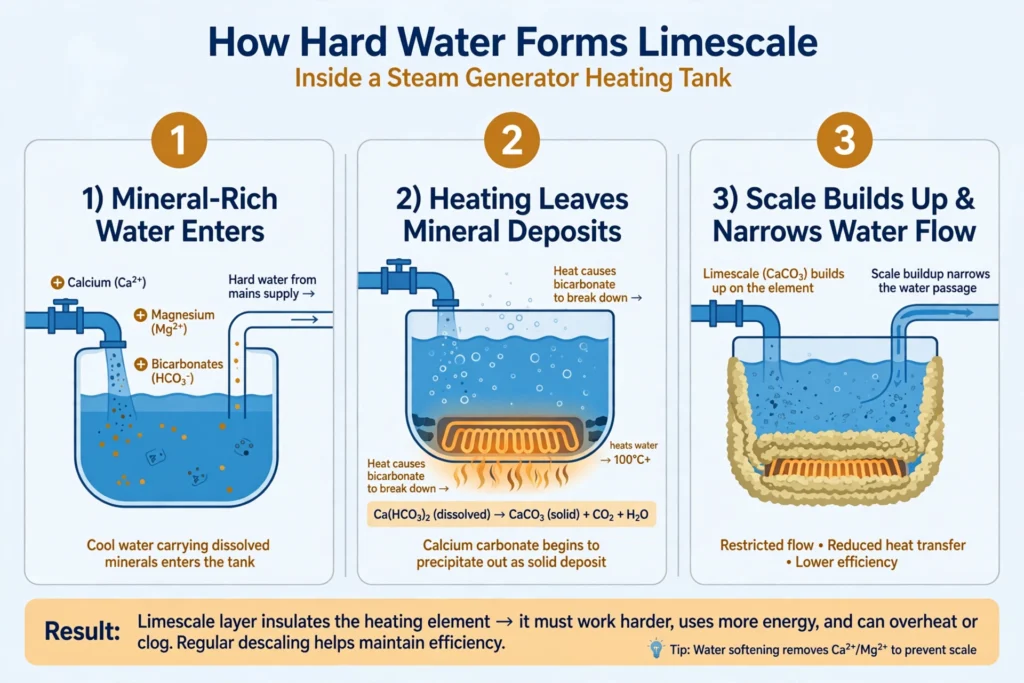
Tap water contains dissolved minerals, mainly calcium and magnesium. When water is heated and turned to steam, the pure water leaves as vapour and the minerals stay behind. Each steam session adds a little more mineral residue to the tank and heating elements, and that residue hardens into scale.


Paid Links - As an Amazon Associate, I earn from qualifying purchases.
Scale acts like insulation on a heating element. The element has to work harder to heat the same amount of water, so heat-up takes longer and steam output can weaken. In severe cases, scale can block narrow water passages, interfere with level sensors and valves, and cause the generator to overheat, shut down, or trip safety cut-outs. That is why manufacturers treat descaling as routine care rather than an occasional deep clean.
How fast scale builds up depends mostly on your water. Homes with hard water will see deposits far sooner than homes with soft water, and a generator used daily will scale faster than one used once a week. Your local water supplier can usually tell you how hard your area’s water is, and that single fact shapes most of the maintenance decisions in this guide.
Know Your Water Before You Pick a Routine
Before setting a descaling schedule, it is worth finding out what kind of water you actually have. If your kettle, showerhead, or taps already show white chalky deposits, your steam generator is facing the same minerals, just at a faster rate because it boils water repeatedly. If you have a water softener for the whole house, your generator’s water is already much kinder to it.
There are a few practical ways to check. Your water supplier’s website or customer service can usually confirm your area’s hardness. Inexpensive test strips from a plumbing or pool supplier give a rough reading at home. Some generator manufacturers also state a recommended water hardness range in their manual, and that is the number worth comparing against, since it is specific to your model.
- Soft water: little visible scale; a lighter maintenance routine is usually enough, but descaling should still not be skipped entirely.
- Moderately hard water: visible deposits over weeks or months; regular descaling and flushing matter most here.
- Hard or very hard water: scale builds quickly; filtration or softening, plus a stricter descaling schedule, is worth considering early.
- Already softened water: check your generator manual first, because some manufacturers give specific guidance for softened or treated water.
For a fuller look at what to fill your generator with, see our guide to the best water to use in a steam sauna. The short version is that there is no single perfect choice: each option trades scale protection against cost, convenience, and what your manufacturer recommends.
Descaling a Steam Generator: The Core Job
Descaling means dissolving the mineral scale inside the tank and off the heating elements, usually with a mild acid solution, and then flushing it all away. The exact method, solution strength, and soak time vary by brand and model, so your manufacturer’s manual is the authority here. What follows is the general pattern most residential generators follow, and the safety steps that apply to all of them.


Paid Links - As an Amazon Associate, I earn from qualifying purchases.
Before you start: safety first
Never work on a generator that is hot or pressurised. Switch the unit off at its isolator or breaker, close the water supply, and let it cool completely. Steam burns are serious, and opening a hot tank can release scalding water and steam without warning. Wear gloves and eye protection when handling descaling solutions, even mild household ones, and keep the room ventilated.
If your generator is still under warranty, check the manual before using any descaling product. Some manufacturers specify an approved descaler and may treat other products as a warranty issue. When in doubt, contact the manufacturer or a licensed plumber who services steam generators rather than improvising.
Vinegar and citric-acid approaches
The two descaling agents most often recommended for home steam equipment are white vinegar and citric acid, both diluted in water. Vinegar is widely available and cheap, and its mild acidity dissolves calcium scale effectively. Citric acid, sold as a powder, is odourless, easy to dose, and rinses cleanly, which is why many manufacturers favour it. Neither is automatically right for your unit: use whichever your manufacturer recommends, at the dilution it specifies.
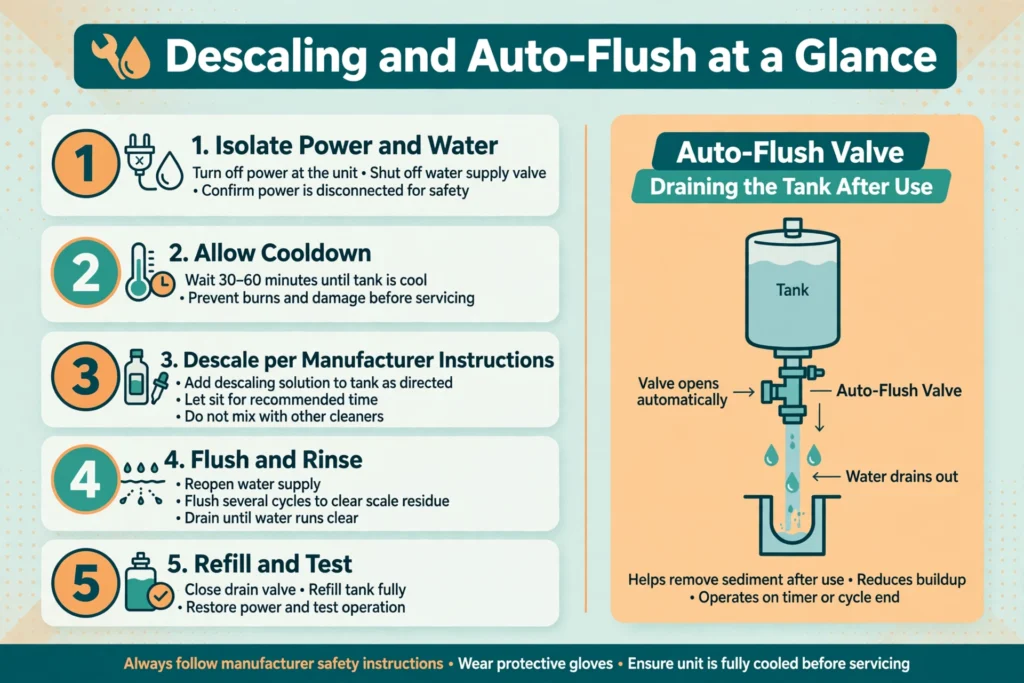
In general terms, the process runs like this. The tank is drained, the descaling solution is introduced according to the manual, and it is left to soak long enough to soften the deposits. The solution is then drained, the tank is flushed with clean water, and the generator is run briefly to rinse the system before normal use. Some models have a dedicated descaling or cleaning cycle that automates part of this; others require manual draining and filling.
- Isolate power and water, and allow the generator to cool completely.
- Drain the tank fully, following the manual’s drain procedure.
- Prepare the descaling solution exactly as your manufacturer directs.
- Introduce the solution and let it soak for the recommended time.
- Drain, then flush thoroughly with clean water, more than once if the manual advises it.
- Refill, restore power and water, and run a short test cycle before your next session.
Two mistakes are worth avoiding. The first is using a stronger solution than recommended in the hope of a faster result; excess acid can damage seals, sensors, and internal finishes. The second is skipping the rinse: leftover descaler can affect steam quality and may irritate skin and airways, so flush until the rinse water runs clear and odour-free.
How often should you descale?
There is no universal interval, because it depends on water hardness, usage frequency, and your model. A reasonable starting point for many homes is every few months in hard-water areas and less often with soft water, but treat that as a prompt to check, not a rule. A better habit is to inspect for scale at the interval your manual suggests and adjust from what you find.
If deposits are heavy each time, descale more often or address the water itself, as described below. If the tank is nearly clean, you can stretch the interval a little.
Keep a simple log: the date, the solution used, and how much scale came out. Over a year, that log tells you more about your generator’s needs than any generic schedule, and it is useful evidence if you ever need warranty or service support.
Auto-Flush and Auto-Drain Systems: What They Actually Do
Many modern residential steam generators include an automatic flush or auto-drain feature, and it is one of the most useful maintenance aids available. After a session, or after a set period of inactivity, the system drains the tank automatically instead of leaving water sitting in it between uses. Standing water is what allows minerals to settle and harden, so draining it away removes a large share of the scale-forming material before it can deposit.
Auto-flush systems vary. Some drain after every use, some on a timer, and some combine a partial flush during operation with a full drain afterwards. Higher-end models may include an automatic blow-down or a programmable flush cycle you can set to match your usage. Check your manual for which type you have and whether it can be adjusted; a system left on a factory default that does not match your usage pattern may flush too rarely to help, or drain water unnecessarily.
Setup and everyday use
Auto-flush needs a suitable drain connection, so it is usually set up at installation. If your generator has the feature but it was never plumbed to a drain, ask a licensed plumber to connect it properly rather than draining it informally. Once connected, the main user job is simply to leave the generator powered so the flush cycle can run; switching the unit off at the breaker immediately after every session can prevent a timed flush from happening.
It is also worth checking occasionally that the drain is actually working. After a session, confirm that the tank has emptied within the expected time and that the drain line is not blocked or backing up. A silent auto-flush failure can go unnoticed for months, during which scale builds exactly as if the feature did not exist.
What auto-flush does not replace
Auto-flush reduces scale, but it does not eliminate it. Minerals still deposit during heating, and a thin layer can form even in a well-flushed tank. Auto-flush is therefore a complement to descaling, not a substitute: it stretches the interval between descales and keeps deposits lighter, but periodic descaling and inspection remain necessary.
Likewise, auto-flush does not clean the steam room itself, clear a blocked steam head, or fix a faulty valve. Treat it as one layer of a maintenance routine, not the whole routine.
Hard-Water Care: Filtration, Softening, and Distilled Water
If your water is hard, tackling the water itself is often more effective than descaling more often. There are three main options, and each suits a different situation.
Inline filters
An inline filter fitted to the generator’s water supply can reduce sediment and some dissolved minerals before they reach the tank. Filters are relatively inexpensive and easy to fit, but their capacity is limited: in very hard water they exhaust quickly, and a spent filter protects nothing. If you use one, note its replacement interval and stick to it. A filter that is never changed is worse than no filter, because it can restrict flow while giving a false sense of protection.
Water softeners
A whole-house or point-of-use water softener removes calcium and magnesium by ion exchange, which is the most thorough answer to hard water. For a home that already has a softener, routing softened water to the generator is usually straightforward. For a home without one, installing a softener purely for a steam generator is a bigger investment, so weigh it against the cost and hassle of more frequent descaling. One caution: always check your generator manual for guidance on softened water, since manufacturers differ on whether they recommend it, and a softener itself needs salt top-ups and servicing to keep working.
Distilled or demineralised water
Distilled water contains almost no minerals, so it produces almost no scale. That makes it attractive for steam generators, but it has practical downsides. Buying distilled water in the quantities a steam generator uses is expensive and inconvenient, and some generators rely on water conductivity for their level sensors, which very pure water can confuse.
Again, the manual decides: if your manufacturer approves distilled or demineralised water, it is a valid option, particularly for small or infrequently used generators. If it does not, stick with treated tap water instead.
A realistic compromise for many hard-water homes is filtered or softened tap water plus regular descaling. That combination keeps scale manageable without the cost of distilled water or the complexity of a new softener, and it keeps the generator within its manufacturer’s stated water requirements.
A Sensible Maintenance Schedule
Pulling all of this together, here is a practical routine you can adapt to your water and usage. Treat the intervals as starting points and adjust them based on your scale log and your manufacturer’s manual.
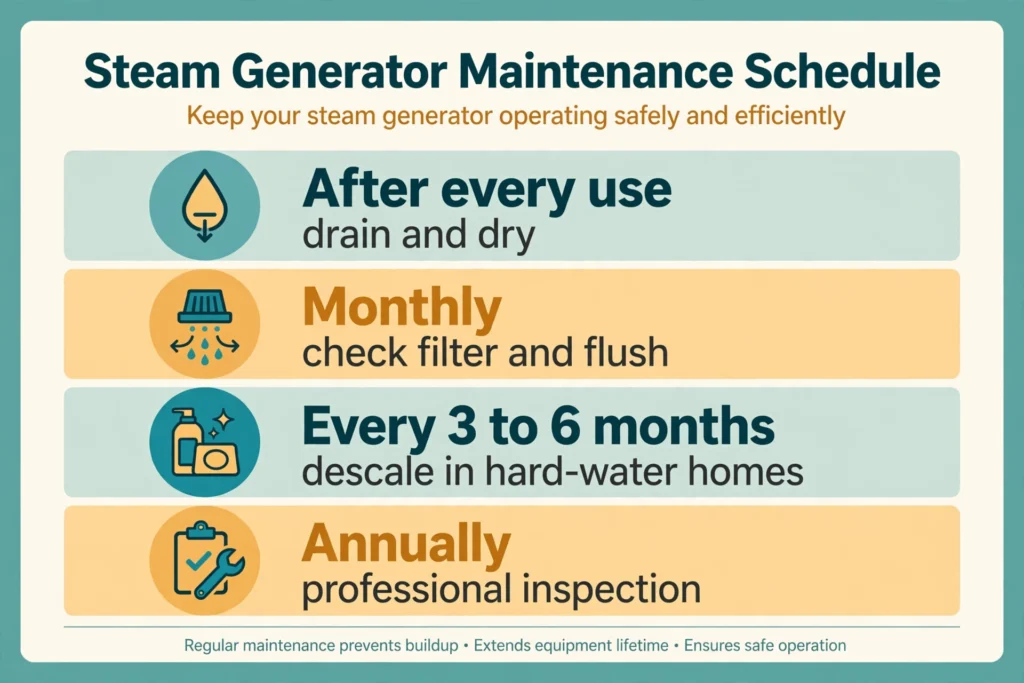
| When | What to do | Why it matters |
|---|---|---|
| After every session | Let the auto-flush or manual drain empty the tank; leave the steam room door ajar to dry | Prevents standing water and damp that feed scale and mould |
| Monthly | Check the inlet filter, drain line, and steam head for deposits or blockages | Catches small problems before they affect steam output |
| Every few months | Descale, more often in hard-water homes, per your manual | Removes scale from the tank and heating elements |
| Annually | Book a professional inspection, including safety cut-outs, valves, and electrical connections | Verifies the parts homeowners cannot safely check themselves |
Moisture care belongs in the same routine. A steam room that never dries out invites mould, so ventilation and drying matter as much as tank care. Our broader guide to how to clean a steam sauna covers the room-side cleaning that pairs with generator maintenance.
Finally, keep your generator correctly sized and properly installed, because an undersized unit that runs flat-out every session will scale and wear faster. If you are still choosing a unit, our steam generator sizing guide explains the capacity question, and the electrical and plumbing requirements guide covers the installation side that should always be left to licensed professionals.
Signs Your Generator Needs Attention
Generators rarely fail without warning. Watch for these signs, and treat any of them as a prompt to inspect, descale, or call a professional rather than to keep running the unit and hope it improves.
- Slower heat-up or weaker steam: often the first sign of scale on the heating elements.
- Unusual noises: rumbling, kettling, or popping during heating can indicate heavy scale deposits.
- Steam that smells musty or chemical: may point to stagnant water, a missed flush, or descaler residue that needs rinsing.
- Error codes or repeated cut-outs: safety devices tripping are a warning, not an inconvenience; have the unit checked.
- Water around the unit or drain: leaks, drips, or a blocked drain line need prompt professional attention.
- White flakes at the steam head: mineral particles carried through with the steam, a sign that descaling is overdue.
If the unit trips a breaker, smells of burning, or shows any sign of electrical fault, stop using it, isolate power, and call a licensed electrician. Never open the generator casing to investigate an electrical problem yourself.
Common Maintenance Mistakes to Avoid
Most generator problems trace back to a handful of avoidable habits. Descaling with an unapproved product, or at double strength, risks seals and sensors. Leaving water standing in the tank between sessions accelerates scale. Ignoring a spent inline filter wastes money while protecting nothing.
Running the generator with the auto-flush disabled, because the drain noise is annoying, quietly removes the best scale protection the unit has.
Another common mistake is treating maintenance as a one-off event rather than a routine. A single thorough descale after years of neglect may not restore a heavily scaled unit, and aggressive cleaning of a badly scaled tank can dislodge debris into valves and pipes. If a generator has been neglected for a long time, a professional service is a safer first step than a heroic home descale.
Frequently Asked Questions
How often should I descale my steam generator?
Follow your manufacturer’s manual first, and use water hardness and usage as your guide. As a starting point, many homes descale every few months in hard-water areas and less often with soft water, adjusting based on how much scale you actually find each time.
Can I use vinegar to descale a steam generator?
White vinegar is a common household descaler, but only use it if your manufacturer recommends or allows it, at the dilution specified in the manual. Some manufacturers specify citric acid or a branded descaler instead, and using an unapproved product may affect your warranty.
Does an auto-flush system mean I never need to descale?
No. Auto-flush drains standing water and greatly reduces scale build-up, but minerals still deposit during heating. You will still need periodic descaling and inspection, just less often and with lighter deposits than without auto-flush.
Is distilled water best for a steam generator?
Distilled water produces almost no scale, but it is costly in the quantities a generator uses, and some generators rely on water conductivity for level sensing. Check your manual: if it approves distilled or demineralised water it is a valid option, otherwise filtered or softened tap water is usually the better choice.
What are the first signs of scale build-up?
Slower heat-up, weaker steam, rumbling or kettling noises during heating, and white flakes at the steam head are the usual early signs. Any of these is a prompt to inspect and descale, or to have the unit serviced.
Should I hire a professional for steam generator maintenance?
Homeowners can handle routine draining, descaling, and filter checks following the manual. Annual inspections, electrical work, plumbing changes, and any fault involving leaks, error codes, or safety cut-outs should go to a licensed professional.