
A steam shower feels simple from inside the glass. You press a button, warm steam fills the enclosure, and twenty minutes later you step out relaxed. Every session sends condensed water down the drain and a cloud of humid air into the bathroom.
Steam shower drain and ventilation is the part of the build that decides whether that relaxing shower stays relaxing. Get the drain slope, the drain type, the fan size and the ducting right and the room dries out after every session. Get any of them wrong and you get standing water, musty smells, peeling paint and, over time, mold behind tiles and inside walls. This guide walks through each piece so you can plan it or check a contractor’s work.
Please read first: This article is general guidance only. It is not a substitute for your local building code, your local permit office, or a licensed professional. Plumbing, drainage and electrical work must follow local code, and installation work should be done by licensed plumbers and electricians. A home steam room is never maintenance free. It needs a drying routine after every session and regular checks for leaks, grout damage and mold.


Paid Links - As an Amazon Associate, I earn from qualifying purchases.
Why drainage and ventilation decide whether a steam shower lasts
A normal shower wets the floor for a few minutes. A steam shower is different in two ways. First, steam condenses on every cool surface, so water appears on the ceiling, the walls, the bench and the door as well as the floor. Second, the room stays warm and humid long after the water stops, which gives mold and mildew a long window to grow.


Paid Links - As an Amazon Associate, I earn from qualifying purchases.
Drainage handles the water you can see. Ventilation handles the moisture you cannot see.
The two systems work as a pair. A perfect drain cannot save a room with a weak fan, because humid air will still condense on the ceiling and soak into grout and paint. A powerful fan cannot save a room with a flat floor, because water will still pool in low spots between sessions. Both have to be planned before tile goes down, not after.
The mistakes that cause most damage are simple ones: a floor that is almost level, a fan that is too small, a duct that ends in the attic, or a drying routine that nobody follows.
How moisture moves through a steam shower
Steam is water vapour. When it touches a surface cooler than the steam itself, it turns back into liquid water. That is condensation, and in a steam shower it happens everywhere at once.
The ceiling is usually the coolest surface, so it collects the most condensation. That is why steam shower ceilings are often sloped, so droplets run down to a wall instead of dripping on the user.
Every time the steam shower door opens, humid air escapes into the bathroom. It fogs mirrors, dampens towels and settles on painted walls and wood trim. Without an exhaust fan, that moisture has nowhere to go except into the materials of the room, and over months paint bubbles, wood swells and metal fixtures spot with corrosion. The fan is the exit route for that humid air, and it has to run long enough after the session to clear the air, not just while the steam is running.


Paid Links - As an Amazon Associate, I earn from qualifying purchases.
Some water always finds its way past grout and into the layers below the tile. A properly built shower has a waterproof membrane under the tile that lets trapped water reach the drain. If the membrane is damaged, water can sit under the tile for weeks and show up later as loose tiles or a smell you cannot find.
This article focuses on drainage and ventilation. For membranes, tile and ceiling materials, see our steam room waterproofing guide.
Drain types compared: centre drain, linear drain and trench drain
The drain is the lowest point of the shower floor, and the floor is shaped around it. The drain you choose decides how the floor must be sloped, how easy the floor is to clean, and how the shower looks.
| Drain type | How the floor is shaped | Best for | Watch out for |
|---|---|---|---|
| Centre point drain | Floor slopes in from all four sides to one low point | Smaller square showers and tight budgets | Four-way slope is hard to tile with large tiles |
| Linear drain | Floor slopes in one direction to a long slot at one wall | Large format tile, curbless entries and a clean modern look | Costs more and needs precise placement before the floor is poured |
| Trench or channel drain | Floor slopes to a wide channel, often across the entry | Wide showers and rooms where a lot of water must clear fast | Needs regular cleaning along the full channel |
A centre point drain is the traditional choice. It works well in a compact square shower. Its weakness is the floor shape. The floor has to slope down from four directions, which means small tiles or careful cuts with large tiles.
A linear drain is now the most popular choice for steam showers. The floor slopes in one direction only, so large tiles sit flat and the floor feels even underfoot. The drain usually sits against the wall opposite the entry or along the back wall, which keeps it out of the main standing area.
A trench or channel drain is a wider version of the same idea. It suits very wide showers or rooms where the steam shower shares a floor with the rest of the bathroom. The trade off is maintenance. A long channel collects hair and soap residue along its full length, so it needs cleaning more often than a short linear drain.
For most home steam showers, a linear drain is the best balance of looks, drainage and ease of tiling. Choose a centre drain if the shower is small and square and the budget is tight. Choose a trench drain if the shower is unusually wide or if you want the drain to act as a barrier at a curbless entry.
Whichever you choose, decide before the floor is built, because moving a drain after tile is laid means breaking the floor. Pick a cover that lifts out with a simple tool, so cleaning stays easy.
Floor slope and drain placement: the quarter inch rule
The most widely published rule of thumb for shower floors is a slope of one quarter inch per foot toward the drain. That means the floor drops about one quarter of an inch for every foot of distance from the drain. Over a four foot run, the far edge sits about one inch higher than the drain. That gentle slope is enough for water to flow reliably without making the floor feel tilted underfoot.
A floor that is almost level is the most common drainage mistake in home steam showers. Water moves slowly on a near flat floor, and surface tension holds small puddles in place. Those puddles sit for hours after each session and feed mildew in grout lines. If your shower floor holds puddles after a session, the slope is the first thing to check.
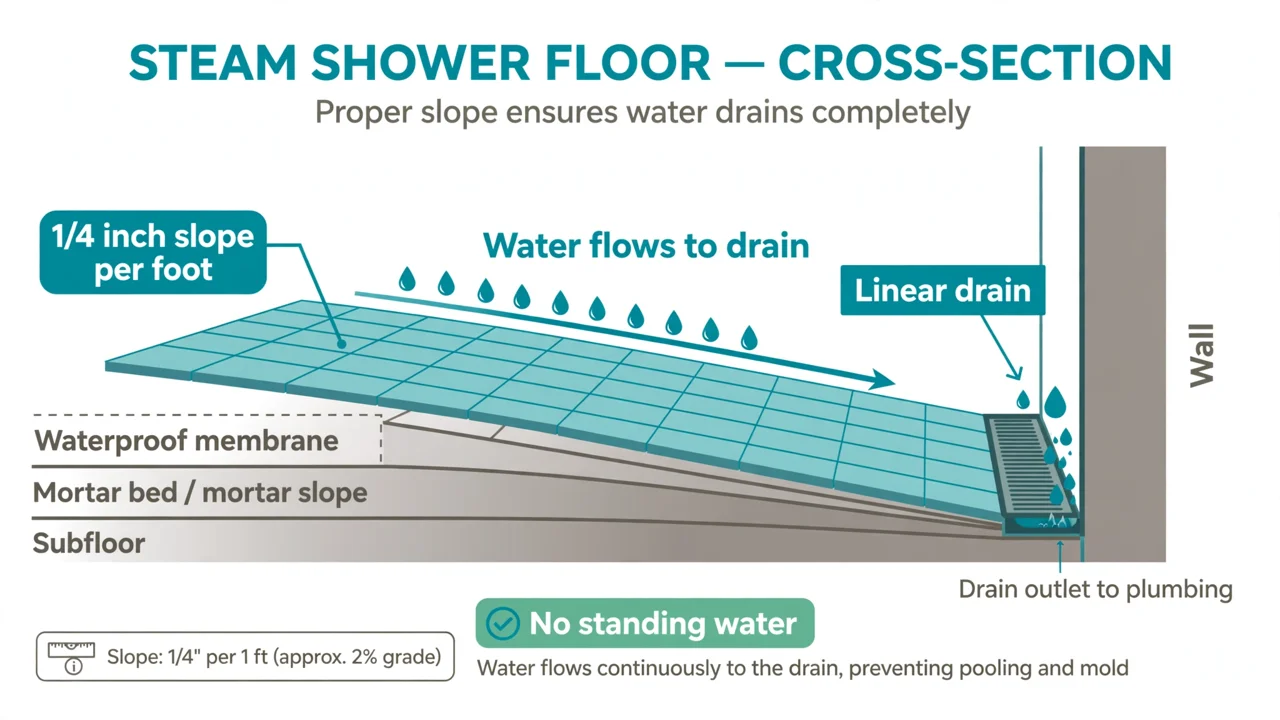
Placement matters as much as slope. Put the drain where the most water lands. In a typical steam shower, that is under the steam outlet wall and below the sloped ceiling edge where condensation runs down. A linear drain along the back wall catches water from the whole floor with a single straight slope.
Traps, vent pipes and sewer gas
Below the drain grate sits the trap, a U shaped bend that holds a small amount of water. That water is a seal. It blocks sewer gas from rising into the bathroom while still letting shower water flow through. The trap needs a vent pipe that lets air into the drain line so water flows smoothly and the seal is not siphoned away.
A dry trap is a common cause of bad smells in a steam shower that is used rarely. If the shower sits unused for weeks, the water in the trap can evaporate and the seal breaks. Run water down the drain for a few seconds every week or two if the shower is not in regular use, so the trap stays full.
Slow draining with gurgling sounds can point to a vent problem rather than a clog. A blocked vent pipe lets air lock in the drain line, so water drains slowly and the trap seal can be pulled away. This is a job for a licensed plumber, and venting rules vary by local code. Our guide to steam sauna electrical and plumbing requirements covers the wider plumbing and electrical picture for a steam install.
Exhaust fan sizing: how much air your bathroom needs
The exhaust fan is the second half of the system, and it is the half most often undersized. A fan that is too small runs loudly, clears the air slowly, and leaves the bathroom damp for hours.
Fan power is measured in CFM, or cubic feet per minute. The widely used rule of thumb for bathrooms is one CFM per square foot of floor area, with a minimum of 50 CFM for a small bathroom. A 60 square foot bathroom would therefore need about a 60 CFM fan, while a 100 square foot bathroom would need about a 100 CFM fan. For larger bathrooms, add an allowance for each extra fixture, following the fan maker guidance and your local code.
| Bathroom size | Fan size rule of thumb | Notes |
|---|---|---|
| Under 50 square feet | 50 CFM minimum | Steam adds far more moisture than a normal shower |
| 50 to 100 square feet | About 1 CFM per square foot | A 70 square foot room needs about a 70 CFM fan |
| Over 100 square feet | 1 CFM per square foot plus fixture allowances | Check the fan maker chart and local code |
| Rooms over 8 feet high | Size by volume, not floor area | Ask your supplier to size by cubic feet |
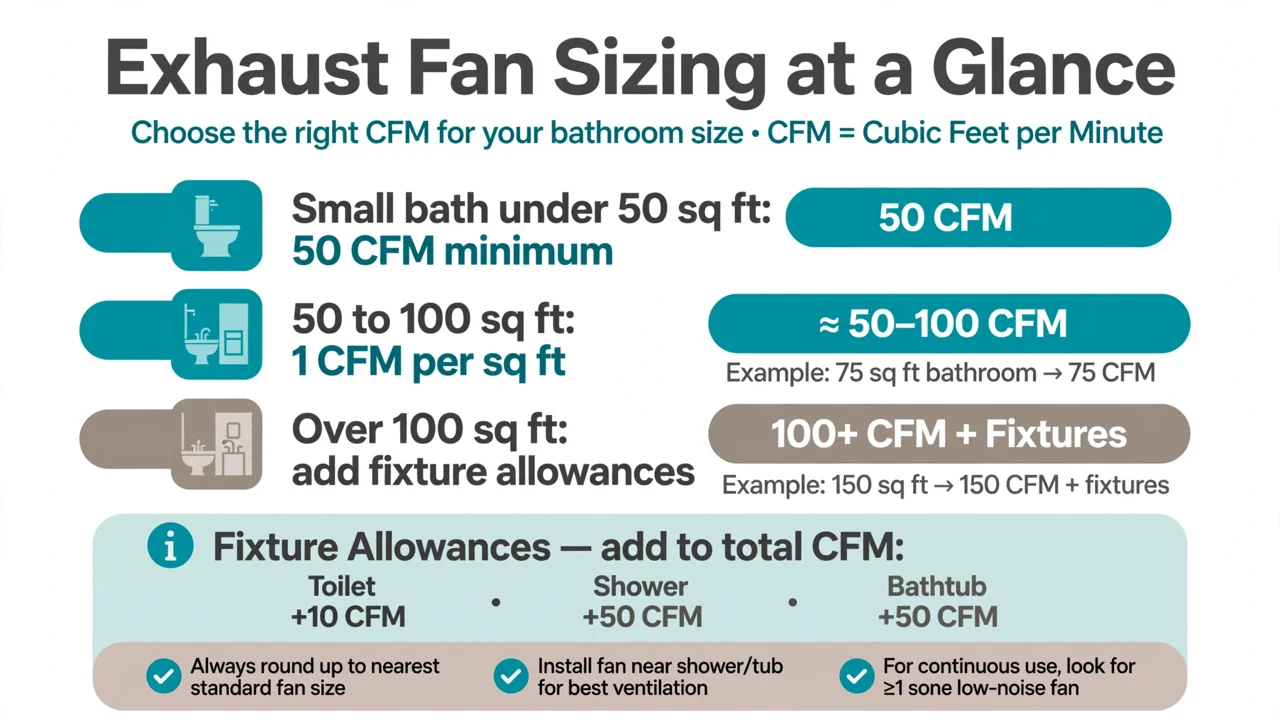
These figures are rules of thumb for planning, not a code calculation. A steam shower adds more moisture than a normal bathroom, so treat the table as a floor rather than a target. If you are choosing between two fan sizes, the larger one is usually the safer choice, provided it is not so loud that nobody wants to use it. A fan rated at about one sone or less is quiet enough to leave running after a session.
Timer and humidity controls
A fan that only runs while someone remembers to switch it on will not protect the room. Fit a timer switch or a humidity sensing control so the fan keeps running after the session ends. A common routine is to let the fan run for at least 30 minutes after a steam session, and longer if the mirror is still fogged or the walls still feel damp. A humidity sensor can do this automatically.
Fan placement and ducting: getting damp air outside
A well sized fan still fails if the ducting is wrong. The duct carries damp air from the fan to the outside of the house, and every bend reduces airflow and gives moisture a place to condense. Place the fan near the shower entry or in the main bathroom ceiling close to the shower, but never directly above the steam outlet, where it would pull steam straight out of the enclosure while you are using it.
- Run the duct to the outside of the house, through a wall cap or a roof cap, never into the attic or between floors.
- Keep the run as short and straight as possible, with as few bends as you can manage.
- Use rigid metal duct where you can, because flexible duct sags, traps moisture and cuts airflow.
- Insulate the duct where it passes through a cold space such as an attic, so moisture does not condense inside it and drip back down.
- Fit a backdraft damper so cold air and pests cannot enter through the vent when the fan is off.
What never to vent into: the attic, the soffit and the crawl space
Venting a steam shower into the attic is one of the most damaging mistakes a builder can make. The attic is cold in winter and poorly ventilated, so the damp air condenses on the roof deck and the insulation. Over a single winter, that moisture can rot wood, soak insulation and grow mold. The damage is hidden until it is large, and the repair is expensive.
Venting into a soffit is nearly as bad. Soffit vents are air intakes for the attic, so damp air pushed out of a soffit vent is often drawn straight back in. Venting into a crawl space or a wall cavity has the same problem in a different place.
The moisture has to leave the building entirely through a proper exterior cap. If you are checking work done by a previous owner, trace the duct to a visible cap on an outside wall or on the roof.
The after session drying routine that protects the room
The build gets the water out. The routine keeps it out. A steam shower that is dried after every session can last for decades with little trouble, while one left wet after every session will develop problems no matter how good the build was. The routine takes about five minutes.
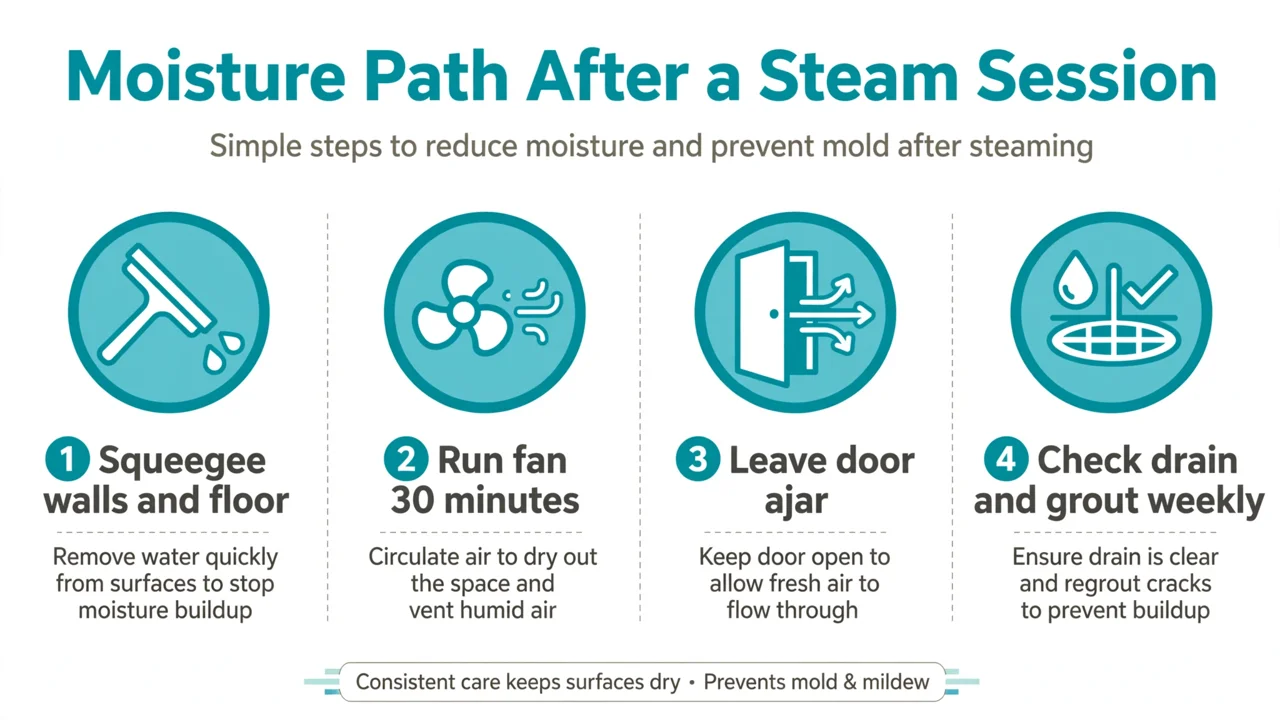
- Squeegee the walls, bench and floor toward the drain as soon as the session ends, while the surfaces are still warm.
- Leave the exhaust fan running for at least 30 minutes after the session, or until the mirror is clear and the walls feel dry to the touch.
- Leave the shower door ajar and the bathroom door open a crack so dry air from the house can flow in and replace the damp air.
- Wipe the door seals and any metal trim dry, because standing water on seals and fixtures is where mildew and corrosion start first.
Keep a squeegee inside the shower on a hook where you will reach for it. It removes most of the water in under a minute. A towel works in a pinch, but it holds the water inside the room, so a squeegee is the better habit.
Mold prevention: weekly and monthly checks
Mold needs three things: moisture, warmth and something to grow on. A steam shower provides all three, so prevention is a routine, not a one time fix.
Every week
- Look at the grout lines and the sealant around the drain, the door and the bench for dark spots or soft patches.
- Lift the drain cover and clear hair and soap residue so water drains fast.
- Check the ceiling corners and the top of the door frame, where condensation collects first.
Every month
- Clean the fan grille and check the fan still moves air strongly.
- Inspect sealant joints for gaps or peeling, and plan a reseal before water gets behind the tile.
- Clean the steam shower as described in our guide to cleaning a steam sauna, and descale the generator as shown in our steam generator maintenance guide if you have hard water.
Warning signs your drain or vent is failing
Each sign below points to a specific part of the system, so treat any of them as a prompt to investigate, not as a quirk to live with.
- Water pools on the floor for more than a minute after the shower stops. This points to a slope problem, a slow drain or a partial clog.
- A sewer smell appears when the shower has not been used for a while. This usually means the trap has dried out.
- The mirror stays fogged for an hour or more after a session. This points to a fan that is too small or a blocked duct.
- Paint bubbles or trim swells outside the shower. This means humid air or water is escaping the enclosure into the room structure.
Planning checklist before you build or remodel
- Drain type chosen, with the floor slope planned around it at about one quarter inch per foot toward the drain.
- Fan sized at about one CFM per square foot, with a 50 CFM minimum, and a quiet rating so it can run after sessions.
- Timer or humidity control fitted so the fan runs for at least 30 minutes after each session without anyone remembering to switch it on.
- Duct route planned to the outside through a proper cap, using rigid duct, kept short and straight and insulated where it crosses cold space.
- Local permit and code office checked before work starts, with licensed trades booked for plumbing and electrical work.
If you are converting an existing shower rather than building from scratch, read our guide on how to turn your shower into a steam sauna first. A conversion has extra limits, because the drain position and the duct route are already fixed. Our steam shower cost guide for 2026 gives planning estimates, not quotes, so get local quotes before you commit.
When to call a licensed professional
Some of this work suits a careful homeowner, such as cleaning a drain cover or following a drying routine. The rest does not. Call a licensed plumber or electrician to move a drain, change a trap, reroute a vent pipe, cut a new duct route, wire a new fan or steam generator, or handle any work that needs a permit or inspection. Call one promptly too if you find persistent mold, a smell you cannot trace, or water damage on a ceiling below the bathroom.
Steam safety basics
Steam saunas are wellness tools, not treatments. Drink water before and after a session, and keep sessions short when you are new to steam. Leave at once if you feel dizzy, unwell or overheated, and cool down slowly. Do not use a steam shower after drinking alcohol, and check with a doctor first if you are pregnant, live with a heart or circulation condition or low blood pressure, or take medication that affects heat tolerance.
Frequently asked questions
What slope does a steam shower drain need?
A widely used rule of thumb is one quarter inch of fall per foot toward the drain. That gentle slope moves water reliably without making the floor feel tilted. Ask your installer to prove it with a water test on the bare floor before tile is laid.
Is a linear drain better than a centre drain for a steam shower?
For most home steam showers, yes. A linear drain needs only a single direction slope, so large tiles sit flat and water clears fast. A centre drain suits small square showers and tight budgets, but it needs a four way slope that is harder to tile with large tiles.
What size exhaust fan do I need for a steam shower bathroom?
Use about one CFM per square foot of bathroom floor, with a minimum of 50 CFM even for a small room. A 70 square foot bathroom needs about a 70 CFM fan. Larger rooms need fixture allowances on top, so check the fan maker guidance and your local code.
How long should I run the fan after a steam session?
Run it for at least 30 minutes after the session, or until the mirror is clear and the walls feel dry. A timer switch or a humidity sensor does this automatically and is worth fitting, because a fan that depends on memory is often switched off too soon.
Can I vent a steam shower fan into the attic?
No. Venting into the attic, a soffit, a crawl space or a wall cavity sends damp air into a cold hidden space where it condenses and can rot wood, soak insulation and grow mold. The duct must run to the outside of the house through a proper wall or roof cap.
Why does my steam shower smell when it has not been used?
The most common cause is a dry trap. The water seal in the trap can evaporate if the shower sits unused for weeks, letting sewer gas rise into the room. Run water down the drain for a few seconds every week or two to keep the trap full. If the smell persists after that, ask a licensed plumber to check the trap and the vent pipe.
How do I stop mold in a steam shower?
There is no single fix. Squeegee the walls and floor after every session, run the fan for at least 30 minutes, leave the door ajar, clear the drain weekly, and check grout and sealant monthly. If mold keeps returning in the same spot, look for the moisture source, such as a flat floor, a weak fan or a leak, rather than cleaning the same spot again.
A steam shower is only as good as its drainage and its ventilation. Plan the drain slope and the fan size before the build, run the duct outside the house, and dry the room after every session. Do those four things and the shower stays a place to relax, not a source of damp, smells and repairs.