
You press the button, the control panel lights up, you wait — and nothing happens. No hiss from the steam head, no cloud building in the shower, no warmth creeping into the room. A steam generator that will not produce steam is one of the most frustrating faults a home steam room can develop, because the cause could sit anywhere between the breaker panel and the steam head.
The good news is that most no-steam faults have a simple, safe explanation: a tripped breaker, a closed water valve, a timer that was never started, or a drain valve left open after cleaning. This checklist works through those causes in a sensible order, starting with the checks that cost nothing and carry no risk. Anything that involves opening a live electrical unit, touching wiring, or bypassing a safety device belongs to a licensed electrician or plumber.
Safety first — please read this before you start.


Paid Links - As an Amazon Associate, I earn from qualifying purchases.
A steam generator is a mains-powered appliance that boils water. Never open the generator cabinet while it is connected to power, never work on wiring or the heating element yourself, and never bypass a safety device such as a pressure relief valve, a thermal cut-out, or a low-water cut-off. If you are unsure about any step, stop and call a licensed electrician or plumber.


Paid Links - As an Amazon Associate, I earn from qualifying purchases.
This article is general guidance only. It is not a substitute for your generator’s installation manual, local electrical and plumbing codes, or a licensed professional. Check with your local code or permit office if you are unsure what applies where you live. Saunas and steam rooms are wellness tools, not treatments. If you feel dizzy or unwell, leave the steam room at once, and check with a doctor first if you are pregnant, live with a heart or circulation condition or low blood pressure, or take medication that affects heat tolerance.
Start Here: The 60-Second Safety Check
Before you touch anything, run through this quick pass. It takes a minute and catches the faults that waste the most time.
- Is the control panel lit? A completely dark panel points to power. A lit panel that shows a timer counting down points to settings or controls.
- Did the generator make any sound? A hum, click, or gurgle tells you power is reaching the unit and water is moving. Total silence tells a different story.
- Has anything changed recently? A recent descale, a plumber’s visit, a power cut, or a new water filter can all leave a valve closed or a setting reset.
- Is the room dry or damp? A damp floor near the generator or steam head can point to a leak or a drain fault, while a bone-dry room after a long run points to water never reaching the tank.
Write down what you observe — panel lit or dark, sounds or silence, any error message. That short note is exactly what a technician will ask for first.
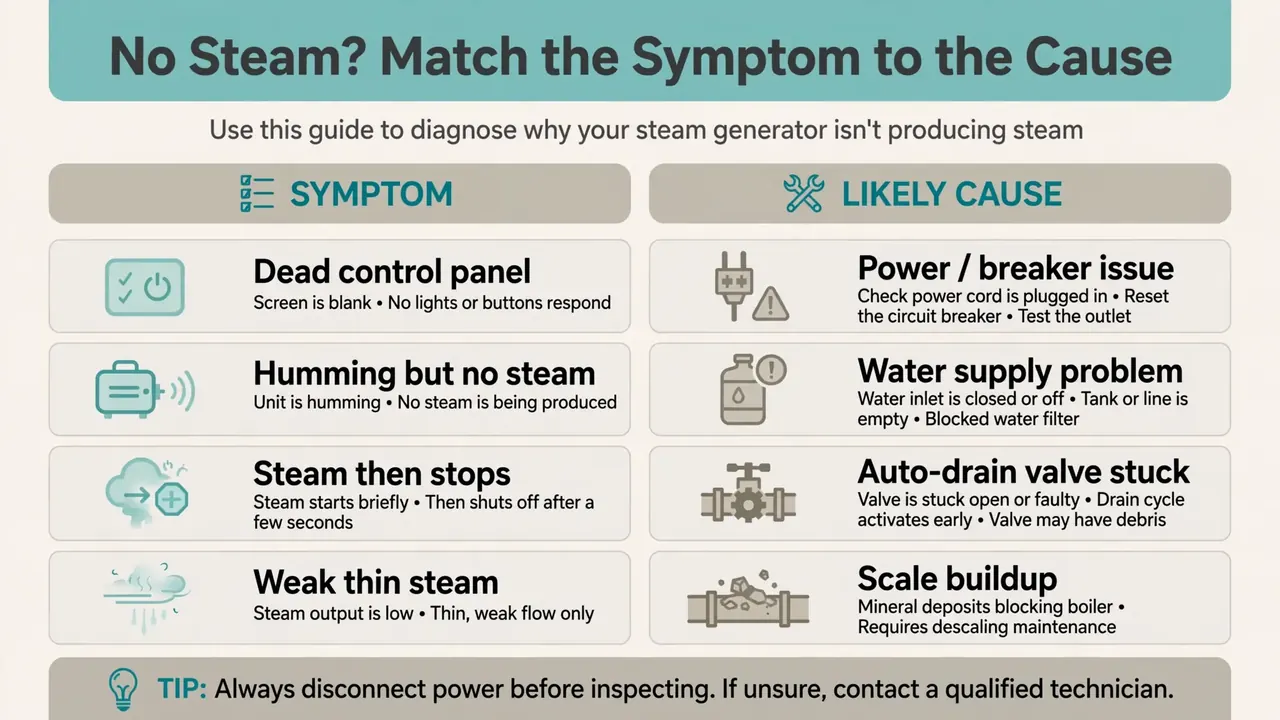
The Quick Diagnostic Table: Symptom, Likely Cause, First Check
Match what you are seeing to the most likely cause, then jump to the matching check below. Two faults can share a symptom, so work through the checks in order rather than replacing parts on a guess.
| What you see | Most likely cause | First safe check |
|---|---|---|
| Control panel completely dark, no sound | No power reaching the unit | Breaker, disconnect switch, and the control’s power setting (Check 1) |
| Panel lit, timer running, no steam at all | Water not reaching the tank, or the unit never started heating | Water supply valve and inlet filter (Check 2) |
| Steam starts, then stops within minutes | Auto-drain or drain valve fault, or low-water cut-off tripping | Drain valve position and auto-drain cycle (Check 3) |
| Unit hums or clicks, tank stays cool | Heating element or thermal cut-out fault | External signs only — then call a professional (Check 4) |
| Panel shows an error code or the temperature never climbs | Control, thermostat, or sensor fault | Error code in the manual, sensor position, settings (Checks 5 and 6) |
| Weak, thin steam that fades quickly | Scale buildup, partly blocked steam line, or wrong generator size for the room | Descaling history and room sizing (Check 7) |
| Steam escapes somewhere it should not | Loose fitting, cracked line, or failed seal | Visible leaks with power off — then call a plumber |
The Safe-Check Order: What to Test First
Troubleshooting works best in a fixed order: power first, then water, then controls, then the parts inside the cabinet that you should not open. Skipping ahead wastes time and adds risk, because a closed water valve can look exactly like a dead element from the outside.
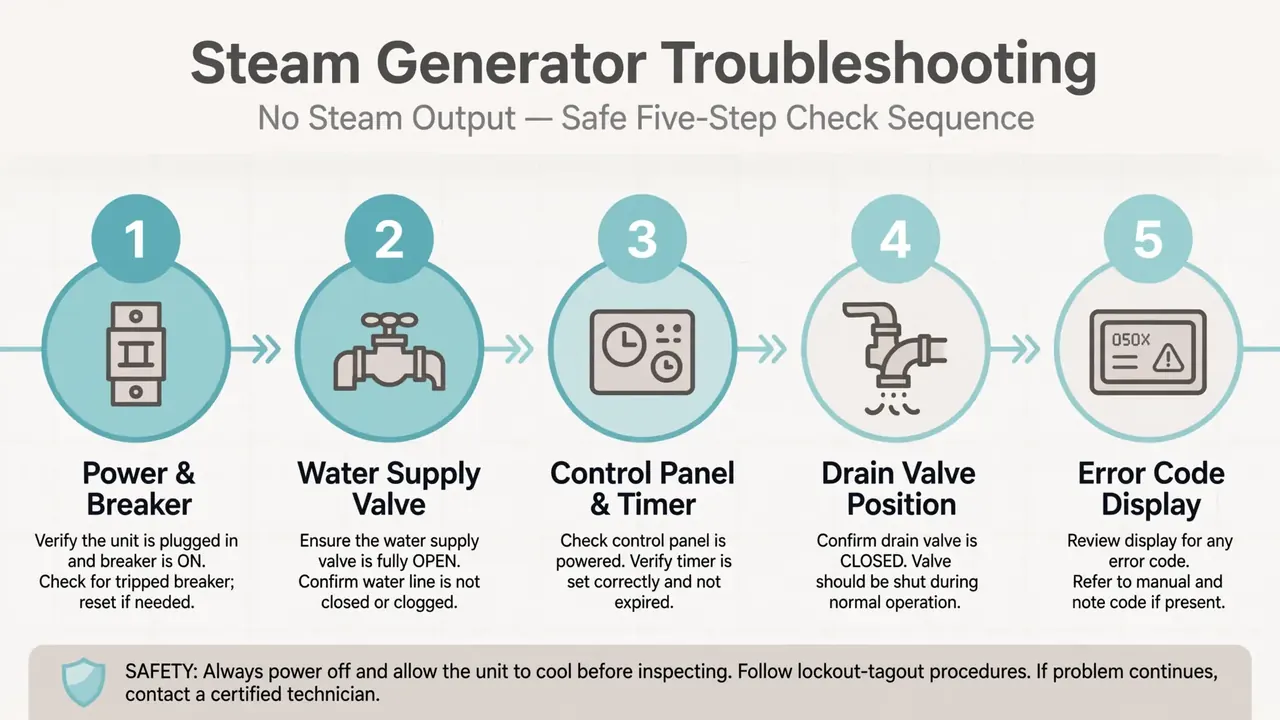
- Power and breaker. Confirm the unit is receiving power at all.
- Water supply. Confirm water can reach the tank.
- Controls and timer. Confirm the unit has actually been told to run.
- Drain valve. Confirm water is staying in the tank instead of draining away.
- Error codes and settings. Read what the panel is telling you before touching anything else.
If a check fixes the problem, stop there and run a full session to confirm the steam stays steady. If a check reveals a fault inside the cabinet, stop and call a professional.


Paid Links - As an Amazon Associate, I earn from qualifying purchases.
Check 1: Power, Breaker and Disconnect
A steam generator draws serious power, and its circuit is protected by a dedicated breaker — the single most common cause of a completely dead unit, and the easiest to check. Find the breaker labelled for the steam generator in your electrical panel. A tripped breaker often sits in a middle position, neither fully on nor fully off.
What to look for
- The breaker for the steam generator, and whether it has tripped.
- A disconnect switch near the generator, if your installation has one, and whether it is in the on position.
- Whether other circuits in the same area are working, which tells you if the problem is local to the generator circuit or wider.
- Any recent electrical work, a power cut, or a storm that could have tripped the breaker.
If the breaker has tripped, switch it fully off and then back on once. If it trips again immediately, or if it trips again the next time you run the generator, stop. A breaker that trips repeatedly is doing its job, and the cause is a fault that needs a licensed electrician. Never hold a breaker on, tape it, or replace it with a higher-rated one.
Some circuits also have a GFCI or RCD. If yours has tripped, reset it once in the same way. If it will not reset, or it trips again straight away, leave it and call an electrician.
For the full picture of what a steam generator circuit should look like, see our guide to steam sauna electrical and plumbing requirements. If the generator shares a circuit with other large appliances, mention that to your electrician, because an undersized or shared circuit can cause repeated tripping.
Check 2: Water Supply and Inlet Valve
A steam generator cannot make steam without water, and it cannot fill if the supply is closed. The water feed usually has a shut-off valve on the line into the unit, and that valve is easy to knock closed during cleaning or other plumbing work. Trace the water line from the generator back to the valve and confirm it is fully open.
What to look for
- The shut-off valve on the water feed, and whether it is fully open. A valve that is only partly open can let in a trickle that never fills the tank.
- Whether other taps and fixtures in the bathroom have normal water pressure. If the whole bathroom is affected, the problem is upstream of the generator.
- An inlet filter or strainer on the water line, if your model has one. A clogged filter starves the tank even when the valve is open.
- Any recent work on the water supply, a new filter, or a water softener installation that could have left a valve closed or a line kinked.
If your model has a removable inlet filter, clean it as the manual describes, with the water supply isolated first. Do not force a stuck filter or open any fitting while the line is pressurised. If water reaches the unit and the tank still does not fill, the fault is likely in the inlet valve or the level controls inside the cabinet — a job for a plumber or the manufacturer’s service technician.
Hard water makes this check more important over time, as mineral deposits narrow pipes and clog filters gradually. If you live in a hard-water area, keep a note of when the filter was last cleaned, and read our guide to steam generator maintenance, descaling and hard-water care for the routine that keeps the water side healthy.
Check 3: Auto-Drain and Drain Valve
Many modern steam generators flush themselves automatically after a session, draining the tank so stale water does not sit and breed scale — until the drain valve sticks open. If the valve never closes, water runs straight through the unit and out to the drain, the tank never fills, and no steam is ever made.
What to look for
- Water running to the drain while the generator is trying to fill. Listen near the drain and watch for a steady flow that does not stop.
- A manual drain valve that was opened for cleaning or descaling and never closed again. This is one of the most common causes after maintenance.
- The auto-drain setting on the control panel, if your model lets you adjust the flush timing. A setting changed by accident can leave the unit draining at the wrong time.
- Scale or debris around the drain valve. Hard-water deposits can stop a valve seating properly, so it leaks continuously.
If you find a manual drain valve open, close it and try a session. If the auto-drain valve is stuck, do not try to dismantle it yourself — forcing it can cause a leak inside the cabinet. Note what you observed and pass it to a plumber or service technician.
A related fault is the low-water cut-off tripping because the tank never reaches its fill level. That cut-off is a safety device that stops the element heating an empty tank. If your generator starts and stops within minutes while the drain is running, the two are usually connected. Our guide to steam shower drain and ventilation explains how the drain side of a steam installation is meant to behave.
Check 4: Heating Element and Tank
If power reaches the unit, water fills the tank, and the controls say the generator is running, yet the tank stays cool and no steam appears, the fault is usually in the heating element or the thermal cut-out that protects it. This is where homeowner troubleshooting stops and professional diagnosis begins.
What you can safely observe from outside
- Whether the unit hums, clicks, or makes any sound when it starts. A relay clicking without the tank warming can point to the element circuit.
- Whether the tank or the pipes near the generator feel warm after the unit has been running for several minutes. Touch only the outside of accessible pipework, and only briefly — never open the cabinet to feel inside.
- Whether the generator has a history of heavy scale. A thick layer of scale insulates the element, so it works harder, overheats, and eventually fails or trips its thermal cut-out.
- Whether the thermal cut-out has tripped before. Some models have a reset button on the outside of the cabinet. Press it once, exactly as the manual describes, and only if the manual says it is user-resettable.
Do not remove the cabinet cover to inspect the element, test it with a meter, or replace it yourself. The element runs on mains voltage, the tank holds boiling water, and the cabinet contains safety devices that must be tested properly after any repair. Leave that to a licensed electrician or the manufacturer’s service technician.
When you call, tell the technician the age of the unit, your water hardness if you know it, and when the generator was last descaled. Our maintenance guide covers descaling and hard-water care in detail, and it is the best reference for preventing this fault from coming back.
Check 5: Control Panel, Thermostat and Temperature Sensor
Sometimes the generator is fine and the problem is the instruction it is receiving. A timer still set to zero, a thermostat set far below the usual range, or a temperature sensor that has slipped out of position can all leave a healthy generator sitting idle. Check these before assuming a part has failed.
What to look for
- The timer or session length. Some controls will not start the generator until a session time is entered, and a timer left at zero looks exactly like a dead unit.
- The temperature set point. If it has been knocked down or reset after a power cut, the generator may be heating to a target it has already reached, so no steam is called for.
- Whether the control is in the right mode. A control left in standby, in a cleaning cycle, or in a child-lock state will not start a session.
- The temperature sensor’s position, if it is visible in the room. A sensor that has come loose, been covered, or moved close to a cold draught can report a wrong temperature and shut the generator down early.
- Whether the panel responds normally to button presses. A frozen or unresponsive display can point to a control fault rather than a generator fault.
If the panel is unresponsive, try the reset procedure in the manual — usually a power cycle at the disconnect switch, left off for a short time before switching back on. Do not open the control housing or pull at its wiring. If the panel stays frozen, or if it works but the generator still does not respond, the control or its connection to the generator needs professional attention.
Our steam sauna temperature guide explains ideal heat, heat-up time, and thermostat settings, so you can tell whether the generator is genuinely underperforming or the settings are simply lower than you expected.
Check 6: Error Codes and the Manual
Many steam generators display an error code or a flashing light when something goes wrong. That code is the most useful clue you will get, and it costs nothing to read. Write it down before you reset anything, because the code often clears on a reset and cannot be recovered afterwards.
Look the code up in the manual for your generator, or on the manufacturer’s support pages for your exact model. Codes vary between brands and even between models from the same brand. Never trust a code definition from a forum post about a different model.
- Codes about water level or filling usually point back to Checks 2 and 3 — supply, inlet filter, or drain valve.
- Codes about overheating or the thermal cut-out usually point to scale, a failed element, or a sensor fault, and mean the unit should stay off until it is checked.
- Codes about the control or communication usually point to the panel, its cable, or the control board, and need a technician.
- A code that returns immediately after a reset means the fault is still present. Resetting again will not fix it, and repeated resets can mask a fault that needs attention.
If you cannot find the manual, search the manufacturer’s website using the full model number from the rating plate on the generator. Keep the model number and the error code together in your note for the technician.
Check 7: Scale Buildup and Hard Water
Scale is the slow fault. It builds up over months in hard-water areas, coating the element and the tank walls, narrowing waterways, and sticking valves open. The first sign is often steam that gets weaker, or a generator that takes longer and longer to produce anything at all.
If your generator has never been descaled, or it has been a long time since the last descale, scale should be high on your list of suspects — especially in a hard-water area. Signs include a white, chalky residue around fittings, a drain valve that will not seat, and a unit that has faded gradually rather than failing suddenly.
Follow your manual’s descaling procedure exactly, using only the descaling product the manufacturer recommends. Never use a stronger acid, a household cleaner, or a homemade mixture, and never run a descale while the unit is powered. If the manual says descaling is a service job for your model, treat it as one — a descale done wrong can damage seals and sensors and leave chemical residue in the tank.
Our guide to steam generator maintenance, descaling and hard-water care covers the descaling schedule, the products, and the water-treatment options that slow scale down. If scale is a recurring problem in your home, a water softener or a treatment system fitted on the feed is worth discussing with your plumber.
When to Stop and Call a Professional
Knowing when to stop is part of troubleshooting, not a failure of it. The checks above put everything a homeowner can safely do at the front and everything that needs a professional at the back. If you reach any of the signs below, switch the generator off at the disconnect, leave it off, and call a licensed electrician or plumber.
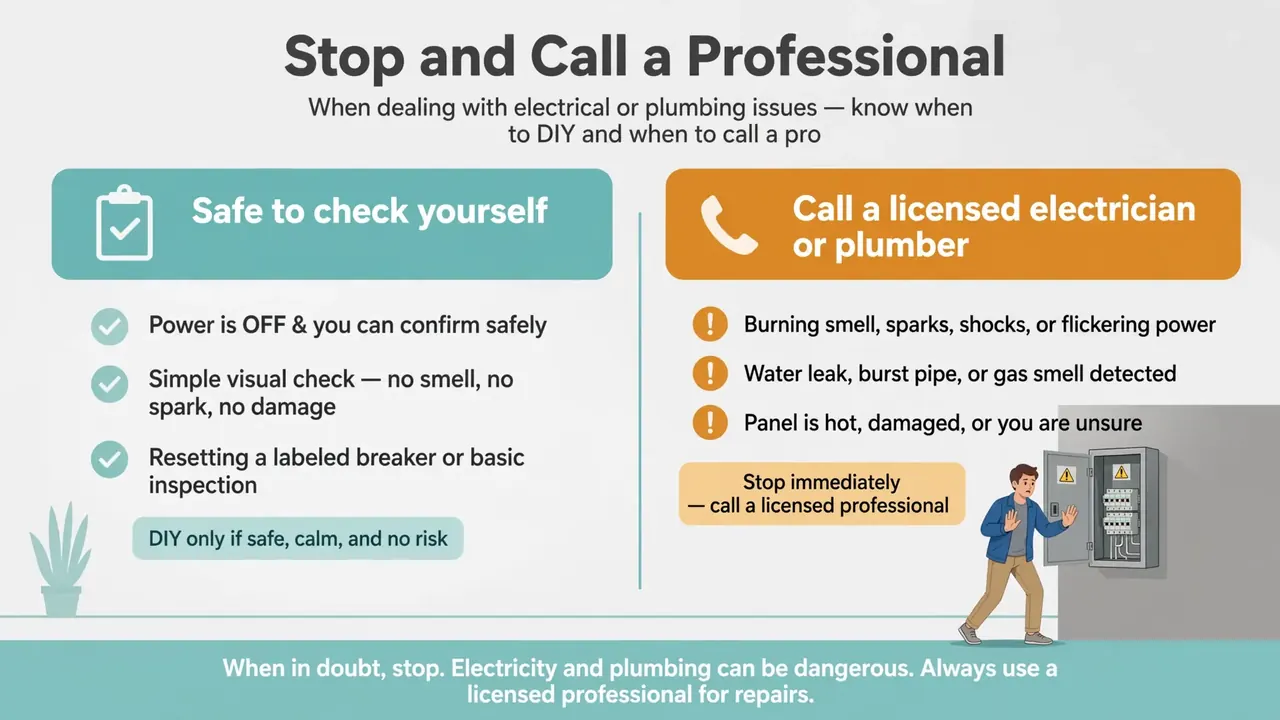
- The breaker or GFCI trips again after one reset. Repeated tripping means a live fault.
- You smell burning, or you see scorch marks or melted plastic anywhere near the generator, the panel, or the control.
- Water is leaking inside the generator cabinet or from a fitting you cannot isolate.
- The fault is inside the cabinet — the element, the control board, the thermal cut-out, or any wiring.
- An error code about overheating keeps returning after a reset.
- The generator is still under warranty. Opening the cabinet or replacing parts yourself can void it, so let the manufacturer’s service route handle it.
- You feel unsure at any point. That is a good enough reason on its own. A service visit costs less than a repair made worse by guessing.
When you call, have your notes ready: the model number, the age of the unit, what the panel showed, what you heard, and which checks you already ran. A technician who arrives with that information can usually diagnose the fault in one visit. If the unit is old, heavily scaled, and needs both an element and a control board, ask for a repair quote in writing before authorising the work.
A Note on Moisture, Mold and Drying the Room
A generator that is not producing steam can leave a damp room behind it, especially if water has been leaking or draining where it should not. A home steam room is never maintenance-free, and a room that stays damp grows mold on grout, sealant, and any surface that never dries out.
After any no-steam fault, check the room itself for standing water, damp patches on the ceiling or around the steam head, and any musty smell that was not there before. Dry the room thoroughly, run the ventilation, and leave the door open until surfaces are dry. If the room has been damp for a while, check the grout and sealant for dark spots before they spread.
Good waterproofing and ventilation keep a steam room healthy in the long term. Our guide to steam room waterproofing, tiling and ceiling materials covers the materials that survive constant steam, and our guide to steam shower drain and ventilation explains how to move moist air out of the bathroom after a session. Both are worth reading while the generator is being repaired.
Preventing the Next No-Steam Morning
Most no-steam faults are preventable. A short routine after each session and a slightly longer one a few times a year will catch most problems while they are still cheap.
- After every session, let the auto-drain or manual flush run as the manual describes, and leave the room ventilated until it is dry.
- Every month or so, check that the water supply valve is fully open, the drain is clear, and the control settings have not been changed by accident.
- On the manufacturer’s schedule, descale the generator and clean the inlet filter. In a hard-water area, that schedule matters more than anywhere else.
- Once a year, have the installation checked as part of a service visit, including the breaker, the connections, and the safety devices.
- Keep a simple log — the date of each descale, each filter clean, and any fault. A log turns a vague “it has been getting worse” into a timeline a technician can use.
It is also worth checking that the generator is the right size for the room. An undersized generator works at its limit every session, scales faster, and produces thin steam that fades quickly — which looks very much like a fault. Our guide on how to size a steam generator explains how room size and materials set the power you need. If your generator has always struggled, sizing — not a fault — may be the real story.
Frequently Asked Questions
Why is my steam generator not producing steam at all?
The most common causes are no power reaching the unit, a closed water supply valve, a drain valve stuck open so the tank never fills, or a control that was never started. Work through the safe checks in order — power, water, controls, drain — before assuming a part has failed, and check the error code on the display first if your model shows one.
Why does my steam generator start and then stop after a few minutes?
A generator that starts and stops quickly is often tripping its low-water cut-off because the tank never fills, or its thermal cut-out because the element is overheating. A stuck-open auto-drain valve is a frequent cause of the first, and heavy scale buildup is a frequent cause of the second. If it keeps happening, switch the unit off and call a professional rather than resetting it repeatedly.
Can I reset my steam generator myself?
You can safely reset a tripped breaker once, reset a tripped GFCI once, and use a user-resettable button exactly as your manual describes. If the breaker or GFCI trips again, or if the fault returns after a reset, stop and call a licensed electrician. Never bypass a safety device or open the generator cabinet while it is connected to power.
How do I know if the heating element has failed?
The outward signs are power reaching the unit, water filling the tank, and the controls saying the generator is running, yet the tank staying cool and no steam appearing. Only a professional with the cabinet open and the power safely isolated can test the element and confirm it. Do not try to test or replace an element yourself.
Does hard water stop a steam generator from making steam?
Yes, over time. Scale from hard water coats the heating element, narrows waterways, and can stop valves seating properly, so steam gets weaker and the generator works harder until it trips or fails. Regular descaling on the manufacturer’s schedule, and water treatment on the feed where scale is a recurring problem, keep it under control.
What should I do if my steam generator shows an error code?
Write down the exact code before you reset anything, then look it up in the manual for your exact model. Codes vary between brands and models, so only your manual’s definition counts. A code that returns immediately after a reset means the fault is still present, and the unit should stay off until a technician checks it.
Is it safe to use my steam room while the generator is faulty?
No. If the generator is not working properly, do not keep running it in the hope that it fixes itself. Switch it off at the disconnect, and do not use the room until the fault is found and fixed. Running a faulty generator can make the fault worse, and it can leave the room damp, which encourages mold.
When should I call a professional instead of troubleshooting myself?
Call a licensed electrician or plumber if the breaker trips repeatedly, you smell burning or see scorch marks, water is leaking inside the cabinet, the fault is inside the generator, an overheating error keeps returning, or the unit is still under warranty. If you feel unsure at any point, that alone is a good reason to call.