
An infrared sauna can be a calm, gentle way for an older adult to relax, warm stiff joints and enjoy a quiet twenty minutes. The heat feels softer than a traditional sauna because the panels warm your body directly while the cabin air stays cooler.
That gentler heat is exactly why infrared saunas appeal to seniors. It is also why the details matter more, not less. Older bodies warm up and cool down more slowly, blood pressure can dip when you stand, and common medicines can change how you handle heat.
This guide is written for seniors and for the family members and carers who help them. It covers safe temperatures, session lengths, getting in and out without a fall, hydration, medicines and conditions to raise with a doctor, and a simple starter routine you can build up slowly.
Please read this first: this is general information, not medical advice.


Paid Links - As an Amazon Associate, I earn from qualifying purchases.
Infrared saunas are wellness tools, not treatments. They do not cure disease, and they are not a substitute for medical care. If you are living with a heart or circulation condition, low blood pressure, diabetes or a condition that affects how you sense heat, or if you take medicine that affects heat tolerance, blood pressure or fluid balance, check with your doctor before your first session. Stop a session and get out straight away if you feel dizzy, unwell, short of breath or faint.
At a Glance: Infrared Sauna Use for Seniors
If you only remember five things, make it these. Start low, start short, never sauna alone if you are frail, drink water before and after, and stand up slowly at the end.


Paid Links - As an Amazon Associate, I earn from qualifying purchases.
- Start at 110 to 120°F (43 to 49°C) for 10 to 15 minutes. That is the sensible first-session range for most healthy older adults. Only raise the temperature or the time gradually, over weeks, and only if sessions feel comfortable.
- Most seniors settle at 120 to 130°F (49 to 54°C) for 15 to 20 minutes. There is no need to chase the hottest setting. A comfortable sweat at a lower temperature is the goal.
- Begin with 2 to 3 sessions a week. Leave at least a day between early sessions so you can see how your body responds.
- Always tell someone you are going in. If you live alone, let a family member or carer know, and keep your phone within reach outside the cabin.
- Check with your doctor first if you have a heart condition, low blood pressure, diabetes, or take blood pressure medicine, diuretics (water tablets), beta blockers or any medicine that affects sweating or heat tolerance.
For the general temperature and session-length background behind these numbers, see our guides on how hot an infrared sauna should be and how long to stay in an infrared sauna. This article does not repeat those basics. It applies them to older bodies.
Why Lower Heat Suits Older Bodies
Ageing changes how the body handles heat in three quiet ways. Sweat glands become less responsive, so cooling starts later and works less well. Blood vessels respond more slowly, so blood pressure can fall when you stand up after warming. And the sense of thirst dulls, so dehydration can creep up before you feel thirsty.
None of this means seniors cannot use an infrared sauna. It means the margin for error is smaller. A temperature that feels pleasant to a 40-year-old can leave a 75-year-old light-headed, especially on a hot day or after a poor night of sleep.
Infrared heat has one real advantage here. Because the panels warm your skin directly, you can sweat at cabin air temperatures of about 120 to 140°F (49 to 60°C), while a traditional sauna needs air at roughly 150 to 195°F (65 to 90°C). That lower air temperature is easier to breathe in and easier to tolerate.

Paid Links - As an Amazon Associate, I earn from qualifying purchases.
Three age-related changes to plan around
- Slower sweating. You may take longer to start sweating, and you may sweat less overall. Do not raise the temperature to force a sweat. Give your body time.
- Blood pressure swings. Heat widens blood vessels and lowers blood pressure. Standing up quickly after a session can cause a sudden dip, dizziness and a fall. Sit on the edge of the bench for a minute before standing.
- Weaker thirst signals. Drink on a schedule, not on thirst alone. A glass of water before the session and another afterwards is a good baseline for most people.
If you want the fuller safety picture first, our guide on whether infrared saunas are safe and our guide to infrared sauna dangers set out the risks that apply at every age.
Safe Temperatures for Seniors: The Zones That Matter
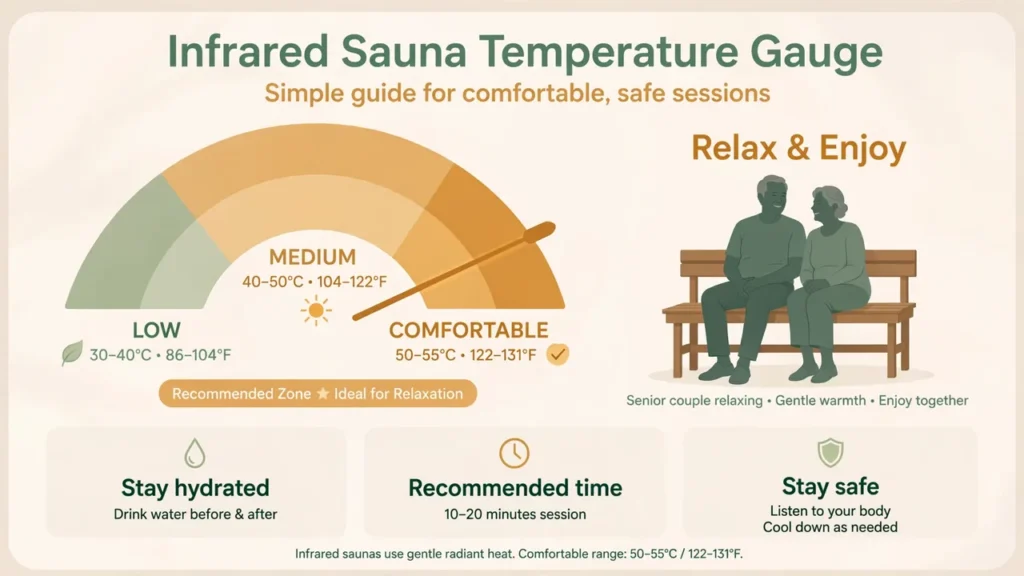
There is no single official temperature limit for seniors, and no regulator publishes one. The ranges below bring together the guidance most manufacturers, clinics and sauna makers repeat: start low, stay in the lower half of the normal infrared range, and let comfort, not the dial, decide.
Most home infrared cabins run between about 120 and 140°F (49 to 60°C) in normal use, with some full-spectrum models going higher. For seniors, the useful part of that range is the lower end. The table below shows how to use it.
| Zone | Temperature | Who it suits | Session length |
|---|---|---|---|
| Starting zone | 110 to 120°F (43 to 49°C) | First sessions, anyone over 70, anyone with a health condition | 10 to 15 minutes |
| Comfortable zone | 120 to 130°F (49 to 54°C) | Healthy seniors who have used the sauna for several weeks | 15 to 20 minutes |
| Upper zone, use rarely | 130 to 140°F (54 to 60°C) | Experienced, healthy seniors only, and only if it still feels easy | 15 to 20 minutes, never longer |
| Above 140°F (60°C) | Avoid for routine senior use | Not a target to work towards | Shorten the session or lower the setting |
Ranges are planning guidance drawn from manufacturer and clinic advice, not a medical prescription. Your doctor may set a lower limit for you. Always follow your sauna manual as well.
Notice what the table does not say. It does not say to work your way up to the hottest setting. For a senior, the comfortable zone is the destination, not a stepping stone. If 120°F feels good and you sweat lightly, you have found your setting.
Why the thermometer can mislead you
The number on the cabin display is the air temperature near the sensor, not the heat reaching your skin. Infrared panels warm you directly, so you can feel warm and start sweating while the display still reads 115°F.
Trust your body over the display. If you feel too hot, open the door a little, sit nearer the door, or end the session. The sauna will still be there tomorrow.
Preheating: warm the cabin, not yourself out
Most cabins take 15 to 30 minutes to reach their set temperature. Preheating is worth doing, because stepping into a cold cabin and then sitting through a long warm-up stretches the session without adding benefit.
Set the cabin to your target temperature, let it preheat, and then get in. If you use a shared or gym sauna, ask staff to set it to the lower end of the range for your session.
How Long Should a Senior Stay In?
Short sessions are the senior rule. Ten to fifteen minutes is the right first session for most older adults, even if you feel fine at the end of it. Feeling fine at minute fifteen does not mean minute thirty would have been fine too. Heat strain builds quietly.
Build up over weeks, not days. Add about five minutes at a time, and only add time or temperature in one step, never both at once. That way, if a session feels too much, you know which change caused it.
| Stage | Temperature | Session length | How often |
|---|---|---|---|
| Week 1, first sessions | 110 to 120°F (43 to 49°C) | 10 to 15 minutes | 2 times a week |
| Weeks 2 to 3 | 115 to 125°F (46 to 52°C) | 15 minutes | 2 to 3 times a week |
| Week 4 onwards | 120 to 130°F (49 to 54°C) | 15 to 20 minutes | 3 times a week |
| Experienced, healthy seniors | Up to 130°F (54°C) | 20 minutes, and no longer than 30 | 3 to 4 times a week at most |
This is a gradual build-up plan, not a target to rush. Stay at any stage for as long as you like. If you miss a week, drop back one stage when you return.
Keep the total under 30 minutes even when you are experienced. Longer sessions add dehydration and blood pressure risk without a clear extra benefit for a senior user. If a session ever feels like endurance, it has gone on too long.
Skip the sauna entirely on days when you feel unwell, have a fever, are dehydrated, or have drunk alcohol. A missed session costs nothing. A session on a bad day can cost a fall.
A Simple Starter Routine for Seniors
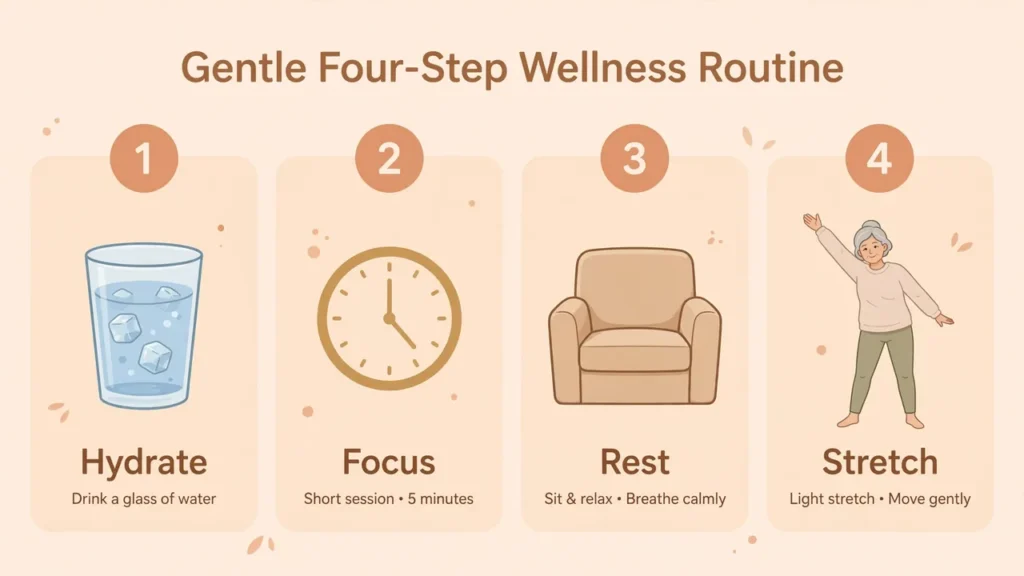
A routine removes guesswork, and guesswork is where most sauna mistakes happen. Follow the same steps each time until they feel automatic. The whole routine, including rest, takes about 45 minutes.
Before the session
- Tell someone. Let a family member or carer know you are going in, and roughly when you will be out.
- Drink a glass of water. Do this 20 to 30 minutes before the session, not in a rush at the door.
- Eat lightly, or wait. A small snack an hour before is fine. Avoid a heavy meal right before a session, and avoid alcohol entirely that day.
- Preheat the cabin to 110 to 120°F for a first session. Lay a towel on the bench and put a second towel within reach.
- Keep water and your phone nearby. Water stays outside the cabin, within easy reach of the door. Your phone stays outside too, where you can reach it when you come out.
During the session
- Set a timer for 10 to 15 minutes. Do not rely on feeling to judge the time. Heat dulls your sense of how long you have been in.
- Sit upright on the lower bench if there is one. Sit with your back against the panels and your feet flat. Avoid lying flat unless your doctor has said it is fine for you, because getting up from lying down is the riskiest move in a sauna.
- Breathe normally and stay still. Gentle stretching is fine, but vigorous movement raises your heart rate and your fall risk when you stand.
- Open the door if you feel too warm. There is no rule that says the door must stay shut. A little cooler air is better than pushing through discomfort.
After the session
- Drink another glass of water. Sip it slowly rather than gulping it down.
- Sit on the edge of the bench for one to two minutes. Swing your legs slowly, let your head clear, and only then stand, holding the grab bar or the door frame.
- Rest for 15 to 20 minutes. Sit in a cool room, let your body temperature settle, and do not rush into a shower, a walk or driving.
- Take a lukewarm shower, not a cold plunge. A sudden cold shock can strain the heart and blood vessels. Lukewarm water is enough to rinse off sweat.
- Note how you felt. A short note, even one line, helps you and your doctor see patterns: how long you stayed in, the temperature, and whether you felt dizzy, tired or fine.
Our step-by-step guide on how to use an infrared sauna covers the same routine in general terms, and what to do before and after an infrared sauna adds more detail on the cool-down. If you are new to saunas altogether, read how to prepare for an infrared sauna before your first visit.
Getting In and Out Safely: The Part Most Guides Skip
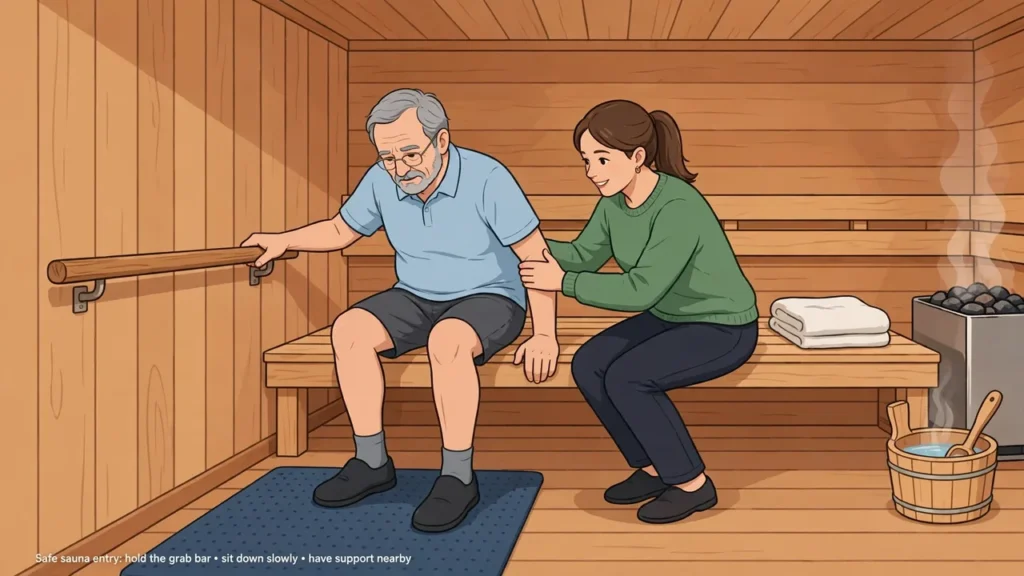
For a senior, the riskiest moments in a sauna are not in the middle of the session. They are the step in and the step out. A low bench, a narrow door, a slippery floor and a sudden stand can combine into a fall in seconds.
Plan the entry and exit like you would plan a staircase. Hold something solid at every step, move slowly, and never rush. If your sauna has no grab bar, that is a problem worth fixing before your next session, not after a fall.
| Moment | What to do | Why it matters |
|---|---|---|
| Approaching the cabin | Wear non-slip sandals, carry nothing in both hands, keep the floor dry | Wet feet on a hard floor are a common cause of sauna-area falls |
| Stepping in | Hold the door frame or grab bar, step in one foot at a time, sit down at once | Standing in a hot cabin while you decide where to sit wastes balance |
| Sitting down | Lower yourself with your arms, sit on the lower bench, keep feet flat | A lower seat means a shorter drop and an easier stand later |
| During the session | Stay seated, avoid lying flat, keep the door handle in view | You should always be able to leave quickly without help |
| Standing up | Sit on the bench edge for 1 to 2 minutes, then stand slowly holding a bar | Blood pressure dips most in the first minute after standing |
| Stepping out | Step out one foot at a time, hold the frame, sit down at once if dizzy | Dizziness on exit is the warning sign, not a thing to walk through |
Five features that make a sauna senior-friendly
- A grab bar inside the cabin, within reach of the bench. If your cabin has none, a sturdy, heat-safe bar fitted by the maker or an installer is a worthwhile addition.
- A low bench, about chair height. A bench you can sit on with your feet flat on the floor is far safer than a high bench you must climb onto.
- A wide, low-threshold door. A door you can step through without lifting your feet high, and wide enough for a walking frame if you use one, removes a trip hazard.
- Simple controls inside and outside. Large buttons or a simple dial beat a small touchscreen, especially with warm, damp hands.
- A timer you can see and hear. An automatic shut-off is the single most useful safety feature for any senior sauna user.
If you use a walking aid, a wheelchair or a hearing aid, talk through the layout with whoever owns the sauna before your first session. A public or gym sauna may be able to set aside a quieter time or a cabin nearer the changing room.
Hydration: Drink on a Schedule, Not on Thirst
Sweating in a sauna loses water and salts. For a younger adult, that is usually a minor thing. For an older adult, it can mean a headache, confusion, a fall or a hospital visit, because thirst signals weaken with age and some medicines increase fluid loss.
The rule is simple. Drink before you feel thirsty, and drink again after. A glass of water before the session and a glass after is a sensible baseline. On a hot day, or if you sweat heavily, add a second glass after and rest longer before driving.
- Before: one glass of water 20 to 30 minutes before the session.
- After: one to two glasses of water, sipped slowly over the cool-down.
- Avoid alcohol before and after a session, and on sauna days generally. Alcohol widens blood vessels, increases dehydration and raises fall risk.
- Avoid caffeine just before a session if it makes your heart race or makes you feel jittery. Water is the safer choice.
- Ask your doctor about electrolytes if you take diuretics or have been told to limit fluids. Do not add salt tablets or sports drinks on your own.
One caution deserves emphasis. Some seniors have been told by a doctor to limit how much fluid they drink, often because of heart or kidney trouble. If that is you, the usual hydration advice does not apply in the same way. Raise it with your doctor before you sauna, and do not try to work it out alone.
Medicines and Health Conditions to Discuss With Your Doctor
This is the most important section in this guide for many readers. A sauna is not a medicine, and it can interact with medicines and conditions in ways that are easy to miss. The table below is a starting point for a conversation with your doctor, not a diagnosis and not a clearance to sauna.
Take a list of your medicines to that conversation. Include over-the-counter medicines, eye drops and supplements, because several of them affect sweating, blood pressure or heat tolerance.
| Condition or medicine | Why it matters in a sauna | What to ask your doctor |
|---|---|---|
| Heart disease, angina, recent heart attack or stroke | Heat raises heart rate and lowers blood pressure, which can strain the heart | Is sauna use safe for me at all, and at what temperature and length? |
| Low blood pressure or fainting | Heat can drop blood pressure further on standing, raising fall risk | What temperature and session length are safe, and should someone stay with me? |
| High blood pressure | Blood pressure can swing during and after heat exposure | Should I check my blood pressure before and after sessions? |
| Diabetes | Nerve damage can dull heat sensation, and heat can affect blood sugar | How should I check my feet and blood sugar around a session? |
| Beta blockers | They can limit how much the heart rate rises during heat, changing how the body copes | Do I need a lower temperature or shorter sessions? |
| Diuretics (water tablets) | They increase fluid loss, so sauna sweating adds to dehydration risk | How much should I drink, and should I avoid the sauna on dose days? |
| Medicines that reduce sweating | Some antihistamines and other medicines blunt sweating, so the body cools less well | Do any of my medicines affect sweating or heat tolerance? |
| Conditions affecting heat sensation | Neuropathy, multiple sclerosis and similar conditions can dull the sense of heat | Is sauna use safe for me, and what warning signs should I watch for? |
| Arthritis and joint pain | Warmth often feels soothing, but it does not treat arthritis itself | Can gentle heat help my routine, and what should I avoid? |
This table is general information for a doctor conversation. It does not list every medicine or condition that matters. Bring your full medicine list to your appointment.
If your doctor says no, or says not yet, that is a complete answer. A sauna is a pleasure, not a prescription. There are other ways to warm stiff joints and relax, and your doctor can suggest them.
Arthritis, Sleep and Heart Health: What the Evidence Actually Says
Many seniors come to infrared saunas hoping for help with stiff joints, poor sleep or heart health. The honest picture is mixed, and it is worth stating plainly before anyone spends money on a cabin.
Arthritis and joint stiffness
Warmth often feels good on stiff joints, and many people with arthritis report that gentle heat loosens them up for a while. That is a real comfort effect, and it is a reasonable reason to enjoy a sauna.
It is not the same as treating arthritis. There is no strong evidence that infrared saunas slow joint damage or replace arthritis medicine, exercise or physiotherapy. Use the warmth as a complement to your prescribed care, not a substitute for it.
Our guide on whether an infrared sauna can reduce arthritis pain looks at this question in more detail, with the same caution.
Heart health
The best-known sauna research is a long Finnish study that followed middle-aged men for about twenty years. It found that men who used a sauna more often had lower rates of fatal heart events than men who used one rarely. That is an interesting finding, and it is often quoted.
Two limits matter. First, the study was observational, which means it found an association, not proof that the sauna caused the difference. People who sauna often may also exercise more, eat differently or have other habits that protect the heart. Second, the study looked at traditional dry saunas, not infrared cabins.
Smaller clinical studies of far-infrared heat, including a supervised Japanese protocol known as Waon therapy, have looked at heart failure patients sitting in far-infrared heat at about 60°C (140°F) for around 15 minutes, followed by rest. Those studies were done in clinics, with medical supervision, in people with a specific condition. They are not a reason for a senior at home to copy the same temperature or length.
Our guide on infrared saunas for heart health and our guide to what the Finnish studies say about sauna and longevity explain both the promise and the limits in full.
Sleep
A warm session in the early evening can help some people feel drowsy and fall asleep more easily, because body temperature falls as you cool down afterwards, and that fall is one of the signals for sleep. This is a plausible, gentle effect, not a treatment for insomnia.
Keep evening sessions on the cooler and shorter side, and finish at least an hour before bed. A session that leaves you wired, sweaty or thirsty at bedtime has missed its purpose. Our guide on infrared saunas for better sleep covers timing in more detail.
Diabetes
Diabetes needs special care in a sauna. Nerve damage in the feet can dull the sense of heat, so a senior with diabetes may not notice a bench or panel that is too hot. Heat can also affect blood sugar, and sweating can mask the early signs of low blood sugar.
Check your feet before and after a session, keep sessions short and cool, and talk to your doctor about checking blood sugar around sauna use. Our guide on infrared saunas for diabetes goes into the practical checks.
One claim to ignore is detox. Saunas make you sweat, and sweat contains small amounts of waste products, but the liver and kidneys do the real work of clearing waste from the body. A sauna does not detox you, and no sauna can replace medical care for any condition.
Signs to Stop a Session Right Away
Leave the sauna as soon as any of these appear. Do not wait to see if it passes. Sit down just outside the cabin, drink water, and ask for help if the feeling does not fade within a few minutes.
- Dizziness, light-headedness or feeling faint
- Nausea or feeling unwell in your stomach
- Headache that starts during the session
- Chest pain, tightness, palpitations or shortness of breath
- Confusion, trouble speaking or unusual drowsiness
- Muscle cramps that do not ease
- Skin that feels painfully hot, or a burn from touching a panel
- Feeling much hotter than usual, or stopping sweating while still feeling hot
Chest pain, trouble breathing, confusion or fainting are emergency signs. Call your local emergency number and do not drive yourself. If you are helping a senior who shows these signs, stay with them and call for help.
Should a Senior Ever Sauna Alone?
It depends on how frail you are. A healthy, steady 65-year-old who has used a sauna for years can reasonably use a home cabin alone, provided someone knows they are in there and a phone is within reach outside the cabin.
A senior who is frail, has fainted before, has low blood pressure, uses a walking aid, or has a heart condition should not sauna alone. The companion does not need to sit inside the cabin. They need to be in the house, aware, and able to check in after the expected time.
For families and carers, agree on a simple check-in before the first session. The senior says when they go in and when they expect to be out. If they have not come out five minutes after that time, the carer checks. That one habit covers most of the risk of saunaing alone.
Common Mistakes Seniors Make in an Infrared Sauna
- Starting at the highest setting. The dial goes higher than you need. Start at 110 to 120°F and let your body tell you what is enough.
- Staying in for a full half hour on day one. Heat strain is quiet. Ten to fifteen minutes is a complete first session.
- Standing up fast at the end. This is the typical senior sauna fall. Sit on the bench edge first, every time.
- Skipping water because you do not feel thirsty. Thirst is a late signal in older adults. Drink on a schedule.
- Saunaing after a drink. Alcohol and heat are a bad combination at any age, and a worse one for balance and blood pressure in later life.
- Pushing through dizziness. Dizziness is the signal to leave, not a hurdle to get past. There is no benefit in staying in while dizzy.
- Copying a younger person’s routine. A routine built for a fit 40-year-old is not a target for a 75-year-old. Build your own, slowly.
A Note for Families and Carers
If you are reading this for a parent or a person you care for, the best help you can give is practical. Go with them for the first few sessions. Check the cabin for a grab bar, a low bench and a working timer. Agree on the temperature and the timer setting together, and write them on a card by the cabin so nobody has to remember them.
Watch the first exits, not just the first entries. The way someone stands up and steps out tells you more about their safety than how they look sitting inside. If they wobble, lower the temperature and shorten the session next time, and raise it with their doctor.
Finally, respect their choice. Some seniors love the warmth and the quiet. Others find it uncomfortable and would rather stop. A sauna should be a pleasure they choose, not a routine they endure.
Frequently Asked Questions
What temperature should a senior set an infrared sauna to?
Start at 110 to 120°F (43 to 49°C). Most healthy seniors who have used a sauna for several weeks settle at 120 to 130°F (49 to 54°C). There is no need to go above 140°F (60°C) for routine use.
How long should a senior stay in an infrared sauna?
Ten to fifteen minutes for a first session, building to 15 to 20 minutes over several weeks. Keep sessions under 30 minutes even when you are experienced, and leave sooner if you feel dizzy or unwell.
Is an infrared sauna safe for someone over 70?
It can be, for many healthy older adults, at low temperatures and short sessions, with a doctor’s agreement first. Age alone is not a ban, but heart conditions, low blood pressure, diabetes and some medicines need a doctor’s advice before the first session.
Can a senior with high blood pressure use an infrared sauna?
Only with a doctor’s agreement. Heat lowers blood pressure, which can be risky on standing, and blood pressure medicines change how the body responds. Ask your doctor about a safe temperature, session length and whether to check blood pressure before and after.
How often can a senior use an infrared sauna?
Start with 2 sessions a week, then build to 2 to 3 times a week. Experienced, healthy seniors may use it 3 to 4 times a week. Leave at least a day between early sessions to see how your body responds.
Should a senior sauna alone?
A healthy, steady senior can sauna alone if someone knows they are in there and a phone is within reach. A frail senior, or one with a history of fainting, low blood pressure or a heart condition, should have someone in the house who can check in.
What should a senior do if they feel dizzy in a sauna?
Leave the sauna straight away, sit down just outside the cabin, and drink water. Do not try to walk through dizziness. Ask for help if it does not fade within a few minutes, and call emergency services for chest pain, trouble breathing, confusion or fainting.
Can an infrared sauna help arthritis pain?
Gentle warmth often feels soothing on stiff joints for a while, and many people with arthritis enjoy that comfort. It is not a treatment for arthritis, and it does not replace medicine, exercise or physiotherapy. Talk to your doctor about fitting gentle heat into your routine.
The Bottom Line
An infrared sauna can be a gentle, enjoyable habit in later life, and the safest version of it is also the simplest. Start at 110 to 120°F for 10 to 15 minutes.
Tell someone you are going in. Drink water before and after. Stand up slowly. And check with your doctor first if you have a heart condition, low blood pressure, diabetes or medicines that affect heat tolerance.
There is no prize for the hottest session or the longest sit. The prize is a warm, calm twenty minutes that leaves you feeling rested, not drained. Keep it low, keep it short, and keep it regular, and the sauna will still be there next week.
Sources and Further Reading
Temperature and session ranges in this guide draw on manufacturer and clinic guidance, including Cleveland Clinic guidance on starting infrared sessions at a low temperature for a short time, and sauna maker guidance on starting at 110 to 120°F for 10 to 15 minutes. The Finnish cohort findings discussed here are observational and relate to traditional dry sauna, not infrared cabins. The Waon therapy protocol described here is a supervised clinical protocol, not a home routine. Readers should follow their own sauna manual and their doctor’s advice, which take priority over general guidance.
Internal reading on this site: how hot an infrared sauna should be, how long to stay in an infrared sauna, is an infrared sauna safe, and how to use an infrared sauna.