
If you have high blood pressure, low blood pressure, or a reading that sits somewhere in between, an infrared sauna raises a fair question. Heat changes how your blood vessels behave, and blood pressure is a direct measure of that behaviour. So what actually happens to your numbers when you sit in a warm cabin for twenty minutes, and is it safe to try?
This guide to Infrared Sauna and Blood Pressure separates what studies have actually measured from what is merely claimed. The short version is that most research points in a reassuring direction for people with stable, controlled blood pressure: pressure usually dips after a session rather than spiking. But the same dip is exactly what can make some people lightheaded when they stand up, and it is why anyone with uncontrolled blood pressure, low blood pressure, a heart condition, or blood pressure medication needs to be more careful. This article looks at what heat does to blood pressure, what the studies actually show, and when to skip a session altogether.
Please read first: this is not medical advice. An infrared sauna is a wellness tool, not a treatment for high or low blood pressure. If you are pregnant, live with a heart or circulation condition, have low blood pressure, or take medication that affects blood pressure or heat tolerance, check with your doctor before using a sauna. Never stop, skip, or change prescribed blood pressure medication in favour of sauna sessions.
How Heat Moves Your Blood Pressure
Blood pressure is the force of blood pushing against your artery walls. It is written as two numbers. The top number, systolic pressure, measures the force when your heart beats and pushes blood out. The bottom number, diastolic pressure, measures the force between beats, when your heart rests and refills.


#Paid Links
Heat changes both numbers because it changes your blood vessels. When your body warms up in a sauna, the vessels near your skin widen to release heat. Doctors call this vasodilation. Wider vessels give blood more room, so pressure on the vessel walls tends to fall. At the same time, your heart beats faster to keep blood moving to the skin, and you lose fluid through sweat.
That combination explains the pattern researchers keep seeing. During a session, pressure often rises at first as your heart works harder and your body reacts to the heat. Then, as your vessels stay open and you cool down afterwards, pressure falls, often to below where it started. The fall is usually modest and short lived, but it is real, and it is the reason the same session can feel relaxing for one person and dizzying for another.



#Paid Links
What the Numbers Mean: Blood Pressure Categories
Before deciding whether sauna heat is a good idea for you, it helps to know where your own readings sit. The categories below follow the widely used American College of Cardiology and American Heart Association thresholds. A single reading never tells the whole story, and home monitors can misread if the cuff is the wrong size or your arm is not supported, so treat these bands as a guide for a conversation with your doctor, not as a diagnosis.
| Category | Systolic (top number) | Diastolic (bottom number) |
|---|---|---|
| Normal | Below 120 | Below 80 |
| Elevated | 120 to 129 | Below 80 |
| Stage 1 high blood pressure | 130 to 139 | 80 to 89 |
| Stage 2 high blood pressure | 140 or higher | 90 or higher |
| Low blood pressure | Often described as below 90 | Often described as below 60 |
Two things about that table matter for sauna use. First, the risk is not only at the top end. Low blood pressure can be just as relevant in a hot cabin, because heat pushes pressure lower still. Second, the numbers on the day matter more than the label. A person with stage 1 hypertension that is stable on medication is in a very different position from someone whose readings are uncontrolled or climbing, even if both share the same category name.
What Happens During and After a Session
Your blood pressure does not move in one direction during a sauna session. It follows a curve, and knowing the shape of that curve helps you understand why the minutes after a session deserve as much care as the session itself.
The first few minutes: your body reacts to the heat
As the cabin warms you, your heart rate climbs and your body starts to sweat. In a small 2019 study of 19 healthy adults, both systolic and diastolic pressure rose measurably during a 25-minute session at 93 degrees C. That rise is your circulation working harder to move blood to the skin and shed heat. For most healthy people it is unremarkable, but it is one reason a very hot session is a poor idea if your blood pressure is already high and uncontrolled.



#Paid Links
The cool-down: pressure dips below where it started
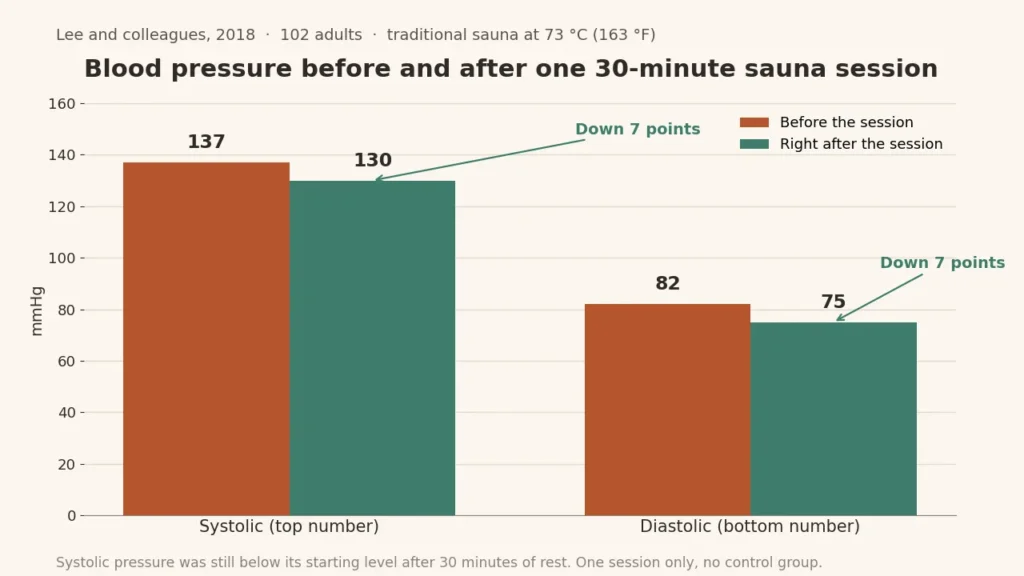
The more consistent finding across studies is what happens next. Once you leave the heat and your vessels stay widened, pressure falls. In that same 2019 study, both numbers dropped below their starting levels during the 30-minute rest period after the session. The same pattern showed up in a larger 2018 study of 102 adults, described in detail below, where the top number was still lower than baseline half an hour after the session ended.
This after-drop is usually a good thing for people with mildly raised pressure. It is also the moment of greatest risk for people prone to dizziness. Standing up quickly from a bench, stepping into a cold shower, or walking to the car while your vessels are still wide open can leave your brain briefly short of blood, and that is when lightheadedness and fainting happen.
Practical takeaway: plan your exit as carefully as your entry. Sit on the edge of the bench for a minute before standing, stand slowly, and give yourself a proper cool-down before driving or doing anything that needs full alertness. If you feel woozy, sit back down and stay there until it passes.
What the Research Actually Shows
The honest picture is mixed, and it matters to say so plainly. There is a solid long-term study, a useful short-term study, and a handful of small trials. None of them proves that an infrared sauna treats high blood pressure, and most of the strongest evidence comes from traditional Finnish saunas, not infrared cabins. Here is what each piece of research actually found.
| Study | Who took part | What it found | What limits it |
|---|---|---|---|
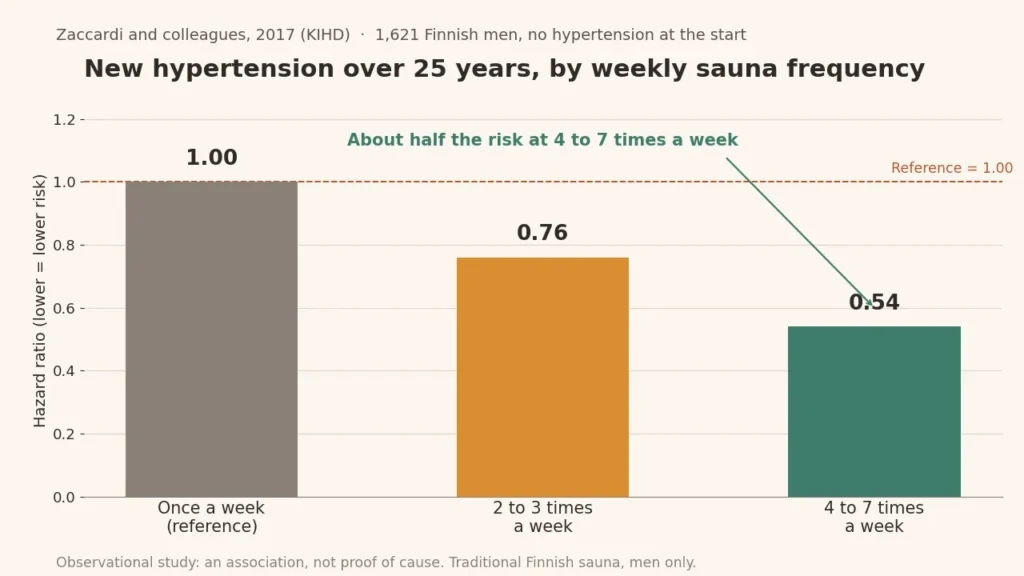
| Zaccardi and colleagues, 2017, American Journal of Hypertension | 1,621 Finnish men aged 42 to 60, no high blood pressure at the start | Over a median of 24.7 years, men using a sauna 4 to 7 times a week had about half the risk of developing hypertension compared with once-a-week users | Observational, men only, traditional Finnish sauna, habits recorded once at the start |
| Lee and colleagues, 2018, European Journal of Preventive Cardiology | 102 adults with at least one cardiovascular risk factor, single 30-minute session at 73 degrees C | Average systolic pressure fell from 137 to 130 and diastolic from 82 to 75; the top number stayed below baseline after 30 minutes of rest | One session only, traditional sauna, no control group, short follow-up |
| Kihara and colleagues, 2001, Journal of the American College of Cardiology | Patients with chronic heart failure, two weeks of far-infrared sauna | Systolic pressure fell from 128 to 124 and diastolic from 77 to 72 on average | Small, supervised clinical setting, patients with heart failure, not a home sauna routine |
| Gayda and colleagues, 2012, Journal of Clinical Hypertension | 16 patients with untreated hypertension, crossover trial | Sauna alone, and exercise followed by sauna, reduced total vascular resistance, with effects lasting up to 120 minutes | Very small sample, short-term measures, not a long-term blood pressure outcome |
The long-term evidence: frequent sauna use and new hypertension
The strongest study is the Finnish Kuopio Ischaemic Heart Disease study, published in 2017. It followed 1,621 men aged 42 to 60 who did not have high blood pressure when the study began. Over a median follow-up of nearly 25 years, 251 of them, or 15.5 percent, developed hypertension.
Compared with men who used a sauna once a week, those who went 2 to 3 times a week had a hazard ratio of 0.76, meaning roughly a quarter lower risk, though the confidence interval crossed 1.0, so that result was not statistically clear. Men who went 4 to 7 times a week had a hazard ratio of 0.54, roughly half the risk, and that result held up after adjusting for fitness, alcohol, family history, and other factors, at 0.53.
The short-term evidence: one session, measured carefully
The clearest short-term numbers come from Lee and colleagues in 2018. In a study of 102 adults, each with at least one cardiovascular risk factor, a single 30-minute session at 73 degrees C (163 degrees F) with low humidity brought average systolic pressure down from 137 to 130 and diastolic from 82 to 75. The top number was still below its starting level after 30 minutes of rest.
That is a real, measured effect, and a drop of around 7 points on both numbers is large enough to matter clinically if it were sustained. But one session is not a treatment plan. The study measured a single visit, it had no control group, and it used a traditional sauna at 73 degrees C, which is far hotter than the 45 to 60 degrees C (113 to 140 degrees F) most infrared cabins run at. The numbers show what heat can do to blood pressure in the short term. They do not show that an infrared cabin at home will produce the same result.
The infrared-specific evidence: small but encouraging
Direct evidence for infrared saunas and blood pressure is thinner. The best-known far-infrared study, Kihara and colleagues in 2001, treated patients with chronic heart failure with two weeks of supervised far-infrared sauna sessions. Average systolic pressure fell from 128 to 124 and diastolic from 77 to 72. That is a modest change, and it happened in a hospital-style setting with patients under supervision, not in a home cabin.
A small crossover trial by Gayda and colleagues in 2012 looked at 16 patients with untreated hypertension. Sauna alone, and exercise followed by sauna, both reduced total vascular resistance, which is the resistance blood meets as it flows through the vessels, and the effect lasted up to two hours. Sixteen people is a very small group, and the study measured short-term changes rather than long-term blood pressure control. Still, it points in the same direction as the larger studies: heat relaxes the vessels.
For a wider view of how sauna heat affects the heart, our guide to infrared sauna for heart health covers the cardiovascular evidence in more detail, including the limits of the Finnish studies.
The Limits of the Evidence, Stated Plainly
It would be easy to read the numbers above and conclude that saunas lower blood pressure. That conclusion goes further than the research allows, and the gaps matter if you are making a health decision.
- The long-term study is observational. The Finnish cohort shows an association between frequent sauna use and lower hypertension risk, not proof of cause. Frequent sauna users may differ from occasional users in income, lifestyle, diet, or general health in ways the study could not fully measure.
- It studied men only. The hypertension study followed middle-aged Finnish men. Women were not included, so the findings cannot simply be assumed to apply to women in the same way.
- It studied traditional saunas, not infrared cabins. The Finnish saunas ran at around 78 to 81 degrees C, far hotter than a typical infrared cabin. The authors themselves noted the findings may not apply to steam rooms or hot tubs, which run cooler, and the same caution applies to infrared cabins.
- The short-term studies are small and brief. A single session, or two weeks of supervised sessions, tells us about immediate responses, not about what happens after months of home use.
- Sauna habits were recorded once. In the long-term study, habits were captured at the start and may have changed over 25 years of follow-up.
None of this means sauna heat is useless for blood pressure. It means the honest claim is narrower: regular heat exposure is linked with lower hypertension risk in one large group of Finnish men, and single sessions measurably lower pressure for a short time. That is a reason to talk to your doctor about trying it, not a reason to treat a sauna as a blood pressure therapy.
High Blood Pressure: How to Use an Infrared Sauna More Safely
If your blood pressure is high but stable and controlled, many doctors are comfortable with gentle sauna use. If it is uncontrolled, rising, or you have recently changed medication, the answer is more likely to be wait and ask first. The rules below are the conservative habits that keep a session low risk. They do not replace your doctor’s advice for your specific readings.
- Get clearance first if your readings are high. Ask your doctor before your first session if your blood pressure is above 140 over 90 despite medication, if it has recently risen, or if you have any heart or kidney condition alongside it.
- Start cooler and shorter than you think you need. Begin with 10 to 15 minutes at the lower end of your cabin’s range, and build up slowly over weeks. There is no benefit in chasing the hottest setting.
- Hydrate before and after. Drink a glass of water before you go in and again afterwards, and keep water nearby. Sweating reduces fluid volume, which can push pressure down further and leave you dehydrated. Our infrared sauna hydration guide explains how much to drink and which warning signs point to dehydration.
- Never sauna alone when your pressure is a concern. Use the sauna when someone else is at home, or tell someone you are going in. If you feel unwell, you want help close by.
- Skip alcohol completely. Alcohol widens blood vessels and lowers pressure further, and it dulls your sense of how hot you are. No drink before or during a session.
- Keep sessions regular rather than extreme. The Finnish research linked benefit to frequency, not intensity: several moderate sessions a week, not one punishing session.
- Cool down gradually. Sit for a few minutes after the session, then stand slowly. Avoid jumping straight into a cold plunge or an ice-cold shower, which constricts vessels suddenly and can swing pressure the other way. For more on contrast routines, see our guide to infrared sauna and cold plunge for beginners.
Older readers should be extra careful here, because blood pressure control and heat tolerance both change with age. Our guide to infrared sauna use for seniors covers safe temperatures, getting in and out, and session tips for older users.
Low Blood Pressure: The Risk Most People Miss
Most sauna and blood pressure articles focus on high readings. Low blood pressure deserves equal attention, because heat pushes it in exactly the wrong direction. Low blood pressure is often described as a reading below 90 over 60, but the number matters less than the symptoms: dizziness on standing, blurred vision, fainting, or a washed-out, weak feeling are the signs that your pressure is too low for comfort.
When your vessels widen in the heat and you lose fluid through sweat, there is less pressure pushing blood upward to your brain. Standing up quickly from a bench makes it worse, because gravity pulls blood toward your legs just as your vessels are at their widest. This is called orthostatic hypotension, and it is the most common reason people feel faint after a sauna.
If you already run low, take these extra steps
- Talk to your doctor first. This is not optional if you have fainted before, have been diagnosed with low blood pressure, or take medication that lowers pressure.
- Keep sessions short and cool. Ten minutes at a lower temperature is a sensible ceiling until you know how your body responds.
- Drink before you go in, not only after. Starting hydrated gives your circulation a better buffer against the pressure drop.
- Change position in stages. Sit up slowly, dangle your legs for a minute, then stand. If the room swims, sit back down at once.
- Eat before your session. Sauna on an empty stomach, especially first thing in the morning, makes lightheadedness more likely.
- Do not use a sauna after a hot bath or heavy exercise. Both already widen your vessels, so the effects stack.
If you regularly feel dizzy when you stand up, with or without a sauna, that is worth raising with your doctor on its own. It can be a side effect of medication, dehydration, or an underlying condition, and a sauna will only make it more obvious.
Blood Pressure Medication and Sauna Use
Medication complicates the picture, because several common blood pressure drugs change how your body handles heat. None of the points below mean you cannot use a sauna. They mean you should check with the doctor or pharmacist who prescribed the drug, and never adjust a dose around a sauna session on your own.
| Medication type | Why it matters in a sauna | What to ask your doctor |
|---|---|---|
| Diuretics, often called water tablets | They increase urine output, so you start the session with less fluid and can dehydrate faster | How much extra water you need, and whether session length should be shorter |
| Beta-blockers | They slow your heart rate, so your heart cannot speed up as easily to cope with heat | Whether your target heart rate and session length should change |
| ACE inhibitors and ARBs | They widen blood vessels, which can add to the sauna’s own vessel-widening effect | Whether your pressure could drop too low, and what symptoms to watch for |
| Calcium channel blockers | They relax vessel walls and can cause ankle swelling and flushing, which heat can worsen | Whether heat makes your side effects worse, and how long to rest afterwards |
| Alpha-blockers | They can cause a sharp pressure drop on standing, especially after heat | How slowly to stand after a session, and whether evening sessions are safer |
A practical point that catches people out: take your medication at your normal time and do not shift the dose to fit a sauna session. If your doctor wants your pressure checked around sauna use, they will say so. And if you use a wearable to track heart rate, our guide to sauna wearables and recovery tracking explains what the numbers can and cannot tell you.
Warning Signs: Leave the Sauna Now
Your body gives clear signals when heat and blood pressure are not mixing well. Learn them before your first session, because the right response is always the same: get out, cool down, sit or lie down, and get help if symptoms do not ease quickly.
- Dizziness or lightheadedness. The most common warning sign, and the one most often ignored. Do not try to push through it.
- Feeling faint, or actually fainting. Lie down with your legs raised and call for help. Do not drive yourself anywhere.
- Chest pain, tightness, or pressure. Get out at once and seek urgent medical help. Do not wait to see if it passes.
- Shortness of breath that feels wrong. Some breathlessness in heat is normal. Gasping, wheezing, or breathlessness that does not ease after leaving the sauna is not.
- Nausea or a sudden headache. Both can signal overheating or a pressure swing, and both mean the session is over.
- A racing or irregular heartbeat. A faster pulse is expected in heat. A pounding, fluttering, or skipping heartbeat is a reason to stop and, if it continues, to seek care.
- Confusion or trouble speaking. A rare but serious sign. Get help immediately.
- Clammy, pale skin or cold sweats. These can point to a pressure drop or heat illness rather than healthy sweating.
If any of these symptoms appear, do not get back in the sauna that day. Tell your doctor what happened before your next session, and describe the temperature and length of the session so they can judge what went wrong.
When to Skip a Session Entirely
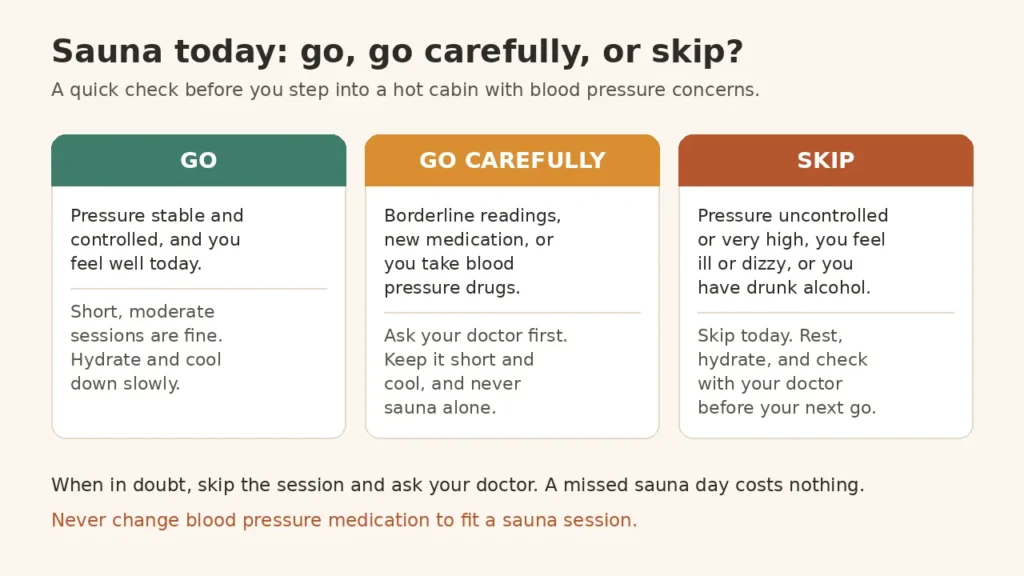
Some days are simply not sauna days. Skipping a session costs nothing, and on the days below it is the right call. If you are unsure whether a day counts, treat it as a skip day and ask your doctor.
Skip the sauna today if any of these apply
- Your blood pressure is unusually high or low today, or you have changed medication in the last few days
- You have chest pain, new shortness of breath, or a racing or irregular heartbeat
- You have a fever, feel ill, or are recovering from an infection
- You are dehydrated, have diarrhoea or vomiting, or have not drunk enough water today
- You have drunk alcohol, or taken a sedative or sleeping medication
- You feel dizzy, faint, or unusually tired before you even go in
- You are pregnant and have not discussed sauna use with your doctor or midwife
- Your doctor has told you to avoid heat, or you have an unstable heart condition or a recent heart procedure
- You have very high blood pressure that is not controlled, generally above 180 over 110, unless your doctor has specifically cleared sauna use
- You would be using the sauna alone and no one would know you were in there
A Safer First Session if You Have Blood Pressure Concerns
If your doctor has said it is fine to try, the goal of a first session is information, not endurance. You are learning how your body responds to heat, so keep everything gentle and leave yourself an easy way out.
- Check your blood pressure first. Sit quietly for five minutes, then take a reading with your home monitor. Write it down, with the time.
- Drink a glass of water. Do this at least 20 minutes before the session, and keep a bottle within reach inside the cabin if your model allows it.
- Set the cabin low. Start around 45 degrees C (113 degrees F). You can raise the temperature in later sessions if this one goes well.
- Sit, do not lie flat, and stay 10 minutes. Ten minutes is enough for a first session. Sit upright so you can stand up easily, and keep the door handle within reach.
- Leave slowly. Sit on the edge of the bench for a minute, then stand. Walk to a cool room and sit down for at least 10 minutes before doing anything else.
- Check your pressure again after resting. Take a second reading after 30 minutes of rest, and write it next to the first one. Over a few sessions, these paired readings show you your own pattern far better than any general guide can.
If that first session goes well, add five minutes at a time over the following weeks, and only raise the temperature once the longer sessions feel easy. If you feel unwell at any stage, go back to the shorter, cooler session that worked, and mention it to your doctor. For the basics of timing and session length, see how long to stay in an infrared sauna and our guide to using an infrared sauna.
Measuring Your Blood Pressure Around Sauna Sessions
A home blood pressure monitor turns guesswork into data, and it is the single most useful tool if you use a sauna with blood pressure concerns. The readings only help if they are taken properly, so a few habits matter.
- Measure at the same times. Before the session, after 30 minutes of rest, and at the same time of day on non-sauna days for comparison.
- Sit properly. Feet flat on the floor, back supported, arm resting on a table at heart height, and no talking during the reading.
- Rest first. Sit quietly for five minutes before measuring. A reading taken the moment you stand up from the bench will be misleading.
- Take two readings a minute apart and record both. A single reading can be thrown off by a tight cuff or a deep breath.
- Note the context. Write down the session length, temperature, how much water you drank, and how you felt. Patterns only emerge from notes.
- Bring the log to your doctor. A page of paired readings, with session details, is far more useful to a doctor than a vague sense that saunas feel fine.
One warning about home readings: do not use them to adjust your own medication. If your readings change after starting sauna sessions, that is a conversation with your doctor, not a reason to change a dose yourself. A sauna is a wellness habit, and it should fit around your prescribed treatment, never replace it.
The Bottom Line
Heat widens your blood vessels, and wider vessels mean lower pressure after a session. The research backs that up in the short term, with measured drops of around 7 points on both numbers after a single session, and in the long term, with frequent Finnish sauna users about half as likely to develop hypertension over 25 years. But both findings come with limits: the long-term study was observational, studied men only, and used traditional saunas far hotter than an infrared cabin.
For most people with stable, controlled blood pressure, a gentle infrared sauna routine is a reasonable wellness habit to discuss with a doctor. For anyone with uncontrolled readings, low blood pressure, a heart condition, or medication that affects heat tolerance, the conversation comes first and the sauna comes second. Start cool, start short, hydrate, stand up slowly, and skip the session on any day your body says no. If you want the wider safety picture first, our guide to whether infrared saunas are safe and our overview of infrared sauna health benefits are good next reads.
Frequently Asked Questions
Can I use an infrared sauna if I have high blood pressure?
Many people with stable, controlled high blood pressure can use an infrared sauna, but check with your doctor first, especially if your readings are above 140 over 90 despite medication or you have a heart or kidney condition. Start with short, cooler sessions of 10 to 15 minutes, hydrate well, and never sauna alone.
Does an infrared sauna lower blood pressure?
Short-term studies show blood pressure usually falls after a session. In a 2018 study of 102 adults, average readings fell from 137 over 82 to 130 over 75 after a single 30-minute traditional sauna session. Long-term, frequent sauna users in a Finnish study were about half as likely to develop hypertension, but that study was observational and used traditional saunas, so it does not prove an infrared sauna lowers blood pressure.
Can an infrared sauna make blood pressure drop too low?
Yes. Heat widens blood vessels and sweating reduces fluid, so pressure can fall further than expected, especially when you stand up. People with low blood pressure, or those taking blood pressure medication, are most at risk of dizziness or fainting. Keep sessions short and cool, hydrate before you go in, and stand up slowly.
Should I take my blood pressure medication before a sauna session?
Take your medication at its normal time and do not change the dose or timing to fit a sauna session. Several blood pressure drugs, including diuretics, beta-blockers, and ACE inhibitors, change how your body handles heat. Ask the doctor or pharmacist who prescribed the drug whether sauna use needs any extra precautions for you.
How long should I wait after a sauna session before checking my blood pressure?
Wait at least 30 minutes after leaving the sauna, and sit quietly for five minutes before measuring. A reading taken straight after a session will be lower than your usual resting pressure and will not reflect your normal level. Record the reading with the session length and temperature so you can spot patterns over time.
References
Zaccardi F, Laukkanen T, Willeit P, Kunutsor SK, Kauhanen J, Laukkanen JA. Sauna bathing and incident hypertension: a prospective cohort study. American Journal of Hypertension, 2017. PubMed
Lee E, Laukkanen T, Kunutsor SK, Khan H, Willeit P, Zaccardi F, Laukkanen JA. Sauna exposure leads to improved arterial compliance: findings from a non-randomised experimental study. European Journal of Preventive Cardiology, 2018. DOI
Kihara T, Biro S, Imamura M, Yoshifuku S, Takasaki K, Ikeda Y, Tei C, et al. Repeated sauna treatment improves vascular endothelial and cardiac function in patients with chronic heart failure. Journal of the American College of Cardiology, 2001.
Gayda M, Paillard F, Sosner P, Juneau M, Garzon M, Gonzalez M, Belanger M, Nigam A. Effects of sauna alone and postexercise sauna baths on blood pressure and hemodynamic variables in patients with untreated hypertension. Journal of Clinical Hypertension, 2012. PubMed