
An infrared sauna in an apartment sounds like a luxury reserved for houses with spare rooms and garages. In practice, a compact one-person or two-person cabin can fit in a bedroom corner, a living room nook or even a large closet, and most small models plug into an ordinary wall outlet. The idea is realistic, but it is not as simple as ordering a cabin and switching it on.
Four things decide whether it works in your flat: power, noise, space and your landlord. Get those four right and an apartment sauna can be a calm daily ritual. Get one wrong and you could trip a breaker, annoy the neighbours downstairs or break the terms of your lease. This guide walks through each check in plain language, with the numbers you need before you buy.
Please read this first: general guidance, not medical advice and not a substitute for a licensed electrician.
Infrared saunas are wellness tools, not treatments. They do not cure disease, and they are not a substitute for medical care. If you are pregnant, live with a heart or circulation condition or low blood pressure, or take medicine that affects how you handle heat, check with a doctor first. Hydrate before and after every session, start short, and leave the sauna at once if you feel dizzy or unwell.


Paid Links - As an Amazon Associate, I earn from qualifying purchases.
Electrical and building advice in this article is general guidance only. It is not a substitute for your local electrical code or a licensed professional. Any new circuit, outlet change or hardwired connection must be done by a licensed electrician, and you must check your lease and local rules first.
Cost figures in this article are planning estimates, not quotes. Prices vary by region, brand and installer, so verify current listings and get local quotes before you buy.


Paid Links - As an Amazon Associate, I earn from qualifying purchases.
The Short Answer: Four Checks Before You Buy
Yes, you can put an infrared sauna in most apartments, as long as you choose a model that suits your power supply, your floor space and your lease. The renters who run into trouble are the ones who skip one of the four checks below. Work through them in order, and you will know before you spend anything whether a sauna fits your home.
| Check | What to confirm | Green light looks like |
|---|---|---|
| 1. Power | Your outlet type, circuit size and the sauna wattage | A 120-volt model under 1,800 watts on its own circuit |
| 2. Noise | Fan and heater sound, and how thin your walls are | A quiet fan model, used at neighbour-friendly hours |
| 3. Space | Footprint, clearance, ventilation and the delivery route | Measured floor space with room to open the door fully |
| 4. Permission | Lease clauses, written landlord approval and insurance | A written yes from your landlord before delivery day |
All four checks matter. A sauna that fits your floor but trips your breaker, or one your landlord never approved, is a problem waiting to happen.
If any check fails, that does not always mean no sauna at all. A smaller model, a portable dome or a sauna blanket may pass where a full cabin does not. The rest of this guide shows you how to test each check and what to do when the answer is not a simple yes.
Power: What Your Apartment Outlet Can Actually Run
Power is the first and most important check, because it is the one that can stop you cold. A sauna is a heating appliance, and heating appliances draw a lot of current. Most compact infrared cabins are built for a standard household outlet, but larger cabins are not, and the difference matters more in an apartment, where you cannot simply add a new circuit without permission.


Paid Links - As an Amazon Associate, I earn from qualifying purchases.
120V vs 240V, in Plain Terms
In North America, a standard wall outlet supplies 120 volts. Almost every small infrared sauna sold for home use is designed for 120 volts, which is why they are marketed as plug-and-play. Larger three-person and four-person cabins often need 240 volts instead, which is the same supply used by electric dryers and ovens.
Most apartments do not have a spare 240-volt outlet in a bedroom or living room, and installing one means electrical work, a permit in many areas and your landlord’s written approval. That is a heavy lift for a rental. For most renters, the practical rule is simple: stick to a 120-volt model unless your landlord has already agreed in writing to electrical work.
Outside North America, standard outlets are usually 220 to 240 volts, so the same sauna may plug straight in. Whatever your region, read the sauna’s spec sheet before you buy and match it to the outlets you actually have, not the ones you wish you had.
Amps, Breakers and the Dedicated-Circuit Question
Watts tell you how much power a sauna uses, and amps tell you how much current flows through the circuit. You can work out the amps by dividing watts by volts. A 1,200-watt sauna on a 120-volt supply draws 10 amps.
A 1,600-watt model draws about 13 amps. A 2,400-watt model draws 20 amps, which is the full rating of a standard 20-amp circuit.
Most apartment circuits are rated at 15 or 20 amps, and each circuit usually serves several outlets, not just one. If your sauna shares a circuit with a television, a lamp and a phone charger, the combined load can trip the breaker mid-session. Electrical guidance commonly recommends keeping a continuous load at or below 80 percent of a circuit’s rating, which leaves a 15-amp circuit with about 12 amps of comfortable headroom.
A dedicated circuit, meaning a circuit that serves only the sauna outlet, is the safest setup. Many renters cannot get one without landlord approval and an electrician, so the next best option is to choose a lower-wattage model and to unplug other heavy appliances on the same circuit while the sauna runs. Never replace a breaker with a higher-rated one to stop it tripping. That is dangerous and it is a job for a licensed electrician only.
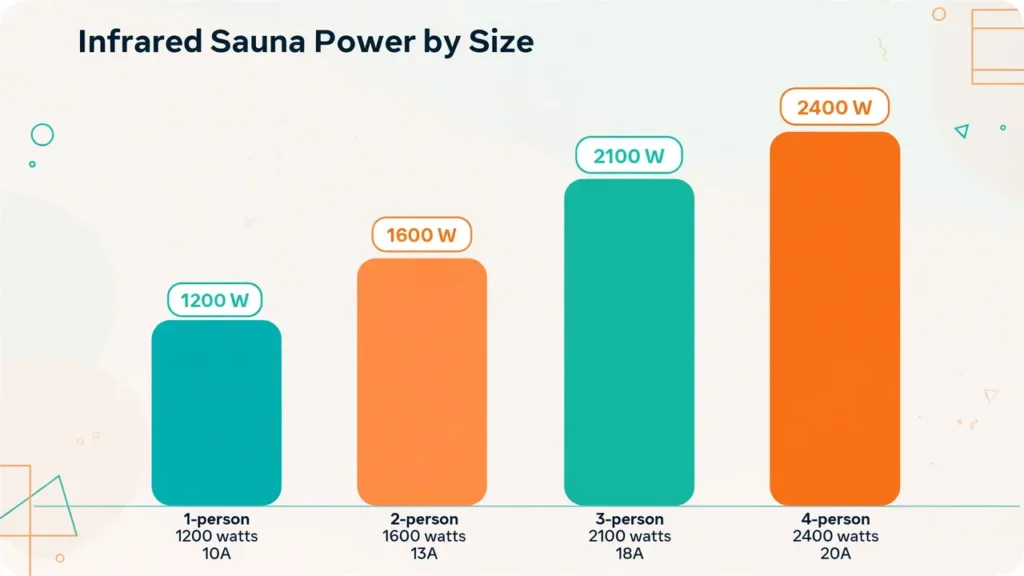
| Sauna size | Typical wattage | Amps at 120V | Typical supply needed |
|---|---|---|---|
| 1-person cabin | 1,000 to 1,400 watts | About 8 to 12 amps | Standard 120V outlet, 15-amp circuit |
| 2-person cabin | 1,400 to 1,800 watts | About 12 to 15 amps | Standard 120V outlet, ideally a dedicated 20-amp circuit |
| 3-person cabin | 1,800 to 2,400 watts | About 15 to 20 amps | Often 240V or a dedicated 20-amp 120V circuit |
| 4-person cabin | 2,400 to 3,000 watts | About 20 to 25 amps | Usually 240V and a dedicated circuit |
| Sauna blanket or dome | 400 to 800 watts | About 3 to 7 amps | Any standard 120V outlet |
Figures are typical ranges taken from manufacturer spec sheets, not exact ratings for any one model. Always check the wattage and voltage printed on the model you plan to buy, and confirm your circuit rating with your landlord or a licensed electrician.
The Extension-Cord Rule
Plug your sauna directly into a wall outlet. Do not run it through a standard extension cord, a power strip or a multi-plug adapter. A sauna draws high current for a long stretch, and a thin or coiled extension cord can overheat, melt or start a fire. This is one of the most common safety mistakes with apartment saunas, and it is easy to avoid.
If the sauna’s own cord cannot reach an outlet, move the sauna, not the outlet. If no outlet is close enough, that spot is the wrong spot. In a rental, adding an outlet means landlord approval and a licensed electrician, so factor that into your decision before you buy. For a deeper look at how much power these units draw in everyday use, see our guide to how much electricity an infrared sauna uses.
- Check the label first. Read the wattage and voltage on the sauna’s spec sheet and on the plug itself.
- Find your breaker panel. Note which breaker serves the outlet you plan to use, and what else is on that circuit.
- Do a trial run. Run the sauna empty for a full session length and check that nothing else on the circuit is running. If the breaker trips, the model is too big for that circuit.
- Ask an electrician. If you are unsure about your panel, your wiring or your circuit rating, ask a licensed electrician before you buy. A short visit costs far less than a damaged circuit.
Noise: How Loud Is an Infrared Sauna, Really?
An infrared sauna is far quieter than a washing machine or a vacuum cleaner, but it is not silent. The sound comes from small fans, a control panel beep and the faint hum of the heating panels. In a detached house nobody notices. In an apartment with thin walls and a neighbour below, it is worth thinking about before you buy.
Where the Sound Comes From
Most of the noise is the circulation fan, which keeps air moving inside the cabin so the heat spreads evenly. Some models also have a small fan for the control unit. The heating panels themselves are usually silent, though a few owners report a faint buzz from older ceramic heaters. The control panel beeps when you press a button or when the timer ends, and that beep can carry through a quiet flat at night.
Before you buy, check the manufacturer’s stated sound level if one is published, and read owner reviews that mention noise. A model with a variable-speed fan or a quiet mode is worth paying a little more for in an apartment. If you can, listen to the same model running in a showroom and stand a few steps away with the door closed.
What Your Neighbours Will Actually Hear
Through a standard interior wall, a neighbour will usually hear very little, about the same as a quiet fan in the next room. The bigger risk is vibration through the floor. A cabin sitting directly on hard flooring can pass a low hum into the flat below, especially in older buildings with wooden floors. A thick rug, a rubber mat or a cork underlay beneath the cabin cuts this down a lot, and it also protects the floor itself.
Timing matters as much as volume. A short evening session at 7 pm is a different matter from a session at midnight in a building with paper-thin walls. Keep sessions to daytime and early evening hours, keep the control panel volume low or muted if the model allows it, and avoid running the sauna late at night. If you share a wall with a neighbour, place the cabin against an interior wall rather than the shared one.
| Sound | Typical level | What it feels like |
|---|---|---|
| Whisper | About 30 decibels | Barely audible across a quiet room |
| Infrared sauna fan | About 40 to 50 decibels | Like a quiet desk fan or a fridge hum |
| Quiet conversation | About 40 to 50 decibels | Normal talking at arm’s length |
| Normal conversation | About 60 decibels | Clearly audible through a thin wall |
| Washing machine spinning | About 70 decibels | Noticeable in the next room and below |
Decibel figures are approximate typical ranges for common household sounds, given for comparison only. Actual sauna fan levels vary by model, so check the manufacturer’s published figure where one is given.
Space: Measuring Before You Buy
Space is the check most people get wrong, because a sauna’s footprint on a website looks small until the box arrives. A one-person cabin is roughly the size of a wardrobe. A two-person cabin is closer to a double wardrobe. Measure your room twice, and measure the route the boxes will take through your building as well.
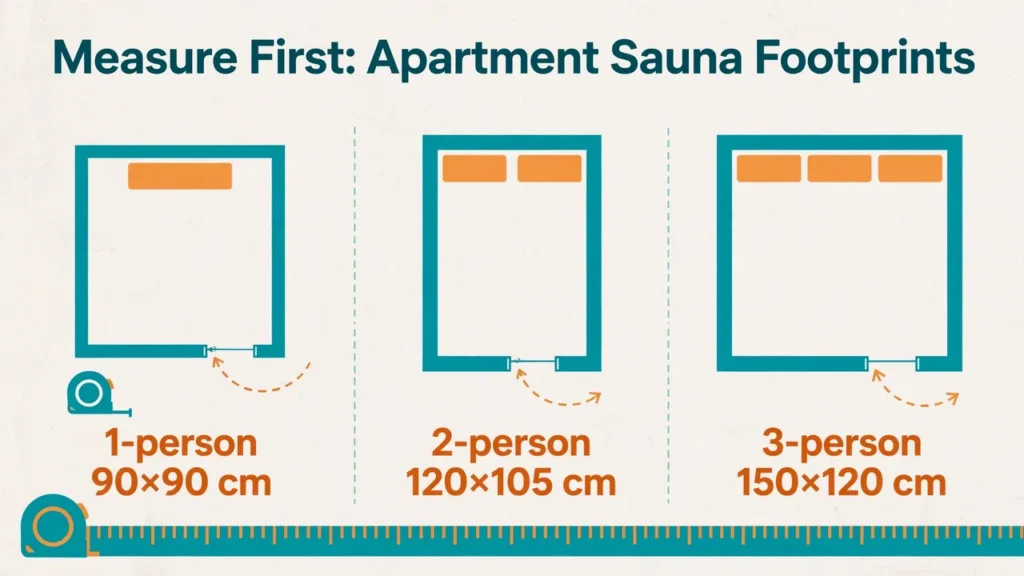
| Sauna size | Typical footprint | Typical height | Floor space to allow |
|---|---|---|---|
| 1-person cabin | About 90 by 90 cm (36 by 36 in) | About 190 cm (75 in) | About 120 by 120 cm, with door swing |
| 2-person cabin | About 120 by 105 cm (48 by 42 in) | About 190 cm (75 in) | About 150 by 140 cm, with door swing |
| 3-person cabin | About 150 by 120 cm (60 by 48 in) | About 195 cm (77 in) | About 180 by 160 cm, with door swing |
| Sauna dome | About 70 by 180 cm lying flat (28 by 71 in) | Folds away | A bed or floor mat area when in use |
| Sauna blanket | About 180 by 90 cm lying flat (71 by 36 in) | Folds away | A bed, sofa or floor mat area when in use |
Dimensions are typical ranges from manufacturer spec sheets. Models vary, so measure the exact unit you plan to buy and add at least 10 cm of clearance on the sides and back for airflow.
Clearance and Airflow
An infrared cabin needs breathing room. Leave at least 10 cm between the cabin and the wall on each side, and more at the back where the panels and wiring sit. Pushing a cabin tight into a corner traps heat, strains the panels and can void the warranty. It also makes cleaning behind the unit impossible, and dust and sweat build up fast in a warm wooden box.
Ventilation matters too. Infrared saunas do not produce steam the way a steam room does, so they do not soak a room with moisture, but a session still releases sweat and warm air. A room with a window you can open, or at least a working extractor fan nearby, stays fresh and dry. Never put a cabin in a room with no airflow at all, and never block the cabin’s own vents.
The Door Swing and the Delivery Route
Measure the door swing as well as the footprint. Most cabin doors open outward, and you need clear floor in front of the door to step in and out safely. A cabin crammed against a bed or a desk is a daily frustration and a trip hazard when you step out warm and a little light-headed.
Then measure the delivery route. Cabins arrive in flat-pack panels, which is good news for apartments, but the longest panels are still close to two metres. Check the width of your building entrance, the lift, the stairwell turns and your front door.
If the lift is small or the stairs are tight, ask the seller for the size of the largest box before you order. If you have already turned a spare corner into a sauna nook, our guide to garage and closet infrared sauna conversions covers the same measure-first thinking for tight spaces.
Floor strength is rarely a problem. A one-person cabin weighs roughly 100 to 150 kg, which is about the weight of one or two adults standing close together, and apartment floors are built for far more. A three-person cabin is heavier, so if your building is very old or your floor feels springy, ask your landlord or building manager before you buy.
Which Type Fits an Apartment Best?
Not every infrared sauna suits a rental. Cabins give the full experience and the best heat, but they are heavy, permanent-looking and hard to move. Domes and blankets give up some comfort and heat coverage, but they fold away, draw very little power and need no landlord approval in most cases. The right choice depends on how long you plan to stay and how much space you have.
- One-person cabin: the best all-round apartment choice. It fits a bedroom corner, runs on a standard outlet and feels like a real sauna. The downside is that it is semi-permanent, so you need landlord approval and a plan for moving day.
- Two-person cabin: worth it only if you share the flat and have the floor space and a 20-amp circuit. Measure carefully, because the jump in size from a one-person model is bigger than it looks on a product page.
- Infrared dome: a good middle ground. You lie on a bed or mat with the dome over your body and your head outside. It stores under a bed, draws little power and makes almost no noise, but the experience is less immersive than a cabin.
- Infrared sauna blanket: the lowest-commitment option. It folds into a cupboard, costs the least to run and needs no permission in most rentals, since it is an appliance like a heated blanket. Heat coverage is uneven and sessions feel hotter and sweatier, so start short.
- Portable sauna tent or box: a small pop-up enclosure with a heater inside. It packs away, but it takes up floor space while set up and needs somewhere to dry after use. Check the heater wattage and the fabric care instructions before you buy.
If you are torn between formats, our comparison of infrared sauna domes vs cabins vs blankets breaks down heat, space and cost side by side. For most renters, the decision comes down to one question: do you want a piece of furniture, or an appliance you can fold away?
Landlord Rules: Getting a Yes in Writing
This is the check renters skip most often, and the one that causes the most trouble. A sauna is a large electrical appliance that stays in one place, generates heat and adds load to the building’s wiring. Many leases cover it, even when the word sauna never appears. Read your lease before you buy anything.
What Leases Usually Say
Look for clauses about alterations, fixtures, appliances, electrical work, insurance and damage. A cabin that is screwed together in a corner is usually classed as furniture, but a landlord may still see it as an alteration if it needs a new outlet, a wall fixing or a floor mat glued down. Clauses about high-wattage appliances, space heaters and water damage can also apply, since a sauna is a heater that makes you sweat.
Some buildings add their own rules on top of the lease, such as a ban on space heaters, a limit on appliance wattage or a requirement to tell the building manager about large deliveries. If your building has a management company or a residents association, check its rules as well as your lease. A landlord’s yes does not override a building rule.
How to Ask, and What to Put in the Email
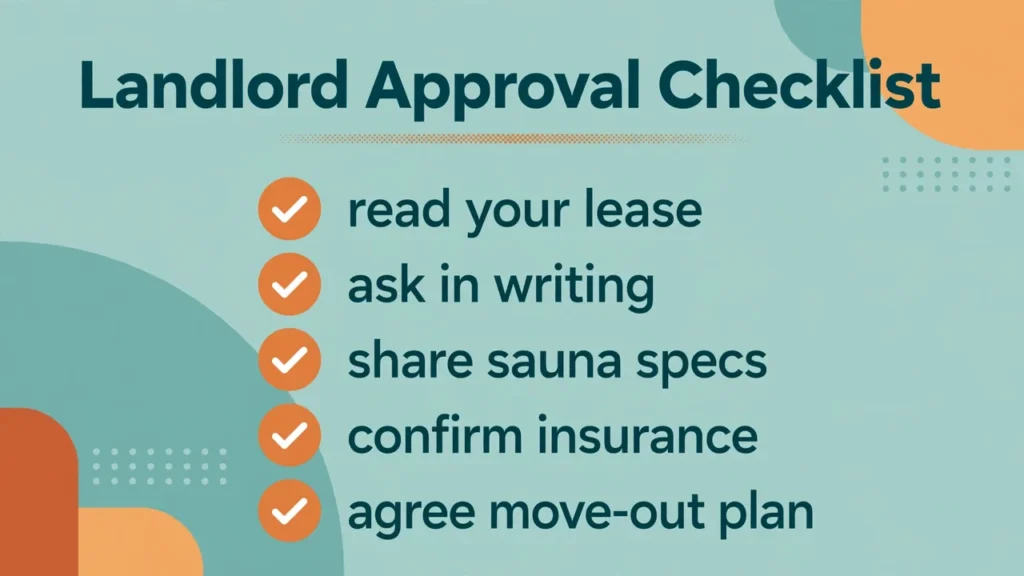
Ask in writing, by email, and keep the reply. A verbal yes is hard to prove if a dispute arises later. Keep the email short and factual, and attach the sauna’s spec sheet so your landlord can see the wattage, voltage, dimensions and weight for themselves.
- The model: brand, model name, size and weight, with a link to the product page.
- The power: wattage, voltage and plug type, plus a note that it plugs into a standard outlet and needs no wiring changes.
- The location: which room, on what floor surface, and how much clearance you will leave around it.
- Floor protection: the mat or rug you will place underneath to protect the flooring.
- The move-out plan: that you will remove the sauna, repair any marks and return the room to its original state.
- Insurance: confirmation that your renter’s insurance covers the appliance, or that you will check with your insurer.
Landlords say yes more often when the request looks low-risk. A one-person 120-volt cabin with a floor mat, no wiring work and a clear move-out plan is an easy yes. A three-person 240-volt cabin that needs a new circuit is a much harder ask, and many landlords will reasonably refuse it.
Insurance, Deposits and Moving Out
Tell your renter’s insurer about the sauna, or at least check that your policy covers it. Some policies treat large heating appliances as a higher risk, and a claim for heat or water damage could be refused if the insurer was never told. Keep the sauna’s manual and purchase receipt somewhere safe, and keep a copy of your landlord’s written approval with them.
Plan for moving day before you buy. A flat-pack cabin can be taken apart and rebuilt, but it takes time, and panels can be damaged in transit. Keep the original boxes if you have storage space, or keep the assembly instructions and a note of the panel order.
When you move out, check the floor and walls for scuffs, heat marks or mat stains, and fix them before the final inspection. Your deposit depends on leaving the room as you found it.
If your landlord says no to a cabin, that is not the end of the story. A sauna blanket or a dome is an appliance, not furniture, and most leases do not restrict appliances of that size. Ask your landlord to confirm that a portable option is acceptable, and keep that confirmation in writing too.
Running Costs: What It Adds to Your Electric Bill
Power is not only a safety question, it is a money question, and renters often pay their own electricity. The good news is that a small infrared sauna is cheap to run compared with most heating appliances. A one-person cabin uses about as much electricity as a hair dryer running for the same length of time, and a session usually lasts 20 to 40 minutes.
| Sauna size | Energy per 30-minute session | Cost per session | Cost per month, 4 sessions a week |
|---|---|---|---|
| 1-person cabin, 1,200 watts | About 0.6 kWh | About $0.09 to $0.18 | About $1.50 to $3.00 |
| 2-person cabin, 1,600 watts | About 0.8 kWh | About $0.12 to $0.24 | About $2.00 to $4.00 |
| 3-person cabin, 2,100 watts | About 1.05 kWh | About $0.16 to $0.32 | About $2.70 to $5.30 |
| Sauna blanket, 600 watts | About 0.3 kWh | About $0.05 to $0.09 | About $0.80 to $1.50 |
Planning estimates only, not quotes. Figures assume a 30-minute session and an electricity price of $0.15 to $0.30 per kWh. Your rate, your session length and your model will change the result, so check your own tariff before you buy. For a fuller breakdown, see our guide to how much it costs to run an infrared sauna.
If your rent includes electricity, check whether the lease sets a fair-use limit. A sauna adds only a few dollars a month, so it rarely breaches a limit, but a landlord who sees a jump in usage may ask questions. A written approval that mentions the expected running cost avoids that conversation later.
Apartment Sauna Safety Basics
A sauna in a small flat deserves the same respect as one in a house. Heat affects everyone, and a small room warms up faster than a large one. Start with short sessions of 10 to 15 minutes at a lower temperature, and build up slowly over a few weeks. Drink water before and after every session, and keep a glass nearby if your model allows it.
Leave the sauna at once if you feel dizzy, nauseous, faint or unwell in any way. Do not use the sauna after drinking alcohol, and do not fall asleep inside it. If you are pregnant, live with a heart or circulation condition or low blood pressure, or take medicine that affects heat tolerance, speak to a doctor before your first session.
Keep the cabin clean and dry between sessions. Wipe the bench and floor after use, leave the door open for a while so the wood dries, and wash towels and seat covers regularly. A damp cabin in a small flat can develop odours fast. Older adults should take extra care getting in and out of a low cabin, and our guide to infrared sauna use for seniors covers safe temperatures and session lengths in more detail.
Finally, keep the area around the sauna clear. Do not store towels, clothes or boxes against the cabin, and do not drape anything over the heaters. If you need an electrician for any reason, such as a new outlet or a circuit check, use a licensed professional and tell your landlord first. A full walkthrough of setting a unit up safely is in our infrared sauna installation guide.
Key Takeaways
- Power comes first. Choose a 120-volt model under 1,800 watts for most apartments, plug it directly into a wall outlet, and never use a standard extension cord or power strip.
- Noise is low but not zero. A sauna fan sounds like a quiet desk fan, so place the cabin away from shared walls, use a rug or mat underneath, and keep sessions to daytime and early evening.
- Measure everything twice. Check the footprint, the door swing, the clearance around the cabin and the delivery route through your building before you order.
- Get permission in writing. Read your lease, email your landlord with the spec sheet, and keep the written approval with your insurance documents.
- Running costs are small. A one-person cabin costs roughly $0.09 to $0.18 per half-hour session at typical electricity prices, or a few dollars a month for regular use.
- When in doubt, go portable. A dome or a sauna blanket folds away, draws little power and usually needs no landlord approval, making it the safest first step for renters.
Frequently Asked Questions
Can I put an infrared sauna in a rented apartment?
Yes, in most cases, as long as your lease allows it and your landlord agrees in writing. Choose a model that fits your power supply and floor space, protect the floor with a mat, and confirm that no building rules ban large heating appliances. A portable dome or blanket usually needs no permission at all, but confirm that in writing too.
Does an infrared sauna need a special outlet?
Most one-person and two-person cabins run on a standard 120-volt household outlet and need no special wiring. Larger three-person and four-person cabins often need 240 volts or a dedicated circuit, which means electrical work and landlord approval. Always check the voltage and wattage on the model’s spec sheet before you buy.
Will an infrared sauna trip my breaker?
It can, if the sauna shares a circuit with other appliances and the combined load passes the breaker rating. A 1,200-watt sauna draws about 10 amps, so it usually runs fine on a 15-amp circuit with little else plugged in. A 2,400-watt model draws about 20 amps and needs a dedicated circuit. If your breaker trips during a trial run, the model is too big for that circuit.
How loud is an infrared sauna?
Most infrared saunas run at about 40 to 50 decibels, roughly the sound of a quiet desk fan or a quiet conversation. Your neighbours are unlikely to hear it through a wall, but a low hum can travel through hard floors, so place a thick rug or rubber mat underneath and avoid late-night sessions.
Will an infrared sauna damage my apartment floor?
It should not, if you protect the floor. Place a waterproof mat or a thick rug under the cabin to catch sweat and condensation, and to stop the wooden base marking the floor. Wipe up any moisture after each session and leave the cabin door open so the wood dries. Check the floor when you move out and fix any marks before the final inspection.
Do I need landlord permission for a portable infrared sauna blanket?
Usually not, because a blanket is an appliance like a heated throw, not furniture and not an alteration. Even so, it is worth a short email to your landlord confirming that portable infrared products are acceptable, and keeping the reply. That short message protects you if anyone questions it later.
Can I take my infrared sauna with me when I move?
Yes. Flat-pack cabins are designed to be taken apart and rebuilt, though it takes time and care, and panels can be damaged in transit. Keep the assembly instructions and, if you can, the original boxes. A dome or blanket is far easier to move, since it folds into a bag or a cupboard box.
Sources and notes: wattage, dimensions and decibel figures in this article are typical ranges taken from manufacturer spec sheets and common household comparisons, not exact ratings for any one model. Always check the spec sheet, manual and warranty of the model you plan to buy, and confirm your circuit rating, lease terms and local rules with your landlord or a licensed electrician before you order.