
If you are an infrared sauna user and often have concerns about your electricity bills, you may have often searched for how much electricity an infrared sauna uses. An infrared sauna typically uses 1,000 to 3,000 watts, depending on its size. Run for a one-hour session at the U.S. average electricity rate of about 18 cents per kWh, that works out to roughly $0.20 to $0.55 per session often less, since the heater doesn’t run at full power the whole time.
Below is the full breakdown about electricity cost of an infrared sauna: exact wattage by sauna size, a cost formula you can plug your own numbers into, a size-by-size cost table, how infrared compares to a traditional sauna, and what actually pushes your usage up or down.
Disclaimer: All the information in this guide is for educational purposes only and will never replace a professional advice.
Quick Facts
- Average wattage: 1,000–3,000 watts, depending on sauna size and heater type
- Energy per session: roughly 1–3 kWh for a one-hour session
- Typical cost per session: $0.15–$0.55 at the U.S. average electricity rate
- Typical monthly cost: $3–$15 for 3–4 sessions a week, for most home units
- Vs. traditional sauna: infrared uses about 60–80% less energy per session
How Many Watts Does an Infrared Sauna Use?
Wattage depends almost entirely on sauna size and how many heating panels it has. Here’s what you’ll find on most manufacturer spec sheets.


Paid Links - As an Amazon Associate, I earn from qualifying purchases.
| Sauna Type | Typical Wattage | Energy Used (1-Hour Session) |
|---|---|---|
| Portable infrared sauna blanket | 300–800 watts | 0.3–0.8 kWh |
| 1-person cabin sauna | 800–1,500 watts | 0.8–1.5 kWh |
| 2-person cabin sauna | 1,400–2,000 watts | 1.4–2.0 kWh |
| 3-person cabin sauna | 1,800–2,400 watts | 1.8–2.4 kWh |
| 4+ person cabin sauna | 2,500–3,500 watts | 2.5–3.5 kWh |
Two things push wattage toward the high end of a range: full-spectrum models (which add near-infrared and mid-infrared emitters alongside the standard far-infrared panels see which is better, far or near infrared sauna for how that affects both heat and power draw) and larger cabins, which need more heating surface to warm the same amount of air and body space.
Key takeaway: A nameplate wattage of “2,000W” is the sauna’s maximum draw, not what it uses every minute. Once the cabin reaches your set temperature, the heater cycles on and off to hold it there — similar to how a home thermostat works.


Paid Links - As an Amazon Associate, I earn from qualifying purchases.
How Much Electricity Does an Infrared Sauna Use?
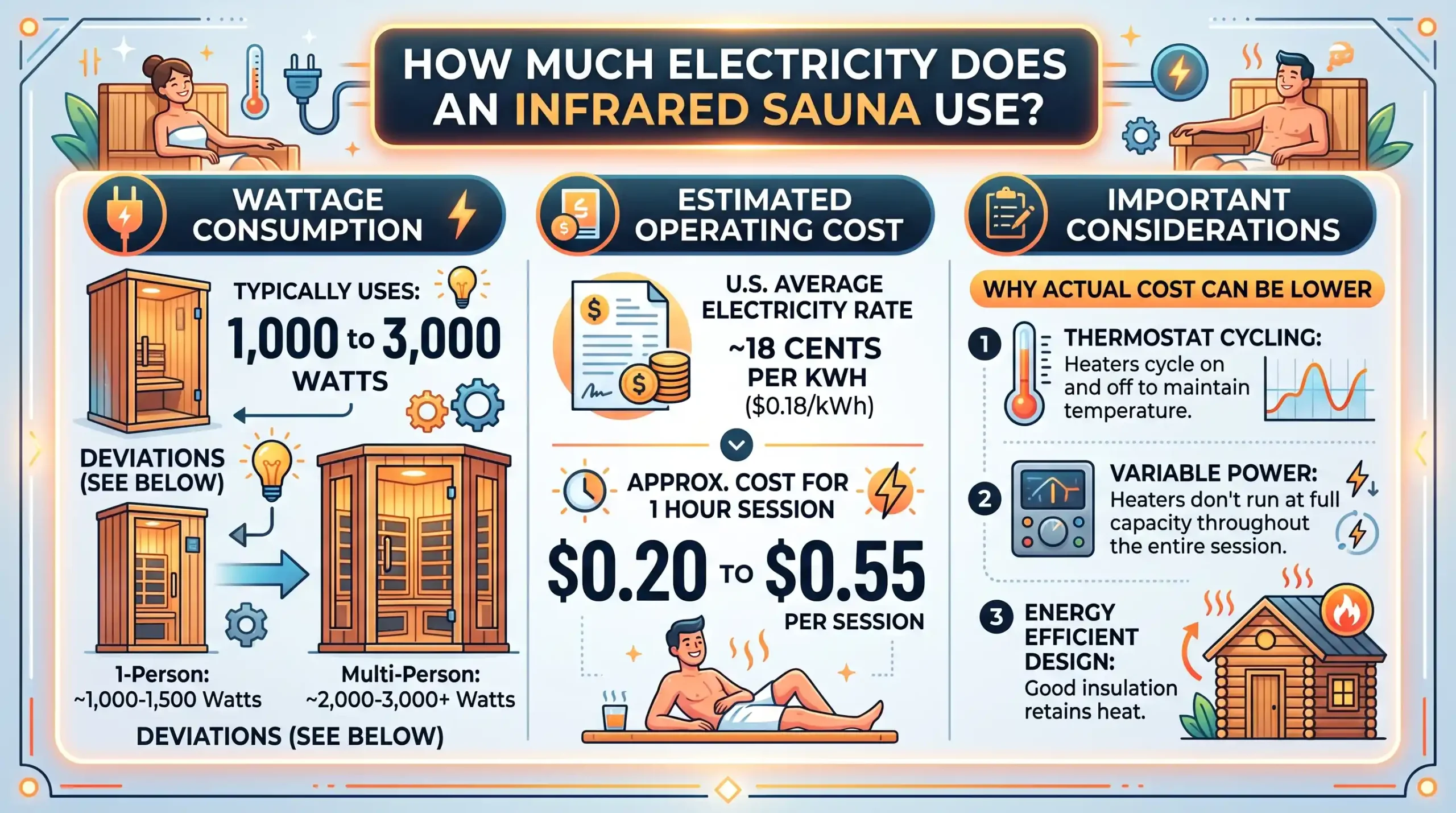
An infrared sauna typically uses around 1,000 to 3,000 watts, depending on its size and model. At the U.S. average electricity rate of about 18 cents per kWh, running a sauna for one hour would cost roughly $0.20 to $0.55 per session. In many cases, the actual cost can be even lower because the heaters do not necessarily operate at full power throughout the entire session.
Estimated Infrared Sauna Electricity Cost
| Sauna Type | Approx. Power | Cost Per Day* | Cost Per Week | Cost Per Month | Cost Per Year |
|---|---|---|---|---|---|
| Small 1-Person Sauna | 1,500 W | $0.27 | $1.89 | $8.10 | $98.55 |
| 2-Person Sauna | 2,000 W | $0.36 | $2.52 | $10.80 | $131.40 |
| 3-Person Sauna | 2,500 W | $0.45 | $3.15 | $13.50 | $164.25 |
| Large 4-Person Sauna | 3,000 W | $0.54 | $3.78 | $16.20 | $197.10 |
*Based on one 60-minute session every day at $0.18/kWh.
Examples
Example 1 – 1,500-watt infrared sauna:
A 1,500-watt sauna running for one hour uses about 1.5 kWh. At $0.18 per kWh, that is approximately $0.27 per session, or about $8.10 per month if used every day.
Example 2 – 2,000-watt infrared sauna:
A 2,000-watt sauna uses about 2 kWh during a one-hour session, costing around $0.36 per day. Daily use would be approximately $10.80 per month or $131.40 per year.



Paid Links - As an Amazon Associate, I earn from qualifying purchases.
Example 3 – 3,000-watt infrared sauna:
A larger 3,000-watt sauna uses about 3 kWh per one-hour session, costing approximately $0.54 per day. If used every day, that works out to around $16.20 per month or $197.10 per year.
For a more realistic routine, such as 3–5 sessions per week or 30–45 minutes per session, the actual electricity cost would be considerably lower. The most important factors are the sauna’s wattage, session length, frequency of use, and your local electricity rate.
Infrared Sauna Cost Per Session, By Sauna Size
This table uses the U.S. average rate of $0.18/kWh so you can compare sizes directly, then adjust for your own rate using the formula above.
| Sauna Size | Wattage | 30-Min Session | 45-Min Session | 60-Min Session |
|---|---|---|---|---|
| 1-person | 1,200W | $0.11 | $0.16 | $0.22 |
| 2-person | 1,800W | $0.16 | $0.24 | $0.32 |
| 3-person | 2,100W | $0.19 | $0.28 | $0.38 |
| 4+ person | 3,000W | $0.27 | $0.41 | $0.54 |
Monthly and Yearly Cost Estimates
Most home users run their sauna 3–5 times a week for 30–45 minutes. Here’s what that adds up to over a month and a year, based on a mid-size 2-person unit (1,800W) at $0.18/kWh.
| Frequency | Monthly Cost | Yearly Cost |
|---|---|---|
| 2x/week, 30 min | ~$1.30 | ~$16 |
| 4x/week, 30 min | ~$2.60 | ~$31 |
| 4x/week, 45 min | ~$3.85 | ~$46 |
| Daily, 45 min | ~$6.75 | ~$81 |
For most households, an infrared sauna adds less to the electric bill than running a hair dryer a few extra times a week.
Infrared Sauna vs. Traditional Sauna: Electricity Comparison
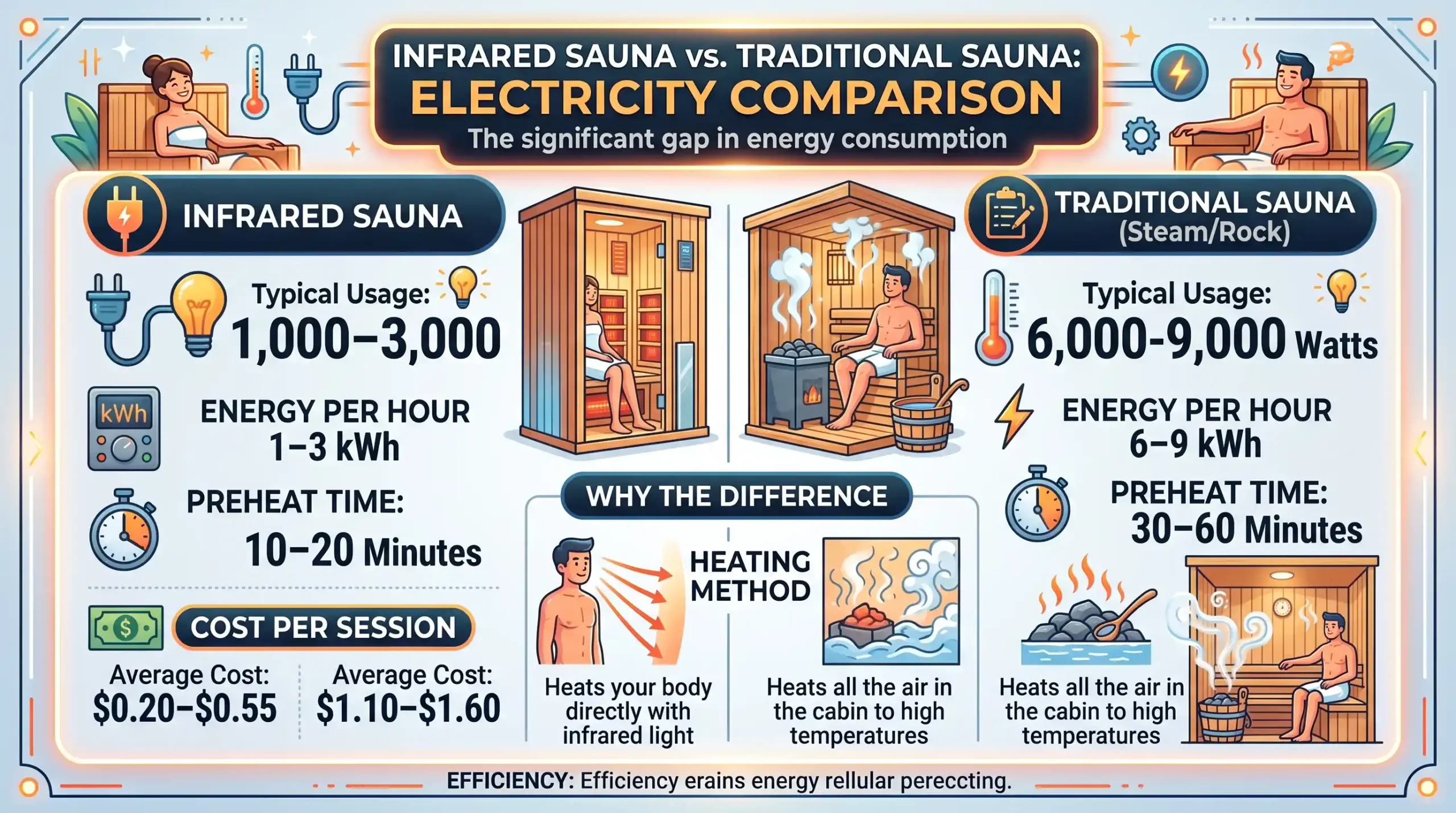
| Feature | Infrared Sauna | Traditional (Steam/Rock) Sauna |
|---|---|---|
| Typical wattage | 1,000–3,000W | 6,000–9,000W |
| Energy per hour session | 1–3 kWh | 6–9 kWh |
| Preheat time | 10–20 minutes | 30–60 minutes |
| Cost per session (avg. rate) | $0.20–$0.55 | $1.10–$1.60 |
| Why the difference | Heats your body directly with infrared light | Heats all the air in the cabin to high temperatures |
Traditional saunas need more energy for two reasons: they heat the entire volume of air in the cabin rather than just your body, and they run at higher target temperatures (170–200°F vs. 120–150°F for infrared), which takes longer to reach and more energy to maintain. If you’re still deciding between the two, this full infrared sauna vs. traditional sauna comparison covers the differences beyond just electricity cost.
What Actually Changes Your Sauna’s Electricity Use
Wattage on the spec sheet is only the starting point. These factors move your real-world cost up or down:
- Session length. The single biggest factor you control directly. Cutting a 60-minute session to 30 minutes roughly halves the energy used.
- Frequency. Daily use costs about 2x weekly use, obviously, but it’s easy to underestimate how it compounds over a year.
- Insulation and cabin condition. A well-sealed cabin holds heat, so the heater cycles off more often. Gaps around the door or thin walls make it run closer to full power the whole session.
- Room temperature. A sauna installed in an unheated garage or outdoor space works harder to reach temperature than one in a climate-controlled room.
- Heater type. Carbon heaters generally sip less power than ceramic heaters for the same coverage area. Full-spectrum saunas, which add near- and mid-infrared emitters, use more than far-infrared-only models.
- Preheat habits. Preheating for 20–30 minutes before every session adds real cost over time. Most infrared saunas only need 10–15 minutes to reach a usable temperature.
How to Calculate Your Infrared Sauna’s Electricity Cost
You only need three numbers: wattage, hours used, and your electricity rate.
Cost = (Watts ÷ 1,000) × Hours Used × Electricity Rate per kWhExample: A 2-person sauna with a 1,800-watt heater, run for a 45-minute (0.75-hour) session, on a $0.18/kWh electricity rate:
(1,800 ÷ 1,000) × 0.75 × $0.18 = $0.24 per session
You can find your exact electricity rate on a recent utility bill, usually listed as “cost per kWh” or “energy charge.” If you don’t have a bill handy, the U.S. average residential rate in 2026 is around 18 cents per kWh, though it ranges from about 12 cents in states like North Dakota and Idaho to over 40 cents in Hawaii.
Can I Plug an Infrared Sauna Into a Regular Outlet?
For most 1- and 2-person infrared saunas, yes. Here’s the general rule:
- Under 1,800W: Usually fine on a standard 120V, 15-amp household outlet.
- 1,800W–2,400W: May need a dedicated 20-amp circuit to avoid tripping the breaker, especially if other appliances share that circuit.
- 2,500W and up (most 4+ person units): Often require a 240V outlet or a dedicated circuit, similar to an electric dryer.
Always check the manufacturer’s spec sheet for the exact amperage and voltage requirement before installing, and have an electrician confirm your circuit can handle it if you’re unsure. For a full breakdown of setup requirements and one-time costs on top of electricity, see this infrared sauna installation and operating cost guide.
5 Ways to Lower Your Infrared Sauna’s Electricity Cost
- Shorten sessions slightly. Dropping from 45 to 30 minutes cuts energy use by about a third with a minimal difference in the sweat you get.
- Skip the long preheat. Start your session as soon as the cabin hits a comfortable temperature instead of waiting for it to peak.
- Improve the room around it. Close doors, add a rug under the sauna, or install it away from drafts so the heater doesn’t fight ambient cold.
- Use off-peak hours if your utility offers time-of-use rates. Some providers charge less overnight or midday, which can meaningfully lower cost for frequent users.
- Choose the right size for your household. A 1-person unit for solo use will always cost less to run than a 4-person cabin, watt for watt.
FAQs
How much electricity does an infrared sauna use per hour?
Most home infrared saunas use 1,000 to 3,000 watts, or about 1–3 kWh, for a full hour of use, though the heater doesn’t draw full power the entire time once it reaches temperature.
Is it expensive to run an infrared sauna?
No. A typical session costs $0.20 to $0.55, and running it several times a week usually adds only a few dollars to your monthly electric bill.
How much does an infrared sauna add to my electric bill per month?
For 3–4 sessions a week at 30–45 minutes each, expect roughly $3–$8 per month on a typical 1- or 2-person unit, more for larger units or daily use.
Do infrared saunas use less electricity than traditional saunas?
Yes, significantly. Infrared saunas use about 60–80% less energy per session because they heat your body directly instead of heating the entire cabin’s air to a high temperature.
How many watts does a 2-person infrared sauna use?
Most 2-person infrared saunas draw between 1,400 and 2,000 watts.
Does an infrared sauna need a special electrical outlet?
Units under about 1,800 watts usually run on a standard household outlet. Larger or full-spectrum units often need a dedicated 20-amp circuit or a 240V outlet.
How much electricity does an infrared sauna blanket use?
Portable infrared sauna blankets are the lowest-power option, typically drawing 300 to 800 watts, which costs a few cents per session.
Does the sauna use full power the whole session?
No. Once it reaches your set temperature, the heater cycles on and off to maintain it, similar to a thermostat-controlled heater, so actual usage is usually lower than the nameplate wattage suggests.
What’s the cheapest way to reduce sauna electricity costs?
Shortening sessions and skipping long preheats are the two easiest changes, since energy use scales directly with how long the heater runs.
Does sauna size affect electricity cost more than wattage?
They’re related. Larger cabins need higher wattage to heat effectively, so size and wattage tend to move together, but a poorly insulated small sauna can sometimes cost more to run than a well-built larger one.