
A steam shower can make a bathroom feel like a small spa. It can also make a listing stand out. What it cannot do, on its own, is guarantee a higher sale price.
That distinction matters. A bathroom remodel and a steam shower are not the same purchase, and remodel data does not measure them the same way. This article explains what the published data actually says, when a steam shower is most likely to help buyer appeal, and when it is most likely to disappoint at resale.
Read this first — planning notes, not promises. Cost figures in this article are planning estimates and national or regional averages, not quotes. Prices vary by region, brand, installer, and the condition of your existing bathroom, so get local quotes and verify current listings before you commit.


Paid Links - As an Amazon Associate, I earn from qualifying purchases.
Build and install guidance here is general only. It is not a substitute for local code or a licensed professional. Check with your local permit and code office, and use licensed electricians and plumbers for electrical and plumbing work.


Paid Links - As an Amazon Associate, I earn from qualifying purchases.
A steam shower is also not maintenance-free. Steam adds moisture, so waterproofing, ventilation, and drying matter every day you use it. Poor moisture control can lead to mould and damage that hurt, rather than help, resale appeal.
Does a steam shower add home value? The honest short answer
Possibly, as part of a well-planned primary-bath remodel — but not by a fixed amount, and not in every home. No credible published dataset gives a steam-shower-only return on investment. That is the first thing to understand before you trust any single percentage you see online.
What remodel data does measure is whole projects, such as a midrange bathroom remodel. A steam shower is one feature inside that project. Its contribution is tangled up with everything else: the tile, the vanity, the layout, the waterproofing, and the condition of the home around it.
So the useful question is narrower than “will this pay for itself?” Ask instead: will this bathroom, in this neighbourhood, at this price level, look better maintained, more usable, and more appealing to the buyers who are actually shopping here?
What remodel data actually measures — and what it does not
Remodelling Magazine’s annual Cost vs. Value Report, produced with Zonda, is the most widely quoted source for remodel payback. Its headline figure is “cost recouped”: the share of a defined project’s cost that its model estimates is reflected in resale value.
Cost recouped is not profit, and it is not the same as “home value added” in the way an appraiser calculates it. An appraiser looks at comparable sales, not at your receipts. If buyers in your area will not pay more for a feature, a high project cost does not force the appraised value up.


Paid Links - As an Amazon Associate, I earn from qualifying purchases.
That is why the same report can show a strong percentage for a modest project and a much weaker percentage for a luxury one. The model is capped by what comparable buyers will pay, not by how much was spent.
What the 2025 Cost vs. Value numbers show for bathroom remodels
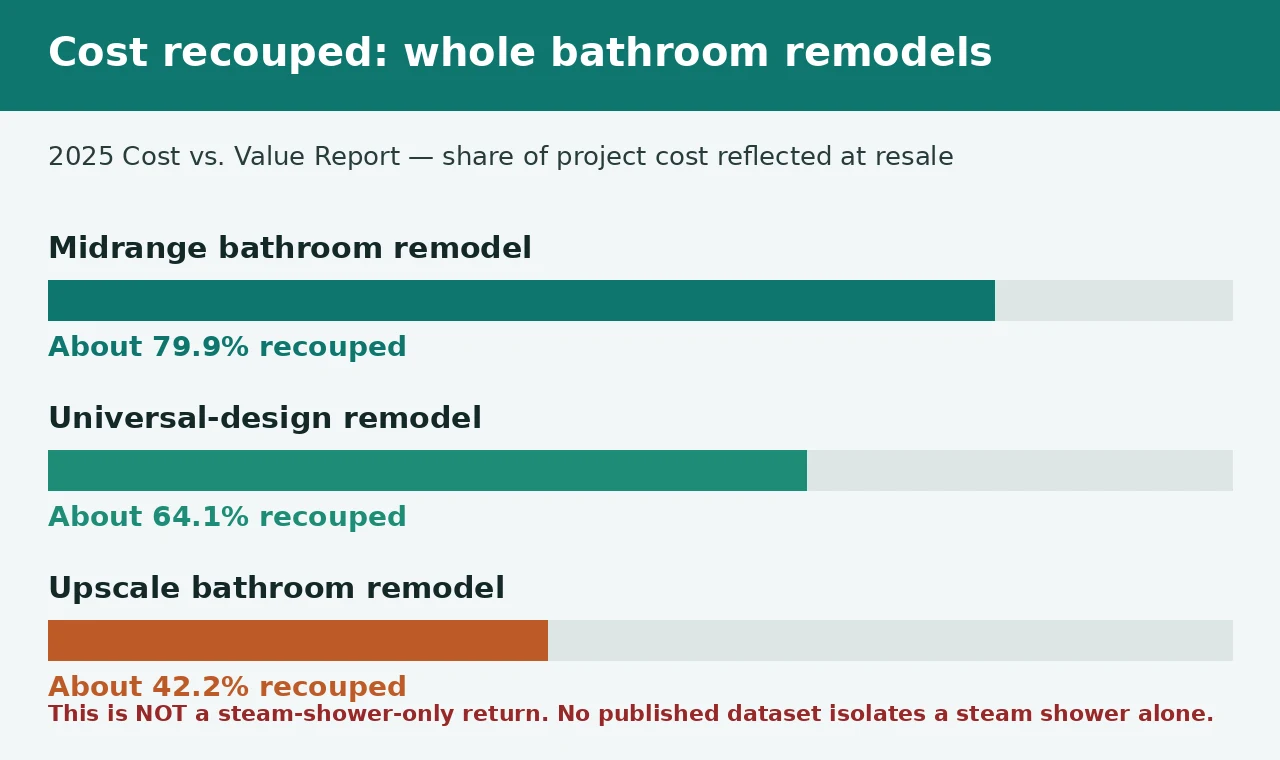
The 2025 Cost vs. Value Report puts a midrange bathroom remodel at about 79.9% of cost recouped nationally. An upscale bathroom remodel, by contrast, sits at about 42.2% nationally. A universal-design bathroom remodel sits between them, at about 64.1%.
Those figures describe whole bathroom remodels, with defined scopes, at national-average costs. They do not describe a steam generator added on its own, a steam shower in isolation, or any individual home.
Regional figures move, too. Published summaries of the same 2025 data put the midrange figure lower in some regions than the national headline. Your market may sit above or below the national average, which is why a local agent’s view of recent comparable sales matters more than a national chart.
The National Association of Realtors’ 2025 Remodeling Impact Report asks a different question. It surveys Realtors about perceived value, rather than modelling a sale price. Its bathroom figure lands lower, at roughly 50%.
Neither number is “wrong.” They measure different things. Cost vs. Value models an estimated resale outcome for a defined project. The Realtors’ survey captures professional judgement about value in general. Treat both as context, not as a promise for your bathroom.
The steam-shower claim you should read with care
You may see a much larger figure attached to steam showers specifically. Some manufacturer marketing cites a finding that listings mentioning “steam shower” sold for about 31% more than listings without the term.
Read that claim for what it is: a correlation in listing descriptions, quoted by a seller of steam equipment. Homes described with a steam shower may also be larger, newer, better located, or more expensively finished in other ways. The listing phrase alone does not prove the steam shower caused the price difference.
No appraiser will add a fixed percentage because a listing mentions a feature. If a seller quotes you a steam-shower-only return, ask for the underlying study, its sample, and whether it controlled for home size, location, and overall finish. If those answers are missing, treat the number as marketing, not evidence.
When a steam shower is most likely to help buyer appeal
A steam shower helps most when it fits the bathroom, the home, and the buyer pool. The strongest case is usually a primary bathroom that is already due for a remodel, in a home where buyers expect a comfortable, updated main bath.
In that setting, the steam shower is not a gimmick added to a tired room. It is the finishing feature of a room that already works: good layout, sound waterproofing, clear glass, sensible storage, and finishes that most buyers would accept without wanting to rip them out.
It also helps when the rest of the home supports the same price level. A well-finished primary bath in an otherwise updated home reads as coherent. Buyers can picture daily use, rather than wondering what else needs replacing.
Presentation matters, too. A clean, working steam shower with a clear control, a bench, and no visible moisture damage photographs well and shows well. A unit that looks complicated, neglected, or unexplained does the opposite, even if it cost a great deal to install.
Midrange context versus upscale context: why scope changes the maths
The Cost vs. Value gap between midrange and upscale remodels is the clearest warning in this whole topic. Spending more does not reliably return more, in percentage terms. Upscale projects often recover a smaller share because fewer buyers will pay a premium for luxury finishes they did not choose.
A midrange primary-bath remodel with a steam shower added sensibly is easier for buyers to value. The work solves visible problems: an outdated shower, worn tile, poor lighting, or a layout that wastes space. Buyers recognise that work without needing to share your taste.
An upscale, highly personalised spa room is a different bet. Bespoke stone, unusual colours, a large footprint taken from a bedroom, or controls that feel more like a gadget than a shower can narrow the buyer pool. Some buyers will love it. Others will price in the cost of changing it.
None of this means luxury finishes are “wrong.” It means they are best justified by years of personal use, not by a resale calculation. If you will enjoy the room for a decade, the daily value may matter more than the resale percentage. If you plan to sell within a year or two, restraint usually protects you better.
When a steam shower does not pay back
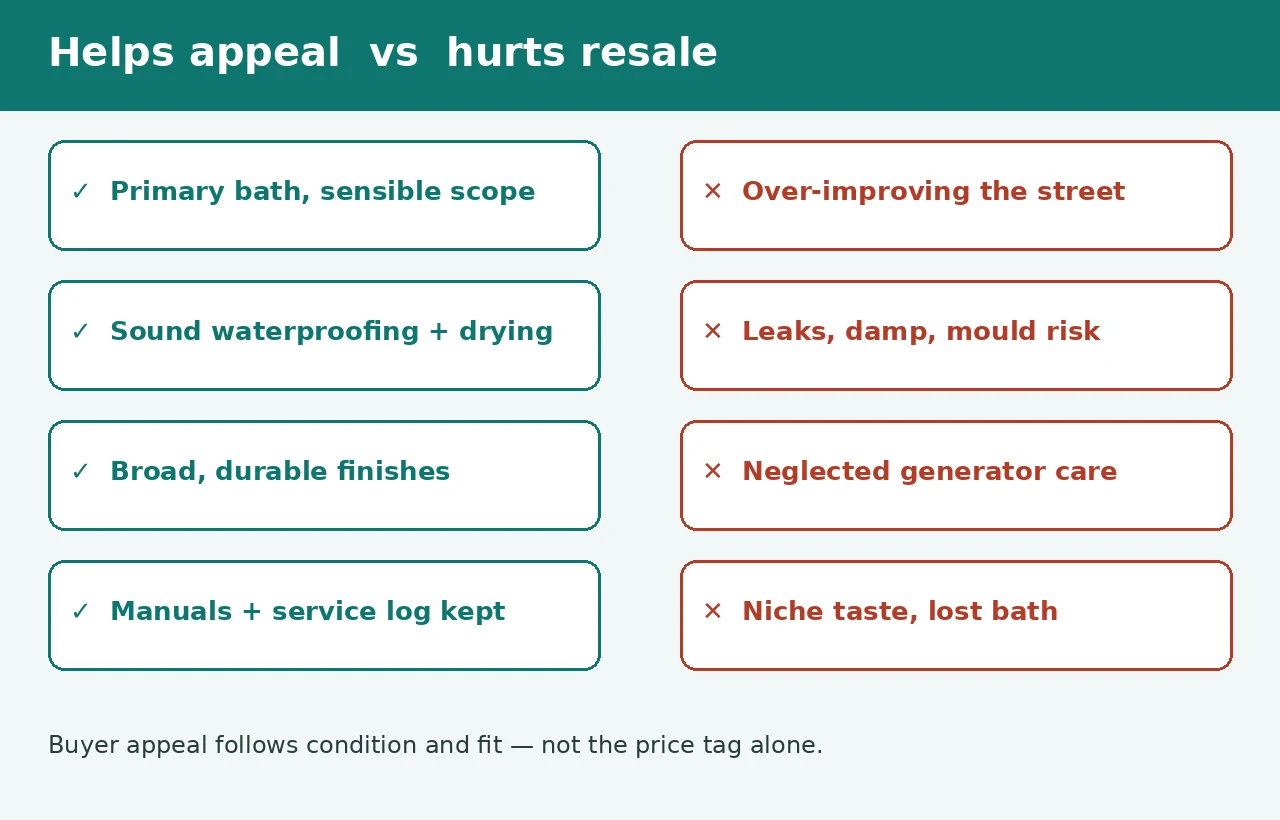
Over-improving for the neighbourhood is the classic way to lose money on a bathroom. If comparable homes sell at a modest price, buyers shopping in that range will not stretch their budget because one bathroom is spectacular. The home’s value is anchored by its neighbours, not by its most expensive room.
A useful test is simple. Look at recent sales of similar homes nearby, with and without updated primary baths. If the price gap is small, a large steam-shower project is unlikely to close a bigger gap on its own. A local agent can show you those comparisons before you spend anything.
Poor waterproofing and ventilation are a second, more serious failure. Steam is moisture by design. If the enclosure leaks, grout stays damp, or the room cannot dry, the result can be mould, stained finishes, and damaged framing or subfloor. Buyers, inspectors, and appraisers notice those problems quickly.
High or unclear maintenance is a third drag on appeal. A steam generator needs descaling and care, especially in hard-water areas. If the next owner inherits a system with no manual, no service history, and visible scale or faults, they will discount for hassle and risk, not admire the feature.
Niche taste finishes the list. A steam shower that only suits one lifestyle — for example, a room that sacrifices the only full bath, removes a bathtub a family buyer wants, or dominates a small bathroom — can shrink the buyer pool. Broad appeal usually beats a striking single feature.
Cost context: what you are actually paying for
A steam shower is rarely just a generator in a box. The full project can include the sealed enclosure, ceiling and door details, waterproofing and tile work, a correctly sized generator, electrical supply, plumbing and drainage, ventilation, controls, and labour. Skimping on the enclosure or the trades is where many projects go wrong.
For a detailed breakdown of generator, enclosure, and installation cost drivers, see our guide to steam shower costs. Use it to build a realistic budget range, then replace every range with written local quotes for your bathroom, your water conditions, and your electrical panel.
Do not compare a generator-only price with a turnkey remodel price. One is a component. The other is a finished, watertight room. The gap between them is where waterproofing, labour, permits, and corrections for existing damage usually sit.
Financing deserves a cold look, too. A remodel paid for with expensive borrowing needs a larger resale gain just to break even, and most bathroom projects do not return 100% of their cost. If the main reason for the project is resale within a short period, borrowing heavily for luxury scope is a weak plan.
Running costs and maintenance: the honesty buyers will check
Running costs are modest compared with the install cost for most households, but they are not zero. Electricity for the generator, water use, and periodic descaling all add up, and hard water can shorten service intervals. Our guide to the cost of running a steam sauna explains the variables to check for your usage pattern and local energy prices.
Maintenance is where resale value is quietly won or lost. Regular descaling, cleaning, and drying protect both the generator and the room. A simple log — dates, products used, and any service visits — is more persuasive at sale time than a claim that the system “works fine.”
For hard-water care in particular, see our steam generator maintenance and descaling guide. If your area has hard water, budget for that care from day one, rather than discovering scale damage after the warranty conversation has ended.
Health-adjacent claims should stay modest here, too. Some people enjoy steam as a relaxing warm-up, but a steam shower is not a treatment, a detox, or a cure. Keep sessions short, drink water before and after, and step out if you feel dizzy, unwell, or overheated.
Do not use steam after drinking alcohol, and check with a doctor first if you are pregnant, have a heart or circulation condition, have low blood pressure, or take medication that affects heat tolerance. A feature that is safe and pleasant for most adults still needs those basic limits.
Steam shower versus a full bathroom remodel
Think of the decision in three layers. The first layer is repair: fix leaks, failed grout, poor drainage, and ventilation. The second layer is the remodel itself: layout, tile, fixtures, and finishes that most buyers accept. The third layer is the steam upgrade, which should sit on top of the first two, not replace them.
If the first layer is skipped, the steam feature can make things worse. More moisture in a room that already struggles to dry is not an upgrade. It is a faster route to the same damage, with a more expensive system attached to it.
If you are choosing between a steam shower and a sauna for a bathroom remodel, the comparison is not only about heat. Space, moisture, ventilation, and buyer familiarity all differ. Our steam sauna versus infrared sauna bathroom remodel guide walks through those trade-offs, including when a dry-heat option may suit a bathroom better than added steam.
Practical pre-remodel checklist
Use this checklist before you sign a contract. It protects both daily use and resale, because the same faults that annoy an owner tend to worry a buyer.
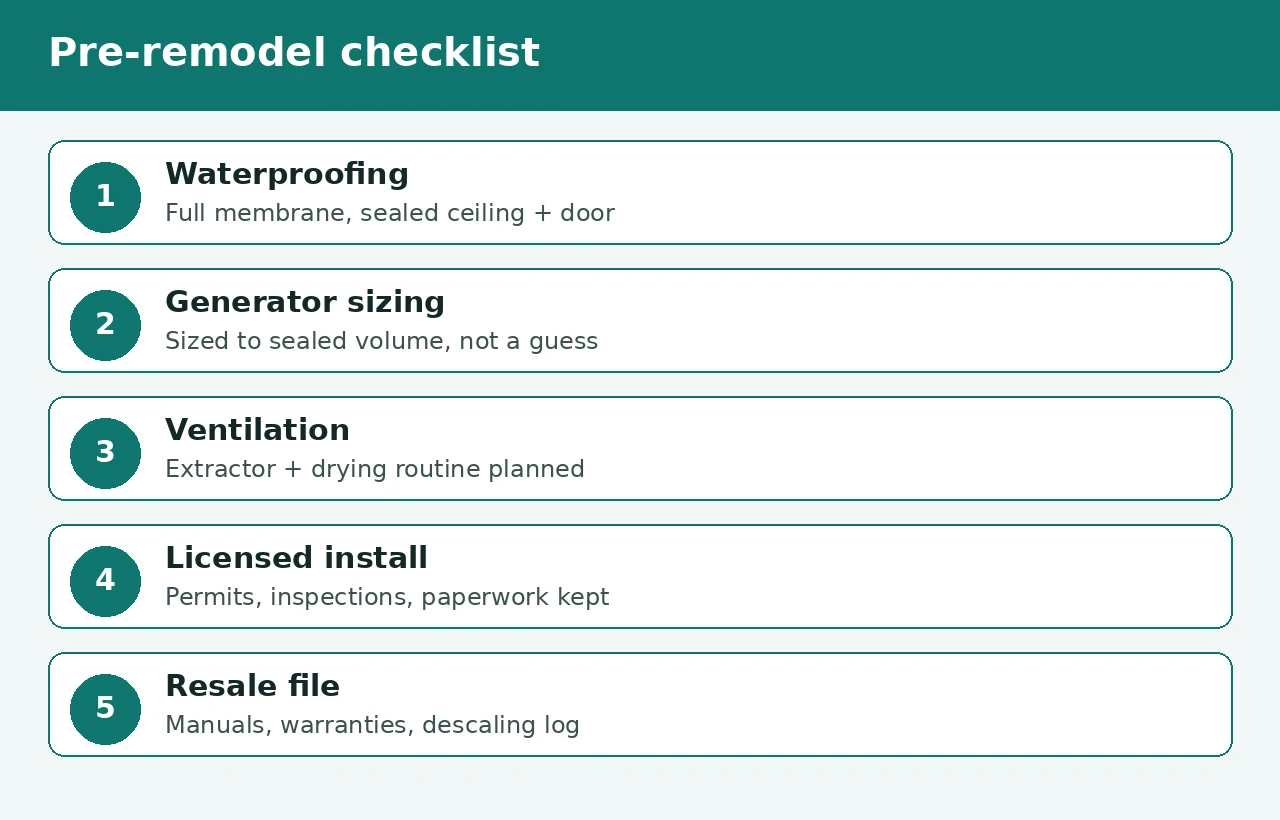
- Waterproofing first. Confirm the full wet-room build-up, membrane, seams, and drainage, not just the tile on top. Ask how the ceiling and door seal, and where steam can escape.
- Ventilation and drying. Plan an extractor that suits a steam room, a drying routine, and a door and ceiling design that does not trap damp air. Check that moisture has a clear route out after each session.
- Generator sizing. Size the generator to the actual sealed volume and materials, not to a guess. An undersized unit runs long and disappoints; an oversized unit wastes energy and money. See our steam generator sizing guide before you buy.
- Electrical and plumbing requirements. Confirm supply, protection, drainage, and water quality needs with licensed trades. Our electrical and plumbing requirements guide lists the questions to ask, but local code and your panel still decide the final answer.
- Licensed install and permits. Ask what permits your area requires, who pulls them, and what inspections apply. Keep the paperwork. Unpermitted work can draw an appraiser comment and complicate a sale.
- Keep the bathroom usable for the next buyer. Avoid removing the only bath, or shrinking the room so far that daily use suffers, unless your market clearly supports that trade.
- Choose broadly appealing finishes. Neutral, durable, easy-to-clean surfaces age better in photos and in person than bold, high-maintenance choices.
- Document everything for resale. Keep manuals, warranties, installer details, service and descaling records, and before-and-after photos in one folder. Hand that folder to the next owner.
- Get a local reality check. Ask an agent for recent comparable sales and ask an appraiser-style question: what would a buyer here actually pay more for, and what would they discount?
How to talk about it when you sell
If you do sell, describe the steam shower accurately. State that it is a sealed steam shower, when it was installed, who installed it, and what maintenance it needs. Vague luxury language helps no one if the buyer’s inspector finds damp grout or a generator with no service history.
Demonstrate it, if it is safe and working. A short, clean demonstration tells a buyer more than a brochure claim. Leave the manual and control instructions where the buyer can find them, and be honest about descaling intervals and any quirks.
Do not promise a return in the listing. A buyer’s lender and appraiser will use comparable sales, not your project invoice. A calm, documented, well-maintained feature supports a strong presentation. An inflated value claim invites scepticism and a harder negotiation.
Turning an existing shower into a steam shower
Converting an existing shower is sometimes possible, but it is not always a simple generator swap. The enclosure must seal, the ceiling must suit steam, drainage and ventilation must cope, and the generator must be sized and supplied correctly. A room built as an ordinary shower may need more rebuilding than the brochure suggests.
Our guide on how to turn your shower into a steam sauna explains the conversion checks in detail. Use it as a screening list, then get a site-specific assessment from a licensed installer before you budget as if conversion were guaranteed.
The bottom line for owners
A steam shower can add appeal, especially as part of a sensible primary-bath remodel in a market where buyers expect that level of finish. It can also add daily enjoyment for years, which is a real return even when it never shows up in a sale price.
What it cannot do is guarantee value. Whole-bathroom data shows midrange projects recouping a higher share than upscale ones, and even the strongest national average leaves part of the cost unrecovered at resale. A steam shower on its own has no published, isolated return figure to quote.
Build it well if you build it. Waterproof it properly, ventilate it, size the generator, use licensed trades, keep the paperwork, and maintain it. Then judge the project on two ledgers: the years you use it, and a realistic, locally checked view of resale. If both ledgers look acceptable, it is a reasonable project. If only a promised percentage makes it look good, walk away from that promise.
Frequently asked questions
Does a steam shower add home value?
It can add buyer appeal as part of a well-planned primary-bath remodel, but there is no published steam-shower-only return figure, and no guaranteed increase in sale price or appraised value.
What does Cost vs. Value data say about bathroom remodels?
The 2025 Cost vs. Value Report puts a midrange bathroom remodel at about 79.9% of cost recouped nationally and an upscale bathroom remodel at about 42.2%. Those figures are for whole bathroom remodels, not for a steam shower alone, and they are national averages that vary by market.
Is cost recouped the same as profit?
No. Cost recouped is the estimated share of project cost reflected in resale value. Most bathroom projects do not return 100% of their cost, and an appraiser uses comparable sales, not your receipts, to judge value.
When does a steam shower hurt resale value?
It can hurt appeal when it over-improves the home for the neighbourhood, suffers from poor waterproofing or ventilation, needs unclear or neglected maintenance, or narrows the buyer pool by removing a wanted bath or dominating a small bathroom.
Should I install a steam shower just before selling?
Usually not as a quick value play. A rushed, expensive, or highly personalised install close to a sale is the version most likely to recoup a smaller share. A modest, well-finished bathroom refresh is often the safer pre-sale choice; ask a local agent to compare recent sales first.
What should I document for resale?
Keep the installer details, permits and inspection records, manuals and warranties, generator sizing notes, and a simple service and descaling log. That folder reassures buyers, inspectors, and agents far more than an undocumented luxury claim.
Sources and further reading: Remodeling Magazine / Zonda, 2025 Cost vs. Value Report (midrange, upscale, and universal-design bathroom remodel figures); National Association of Realtors, 2025 Remodeling Impact Report (Realtor-perceived bathroom value). Manufacturer marketing citing a listing-description finding is discussed in the article as correlation, not as an appraisal result. For local decisions, check recent comparable sales with a local agent and confirm permit and code requirements with your local office.