
This article is general wellness and home-remodel information only. It is not medical advice. Saunas are wellness tools, not treatments, and they do not cure, prevent, or treat any disease. Talk to your doctor before using a sauna if you are pregnant, have a heart or circulation condition, have low blood pressure, or take medication that affects how you handle heat.
A bathroom remodel is one of the few moments when adding a sauna is actually practical. Walls are already open, trades are already on site, and choices about waterproofing, drainage, ventilation, and electrical capacity can be made before tile goes up. That is also why the steam-versus-infrared decision matters so much at this stage.
Once the enclosure is built and the tile is set, changing your mind is expensive. A steam room needs a sealed, waterproofed space, a drain, and a generator. An infrared cabin needs a dry footprint and power, but no plumbing. Those two paths lead to very different remodels, even when the finished bathroom looks similar.


Paid Links - As an Amazon Associate, I earn from qualifying purchases.
This guide compares the two options specifically for a bathroom remodel. It covers how each type feels, what each one demands from your space, how much disruption to expect, what upkeep really looks like, and who each option tends to suit best. By the end, you should have a clear way to choose — not just a winner picked for you.


Paid Links - As an Amazon Associate, I earn from qualifying purchases.
Steam Sauna vs Infrared Sauna at a Glance
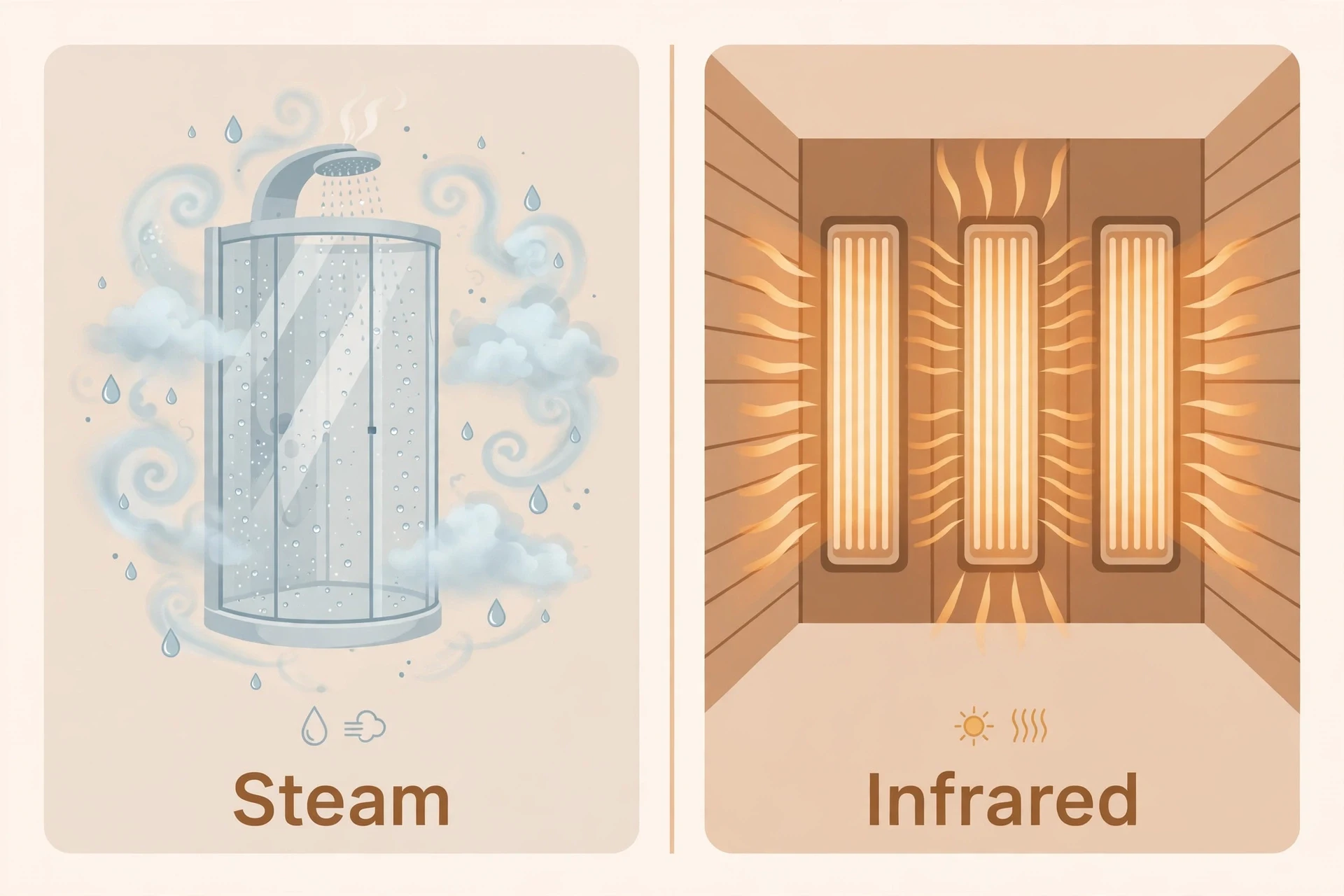
The simplest difference is the kind of heat. A steam sauna fills a sealed enclosure with warm, humid air. The moisture is the point: it softens the feeling of the heat, makes the air feel dense, and leaves skin and airways feeling damp.
An infrared sauna works differently. Panels emit radiant heat that warms your body and the cabin surfaces directly, while the air itself stays drier. Many people describe it as a gentler, drier warmth that is easier to sit in for a longer session.
Neither feeling is objectively better. Some people love the enveloping humidity of steam and find dry heat uncomfortable. Others find steam heavy or hard to breathe in and prefer the drier air of an infrared cabin. If you have used either type before — at a gym, spa, or hotel — trust that memory more than any marketing claim.
| Decision factor | Steam sauna | Infrared sauna |
|---|---|---|
| Heat and feel | Humid, enveloping warmth; air feels wet and dense | Dry, radiant warmth; air stays lighter and drier |
| Plumbing needed | Yes — water supply, drain, and generator | No — no water supply or drain required |
| Enclosure | Fully sealed, waterproofed, tile or suitable stone | Prefabricated wood cabin, usually freestanding |
| Ventilation | Critical — moisture must be vented and the room dried after use | Still needed, but moisture load is far lower |
| Remodel disruption | Higher — wet-room construction, trades, curing and sealing time | Lower — cabin assembly, electrical work, finishing around it |
| Ongoing upkeep | Descaling, drying, grout and seal care, mold vigilance | Wiping wood, occasional heater and electrical checks |
| Best for small bathrooms | Harder to fit well; needs a properly sealed footprint | Often easier; compact cabins fit tighter spaces |
How Each Type Actually Works in a Bathroom
How a steam sauna works
A steam generator boils water and sends steam through a pipe into a sealed enclosure. The room fills with humid air, condensation forms on cool surfaces, and the space stays warm and wet throughout the session. Afterward, that moisture has to go somewhere — out through ventilation and down the drain.
That is why a steam room is a construction project, not an appliance purchase. The enclosure must be waterproofed behind the tile, sloped to a drain, and sealed at every joint. A regular shower enclosure with a steam generator added is not the same thing, and cutting corners here is how moisture damage starts.
Heat-up is usually quick once the generator is running, because steam fills a small sealed space fast. Sessions tend to be shorter for many people, simply because humid heat feels intense. Short does not mean less satisfying — for steam lovers, ten to twenty minutes can feel complete.


Paid Links - As an Amazon Associate, I earn from qualifying purchases.
How an infrared sauna works
An infrared cabin uses heater panels mounted in the walls, under benches, or both. The panels radiate heat toward your body rather than heating a large volume of humid air. The cabin warms up gradually, and the air stays comparatively dry.
Because there is no steam, there is no drain, no water line, and no waterproof membrane to build. Most cabins arrive as prefabricated panels that are assembled in place. That simplicity is the main reason infrared cabins are popular in remodels where the budget, timeline, or bathroom size is tight.
Sessions in an infrared cabin often feel milder at first and build slowly. Some people prefer that gradual warmth and sit longer. Others miss the immediate intensity of steam. Again, personal preference matters more than any specification sheet.
Space and Layout: What Each One Needs in a Remodel
Start with the floor plan, not the product catalogue. A sauna that crowds the bathroom, blocks the door swing, or leaves no drying space will be used less — no matter how good it feels in a showroom.
Steam: a sealed room within the room
A steam enclosure needs a footprint large enough to sit comfortably, a ceiling height that keeps steam where it belongs, and a door that seals. Sloped ceilings, transom vents, and steam-rated fixtures are not decorative details; they control where steam goes and how it leaves.
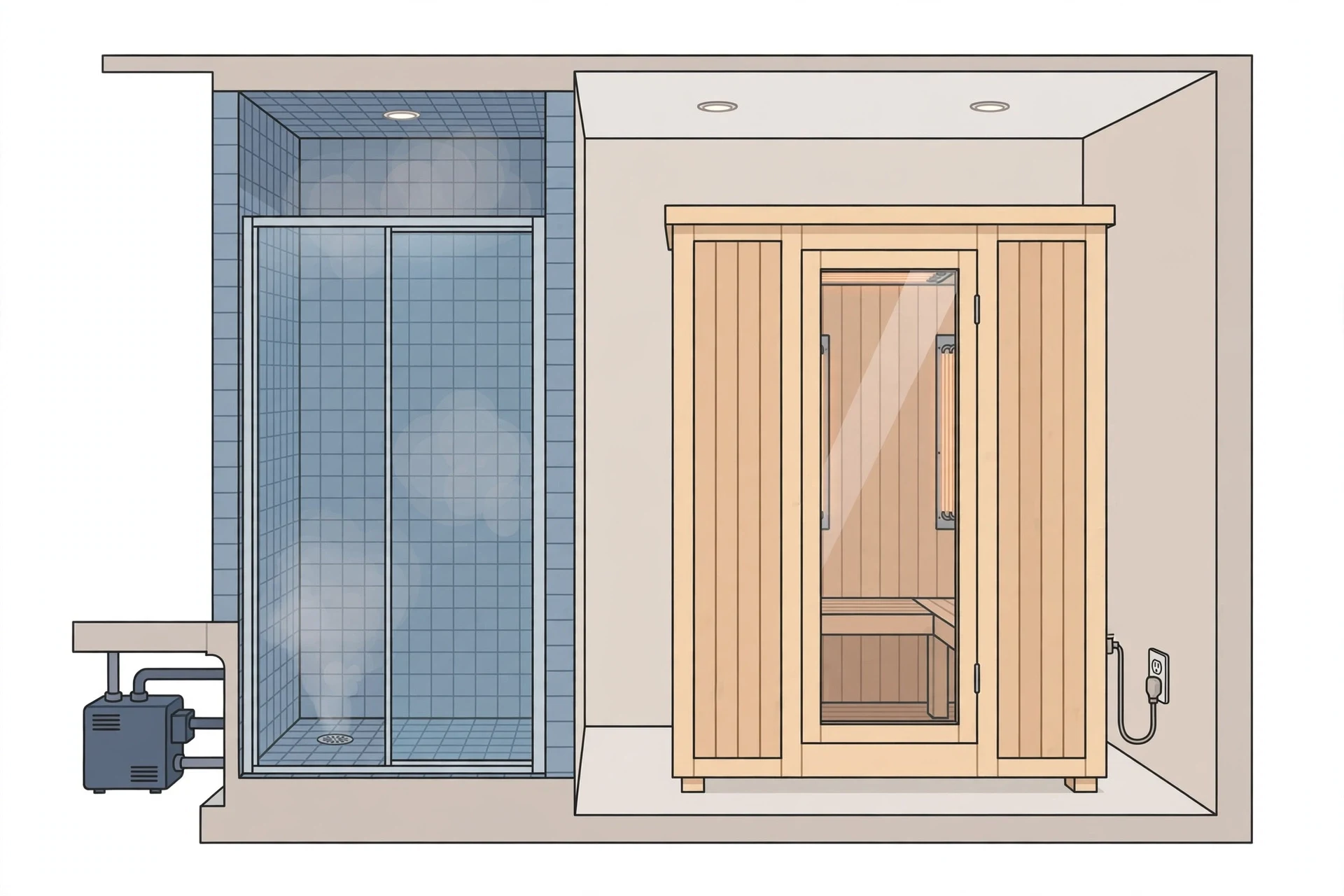
Behind the visible tile, the build needs a waterproof membrane, a drain with the right fall, and a generator location that is accessible for service. Generators are often tucked into a nearby closet, vanity cavity, or utility space, but they still need water, power, drainage for servicing, and enough clearance for a technician to reach them later.
Ventilation deserves its own line in the plan. A steam room needs a way to clear moisture after each session, and the bathroom as a whole needs an exhaust fan sized and ducted for a wet room. If your remodel plan only mentions a standard bathroom fan with no thought to steam clearance and drying time, ask your contractor to revisit it before work starts.
For help thinking through generator size and placement, see our guide to sizing a steam generator. Getting that decision right early prevents the two most common remodel regrets: a generator that struggles to fill the space, and one buried somewhere no one can service.
Infrared: a cabin footprint and a power supply
An infrared cabin needs a flat, dry floor area, enough headroom to sit upright, and clearance around the unit for assembly and airflow. Measure doorways and hallways too — flat-packed panels still have to reach the bathroom, and a cabin that cannot be carried in is a problem best discovered on paper.
Power is the main technical requirement. Cabins vary in their electrical needs, so confirm the circuit, amperage, and outlet location with a licensed electrician before the walls close up. Running a new dedicated circuit during a remodel is straightforward; retrofitting one after tiling is not.
Ventilation still matters for an infrared cabin, just for different reasons. The bathroom needs fresh air and humidity control for showers and daily use, and the cabin itself needs airflow so heat does not build up in a sealed corner. A cabin squeezed tight against three walls with no air gap is a design flaw, not a space-saving win.
Small bathrooms: an honest check
In a small bathroom, an infrared cabin is usually the easier fit. Compact one- or two-person cabins take up roughly the footprint of a small shower, and they do not demand a wet-room build around them. That makes them realistic in remodels where every square foot is already spoken for.
A steam room in a small bathroom is possible, but only if the enclosure is genuinely well designed. A cramped steam shower that is hard to clean, hard to dry, and hard to ventilate will cause more trouble than enjoyment. If the steam option forces compromises on sealing, drainage, or ventilation, that is a sign to choose infrared — or to wait for a larger remodel.
Build Scope, Disruption, and Materials
A steam build touches more trades and more layers of the bathroom. Expect waterproofing, tiling, plumbing, electrical work, and sealing, each with its own curing or inspection time. The bathroom will likely be out of service longer, and the sequence matters: waterproofing and drainage must be right before tile covers them forever.
An infrared install is closer to assembling furniture with an electrical hookup. The cabin goes together in hours to a day in many cases, and the surrounding remodel — flooring, trim, paint — can proceed around it. If your household needs a working bathroom again quickly, that shorter disruption is a real advantage.
Materials tell the same story. Steam rooms need surfaces that tolerate constant moisture: porcelain tile, suitable stone, steam-rated grout and sealants, and corrosion-resistant fixtures. Wood benches inside a steam room must be chosen and maintained for wet conditions, or they will deteriorate.
Infrared cabins are typically wood — cedar, hemlock, or similar species — and that wood stays dry. It still needs care, but it is not living in a wet room. Cleaning is usually a wipe-down, and the cabin does not demand the same sealing regime as tile in a steam enclosure.
One caution applies to both options: do not let a remodel schedule rush the drying and sealing steps. Grout, sealant, and waterproof membranes need their stated curing time. A contractor who promises to tile over a membrane the same day it was applied should be asked to explain the product’s actual instructions.
Planning note: this article gives general remodel guidance only. Building, electrical, and plumbing requirements vary by location, so check with your local code and permit office and use licensed electricians and plumbers for the work. Nothing here replaces a local professional’s advice for your home.
Electrical and Plumbing Requirements Compared
Steam and infrared diverge sharply here, and the difference should be settled before demolition, not discovered mid-project. Steam needs both a water supply and a drain, plus power for the generator and controls. Infrared needs power and a sensible location, but no water at all.
For a fuller breakdown of circuits, clearances, and service access, read our guide to steam sauna electrical and plumbing requirements. Use it as a checklist for your contractor meeting, and have your electrician and plumber confirm every item against your home’s existing systems.
A practical tip for either option: photograph and label everything before walls close. Note where pipes, circuits, and generator connections run. Future servicing — and future buyers — will thank you, and a service technician who can find the generator without opening tile will charge less for the visit.
Running Costs and Maintenance Compared
Cost note: any figures or comparisons in this section are broad planning estimates only, not quotes. Actual costs vary widely by region, brand, unit size, energy and water rates, installer, and how often you use the sauna. Get itemised quotes from local installers before budgeting.
Upfront, steam usually costs more. The generator, waterproofing, tile, drain work, and extra trades add up beyond the price of the steam unit itself. Infrared cabins usually cost less to install because the cabin is prefabricated and the site work is mostly electrical and finishing.
Running costs are harder to compare fairly, because they depend on how often and how long you use the sauna, your local electricity and water rates, and the size and insulation of the enclosure. As a broad pattern, steam uses both water and electricity, while infrared uses electricity only. That does not automatically make infrared cheaper per session — session length, cabin size, and heat-up time all matter — but it does make steam’s running cost a two-utility question.
For a detailed look at what drives day-to-day expense, see our guide to the cost to run a steam sauna. Use it to estimate your own usage pattern rather than copying someone else’s: a household using a sauna daily will have a very different bill from one using it twice a week.
Maintenance: the part people underestimate
Steam maintenance is regular and non-negotiable. Generators need descaling, especially in hard-water areas, and the enclosure needs drying after every session. Grout lines, seals, and benches should be inspected for moisture damage, and any musty smell should be investigated promptly rather than masked with fragrance.
Our guide to steam generator maintenance and descaling in hard-water areas walks through the routine in detail. If you have hard water and no softening or filtration plan, budget extra attention here — scale shortens generator life and dulls performance.
Infrared maintenance is lighter. Wipe wood surfaces, keep the cabin dry, vacuum occasionally, and check heaters and controls as the manufacturer directs. There is no descaling, no grout regime, and no wet-room drying routine. That lighter load is one of the strongest practical arguments for infrared in a busy family bathroom.
The honest summary is this: a steam room is not maintenance-free, and anyone who sells it as one is oversimplifying. An infrared cabin is lower-maintenance, but not no-maintenance. Choose the upkeep routine you will actually do, because a sauna you resent maintaining is a sauna you will stop using.
| Upkeep task | Steam | Infrared |
|---|---|---|
| After every session | Ventilate, wipe down, leave door ajar to dry | Quick wipe; leave door ajar for airflow |
| Weekly to monthly | Clean tile and grout; check seals and drains | Wipe benches and walls; check for dust buildup |
| Periodic | Descale generator; inspect membrane-adjacent seals | Inspect heaters, controls, and electrical connections |
| Biggest risk if neglected | Scale, mold, and moisture damage behind tile | Wood staining, dust, or heater issues over time |
Safety Comparison
Both types share the same core safety basics. Hydrate before and after, start with short sessions, and leave immediately if you feel dizzy, nauseous, or unwell. Do not use a sauna after drinking alcohol, and do not try to push through discomfort to hit a target time.
Steam adds two specific cautions. First, humid heat can feel harder to breathe in, especially for people with respiratory sensitivity — if steam has ever felt oppressive to you, take that seriously. Second, wet floors and benches are slip hazards, so non-slip surfaces, grab support where appropriate, and dry footing outside the enclosure matter.
Infrared adds a different caution: radiant heat can be deceptive. Because the air feels milder, it is easy to stay in longer than you planned. Set a timer, keep water nearby, and step out at the first sign of overheating rather than waiting for a preset session length.
Children, older adults, and anyone with a medical condition or medication that affects heat tolerance should get a doctor’s advice first, and should never sauna alone if there is any doubt. Keep sessions supervised for children, and never leave a child unattended in either type of sauna.
On the building side, electrical and plumbing work must be done by licensed professionals, and steam rooms in particular must never be improvised from a standard shower. Poor sealing does not just risk cosmetic damage — trapped moisture can damage structure and encourage mold growth that is costly to remediate.
Who Each Option Suits Best
Choose steam if you love humid heat, want a spa-like shower-and-steam combination, and are remodeling a bathroom that can genuinely support a sealed wet room. Steam suits dedicated wellness spaces and primary bathrooms where the enclosure gets its own well-planned footprint, and where someone in the household will own the drying and descaling routine.
Choose infrared if you prefer dry heat, want the simplest install, have a smaller bathroom, or share the bathroom with a busy household. Infrared suits families who want regular, low-fuss sessions without a wet-room build, and remodels where keeping the bathroom usable and the timeline short matters.
Health sensitivities can tip the decision either way, and this is where personal experience beats general advice. Some people find humid air soothing and dry heat irritating; others find the reverse. If you have a respiratory or skin condition, discuss both options with your doctor and, if possible, try both types before committing to a build.
Household pattern matters too. A shared family bathroom that also handles school mornings and guest showers may be a better home for a dry infrared cabin than for a steam room that needs drying time after every use. A dedicated primary suite, used mainly by adults who enjoy a slower wind-down ritual, may justify the steam build.
Decision Framework: A Remodel Checklist
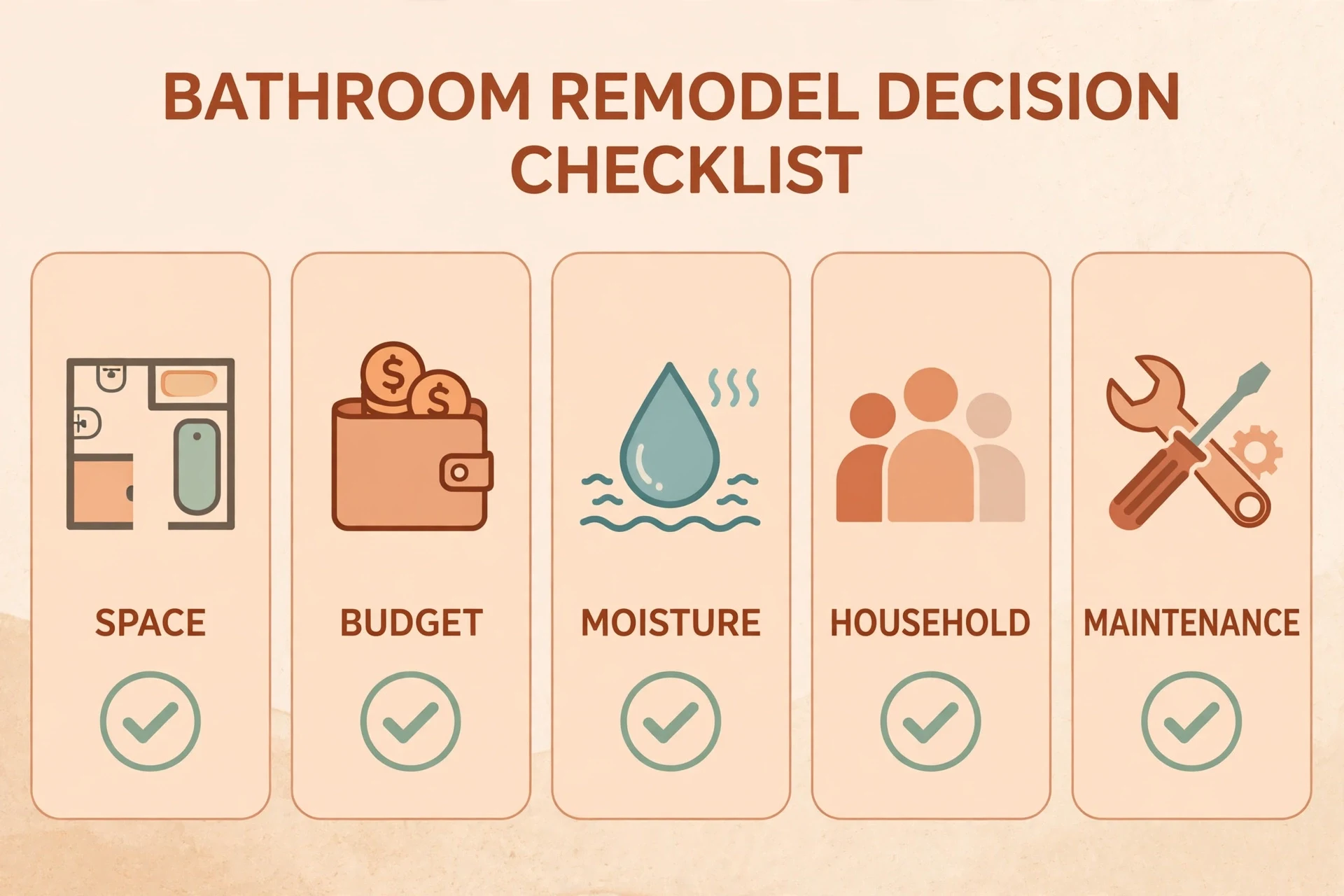
Work through these questions in order. The first “no” that stops you is usually your answer.
- Which heat do you actually enjoy? If you have tried both, your preference outranks every other factor. If you have tried neither, visit a spa or gym that offers both before you build.
- Can the bathroom support a sealed steam room? That means space, drainage, waterproofing, ventilation, and generator access — all without compromise. If any one of those is a stretch, infrared is the safer remodel choice.
- What is your tolerance for upkeep? Steam needs drying, descaling, and seal checks. Infrared needs wiping and occasional checks. Be honest about which routine you will keep doing in year two, not just week two.
- How much disruption can the household handle? Steam means a longer, trade-heavy build. Infrared means a shorter install. If the bathroom must be back in service fast, weight that heavily.
- What does your water do to appliances? Hard water raises steam maintenance significantly. If descaling sounds like a chore you will skip, that alone may settle it.
- Who will use it, and when? A shared family bathroom favours the drier, quicker-to-live-with option. A dedicated adult wellness space can carry the steam routine more easily.
- What do local professionals quote? Get itemised steam and infrared quotes for your actual bathroom, not catalogue prices. The gap in your home, with your plumbing and electrical situation, is the only gap that counts.
Remodel Mistakes to Avoid
Steam mistakes
- Adding a generator to a standard shower enclosure without full waterproofing, drainage, and sealing.
- Burying the generator where it cannot be serviced without removing tile.
- Skipping or undersizing ventilation, then wondering why the room stays damp.
- Closing the door immediately after every session instead of letting the room dry.
- Ignoring hard water until scale damages the generator.
- Choosing porous stone or untreated wood that cannot handle constant moisture.
Infrared mistakes
- Assuming any spare outlet will do, without confirming the circuit with an electrician.
- Squeezing a cabin against walls with no airflow or service clearance.
- Placing a cabin where bathroom humidity from showers keeps the wood damp.
- Skipping measurements for doorways, hallways, and stair turns on delivery day.
- Staying in too long because the milder air feels deceptively easy.
Mistakes for either type
- Letting the schedule rush waterproofing, sealing, or curing times.
- Skipping itemised local quotes and budgeting from catalogue prices alone.
- Designing for a showroom, not for the household that will clean and use the room daily.
- Forgetting storage, towelling space, and a dry place to stand after a session.
Combining Sauna Use With a Recovery Routine
Some households pair a sauna with a cold plunge or cool shower as part of a contrast routine. Order, timing, and safety matter more than enthusiasm here, and the same “leave if unwell” rule applies to every stage. If that interests you, read our guide to steam sauna and cold plunge order and timing before building the habit into your remodel — and discuss contrast routines with your doctor if you have any heart, circulation, or blood-pressure concern.
Budget planning belongs in the same conversation. Before you commit, compare the full remodel scope — not just the sauna unit — for both options. Our guide to steam shower costs is a useful starting point for the steam side, but treat every figure there as a planning reference and get local quotes for your bathroom.
Frequently Asked Questions
Is a steam sauna or an infrared sauna better for a small bathroom?
An infrared cabin is usually the easier fit for a small bathroom, because it needs a dry footprint and power but no plumbing, drain, or wet-room build. A steam room can work in a small space only if sealing, drainage, ventilation, and generator access are all done properly without compromise.
Can I add a steam sauna to my existing shower during a remodel?
Only if the enclosure is rebuilt as a properly sealed steam room, with waterproofing behind the tile, a drain, steam-rated materials, and ventilation. Adding a generator to a standard shower enclosure without that work risks moisture damage and mold, so have a professional assess the space first.
Does an infrared sauna need plumbing?
No. An infrared cabin needs electrical power and airflow, but no water supply or drain. That is one of the main reasons its remodel scope is usually smaller than a steam build.
Which type costs more to install in a bathroom remodel?
Steam usually costs more to install, because the build includes waterproofing, tile, drainage, plumbing, and generator work on top of the unit itself. Infrared cabins are usually cheaper to install, since the cabin is prefabricated and the main site work is electrical and finishing. Get itemised local quotes, as the gap varies widely by home and region.
Which type is easier to maintain?
Infrared is generally easier to maintain, with wiping and occasional heater and control checks. Steam needs drying after every session, regular tile and seal care, and generator descaling, especially in hard-water areas.
Is steam or infrared heat safer?
Neither type is inherently safe for everyone. Both require hydration, short sessions at first, and stopping immediately if you feel dizzy or unwell. Steam adds humidity and slip considerations, while infrared heat can feel milder and tempt longer sessions. Anyone who is pregnant, has a heart or circulation condition, has low blood pressure, or takes medication affecting heat tolerance should check with a doctor first.
How long does each remodel take?
Timelines vary by project, but steam builds usually take longer because they involve more trades, waterproofing, and curing time. Infrared installs are usually quicker, since the cabin is assembled on site and the main additional work is electrical. Ask your contractor for a sequenced timeline for your bathroom rather than relying on a general estimate.
Can I switch from one type to the other later?
Switching is rarely simple. A steam room leaves behind a wet-room build that an infrared cabin does not need, and an infrared cabin location may lack the drain, waterproofing, and generator access a steam room requires. That is why this decision should be made before tile goes up, not after.
Which should I choose if my household shares one bathroom?
A shared family bathroom usually favours infrared, because it is drier, quicker to live with, and needs less drying time after each session. Steam can still work in a shared bathroom, but only if the household will reliably follow the drying and maintenance routine.
Do saunas help with detox or weight loss?
No. Saunas are wellness and relaxation tools, not treatments. Any weight change after a session is mainly temporary water loss from sweating, which should be replaced by drinking water, and saunas do not detox the body or guarantee weight loss. Enjoy them for comfort and relaxation, not as a health cure.
Conclusion: A Recommendation Framework, Not a Forced Winner
If you love humid heat, have room for a properly sealed enclosure, and will keep up with drying and descaling, steam is a wonderful remodel choice. It turns a bathroom into a genuine spa space, and the shower-and-steam combination is hard to beat for people who enjoy that feeling.
If you prefer dry heat, have a smaller or shared bathroom, want a shorter build, or want the lightest upkeep, infrared is the smarter remodel choice. It delivers regular, comfortable sessions without rebuilding the bathroom as a wet room.
If you are still torn, let the checklist decide. Try both types first if you can, get itemised local quotes for both builds in your actual bathroom, and choose the option whose daily routine you will honestly maintain. The best sauna for a remodel is not the most impressive one on paper — it is the one that still gets used, comfortably and safely, years after the remodel dust has settled.
Whatever you choose, build it properly: licensed trades, honest ventilation and drainage, curing times respected, and a doctor’s check first if any health question applies. A well-planned sauna should add calm to your bathroom, not a maintenance problem behind the tile.