
If you live with diabetes, someone has probably told you that heat is good for your blood sugar. Maybe it was a sales page, a wellness podcast, or a friend who swears by the cabin in their backyard. So is infrared sauna for diabetes a real option, or just a nice-sounding idea?
Here’s the honest answer. Early research on heat therapy is interesting, but it’s small. The one trial that tested a single infrared session found no blood sugar benefit. The bigger conversation is really about safety. Low blood sugar, dehydration, and numb feet can turn a relaxing session into a rough afternoon.
This guide covers what the studies actually show, who needs to be careful, and how to use a sauna safely if your doctor gives you the green light.
Quick answer: Many people with well-controlled type 2 diabetes can use an infrared sauna, but only after talking with their doctor. Heat changes how your body handles fluids, blood pressure, and insulin. People with type 1 diabetes, nerve damage, or unpredictable glucose need extra care and medical guidance first.


Paid Links - As an Amazon Associate, I earn from qualifying purchases.
The effect of an Infrared Sauna on the body
Some people think that the cabin is less intense than a regular sauna because of the word “infrared”. It’s different, but not necessarily easier on your body.
A traditional sauna heats the air, and the hot air heats you. An infrared sauna uses infrared light to warm your body directly. Researchers describe those waves as reaching deeper than the surface of the skin. The air inside is usually cooler than in a traditional sauna, which is why a lot of people find it easier to sit through.



Paid Links - As an Amazon Associate, I earn from qualifying purchases.
Your body reacts to the heat, however. Your heart rate climbs. Your blood vessels near your skin open up. You sweat, sometimes a lot, and your blood pressure can dip.
For most people, that’s just a warm, relaxing experience. Each of those changes affects something you’re already dealing with: glucose, fluids, circulation and medication – for a person with diabetes. So the question isn’t only “does it work?” It’s “is it safe for me, and how do I do it right?”

What the Research Says About Infrared Sauna for Diabetes
The studies people quote don’t all test the same thing. Some looked at infrared saunas, some at hot tubs, and some at traditional Finnish saunas. Mixing them up is how the hype gets started, so let’s take them one at a time.
The only trial that tested an infrared session
This is the study of greatest relevance here. A randomized crossover trial was conducted in older type 2 diabetes patients at Maastricht University. Each person came in twice. The one visit consisted of a 40-minute infrared sauna session at 60°C. Next, the participants were given a glucose drink, and the researchers observed how the body responded to sugar.



Paid Links - As an Amazon Associate, I earn from qualifying purchases.
The result was a letdown for sauna fans. A single infrared session did not improve blood sugar handling after the drink. Insulin levels and insulin sensitivity scores weren’t different between the hot and cool visits either.
There are two points to consider here. First, it was one session. The authors themselves stated that future research could focus on longer use and on the day-to-day regulation of glucose, and this trial does not provide any indication of what months of regular sauna use might do. Second, those who use insulin were excluded, as were those whose diabetes medications had recently changed. The results do not apply to all people with diabetes.
The hot tub study that started the buzz
A lot of the “heat helps diabetes” story goes back to a small report published in 1999. Eight people with type 2 diabetes sat in a hot tub for 30 minutes a day, six days a week, for three weeks. Later summaries describe better fasting glucose, roughly a 1% drop in HbA1c, and some relief from neuropathy symptoms. One participant even cut his insulin dose by 18% so his blood sugar wouldn’t fall too low.
That sounds exciting until you look at the limits. It was eight people. There was no control group. And it was a hot tub, not an infrared cabin. The report also mentioned that some patients felt dizzy when they stood up too fast, so staff helped them out and sat them down first. A letter to the journal later raised another concern: hot tubs can carry a risk of Pseudomonas infections if the water isn’t well maintained.
Finnish sauna research, and why it doesn’t settle this
You’ve probably seen headlines about sauna and heart health. Those mostly come from Finnish studies of traditional saunas. One well-known study followed 2,315 middle-aged men in eastern Finland. Men who used a sauna more often had lower rates of sudden cardiac death, fatal heart disease, cardiovascular disease, and death from any cause.
There are two problems. It was an observational study, meaning that it cannot demonstrate that the sauna was the cause of the benefit. It was not designed to address a diabetes question and it was looking at traditional Finnish saunas, not infrared.
A review, and a reality check
In 2021, a group of researchers published a systematic review and meta-analysis with an encouraging title: heat therapy shows benefit in patients with type 2 diabetes. That’s worth knowing about. But “heat therapy” is a broad label, and it isn’t limited to infrared cabins.
| Study | What was tested | What it suggests | Main limit |
|---|---|---|---|
| Maastricht trial (2024) | One 40-minute infrared session | No improvement in blood sugar handling | One session; insulin users excluded |
| Hot tub pilot (1999) | 30 min a day for 3 weeks | Lower HbA1c, some symptom relief | Eight people, no control group |
| Finnish cohort | Traditional sauna use | Lower heart and overall mortality risk | Observational; not infrared |
| Meta-analysis (2021) | Heat therapy in type 2 diabetes | Reported benefit | Broad definition of heat therapy |
The bottom line: Evidence is early and mixed. There is no reliable evidence that an infrared sauna will substitute for drugs, diet, or physical activity. I also didn’t see any firm numbers on how much regular infrared sauna use could reduce HbA1c, so I won’t guess at a number.
Possible Benefits, With Honest Labels
Here’s what researchers are curious about, along with how much weight each idea deserves.
Better long-term blood sugar. This is possible, based on hot tub and heat therapy research. For infrared saunas specifically, it’s unproven.
Better blood flow. Heat widens blood vessels, and that’s the leading theory for why heat therapy might help. Whether it leads to better diabetes outcomes isn’t settled.
Relaxation and sleep. Participants in the hot tub study reported sleeping better and feeling better overall. That’s a nice bonus, but it comes from a tiny, uncontrolled study.
An option when exercise is hard. This was the original hope behind heat therapy. It’s still just a hope. Heat may share a few effects with exercise, but it doesn’t replace it.
If a relaxing session fits into a routine your doctor approves, that’s a fine reason to use one. Just don’t count on it to fix your numbers.
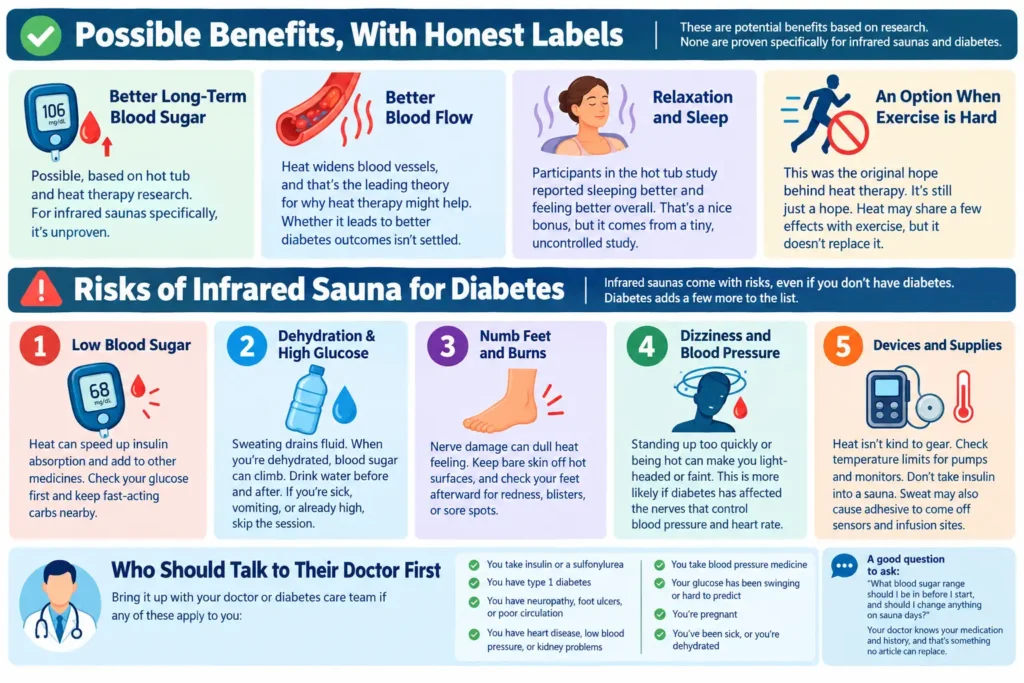
Risks of Infrared Sauna for Diabetes
Infrared saunas come with risks worth knowing about even if you don’t have diabetes. Diabetes adds a few more to the list.
1. Low blood sugar
Heat can speed up how quickly your body absorbs injected insulin. Sauna time may also add to the effect of glucose-lowering medicine, especially insulin and sulfonylureas. If your blood sugar is already on the lower side when you walk in, it can drop further. Check your glucose first, and keep a fast-acting carb within arm’s reach.
2. Dehydration and high glucose
Sweating drains fluid. When you’re dehydrated, blood sugar concentrations can climb, and you’ll probably feel worse overall. Drink water before you go in and after you come out. If you’re sick, vomiting, or already running high, skip the session.
3. Numb feet and burns
Nerve damage can dull your ability to feel heat. If you have neuropathy, your skin might be getting too warm before you notice. Keep bare skin off hot surfaces, and check your feet afterward for redness, blisters, or sore spots.
4. Dizziness and blood pressure
Standing up too quickly or being hot can make you feel lightheaded or faint. This is more likely if diabetes has damaged the nerves that control blood pressure and heart rate. That’s a real world reminder from the hot tub study: even those patients required assistance to get out safely.
5. Devices and supplies
Heat isn’t kind to gear. Many insulin pumps and glucose monitors will have temperature limits written in the manual, so check before wearing in a cabin. Do not take insulin into a sauna as heat can affect it. Sweat may also cause adhesive to come off sensors and infusion sites.
Who Should Talk to Their Doctor First
Bring it up with your doctor or diabetes care team before you start if any of these apply to you:
- You take insulin or a sulfonylurea
- You have type 1 diabetes
- You have neuropathy, foot ulcers, or poor circulation
- You have heart disease, low blood pressure, or kidney problems
- You take blood pressure medicine
- Your glucose has been swinging or hard to predict
- You’re pregnant
- You’ve been sick, or you’re dehydrated
A good question to ask: “What blood sugar range should I be in before I start, and should I change anything on sauna days?” Your doctor knows your medication and history, and that’s something no article can replace.
How to Use an Infrared Sauna Safely With Diabetes
These are common-sense precautions, not a medical prescription. Run your plan by your care team first.
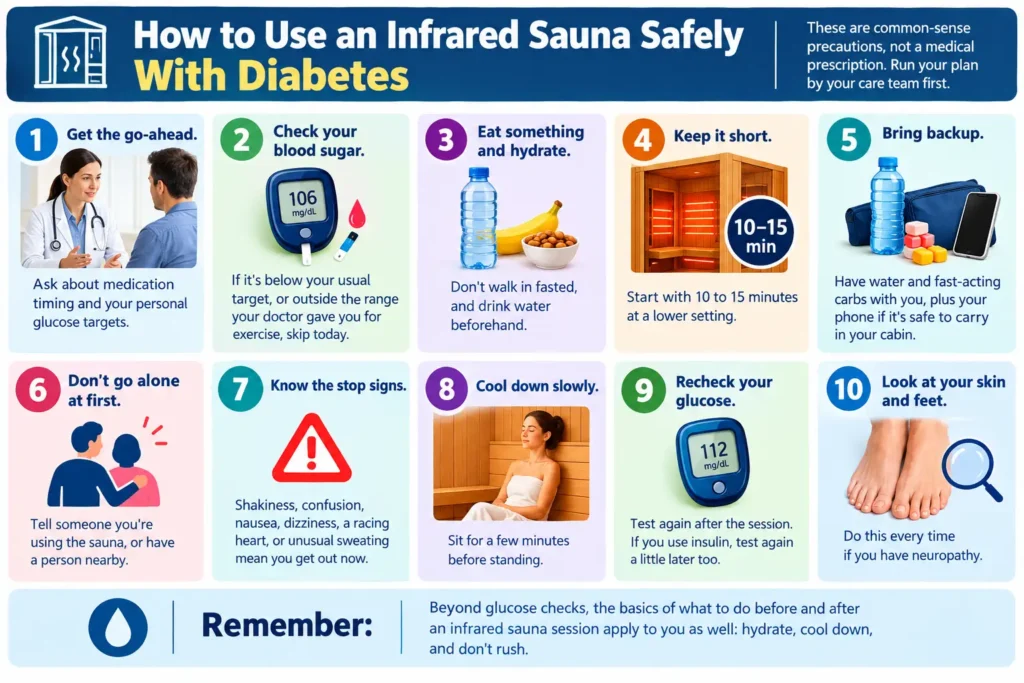
- Get the go-ahead. Ask about medication timing and your personal glucose targets.
- Check your blood sugar. If it’s below your usual target, or outside the range your doctor gave you for exercise, skip today.
- Eat something and hydrate. Don’t walk in fasted, and drink water beforehand.
- Keep it short. There’s no research-backed session length for people with diabetes, so how long you stay in an infrared sauna comes down to caution. Start with 10 to 15 minutes at a lower setting.
- Bring backup. Have water and fast-acting carbs with you, plus your phone if it’s safe to carry in your cabin.
- Don’t go alone at first. Tell someone you’re using the sauna, or have a person nearby.
- Know the stop signs. Shakiness, confusion, nausea, dizziness, a racing heart, or unusual sweating mean you get out now.
- Cool down slowly. Sit for a few minutes before standing.
- Recheck your glucose. Test again after the session. If you use insulin, test again a little later too.
- Look at your skin and feet. Do this every time if you have neuropathy.
Beyond glucose checks, the basics of what to do before and after an infrared sauna session apply to you as well: hydrate, cool down, and don’t rush.
Infrared Sauna vs Traditional Sauna vs Hot Tub
Here’s how the three compare when diabetes is part of the picture. If you’re trying to decide between heat options, infrared saunas vs traditional saunas differ in more ways than this table covers.
| Infrared sauna | Traditional sauna | Hot tub | |
|---|---|---|---|
| How it heats | Infrared light warms your body | Hot air and heated rocks | Hot water |
| Typical feel | Milder air temperature | Hotter, sometimes humid | Full-body warmth |
| Diabetes research | Very limited | Mostly heart-health studies | One small pilot study |
| Extra caution | Long sessions can still overheat you | Very hot air | Water hygiene |
Myths vs Facts
Myth: An infrared sauna can replace diabetes medicine.
Fact: Nothing supports that. Changing medication on your own can be dangerous.
Myth: Sauna is the same as exercise.
Fact: It may share a few effects, but it can’t replace movement.
Myth: Infrared is gentler, so it’s safe for everyone.
Fact: It still raises your body temperature and heart rate.
Myth: Finnish sauna studies prove infrared saunas help diabetes.
Fact: Those studies covered a different type of sauna and different outcomes.
Frequently Asked Questions
Can diabetics use an infrared sauna?
Many people with well-controlled type 2 diabetes can, with their doctor’s approval. Insulin users, people with type 1 diabetes, and those with neuropathy need extra caution.
Does an infrared sauna lower blood sugar?
Not reliably. One trial found no improvement in blood sugar handling after a single session, and long-term effects haven’t been proven for infrared saunas.
Can a sauna cause low blood sugar?
It can contribute, especially if you take insulin or certain oral medicines. Heat may speed insulin absorption.
How long should someone with diabetes stay in an infrared sauna?
There’s no proven standard. Many people start with 10 to 15 minutes at a lower setting and adjust based on how they feel and their doctor’s advice.
Should I check my glucose before and after?
Yes, both times.
Can infrared sauna help diabetic neuropathy?
There’s no solid evidence for infrared saunas. The 1999 hot tub report mentioned symptom relief, but it was very small and uncontrolled.
Can I skip medication on sauna days?
No. Never change your medicine without your doctor’s guidance.
What should make me leave right away?
Dizziness, confusion, shakiness, nausea, chest discomfort, or a racing heart.
Final Thoughts
An infrared sauna isn’t a diabetes treatment. The research on heat therapy is interesting, but it’s small, and the best infrared-specific trial found no benefit from a single session. What happens with weeks or months of regular use is still unknown.
That doesn’t mean saunas are off-limits. For many people with well-controlled type 2 diabetes, a short, careful, doctor-approved routine can be a reasonable way to unwind. Think of it as a bonus on top of medication, good food, movement, and regular check-ups, never a replacement.
If you’re curious, here’s where to start. Talk to your care team, check your glucose before and after, keep water and fast-acting carbs close, and stop at the first warning sign. If it feels good and your numbers stay steady, great. If not, you’ve lost nothing by being careful.