
Can an infrared sauna reduce arthritis pain? For many people, yes — at least in the short term. Clinical research on rheumatoid arthritis (RA) and ankylosing spondylitis (AS) patients found statistically significant reductions in pain and stiffness during individual infrared sauna sessions. But it’s not a cure, the long-term evidence is still limited, and it’s not the right choice for everyone.
If you’re dealing with joint pain and wondering whether a sauna is worth trying, you deserve a straight answer — not vague marketing language or an overly cautious shrug. Here’s what the actual research says, how it likely works, and how to use one safely if you decide to try it.
Key Takeaways
- A pilot study of 34 arthritis patients found infrared sauna sessions produced statistically significant short-term drops in pain, stiffness, and fatigue.
- The effect was strongest during and right after a session — long-term improvement over weeks showed a positive trend but wasn’t statistically significant in that study.
- No participants experienced a disease flare-up from sauna use in the available research.
- Heat therapy likely helps through improved blood flow, muscle relaxation, and possible anti-inflammatory effects on certain immune signaling molecules.
- Infrared saunas are not appropriate during an active flare, for certain heart conditions, or during pregnancy — check with your doctor first.
Can an Infrared Sauna Reduce Arthritis Pain?
What Does the Research Actually Say?
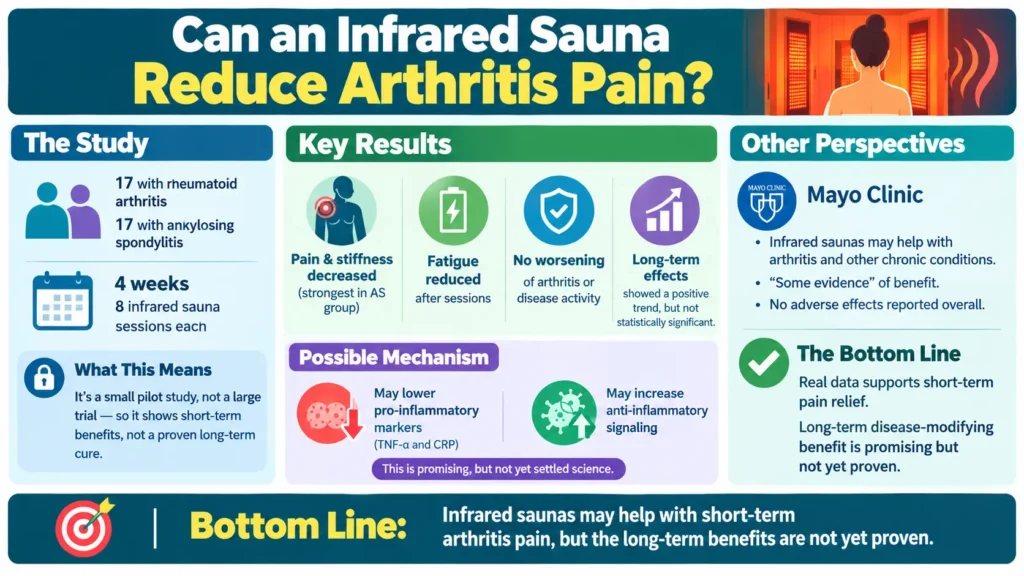
The most directly relevant study is a pilot trial published in Clinical Rheumatology (Oosterveld et al.), which tracked 17 people with rheumatoid arthritis and 17 with ankylosing spondylitis over a 4-week period. Each participant did eight infrared sauna sessions.
The results were encouraging on a few fronts:


Paid Links - As an Amazon Associate, I earn from qualifying purchases.
- Pain and stiffness dropped in a statistically significant way during individual sauna sessions — the improvement was strongest for the AS group.
- Fatigue also decreased after sessions.
- No one reported an infrared sauna making their arthritis worse, and disease activity scores didn’t show any meaningful negative change over the study period.
- Improvements measured over the full 4-week period (rather than just immediately after a session) trended positive but weren’t statistically significant — meaning the study was too small to confirm a lasting, cumulative effect.
It’s worth being clear about what this study is and isn’t. It’s a small pilot study, not a large randomized controlled trial, so it tells us infrared sauna use seems safe and beneficial in the short term for these conditions — not that it’s a proven long-term treatment.
A more recent review of the literature on sauna therapy in rheumatic diseases took a more holistic approach to the studies and suggested a biological mechanism: heat exposure seems to lower some pro-inflammatory markers (such as TNF-α and CRP) and increase anti-inflammatory signaling. This is a good mechanism, but the review itself admits that this is not yet settled science.



Paid Links - As an Amazon Associate, I earn from qualifying purchases.
Mayo Clinic’s own take is more broad: infrared saunas have been investigated for a variety of chronic health issues, including arthritis, and there is “some evidence” that they can help, but more rigorous and extensive research is required. Notably, Mayo Clinic also states that there have been no adverse effects reported from infrared sauna use overall.
The bottom line: There is actual published data that supports the short-term pain relief. The long-term disease-modifying benefit is promising but not yet proven.
How Might Infrared Heat Help Arthritis Pain?
While no one has yet fully outlined the exact mechanism, several explanations are well supported by the knowledge of heat and the body:
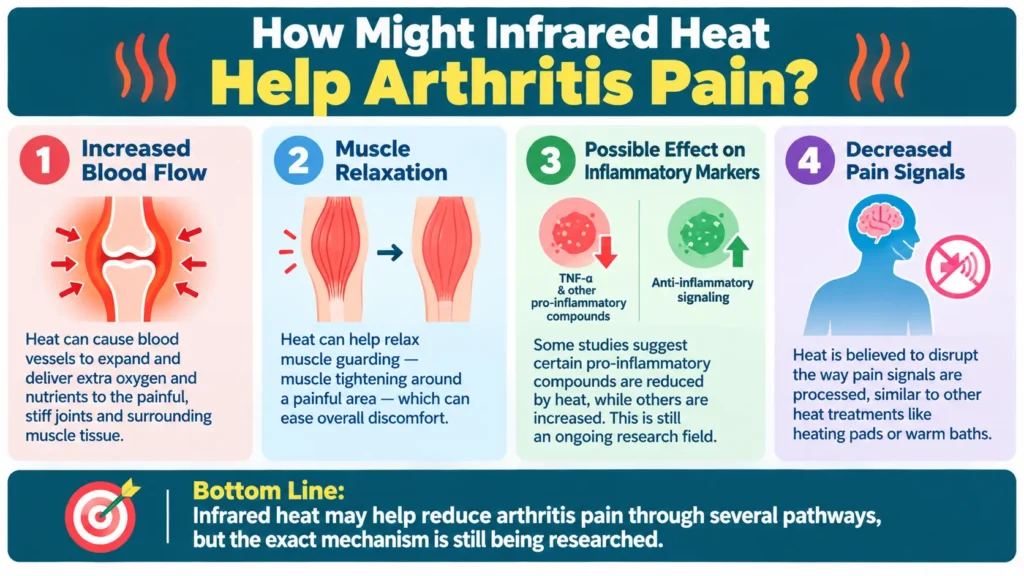
- Increased blood flow. Heat can cause blood vessels to expand and deliver extra oxygen and nutrients to the painful, stiff joints and surrounding muscle tissue.
- Muscle relaxation. Muscle guarding — muscle tightening around a painful area — is often associated with chronic joint pain. Heat can help to relax that guarding, which can ease overall discomfort.
- Possible effect on inflammatory markers. As mentioned, some studies suggest that certain pro-inflammatory compounds are reduced by heat, while others are anti-inflammatory and are increased by heat, but this is an ongoing research field.
- Decreased sensitivity to pain signals. Like other heat treatments such as heating pads or warm baths, heat is believed to disrupt the way pain signals are processed.
Types of Arthritis: Does the Research Apply to Yours?
“Arthritis” isn’t one condition — and the research doesn’t apply equally to all types.



Paid Links - As an Amazon Associate, I earn from qualifying purchases.
| Arthritis Type | What It Is | Infrared Sauna Evidence |
|---|---|---|
| Rheumatoid arthritis (RA) | Autoimmune condition where the immune system attacks joint linings | Directly studied — short-term pain/stiffness relief shown in pilot research |
| Ankylosing spondylitis (AS) | Inflammatory arthritis mainly affecting the spine | Directly studied — strongest short-term effect seen in this group |
| Osteoarthritis (OA) | “Wear and tear” arthritis from cartilage breakdown | Not directly studied in the same trial, but general heat therapy is a well-established, widely recommended approach for OA joint stiffness |
| Psoriatic arthritis | Autoimmune arthritis linked to psoriasis | No dedicated infrared sauna studies found; general inflammatory-arthritis heat precautions apply |
If you have an autoimmune type of arthritis, this distinction matters more than it might seem — flare management and medication interactions differ from OA, so it’s worth discussing sauna use specifically with your rheumatologist rather than a general physician.
Benefits of Infrared Sauna for Arthritis Pain

- Short-term pain relief. The most well-documented benefit, supported by the pilot study data above.
- Reduced stiffness. Particularly helpful first thing in the morning or after long periods of inactivity, when arthritis stiffness tends to peak.
- Lower perceived fatigue. Chronic pain and fatigue often go hand in hand; participants in the pilot study reported both easing after sessions.
- A lower-impact alternative to exercise-based heat. Because infrared saunas heat the body directly at lower ambient air temperatures than a traditional sauna, they may be more tolerable for people who find high heat or humidity difficult something worth understanding before your first session.
- Non-drug option to pair with existing treatment. It’s not a replacement for prescribed RA or AS medication, but it may serve as a helpful complement for managing day-to-day symptoms.
Risks and Who Should Be Cautious
This is the part most sauna-brand blogs skip over. Infrared sauna use isn’t risk-free for everyone with arthritis.
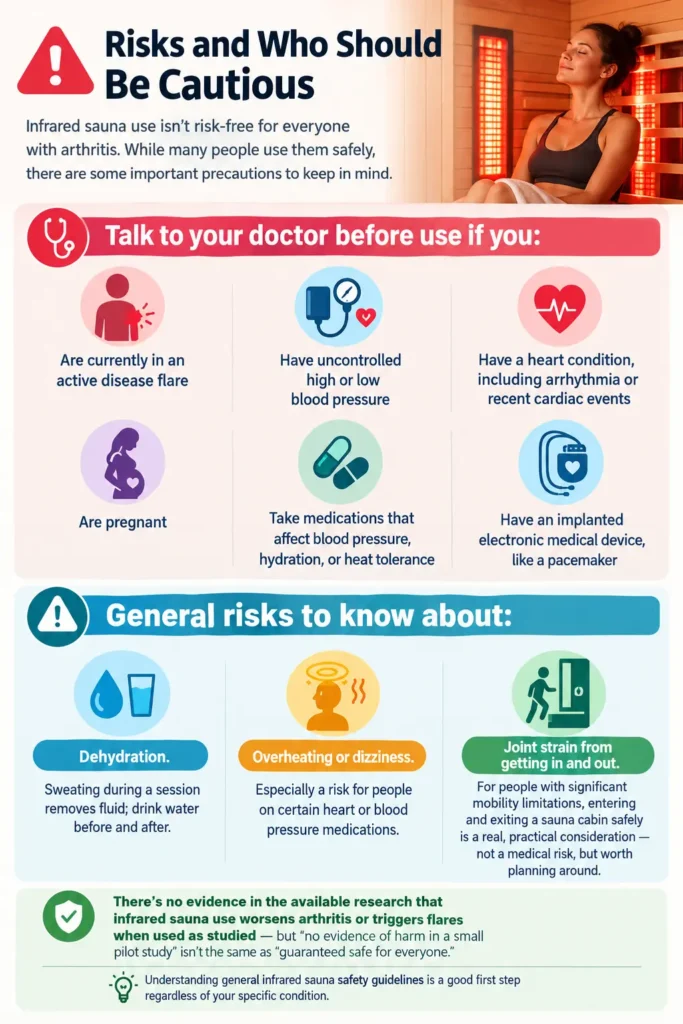
Talk to your doctor before use if you:
- Are currently in an active disease flare
- Have uncontrolled high or low blood pressure
- Have a heart condition, including arrhythmia or recent cardiac events
- Are pregnant
- Take medications that affect blood pressure, hydration, or heat tolerance
- Have an implanted electronic medical device, like a pacemaker
General risks to know about:
- Dehydration. Sweating during a session removes fluid; drink water before and after.
- Overheating or dizziness. Especially a risk for people on certain heart or blood pressure medications.
- Joint strain from getting in and out. For people with significant mobility limitations, entering and exiting a sauna cabin safely is a real, practical consideration — not a medical risk, but worth planning around.
There’s no evidence in the available research that infrared sauna use worsens arthritis or triggers flares when used as studied — but “no evidence of harm in a small pilot study” isn’t the same as “guaranteed safe for everyone.” Understanding general infrared sauna safety guidelines is a good first step regardless of your specific condition.
Myth vs. Fact
| Myth | Fact |
|---|---|
| “Infrared sauna cures arthritis.” | No study supports this. It may reduce pain and stiffness short-term, not reverse the underlying disease. |
| “Heat always helps arthritis pain.” | Heat generally helps stiffness; during an active, swollen flare, some people find cold therapy more effective. Individual response varies. |
| “It’s completely risk-free because it’s natural.” | Anyone with cardiovascular issues, certain medications, or active flares should get medical clearance first. |
| “Only rheumatoid arthritis has been studied.” | Both RA and ankylosing spondylitis were included in the key pilot study; osteoarthritis relies on general heat-therapy evidence rather than a sauna-specific trial. |
| “More heat means more benefit.” | Longer or hotter isn’t automatically better — following recommended session lengths matters more than pushing extremes. |
How to Use an Infrared Sauna Safely for Arthritis Pain
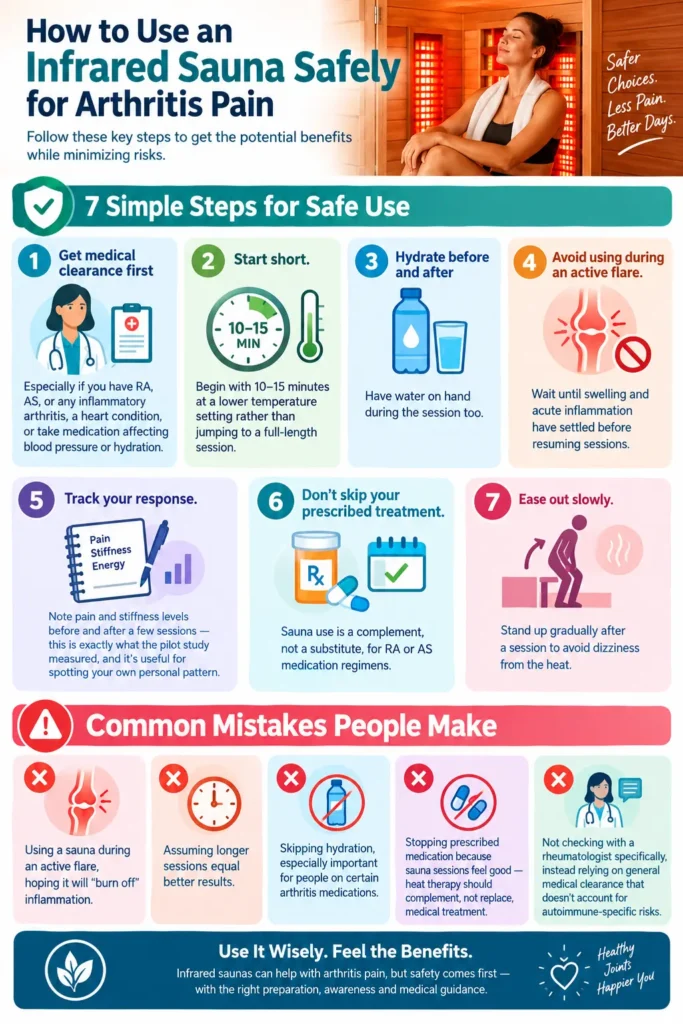
- Get medical clearance first, especially if you have RA, AS, or any inflammatory arthritis, a heart condition, or take medication affecting blood pressure or hydration.
- Start short. Begin with 10–15 minutes at a lower temperature setting rather than jumping to a full-length session.
- Hydrate before and after. Have water on hand during the session too.
- Avoid using during an active flare. Wait until swelling and acute inflammation have settled before resuming sessions.
- Track your response. Note pain and stiffness levels before and after a few sessions — this is exactly what the pilot study measured, and it’s useful for spotting your own personal pattern.
- Don’t skip your prescribed treatment. Sauna use is a complement, not a substitute, for RA or AS medication regimens.
- Ease out slowly. Stand up gradually after a session to avoid dizziness from the heat.
Common Mistakes People Make
- Using a sauna during an active flare, hoping it will “burn off” inflammation.
- Assuming longer sessions equal better results.
- Skipping hydration, especially important for people on certain arthritis medications.
- Stopping prescribed medication because sauna sessions feel good — heat therapy should complement, not replace, medical treatment.
- Not checking with a rheumatologist specifically, instead relying on general medical clearance that doesn’t account for autoimmune-specific risks.
Frequently Asked Questions
Can an infrared sauna reduce arthritis pain?
Yes, in the short term for many people. A pilot study on RA and AS patients found statistically significant reductions in pain and stiffness during individual sessions, though long-term effects need more research.
Is infrared sauna good for rheumatoid arthritis specifically?
The available clinical evidence, though limited to one small pilot study, showed short-term pain and stiffness relief for RA patients with no reported disease flare-ups.
Does infrared sauna help osteoarthritis?
There’s no dedicated infrared sauna trial for osteoarthritis specifically, but general heat therapy — which infrared saunas provide — is a well-established approach for easing OA joint stiffness.
How often should someone with arthritis use an infrared sauna?
The pilot study used eight sessions over four weeks (roughly twice a week). That’s a reasonable starting frequency, but check with your doctor for guidance specific to your condition and medications.
Can an infrared sauna make arthritis worse?
No study reviewed found that infrared sauna use worsened arthritis or triggered flares when used outside of an active flare period. Using it during an active flare isn’t well studied and is generally not recommended.
How long should an arthritis patient stay in an infrared sauna?
Starting with 10–15 minutes and building up gradually is a reasonable, cautious approach, though your specific tolerance and any medical guidance should take priority over a general rule.
Is infrared sauna safer than a traditional sauna for arthritis?
Infrared saunas heat the body directly at lower ambient temperatures, which many people — especially those with cardiovascular sensitivity — find easier to tolerate than the higher heat of a traditional sauna. Neither is automatically “safer” in every case; it depends on your specific health profile.
Should I use a sauna during an arthritis flare-up?
Most guidance leans toward waiting until acute swelling and flare symptoms subside before resuming sauna sessions, since this scenario hasn’t been specifically studied.
Can infrared sauna replace arthritis medication?
No. It may help manage day-to-day symptoms alongside treatment, but it isn’t a substitute for prescribed disease-modifying medication.
Does infrared sauna reduce inflammation from arthritis?
Some research suggests heat exposure may influence certain inflammatory markers, but this mechanism is still being studied and isn’t confirmed as a reliable, measurable anti-inflammatory treatment on its own. Learning more about how infrared heat interacts with inflammation generally can help set realistic expectations.
Is it safe to use an infrared sauna with a pacemaker if I have arthritis?
Anyone with an implanted electronic medical device should get clearance from their cardiologist before infrared sauna use, regardless of their arthritis status.
What’s the difference between using a sauna and a heating pad for arthritis pain?
A heating pad targets one localized area, while an infrared sauna provides full-body heat exposure, which may offer broader relief for widespread stiffness but requires more caution around hydration, blood pressure, and overall heat tolerance.
Final Thoughts
The honest answer to “can an infrared sauna reduce arthritis pain” is a research-backed yes — for short-term relief, in the specific conditions that have actually been studied. It’s not a miracle cure, and the long-term picture isn’t fully settled yet. What we do know is that a real clinical pilot study found meaningful, statistically significant pain and stiffness reduction with no reported flare-ups, and a lower-heat, gentler alternative to traditional sauna bathing seems to be well tolerated by arthritis patients.
If you’re considering trying it, the smartest next step isn’t buying the priciest sauna on the market — it’s a quick conversation with your rheumatologist or doctor about your specific condition, medications, and risk factors. From there, start short, track how your body responds, and treat it as one tool in your broader pain management approach rather than a replacement for anything your doctor has already prescribed.