
Music can turn a good sauna session into a great one. A quiet playlist, a podcast, or a guided breathing track can help you relax, slow down, and enjoy the heat. The right outdoor sauna speakers make that possible without putting your gear, or your safety, at risk.
But a sauna is a hard place for electronics. The hot room runs far hotter than any living room, steam and sweat fill the air, and an outdoor sauna also faces rain, cold nights, and dust. A normal indoor speaker will not last long in those conditions, and in the worst case it can fail in a way that is unsafe.
This guide walks you through the whole setup, step by step. You will learn what makes a speaker sauna safe, where to place it, how to choose between wired, Bluetooth, and Wi-Fi sound, and how to run cables and power without cutting corners. You will also find simple setup plans for three budgets, so you can start small or build a permanent system with confidence.


#Paid Links
Please note: this article is for general information only and is not medical advice.
Saunas are wellness tools, not treatments. They do not cure illness, detox your body, or cause lasting weight loss. If you are pregnant, live with a heart or circulation condition, have low blood pressure, or take medication that affects how you handle heat, check with your doctor before using a sauna.
Hydrate well, keep sessions short, and leave the hot room at once if you feel dizzy or unwell. Do not drink alcohol before or during a sauna session.
Why Music in a Sauna Needs a Different Plan
Most of us are used to putting a speaker anywhere and pressing play. A sauna breaks that habit in three ways at once. Heat, moisture, and the outdoors each attack electronics in a different way, and a garden sauna combines all three.
Heat is the biggest problem. A traditional outdoor sauna hot room often runs between 70 and 90 degrees Celsius, which is roughly 158 to 194 degrees Fahrenheit. That is far above the operating range printed on most consumer speakers. Plastic parts can soften, glues can weaken, batteries can swell, and drivers can lose their shape.
A speaker that sounds fine for a week may slowly fail over a season. Heat damage builds up quietly, and by the time the sound turns muffled or distorted, the harm is already done.


#Paid Links
Moisture is the second problem. Every session adds steam, sweat, and condensation to the air. Water finds its way into grilles, ports, and seams, and it can corrode contacts and circuit boards over time.
Outdoors, rain and morning dew add to the load, and winter cold can follow a hot session within hours. That swing from hot and damp to cold and dry is hard on any device.
The good news is that none of this means you have to give up on music. It only means the setup needs a plan. The safest systems keep the most fragile parts out of the worst heat, use gear rated for water and humidity, and treat power with respect. Once you understand those three ideas, the rest is simple.
- Heat shortens the life of speakers, batteries, and glues.
- Steam and condensation corrode contacts and boards.
- Rain, dust, and cold add wear to any outdoor setup.
- Power near water needs proper protection and a licensed electrician.
What Makes a Speaker Sauna Safe
A sauna safe speaker is not one single product. It is a speaker whose ratings, materials, and placement all suit the place where it will live. Start by reading the maker specs before you buy. If the maker does not list a maximum operating temperature or a water protection rating, treat that as a warning sign.
Heat tolerance comes first
Check the maximum operating temperature in the product manual or spec sheet. Many portable Bluetooth speakers are rated to around 40 or 45 degrees Celsius. That is fine for a garden party, but it is far below hot room temperatures. A speaker rated for heat will say so clearly, and it will usually be a fixed outdoor or marine speaker rather than a portable one.
If no speaker you like is rated for the full heat of the hot room, that is useful information, not a dead end. It tells you to mount the speakers outside the hot room and let the sound come through the door or a vent. Many sauna owners choose this route, and it is often the best sounding option too, because the speakers stay cool and dry.
Humidity and steam matter as much as heat
Steam is water in the air, and it gets into places that rain never reaches. Look for speakers with sealed cabinets, coated drivers, and stainless or rust resistant fixings. Marine speakers are built for this kind of life, because boats face the same mix of moisture and salt air. Outdoor rated speakers from known audio brands are the next best choice.
Ventilation helps here as well as for comfort. A sauna that vents well dries out faster after a session, and dry wood and dry electronics last longer. If you have not planned your airflow yet, read our guide to outdoor sauna ventilation before you fix speaker positions.
Water protection ratings, honestly explained
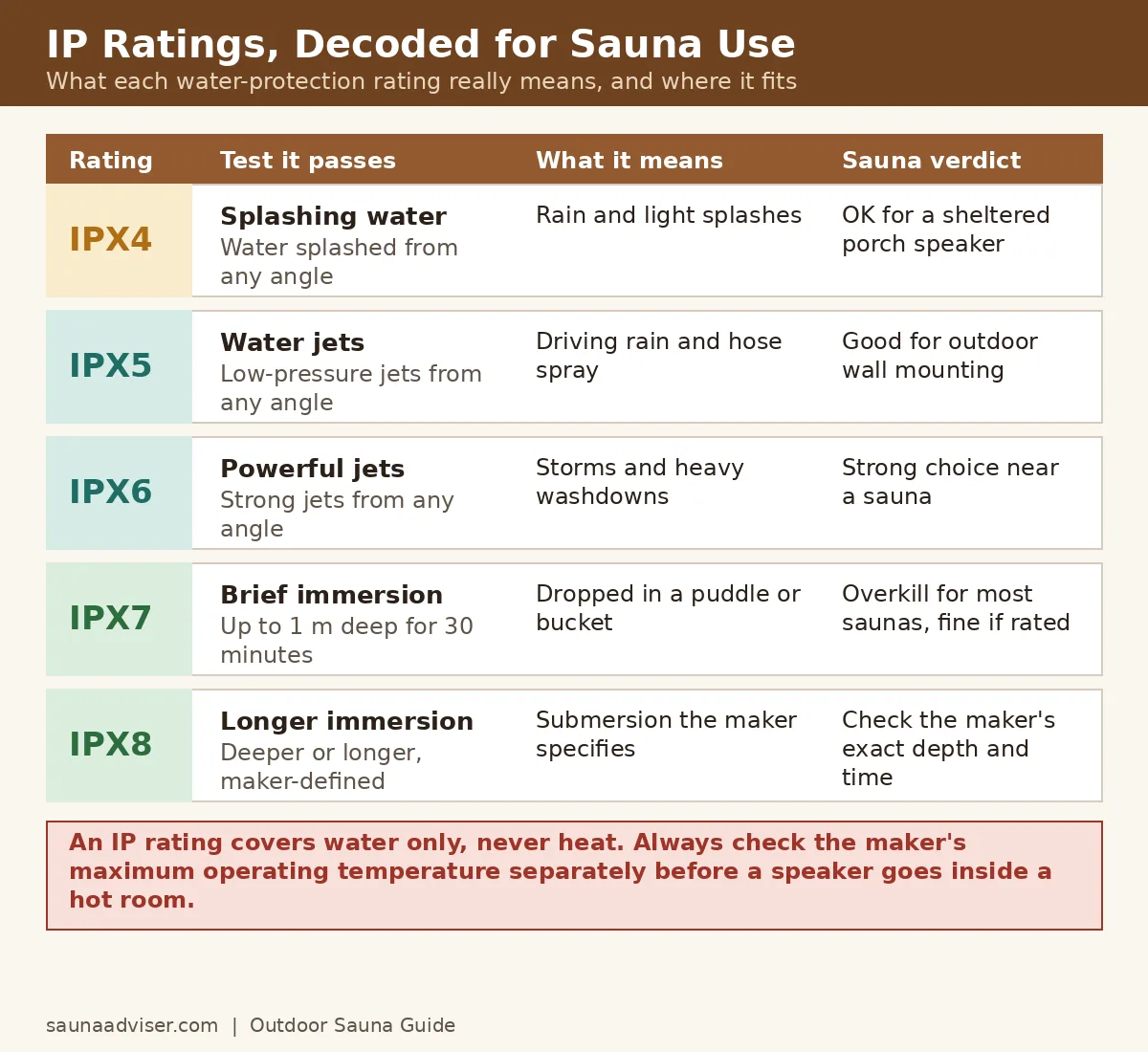
Ingress Protection ratings, usually shortened to IP ratings, describe how well a device keeps out dust and water. The first digit covers dust and the second covers water. A speaker marked IPX5 has been tested against water jets, while one marked IPX7 has been tested against brief immersion. The X simply means the maker did not test dust protection for that product.
For a sauna, IPX5 or higher is a sensible minimum for anything that may face rain or splashes. IPX4 can work under a deep porch roof, but it is a light rating for garden life. Remember that an IP rating says nothing about heat. A speaker can be fully waterproof and still fail in a hot room, so always check the temperature rating separately.
Materials that last outdoors
Wood, UV light, and temperature swings punish cheap plastics. Look for cabinets made from sealed wood, marine grade polymer, or powder coated metal, with grilles that resist rust. Rubber seals should feel firm and even, not thin or loose. If the speaker will sit in direct sun, a shaded mount or a small cover will add years to its life.
Cables and mounts deserve the same care. Outdoor rated speaker cable resists sun and moisture far better than indoor cable. Stainless screws and brackets will not stain your sauna wood with rust marks. These small choices cost little at the start and save you from replacing the whole setup later.
Where to Put Your Speakers
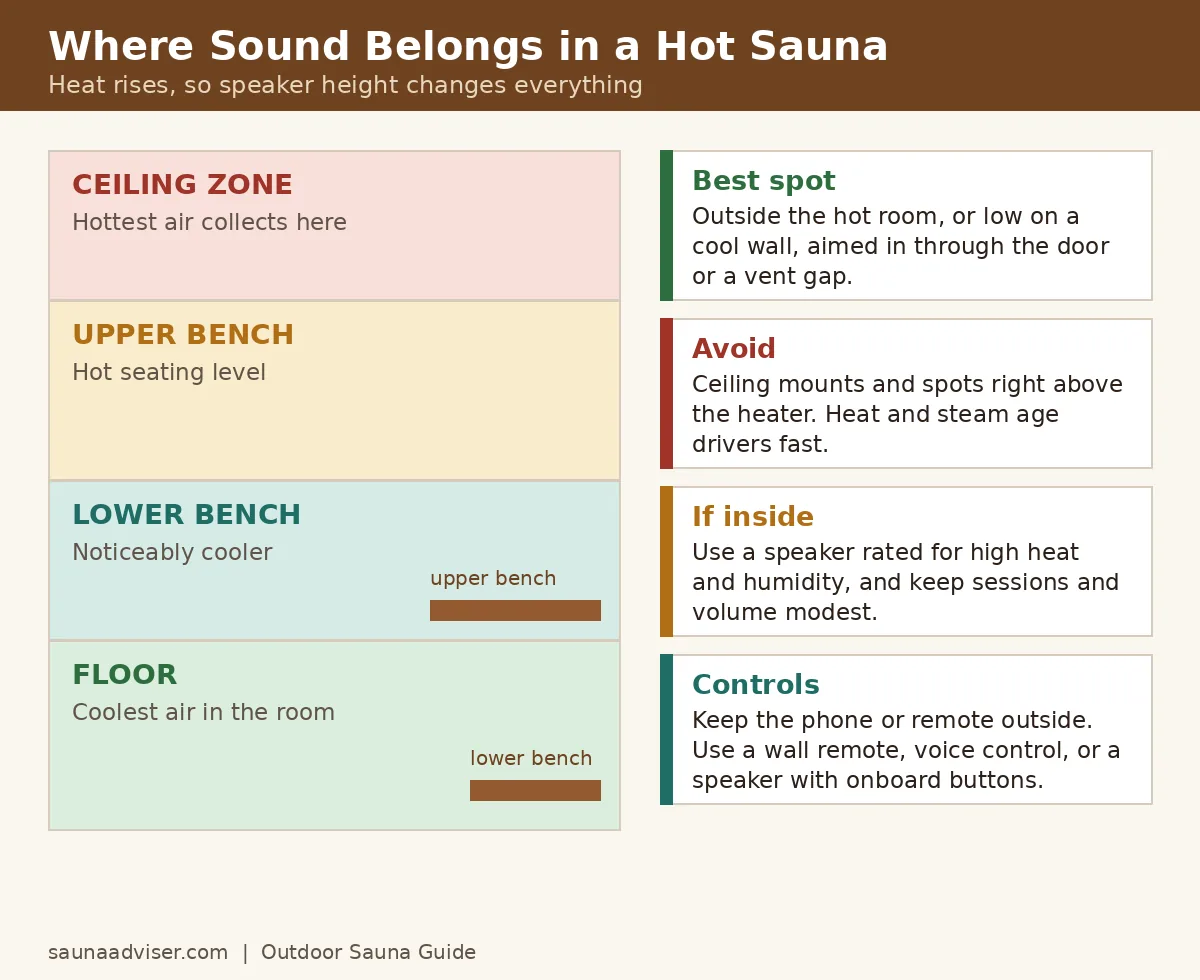
Placement decides both sound quality and speaker life. Heat rises, so the air near the ceiling of a hot room is much hotter than the air near the floor. A speaker mounted high on the wall lives in the worst heat in the room, while one mounted low, or outside the room entirely, lives in far kinder conditions.
Sound also behaves differently in a small wooden room. Bare wood reflects sound, benches and bodies absorb it, and the heater adds a low background hum. Two small speakers placed at ear height when seated usually sound better than one large speaker shouting from a corner. Keep the speakers aimed at the benches, not at the heater or the door.
Inside the hot room
Putting speakers inside the hot room gives the most direct sound, but it is the hardest option for the gear. Only do this with speakers rated for high heat and humidity, and mount them low on the wall, below bench height if you can. Never mount a speaker above the heater or near the ceiling, where the hottest air collects.
Keep wiring inside the hot room short and protected. Heat resistant cable and proper glands where cable passes through wood will stop the cable from drying out or chafing. If your sauna has a changing room, consider running the amplifier there and only the speaker cables into the hot room.
Outside the hot room
Mounting speakers just outside the hot room is the choice most sauna owners end up happiest with. The speakers stay cool and dry, they last for years, and the sound still reaches you clearly through an open door or a vent gap. A pair of weatherproof speakers on the changing room wall, aimed toward the hot room door, can fill the whole sauna with gentle sound.
This approach also makes control much easier. You can adjust volume, change tracks, or pause a podcast without opening the hot room door and losing heat. A simple wall mounted volume control in the changing room is a small addition that you will use every single session.
The changing room, porch, and deck
Do not forget the spaces around the sauna. A speaker in the changing room makes getting ready and cooling down more pleasant. A speaker on the porch or deck lets you enjoy music while you cool off outside between rounds. These spots are far easier on gear than the hot room, so standard outdoor rated speakers work well here.
Think about your neighbours too. Sound carries easily across a quiet garden at night, especially bass. Keep outdoor speakers aimed at your own seating area, keep the volume modest after dark, and choose smaller speakers for the deck if your garden is close to other homes. Good placement is kind to both your ears and your neighbours.
Wired, Bluetooth, or Wi-Fi: Which Way Should Sound Travel
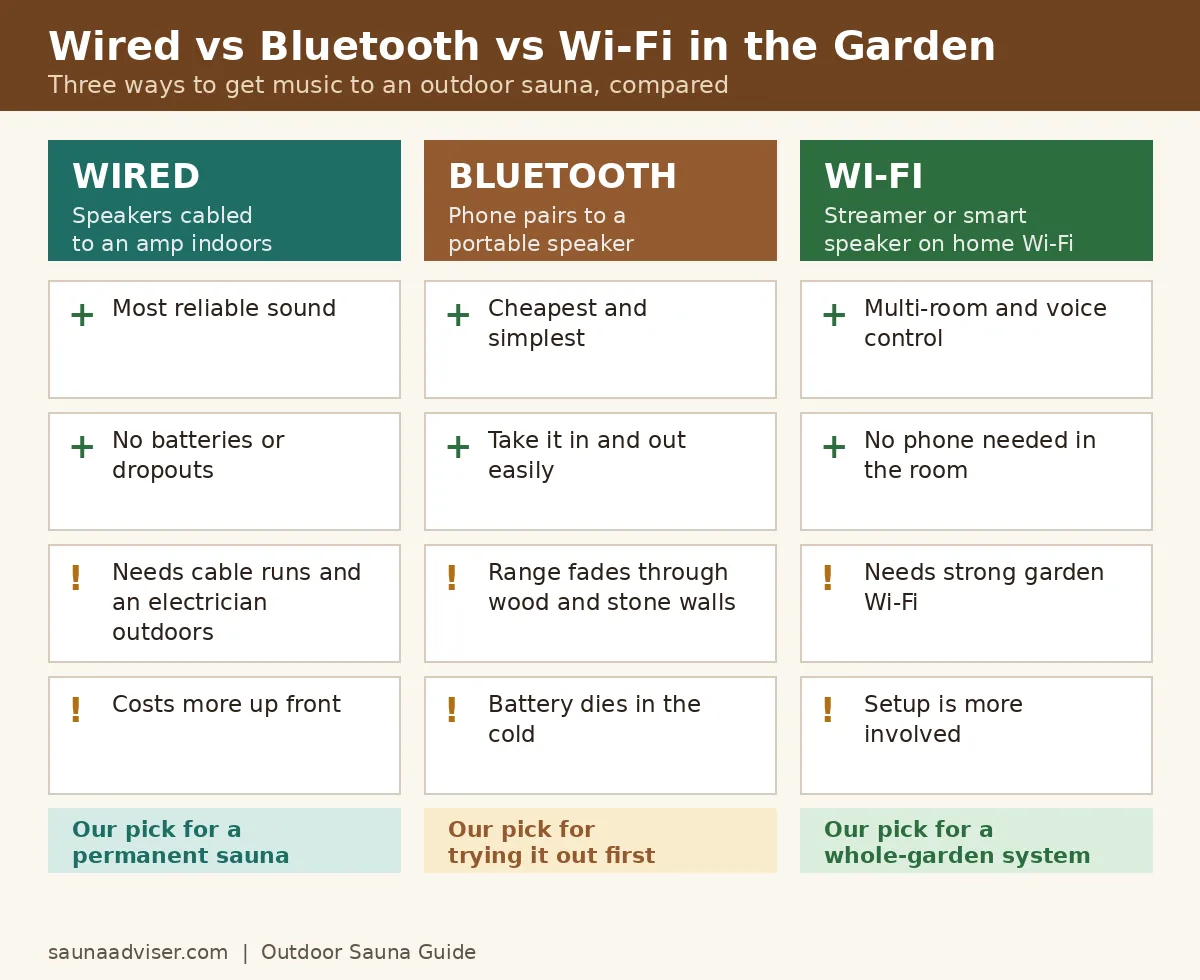
There are three main ways to get music to an outdoor sauna. Each one suits a different kind of owner. Wired sound is the most reliable, Bluetooth is the simplest to start with, and Wi-Fi gives you the most control across the whole garden. Many owners start with Bluetooth and move to wired or Wi-Fi later, and that is a fine path.
Wired sound: reliable and permanent
A wired setup runs speaker cable from an amplifier indoors, or in a dry changing room, out to fixed speakers. There are no batteries to charge, no dropouts when a wall gets in the way, and no pairing to fight with wet hands. The sound quality is steady, and the system is ready the moment you switch it on.
The cost is the installation work. Cables need a safe route, outdoor rated cable costs more than indoor cable, and any mains power work outdoors must be done by a licensed electrician. If you are already planning the electrical supply for your sauna, adding speaker cable at the same time is the smart moment to do it. Our guide to outdoor sauna electrical hookup explains what to plan for.
Bluetooth: simple and portable
Bluetooth is the easiest way to add music to a sauna this weekend. Pair your phone to a portable speaker, place the speaker in a safe spot, and press play. There is no wiring, no amplifier, and no permanent change to your sauna. When the session ends, the speaker comes back indoors to charge and dry out.
The limits are range and battery. Bluetooth signals weaken through thick wood walls, stone, and metal, so the phone usually needs to stay close to the speaker. Batteries also lose charge faster in heat and cold, and a phone left in a hot room can overheat and shut down. Keep the phone outside the hot room, in the shade, and bring the speaker in after every session.
Wi-Fi: flexible and whole garden sound
A Wi-Fi setup uses a streamer or a smart speaker connected to your home network. You can control it by voice, from an app, or from a wall panel, and you can link the sauna speakers with speakers on the deck or in the house for one shared system. There is no need to keep a phone nearby, which is a real benefit with wet hands.
Wi-Fi needs a strong signal in the garden, and many homes find their router does not reach that far. Test the signal at the sauna with your phone before you buy anything. If the signal is weak, an outdoor rated access point or a mesh Wi-Fi node can fix it, but that is another device to install and protect from the weather.
Running Cables and Power Safely
General guidance only.
This section explains the ideas behind a safe install. It is not a wiring manual, and it does not replace local rules. Electrical work outdoors, near water, or inside a sauna must follow your local code, and any mains wiring should be done or checked by a licensed electrician. If you are unsure about any step, stop and call a professional.
Electricity and water are a dangerous mix, and a sauna has plenty of both. That is why power planning deserves more care than speaker shopping. A good install keeps mains power out of the hot room wherever possible, protects every outdoor cable, and gives you a safe way to switch everything off.
Low voltage speaker cable is far safer to run than mains cable, which is one more reason to keep the amplifier indoors or in a dry changing room. The amplifier plugs into a protected indoor socket, and only low voltage speaker cable travels out to the sauna. Ask your electrician about RCD or GFCI protection for every outdoor circuit, and about the right cable type for burial or outdoor runs in your area.
A safe cable route, step by step
- Plan the route on paper first, from amplifier to each speaker, and measure twice.
- Choose outdoor rated speaker cable and conduit, and keep the route away from the heater and flue.
- Run cables through conduit where they pass outdoors, underground, or through walls.
- Seal every wall entry with a proper gland or sealant so rain and insects stay out.
- Leave a little slack at each end for service, and label both ends of every cable.
- Have a licensed electrician check any mains work, test the protection devices, and sign off the install.
Where you place the sauna also affects the cable run. A sauna close to the house needs a short, simple route, while a sauna at the far end of the garden may need buried conduit and a longer planning process. If you are still choosing a spot, our guide to outdoor sauna placement covers sun, wind, drainage, and privacy alongside access for power.
Lighting and audio can share the plan
Many owners install sauna lighting and audio in the same project, and that makes sense. Both need low voltage cable, both need careful routing away from heat, and both benefit from a single dry location for controls. Planning them together saves you from drilling new holes later. See our guide to outdoor sauna lighting fixtures, wiring, and ambience for ideas that pair well with sound.
Setting Up a Simple Bluetooth System
If you want music this weekend with no wiring, Bluetooth is the way to start. The whole setup takes less than an hour, and you can test whether you actually enjoy music in the sauna before spending more. Follow these steps and the system will sound good and stay safe.
- Choose a portable speaker rated at least IPX5, and check its maximum operating temperature.
- Charge it fully indoors before your session, and download your playlist so a weak signal does not interrupt playback.
- Place the speaker low and outside the hot room if you can, such as on a bench in the changing room with the door ajar.
- Keep your phone in the shade outside the hot room, close enough to hold the Bluetooth link.
- Set the volume before you enter, so you are not fiddling with wet hands in the heat.
- After the session, bring the speaker indoors, wipe it dry, and let it air out before charging.
A small waterproof pouch or a zip lock bag can protect a phone that must stay near the sauna, but it will muffle the microphone and trap heat, so use it only for storage, not for playback inside the hot room. A cheap phone stand on a shaded shelf is a better answer for most people.
Building a Permanent Wired Setup
A permanent wired system is the best choice if you sauna several times a week and want sound that simply works every time. The work is front loaded, but the daily routine becomes effortless. Switch on, press play, and the music is there.
Start with the amplifier. A small stereo amplifier or a multi room streamer amplifier, kept indoors or in a dry changing room, will drive two outdoor rated speakers with ease. Choose an amplifier with Bluetooth and Wi-Fi built in if you want both options, and make sure it has a simple remote or app control so you are not walking back to the house to change tracks.
- Two weatherproof speakers, rated at least IPX5, mounted low and aimed at the benches.
- Outdoor rated speaker cable in conduit, with sealed wall entries.
- An amplifier in a dry spot, with RCD or GFCI protected power.
- A volume control in the changing room, so you can adjust sound without leaving the sauna area.
- A clear way to switch the whole system off when the sauna is not in use.
Test the system before you seal any cable entries or fix any covers in place. Play music at normal volume, walk around the sauna, and listen from each bench. Move a speaker a few inches if the sound is uneven, and only then tighten everything down. A half hour of testing now saves a full afternoon of rework later.
What to Play, and How Loud
A sauna is a place to slow down, so the best sound is usually gentle and steady. Many people choose ambient music, soft acoustic tracks, or nature sounds. Podcasts and audiobooks work well too, because the spoken word carries clearly at low volume. Guided breathing or meditation tracks can pair nicely with the rhythm of a sauna session.
Keep the volume low enough to hear your own breathing and to notice how your body feels. That is not just good manners for your neighbours. It is also a safety habit.
If music is so loud that you cannot hear yourself, you may miss the early signs of feeling unwell. As a rough guide, if you need to raise your voice to talk over the music, it is too loud for a sauna.
Playlist ideas for different sessions
- Morning sessions: calm acoustic music or a short news podcast to start the day.
- Evening wind down: ambient, classical, or slow instrumental tracks.
- Family sessions: a shared playlist everyone agrees on, kept at low volume.
- Cool down breaks: nature sounds or silence on the deck between rounds.
Download playlists before your session rather than streaming over a weak garden connection. A downloaded playlist will not stutter when the Wi-Fi dips, and your phone will use less battery. If you use a streaming service, check its offline mode before you head outside.
Mistakes to Avoid
Most sauna audio problems come from a small list of avoidable errors. Learn them once and your setup will last far longer than the average one. Each mistake below is easy to make and easy to prevent.
- Putting a normal indoor speaker in the hot room and hoping for the best.
- Mounting speakers above the heater or near the ceiling, where heat is worst.
- Leaving a phone or tablet inside the hot room, where it can overheat and shut down.
- Running indoor cable outdoors without conduit, and watching it fail within a season.
- Placing mains power or sockets where water or steam can reach them.
- Playing music so loud that you cannot hear how your body feels.
- Forgetting to dry and store portable speakers after every session.
The phone mistake deserves a special note. Modern phones protect themselves by shutting down when they overheat, but repeated heat exposure still shortens battery life. A phone that has shut down in a sauna may also be too hot to hold safely. Keep it outside the hot room, every time, without exception.
Looking After Your Sauna Speakers
Outdoor speakers need a little routine care, and the sauna calendar is a good place to fit it in. A quick check each month will catch loose mounts, worn seals, and early corrosion before they become real problems. Add the check to your regular sauna routine so it never gets forgotten.
- Wipe grilles and cabinets with a dry cloth after sessions, and check seals for cracks.
- Tighten mounts and brackets each season, since wood moves with heat and moisture.
- Check cable entries for gaps, insects, or water marks, and reseal them promptly.
- Bring portable speakers indoors for winter if you do not sauna in the cold months.
- Test the system after any storm, and look for water inside covers and conduit.
Cleaning the sauna itself matters for the speakers too. Dust, oils, and wood treatments can build up on grilles and affect sound over time. Our outdoor sauna cleaning guide and our outdoor sauna maintenance calendar give you a simple routine that covers both the room and the gear inside it.
If a speaker starts to sound muffled, distorted, or quiet on one side, stop using it and check for moisture inside the cabinet. Do not open a sealed speaker while it is still under warranty, since that can void the cover. Contact the maker first, and describe the conditions it has faced, including heat, steam, and outdoor exposure.
Three Setup Plans for Three Budgets
There is no single right way to add sound to an outdoor sauna. The right plan is the one that fits how often you sauna, how much work you want to do, and how much you want to spend. These three plans cover the most common situations, and you can move from one to the next as your needs grow.
Try It Out
Best for: first time sauna sound
One portable Bluetooth speaker rated at least IPX5, used outside the hot room and brought indoors after each session. No wiring, no install, and no permanent change to your sauna.
Cost note: lowest cost of the three plans. Prices vary by brand, so compare current 2026 prices before you buy.
Step Up
Best for: regular sauna users
A Wi-Fi streamer or smart speaker in the changing room, plus a weatherproof speaker on the porch. Voice or app control, no phone in the hot room, and sound that follows you from sauna to deck.
Cost note: mid range. You may need a garden Wi-Fi boost, so test your signal first.
Go Permanent
Best for: keen sauna owners
A wired system with an amplifier indoors, two fixed weatherproof speakers, and a volume control in the changing room. Installed once by a licensed electrician, then ready every session with no charging or pairing.
Cost note: highest cost up front, lowest hassle over time. Get a quote from a local electrician before you commit.
Whichever plan you choose, start with placement and protection before you spend money on sound quality. A modest speaker in the right spot will always sound better than an expensive speaker cooking on the ceiling. If your sauna is a barrel, cabin, or pod shape, the room shape will also change how sound spreads, so read our comparison of barrel vs cabin vs pod saunas and think about where benches and walls sit in your model.
Frequently Asked Questions
Can I put a normal Bluetooth speaker in my outdoor sauna?
You can use a portable Bluetooth speaker near a sauna, but do not leave a normal indoor rated speaker inside the hot room. The heat can damage batteries, glues, and drivers. Use it outside the hot room, or in the changing room, and bring it indoors after each session.
What IP rating do sauna speakers need?
Look for at least IPX5 for anything that may face rain or splashes, and higher if the speaker sits fully exposed. Remember that an IP rating covers water only, never heat, so check the maximum operating temperature separately before any speaker goes inside a hot room.
Is it safe to run speaker cables into a sauna?
Low voltage speaker cable is the safer way to bring sound into a sauna, and it should run through conduit with sealed wall entries. Mains power work outdoors or near water must be done by a licensed electrician and follow your local code. Keep mains sockets out of the hot room.
Where is the best place for sauna speakers?
Low on a cool wall, or just outside the hot room with the sound aimed through the door, works best for most people. Avoid ceiling mounts and spots above the heater, where the hottest air collects. Two small speakers at seated ear height usually sound better than one large speaker in a corner.
Can I leave my phone in the sauna while music plays?
No, keep your phone outside the hot room. Phones can overheat and shut down in sauna heat, and repeated heat exposure shortens battery life. Keep the phone in the shade nearby, or use a Wi-Fi speaker or wall remote so no phone is needed in the room at all.
Bringing It All Together
Good sauna sound is not about buying the most expensive speaker. It is about choosing gear that suits heat and moisture, placing it where it will last, and keeping power safe. Start with a simple Bluetooth speaker outside the hot room if you are unsure, and build toward a permanent wired system once you know you love music in the sauna.
Take your time, read the maker specs, and get a licensed electrician involved for any mains work. Your sauna will reward that care with years of warm, quiet evenings and music that sounds just right. If you are still learning the basics of outdoor saunas, start with what an outdoor sauna is and our comparison of outdoor vs indoor saunas, then come back to this guide when you are ready to add sound.