
Night shift work asks your body to do the opposite of what it was built to do. You stay alert while the world sleeps, then try to sleep while the world wakes up. If you work nights in a hospital, warehouse, factory, or on the road, you already know how heavy that trade can feel by the third shift in a row.
An infrared sauna will not fix a night shift schedule. No wellness tool can. What it can do is give you a short, warm wind-down ritual at the right moment in your day, one that helps tired muscles relax and sets up the cool-down your body needs before daytime sleep.
This guide to the infrared sauna for night shift workers is written for people who work nights and want to use an infrared sauna well. You will learn when to sauna around a night shift, how long and how hot a session should be, and how to build a simple routine that protects your daytime sleep.
Please read first: This article is general wellness information, not medical advice. An infrared sauna is a wellness tool, not a treatment for sleep problems or any health condition. If you are pregnant, live with a heart or circulation condition or low blood pressure, or take medication that affects heat tolerance, check with your doctor before using a sauna. Never sauna after drinking alcohol, and leave the sauna right away if you feel dizzy or unwell.


#Paid Links
Why Night Shifts Make Sleep So Hard
Your body runs on a roughly 24-hour internal clock called the circadian rhythm. It tells you to feel sleepy at night and alert during the day, and it is steered mainly by light. When you work through the night and sleep through the day, that clock keeps pushing you toward wakefulness in the morning, right when you are trying to sleep.
The U.S. National Institute for Occupational Safety and Health (NIOSH) explains the mismatch clearly. A night shift worker who has not adjusted to the schedule falls asleep quickly after a shift because sleep pressure is high, but then wakes too early because the circadian drive for wakefulness keeps rising through the morning.


#Paid Links
The numbers back up what shift workers feel. The CDC has reported that 44 percent of night shift workers say they do not sleep long enough, and NIOSH notes that night shift workers usually get less sleep overall than day workers, and poorer quality sleep too. That shortfall builds up across a run of shifts.
What circadian disruption feels like on a night shift
Circadian disruption is not just feeling tired. It is your alertness, digestion, mood, and body temperature all running on a schedule that no longer matches your life. NIOSH points out that sleepiness is strongest between 2 a.m. and 6 a.m., when the circadian drive for wakefulness is at its lowest and sleep pressure is high.
That early morning dip is also the most dangerous part of the shift. NIOSH warns that the end of a night shift carries the highest risk of drowsy driving, because a worker faces high sleep pressure and a low circadian drive at the same time. This matters for your sauna routine too, because a session that leaves you more tired right before the drive home is a bad plan.
- Trouble falling asleep after a shift even when you feel exhausted, because daylight and morning noise signal your brain to wake up.
- Waking too early after only a few hours of daytime sleep, then struggling to fall back asleep.
- A heavy dip between 2 a.m. and 6 a.m. when focus, reaction time, and mood all drop.
- Broken sleep across the day from light, noise, phone calls, deliveries, and family life going on around you.
- A sleep debt that grows across consecutive night shifts, so recovery days matter as much as work days.
Why daytime sleep is shorter, even in a good bedroom
Daytime sleep fights your biology in three ways at once. Light leaking through curtains tells your brain it is morning. Noise from traffic, neighbors, and household activity breaks light sleep. And your body temperature, which naturally dips at night to help you sleep, is rising through the morning instead.

#Paid Links
NIOSH gives practical advice that still holds up. Go straight to bed when you get home instead of running errands first, because the hours before 2 p.m. are your best sleep window. Make the room as dark as you can, use blackout shades and earplugs or white noise, and ask family and friends not to disturb you. A sauna session fits into this picture as the bridge between the end of your shift and the bedroom door.
How an Infrared Sauna Fits Into a Shift Worker’s Day
An infrared sauna heats your body directly with radiant warmth instead of heating the air around you first. That is why infrared cabins run cooler than traditional saunas. Cleveland Clinic puts infrared saunas at about 110 to 135 degrees Fahrenheit, compared with about 150 to 195 degrees for a traditional sauna, and suggests sessions of around 15 to 20 minutes for most people.
For a night shift worker, the gentle heat is the point. After eight to twelve hours on your feet, a short warm session can loosen stiff muscles, slow a racing mind, and give you a clear marker that the shift is over. Many shift workers say the hardest part of coming home is switching off, and a fixed ritual helps the brain learn that work is done.
There is also a simple temperature idea behind sauna before sleep. Your body cools down after you leave the heat, and that cooling lines up with the natural temperature drop that helps you fall asleep. Cleveland Clinic notes that this cool-down may support your body’s natural temperature drop ahead of sleep. It is a nudge, not a guarantee, and it works best when the rest of your sleep setup is right.
Keep expectations honest. Infrared sauna research is still limited, and most long-term sauna studies were done on traditional Finnish saunas, not infrared cabins. Mayo Clinic has said studies show some evidence that infrared saunas may help with conditions such as high blood pressure and arthritis, but larger studies are still needed. Treat the sauna as a relaxation ritual, not a cure for shift work sleep problems.
What a sauna can realistically do for you
- Help you unwind after a shift. Warmth and quiet time lower the mental noise of a busy night.
- Ease stiff muscles and joints. Heat increases blood flow to muscles, which many people find soothing after physical work.
- Mark the end of work. A fixed post-shift ritual helps your brain switch from work mode to rest mode.
- Support your wind-down. The cool-down after a session lines up with the temperature drop that comes before sleep.
What a sauna cannot do
- Replace lost sleep. No session makes up for a short night of daytime sleep.
- Fix your circadian clock. Light exposure, meal timing, and a steady schedule matter far more than heat.
- Cancel out exhaustion. If you are dangerously tired, rest comes first and the sauna can wait.
- Treat a sleep disorder. Ongoing insomnia, loud snoring, or falling asleep at the wheel need a doctor, not a sauna.
Before or After Your Shift? The Timing Question
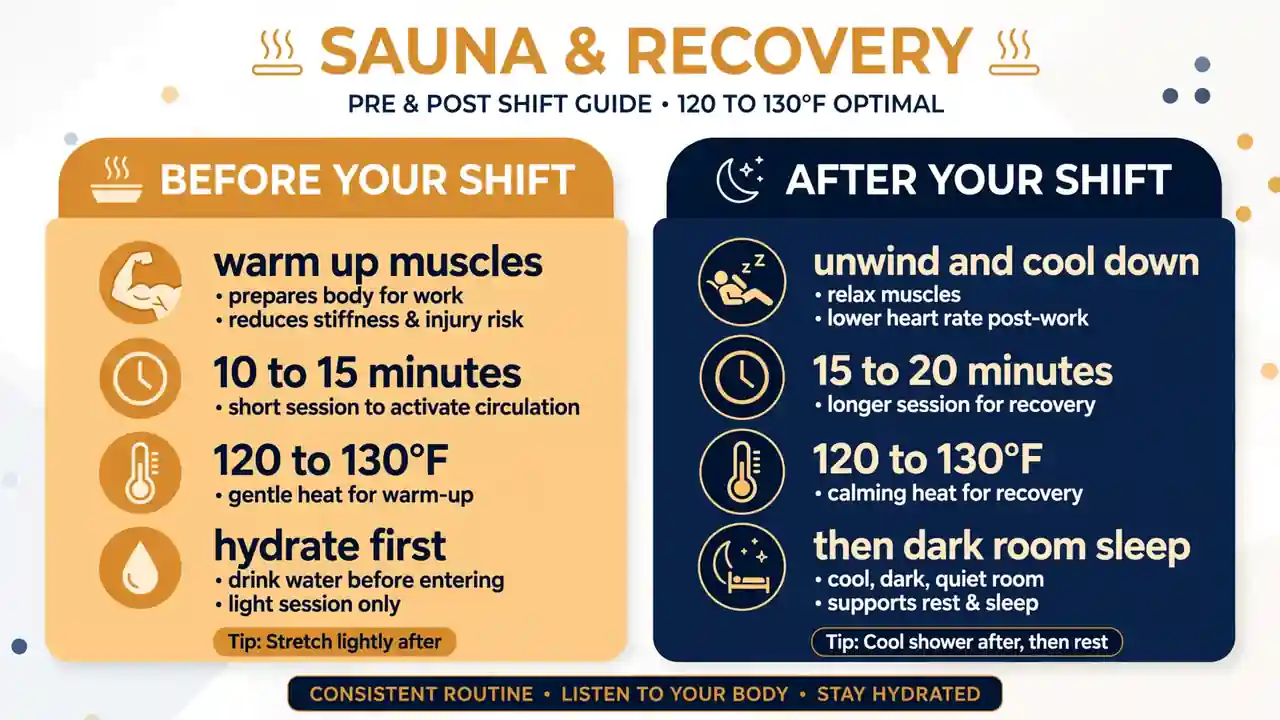
The most common question from night shift workers is whether to sauna before the shift or after it. Both can work, but they do different jobs, and after-shift sessions are the better default for most people. A sauna relaxes you, and relaxation is what you want when the shift is over, not at the start of a long night.
A short session before your shift can still help if your job is physical. Warm muscles and loose joints make the first hours of lifting, walking, or standing easier. Keep it light, though. A long hot session before work can leave you drained before the hardest hours of the night, and the 2 a.m. to 6 a.m. dip is hard enough without adding heat fatigue on top of it.
After your shift, the sauna earns its place. You come home wired and tired at the same time, which many night workers know well. Your body is exhausted but your mind is still running through the shift. Fifteen to twenty minutes of gentle heat gives that mental noise somewhere to go, and the cool-down that follows helps you slide toward sleep.
| Timing | Best for | Session | Watch out for |
|---|---|---|---|
| Before your shift | Loosening stiff muscles before physical work | 10 to 15 minutes, 120 to 130 F | A long session can drain you before the 2 a.m. dip |
| After your shift | Unwinding, muscle recovery, wind-down before daytime sleep | 15 to 20 minutes, 120 to 130 F | Do not delay bedtime to fit it in, sleep comes first |
| On a day off | A longer, relaxed session without time pressure | 20 to 30 minutes, 120 to 140 F | Still hydrate well and stop if you feel unwell |
| Mid-shift break | Not recommended for most workers | Skip it | Heat plus fatigue mid-shift raises drowsiness and safety risk |
Temperature and time ranges follow Cleveland Clinic guidance for infrared saunas, about 110 to 135 F and around 15 to 20 minutes for most people. Always follow your own sauna maker’s instructions too.
If you only have time for one session on a work day, make it the after-shift one. It does the most useful job at the moment you need it most, and it fits naturally into the wind-down that NIOSH recommends before daytime sleep. A before-shift session is a bonus for physical jobs, not a must.
The Best Time to Sauna Around a Night Shift
Timing is not just about before or after. It is about where the session sits in the whole arc of your day. A sauna taken too close to bedtime can leave you too warm to fall asleep, while one taken too early does little for your sleep. For most night shift workers, the sweet spot is a session that ends about 45 to 60 minutes before you plan to be asleep.
That gap matters because your body needs time to cool down. You step out warm and a little flushed, then your temperature drifts down over the next half hour or so. That cooling is the part that lines up with sleep. If you rush from the sauna straight into bed while still hot and sweating, you can end up tossing and turning instead of drifting off.
Your shift pattern changes the details. A nurse on a 7 p.m. to 7 a.m. rotation and a warehouse worker on 10 p.m. to 6 a.m. have different windows, but the same rule applies. Sauna after the shift, cool down, then bed, and protect the hours before 2 p.m. as your main sleep block. For more on session times in general, see our guide to the best time to use an infrared sauna.
| Shift pattern | Shift hours | Best sauna window | Target bedtime |
|---|---|---|---|
| Hospital night, 12 hours | 7 p.m. to 7 a.m. | 7:30 to 7:50 a.m., right after getting home | 8:30 to 9 a.m. |
| Warehouse night, 8 hours | 10 p.m. to 6 a.m. | 6:30 to 6:50 a.m., after a light snack | 7:30 to 8 a.m. |
| Factory night, 10 hours | 9 p.m. to 7 a.m. | 7:15 to 7:35 a.m., once home and changed | 8:15 to 8:45 a.m. |
| Rotating roster | Varies | Within 30 minutes of getting home | About 60 minutes after the session ends |
These are starting points, not rules. If your commute is long, sauna when you get home and shorten the session so you still get to bed early.
How to time the cool-down
- Finish your session and step out slowly. Sit for a minute before standing, because heat can make you light-headed.
- Take a lukewarm shower. Rinse off sweat and let your skin cool. Skip a hot shower, which keeps your temperature up.
- Drink a glass of water. You have been sweating, and rehydrating is part of the cool-down.
- Change into loose sleep clothes. Keep the bedroom cool, dark, and quiet.
- Get into bed within the hour. Aim to be asleep while your temperature is still drifting down, not after it has leveled off.
A Sample Night Shift Day With an Infrared Sauna
A routine works best when it is written down and easy to repeat on a tired morning. Here is a full example built around a 10 p.m. to 6 a.m. warehouse shift. It follows NIOSH advice to get to bed promptly, protect the hours before 2 p.m., and keep the bedroom dark and quiet.
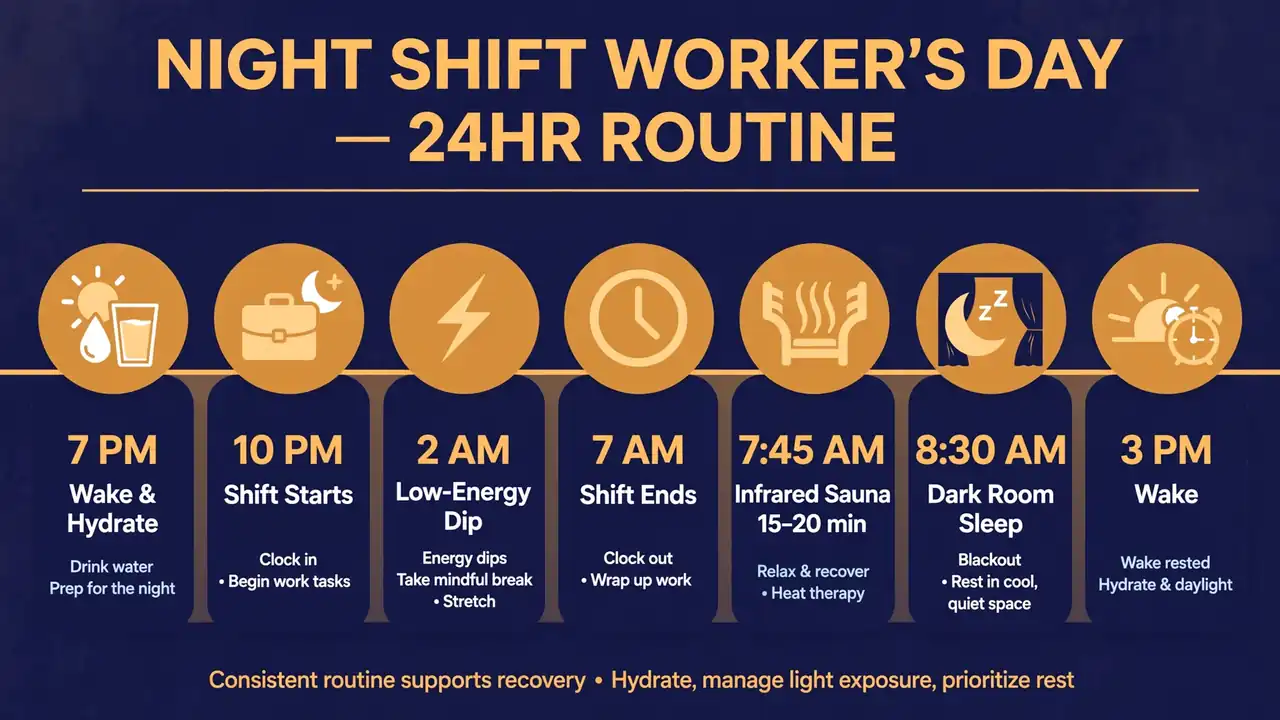
6:30 P.M. WAKE UP
Get up, drink water, and eat a proper meal before work. This is your breakfast, even though the clock says evening.
8 P.M. PREPARE FOR WORK
Pack food and water for the shift. If your job is physical, take a short 10 to 15 minute sauna now, then shower and change.
10 P.M. SHIFT STARTS
Work through the night. Eat a light meal around midnight and keep water nearby. Save caffeine for the first half of the shift only.
2 A.M. TO 6 A.M. LOW DIP
Expect the hardest hours here. Take breaks when you can and move around. Do not drive if you feel yourself nodding off.
6:30 A.M. SAUNA SESSION
Home and changed, with a small snack if hungry. Sauna for 15 to 20 minutes at 120 to 130 F.
7:15 A.M. COOL DOWN
Lukewarm shower, a glass of water, and loose sleep clothes. Dim the lights and put your phone on silent.
8 A.M. TO 3 P.M. DAYTIME SLEEP
Blackout curtains closed, earplugs or white noise on, room cool. Aim for 7 to 8 hours.
3 P.M. WAKE AND RECOVER
Wake gently, eat, get some daylight, and handle errands. A short nap before the next shift can help.
Notice what the routine protects. The sauna never pushes bedtime later. It sits inside the gap between getting home and getting into bed, and the whole point of that gap is to help you arrive at the bedroom calm, clean, and cool. If your commute eats into that gap, shorten the sauna or skip it that day.
On your first night back after days off, the routine may feel harder. Your body has drifted back toward a day schedule, and the first night shift is the toughest. Keep the sauna session short that day, get to bed on time, and let the routine do its work over the next two or three shifts.
How Long and How Hot Should a Session Be?
Night shift workers are often already dehydrated and tired when they get home, so conservative sessions are the right call. Cleveland Clinic suggests around 15 to 20 minutes for most people in an infrared sauna, with beginners starting at about five minutes and building up.
Temperature matters less than most people think. Infrared cabins typically run between about 110 and 135 degrees Fahrenheit, and the lower end of that range is plenty for a wind-down session. A cooler session still warms your muscles and still gives you the cool-down effect afterward, with less risk of feeling wiped out. If you want detail on session length in general, our guide on how long to stay in an infrared sauna covers the full range.
| Experience level | Session length | Temperature | How often |
|---|---|---|---|
| First two weeks | 10 to 15 minutes | 110 to 120 F | 2 to 3 times a week |
| Settled in | 15 to 20 minutes | 120 to 130 F | After most shifts |
| Experienced, days off | 20 to 30 minutes | 120 to 135 F | As a relaxed longer session |
| Very tired or unwell | Skip it, or 5 to 10 minutes only | 110 F or lower | Rest first, sauna later |
These ranges are general guidance based on Cleveland Clinic figures for infrared saunas. Follow your sauna maker’s instructions, and listen to your body.
Signs to cut a session short
Your body gives clear warnings when heat is too much, and tired shift workers should take them seriously. Leave the sauna right away if you feel dizzy, nauseous, or unusually weak, if your heart is racing, or if you develop a headache or confusion. Sit down, drink water, and cool off. If symptoms do not pass quickly, get medical help.
Do not try to push through discomfort to hit a target time. The session is a wind-down ritual, not a test. A calm ten minutes that leaves you relaxed is worth far more than twenty minutes that leaves you shaky and overheated.
Daytime Sleep After a Night Shift: Making It Count
The sauna is only the opening act. The main event is the daytime sleep that follows it, and that sleep needs real protection. NIOSH recommends at least 10 consecutive hours off duty so workers can get 7 to 8 hours of sleep, and its training for night shift nurses stresses going straight to bed and sleeping as long as possible. For a deeper look at sleep and sauna timing in general, see our guide on infrared sauna for better sleep.
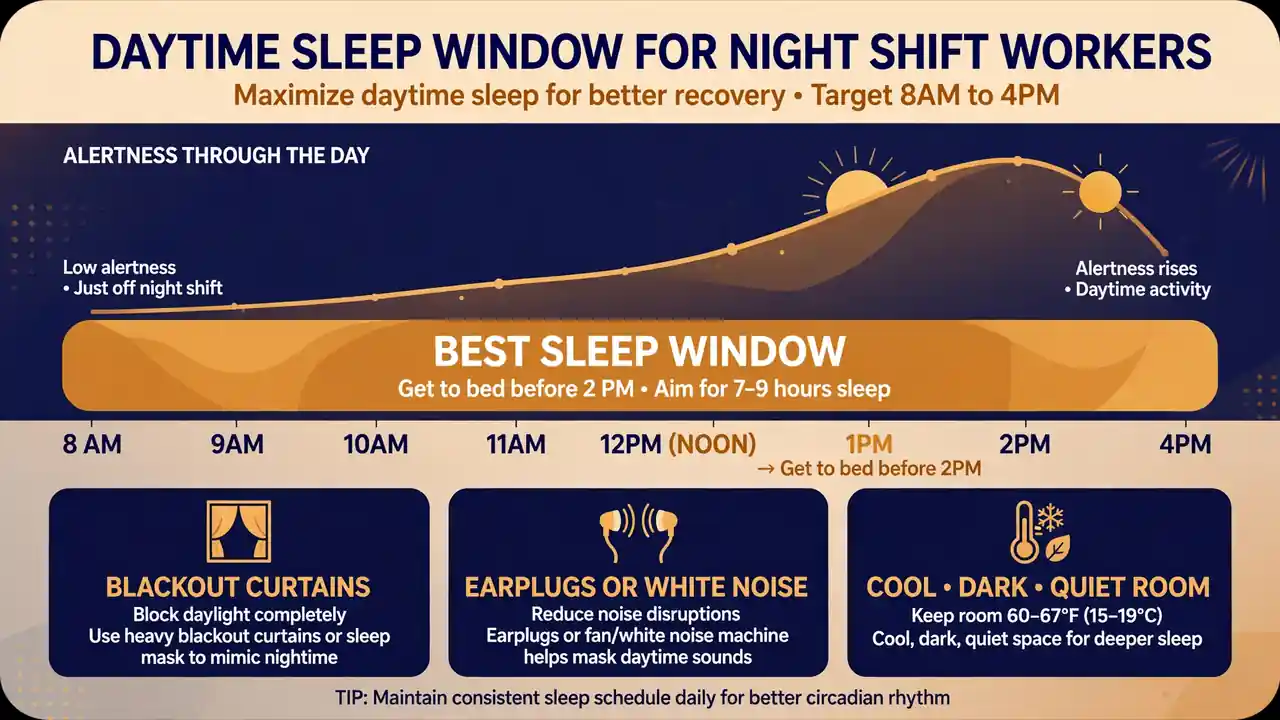
Darkness is the single most powerful tool you have. NIOSH advises a room so dark you cannot see your hand in front of your eyes, with blackout shades or drapes on every window, including the bathroom. Light leaking under the door matters too. If you get up briefly during sleep, use a dim red nightlight rather than a bright lamp.
Noise is the second battle. Earplugs or a white noise machine can block traffic, neighbors, and household sounds. Put your phone on silent and ask family and friends not to disturb you during your sleep block. A short note on the bedroom door helps.
A daytime sleep checklist for after your sauna
- Blackout shades or drapes closed on every window, with light blocked under the door.
- Earplugs in or white noise on before you get into bed, not after the first noise wakes you.
- Room cool, around 65 to 68 F if you can manage it, with light bedding.
- Phone on silent and face down in another room if possible, so notifications cannot wake you.
- A small snack before bed only if hungry. NIOSH suggests a small meal with protein and carbohydrate, such as cereal and milk, if you have not eaten for hours.
- No chores or errands first. The hours right after your shift are prime sleep time, so protect them.
If you wake after four or five hours and cannot get back to sleep, do not lie there frustrated. Get up, keep the lights low, do something quiet for twenty minutes, and try again. A short nap before your next shift can also top up your total sleep, and NIOSH notes that a pre-shift nap can help you stay alert during the night.
Hydration, Food, and Caffeine Around Your Session
Night shift workers often arrive home mildly dehydrated. You have been on your feet for hours, you may not have drunk enough during the shift, and then you step into a sauna and sweat more. Cleveland Clinic calls dehydration one of the biggest sauna risks, and tired workers should treat water as part of the session itself.
Drink water before you get in, keep a bottle nearby, and drink again after you get out. A glass before and a glass after is a good minimum, and more if your shift was hot or physical. Some people like an electrolyte drink after a long shift, which is a reasonable option, but plain water covers most needs. For a full guide, see our infrared sauna hydration guide.
Eating around the sauna and the shift
Do not sauna on a full stomach right after a big meal, and do not sauna when you are very hungry either. A small snack before your after-shift session is the middle ground. If you have not eaten for several hours, NIOSH suggests a small meal with protein and carbohydrate before bed.
Heavy, greasy food late in the shift is a common trap. It sits badly, makes the last hours of work harder, and can disturb daytime sleep. Lighter meals with protein, vegetables, and whole grains tend to sit better at 2 a.m. than fast food.
Caffeine: useful early, harmful late
Caffeine is a genuine tool for night workers, but only in the first half of the shift. A coffee at the start of the night or around midnight can help alertness. Caffeine taken in the last few hours before you get home will still be working when you are trying to sleep, and it can undo the wind-down your sauna session built.
A simple rule works well. Stop caffeine at least six hours before your planned bedtime. On a 10 p.m. to 6 a.m. shift with an 8 a.m. bedtime, that means no caffeine after about 2 a.m. Switch to water or herbal tea for the rest of the night.
What to Avoid When You Use a Sauna as a Night Shift Worker
A few mistakes turn a helpful ritual into a harmful one. The most common is delaying bedtime to fit the sauna in. If your commute ran long or the shift ran over, skip the session and get to bed. Never trade an hour of sleep for twenty minutes of heat.
- Alcohol before or after a session. Cleveland Clinic advises against sauna use after drinking, and NIOSH advises against alcohol before sleeping. A drink after a night shift may feel relaxing, but it fragments sleep and raises heat risk.
- Long sessions when you are exhausted. A 30 minute session after a brutal 12 hour shift can leave you more drained. Shorten it or skip it.
- Sauna right before driving. Heat can make you drowsy, and the drive home is already the riskiest part of the day. Sauna after you are home, never before a long drive.
- Very hot sessions to force a sweat. More heat is not more benefit. Stay in the 110 to 135 F range and let the warmth do its work gently.
- Skipping water. Sweating without drinking is the fastest route to a headache and a bad sleep.
- Phone and bright screens in the sauna. The wind-down works better without blue light and work messages. Leave the phone outside.
One more caution deserves its own line. If your job involves heavy machinery, driving, or safety-critical work, fatigue is a workplace safety issue, not just a personal comfort issue. The Working Time Society consensus, published with CDC involvement, notes that shift workers face a significantly higher risk of workplace accidents than day workers. A sauna routine is one small piece of a bigger fatigue plan that includes sleep, scheduling, and honest conversations with your employer about rest.
Who Should Check With a Doctor First
Most healthy adults can use an infrared sauna safely when they start short, stay hydrated, and listen to their body. Some people should talk to a doctor before their first session. Cleveland Clinic advises checking with a provider first if you are pregnant or trying to conceive, over 65 or under 16, or living with heart disease, heart failure, high or low blood pressure, epilepsy, or certain neurologic conditions.
Medication deserves a special mention. Some drugs affect how your body handles heat, including diuretics, some blood pressure medicines, and certain psychiatric medicines. Ask your doctor or pharmacist whether your medication changes your heat tolerance, and never skip a dose to fit in a session. If you have recently had a heart attack or stroke, or you are ill with a fever, skip the sauna entirely.
Watch for warning signs even if you are healthy. Feeling faint, confused, or unusually short of breath in the sauna is a reason to get out and seek help, not to wait it out. The same applies to chest pain or a racing heartbeat that does not settle after you leave the heat. Night shift workers sometimes dismiss these signs as tiredness, so be honest with yourself about what is normal fatigue and what is not.
Building the Habit: A 4-Week Starter Plan
A sauna habit works when it is boring and repeatable. This four-week plan starts short and builds slowly, which is the right approach for a body already adjusting to night work. If a week feels hard, repeat it before moving on.
| Week | Session | Focus | Sleep habit to add |
|---|---|---|---|
| Week 1 | 10 minutes, 110 to 120 F, twice after shifts | Learn how your body reacts. Note how you feel the next day. | Blackout shades up, phone on silent for the sleep block. |
| Week 2 | 15 minutes, 120 to 125 F, after most shifts | Lock in the cool-down routine: shower, water, bed within the hour. | Earplugs or white noise every sleep block, plus a caffeine cutoff. |
| Week 3 | 15 to 20 minutes, 120 to 130 F, after each shift | Add the full sample day routine, including the pre-shift meal plan. | A short nap before the first shift of a new run if sleep was short. |
| Week 4 | 15 to 20 minutes after shifts, one longer 20 to 30 minute session on a day off | Review what worked. Keep the parts that helped, drop the rest. | A steady wake time on days off, so the clock drifts less. |
Track two simple things during the month: how long you slept, and how rested you felt when you woke up. A notebook by the bed or a note on your phone is enough. If you use a wearable, our guide to sauna wearables, HRV, and sleep recovery explains what the numbers can and cannot tell you. And if you train on days off, read our guide to infrared sauna before or after workout so the session fits your training too.
After a month, most people know whether the ritual helps them. Some find the after-shift session becomes the part of the day they look forward to most. Others prefer a shorter session or a different time. Both answers are fine.
Frequently Asked Questions
Should I use an infrared sauna before or after a night shift?
After your shift is the better default for most night shift workers. A 15 to 20 minute session at 120 to 130 F helps you unwind, and the cool-down that follows supports daytime sleep. A short 10 to 15 minute session before a physical shift can loosen muscles, but keep it light.
How long should an infrared sauna session be after a night shift?
Most people should aim for 15 to 20 minutes at about 120 to 130 F. Beginners should start with 10 to 15 minutes at 110 to 120 F and build up over two weeks. If you are very tired after a long shift, shorten the session or skip it and get to bed instead.
Can an infrared sauna help a night shift worker sleep during the day?
It can help as part of a wind-down routine. The cool-down after a session lines up with the natural temperature drop that comes before sleep, and the ritual itself helps your mind switch off after work. It cannot replace lost sleep or fix a disrupted circadian clock, so it works best alongside a dark, quiet, cool bedroom.
Is it safe to use an infrared sauna when I am exhausted after a night shift?
Short, gentle sessions are usually fine for healthy adults, but exhaustion is a reason to be cautious. Keep the session to 10 to 15 minutes at a lower temperature, drink water before and after, and leave right away if you feel dizzy or unwell. If you are dangerously tired, skip the sauna and sleep.
Should I sauna before driving home after a night shift?
No. Heat can make you drowsy, and the drive home after a night shift is already the highest-risk time for drowsy driving, according to NIOSH. Sauna after you are home, never before a long drive. If you feel yourself nodding off, pull over somewhere safe and rest.
How often can a night shift worker use an infrared sauna?
Most people can use one after most shifts once they are used to the heat, starting with 2 to 3 sessions a week and building up. A longer 20 to 30 minute session on a day off is a good way to enjoy the sauna without time pressure.
The Short Version
Night shift work makes sleep hard because your body clock keeps pushing you awake in the morning, and NIOSH data shows night workers sleep less and worse than day workers. An infrared sauna for night shift workers cannot fix that, but a short after-shift session can still help you unwind and cool down before daytime sleep.
Keep it simple. Sauna after the shift, 15 to 20 minutes at 120 to 130 F once you are used to it. Shower lukewarm, drink water, and get into a dark, quiet, cool bedroom within the hour. Protect the hours before 2 p.m., stop caffeine six hours before bed, and never trade sleep for a session.
References
- U.S. National Institute for Occupational Safety and Health, Training for Nurses on Shift Work and Long Work Hours, Module 9, Coping with the Night and Evening Shifts, Sleep: cdc.gov
- U.S. National Institute for Occupational Safety and Health, Sleep and Work: cdc.gov
- U.S. National Institute for Occupational Safety and Health, Training for Nurses on Shift Work and Long Work Hours, Module 2, Desynchronization of Homeostatic and Circadian Processes: cdc.gov