
A steam generator is the heart of a home steam room. It heats water, sends steam through a pipe, and fills a sealed room with mist. The generator itself is a compact box, but installing it is a real plumbing and electrical project, and the quality of that install decides whether your steam room works quietly for years or leaks, trips breakers and grows mould.
This guide walks through the whole decision: what the installation involves, how to judge whether you can do part of it yourself, when hiring a licensed pro is smarter, what to check about permits, and the plumbing steps in order. Cost figures are planning estimates only, not quotes, and permit and code statements are local check guidance.
Please note: This article is general guidance only, not a substitute for local building code or a licensed professional. Steam generator installation involves plumbing, drainage and electrical work. Check your local permit and code office before you start, and use licensed electricians and plumbers. Cost figures in this guide are planning estimates, not quotes. This article is also general wellness information, not medical advice. If you are pregnant, live with a heart or circulation condition or low blood pressure, or take medication that affects heat tolerance, check with your doctor before using a steam sauna. Hydrate before and after sessions, start with short sessions, leave at once if you feel dizzy or unwell, and do not drink alcohol before or during a session.


#Paid Links
The Decision in One Minute
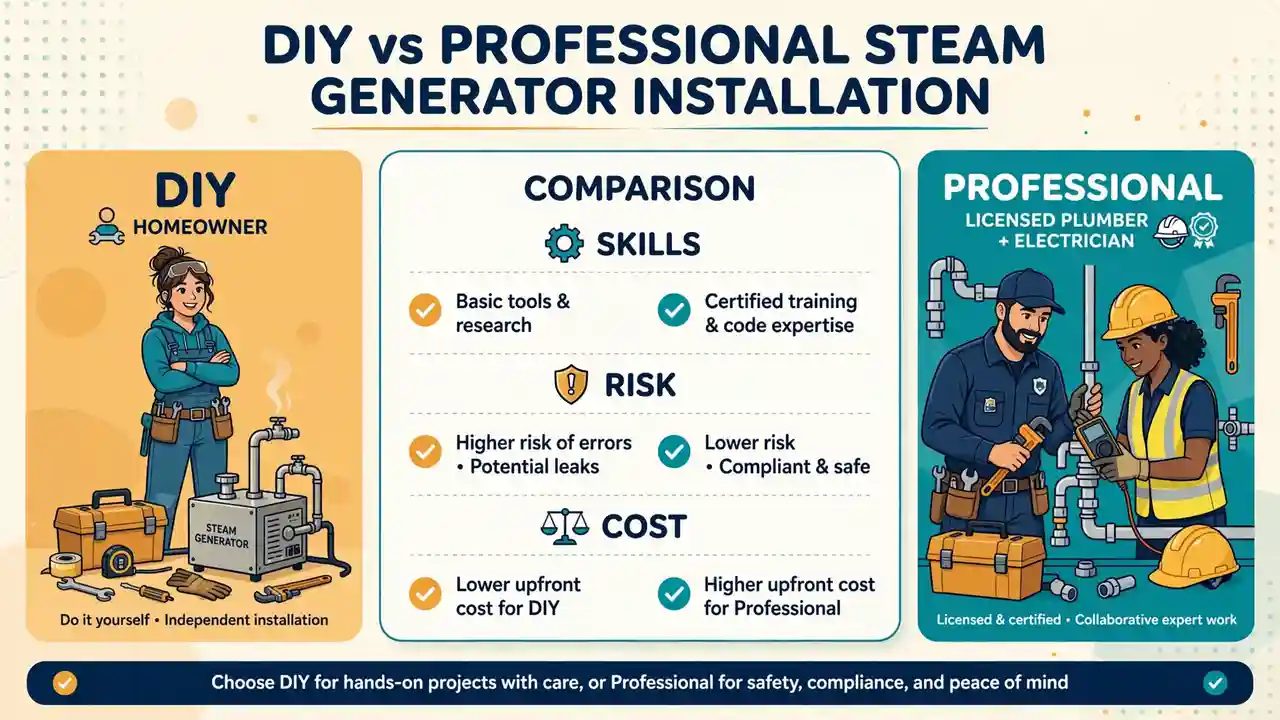
If you want the short answer, here it is. Most homeowners should hire a licensed plumber for the water and drain work and a licensed electrician for the power supply, even if they handle the room build. A steam generator connects to your water supply, your drain, your electrical panel and a steam line into a hot, wet room. Each of those four connections can go wrong in ways that are expensive to fix later, and two carry safety risk.


#Paid Links
That does not mean there is no DIY role. Confident homeowners often do the room preparation, the generator mounting, the steam line layout planning and the finishing work, then bring in licensed trades for the final connections. This hybrid route saves money where the work is low risk and keeps the high risk work with the people trained and insured to do it.
| Route | Best for | Main risk | Typical planning estimate |
|---|---|---|---|
| Full DIY | Experienced DIYers with plumbing and electrical knowledge, with water, drain and power nearby | Leaks behind tile, wrong wiring, voided warranty | Parts and materials only |
| Hybrid: DIY prep plus licensed trades | Most homeowners, including confident DIYers who want a safe result | Coordination gaps if the prep does not match the pro’s plan | Mid range, trade labour for connections only |
| Full professional install | New builds, complex rooms, no nearby services, or owners who want a warranty and an inspection passed first time | Higher upfront cost, and waiting for a good installer | Highest cash cost, lowest total risk |
The figures in that table are planning estimates, not quotes. Real costs vary by region, by brand, by the distance to your services, and by how much of the room already exists. The cost section later in this guide breaks down what drives the number.
What Steam Generator Installation Actually Involves
A steam generator install is five jobs in one, and they have to fit together. A perfect water connection means little if the drain cannot take the condensate, and a tidy steam line means little if the room cannot dry out. Read this section before you decide anything.
One: choosing and preparing the generator location
The generator is a metal box that needs a dry, accessible spot close to the steam room but outside it. Common spots include a closet next to the bathroom, a vanity cabinet, an attic space above the room, or a utility area on the other side of the wall. The unit must stay reachable for servicing and descaling, so never bury it behind fixed panels.
Distance matters more than most first timers expect. The steam line should be kept as short as practical, and the maker gives a maximum run length in the instructions. A long run loses heat, produces more condensate in the pipe, and makes the steam arrive weaker at the head. If your only free spot is far from the steam room, that fact alone can push you toward a pro.
Two: the cold water supply
The generator needs a cold water feed, usually tapped from a nearby supply line with a shut off valve. A shut off valve matters because the generator needs descaling and service, and you want to isolate it without shutting off the whole house. Water quality matters too, because hard water leaves scale inside the tank and shortens the life of the heating element. Our guide to steam generator maintenance, descaling and hard water care explains the descaling routine and the case for a filter or softener in hard water areas.


#Paid Links
One detail catches people out. The water feed must include the backflow protection and fittings the maker specifies, and the connection must suit local code. A small leak on a pressurised line inside a wall can run for weeks before anyone notices, and by then the repair is a tile job, not a plumbing job.
Three: the drain and the condensate
Every steam session produces water that has to go somewhere. The generator drains for servicing and produces condensate, and the steam room itself sheds condensation that runs down the walls and across the floor. The generator drain line must run to a proper drain with the fall the maker specifies, and the steam room floor needs a drain of its own. Our full guide to building a steam sauna at home covers the room side of this, including the sloped floor and the sealed door.
Drainage is the part of the job that most often turns a weekend project into a major one. If the generator sits below the sewer line, gravity will not help, and the drain route may need a pump or a different location. If the room has no floor drain at all, adding one can mean cutting concrete. Be honest about your drainage before you buy anything, because it is the single biggest driver of install difficulty.
Four: the electrical supply
Steam generators draw serious power, and most need a dedicated circuit from the electrical panel, with the breaker size and cable type the maker specifies. This is licensed electrician work in most areas, and it is the part of the job where DIY confidence is most often misplaced. The requirements post on steam sauna electrical and plumbing requirements sets out what to plan for before building.
Do not guess at breaker sizes or cable runs, and do not extend an existing bathroom circuit and hope it holds. A generator that trips its breaker every session is telling you the circuit is wrong, and a circuit that does not trip when it should is a fire risk. A licensed electrician will also check that your panel has capacity for the extra load, which no article can answer for your house.
Five: the steam line, the steam head and the controls
The steam line carries hot steam from the generator to the steam head inside the room, and it must be run in the right material, with the right fall, so condensate drains back and does not pool in the pipe. The steam head sits low on the wall, away from the seating area and away from where a bather could touch it, because it gets very hot during a session. The control panel goes outside the room or just inside the door, where it stays dry and reachable.
Modern controls add timers, temperature limits and app control, and they are worth reading about before you choose a model. Our guide to smart steam controls, timers and auto shutoff explains what the controls do and why an auto shutoff matters for safety. The control cable is low voltage work in most systems, but it still has to be run neatly and kept away from the steam line.
DIY or Hire a Pro? An Honest Self Check
The honest answer depends on your skills, your house and your tolerance for risk. A steam generator install rewards careful, patient work and punishes shortcuts, and fixing a bad install usually costs more than hiring a pro in the first place. Use the checklist below as a real test. If you cannot tick most of the boxes, hire the work out.
- You have soldered or properly joined copper or PEX water lines before, and those joints have held under pressure
- You understand your local plumbing code well enough to know when a fitting, a valve or a drain route is not allowed
- You can read the generator maker’s installation manual in full and follow it step by step
- Your generator location is close to the steam room, with water, a drain and electrical capacity already nearby
- You have a licensed electrician lined up for the power supply
- You will stop and call a pro if something does not fit, rather than forcing it and hoping it holds
Profile one: the experienced DIYer with services nearby
Picture a homeowner converting an existing shower into a steam shower. The water supply is in the wall already, the drain is under the floor, and the electrical panel has spare capacity. The generator will sit in a closet on the other side of the steam room wall, so the steam line is short. This person has plumbed a bathroom before and reads manuals before starting.
This is the strongest DIY case, and even here the smart move is to hire a licensed electrician for the dedicated circuit. The DIYer does the room preparation, mounts the generator, runs the steam line and fits the steam head, then the plumber checks the water and drain connections.
Profile two: the keen beginner with a new room to build
Now picture a homeowner building a steam room in a spare room or a garage corner. There is no water supply in the room, no drain, and the electrical panel is at the other end of the house. The owner is enthusiastic and good with tools, but has never made a pressurised water joint or run a drain with proper fall. This is the most common situation, and the one where DIY goes wrong most often.
The right call here is a licensed plumber for the water and drain work and a licensed electrician for the power, while the owner handles the room shell, the tiling preparation and the bench. The parts that can flood a house or start a fire sit with insured professionals. If the budget is tight, it is better to delay the project and save for the trades than to cut corners on the connections.
Profile three: the time poor owner who wants it done right
The third profile is the owner who could learn the work but has no time to do it well. A steam generator install done properly takes days of careful work, not a single Saturday, because the room has to be sealed, the connections tested, and the drying routine proven before the room is finished. Rushing any stage creates problems that only appear months later, behind tile and inside walls.
For this owner, a full professional install is the right choice. Ask the installer for a written scope that covers the generator, the water supply, the drain, the electrical supply, the steam line, the steam head, the controls and the first test run. Ask what warranty covers the labour as well as the parts, and what happens if the first test finds a problem.
How to Find and Brief a Good Installer
Finding the right pro matters as much as the decision to hire one. Start with the generator maker’s dealer or installer list if one exists, because those installers have fitted that brand before and know its quirks. Local plumbers with bathroom and wet room experience are a good second route.
When you brief an installer, give them the full picture in one conversation. Tell them the generator model you plan to buy, or ask them to supply it, and share the room size, the generator location, and the distance to the water supply and the drain. A good installer will visit before quoting, will ask about your local permit office, and will flag problems early, such as a drain route that needs a pump. Be wary of any quote given without a visit, and of any installer who dismisses the permit question without checking.
Permits: What to Check Before You Start
Permits are the part of the project most people want to skip, and the part that causes the most trouble when skipped. A steam room is a plumbing alteration, an electrical alteration and a wet room build in one, and many areas treat at least part of that work as permit work. This article cannot state the rules for your home, because permit rules vary by area and change over time. What it can do is show you what to check and what to ask.
| Question to ask | Why it matters | Who to ask |
|---|---|---|
| Does a steam room conversion need a building permit | A permit triggers inspections that catch mistakes | Local permit or building office |
| Does the plumbing work need a separate permit | Water and drain changes are often permitted separately | Local permit office or plumbing inspector |
| Does the electrical work need a permit | Most areas require a licensed electrician for a new circuit | Local permit office or your electrician |
| Are there ventilation or moisture rules | Some codes set rules for fans, vapour barriers and drying | Local building office |
| What drawings or details do you need | A simple plan of the room, the generator location and the services | Local permit office |
| When do inspections happen, and who books them | Rough in inspections happen before walls close, and missing one can mean reopening finished work | Local permit office or your installer |
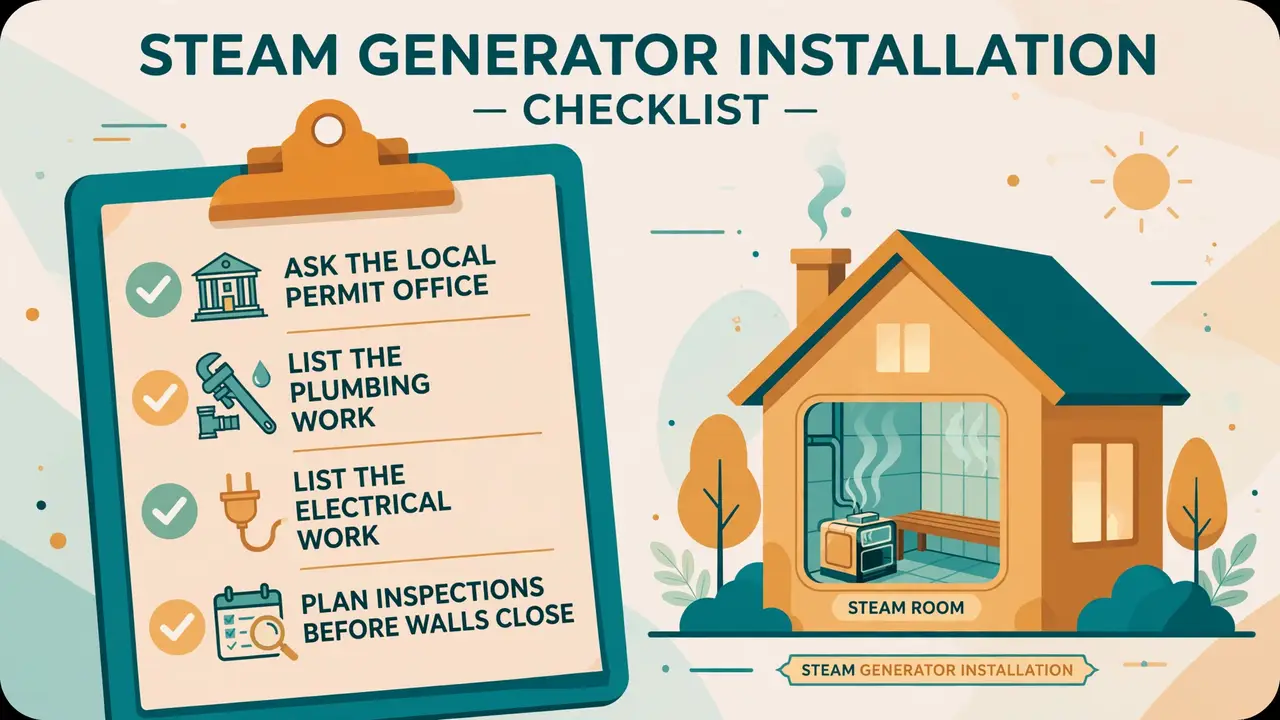
Start the permit check before you buy the generator. A permit office can tell you in one visit or one phone call whether your project needs a permit, and that answer shapes the whole plan. Inspections usually happen at two stages: a rough in inspection before the walls are closed, when the pipes and cables are visible, and a final inspection after the room is finished. Missing the rough in inspection can mean opening up finished tile to show work that was covered too soon.
One more honest point. Some owners skip the permit because the work is inside an existing bathroom and feels minor. That choice carries real risk, because unpermitted plumbing and electrical work can affect a home insurance claim and a future sale. The permit fee is usually a small part of the project cost, and the inspections are a second pair of trained eyes on the riskiest parts of the job.
Plumbing Steps, in Order
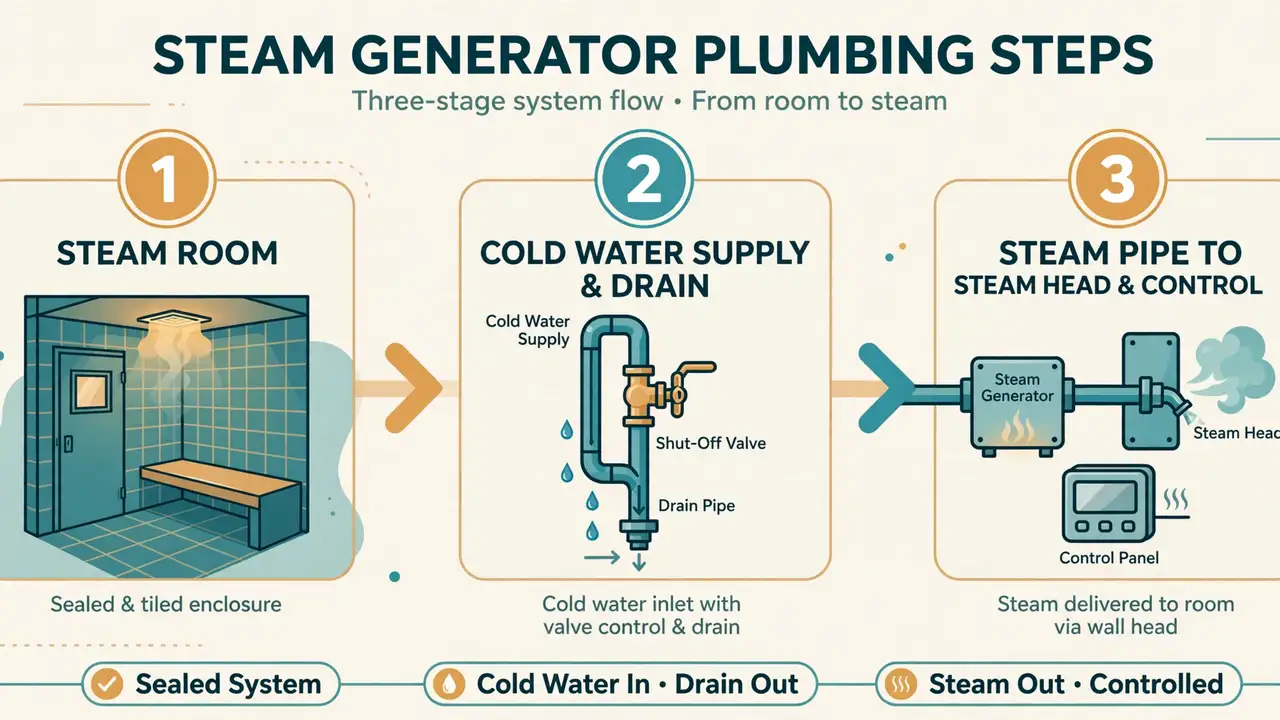
The plumbing work follows a fixed order, and skipping ahead is how mistakes happen. The steps below describe the sequence for a typical install in an existing bathroom or a prepared steam room shell. The generator maker’s manual is the final word on the specifics for your model.
Phase one: prepare the room and the generator spot
- Confirm the room is sealed and waterproofed, with a sloped floor running to the floor drain and a door that closes tightly. Our guide to steam room layout, seating and sealing mistakes shows the errors that let steam escape and water creep into walls.
- Fix the generator in its chosen spot, level and secure, with clear access for service and descaling. Leave the space the maker specifies around the unit for air flow and for the drain valve.
- Mark the routes for the water feed, the drain line, the steam line and the control cable before cutting or drilling anything, and check that no route crosses a joist, a stud or an existing service.
Phase two: water in and water out
- Tap the cold water supply and fit the shut off valve, the filter or strainer if the maker specifies one, and the backflow protection the maker and local code require. Keep the valve reachable.
- Run the feed to the generator inlet, using the pipe material and jointing method the maker specifies. Support the pipe so its weight does not pull on the generator connection.
- Run the generator drain line to a proper drain with a continuous fall, so water flows away by gravity and cannot sit in the pipe. If the generator sits below the sewer line, stop here and sort the pumped route with a licensed plumber.
- Pressure test the water feed before any wall is closed. Turn the supply on, check every joint with dry hands and dry tissue, and leave it under pressure long enough to be sure. A joint that weeps now is a five minute fix, while the same joint behind tile is a demolition job.
Phase three: steam line, steam head and controls
- Run the steam line from the generator to the steam head in the material the maker specifies, keeping the run as short as practical and with the fall the maker requires, so condensate drains back and never pools in the pipe.
- Fit the steam head low on the wall, opposite the seating if possible, and away from where a bather sits or stands. Insulate the pipe run where the maker calls for it, and keep the steam line clear of the control cable.
- Mount the control panel outside the steam room or just inside the door, where it stays dry and can be reached without stepping into the steam. Run the control cable neatly, away from hot pipes.
- Do a cold check of the whole system before the first steam test. Confirm the water feed holds pressure, the drain runs clear, the steam line is secure, and every connection is tight. Only then power up the generator and run the first test with the room empty.
Two details deserve emphasis. First, never use a garden hose, a flexible connector or a spare fitting that is not rated for hot water and steam service on the steam line. A fitting that holds cold water can fail quickly under steam.
Second, never trap the steam line in a way that lets condensate collect. Pooled condensate causes banging, spitting at the steam head and uneven steam, and it is a sign the fall or the routing is wrong.
Electrical Work Belongs to a Licensed Electrician
The electrical side of a steam generator install is short to describe and wrong to improvise. Most generators need a dedicated circuit, a breaker of the size the maker specifies, the right cable type for the load and the run, and proper earthing. The work also has to suit local code, and in many areas it must be done by a licensed electrician and inspected. Even confident DIYers should treat this as a line they do not cross.
Your electrician will check three things before quoting: the capacity of your panel, the route for the new circuit, and the location of the isolator or disconnect the maker specifies. If your panel is already full or near its limit, the job may need a panel upgrade or a load calculation, and that changes the cost and the timeline. Bring the electrician in while the plan is still flexible.
What Installation Typically Costs
Install costs vary so much by region and by house that any single figure would mislead. What helps is knowing what drives the cost, so you can read a quote properly. The table below lists the cost factors and the choices that push each one up or down. All figures here are planning estimates, not quotes, and you should get local quotes before committing.
| Cost factor | What pushes it up | What keeps it down |
|---|---|---|
| Generator itself | Larger room, premium brand, smart controls | Right sizing the unit to the room |
| Plumbing labour | Long water and drain runs, cutting concrete, a pumped drain | Generator close to existing water and drain |
| Electrical labour | Long circuit run, panel upgrade, difficult cable route | Spare panel capacity, short cable run |
| Room preparation | New room build, waterproofing, tiling, sealed door, ventilation | Converting an existing shower or bathroom already tiled and sealed |
| Permit and inspection fees | Multiple permits, plan review, repeat inspections | Asking the permit office early, booking inspections at the right stage |
| Finishing and extras | Premium tile, bench work, lighting, aroma system | Simple, durable finishes, standard controls |
Two cost traps deserve a warning. The first is choosing the cheapest generator without checking the install requirements, then finding the cheap unit needs expensive pipework that a slightly dearer unit would not. Always compare total installed cost, not the price of the box alone, and read our guide to sizing a steam generator in kilowatts before you buy.
The second trap is skipping the water treatment question. In a hard water area, a filter or softener costs money up front and saves far more over the life of the generator, because scale is the most common reason a generator fails early.
Brand choice also affects the long term cost, because parts, controls and service vary between makers. Our comparison of steam generator brands including MrSteam, ThermaSol, Kohler and Amerec sets out the differences worth weighing, with prices and specs to verify against current listings before you buy.
The First Steam Test and the Drying Routine
The first steam test is a milestone, but treat it as a test, not a celebration. Run the generator with the room empty, watch for leaks at every joint, listen for banging or spitting in the steam line, and check that steam arrives steadily at the head.
If the steam is weak, the line may be too long or poorly insulated. If the head spits water, condensate may be pooling in the pipe. Fix those things now, while access is still easy.
Once the system passes its test, the drying routine begins. A steam room is not maintenance free, and pretending otherwise is how mould starts. After every session, wipe the walls and bench, leave the door open, and run the exhaust fan until the room is dry.
Empty the generator and flush it on the schedule the maker gives, and descale on time. A room that dries out after every session will smell clean and look good for years, while one that stays damp will not.
Keep the generator manual somewhere you will find it again. Knowing how long a steam generator lasts helps you plan for descaling, parts and eventual replacement, and the maintenance habits you build in the first month set the pattern for the life of the unit. If the generator ever stops producing steam, our guide to a steam generator not producing steam walks through the common causes in order, starting with the simple checks.
Mistakes That Cost the Most
Most steam room failures trace back to a short list of avoidable mistakes, each cheap to prevent and expensive to fix once the room is tiled and finished.
- Buying the generator before checking the drain route, then finding the only location needs a pump or a concrete cut
- Oversizing the generator for the room, which wastes power and cycles the unit harder than it needs to
- Burying the generator behind fixed panels with no access for descaling and service
- Running the steam line with no fall, so condensate pools and the head spits hot water
- Closing the walls before the pressure test and the rough in inspection, then opening finished tile to fix it
- Skipping the exhaust fan or the drying routine, then fighting mould for years
- Using fittings not rated for steam service on the steam line
- Treating a leaking steam room as a small annoyance, when a leak behind tile is quietly damaging the structure. Our guide to fixing a leaking steam room shows how to trace the source early.
Frequently Asked Questions
Can I install a steam generator myself?
Some experienced DIYers can do the room preparation, the generator mounting and the steam line work, but the water, drain and electrical connections should go to licensed trades. A steam generator connects to a pressurised water supply, a drain, a dedicated electrical circuit and a hot steam line, and a mistake in any of those four can cause leaks, damage or a safety risk. A hybrid route, with DIY prep and licensed trades for the connections, is the sensible middle ground.
Do I need a permit to install a steam generator?
Permit rules vary by area, and this article cannot state them as fact for your home. Many areas treat a steam room as a plumbing and electrical alteration and want a permit and an inspection. Ask your local permit and code office before you build, and follow what they ask for.
How close does the steam generator need to be to the steam room?
As close as practical, and within the maximum steam line run the maker specifies in the installation manual. A short steam line loses less heat, produces less condensate, and delivers stronger steam at the head. Common spots include a closet next to the bathroom, a vanity cabinet, or a utility area on the other side of the steam room wall, always with access left open for service.
Does a steam generator need a drain?
Yes, the generator needs a drain line for servicing and condensate, and the steam room itself needs a floor drain for condensation and washdown water. The drain line must run to a proper drain with a continuous fall so water flows away by gravity. If the generator sits below the sewer line, the drain route may need a pump, which is licensed plumber work.
Can a steam generator share a circuit with other bathroom appliances?
No, a steam generator should have its own dedicated circuit from the electrical panel, with the breaker size and cable type the maker specifies. Sharing a circuit with other appliances risks tripping the breaker every session. A licensed electrician should check your panel capacity and install the circuit.
How long does a steam generator installation take?
It depends on the room and the distance to the services. A simple install in an existing shower with water, drain and power nearby can take a day or two of trade work, while a new room build with new plumbing, drainage, ventilation and electrical work takes much longer. The room sealing, the pressure test and the rough in inspection should never be rushed.
A steam generator installation rewards patience and honest judgement. Decide the route before you buy, check the permit question before you build, pressure test before you close the walls, and dry the room after every session. Do those things, and the steam room you build will be one you actually use, quietly and safely, for years.