
If you live with fibromyalgia, you already know the pattern. Widespread aching that never quite switches off. Tiredness that a full night of sleep does not fix. Days when even a light touch, a cold draught or a busy afternoon can set your symptoms flaring.
It is no surprise that so many people ask about infrared sauna for fibromyalgia, and whether gentle, deep warmth could offer some relief.
The honest answer is encouraging but limited. A handful of small studies have found that far-infrared heat can lower pain scores for some people with fibromyalgia, and one well-designed trial found a real effect that lasted months. But the studies are tiny, none tested a home infrared sauna as most people would use one, and nothing suggests a sauna treats or cures the condition. This article looks at what the evidence actually shows, and how to try heat safely if your doctor agrees.
Please read first: this is not medical advice. An infrared sauna is a wellness tool, not a treatment for fibromyalgia. If you live with fibromyalgia, check with your doctor before trying a sauna, especially with a heart or circulation condition, low blood pressure, pregnancy, or medication that affects heat tolerance. Never stop or change prescribed treatment in favour of sauna sessions.


#Paid Links
The Short Answer
Infrared sauna sessions may ease fibromyalgia pain and stiffness for some people, for a while. That is the most the current evidence supports. The strongest study, a sham-controlled trial published in 2023, found that supervised whole-body infrared heat reduced pain more than a fake treatment, and the benefit was still measurable 30 weeks later. Two earlier Japanese studies using far-infrared sauna cabins also reported large drops in pain scores, but both were small and uncontrolled.
What that means in practice is simple. Heat is worth discussing with your doctor as one small part of a wider plan, alongside movement, sleep and prescribed treatment. It is not a cure, it does not work for everyone, and short, gentle sessions are the sensible starting point. Flare days are days to skip.


#Paid Links
| At a glance | What we know |
|---|---|
| Does it help pain? | Possibly, for some people. Small studies report lower pain scores after regular sessions. |
| Is it proven? | No. The evidence is preliminary, with small samples and no large trials of home saunas. |
| Does it cure fibromyalgia? | No. There is no cure, and a sauna does not change that. |
| How was it studied? | 15-minute far-infrared sessions at 60°C, or supervised medical heat, 2 to 5 times a week. |
| Who should be careful? | Anyone with a heart condition, low blood pressure, pregnancy, or heat-affecting medication. |
What Fibromyalgia Actually Is
Fibromyalgia is a long-term condition that causes widespread pain, along with fatigue, sleep problems and trouble with memory and mood. The Mayo Clinic describes it as a disorder in which the brain and spinal cord process pain signals differently, so painful sensations are amplified and even light touch can hurt. It affects an estimated 2 to 8 percent of people worldwide, and women more often than men.
The pain is usually a constant dull ache that has lasted at least three months, felt on both sides of the body and above and below the waist. Many people also have tender points, where light pressure hurts more than it should. Symptoms often begin after a triggering event such as an injury, surgery, infection or severe stress, but they can also build up slowly with no single trigger.
The symptoms that shape daily life
- Widespread pain. A dull ache across muscles and soft tissue, often worse in the morning and after activity or cold weather.
- Fatigue that sleep does not fix. Many people wake up tired even after a long night, because pain keeps waking them or their sleep is light.
- Sleep problems. Trouble falling asleep, staying asleep or waking unrefreshed, sometimes alongside restless legs or sleep apnoea.
- “Fibro fog”. Difficulty concentrating, remembering words or staying focused, which many people find as disruptive as the pain.
- Mood and related conditions. Anxiety and low mood are common, as are headaches, jaw pain, irritable bowel symptoms and sensitivity to noise or light.
There is no single test for fibromyalgia, and no cure. Treatment usually means a combination of approaches: medicines that can calm pain signals, gentle exercise, better sleep habits, stress management and pacing. That is why heat is interesting to researchers.
It is cheap, widely available and easy to use at home, and many people with chronic pain already report that warmth loosens stiff muscles and takes the edge off an ache. The question is whether that everyday experience holds up in proper studies.


#Paid Links
The National Center for Complementary and Integrative Health, part of the US National Institutes of Health, takes a cautious view of all complementary approaches for fibromyalgia. It describes the research as preliminary overall, while noting encouraging evidence for practices such as tai chi, yoga, massage and balneotherapy, bathing in warm mineral water. Heat therapy sits in the same category: plausible, with some early support, but far from proven.
What the Research Actually Shows
Only a few studies have tested heat or sauna sessions in people with fibromyalgia, and they are all small. The largest involved 44 people. Three used far-infrared saunas or medical infrared heat chambers, which is why this article focuses on infrared saunas. A fourth used hot-water immersion, which is a useful clue about heat in general but is not the same as sitting in a sauna.
Before looking at each study, keep one thing in mind. Pain was measured with standard tools such as a 0 to 10 pain scale and the Fibromyalgia Impact Questionnaire, which measures how much the condition affects daily life. A drop in those scores means people felt better. It does not mean the underlying condition changed.
| Study | People | What they did | What happened |
|---|---|---|---|
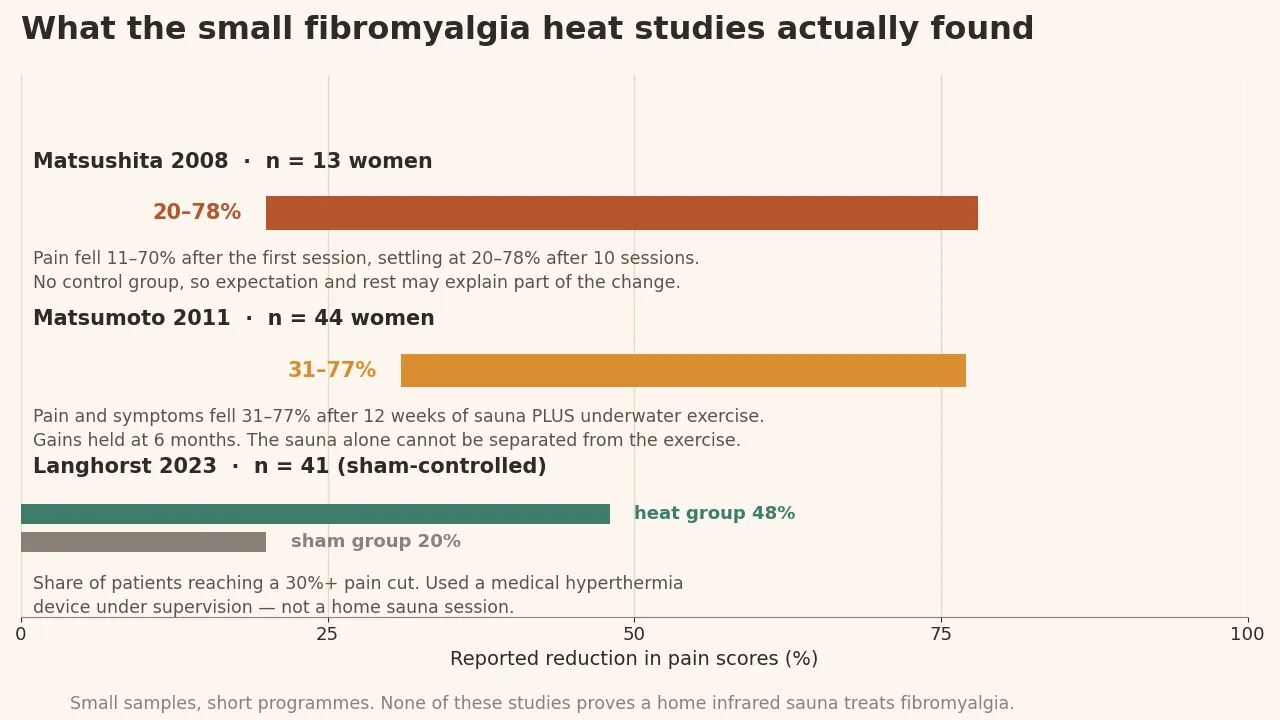
| Matsushita et al., 2008, Japan | 13 women | Far-infrared sauna at 60°C for 15 minutes, then 30 minutes resting wrapped in a blanket | Pain fell by about half after the first session, and by 20 to 78% after 10 sessions |
| Matsumoto et al., 2011, Japan | 44 women | Sauna 3 days a week plus gentle underwater exercise 2 days a week, for 12 weeks | Pain and symptoms fell 31 to 77%, and gains held at 6 months |
| Langhorst et al., 2023, Germany | 41 people | Supervised medical infrared heat, 6 sessions over 3 weeks, versus sham treatment | Pain scores lower than sham at 4 weeks and still lower at 30 weeks |
| Brockow et al., 2007, Germany | 139 people | Medical infrared heat twice a week for 3 weeks, added to standard rehabilitation | Significant pain improvement compared with rehabilitation alone |
| Chadwick et al., 2025, pilot study | Small group | Hot-water immersion, 3 times a week for 4 weeks | Lower average and worst pain scores, better sleep and physical function |
The Waon therapy study: Matsushita, 2008
The study most often quoted in sauna articles comes from Kagoshima University in Japan. Thirteen women with fibromyalgia tried a treatment called Waon therapy, which means soothing warmth therapy. Each session meant sitting or lying in a far-infrared dry sauna held at 60°C (140°F) for 15 minutes, then resting wrapped in a blanket in a warm room kept at 26 to 27°C for 30 minutes. Sessions ran once a day, 2 or 5 days a week.
The results looked striking. Every patient felt less pain after the very first session, by roughly half on average, with results ranging from an 11% drop to a 70% drop. After 10 treatments, the effect had settled at a 20 to 78% reduction, and pain and symptom scores stayed significantly lower throughout.
Those numbers deserve a careful reading. Thirteen people is a very small group, all of them women, and there was no comparison group. Without a control group, nobody can say how much of the improvement came from the heat itself, and how much came from rest, attention, gentle care and the expectation of feeling better.
The 30-minute blanket rest after the sauna is also a deliberate part of Waon therapy, not an afterthought, and it is not what most people do after a home sauna session. The study is real evidence that heat can coincide with feeling better, not proof that a sauna treats fibromyalgia.
Sauna plus exercise: Matsumoto, 2011
The largest study followed 44 women through a 12-week programme that combined sauna therapy three days a week with gentle underwater exercise two days a week. All of the patients reported significant reductions in pain and symptoms of 31 to 77% after the programme, and the gains stayed relatively stable, at 28 to 68%, during a six-month follow-up. Quality of life scores improved too.
This is the most encouraging study in the group, because it had the most people and the longest follow-up. But it has the same core weakness: there was no control group, and the programme combined sauna and exercise at once. The study cannot show how much of the benefit came from the sauna, the exercise, or the combination. The honest lesson is that heat plus gentle movement looks promising, not that heat alone does the job.
The sham-controlled trial: Langhorst, 2023
The strongest evidence comes from Germany, where researchers ran a randomised, sham-controlled trial of water-filtered infrared-A whole-body hyperthermia. Forty-one people with fibromyalgia were split into two groups. One group received six 60-minute sessions over three weeks in a medical heat chamber that raised core body temperature to about 38.7°C. The other group went through the same ritual, but with insulating foil that blocked the heat.
On a 0 to 10 pain scale, the heat group scored 3.83 against 4.76 for the sham group at week four, a statistically significant difference. The gap was still there at week 30, at 4.59 against 5.80. Ten of the 21 people in the heat group, almost half, reported a pain drop of 30% or more, compared with 4 of 20 in the sham group. This is genuine, peer-reviewed evidence that controlled infrared heat can reduce fibromyalgia pain beyond placebo.
Even so, there is an important gap between this trial and a home sauna. The treatment used a medical device that precisely controls core body temperature under supervision. A consumer infrared cabin does not do that, and a home session is not the same as a 60-minute medical procedure.
The trial shows that heat can help. It does not show that an ordinary sauna session delivers the same result.
Supporting evidence, and what it does not prove
An earlier German trial by Brockow and colleagues in 2007 adds weight. It involved 139 people, the largest group in this field, and added medical infrared heat twice a week for three weeks to standard rehabilitation, with pain improving significantly more than with rehabilitation alone.
A 2025 pilot study by Chadwick and colleagues found that four weeks of hot-water immersion, three times a week for 45 minutes, lowered average and worst pain scores and improved sleep and physical function. That study used hot water rather than a sauna, but it points in the same direction: gentle, sustained warmth can ease fibromyalgia symptoms for some people.
An older study of chronic pain patients by Masuda and colleagues in 2005 found that adding regular far-infrared sauna sessions to usual treatment was linked with better function: 77% of the sauna group had returned to work after two years, compared with 50% of the group without sauna. That study was about chronic pain in general, not fibromyalgia, so it is supporting evidence, not direct proof.
Taken together, the research paints a consistent but modest picture. Heat helps some people feel better, and the effect is real enough to show up even against a sham treatment. Yet the studies are small and short, and mostly used supervised medical equipment. Nobody has run a large trial of home infrared sauna use for fibromyalgia, and nobody can say how many sessions, at what temperature, or for how long, would give the best result.
Why Gentle Heat Might Help
Researchers do not fully understand why heat seems to help fibromyalgia. The mechanisms below are plausible explanations, not proven facts. Fibromyalgia involves the nervous system amplifying pain signals, so anything that calms that system, relaxes muscles or improves sleep could plausibly take the edge off symptoms.
- Muscle relaxation. Warmth relaxes tense muscles and eases the stiffness many people feel worst in the morning. Looser muscles mean less guarding, less ache and easier movement.
- Blood flow. Heat widens blood vessels and increases circulation to skin and muscle, which may help tired muscles recover, although this has not been shown directly in fibromyalgia.
- The nervous system calms down. Warmth activates the body’s relaxation response, lowering stress hormones and shifting the nervous system away from its fight-or-flight state. Since stress and pain amplify each other in fibromyalgia, that calming effect may matter as much as the heat.
- Sleep improves. A warm session in the late afternoon or evening can help some people fall asleep more easily. Better sleep means less fatigue and, often, less pain the next day. If sleep is your main problem, our guide to infrared sauna for better sleep goes into the timing in more detail.
- Mood and stress. A quiet, warm space with no demands on you is a form of rest, and many people find the ritual itself lowers anxiety. Stress and symptoms amplify each other, and our article on infrared sauna for anxiety and stress covers that link in depth.
None of these mechanisms has been proven as the reason heat helps fibromyalgia. They are the best current explanations for an effect that shows up in the studies. What matters for you is simpler: if warmth relaxes you, helps you sleep and loosens stiff muscles, those are real benefits.
Infrared vs Traditional Sauna for Fibromyalgia
Most of the fibromyalgia research used far-infrared heat, which favours infrared cabins. Traditional saunas run much hotter, usually 70 to 100°C, while infrared cabins typically run at 45 to 65°C and heat the body directly. For a nervous system already sensitive to temperature, that gentler heat is often easier to tolerate.
| Infrared sauna | Traditional sauna | |
|---|---|---|
| Typical temperature | 45 to 65°C | 70 to 100°C |
| How it heats you | Infrared panels warm the body directly | Hot air and steam warm the skin first |
| Fibromyalgia research | Most of the small studies used far-infrared heat | Almost no direct fibromyalgia studies |
| Ease of use on a bad day | Gentler heat, easier to sit through, shorter warm-up | Intense heat can feel overwhelming during a flare |
| Humidity | Dry, low humidity | Can be dry or steamy, depending on water on the stones |
| Best for | Starting slowly, shorter sessions, heat-sensitive people | People who already enjoy and tolerate high heat |
If you already use a traditional sauna and enjoy it, there is no reason to switch. The research does not show that traditional saunas fail, only that they have not been studied for fibromyalgia. If you are choosing a sauna because of fibromyalgia, an infrared cabin is the more sensible starting point, because it matches the research and its lower temperature gives you more room to find a level that feels good.
One caution applies to both types. Some people with fibromyalgia are unusually sensitive to heat as well as cold, and a minority find that heat makes their symptoms worse rather than better. That is a reminder to start low and listen to your body, not to push through discomfort in the hope of a benefit.
How to Try an Infrared Sauna With Fibromyalgia
There is no studied home protocol for fibromyalgia, so the guidance below is built from the study protocols and general sauna safety, not from a prescription. The studies used 15-minute sessions at 60°C or 60-minute medical heat treatments, but those were supervised programmes. At home, a cautious start is wiser than copying a study protocol.
A gentle first session, step by step
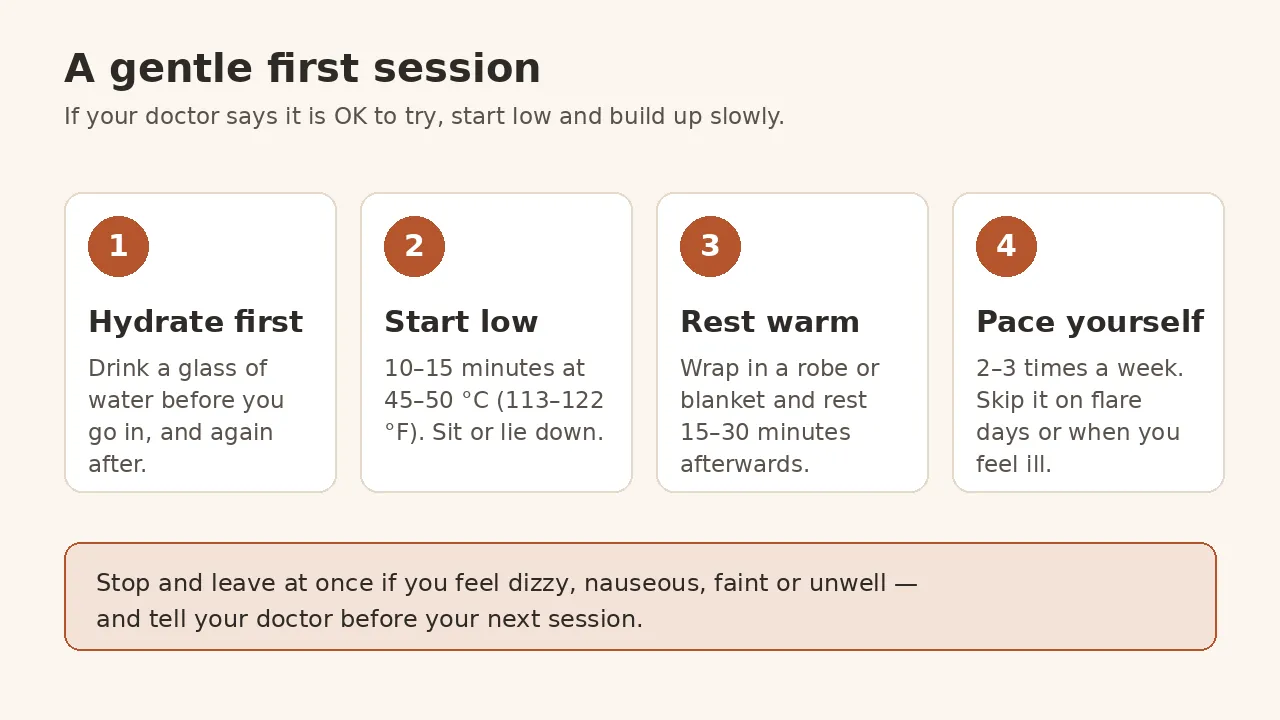
- Talk to your doctor first. Mention any heart condition, low blood pressure, dizziness, medication that affects heat tolerance, or pregnancy, and ask whether sauna use fits your current treatment.
- Pick a good day. Choose a day when your symptoms are moderate, not a flare day, so you can learn how your body responds.
- Drink water before you go in. Have a glass beforehand and keep another nearby for after. Good hydration is the simplest safety step there is, and our infrared sauna hydration guide explains how much to drink and when.
- Start at 45 to 50°C for 10 to 15 minutes. Sit or lie down, whichever feels better. You can build up to the 60°C used in the Waon study over several weeks if it feels comfortable.
- Leave at once if you feel unwell. Dizziness, nausea, a racing heartbeat or feeling faint are all signals to get out, cool down and drink water. Never try to push through them.
- Rest warm afterwards. The Japanese Waon protocol includes 30 minutes of rest wrapped in a blanket after the sauna. Wrap up in a robe or blanket and rest for 15 to 30 minutes before doing anything else.
- Shower lukewarm, not cold. A cold plunge or cold shower can shock a sensitive nervous system, and many people with fibromyalgia are also sensitive to cold.
- Note how you feel. Write down your pain level, fatigue and sleep quality before the session and again the next morning. A simple 0 to 10 score is enough to tell whether sessions are actually helping you.
Session guidance at a glance
| First two weeks | Once you are comfortable | |
|---|---|---|
| Temperature | 45 to 50°C (113 to 122°F) | 50 to 60°C, only if it feels good |
| Session length | 10 to 15 minutes | 15 to 20 minutes |
| How often | 2 times a week | 2 to 3 times a week |
| After the session | Rest wrapped up for 15 to 30 minutes | Same rest, then a lukewarm shower |
| Drink | Water before and after | Water before and after |
| Skip the session if | You are flaring, ill, dehydrated or exhausted | Same, every time |
How long you stay in matters more than most people think. A 10-minute gentle session that leaves you relaxed is worth far more than a 30-minute session that leaves you drained. For more detail, see how long you should stay in an infrared sauna and how to use an infrared sauna.
Pacing, flare days and the day after
Fibromyalgia rewards pacing, and sauna use is no exception. A common mistake is to feel good after a session and then do too much, which triggers a crash the next day. Plan a quiet rest after your first few sessions, and keep the rest of the day light.
If you feel worse the day after a session, that is useful information: the session was probably too long, too hot or too frequent. Shorten it next time rather than giving up entirely.
Flare days are days to skip. Heat will not fix a flare, and adding a stressor to an already overloaded nervous system rarely helps. Wait until symptoms settle back to your usual level.
The same goes for days when you are ill, dehydrated or running a fever. A sauna is for days when your body has some capacity to spare.
Some people find that gentle movement after a sauna, such as a short walk or light stretching, feels good once muscles are warm. Others prefer to rest completely. Both are fine.
The Matsumoto study paired sauna with underwater exercise and got the best results of any study in this field, which hints that heat plus gentle movement may work better than heat alone. If you already have a movement routine that suits you, a sauna session beforehand may make it easier.
Who Should Check With a Doctor First
Most healthy adults can use an infrared sauna safely with basic precautions, but fibromyalgia often travels with other conditions, and heat affects the heart and blood pressure. Our guide to whether infrared sauna is safe covers the general picture. Talk to your doctor first if any of the following apply to you.
- You have a heart condition, high or low blood pressure, or poor circulation.
- You feel dizzy or faint easily, or you have fainted before.
- You take medication that affects blood pressure, heart rate, sweating or heat tolerance, including some medicines for pain, mood and blood pressure.
- You are pregnant, or trying to become pregnant.
- You have a condition that affects sweating, or you have had heatstroke before.
- You have open wounds, a skin infection, or a recent injury or surgery.
- You have another condition alongside fibromyalgia, such as diabetes, multiple sclerosis or rheumatoid arthritis, where heat needs extra thought.
Red flags: stop and get help
Leave the sauna at once and seek medical help if you develop chest pain, severe breathlessness, confusion, a very fast or irregular heartbeat, or you faint. These are rare, but they are not symptoms to wait out. Also tell your doctor promptly about new or much worse symptoms after sessions, such as severe headaches, joint swelling, numbness or a rash.
Never drink alcohol before or during a sauna session. Alcohol widens blood vessels, increases dehydration and raises the risk of fainting, and the combination with heat is genuinely dangerous. The same caution applies to recreational drugs and sedating medication unless your doctor has said otherwise.
What an Infrared Sauna Cannot Do
It is worth being plain about the limits, because sauna marketing is often not. An infrared sauna cannot cure fibromyalgia. It cannot repair the way the nervous system processes pain, and it cannot replace prescribed medicine, exercise therapy or sleep treatment. Anyone who promises a cure or a permanent fix is selling something, not citing science.
It also cannot do the job on its own. In the best studies, heat was part of a programme that included exercise, rest and medical supervision. A sauna works best as a small addition to a plan that is already in place, not as a replacement for one.
Related claims deserve the same scepticism. If you have read that infrared heat reduces inflammation in fibromyalgia, the evidence is indirect: heat may affect inflammatory markers in general, but no study has shown that it lowers inflammation in fibromyalgia specifically. Our article on whether infrared sauna reduces inflammation explains what is and is not known.
The same applies to muscle recovery. Heat can ease sore muscles, which is why athletes use it, and our guide to infrared sauna for muscle recovery is useful background, but sore muscles after exercise and fibromyalgia pain are different things.
Setting Realistic Expectations
If you and your doctor agree to try it, give the experiment a fair chance. In the studies, benefits appeared after the first session for some people, but the effects stabilised over about ten sessions. A fair trial is four to six weeks of two to three gentle sessions a week.
Track three things: average pain on a 0 to 10 scale, fatigue, and sleep. Note them before each session and again the next morning. If, after a month, your scores are no better, heat is probably not your tool, and that is useful to know. If your pain drops by even one or two points, or you sleep better on sauna days, that is a meaningful gain.
Expect variation. Some weeks will feel better than others, and one session proves nothing. Fibromyalgia symptoms fluctuate with weather, stress, sleep and activity, so judge the pattern over a month.
And if heat helps, keep the routine modest. The goal is a sustainable habit that fits your life, not a daily ordeal that adds stress.
Frequently Asked Questions
Can an infrared sauna help fibromyalgia pain?
It may ease pain for some people. Small studies found lower pain scores after far-infrared sessions, and one sham-controlled trial found a real benefit that lasted 30 weeks. But the studies were small, and a home sauna has not been tested in a large trial, so it is best seen as a possible aid rather than a proven treatment.
How long should a session be if I have fibromyalgia?
Start with 10 to 15 minutes at 45 to 50°C. The studies used 15 minutes at 60°C, but that was in supervised programmes. Build up slowly over several weeks, and only if shorter sessions feel good. Leave at once if you feel dizzy, nauseous or unwell.
How often should I use an infrared sauna for fibromyalgia?
Two to three times a week is a sensible starting point, matching the frequency used in the studies. Give it four to six weeks before judging the result, and skip sessions on flare days or when you feel ill.
Is infrared sauna safe for fibromyalgia?
For most people it is safe when used gently, but check with your doctor first if you have a heart or circulation condition, low blood pressure, are pregnant, or take medication that affects heat tolerance. Hydrate well, keep sessions short, never drink alcohol before a session, and leave immediately if you feel dizzy or unwell.
Is infrared or traditional sauna better for fibromyalgia?
Infrared is the better starting point. Most of the fibromyalgia research used far-infrared heat, and infrared cabins run cooler, which is easier to tolerate when your nervous system is sensitive. If you already enjoy a traditional sauna and tolerate it well, there is no need to switch.
Can infrared sauna cure fibromyalgia?
No. There is no cure for fibromyalgia, and a sauna does not change that. At best, gentle heat may ease pain, stiffness and fatigue for some people, as one part of a wider care plan that includes movement, sleep and prescribed treatment.
References
- Matsushita K, Masuda A, Tei C. Efficacy of Waon therapy for fibromyalgia. Internal Medicine 2008;47(16):1473–1476. PubMed 18703857
- Matsumoto S, Shimodozono M, Etoh S, Miyata R, Kawahira K. Effects of thermal therapy combining sauna therapy and underwater exercise in patients with fibromyalgia. Complementary Therapies in Clinical Practice 2011;17(3):162–166. PubMed 21742283
- Langhorst J, Koch AK, Kehm C, Öznur Ö, Engler H, Häuser W. Mild water-filtered infrared-A whole-body hyperthermia reduces pain in patients with fibromyalgia syndrome: a randomized sham-controlled trial. Journal of Clinical Medicine 2023;12(8):2945. PubMed 37109279
- Brockow T, Wagner A, Franke A, Offenbächer M, Resch KL. A randomized controlled trial on the effectiveness of mild water-filtered near-infrared whole-body hyperthermia as an adjunct to a standard multimodal rehabilitation in the treatment of fibromyalgia. Clinical Journal of Pain 2007;23(1):67–75. PubMed 17277647
- Chadwick AL, et al. The impact of a heat therapy intervention on pain and fibromyalgia symptoms in patients with fibromyalgia: a pilot study. Frontiers in Pain Research 2025;6:1526491. PMC11966051
- Masuda A, Koga Y, Hattanmaru M, Minagoe S, Tei C. The effects of repeated thermal therapy for patients with chronic pain. Psychotherapy and Psychosomatics 2005;74(5):288–294. PubMed 16088266
- Mayo Clinic. Fibromyalgia: symptoms and causes. Mayo Clinic
- National Center for Complementary and Integrative Health. Complementary health approaches for fibromyalgia. NCCIH