
An infrared sauna is a simple machine with a straightforward job. Heater panels warm your body directly, a control panel manages time and temperature, and a wooden cabin holds the heat in. Keep those three parts in good shape and the sauna will serve you well for years.
Maintenance is what keeps it that way. A loose cord, a panel that no longer heats evenly, or a thermometer that reads ten degrees high will not announce itself loudly. Small problems show up as slightly cooler sessions, a faint smell, or a display that flickers once and then behaves. A regular calendar catches those signs early, when the fix is still small.
This guide gives you a full infrared sauna maintenance calendar. Monthly checks take about fifteen minutes and cover the parts you touch every session. Annual checks go deeper and cover wiring, calibration, wood care, and the parts you rarely see. Everything here is specific to infrared cabins, which heat very differently from traditional stove saunas.
Health note: This article is general information, not medical advice. Saunas are wellness tools, not treatments. If you are pregnant, live with a heart or circulation condition, have low blood pressure, or take medication that affects heat tolerance, check with your doctor before using a sauna. Hydrate before and after every session, start with short sessions, and leave immediately if you feel dizzy, unwell, or overheated. Never drink alcohol before or during a session.


#Paid Links
Why Infrared Saunas Need Their Own Maintenance Rhythm
Infrared cabins and traditional saunas share a wooden box and a bench. Almost everything else is different. A traditional sauna uses a hot stove and stones to heat the air, and its maintenance centres on the stove, the stones, and the chimney or vent. An infrared cabin has no stove, no stones, and no steam. Its heat comes from electric panels, so its maintenance centres on electricity, electronics, and even heating.
That difference matters for your calendar. You do not need to check stones or flues. You do need to check heater panels, cords, plugs, and the control panel. You need to know whether the thermometer is telling the truth, because infrared cabins run cooler than traditional saunas and a wrong reading is easy to miss. And you need a plan for the wood, which faces steady dry heat rather than bursts of steam.

#Paid Links
A calendar also protects your warranty and your safety. Many manufacturers ask owners to follow a basic care routine, and a written record of checks is useful if you ever need support or a repair. More importantly, the two most serious infrared sauna problems, electrical faults and uneven heating, both develop slowly. A monthly look-over finds them while they are still cheap and safe to fix.
Your Infrared Sauna Maintenance Calendar at a Glance
Think of the calendar in two layers. Monthly checks are quick, hands-on, and done while the cabin is cool. Annual checks are a deeper once-a-year review, best done on a quiet day when you can take your time. The table below shows the full rhythm, and the timeline image underneath it is a handy summary to keep near the cabin.
| Check | Monthly | Annually |
|---|---|---|
| Wipe down benches and walls | Yes, after sessions | Deep clean and inspect |
| Heater panels | Look and feel check | Full panel-by-panel test |
| Cords, plugs and outlets | Visual check | Electrician inspection |
| Control panel | Buttons and display | Settings and sensor check |
| Thermometer | Reading sanity check | Calibrate or replace |
| Wood care | Spot stains and cracks | Sand and treat if needed |
| Ventilation and seals | Vents clear, door closes | Seal and hinge review |
| EMF reading | Not needed | Optional meter check |
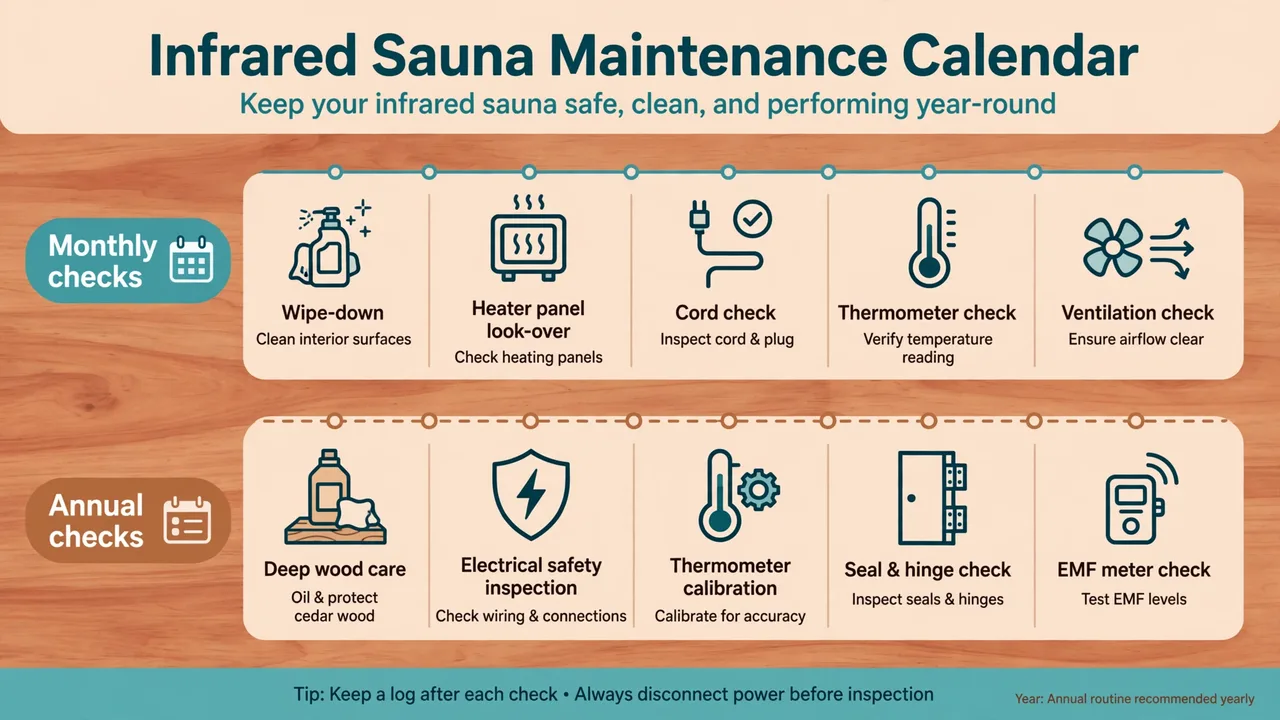
The infrared sauna maintenance calendar: quick monthly checks plus a deeper annual review.
Pick one fixed day each month for the monthly round, such as the first Saturday. Put the annual review on your calendar too, ideally at the same time every year. A routine you can remember is a routine you will actually do.



#Paid Links
Monthly Checks: Fifteen Minutes That Prevent Most Problems
Do monthly checks with the sauna switched off and fully cool. Never inspect heater panels or wiring while the unit is hot or plugged in and running. Work through the list in the same order each month so nothing gets skipped.
1. Wipe down benches, walls and floor
Sweat is the main thing your cabin collects. Wipe benches and backrests after each session with a clean, slightly damp cloth, and do a fuller wipe of walls and floor once a month. Let everything dry with the door open before the next session.
Cleaning is only one monthly task among several, not the whole job. For the full step-by-step cleaning routine, including what to use on cedar and what to avoid, see our guide on how to clean an infrared sauna. The rest of this article covers the checks that cleaning alone does not cover.
2. Look over every heater panel
Stand in front of each panel and look for cracks, dark spots, warping, or discolouration. Panels should look uniform. A panel with a brown or blackened patch, a visible crack, or a section that looks different from the rest deserves a closer look and a test run.
Run the sauna for a few minutes with the door open and hold your hand a safe distance from each panel in turn. Every panel should warm up at roughly the same rate. A panel that stays cold, heats far more slowly than the others, or makes a buzzing sound is a warning sign. Note it, and if the problem repeats, contact the manufacturer or a qualified technician.
3. Check cords, plugs and outlets
Follow the power cord from the cabin to the outlet. Look for fraying, kinks, flattened sections, melted spots, or scorch marks on the plug. The plug should sit firmly in the outlet with no looseness or wobble. The outlet face should be cool to the touch after a session, never warm or hot.
Never use a damaged cord, and never run an infrared sauna through a standard extension cord unless the manufacturer explicitly allows it. Most infrared cabins draw significant power, and an undersized extension cord is a fire risk. If your setup needs a longer reach, ask a licensed electrician about a proper outlet placement instead. Our guide to infrared sauna power requirements explains what your model needs and why the circuit matters.
4. Test the control panel
Press each button and confirm it responds. The display should be clear, with no missing segments, flicker, or dim patches. Set a short test session and confirm the timer counts down and the temperature setting changes as expected. A display that freezes, a button that needs several presses, or a timer that behaves oddly can be an early sign of a failing control board.
Keep the control panel dry. Wipe it with a barely damp cloth only, and never spray cleaner directly onto it. Moisture behind the panel is a common cause of erratic behaviour.
5. Sanity-check the thermometer
Before a session, the cabin thermometer should read close to room temperature. After the sauna has run for fifteen minutes, it should show a steady climb. If it reads far above or below what the cabin feels like, or if it never moves at all, the sensor may be faulty or misplaced. Thermometer calibration gets a full section later in this guide.
6. Check ventilation and the door
Find the cabin vents and confirm they are open and unblocked. Furniture, towels, or stored items often end up in front of a vent without anyone noticing. Open and close the door and check that it shuts fully and the handle and hinges feel solid. A door that does not close properly lets heat escape and makes every session work harder.
Heater Panels: The Heart of Your Infrared Cabin
Infrared heater panels do the actual work in your cabin. Most cabins use carbon panels or ceramic heaters, sometimes a mix of both. Carbon panels spread heat over a wide surface and warm up gently. Ceramic heaters run hotter in a smaller area and give a more intense local heat. Both types need the same basic inspection, but ceramic heaters deserve a closer look for hot spots because their heat is more concentrated.
Uneven heating is the most common panel problem and the easiest to miss. You sit in the same spot each session, so a cold panel behind you can go unnoticed for weeks. The monthly hand check described above is your main defence. Once a year, do a fuller test by running the cabin empty for twenty minutes, then checking each panel in turn from a safe distance.
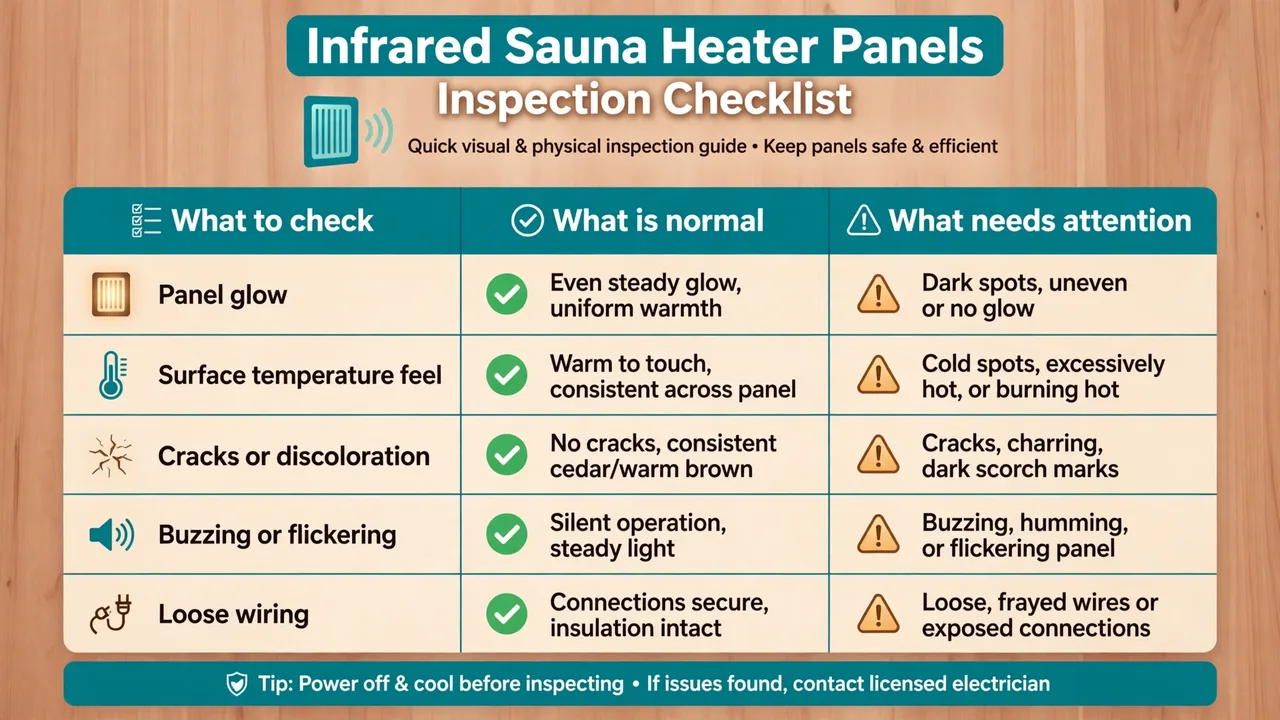
Heater panel inspection at a glance: normal signs versus signs that need attention.
| What to check | Normal | Needs attention |
|---|---|---|
| Panel surface | Even colour, no cracks | Cracks, dark patches, warping |
| Warm-up | All panels warm together | One panel cold or much slower |
| Sound | Silent or a faint hum | Buzzing, clicking, or popping |
| Smell | Clean wood smell only | Burning, plastic, or chemical smell |
| Connections | Wiring hidden and secure | Exposed, loose, or scorched wiring |
Never open a heater panel yourself or try to repair its internal wiring. Panels are sealed units, and opening one voids most warranties and creates a real shock risk. If a panel fails the checks above, switch the sauna off at the outlet, stop using it, and contact the manufacturer or a licensed electrician. If you are choosing a replacement panel, our guide on how to choose an infrared heater explains the differences between panel types.
Thermometer Calibration and Placement
Your thermometer is only useful if it tells the truth. Infrared cabins usually run between about 110 and 140 degrees Fahrenheit, which is cooler than a traditional sauna. At those temperatures, a thermometer that reads ten degrees high or low changes how you judge a session, and it can hide a heater problem.
Where the thermometer should sit
Place the thermometer at head height when seated, away from direct contact with a heater panel and away from the door. A thermometer mounted right next to a panel will read hotter than the air you actually sit in. One mounted near the door will read cooler. The middle of a side wall, at seated head height, gives the most honest reading.
If your cabin has a built-in sensor for the control panel, that sensor has its own placement rules set by the manufacturer. Do not move it. The wall thermometer is your independent cross-check, and comparing the two readings is one of the best monthly habits you can build.
How to check calibration once a year
Start with a simple room-temperature test. Leave a reliable household thermometer next to the cabin thermometer for an hour with the sauna off. Both should agree within a couple of degrees. If they differ by five degrees or more, the cabin thermometer needs attention.
- Place a trusted thermometer beside the cabin thermometer for one hour, sauna off.
- Compare the readings. A gap of two degrees or less is fine.
- If the gap is five degrees or more, check the thermometer manual for a calibration step.
- If there is no calibration step, replace the thermometer rather than guessing.
- Repeat the check after any panel repair, sensor replacement, or control panel work.
Do not rely on a single reading during a session. Cabin temperature moves as the panels cycle on and off, so a reading taken at one moment is only a snapshot. What matters is the pattern: a steady climb, a stable plateau, and agreement between the wall thermometer and the control panel display. For guidance on the right temperature range for your sessions, see how hot an infrared sauna should be.
Electrical Safety: What You Can Check and What You Must Not Touch
Infrared saunas are electrical appliances that run at high power for extended periods. That combination deserves respect. The good news is that the checks an owner can safely do are simple, and the work an owner should never do is equally clear.
Electrical note: This section is general guidance only. Electrical work, repairs, and installation must follow your local code, and a licensed electrician should handle anything beyond a visual check. Never open the control box, junction box, or heater wiring yourself.
Safe owner checks
- Look at the plug, cord, and outlet for damage, heat, or scorch marks.
- Confirm the plug fits firmly and the outlet face stays cool after a session.
- Check that the sauna is on its own dedicated circuit, as most manufacturers require.
- Test the outlet’s ground-fault protection if one is fitted, using its test button.
- Note any breaker trips, even one-off trips, and record the date.
Jobs for a licensed electrician only
- Anything inside the control box or junction box.
- Replacing or repairing heater panel wiring.
- Moving the sauna to a new circuit or outlet.
- Repeated breaker trips or a breaker that feels hot.
- Any shock, tingle, or spark, however small.
A breaker that trips once after a storm may be nothing. A breaker that trips twice in a month is a pattern, and patterns deserve a professional look. The same applies to any burning smell. Switch the sauna off at the outlet, ventilate the room, and do not use the cabin again until it has been inspected. If you ever need to move the cabin to a new room, read our guide on how to move an infrared sauna before you start, and have an electrician check the new circuit.
Check with your local code or permit office before any electrical change, and keep the manual that came with your cabin. Manufacturers differ on circuit size, plug type, and whether a dedicated circuit is required. The manual is the authority for your model, and this guide is no substitute for it.
Wood Care for Infrared Cabins
Most infrared cabins are built from cedar, hemlock, or basswood. These woods handle dry heat well, but they still change over time. Sweat stains, small cracks, and a gradual drying of the surface are normal. Deep splits, soft spots, or black mould marks are not, and each needs a different response.
Monthly wood checks
Run your hand along the bench tops and backrests once a month. You are feeling for rough patches, splinters, sticky residue, and new cracks. Check the floor boards under the bench too, since sweat and moisture collect there first. A small crack in a bench board is usually cosmetic. A crack that runs through a board, or a board that flexes under weight, needs attention before the next session.
Annual wood care
Once a year, give the wood a deeper review. Lightly sand stained or rough bench areas with fine sandpaper, working with the grain, and wipe away the dust with a damp cloth. Let the cabin dry fully with the door open. Only use treatments your manufacturer approves for interior sauna wood. Many makers advise against varnish, paint, or standard wood oils inside the cabin, because heat can release fumes from finishes that are safe at room temperature.
Never soak sauna wood. A damp cloth is enough. Standing water seeps into joints and encourages mould in places you cannot see. If you find mould, follow your manufacturer guidance and ventilate the cabin well. Persistent mould, or a musty smell that survives cleaning and drying, is a reason to ask the manufacturer for advice rather than to keep scrubbing.
Towels are your best wood protection. Sitting on a towel keeps most sweat off the bench, and a small towel under your feet protects the floor boards. It is a small habit that adds years to the wood.
EMF Checks: What They Can and Cannot Tell You
EMF, or electromagnetic field, is a common concern for infrared sauna buyers, and many cabins are sold as low-EMF models. An annual EMF check with a handheld meter can confirm that your cabin still reads in the range the manufacturer states. It is an optional check, not a safety requirement, and it is worth understanding what the numbers mean before you measure.
Measure with the sauna running at its normal temperature, holding the meter where you sit, at torso height. Take readings at each seating position and near each panel. Write the numbers down with the date. A single reading tells you little. A yearly series tells you whether anything has changed.
Keep expectations realistic. A handheld meter gives an approximate reading, not a laboratory result, and readings vary with meter type, distance, and panel cycling. A small change from one year to the next is usually measurement variation, not a fault. A large jump, or a reading far above the manufacturer’s stated range, is worth a call to the manufacturer. For background on what low-EMF means and how manufacturers measure it, see our guide on what a low-EMF infrared sauna is.
Do not let an EMF check replace the electrical checks above. A cabin can read low on EMF and still have a damaged cord, and a cabin with a healthy cord can read slightly higher than last year. The two checks answer different questions.
Ventilation, Seals and Door Hardware
Infrared cabins need fresh air. The vents bring it in, and the door gap lets warm air out. Without that flow, sessions feel stuffy and the cabin holds moisture after use. Monthly, confirm the vents are open and clear. Annually, check that the vent covers still move freely and have not warped or stuck shut.
Door seals and hinges wear slowly. Once a year, close the door and look at the gap around it in daylight. The gap should be even. A door that sags, a hinge that squeaks or wobbles, or a handle that feels loose should be tightened or adjusted before it becomes a real problem. A few drops of suitable lubricant on a hinge, and a gentle tightening of screws, will fix most door issues.
Glass doors need a separate look. Check the glass for chips or cracks, especially at the corners and around the handle fixings. A small chip in tempered glass can spread with heat cycling, so report it to the manufacturer promptly rather than waiting for the next annual review.
Annual Deep Checks: The Once-a-Year Review
Set aside an hour once a year for the full review. Do it with the sauna cool and unplugged. Work through the checklist below and write down what you find. The written record is the point. Next year, you will know exactly what changed.
| Annual check | How to do it | If it fails |
|---|---|---|
| Full panel test | Run empty for 20 minutes, check each panel | Stop use, call manufacturer |
| Electrician inspection | Licensed electrician checks circuit and connections | Follow their repair advice |
| Thermometer calibration | Compare with a trusted thermometer for one hour | Calibrate or replace |
| Control panel and sensors | Test every button, timer, and sensor reading | Contact manufacturer support |
| Wood deep review | Sand stains, check joints and boards | Replace damaged boards |
| Seals, hinges, glass | Check gaps, tighten, inspect glass | Adjust or replace hardware |
| EMF meter reading | Measure at each seat, record the numbers | Ask manufacturer if far above stated range |
| Ventilation | Confirm vents open, move freely, and are clear | Clean or replace vent covers |
The annual review is also the right time to read your manual again. Manufacturers update guidance, and a detail you missed on first reading, such as a recommended cleaning product or a filter that needs changing, may be waiting there. If your cabin has a replaceable part, such as an air filter or a sensor, check whether it is due.
When to Call a Licensed Professional
Most infrared sauna maintenance is simple owner care. Some signs mean stop and call a professional. The difference is worth memorising, because the cost of guessing wrong on electrical work is far higher than the cost of a call-out.
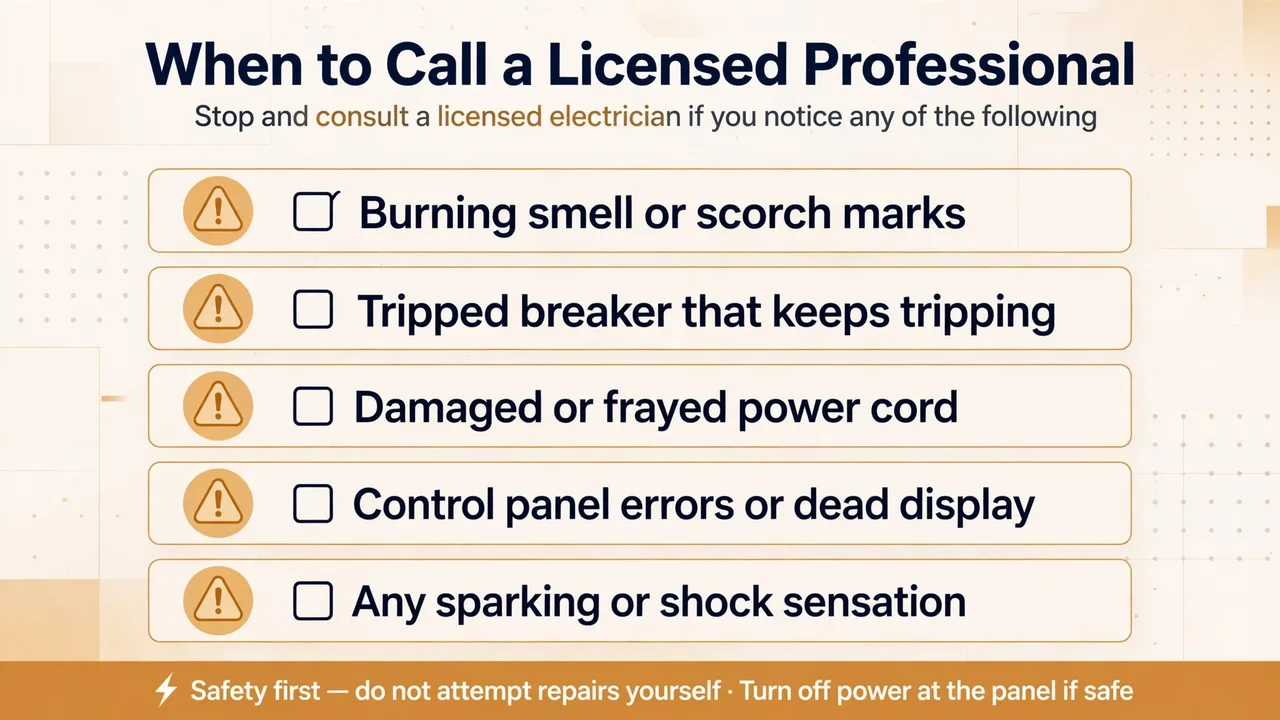
Stop using the sauna and call a licensed professional if you see any of these warning signs.
- A burning smell, scorch marks, or melted plastic anywhere in or near the cabin.
- A breaker that trips repeatedly, or an outlet that feels warm after a session.
- A damaged, frayed, or melted power cord or plug.
- Control panel errors, a dead display, or a sauna that will not switch off.
- Any sparking, or any shock or tingling sensation when touching the cabin.
- A heater panel that stays cold, buzzes loudly, or shows visible damage.
If any of these appear, switch the sauna off at the outlet and do not use it again until it has been inspected. Do not open the control box to look inside. A licensed electrician can diagnose the fault safely, and the manufacturer can advise on parts and warranty cover. For smaller issues, such as a sauna that heats slowly or a display that behaves oddly, our infrared sauna troubleshooting guide walks through the common causes before you call anyone.
A Simple Record-Keeping Habit
A notebook, or a note on your phone, turns maintenance from a vague intention into a real routine. Each month, write the date and one line per check: panels even, cord fine, thermometer agrees, vents clear. Each year, add the calibration result and any EMF readings. That is all it takes.
The record pays off in three ways. First, it shows patterns you would otherwise miss, such as a panel that has been slightly cooler for three months running. Second, it helps a technician diagnose a fault faster, because you can say when the problem started. Third, it supports a warranty claim, since it shows the cabin was cared for as the manufacturer asked.
Older users and anyone with a health condition should treat the record as part of their safety routine too. If you use the sauna for relaxation or gentle warmth, keep sessions short, sit near the door for easy exit, and have someone nearby for your first few sessions. Our guide on infrared saunas for seniors covers session length and safety in more detail. And if you ever feel unsure whether infrared sauna use is right for you, our overview of whether infrared saunas are safe is a good place to start, followed by a conversation with your doctor.
Frequently Asked Questions
How often should I maintain my infrared sauna?
Do a quick check every month and a deeper review once a year. Wipe down benches after each session, and run the full monthly list on a fixed day so nothing gets missed.
How do I know if a heater panel is failing?
A failing panel usually stays cold, heats much more slowly than the others, buzzes, or shows cracks or dark patches. Run the sauna empty for a few minutes and check each panel in turn from a safe distance.
Can I repair an infrared sauna heater panel myself?
No. Heater panels are sealed units with mains wiring inside. Never open a panel or its wiring yourself. Contact the manufacturer or a licensed electrician if a panel fails your checks.
How do I calibrate my infrared sauna thermometer?
Leave a trusted household thermometer beside the cabin thermometer for an hour with the sauna off. If they differ by five degrees or more, follow the calibration step in your manual, or replace the thermometer if there is none.
Do infrared saunas need an electrician every year?
An annual electrician inspection is good practice, especially for older cabins or any cabin with a history of breaker trips. At minimum, have an electrician check the circuit and connections once a year and after any electrical problem.
What is the most important monthly check?
The power cord, plug, and outlet. Electrical faults are the most serious risk in an infrared cabin, and a monthly look for damage, looseness, or warmth catches them early.
Start This Month, Not Next Year
Infrared sauna maintenance is not complicated. Fifteen minutes a month and one deeper hour a year will keep your cabin heating evenly, running safely, and lasting far longer than a neglected one. The calendar in this guide gives you the whole routine in one place.
Start with the monthly round this week. Check the panels, the cord, the control panel, and the thermometer while the cabin is cool. Write down what you find. Then put the annual review on your calendar for the same month next year, and book an electrician for the same visit. Your future self, stepping into a warm, even, and safe cabin, will be glad you did.