
Last updated: November 11, 2026. Before you buy an infrared sauna, or before you plug one in for the first time, you need to know what it asks of your home wiring. The question is simple.
How much power does it draw, what kind of outlet does it need, and will your breaker handle it? The answers decide whether your sauna runs safely for years or trips the breaker halfway through every session.
Most small infrared saunas are made to plug into a normal household outlet. Larger cabins need a 240 volt circuit, a bigger breaker, and work from a licensed electrician. The difference between the two is not a detail you can guess at. It is written on the rating label of your model, and this guide shows you how to read it, how to turn watts into amps with one simple calculation, and how to check your outlet, breaker, and panel before the sauna arrives.
You will learn the typical wattage and amp draw for each sauna size, how 120 volt and 240 volt models compare, what size breaker each one needs, which outlet types you will see, why a dedicated circuit matters, and what to do when a breaker trips. You will also learn when the job is a plug-in task you can do yourself and when it is time to call a licensed electrician.


#Paid Links
Please read first, electrical work is general guidance only. This article is general guidance, not a substitute for local code or a licensed electrician. Electrical rules vary by area, so check your local code and permit office, and use a licensed electrician for any new circuit, outlet change, or panel work. Follow your own model’s manual first, because it overrides anything general written here. Never work on live wiring.
Key takeaways
- Amps equal watts divided by volts, so a 1,800 watt sauna on a 120 volt outlet draws 15 amps, while the same sauna on 240 volts draws only 7.5 amps.
- Small one and two person infrared saunas usually run on a standard 120 volt outlet, while most three and four person cabins need a 240 volt circuit installed by a licensed electrician.
- Your sauna should have its own dedicated circuit, with nothing else sharing the breaker, so the heater never competes with a hair dryer, a heater, or a kitchen appliance.
- A breaker should carry no more than 80 percent of its rated amps for a long, steady load, so a 20 amp breaker is a safe match for a load of 16 amps or less.
- Never use an extension cord or a power strip with an infrared sauna, and plug the sauna directly into the wall outlet.
- If the breaker trips, unplug the sauna, find the cause, and call a licensed electrician if it trips again or if you smell burning, see scorch marks, or feel heat at the outlet.
- Your model’s manual and rating label are the final word on watts, volts, and amps, and they override every typical range in this guide.
What infrared sauna power requirements actually mean
Three numbers describe what a sauna needs from your home. Watts tell you how much power the heaters use. Volts tell you the pressure of the electricity coming from the outlet. Amps tell you how much current flows through the wire.

#Paid Links
The three are linked by one simple formula, and once you know it, every rating label makes sense.
Think of it like water in a hose. Volts are the water pressure. Amps are how much water flows. Watts are the total work the water can do.
A sauna heater needs a set amount of watts to warm up. At higher volts, the same watts need fewer amps, which is why large saunas run on 240 volts instead of 120 volts.
The one formula you need: amps equal watts divided by volts
The formula is amps equals watts divided by volts. If your sauna is rated at 1,800 watts and plugs into a 120 volt outlet, divide 1,800 by 120 and you get 15 amps. If the same 1,800 watts ran on a 240 volt circuit, divide 1,800 by 240 and you get 7.5 amps. That is the whole calculation, and you can use it for any model once you know its wattage.



#Paid Links
You will find the wattage on the rating label, usually on the back panel or near the power inlet, and in the specifications page of the manual. Use the rated watts from the label, not a number from a sales page or a review, because the label is the number your electrician will work from. If the label gives a range, use the top number for your planning, so your circuit has room to spare.
Why volts matter more than watts
Two saunas can use the same watts and still need very different wiring. A 2,000 watt sauna on 120 volts draws about 16.7 amps, which is already more than a standard 15 amp household circuit can carry safely. The same 2,000 watts on 240 volts draws only about 8.3 amps, which a 20 amp circuit handles with room to spare. This is why makers switch larger cabins to 240 volts.
Volts also decide what kind of outlet you need. A 120 volt sauna uses a normal household plug, the same shape as a lamp or a phone charger. A 240 volt sauna uses a larger plug with a different shape, and the outlet must be wired for 240 volts.
You cannot plug a 240 volt sauna into a normal outlet, and you cannot run a 120 volt sauna on a 240 volt outlet. The plug shapes are different on purpose, so a mismatch is hard to make by accident.
Where to find your sauna’s power numbers
- Rating label on the sauna, usually on the back panel, the roof, or near the power inlet, listing watts, volts, and sometimes amps directly.
- Manual specifications page, which lists the electrical requirements, the plug type, and whether a dedicated circuit is required.
- Maker website product page, useful for planning before you buy, but always confirmed against the label once the sauna arrives.
- Control panel or power supply box, which sometimes carries a second label with the input rating.
Write the three numbers down before you shop for a sauna or call an electrician. An electrician will ask for watts, volts, and whether the model is plug-in or hardwired, and having those numbers ready saves a wasted visit. If the label is missing or unreadable, contact the maker with your model number before you plug the sauna in.
How many amps does an infrared sauna draw?
The short answer is that it depends on size. A small one person sauna draws far less than a four person cabin, and the voltage makes a big difference too. The table below shows typical wattage ranges for common home infrared saunas, with the amps worked out at both 120 volts and 240 volts using the formula from the last section. Treat these as planning ranges, not as the rating for your model, because heater counts and panel types vary by maker.
Read the table from left to right. Find your sauna size, check the typical watts, then look at the amps for your voltage.
If your sauna is a plug-in 120 volt model, the 120 volt column is the one that matters. If it is a 240 volt model, use the 240 volt column. Your manual will tell you which voltage your model uses, and the plug shape will confirm it.
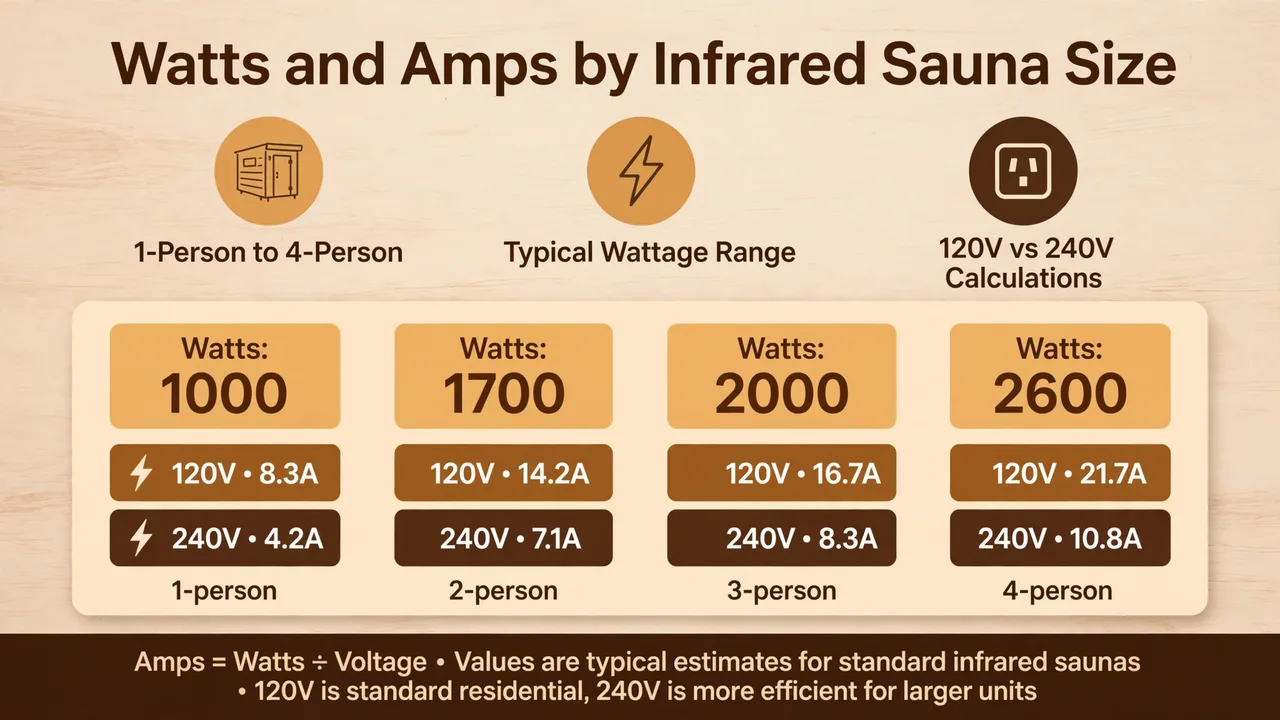
| Sauna size | Typical watts | Amps at 120 volts | Amps at 240 volts | Usual voltage |
|---|---|---|---|---|
| 1 person | 1,200 to 1,750 watts | 10 to 14.6 amps | 5 to 7.3 amps | 120 volts |
| 2 person | 1,600 to 2,200 watts | 13.3 to 18.3 amps | 6.7 to 9.2 amps | 120 or 240 volts |
| 3 person | 2,000 to 2,600 watts | 16.7 to 21.7 amps | 8.3 to 10.8 amps | Usually 240 volts |
| 4 person | 2,400 to 3,200 watts | 20 to 26.7 amps | 10 to 13.3 amps | 240 volts |
| Corner or 4 to 5 person | 2,800 to 3,600 watts | 23.3 to 30 amps | 11.7 to 15 amps | 240 volts |
Worked examples you can check against your own model
Take a one person sauna rated at 1,500 watts on 120 volts. Divide 1,500 by 120 and you get 12.5 amps. That fits a 20 amp circuit with room to spare, but it is close to the safe limit of a 15 amp circuit, which is 12 amps for a long steady load. This is why many one person models still ask for a 20 amp dedicated circuit in the manual, even though the plug looks ordinary.
Now take a two person sauna rated at 2,000 watts on 120 volts. Divide 2,000 by 120 and you get 16.7 amps. That is more than a 15 amp breaker can carry and more than the 16 amp safe limit of a 20 amp breaker.
A sauna like this either needs a 240 volt circuit or a larger 120 volt circuit that a licensed electrician must install. You cannot fix this by fitting a bigger breaker to the existing wire, because the wire itself is only rated for the smaller breaker.
Finally, take a four person cabin rated at 3,000 watts on 240 volts. Divide 3,000 by 240 and you get 12.5 amps. A 20 amp 240 volt circuit handles that load with room to spare, and the wiring is thinner and cheaper than the wiring a 120 volt version would need. This is the practical reason large cabins are built for 240 volts, and it is also why they heat up faster and hold their temperature better.
Why the same size sauna can have different power needs
Two saunas with the same number of seats can draw different watts. One may have five heater panels and the other may have eight. Carbon panels, ceramic panels, and full spectrum heaters all use different amounts of power.
Extra features add watts too, such as a floor heater, a red light panel, or a built-in sound system. The seat count is a rough guide only, and the rating label is the number that counts.
Heater panels also draw their full watts from the moment they switch on until the cabin reaches temperature. They do not ramp up gently, and they cycle on and off to hold the set temperature. That means the peak draw, not the average draw, is what your circuit must handle. Plan for the peak, and your breaker will not trip on the coldest day of the year when the cabin starts from a cold room.
If you want a fuller picture of what a sauna costs to run once it is plugged in, read our guide on how much electricity an infrared sauna uses. It covers wattage, session length, and running costs, while this guide focuses on the wiring, outlets, and breakers that make those sessions safe.
120 volt vs 240 volt: which one do you need?
The voltage question is really a size question. Small saunas run on the same 120 volt supply as the rest of your home. Large saunas need 240 volts, the same supply that powers an electric oven or a clothes dryer.
Neither is better in itself. The right one is the one your model was built for, and the choice is made for you by the size of sauna you buy.
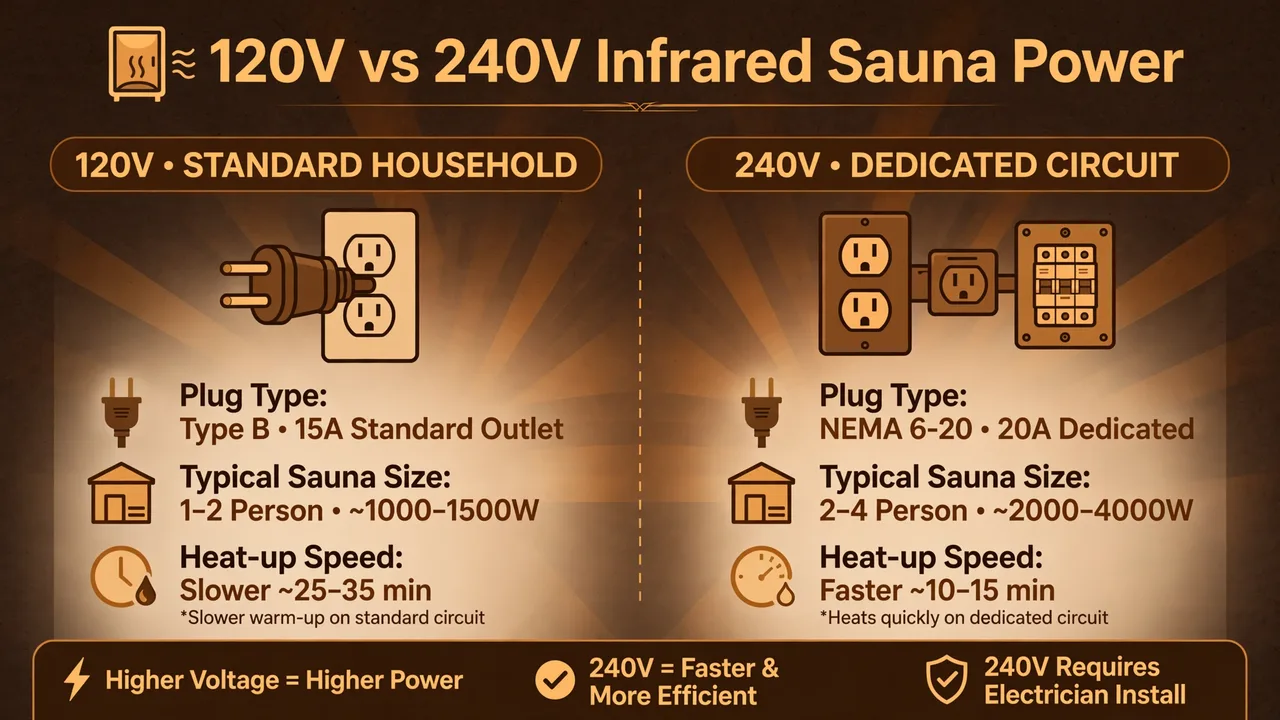
| Feature | 120 volt models | 240 volt models |
|---|---|---|
| Typical size | 1 to 2 person cabins | 2 to 5 person cabins |
| Plug type | Standard household plug | Larger dedicated plug, shape varies by model |
| Outlet needed | Normal wall outlet on a dedicated circuit | Dedicated 240 volt outlet, new circuit required |
| Typical breaker | 15 or 20 amps | 20 or 30 amps |
| Electrician needed | Often not, if a suitable dedicated circuit already exists | Yes, for the new circuit and outlet |
| Heat-up speed | Slower, because fewer watts are available | Faster, because more watts are available |
| Best for | Flats, rented homes, and small spare rooms | Family cabins and larger dedicated sauna rooms |
120 volt saunas: plug in and go, with one condition
A 120 volt sauna is the simplest option. It plugs into a normal wall outlet, it needs no special wiring in most homes, and you can set it up in an afternoon. That is why it is the usual choice for a first sauna, for a flat, or for a room where you cannot run new wiring. Our guide to an infrared sauna in an apartment covers the extra checks renters face, including landlord permission and shared circuits in older buildings.
The condition is the dedicated circuit. A normal outlet is often shared with other rooms, and a sauna that draws 12 to 15 amps leaves almost nothing for anything else on the same breaker. If the circuit already serves lights, a television, or a space heater, the sauna will trip it. A licensed electrician can confirm whether your chosen outlet is already on its own circuit, and that check costs far less than a tripped breaker every session.
240 volt saunas: more power, more planning
A 240 volt sauna needs a new circuit run from your breaker panel to the sauna location, a matching outlet, and usually a permit or inspection depending on your area. A licensed electrician does this work. The cost varies by distance from the panel, by whether the cable runs through finished walls, and by local rates, so get a local quote before you order the sauna. Treat any price you see online as a planning estimate, not a quote.
The payoff is real. A 240 volt cabin heats up faster, holds its temperature more steadily with several people inside, and draws fewer amps for the same watts, which means less stress on the wiring. If you are choosing between a large 120 volt cabin and a 240 volt cabin of the same size, the 240 volt model is usually the better long term choice, as long as your panel has room for the new circuit.
Can you convert a sauna from 120 volts to 240 volts?
No, not as a do-it-yourself job, and usually not at all. The heaters, the control panel, and the power supply are built for one voltage. Changing the voltage would mean replacing parts the maker never designed to be swapped, and it would void the warranty and any safety certification.
If you want 240 volt performance, buy a 240 volt model. If you already own a 120 volt model, use it on the circuit it was made for.
What size breaker does an infrared sauna need?
The breaker protects the wire, not the sauna. Its job is to cut the power if the current gets too high for the cable behind the wall. That means the breaker size, the wire size, and the outlet must all match.
You cannot fix an undersized circuit by fitting a bigger breaker, because the wire would overheat before the bigger breaker ever tripped. This is the single most dangerous mistake in sauna wiring, and it is why breaker work belongs to a licensed electrician.
The 80 percent rule for long, steady loads
Electricians plan continuous loads, which are loads that run for three hours or more, at no more than 80 percent of the breaker rating. A sauna session is usually shorter than three hours, but the heaters run steadily for the whole session, so most electricians apply the same 80 percent rule as a safety margin. It is a planning rule, not a law of physics, and your local code and your electrician decide how it applies in your home.
Here is what the rule means in practice. A 15 amp breaker should carry no more than 12 amps for a long steady load. A 20 amp breaker should carry no more than 16 amps. A 30 amp breaker should carry no more than 24 amps.
A 40 amp breaker should carry no more than 32 amps. If your sauna draws more than 80 percent of the breaker rating, the circuit is too small, even if it works most of the time.
| Breaker size | Safe steady load (80 percent) | Sauna draw it suits |
|---|---|---|
| 15 amps | 12 amps | Small 1 person sauna up to about 1,440 watts on 120 volts |
| 20 amps | 16 amps | Most 1 to 2 person saunas up to about 1,920 watts on 120 volts, or 3,840 watts on 240 volts |
| 30 amps | 24 amps | Large 240 volt cabins up to about 5,760 watts |
| 40 amps | 32 amps | Very large 240 volt cabins, if the manual calls for it |
How to match the breaker to your sauna
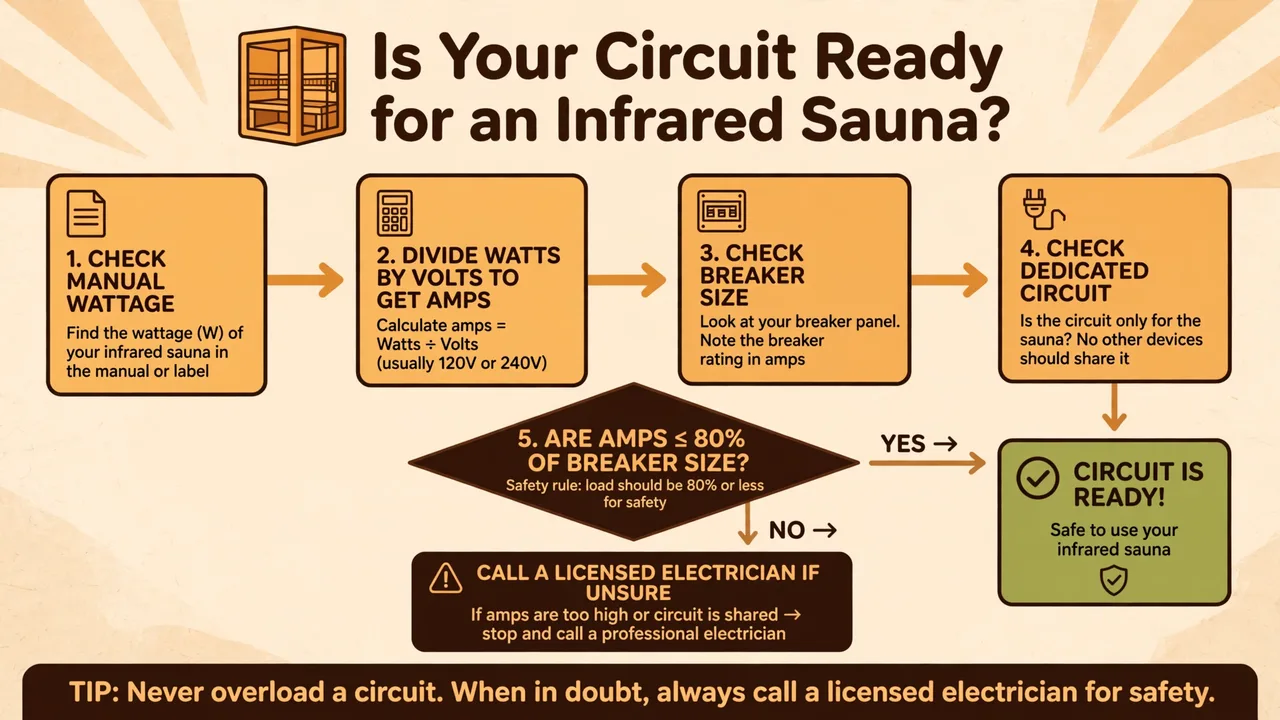
- Read the watts and volts from your sauna rating label, and work out the amps by dividing watts by volts.
- Check the manual for the breaker size the maker recommends, and follow it over any general table in this guide.
- Divide the breaker rating by 1.25 to find the safe steady load, or multiply the breaker rating by 0.8, and check that your sauna draw is below that number.
- If the draw is above the safe load, ask a licensed electrician about a larger circuit with matching wire, never just a larger breaker.
- Label the breaker in your panel so anyone in the home can find the sauna circuit in a hurry.
A common example shows why this matters. A two person sauna rated at 2,000 watts on 120 volts draws 16.7 amps. A 20 amp breaker has a safe steady load of 16 amps, so this sauna is just over the line.
The fix is a 240 volt circuit, or a larger dedicated 120 volt circuit with the right wire, fitted by an electrician. The wrong fix is a 30 amp breaker on the existing 20 amp wire, which is a fire risk and a code violation in most areas.
Breaker types you may see in your panel
Most homes have standard breakers that trip on overload and short circuits. Some panels also have arc fault breakers, which trip when they sense sparking in the wiring, and ground fault breakers, which trip when current leaks to earth. Your electrician will know which type your local code requires for a sauna circuit.
If your sauna trips an arc fault breaker but runs fine on a standard one, do not swap the breaker yourself. Ask the electrician, because the tripping may be warning you about a real fault.
Older homes may still have fuses instead of breakers. A fuse panel can still serve a sauna, but a fuse that blows must be replaced with the correct rating, never with a higher one or a piece of wire. If your panel is very old, crowded, or has no spare slots, an electrician should look at it before you buy a sauna, because a panel upgrade may be needed first.
Outlet types, plug shapes, and GFCI protection
Outlets are not all the same, and the plug on your sauna tells you which one you need. The plug shape is a safety system. It stops you from connecting a device to the wrong voltage, and it stops a high draw device from overloading a small circuit. Match the plug to the outlet, and never force a plug to fit, cut a plug off, or use an adapter to defeat the shape.
Standard 120 volt outlets
Most 120 volt infrared saunas use a standard three pin grounded plug, the same shape as a kettle or a vacuum cleaner. It fits a normal household outlet, but it still needs a grounded outlet in good condition. If your outlet is loose, cracked, warm to the touch, or so old that plugs fall out of it, have an electrician replace it before you plug the sauna in. A loose outlet creates heat at the connection, and heat is what damages plugs and starts fires.
Some 120 volt saunas draw close to 20 amps and use a plug with one blade turned sideways. That plug only fits a 20 amp outlet, and it is telling you the circuit must be a 20 amp circuit. Do not file the blade down, do not use an adapter, and do not plug it into a 15 amp outlet. Call an electrician and ask for the correct outlet and circuit.
240 volt outlets
A 240 volt outlet is larger, has a different slot pattern, and is wired with a double pole breaker that fills two slots in your panel. The exact shape depends on the plug your maker chose, and the common types include the larger three and four pin patterns used for dryers and ovens. Your manual will name the plug type, and your electrician will fit the matching outlet. Never guess the outlet type from a photo online, because similar looking plugs can carry different voltages.
A 240 volt outlet must be installed by a licensed electrician, with the correct wire size for the breaker and the correct outlet for the plug. The work usually needs a permit or inspection in your area, so ask your electrician what your local code requires. Keep the receipt and any inspection record with your sauna paperwork, because a future buyer or insurer may ask for it.
GFCI protection and damp locations
A ground fault circuit interrupter, known as a GFCI, cuts the power in a fraction of a second if current leaks where it should not, such as through water or through a person. Many infrared sauna manuals ask for a GFCI protected outlet or a GFCI breaker, especially for saunas placed in a basement, a garage, or near a bathroom. Our guide to an infrared sauna in a basement covers the damp and ventilation checks that matter in below ground rooms, and GFCI protection is one of them.
If your sauna has a GFCI plug built into its power cord, do not remove it or replace it with a standard plug. If the GFCI keeps tripping, do not bypass it. A GFCI that trips is doing its job, and the cause may be moisture, a damaged heater cable, or a faulty heater panel.
Unplug the sauna and contact the maker or a licensed electrician. Test the GFCI test button once a month, as the maker instructs, so you know it still works.
Do you need a dedicated circuit?
Yes, in almost every case. A dedicated circuit is a circuit that serves only the sauna, with nothing else on the same breaker. Most infrared sauna manuals require one, and the reasons are practical. A sauna draws a large, steady current for 30 to 60 minutes, and anything else on the same circuit pushes the total over the breaker limit.
A shared circuit is the most common cause of a tripping breaker. The sauna alone draws 13 amps, the lights and a television add 3 amps, and a space heater in the same room adds 10 amps. The total is 26 amps on a 20 amp breaker, so it trips.
Each device is fine on its own, and the combination is too much. A dedicated circuit removes the combination problem entirely.
How to check whether your circuit is dedicated
- Plug the sauna in, switch it on, and turn on every light and device in the nearby rooms, then check the panel to see which breaker carries them all.
- Switch the sauna breaker off and see what else loses power. If lights or outlets in other rooms go dark, the circuit is shared.
- Look at the panel label. A dedicated sauna circuit should be labelled clearly, with only the sauna on it.
- If you are unsure, ask a licensed electrician to trace the circuit. It is a quick job, and it settles the question for good.
If no dedicated circuit exists, an electrician can run one from the panel to the sauna location. The cost depends on the distance and on whether the cable runs through finished walls or an open basement ceiling. For a 120 volt sauna, a new 20 amp dedicated circuit is a common and modest job. For a 240 volt sauna, the new circuit is part of the installation anyway, so the cost is built into the plan from the start.
Renters face a special version of this problem. You cannot run a new circuit in a home you do not own without the landlord permission, and many rental flats have shared circuits in every room. If you rent, read the power section of our guide to an infrared sauna in an apartment before you buy, and get the landlord agreement in writing.
Extension cords: the rule is simple, do not use one
Do not use an extension cord or a power strip with an infrared sauna. Plug the sauna directly into the wall outlet. Almost every infrared sauna manual states this in plain words, and the reason is heat.
A sauna draws a high current for a long time, and a thin or coiled extension cord heats up along its whole length. That heat melts insulation, damages plugs, and can start a fire.
A power strip is worse than a cord. Most household power strips are rated for 13 to 15 amps in total, and many have thin internal wiring and no real overload protection. A sauna that draws 14 amps leaves no margin at all, and a second device on the same strip pushes it over the limit. Surge protected strips do not fix this, because a surge protector guards against voltage spikes, not against a steady overload.
What to do if the outlet is too far away
- Move the sauna closer to a suitable outlet, on a dedicated circuit, and recheck the floor, ventilation, and door swing in the new spot.
- Ask a licensed electrician to fit a new outlet near the sauna, on a dedicated circuit, with the correct breaker and wire.
- Choose a smaller plug-in model that fits the room and the circuit you already have, rather than stretching a cord to a larger one.
- Never run a cord under a rug, through a doorway, or across a walkway, because damage and tripping hazards follow.
If an electrician ever tells you a short, heavy duty cord is acceptable as a temporary measure, follow their exact specification for length, wire thickness, and rating, and replace it with a proper outlet as soon as you can. A temporary cord is not a permanent installation, and a cord that feels warm to the touch is already overloaded. Unplug it and stop using it.
What to do when the breaker trips
A breaker that trips once is an annoyance. A breaker that trips every session is a message. It is telling you the circuit is overloaded, the sauna has a fault, or the wiring has a problem. The steps below work through the causes in order, from the simplest to the most serious, and they stop at the point where a licensed electrician must take over.
Step 1: switch the sauna off and unplug it
Switch the sauna off at its control panel, then unplug it from the wall. Do not reset the breaker while the sauna is still plugged in and switched on. Let the sauna and the outlet cool down for a few minutes. Touch the plug and the outlet face, and if either feels hot, leave the sauna unplugged and call a licensed electrician.
Step 2: reset the breaker once, the right way
Find the tripped breaker in your panel. It will sit in the middle position, between on and off, or it will show a red or orange marker. Push it firmly to off, then firmly to on.
Stand to the side of the panel when you reset it, and never hold a breaker in the on position. If it trips again the moment you reset it with nothing plugged in, the fault is in the circuit itself, and an electrician must look at it.
Step 3: check what else shares the circuit
With the sauna still unplugged, switch the breaker on and walk the house. Note every light, outlet, and device that lost power when the breaker was off. If the circuit serves other rooms, a kitchen appliance, or a space heater, the sauna was probably sharing a circuit it should not share. The fix is a dedicated circuit, fitted by a licensed electrician, not a bigger breaker on the same wire.
Step 4: plug the sauna in alone and test it empty
Plug only the sauna into the outlet, with nothing else on that circuit, and run a short empty test session. Watch the first ten minutes closely. If the breaker holds and the sauna heats normally, the problem was likely an overloaded shared circuit. If the breaker trips again with the sauna alone on the circuit, unplug it and do not keep resetting the breaker.
Step 5: check the sauna itself for faults
Look at the power cord for cuts, kinks, or melted spots. Check the plug for bent pins, cracks, or scorch marks. Smell the control box and the heater panels for a burning smell, and look for dark marks around any connection.
If you find damage, stop using the sauna and contact the maker, because a damaged heater panel or control box is a maker repair, not a home repair. Our infrared sauna troubleshooting guide covers the common faults in more detail, including heaters that stay cold and controls that will not respond.
Warning signs that mean stop and call an electrician
- The breaker trips again after one reset with the sauna alone on the circuit.
- You smell burning, see smoke, or find scorch marks on the plug, the outlet, or the panel.
- The outlet or the plug feels hot to the touch, or the outlet face is cracked or discoloured.
- Lights flicker or dim in other rooms when the sauna switches on.
- The breaker buzzes, hums, or feels hot, or the panel smells of burning.
- The GFCI trips every time the sauna switches on, even after the sauna has dried out fully.
Never tape a breaker in the on position, never replace a breaker with a larger one to stop the tripping, and never bypass a GFCI or a safety device. A breaker that trips is protecting you and your home. The cost of an electrician visit is small next to the cost of a fire.
Will your home electrical panel cope?
A new circuit is only possible if your panel has room for it. Most modern homes have a 100 amp or 200 amp main panel with spare slots for new breakers. Older homes may have a 60 amp panel that is already full, or a fuse box with no room at all. A sauna is a large new load, and it deserves a panel check before you order it.
Open the panel door and look at the main breaker rating, printed on the main switch, and count the empty slots. If the panel is full, an electrician may fit slim breakers, add a small sub panel, or recommend a panel upgrade. None of these are do-it-yourself jobs, and a panel upgrade is a significant cost, so find out before you buy the sauna, not after it arrives.
Add up the big loads before you add a sauna
Your panel serves every large load in the home at once, at least in theory. An electric oven, a clothes dryer, a water heater, an air conditioner, and an electric vehicle charger all draw large currents. A sauna adds to that total. An electrician performs a load calculation, which adds up the loads properly, applies the diversity rules for your area, and tells you whether the panel can take one more large load.
If the calculation says the panel is full, you still have options. A smaller 120 volt sauna may fit where a large 240 volt cabin will not. Running the sauna at a time when the oven and dryer are off also helps, but it is a habit, not a fix, and it does not replace a proper load calculation. Ask the electrician to put the answer in writing, so you can plan with confidence.
Before you buy: a power checklist
Run through this checklist before you order a sauna, and again before the delivery arrives. It takes ten minutes, and it catches the problems that cause most installation delays. Keep the answers with your sauna paperwork, because your electrician will ask for most of them.
- Read the watts, volts, and plug type from the model specifications, and work out the amps with the watts divided by volts formula.
- Check whether the model needs a 120 volt outlet or a 240 volt circuit, and whether the manual asks for a dedicated circuit.
- Measure the distance from the breaker panel to the sauna spot, and note whether the cable route crosses finished walls or open ceilings.
- Check the panel for a spare slot and read the main breaker rating, then ask an electrician for a load calculation if the panel looks full.
- Confirm the outlet near the sauna is grounded, in good condition, and on its own circuit, or get a quote for a new one.
- Check local code and permit rules with your local office, and ask your electrician whether the new circuit needs an inspection.
- Confirm the sauna will fit through every doorway and around every stair turn on the way to its room, and that the room has ventilation and a flat, level floor.
- Read the full installation guide for your model. Our infrared sauna installation guide walks through the whole setup, and the heater advice in our guide on how to choose an infrared heater helps if you are still deciding between heater types.
When to call a licensed electrician
Some sauna power jobs are simple, and some are not. Plugging a 120 volt sauna into a suitable dedicated outlet is a simple job. Everything below that line is electrician work, and the line is lower than most people think.
When in doubt, call the electrician. A short visit and a straight answer cost far less than a damaged sauna or a house fire.
- You need a new circuit, a new outlet, a bigger breaker, or any change to the panel.
- Your sauna is a 240 volt model or a hardwired model with no plug.
- The breaker trips more than once, or trips with the sauna alone on the circuit.
- You find heat, scorch marks, a burning smell, a cracked outlet, or a buzzing breaker.
- Your panel is full, has fuses, or has no spare slots for a new breaker.
- Your home has aluminium wiring, knob and tube wiring, or any wiring you do not recognise.
- Your local code requires a permit or inspection for the new circuit, which only a licensed electrician can arrange in most areas.
When you call, have the sauna watts, volts, plug type, and model number ready, plus the distance from the panel to the sauna and a photo of your panel with the door open. Ask for a written quote that lists the breaker size, the wire size, the outlet type, and whether a permit and inspection are included. Keep that quote with your sauna paperwork.
Common power mistakes to avoid
Most sauna power problems come from a short list of avoidable mistakes. Knowing them in advance is cheaper than learning them from a tripped breaker, a scorched plug, or a sauna that never heats properly. Check your plan against this list before the delivery arrives.
- Buying the sauna before checking the panel, then finding no spare slot for the new circuit.
- Sharing the sauna circuit with a kitchen appliance, a space heater, or another room, then wondering why the breaker trips.
- Fitting a bigger breaker to stop the tripping, without changing the wire, which is a fire risk.
- Using an extension cord or a power strip because the outlet is a few feet too far away.
- Trusting the sales page wattage instead of the rating label, and planning the circuit around the wrong number.
- Ignoring a warm plug or a loose outlet, which are early warnings of a bad connection.
- Skipping the GFCI test button, or bypassing a GFCI that keeps tripping instead of finding the cause.
- Assuming local code allows the work without checking, and finding out at inspection time that a permit was needed.
One last point covers the sauna sessions themselves, not the wiring. Saunas are wellness tools, not treatments.
Hydrate before and after each session, start with short sessions, leave straight away if you feel dizzy or unwell, and never drink alcohol before or during a session. If you are pregnant, live with a heart or circulation condition, have low blood pressure, or take medication that affects heat tolerance, check with a doctor first. If you want to know what a session costs once the power is sorted, read our guide on how much it costs to run an infrared sauna.
Frequently asked questions
How many amps does an infrared sauna use?
Most one and two person infrared saunas draw 10 to 18 amps on a 120 volt outlet, depending on their wattage. Larger three and four person cabins draw 8 to 15 amps on a 240 volt circuit. Work out your own model with the formula amps equals watts divided by volts, using the watts from the rating label.
Can I plug an infrared sauna into a regular outlet?
Yes, if your model is a 120 volt plug-in sauna and the outlet is on a dedicated circuit with the right breaker size. Check the manual first, because some 120 volt models still need a 20 amp dedicated circuit. A 240 volt sauna cannot plug into a regular outlet, and it needs a dedicated 240 volt circuit fitted by a licensed electrician.
Does an infrared sauna need a dedicated circuit?
Yes, in almost every case, and most manuals require one. A dedicated circuit serves only the sauna, so nothing else can push the total current over the breaker limit. Without one, the breaker will trip whenever another device on the same circuit runs at the same time as the sauna.
Does an infrared sauna need a 240 volt outlet?
It depends on the size. Small one and two person saunas usually run on 120 volts, while most three and four person cabins need 240 volts. The voltage is decided by the model, not by the buyer, so check the specifications before you order. A licensed electrician must install any new 240 volt circuit and outlet.
What size breaker does an infrared sauna need?
Small 120 volt saunas usually need a 15 or 20 amp breaker, and larger 240 volt cabins usually need a 20 or 30 amp breaker. Follow the breaker size in your manual, and apply the 80 percent rule, which says a long steady load should stay below 80 percent of the breaker rating. Never fit a bigger breaker without matching wire, and ask a licensed electrician if you are unsure.
Why does my infrared sauna keep tripping the breaker?
The most common cause is a shared circuit, where other devices push the total current over the breaker limit. Other causes are a circuit that is too small for the sauna draw, a damaged power cord or heater panel, or a faulty breaker. Unplug the sauna, reset the breaker once, test the sauna alone on the circuit, and call a licensed electrician if it trips again or if you find heat, scorch marks, or a burning smell.
Can I use an extension cord with an infrared sauna?
No. Plug the sauna directly into the wall outlet, and never use an extension cord or a power strip. A sauna draws a high current for a long time, and a cord or strip heats up, melts insulation, and can start a fire. If the outlet is too far away, move the sauna or ask a licensed electrician to fit a new outlet near it.