
Most people shop for a heater the way they shop for a toaster. They check the price, glance at the wattage and click buy. Then winter arrives, and the heater either feels fantastic or does almost nothing.
Knowing how to choose an infrared heater keeps you out of that second group. Infrared heaters work differently from fan heaters and radiators, so the usual rules don’t apply.
A heater that suits a drafty garage can be a poor fit for a bedroom. A panel that works for a small office can leave a big living room cold.
This guide covers what to check before you buy: heater type, size, safety marks, running cost and controls. It also shows where infrared falls short, so you don’t pay for a promise it can’t keep.
Key Takeaways
- Infrared heaters warm people and objects directly, not the air first.
- Size matters more than brand. Match watts to room size and insulation.
- Look for a recognized safety mark: UL or ETL in the US, CE or UKCA in Europe and the UK.
- Electricity is costly, so infrared works best as spot or zone heating, not as a gas replacement.
- Never leave a portable heater running while you sleep or when you’re out.
What Is an Infrared Heater?
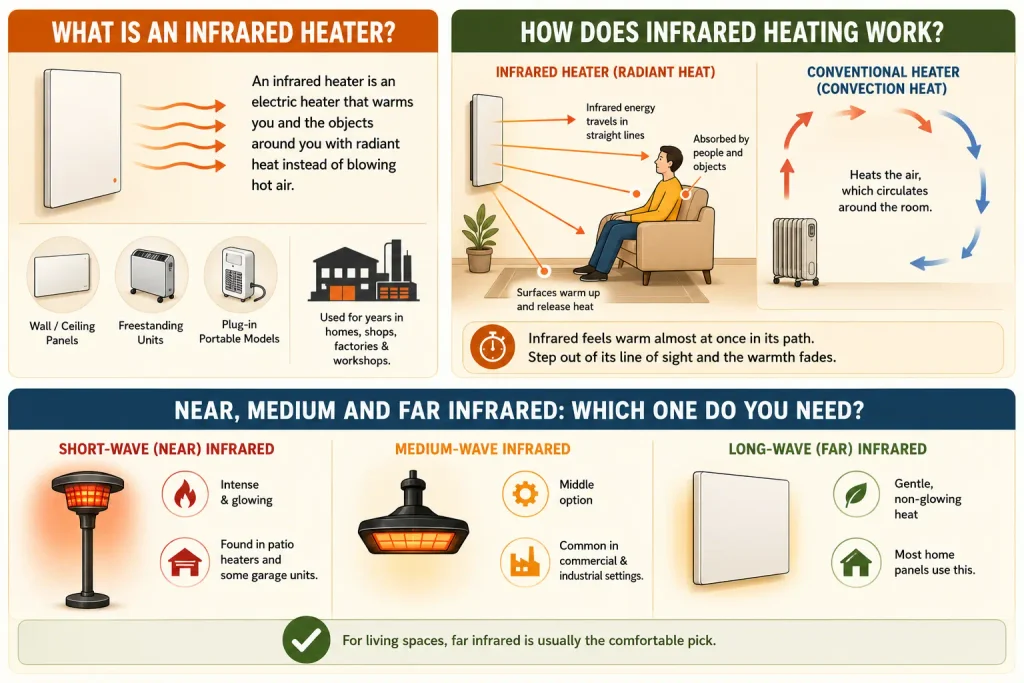
An infrared heater is an electric heater that warms you and the objects around you with radiant heat instead of blowing hot air. Picture standing in the sun on a cold day. The air is chilly, yet your skin feels warm. Same idea.
The Energy Saving Trust describes infrared heating as a type of direct electric heating. In homes it usually comes as flat panels fixed to a wall or ceiling, freestanding units, or plug-in portable models. Shops, factories and workshops have used it for years.
How Does Infrared Heating Work?
The heater’s element warms up and sends out infrared radiation. That energy travels in straight lines until it lands on something solid, like your skin, a sofa, a wall or the floor. Those surfaces absorb it and turn it into warmth.
A radiator or fan heater works the other way around. It heats the air, and the warm air drifts around the room. That’s convection.
This one difference explains most of what you’ll notice day to day. Infrared feels warm almost at once if you’re in its path. Step out of its line of sight and the warmth fades.
Near, Medium and Far Infrared: Which One Do You Need?
Infrared comes in different wavelengths, and the wavelength changes how the heat feels.
- Short-wave (near) infrared: Intense and glowing. You’ll find it in patio heaters and some garage units.
- Medium-wave: A middle option, common in commercial and industrial settings.
- Long-wave (far) infrared: Gentle, non-glowing heat. Most home panels use this.
For living spaces, far infrared is usually the comfortable pick. If you want to see how the gap between near and far infrared plays out in practice, the differences are easier to grasp once you’ve seen them side by side.
Benefits of Infrared Heaters
Infrared heating isn’t magic, but it has real strengths.
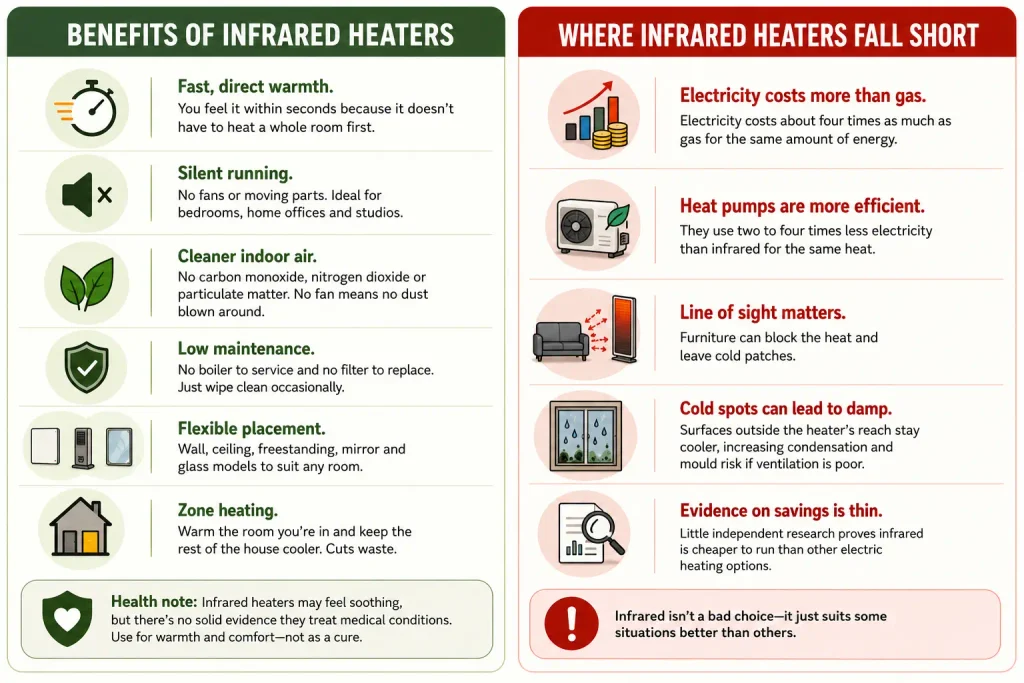
- Fast, direct warmth. You feel it within seconds because it doesn’t have to heat a whole room first. That’s handy at a desk, on a sofa or in a cold workshop corner.
- Silent running. Panels have no fans or moving parts. Bedrooms, home offices and studios benefit most.
- Cleaner indoor air. The Energy Saving Trust notes that infrared heaters don’t release carbon monoxide, nitrogen dioxide or particulate matter in your home, unlike wood burners or open fires. With no fan, they don’t blow dust around either.
- Low maintenance. There’s no boiler to service and no filter to replace. A wipe with a soft cloth now and then is usually enough.
- Flexible placement. Wall, ceiling, freestanding, mirror and glass models let you match the heater to the room.
- Zone heating. Warm the room you’re in and let the rest of the house stay cooler. Done well, that cuts waste.
A quick word on health claims. Some brands say infrared heaters ease pain or boost wellbeing. Gentle radiant warmth can feel soothing, but I couldn’t find solid evidence that a room heater treats any medical condition. Buy one for warmth and comfort, and talk to a doctor about health concerns.
Where Infrared Heaters Fall Short
A good buying guide should be honest about the downsides.
- Electricity costs more than gas. The Energy Saving Trust says electricity costs about four times as much as gas for the same amount of energy. If you already have gas central heating, swapping it for whole-house infrared rarely saves money.
- Heat pumps are more efficient. They typically use two to four times less electricity than infrared for the same heat.
- Line of sight matters. Furniture can block the heat and leave cold patches.
- Cold spots can lead to damp. Surfaces outside the heater’s reach stay cooler, which raises condensation and mould risk when ventilation is poor.
- Evidence on savings is thin. The Trust says there’s little independent research proving infrared is cheaper to run than other electric options.
None of this makes infrared a bad choice. It means infrared suits some jobs better than others.
Types of Infrared Heaters and Where Each Works Best
| Type | Best for | Watch out for |
|---|---|---|
| Wall or ceiling panel | Living rooms, bedrooms, offices | Needs fixing; hardwired units need an electrician |
| Freestanding or portable panel | Renters, desks, spot heating | Switch off when you leave; tip-over risk |
| Mirror or glass panel | Bathrooms, hallways | Needs a suitable water-protection (IP) rating |
| Quartz or halogen heater | Garages, workshops, occasional use | Glowing element, hotter surface, closer fire risk |
| Outdoor or patio heater | Terraces, open-air seating | Must be a rated outdoor model; wind weakens the effect |
| Commercial or industrial emitter | Warehouses, process heating | Needs professional specification |
For a home, a far infrared panel is the safest starting point. For industrial jobs like drying coatings or heat processing, the wavelength has to suit the material being heated, so ask a specialist instead of guessing.
How to Choose an Infrared Heater: Step by Step
Here’s the process I’d follow before spending any money.
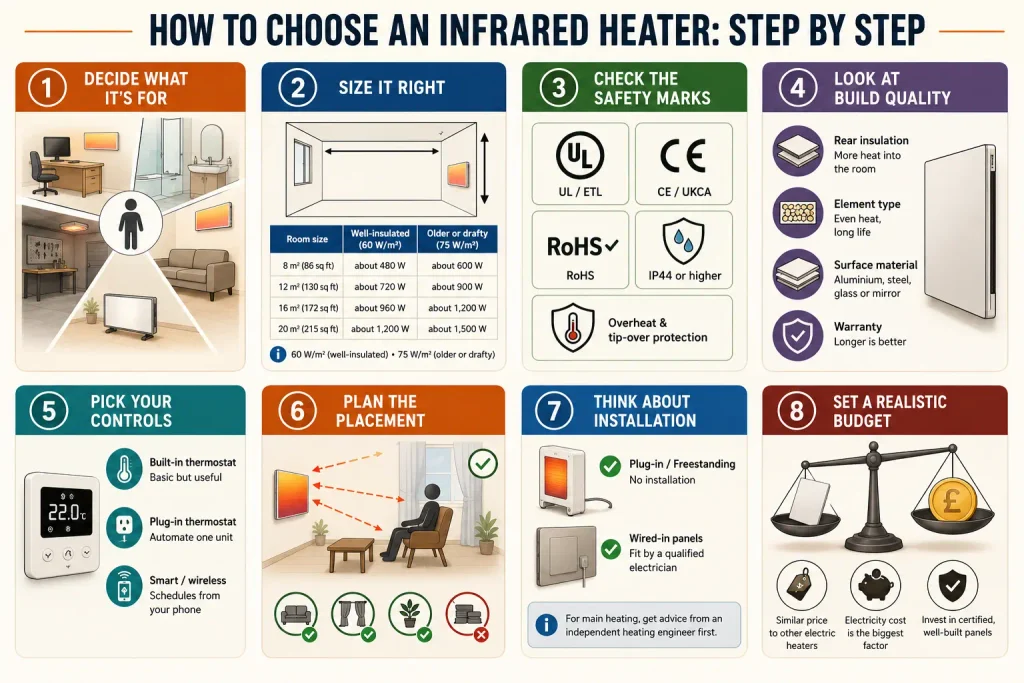
Step 1: Decide What the Heater Is For
Get clear on the job before you look at products. Are you heating a whole room, one seat or a cold corner? Will it be your main heat or a top-up?
A few common cases:
- Home office: One small panel aimed at your legs and torso.
- Bathroom: A mirror or wall panel with a proper water rating.
- Garage or workshop: A higher-output unit, mounted high, aimed at where you stand.
- Living room: A wall or ceiling panel, or two smaller panels for even coverage.
- Rented flat: A freestanding panel, since you can’t drill into walls.
Step 2: Size It Right
Wattage is where most people go wrong. Too small and the room never warms up. Too big and you waste money.
Warm4Less suggests a rough guide of 60 watts per square metre for a modern, well-insulated home and 75 for an older, draftier one. In US terms, that’s roughly 5.5 to 7 watts per square foot.
| Room size | Well-insulated (60 W/m²) | Older or drafty (75 W/m²) |
|---|---|---|
| 8 m² (86 sq ft) | about 480 W | about 600 W |
| 12 m² (130 sq ft) | about 720 W | about 900 W |
| 16 m² (172 sq ft) | about 960 W | about 1,200 W |
| 20 m² (215 sq ft) | about 1,200 W | about 1,500 W |
Treat these as starting points. Ceiling height, windows, floor type and how cold you feel all shift the answer. If you land between sizes, going one step up with a good thermostat is usually safer than going under.
The Energy Saving Trust says wall panels made for homes typically range from 350 to 900 watts. For bigger rooms, two panels often give more even warmth than one large one.
For plug-in models in the US, a standard household outlet limits most portable heaters to around 1,500 watts. If you need more power, you’re looking at a hardwired install.
Step 3: Check the Safety Marks
This is the one step you should never skip. Look for:
- A recognized testing mark. UL or ETL in the US and Canada. CE or UKCA in Europe and the UK.
- RoHS compliance, which covers restricted hazardous materials.
- An IP rating for damp rooms. Warm4Less says bathroom heaters should be rated IP44 or higher, meaning protected against splashing water from any direction.
- Overheat and tip-over protection on portable models. The Energy Saving Trust notes that automatic shut-off can help reduce fire risk.
If a listing shows no safety certification, that’s your cue to move on.
Step 4: Look at Build Quality
A few details separate a good panel from a cheap one.
- Rear insulation. A layer behind the element pushes more heat into the room instead of into the wall.
- Element type. Carbon-based elements are often promoted for even heat and long life. Ask for the manufacturer’s specs instead of trusting marketing language.
- Surface material. Aluminium and steel are light and common. Glass and mirror look premium and clean easily.
- Warranty. Longer is better. A panel with no moving parts should last many years, and a strong warranty shows the maker believes it.
Step 5: Pick Your Controls
A heater without a thermostat is a bill waiting to happen. Controls decide whether you get comfort or waste.
- Built-in thermostat: Basic but useful for a single heater.
- Plug-in thermostat: A cheap way to automate one portable unit.
- Smart or wireless controller: Lets you set daily schedules from your phone, which pays off across several rooms.
The Energy Saving Trust says controls matter more when you have panels in multiple rooms and want the best savings.
Step 6: Plan the Placement
Radiant heat needs a clear path. Mount panels where they can “see” the spots where you sit or work, and keep furniture, curtains and clutter out of the way.
Ceiling panels stay out of reach of children and pets and free up wall space. Wall panels are easier to fit and adjust. Keep a safe gap from anything that can burn, and never cover a panel.
Step 7: Think About Installation
Plug-in and freestanding heaters need no installation. Wired-in panels should be fitted by a qualified electrician. If infrared will be your main heating, get advice from an independent heating engineer first. The Energy Saving Trust suggests collecting quotes from at least three installers, and in the UK a scheme such as TrustMark can help you find certified ones.
Step 8: Set a Realistic Budget
Panels cost about the same as other electric heaters. A whole-house infrared system can cost less to install than a boiler or heat pump with radiators. The bigger cost over time is electricity, so factor in running cost, not just the price tag.
My rule of thumb: spend a bit more on a certified, well-built panel instead of saving money on one with no safety paperwork.
How Much Does an Infrared Heater Cost to Run?
You can work it out with simple math. Divide the wattage by 1,000 to get kilowatts, then multiply by hours used and your electricity price per kWh.
A 600-watt panel running for five hours uses 3 kWh. Multiply that by your local rate and you have the daily cost. A thermostat helps because the heater cycles on and off instead of running flat out.
The biggest savings usually come from heating only where you are. If you work from one room all day, a small panel aimed at your desk lets you turn the rest of the house down.
If you want to see how wattage turns into real bills, it helps to understand how much electricity infrared devices use over a typical session.
Infrared Heater Safety: What You Must Know
Heaters cause real fires, and the numbers are worth knowing. According to the NFPA, an average of 44,210 US home heating fires happened each year between 2016 and 2020. Space heaters were behind about a third of those fires and 88 percent of the related deaths.
Infrared panels often run cooler on the surface than other portable heaters. The Energy Saving Trust says surface temperatures are usually below 100°C.
But cooler doesn’t mean safe to ignore. Infrared heat also isn’t right for everyone, so it’s worth knowing who should be careful around infrared heat before you set one up in a bedroom or nursery.
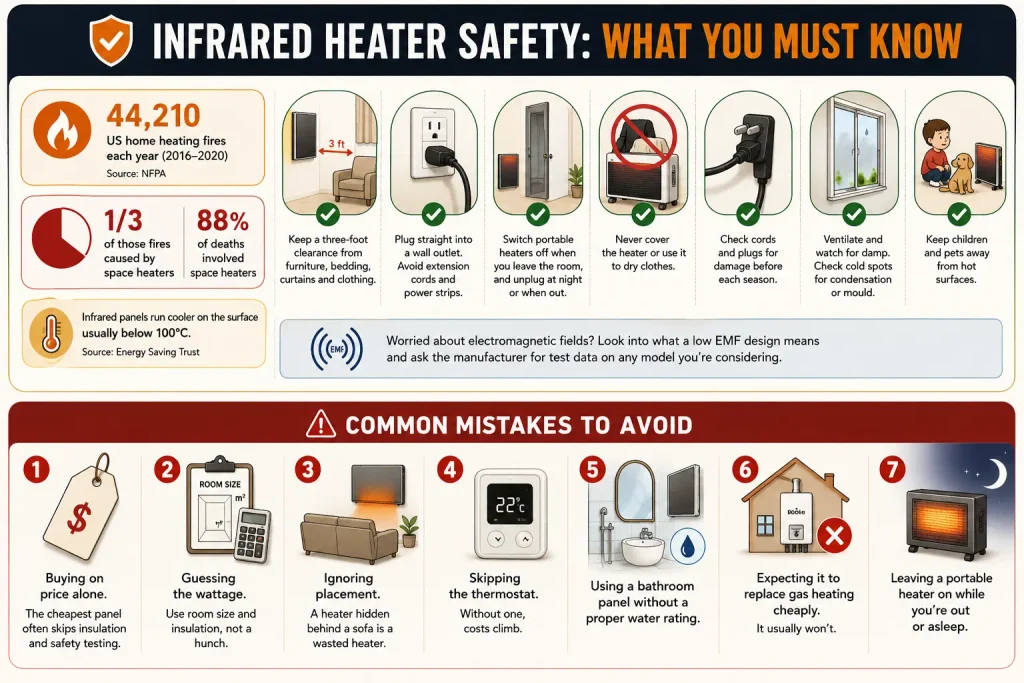
Follow these rules:
- Keep a three-foot clearance from furniture, bedding, curtains and clothing. The NFPA recommends this distance for space heaters.
- Plug straight into a wall outlet. Avoid extension cords and power strips.
- Switch portable heaters off when you leave the room, and unplug them at night or when you go out.
- Never cover the heater or use it to dry clothes.
- Check cords and plugs for damage before each season.
- Ventilate and watch for damp. Check cold spots for condensation or mould.
- Keep children and pets away from hot surfaces.
Some buyers also ask about electromagnetic fields. If that worries you, look into what a low EMF design actually means and ask the manufacturer for test data on any model you’re considering.
Common Mistakes to Avoid
- Buying on price alone. The cheapest panel often skips insulation and safety testing.
- Guessing the wattage. Use room size and insulation, not a hunch.
- Ignoring placement. A heater hidden behind a sofa is a wasted heater.
- Skipping the thermostat. Without one, costs climb.
- Using a bathroom panel without a proper water rating.
- Expecting it to replace gas heating cheaply. It usually won’t.
- Leaving a portable heater on while you’re out or asleep.
Myth vs. Fact
| Myth | Fact |
|---|---|
| Infrared heaters are 100% efficient, so they’re cheap to run | Nearly all electric heaters turn electricity into heat. The real difference is where the heat goes and how well you control it. |
| Infrared heaters warm the whole room fast | They warm what’s in their path quickly, but room air warms more slowly. |
| It’s safe to leave one on all night | Portable units should be off when you sleep. Fixed systems should only run overnight if the installer says they’re designed for it. |
| Infrared heaters cure health problems | There’s no strong evidence for that. They provide warmth, not treatment. |
Quick Buying Checklist
- Room size and insulation checked, wattage calculated
- Heater type matched to the space
- UL, ETL, CE or UKCA mark confirmed
- Correct water rating for bathrooms
- Overheat and tip-over protection on portable models
- Thermostat or smart control included or planned
- Clear line of sight to where you sit
- Warranty length and return policy read
- Running cost estimated
Frequently Asked Questions
1. What size infrared heater do I need?
A common starting point is 60 watts per square metre for well-insulated rooms and 75 for older ones. That’s about 5.5 to 7 watts per square foot.
2. Are infrared heaters cheaper to run than other electric heaters?
They can be if you control them well and feel warm at a lower air temperature. The Energy Saving Trust says there’s little research confirming it, so treat savings as possible, not guaranteed.
3. Can infrared heaters replace central heating?
Technically yes, but electricity costs about four times as much as gas, so it’s rarely cheaper if you already have gas. Heat pumps are more efficient.
4. Are infrared heaters safe?
Certified models used correctly are generally safe. Fire risk comes from poor placement, covering the heater, damaged cords and leaving portable units running unattended.
5. Can I leave an infrared heater on overnight?
Not a portable one. Professionally installed fixed panels may be designed for night use, but confirm with your installer first.
6. What’s the difference between infrared and regular space heaters?
Infrared heaters warm objects and people directly. Fan and convection heaters warm the air.
7. Do infrared heaters work in large rooms?
They can, but you’ll likely need several panels for even coverage. A single heater mostly warms the area it faces.
8. Which is better, a wall panel or a freestanding heater?
Wall or ceiling panels suit permanent use. Freestanding ones suit renters and spot heating.
9. Can I use an infrared heater in a bathroom?
Yes, but only a model with a suitable IP rating, such as IP44 or higher, installed according to local electrical rules.
10. Do infrared heaters cause damp or mould?
They can contribute if cold, unventilated areas stay damp. Ventilate the room and check cold spots regularly.
Final Thoughts
The best infrared heater isn’t a brand name. It’s the one that’s correctly sized, properly certified, easy to control and placed where you’ll actually feel its warmth.
Start with the job, work out the wattage, check the safety marks and add a thermostat. Be honest about running costs too. Infrared shines for targeted warmth and quiet comfort, and it isn’t a magic fix for a whole house.
Measure your room, run the numbers from the sizing table and shortlist two or three certified models. That small bit of prep is how you choose an infrared heater you’ll still be happy with in five winters.