
Step into an infrared sauna and you won’t feel the blast of dry heat you’d get from a traditional sauna. Instead, you’ll feel a gentler, more direct warmth one that raises your core temperature, gets you sweating, and puts your cardiovascular system to work, all at a fraction of the temperature.
That’s the appeal. But how much of what you’ve heard about infrared saunas heart health, detox, weight loss, glowing skin actually holds up? Below is a clear, evidence-based breakdown: what’s well-supported, what’s promising but still early, and what’s overstated.
Quick answer: Infrared saunas are best supported for cardiovascular conditioning, muscle recovery, relaxation, and chronic pain relief. Claims about “detoxing” heavy metals or sauna use alone causing meaningful weight loss are not well-supported by current evidence.
What Is an Infrared Sauna, Exactly?

An infrared sauna uses infrared lamps to warm your body directly, rather than heating the air around you the way a traditional sauna does. Because the heat targets your skin and tissue instead of the room, infrared saunas can deliver a similar sweat-inducing, heart-pumping effect at noticeably lower air temperatures.


Paid Links - As an Amazon Associate, I earn from qualifying purchases.
How It’s Different From a Traditional Sauna
A traditional sauna the kind with heated rocks or a wood stove typically runs between 150°F and 195°F (65°C to 91°C), warming the air until your body heats up by convection. An infrared sauna usually operates between 110°F and 135°F (43°C to 57°C), because the infrared light is absorbed directly by your skin instead of having to heat the whole room first.
For people who find traditional sauna heat overwhelming, or who simply prefer a longer, more tolerable session, infrared is often the more comfortable option without necessarily sacrificing the physiological benefits.



Paid Links - As an Amazon Associate, I earn from qualifying purchases.
Near, Mid, and Far Infrared, What’s the Difference?
Most consumer infrared saunas use far infrared wavelengths, which penetrate the skin’s surface and are the most studied type in sauna research. Some units combine far infrared with near infrared (shorter wavelength, marketed for skin-level effects) and mid infrared (associated with circulation). It’s worth knowing these terms exist, but far infrared is what most of the clinical research on “infrared saunas” is actually referring to.
How Infrared Saunas Work on Your Body
When you sit in an infrared sauna, a cascade of predictable things happens:
- Your skin absorbs infrared energy and your core temperature begins to rise.
- Blood vessels near the skin’s surface dilate (vasodilation), increasing blood flow.
- Your heart rate climbs often into a range comparable to a brisk or moderate-paced walk.
- You begin to sweat as your body works to cool itself down.
As Dr. Melissa Young, a functional medicine specialist at Cleveland Clinic, puts it, what’s happening in your body during a sauna session “mimics exercise when you think of the physiology.” That’s the mechanism behind most of the benefits discussed below it’s a passive cardiovascular and thermal stressor, not a magic wavelength.
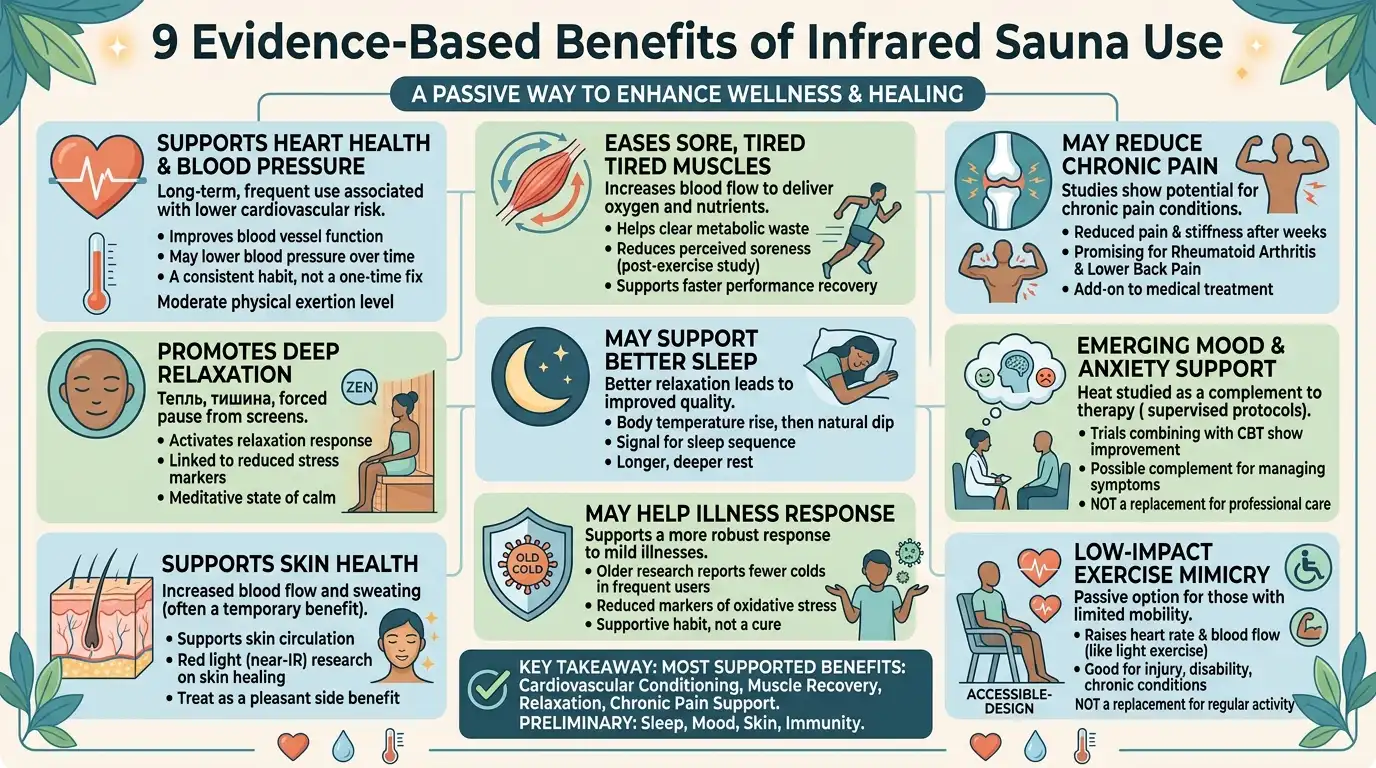
9 Evidence-Based Benefits of Infrared Sauna Use
1. Supports Heart Health and Blood Pressure
The best-documented benefit of sauna use infrared included is cardiovascular. Research on heat therapy has found associations between regular sauna bathing and improved blood vessel function and lower blood pressure, with the physical demand of a session compared to that of walking at a moderate pace. Repeated exposure to that mild cardiovascular stress, over time, appears to support healthier blood vessels.



Paid Links - As an Amazon Associate, I earn from qualifying purchases.
That said, this is an area of ongoing research. Some newer meta-analyses have not found a significant short-term drop in blood pressure from a single session, even though longer-term, population-level studies (many from Finland, home of traditional sauna culture) show a link between frequent sauna use and lower cardiovascular risk. The honest takeaway: sauna use looks heart-healthy as part of a consistent habit, not as a one-time fix.
2. Eases Sore, Tired Muscles
The increased blood flow triggered by an infrared sauna session can help deliver oxygen and nutrients to fatigued muscles while helping clear metabolic waste the same basic mechanism behind a warm-up or a massage. Many athletes use post-workout infrared sessions specifically for this reason.
A 2025 study following resistance-trained athletes over several weeks found that post-exercise infrared sauna use reduced perceived muscle soreness and supported neuromuscular recovery (things like jump performance and power output), even though it didn’t change how much muscle the athletes actually built. In other words: it may help you feel and perform better between sessions, even if it isn’t a shortcut to bigger muscles.
3. May Reduce Chronic Pain
Several studies including research on rheumatoid arthritis patients and a longer-term trial on chronic pain have found reduced pain and stiffness after weeks of regular infrared sauna use. A research review concluded that infrared sauna therapy “may be a promising method” for chronic pain conditions, with some of the more encouraging results seen in fibromyalgia and chronic lower back pain.
This doesn’t mean infrared sauna use replaces medical treatment for chronic pain conditions but as an add-on, the evidence is more encouraging here than for almost any other claimed benefit besides cardiovascular health.
4. Promotes Deep Relaxation and Stress Relief
There’s a reason people describe sauna time as meditative. The combination of warmth, quiet, and a forced pause from screens and obligations activates a relaxation response in many people. Some research has linked regular sauna use to reduced markers of stress and improvements in mood and anxiety symptoms.
5. May Support Better Sleep
Better relaxation tends to translate into better sleep, and some research has specifically linked sauna use to improved sleep quality. One proposed mechanism: your core body temperature rises during the session and then drops afterward, mimicking the natural temperature dip that helps signal to your body that it’s time to sleep.
6. Emerging Research on Mood and Anxiety
This is one of the more actively studied and most exciting areas right now, but it’s also where you should be most careful about overstated claims. Whole-body heating (via traditional and infrared methods) has been studied as a potential complement to therapy for depression, and some clinical trials combining heat exposure with cognitive behavioral therapy have reported meaningful improvements in participants’ symptoms. This research is genuinely promising, but it typically involves supervised clinical protocols alongside therapy not simply owning a home sauna. Anyone managing depression or anxiety should treat sauna use as a possible complement to, not a replacement for, professional care.
7. Supports Skin Health
Increased blood flow to the skin during a sauna session, combined with sweating, is often cited for supporting circulation and giving skin a temporary flushed, refreshed appearance. Some near-infrared research (often studied alongside red light therapy, a related but distinct technology) has looked at effects on skin appearance and healing. If clear skin is your main goal, treat this as a pleasant side benefit rather than the main reason to use an infrared sauna the strongest research still centers on cardiovascular and musculoskeletal effects.
8. May Help the Body Handle Illness Better
Older research has found that frequent sauna users report fewer colds than infrequent users, though the study designs here are relatively modest. Sauna use is also associated with reduced markers of oxidative stress, a factor tied to a range of chronic diseases. This is a “supportive habit” benefit, not an immune-boosting cure no sauna session will prevent or treat a viral infection.
9. A Low-Impact Way to Mimic Some Exercise Effects
Because heart rate and blood flow rise similarly to how they would during light-to-moderate exercise, infrared sauna sessions have been explored as a passive cardiovascular option for people who can’t exercise due to injury, disability, or a chronic condition affecting mobility. It is not a replacement for exercise for people who are able to be physically active, but for those who genuinely cannot, it may offer a way to give the cardiovascular system some of the stimulus it would otherwise miss.
Key takeaway: The most consistently supported benefits are cardiovascular conditioning, muscle recovery, relaxation, and chronic pain support. Everything else sleep, mood, skin, immunity has real but more preliminary research behind it.
What About Detox and Weight Loss? (Setting the Record Straight)
These are the two claims most likely to be exaggerated in sauna marketing, so they deserve their own section.
Detoxification: It’s true that sweat contains trace amounts of substances like heavy metals. But your liver and kidneys not your sweat glands do the vast majority of the work of clearing toxins from your body. Cleveland Clinic’s Dr. Young is direct about this: research on sauna-based detoxification “is still in its infancy.” Consider this claim unproven rather than false just don’t expect a sauna session to replace what your organs already do continuously.
Weight loss: You do burn some calories during a sauna session, since your heart is working harder and you’re sweating. But most of the water lost is exactly that water, not fat and it returns once you rehydrate. Any real weight-management benefit from sauna use is more likely to be indirect: better sleep, lower stress, and improved recovery can make it easier to stick with exercise and healthy eating. Marketing that promises sauna use will “melt fat” on its own is not supported by solid evidence.
Infrared Sauna vs. Traditional Sauna: Comparison Table
| Feature | Infrared Sauna | Traditional Sauna |
|---|---|---|
| Heat source | Infrared lamps heat the body directly | Heated air (rocks, stove, or electric heater) |
| Typical temperature | 110–135°F (43–57°C) | 150–195°F (65–91°C) |
| Humidity | Low | Low, unless water is added to rocks (higher humidity) |
| Warm-up time | Minutes | Can take 30–60 minutes to fully heat |
| Comfort for heat-sensitive users | Generally more tolerable | Can feel intense for beginners |
| Best-studied benefits | Similar cardiovascular and muscle-recovery evidence base | Larger, longer-term population studies (mostly Finnish research) |
| Typical session length | 15–30 minutes | 10–20 minutes |
Neither type is definitively “better” for health outcomes the research base for cardiovascular benefits is actually larger for traditional Finnish-style saunas, simply because they’ve been studied for longer. Infrared saunas appear to offer a comparable physiological response at a more tolerable temperature, which is why many people choose them.
How to Use an Infrared Sauna Safely (Step-by-Step)
- Start low and short. Begin around 110°F for 5–10 minutes and see how your body responds before increasing time or temperature.
- Build up gradually. Over several sessions, work up to 20–30 minutes as your tolerance improves. Most research protocols showing benefits use sessions in this range.
- Hydrate before and during. Bring water into the sauna with you. Electrolyte drinks can help if you sweat heavily.
- Avoid alcohol before or during a session. It increases dehydration risk and impairs your ability to notice warning signs like dizziness.
- Cap sessions at 30 minutes. Longer sessions haven’t been shown to add meaningful extra benefit and increase dehydration risk.
- Limit frequency to 3–4 sessions per week unless a healthcare provider has advised otherwise for a specific condition.
- Shower afterward. This rinses away sweat (and anything in it) before it can be reabsorbed into the skin.
- Stop immediately if you feel dizzy, nauseated, or unusually unwell. These are signs to exit and rehydrate, not to push through.
Who Should Avoid or Be Cautious With Infrared Saunas
Talk to a healthcare provider before starting infrared sauna use if any of the following apply to you:
- You’re pregnant or trying to conceive. Heat exposure, especially in early pregnancy, has been linked to risk for the fetus; heat is also known to affect sperm quality.
- You have multiple sclerosis. People with MS are often heat-intolerant, and sauna use can worsen symptoms temporarily.
- You have cardiovascular disease, low blood pressure, or take blood pressure medication. The cardiovascular stress of a sauna session is generally mild but should be cleared with a provider first.
- You’re currently sick, especially with a fever. Wait until you’ve recovered.
- You have any medical condition that affects your ability to sweat, regulate temperature, or notice dehydration (including certain skin conditions and some neurological conditions).
Overall, sauna use including infrared is considered safe for most healthy adults, and no significant harms have been documented in the available research. But “generally safe” isn’t the same as “safe for everyone,” so check with a doctor if you fall into any of the categories above.
How Often Should You Use an Infrared Sauna?
Most of the research showing cardiovascular and recovery benefits used sessions of 20–30 minutes, several times a week commonly in the range of 3 to 7 sessions weekly in population studies, though most consumer guidance (including Cleveland Clinic’s) suggests 3 to 4 sessions per week as a sustainable starting point for general wellness. If you’re using an infrared sauna for a specific condition like chronic pain, your healthcare provider can help tailor frequency to your situation.
FAQs
What does an infrared sauna actually do to your body?
It raises your core temperature, dilates your blood vessels, increases your heart rate, and makes you sweat a physiological response similar to moderate exercise, delivered at a lower ambient temperature than a traditional sauna.
Is an infrared sauna better than a regular sauna?
Not definitively. Traditional saunas have a longer research history and operate at higher temperatures, while infrared saunas offer a more tolerable experience with a comparable, though less extensively studied, set of benefits.
How long should you sit in an infrared sauna?
Most guidance recommends starting at 5–10 minutes and building up to 20–30 minutes as your tolerance allows. Sessions beyond 30 minutes haven’t been shown to add meaningful extra benefit.
Can an infrared sauna help you lose weight?
Not on its own. You’ll lose water weight temporarily during a session, but meaningful fat loss requires diet and exercise. Any weight-related benefit from sauna use is more likely indirect, through better sleep and lower stress.
Can pregnant women use an infrared sauna?
No heat exposure during pregnancy, particularly in the first trimester, has been linked to risk for the developing fetus. Avoid sauna use if you’re pregnant or trying to conceive without your doctor’s guidance.
What temperature should an infrared sauna be set to?
Most infrared saunas operate between 110°F and 135°F. Beginners should start at the lower end of that range.
Do infrared saunas help with anxiety or depression?
Emerging clinical research on whole-body heating combined with therapy is promising, but it should be viewed as a potential complement to professional mental health treatment, not a substitute for it.
Can infrared sauna use help with skin health?
It may support circulation and give skin a temporary healthy glow, but skin health is not the best-supported benefit of infrared sauna use treat it as a bonus rather than a primary reason to use one.
Is it normal to feel lightheaded in an infrared sauna?
Mild lightheadedness can be a sign of dehydration or overheating. Exit the sauna, rehydrate, and cool down. If it happens repeatedly, shorten your sessions and check in with a doctor.
How is far infrared different from near infrared?
Far infrared penetrates the skin’s surface and is the type most sauna research focuses on. Near infrared has a shorter wavelength and is more associated with skin-level effects, often studied alongside red light therapy.
Do infrared saunas actually reduce chronic pain?
Several studies, including research on rheumatoid arthritis and general chronic pain, have found reduced pain and stiffness with regular infrared sauna use over several weeks, though larger studies are still needed.
Final Thoughts
Infrared saunas aren’t a miracle cure, and they aren’t a scam either. Strip away the marketing, and what’s left is a genuinely useful if modest wellness tool: a way to get some of the cardiovascular benefits of moderate exercise, ease sore muscles, unwind, and possibly take some pressure off chronic pain, all without cranking the thermostat to sauna-classic extremes.
The claims worth trusting are the ones backed by consistent research: heart health, muscle recovery, relaxation, and pain relief. The claims worth questioning dramatic detox, effortless weight loss aren’t supported by solid evidence yet. Start slow, stay hydrated, check with your doctor if you have an underlying health condition, and treat your infrared sauna as one healthy habit among several, not a replacement for the basics: sleep, movement, and good medical care.