
Step into a sauna and you’ll feel dry, crackling heat that makes your skin prickle within minutes. Step into a steam room and you’re hit with a thick wall of wet air that fogs your vision almost immediately. Both leave you dripping but they don’t get you there the same way, and the sweat itself isn’t even doing the same job.
If you’ve ever wondered which one actually makes you sweat more, you’re asking a more interesting question than it seems. The honest answer involves temperature, humidity, and a basic law of physics your body relies on every single day: evaporation.
Quick answer: A traditional sauna makes you produce more actual sweat, because its high heat and low humidity let sweat evaporate freely, which drives your body to keep making more of it. A steam room’s near-100% humidity blocks evaporation, so sweat pools on your skin instead of evaporating you feel wetter and hotter, but you’re not necessarily producing more sweat from your glands.


Paid Links - As an Amazon Associate, I earn from qualifying purchases.
The Quick Answer
If you’re only here for the headline: saunas typically make your body produce more sweat, because dry heat lets perspiration evaporate off your skin, which keeps your body’s cooling system working overtime. Steam rooms make you feel more soaked because the moisture in the air has nowhere to go, so sweat and condensation sit on your skin instead of evaporating. It looks and feels like more sweat, but a meaningful portion of that wetness is condensed steam, not fresh perspiration from your sweat glands.


Paid Links - As an Amazon Associate, I earn from qualifying purchases.
Both are legitimate forms of heat therapy with real, evidence-backed benefits. Neither is “better” across the board they’re suited to different goals, which we’ll break down below.
What Is a Sauna? (Dry Heat Explained)

A sauna is an enclosed room heated with dry air, usually by an electric heater, wood-burning stove, or infrared panels. The walls are typically cedar, hemlock, or pine because these woods hold up well under intense, sustained heat.
Traditional Finnish Sauna
This is the classic version most people picture. A stove heats a pile of rocks, which radiate heat into the room. Temperatures usually run 150–195°F (65–90°C), with humidity kept low, generally 5–20%. In Finnish tradition, water is occasionally splashed on the hot rocks to create a brief burst of steam called löyly, but the room’s overall humidity stays low between splashes.
Because the air is dry, sweat evaporates off your skin almost as fast as it forms. That evaporation is a cooling mechanism, which is part of why the body can tolerate such extreme air temperatures for 10–20 minutes at a time.
Infrared Sauna
Instead of heating the air around you, infrared panels use radiant heat to warm your body directly. Air temperatures are lower, typically 120–150°F (50–65°C), but you still sweat because your core and skin temperature rise. Humidity stays low, similar to a traditional sauna. Infrared saunas are often marketed as more tolerable for people who find 180°F+ air overwhelming, though the research base on infrared saunas is smaller than the decades of data on traditional Finnish sauna use.
What Is a Steam Room? (Moist Heat Explained)

A steam room is a sealed, tiled enclosure where a steam generator boils water and pumps vapor into the space. Because the room is airtight, humidity climbs to 95–100%, while air temperature stays much lower than a sauna’s, typically 110–120°F (43–49°C).


Paid Links - As an Amazon Associate, I earn from qualifying purchases.
At that level of humidity, the air is already saturated with water vapor, so it can’t absorb any more moisture from your skin. That means your sweat has nowhere to evaporate to it just sits on your skin, mixing with condensation dripping down the walls and ceiling. This is why a steam room at 115°F can feel more intense than a sauna at 175°F: without evaporative cooling, your body has a harder time shedding heat.
Sauna vs. Steam Room: Temperature & Humidity Compared
| Feature | Traditional Sauna | Steam Room |
|---|---|---|
| Heat type | Dry heat | Moist heat (steam) |
| Air temperature | 150–195°F (65–90°C) | 110–120°F (43–49°C) |
| Humidity | 5–20% | 95–100% |
| Heat source | Heated rocks, electric or wood stove | Steam generator (boiled water) |
| Typical session length | 10–20 minutes | 10–15 minutes |
| Sweat evaporates? | Yes, continuously | No, sweat and steam condense on skin |
| Feels hottest | At the top, near the heater | Throughout, due to trapped humidity |
| Best known for | Cardiovascular training effect, deep sweating | Respiratory relief, skin hydration |
So, Which One Actually Makes You Sweat More?
Why Dry Heat Produces More Visible (and Measurable) Sweat
In a sauna, your body is working against a real cooling mechanism: evaporation. Every time sweat evaporates, it pulls heat away from your skin. Because the sauna’s dry air keeps absorbing that moisture, your body has to keep producing more sweat to maintain the cooling effect. Over a 15–20 minute session, this typically adds up to a higher total sweat output than an equivalent steam room session, according to health and wellness experts who study heat therapy. Higher air temperature also plays a direct role hotter air raises your skin and core temperature faster, which is one of the primary triggers for sweat production in the first place.
Why Steam Rooms Feel Hotter (Even Though They’re Not)
Here’s the twist: even though the steam room’s air temperature is lower, it can feel more intense because your body’s main cooling tool evaporation is essentially switched off. Sweat and condensed steam sit on your skin instead of evaporating, so heat builds up in your body faster relative to the air temperature. This is why some people find a 115°F steam room harder to sit through than a 180°F sauna. You feel wetter in a steam room, but a large share of that moisture is condensation from the steam itself, not newly produced sweat.
Bottom line: if you’re measuring actual sweat gland output, the sauna wins, for a deeper dive into this exact question, read dry sauna vs. steam sauna: which is better. If you’re measuring how soaked you look and feel when you walk out, the steam room can give that impression just not for the reason most people assume.
The Science Behind Sweat: How Your Body Cools Itself

Sweating is your body’s primary defense against overheating. When your core or skin temperature rises, your hypothalamus (the brain’s temperature control center) signals your sweat glands to release fluid onto your skin. As that fluid evaporates, it carries heat away with it a process called evaporative cooling.
This system depends on a humidity gradient: the surrounding air needs to be drier than your skin for evaporation to happen efficiently. That’s exactly what a sauna provides. A steam room removes that gradient almost entirely, which is why the same amount of sweat can feel far less effective at cooling you down.
This is also why steam rooms are generally considered less taxing on your cardiovascular system per degree of air temperature than saunas but because they don’t offer the same evaporative “training effect,” most of the sauna-specific cardiovascular research doesn’t directly translate to steam rooms.
Sauna vs. Steam Room: Health Benefits Compared
Both environments raise your heart rate and core body temperature, mimicking some of the cardiovascular demand of light exercise. But their strongest evidence and use cases diverge.
Cardiovascular Health
Saunas have the deepest research base here. Long-term cohort studies out of Finland most notably the Kuopio Ischemic Heart Disease Risk Factor Study, which followed more than 2,300 middle-aged men for over two decades have repeatedly linked frequent sauna bathing (4–7 sessions per week, sessions longer than 19 minutes) to meaningfully lower rates of sudden cardiac death, fatal coronary heart disease, and all-cause mortality compared with men who used a sauna once a week. Later analyses from the same cohort also tied frequent sauna use to a lower risk of stroke, hypertension, and dementia.
Steam rooms haven’t been studied nearly as extensively for cardiovascular outcomes. They still raise heart rate and can support circulation, but you shouldn’t assume the sauna research applies equally to steam.
Important: This is observational research showing an association, not proof that sauna use alone causes longer life. Regular sauna users in these studies were also, on average, healthier and more active. Saunas and steam rooms are not a substitute for medical care, exercise, or a healthy diet.
Muscle Recovery & Pain Relief
Both forms of heat can help relax tight muscles and ease joint stiffness by increasing blood flow to soft tissue. Many people use a sauna after a workout to relieve delayed-onset muscle soreness, while others find a steam room’s humidity more soothing for stiff joints, particularly in colder months.
Respiratory Health
This is where steam rooms tend to have the edge. The moist heat can loosen mucus and open nasal passages, which is why steam rooms are frequently recommended for temporary relief of congestion, sinus pressure, or mild cold symptoms. People with asthma should be cautious, though humid heat can trigger symptoms in some individuals, so it’s worth checking with a doctor first (our guide to steam sauna for allergies and sinus relief covers this in more depth).
Skin Health
Steam rooms open pores and add moisture to the skin’s surface, which some dermatologists say can help with hydration and give skin a temporary “glow”, see our full breakdown of which is better for skin, sauna or steam room for more. Saunas, by contrast, are associated with deep pore-cleansing through profuse sweating, though the actual detox claims (sweating out toxins) are often overstated your liver and kidneys do the heavy lifting there, not your skin.
Stress & Relaxation
Both environments trigger relaxation responses: heart rate rises, then falls during the cool-down period, and many people report a genuine mood boost and reduced perceived stress afterward. This benefit is well-documented for saunas and anecdotally strong for steam rooms, though less formally studied.
Does Sweating More Burn More Calories or Help You Lose Weight?
Short answer: not in any meaningful, lasting way. The weight you lose in a sauna or steam room session is almost entirely water weight, and it comes right back once you rehydrate. Sitting in heat does slightly raise your heart rate and calorie expenditure similar to light activity but it’s nowhere near a substitute for exercise, and there’s no reliable data showing you burn a specific number of “extra” calories from sweat volume alone.
If a fitness resource or product claims you can meaningfully lose fat by sweating more in a sauna or steam room, treat that claim with skepticism it isn’t well supported by current research.
Sauna vs. Steam Room: Pros and Cons
| Pros | Cons | |
|---|---|---|
| Sauna | Deepest cardiovascular research base; higher sweat output; efficient cooling makes high heat more tolerable; good for muscle relaxation | Very high temperatures can be intense for beginners; dry air can be harsh on some people’s sinuses; not ideal for those seeking congestion relief |
| Steam Room | Great for congestion and sinus relief; hydrates and softens skin; lower air temperature feels more approachable at first | Can feel more intense than expected due to lack of evaporative cooling; humidity can promote bacterial/mold growth if not well-maintained; less cardiovascular research |
Which One Should You Choose?
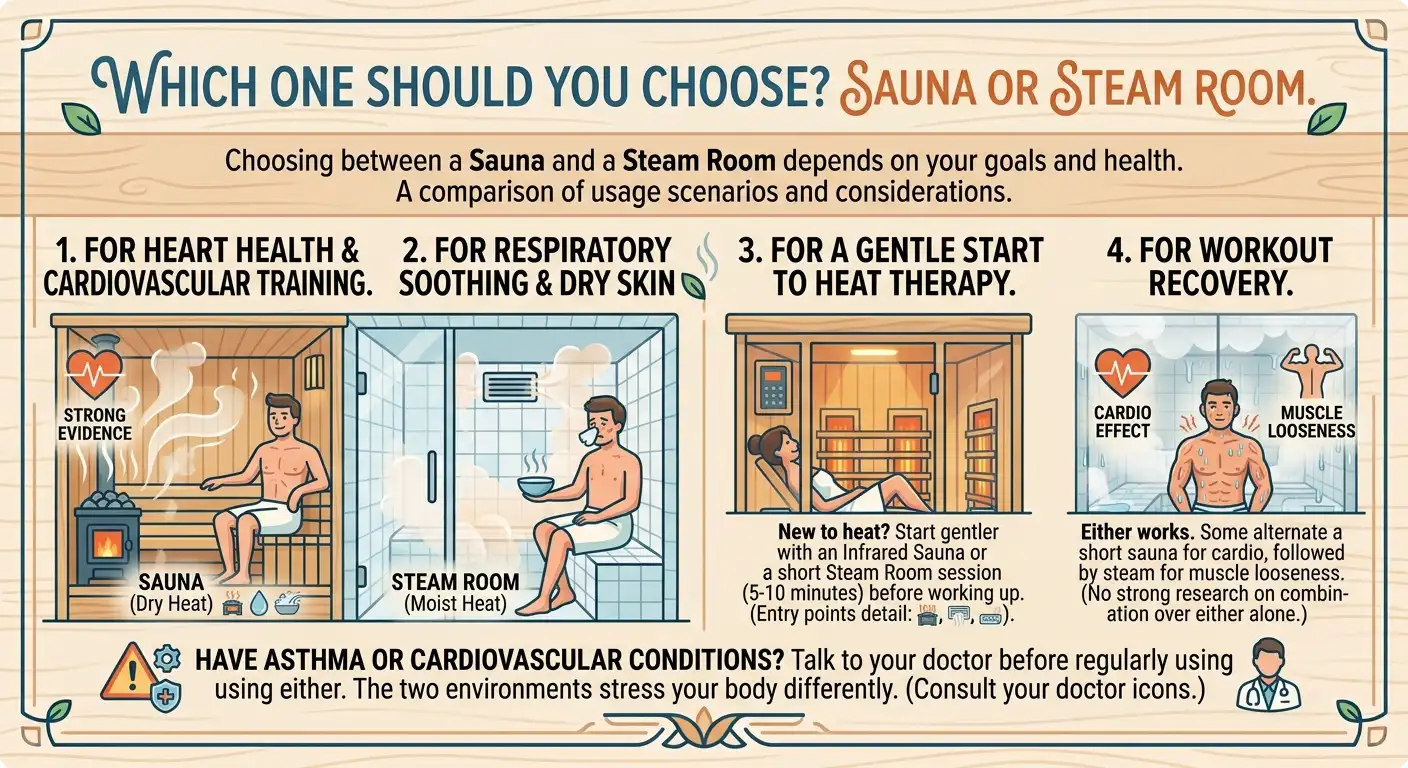
- Want the strongest evidence for heart health? Choose a sauna, ideally used consistently (3+ sessions a week) rather than as a one-off.
- Dealing with a stuffy nose, sinus pressure, or dry winter skin? A steam room’s humidity is likely to feel more immediately soothing.
- New to heat therapy and want something gentler to start? An infrared sauna or a shorter steam room session (5–10 minutes) is a reasonable entry point before working up to a traditional sauna.
- Recovering from a hard workout? Either works; some people alternate a short sauna session for the cardiovascular effect, followed by a steam room for muscle looseness though there’s no strong research specifically validating that combination over either alone.
- Have asthma, a respiratory condition, or a cardiovascular condition? Talk to your doctor before regularly using either, since the two environments stress your body differently.
How to Use a Sauna or Steam Room Safely
- Hydrate before and after. You can lose a significant amount of fluid through sweat in just 15–20 minutes; drink water before you go in and after you’re done, and consider replacing electrolytes if you sweat heavily or use heat therapy often.
- Limit sessions to 15–20 minutes. Longer isn’t automatically better and increases the risk of dehydration or overheating.
- Skip alcohol beforehand. Alcohol impairs your body’s ability to regulate temperature and increases dehydration risk.
- Cool down gradually. Step out, let your heart rate settle, and consider a lukewarm (not ice-cold) shower rather than jumping straight into extreme cold.
- Listen to your body. Dizziness, nausea, or a racing heart are signs to leave immediately.
- Check with a doctor first if you’re pregnant, have heart disease, uncontrolled high or low blood pressure, or are on medications that affect blood pressure or hydration.
- Never use a sauna or steam room after intense exercise while still dehydrated rehydrate first.
Key Takeaways
- Saunas use dry heat (150–195°F, 5–20% humidity); steam rooms use moist heat (110–120°F, 95–100% humidity).
- Saunas generally cause your body to produce more actual sweat because evaporation keeps the cooling cycle going.
- Steam rooms feel more intense and “wetter” because trapped humidity blocks evaporation, even though the air temperature is lower.
- Sauna use has by far the stronger long-term cardiovascular research base.
- Steam rooms are better known for respiratory and skin-hydration benefits.
- Neither will meaningfully help you lose fat weight lost is water weight.
- Hydration, time limits, and a doctor’s clearance for certain health conditions matter more than which room you pick.
FAQs
Does a steam room make you sweat more than a sauna?
Not really. A steam room’s near-100% humidity actually prevents your sweat from evaporating, which makes you feel wetter, but it doesn’t mean your sweat glands are producing more sweat. A sauna’s dry heat typically drives higher actual sweat output.
Why do I feel hotter in a steam room than in a sauna, even though it’s a lower temperature?
Because your body can’t cool itself through evaporation in a steam room. With no evaporative relief, heat builds up in your body faster relative to the air temperature, which is why a 115°F steam room can feel more intense than a 180°F sauna.
Is the water on my skin in a steam room actually sweat?
It’s a mix. Some of it is genuine sweat from your glands, but a significant portion is condensed steam from the humid air settling on your skin.
Which is better for weight loss, a sauna or a steam room?
Neither. Any weight lost during a session is water weight that returns once you rehydrate. Heat therapy isn’t a reliable fat-loss tool.
Is it safe to use a sauna or steam room every day?
For most healthy adults, moderate daily or near-daily use (10–20 minutes) is generally considered safe, and some cardiovascular research even links frequent sauna use to better outcomes. Anyone with a heart condition, pregnancy, or other medical concern should check with a doctor first.
Which is better for sore muscles after a workout?
Both can help relax muscles by increasing blood flow, but you should rehydrate first using either while dehydrated can add unnecessary strain on your body.
Can a steam room help with a cold or congestion?
Many people find that a steam room’s humid heat temporarily loosens mucus and eases sinus pressure. It’s not a cure, but it can offer short-term relief. Those with asthma should be cautious, since humid heat can trigger symptoms in some people.
Does a sauna help with skin problems?
Sweating in a sauna can help clear pores, and some research links regular sauna use to benefits for certain skin conditions. It’s not a substitute for dermatologist-recommended treatment, though.
How long should I stay in a sauna or steam room to sweat?
Most guidance points to 15–20 minutes per session as a reasonable range for adults without underlying health conditions. Beginners should start with 5–10 minutes and build up gradually.
Is dry heat or wet heat better for your heart?
Sauna use (dry heat) has decades of cohort research linking frequent use to lower cardiovascular mortality risk. Steam rooms haven’t been studied to the same extent for heart health specifically.
Can you use a sauna and a steam room in the same day?
Yes, many people do, often with a rest and rehydration period in between. There isn’t strong research proving this combination provides extra benefit over either alone, but there’s no clear evidence it’s harmful for healthy adults either.
Why does sauna heat feel “easier to breathe” than steam room heat?
Dry air doesn’t carry the same density of water vapor, so it doesn’t feel as heavy or humid in your lungs, even at a much higher temperature.
Do infrared saunas make you sweat as much as traditional saunas?
Many people report sweating heavily in infrared saunas despite the lower air temperature, since infrared heat warms the body directly. However, less long-term research exists on infrared saunas compared with traditional Finnish saunas.
Is it bad to drink alcohol before a sauna or steam room?
Yes. Alcohol interferes with your body’s temperature regulation and speeds up dehydration, which raises the risk of dizziness, fainting, or overheating in either environment.
What should I do if I feel dizzy in a sauna or steam room?
Leave immediately, sit or lie down in a cooler area, and drink water. If symptoms don’t improve quickly or you feel chest pain, seek medical attention.
Final Thoughts
If the question is purely “which one makes me sweat more,” the sauna generally takes it dry heat keeps your body’s evaporative cooling system running, which means more actual sweat production over a typical session. But that’s really only half the story. A steam room can feel just as intense, sometimes more so, because it blocks the very cooling mechanism your body relies on.
Neither one is the “correct” choice for everyone. If your priority is heart health backed by decades of research, lean toward the sauna. If you’re dealing with congestion or want a hydrating boost for your skin, the steam room has the edge. Used safely with proper hydration, reasonable time limits, and a doctor’s input if you have underlying health conditions both are worthwhile additions to a wellness routine. The best one is simply the one that fits your goals and that you’ll actually use consistently.