
What is a sauna suit, and does it really do anything? You’ve probably seen the ads: a shiny jacket, matching pants, and a promise that you’ll sweat off pounds in a single workout.
The truth is a little less exciting, and a lot more useful. A sauna suit traps your body heat while you exercise, so you sweat more and your heart works harder. A few small studies show some fitness perks. But the quick drop on the scale is mostly water, and overheating is a real risk.
This guide explains how sauna suits work, what the research actually says, who should skip them, and how to try one without putting your health on the line.


Paid Links - As an Amazon Associate, I earn from qualifying purchases.
Quick answer: A sauna suit is a waterproof, heat-trapping workout outfit, usually made of neoprene, PVC, or coated nylon. It holds in body heat and sweat while you exercise, so you sweat more and your body works harder to cool down. Research shows modest fitness benefits. The fast weight loss is mostly water, and heat illness is the main danger.
Key takeaways
- A sauna suit is gear for exercise. Sitting still in one does nothing useful.
- Small studies link it to heavier sweating, better heat tolerance, and some aerobic gains.
- Weight lost in a session is mostly fluid, and it comes back when you drink.
- Sweating isn’t detoxing. Your liver and kidneys handle that.
- Dehydration, heat exhaustion, and heat stroke are the big risks.
- Check with a doctor first if you have a heart, metabolic, or heat-related health issue, or if you’re pregnant.
What Is a Sauna Suit?
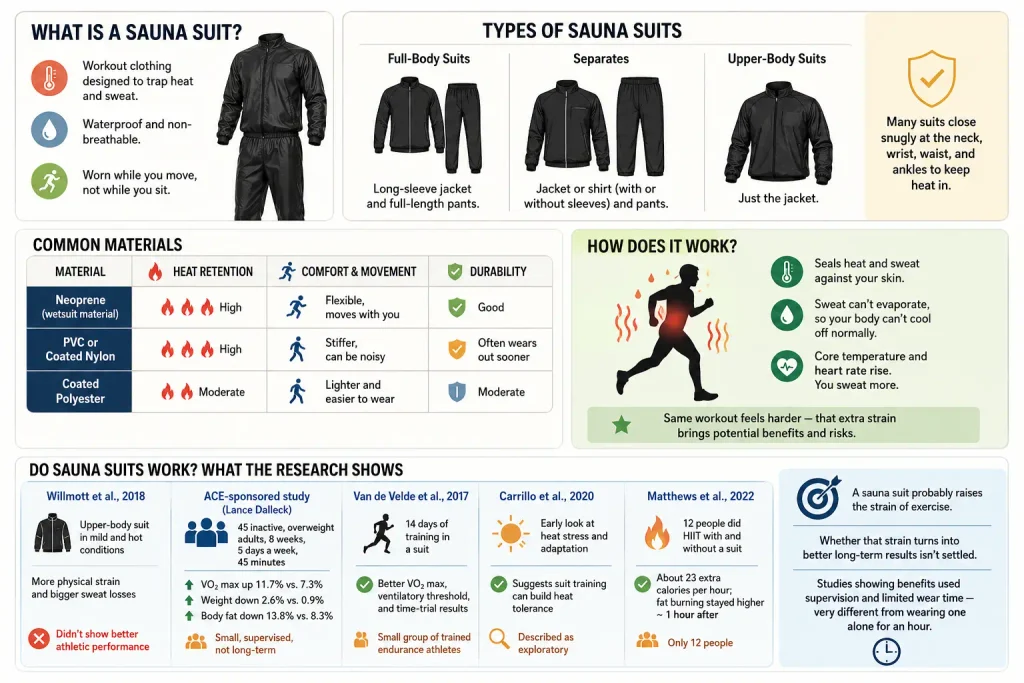
A sauna suit, also called a sweat suit, is workout clothing built to hold heat in. Most are waterproof and don’t breathe. Normal gym clothes let sweat evaporate, and that’s what cools you down. A sauna suit blocks it.


Paid Links - As an Amazon Associate, I earn from qualifying purchases.


Paid Links - As an Amazon Associate, I earn from qualifying purchases.
The name comes from saunas, but the suit isn’t one. It’s something you wear while you move, not something you sit in.
Types of sauna suits
You’ll mostly see three styles:


Paid Links - As an Amazon Associate, I earn from qualifying purchases.


Paid Links - As an Amazon Associate, I earn from qualifying purchases.
- Full-body suits: a long-sleeve jacket and full-length pants, like a tracksuit.
- Separates: a jacket or shirt (with or without sleeves) and pants you can wear together or on their own.
- Upper-body suits: just the jacket. This is the style one well-known 2018 study tested.
Many suits close snugly at the neck, wrists, waist, and ankles. That’s how they keep the heat from escaping.
Common materials
| Material | Heat retention | Comfort and movement | Durability |
|---|---|---|---|
| Neoprene (wetsuit material) | High | Flexible, moves with you | Good |
| PVC or coated nylon | High | Stiffer, can be noisy | Often wears out sooner |
| Coated polyester | Moderate | Lighter and easier to wear | Moderate |
Neoprene is the usual pick for regular training. PVC shows up in cheaper suits. Coated polyester is gentler, so it suits walking and light cardio better than hard workouts.
How Does a Sauna Suit Work?
A sauna suit works by sealing heat and sweat against your skin. Your sweat can’t evaporate, so your body can’t cool off the normal way. Your core temperature rises, your heart rate climbs, and you sweat even more.
Put simply, the same workout feels harder. That extra strain is where the possible benefits come from. It’s also where the risks come from. And the suit only does this while you’re active. If you sit around in one, you just get hot and uncomfortable.


Paid Links - As an Amazon Associate, I earn from qualifying purchases.
Do Sauna Suits Work? What the Research Shows
There’s some research, but not a lot. Most studies are small and short. Here’s a quick look:
| Study | What they did | What they found | The catch |
|---|---|---|---|
| Willmott et al., 2018 | People exercised in an upper-body suit, in mild and hot conditions | More physical strain and bigger sweat losses | Didn’t show better athletic performance |
| ACE-sponsored study (Lance Dalleck) | 45 inactive, overweight adults, 8 weeks, 5 days a week, 45 minutes | Suit group: VO2 max up 11.7% vs. 7.3%; weight down 2.6% vs. 0.9%; body fat down 13.8% vs. 8.3% | Small, supervised, not long-term |
| Van de Velde et al., 2017 | 14 days of training in a suit | Better VO2 max, ventilatory threshold, and time-trial results | Small group of trained endurance athletes |
| Carrillo et al., 2020 | Early look at heat stress and adaptation | Suggests suit training can build heat tolerance | Described as exploratory |
| Matthews et al., 2022 | 12 people did HIIT with and without a suit | About 23 extra calories per hour; fat burning stayed higher for roughly an hour after | Only 12 people |
So what does it all add up to? A sauna suit probably raises the strain of exercise. Whether that strain turns into better long-term results isn’t settled.
One more thing worth knowing. In the studies that found benefits, researchers kept an eye on participants and limited how long the suits were worn. That’s very different from wearing one by yourself for an hour.
Sauna Suit Benefits: What’s Backed Up and What Isn’t
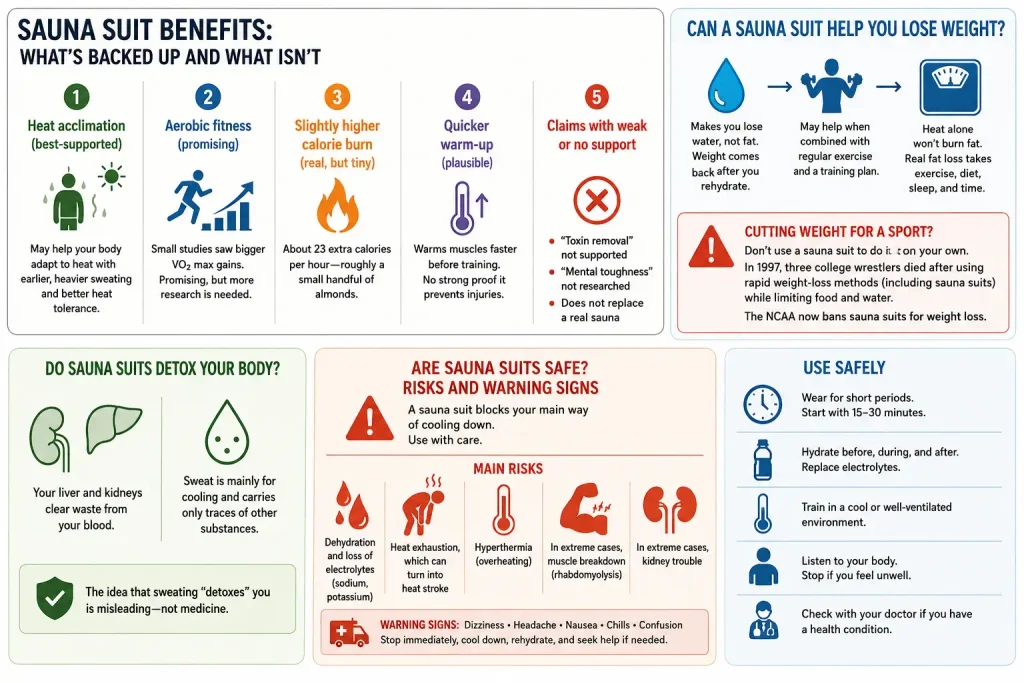
1. Heat acclimation (the best-supported benefit)
Say you’re training for a race in hot weather, but you live somewhere cool. A suit may help your body adapt. Studies saw earlier, heavier sweating and better heat tolerance, which are signs your body is getting used to heat.
2. Aerobic fitness (promising, but small studies)
Two trials reported bigger VO2 max gains in the suit groups. VO2 max is how much oxygen your body can use during hard exercise. The groups were small, so think of this as a hint, not proof.
3. A slightly higher calorie burn (real, but tiny)
The 2022 HIIT study found about 23 extra calories per hour. That’s roughly what you’d get from a small handful of almonds. It’s not a reason to buy a suit.
4. A quicker warm-up (plausible)
The suit warms your muscles fast, which is why many athletes wear one before training. No strong trial proves it prevents injuries, though, so don’t count on that.
5. Claims with weak or no support
- “Toxin removal”: not supported (more on that below).
- “Mental toughness”: that’s a brand claim, not a research result. It may feel true, but nobody has measured it well.
- Replacing a real sauna: no research shows a suit gives you the same benefits as sauna bathing. The research on sauna bathing is about sitting in heat, not working out in a garment.
Can a Sauna Suit Help You Lose Weight?
Not directly. A sauna suit makes you lose water, not fat. That weight comes right back once you drink again.
In the ACE-sponsored study, the suit group did lose more weight and body fat over eight weeks. But those people were also exercising five days a week. The suit boosted a training plan. It didn’t replace one.
Heat alone won’t burn fat either. Real fat loss still comes from regular exercise, what you eat, sleep, and time. Think of the suit as a small training add-on, not a shortcut.
Cutting weight for a sport? Don’t use a sauna suit to do it on your own. In 1997, three college wrestlers died after using rapid weight-loss methods. According to a CDC report, those included exercising in hot conditions in sauna suits while limiting food and water. The NCAA tightened its weight-loss rules afterward, including a ban on sauna suits.
Do Sauna Suits Detox Your Body?
No. Your liver and kidneys clear waste from your blood. Sweat is mainly your body’s cooling system, and it carries only traces of other substances. Healthline, WebMD, and Harvard Health all call the idea that sweating helps you detox misleading.
Some brand pages still describe heavy sweating as detoxification. It’s marketing, not medicine.
Are Sauna Suits Safe? Risks and Warning Signs
They can be, if you’re careful. The problem is simple: a sauna suit blocks your main way of cooling down.
The main risks:
- Dehydration and loss of electrolytes like sodium and potassium
- Heat exhaustion, which can turn into heat stroke, a life-threatening emergency
- Hyperthermia, which just means overheating
- In extreme cases, muscle breakdown (rhabdomyolysis) and kidney trouble
Warning signs to watch for
| Stop, take the suit off, and cool down | Get emergency help |
|---|---|
| Dizziness, faintness, headache | Confusion |
| Nausea | Fainting |
| Muscle cramps | You stop sweating even though you feel hot |
| Weak, rapid pulse | Chest tightness |
| Heavy sweating and unusual tiredness | |
| Lightheaded when you stand up |
If you notice an early sign, stop exercising and remove the suit. Move somewhere cool, then sip water or an electrolyte drink.
Who should skip it or ask a doctor first
- People with heart disease or high blood pressure
- People with diabetes or other metabolic conditions
- Anyone with a history of heat illness
- Anyone whose body has trouble regulating temperature
- People who are pregnant
- People taking medications that affect how the body handles heat
- Anyone who’s sick or already dehydrated
- Athletes trying to make weight for a weigh-in (talk to a coach and a doctor instead)
A quick note on skin conditions: Healthline mentions that doctors sometimes use wet wraps for severe eczema, and a sauna suit is occasionally used as the outer layer. That’s a medical technique. Don’t try it without your doctor’s guidance.
How to Use a Sauna Suit Safely
Start low, go slow, and keep water within reach. Here’s a simple plan:
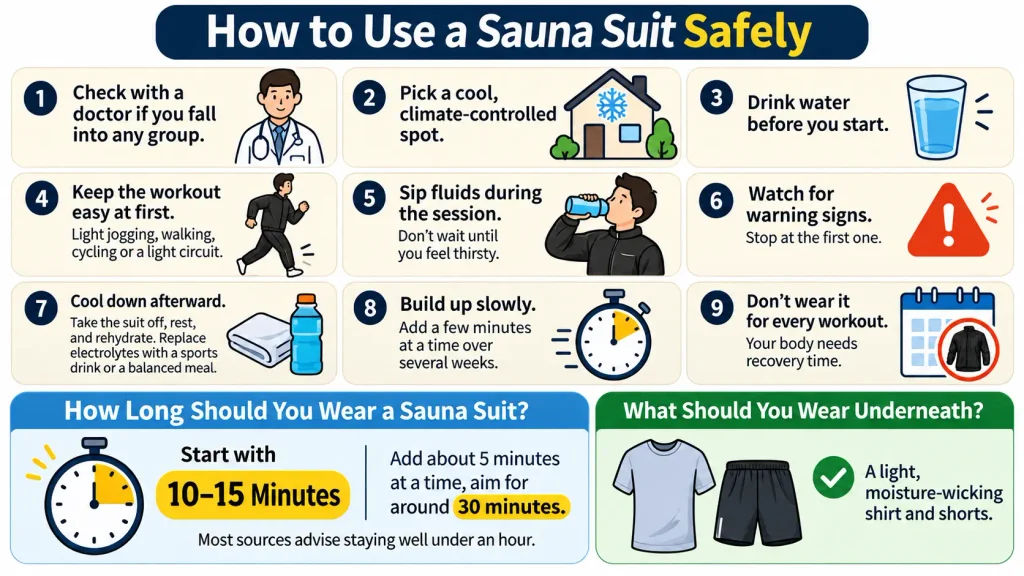
- Check with a doctor if you fall into any group above.
- Pick a cool, climate-controlled spot. Skip hot gyms, summer afternoons, and direct sun.
- Drink water before you start.
- Keep the workout easy at first. Light jogging, brisk walking, cycling, or a light circuit is plenty. Skip all-out sprints and heavy lifting in the suit.
- Sip fluids during the session. Don’t wait until you feel thirsty.
- Watch for warning signs. Stop at the first one.
- Cool down afterward. Take the suit off, rest, and rehydrate. Replace electrolytes with a sports drink or a balanced meal.
- Build up slowly. Add a few minutes at a time over several weeks.
- Don’t wear it for every workout. Your body needs recovery time.
How long should you wear a sauna suit?
Beginners should start with about 10 to 15 minutes. Garage Gym Reviews suggests adding around 5 minutes at a time until you reach roughly 30. Some experienced athletes go longer, but most sources say that isn’t smart for the average person, and several advise staying well under an hour. There’s no official rule, so let how you feel guide you.
What should you wear under a sauna suit?
A light, moisture-wicking shirt and shorts is the usual choice. It cuts down on skin irritation. Avoid heavy layers, because they trap even more heat.
Sauna Suit vs. Sauna: What’s the Difference?
People mix these up all the time, but they’re very different tools.
| Sauna suit | Sauna | |
|---|---|---|
| What it is | Heat-trapping clothing | A heated room or cabin |
| How you use it | While exercising | Sitting or lying still |
| Where the heat comes from | Your own body | The room or heater |
| Research behind it | Small studies on exercise and heat adaptation | A larger body of research on heart health and relaxation |
| Main risk | Overheating during exercise | Overheating and dehydration |
A suit is something you work in. A sauna is something you rest in. If you’re also curious about the difference between an infrared or traditional sauna, that’s a separate choice with its own pros and cons.
Can you wear a sauna suit inside a sauna?
No. WebMD and Haven of Heat both warn against it. A sauna already pushes your body temperature up. Adding a suit raises the risk of overheating and gives you nothing in return. Even without a suit, it pays to think about how long you stay in a sauna and to leave if you feel unwell.
How to Choose and Care for a Sauna Suit
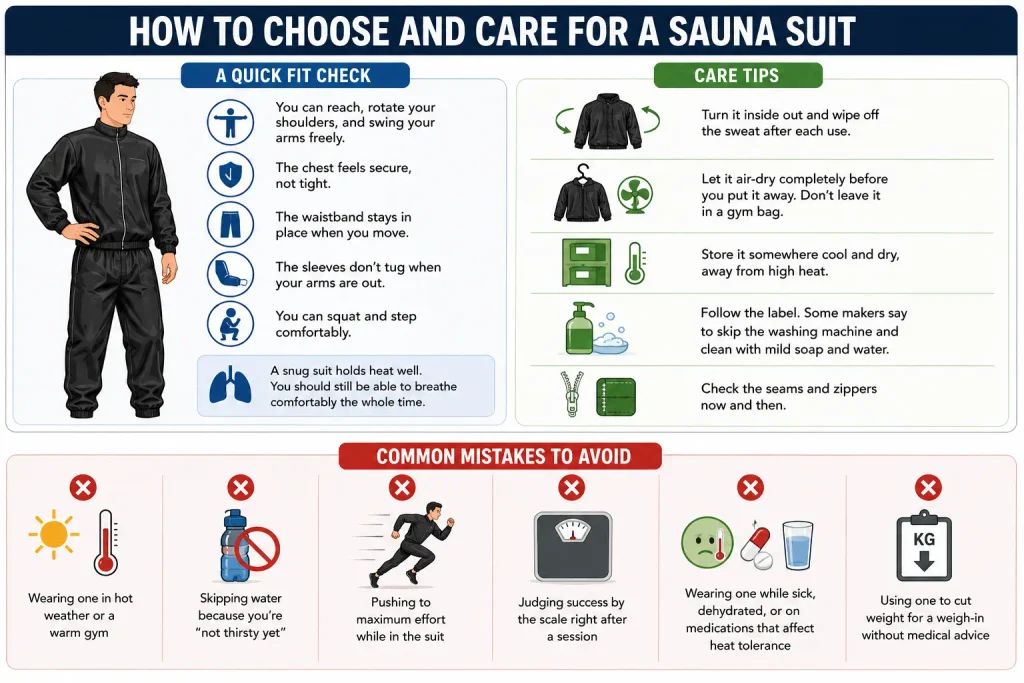
A quick fit check
- You can reach, rotate your shoulders, and swing your arms freely.
- The chest feels secure, not tight.
- The waistband stays in place when you move.
- The sleeves don’t tug when your arms are out.
- You can squat and step comfortably.
A snug suit holds heat well. You should still be able to breathe comfortably the whole time.
Care tips
- Turn it inside out and wipe off the sweat after each use.
- Let it air-dry completely before you put it away. Don’t leave it in a gym bag.
- Store it somewhere cool and dry, away from high heat.
- Follow the label. Some makers say to skip the washing machine and clean with mild soap and water.
- Check the seams and zippers now and then.
Myths vs. Facts
| Myth | Fact |
|---|---|
| “A sauna suit burns fat fast.” | Quick weight loss is mostly water, and it returns. |
| “Sweating flushes out toxins.” | Your liver and kidneys do that. Sweat cools you. |
| “More sweat means a better workout.” | Sweat shows heat, not effort or results. |
| “It works like a real sauna.” | No research shows the same health effects. |
| “I feel fine, so I’m safe.” | Heat illness can build fast. Warning signs matter. |
Common Mistakes to Avoid
- Wearing one in hot weather or a warm gym
- Skipping water because you’re “not thirsty yet”
- Pushing to maximum effort while in the suit
- Judging success by the scale right after a session
- Wearing one while sick, dehydrated, or on medications that affect heat tolerance
- Using one to cut weight for a weigh-in without medical advice
Frequently Asked Questions
Do sauna suits actually work?
They make exercise feel harder and increase sweat. Small studies show possible gains in heat tolerance and aerobic fitness. Proof of long-term fat loss is weak.
Do sauna suits burn belly fat?
No. You can’t choose where your body burns fat. A suit may nudge calorie burn up a little, but overall fat loss still depends on exercise and diet.
How long should you wear a sauna suit?
Start with 10 to 15 minutes. Build toward about 30 if you feel fine. Most healthy people shouldn’t push toward an hour.
Can you wear a sauna suit every day?
It’s best not to. Give your body recovery time and don’t use one for every workout.
Can you run in a sauna suit?
Yes, but start slowly, use it indoors or in cool weather, and keep an eye on your pace and hydration.
Are sauna suits bad for you?
Not automatically, but they carry real risks, including dehydration, heat exhaustion, and heat stroke. Used briefly and carefully, with a doctor’s okay when needed, many healthy adults tolerate them.
Are sauna suits allowed in sports?
Not always. After the 1997 wrestler deaths, the NCAA banned sauna suits in its weight-management rules. Other governing bodies may have similar rules, so check yours.
How is a sauna suit different from a sauna?
A suit is clothing you exercise in. A sauna is a heated room you sit in. Sauna research is much larger and covers different benefits.
Final Thoughts
A sauna suit is a tool, not a shortcut. It traps heat so your workouts feel harder, and small studies suggest it can help with heat tolerance and maybe some aerobic fitness. It won’t melt fat on its own, and it doesn’t detox you.
The biggest takeaway is safety. If you try one, stay hydrated, keep sessions short, keep the exercise easy, and stop at the first warning sign. If you have a health condition, talk to a doctor first.
If your real goal is fat loss, build around regular exercise, good food, and sleep. And if you still want to try a suit, begin with one short, easy session in a cool room and see how your body responds.
This article is general information, not medical advice. Talk to a doctor before starting heat training, especially if you have a health condition.