
You’ve seen the ads. A vest lined with glowing LEDs that promises faster recovery, calmer joints and better skin while you sit on the couch. It’s easy to be skeptical. So, does a red light therapy vest work, or is it just a pricey jacket with a red glow?
Here’s the honest version. The light itself does real things inside your cells. What’s missing is solid proof that a vest delivers those benefits well. This guide covers what the research supports, what it doesn’t, and how to use a vest safely if you decide to try one.
Quick Answer: A red light therapy vest may help in some cases, but no strong vest-specific trials prove it. Red and near-infrared light does affect cells, and research backs a few narrow uses. Results depend mostly on dose, and many consumer devices don’t deliver a therapeutic one.
Key takeaways
- The science behind red and near-infrared light (called photobiomodulation) is real and still growing.
- The best-supported uses, like pattern hair loss and mouth sores from cancer treatment, aren’t things a torso vest treats.
- For muscle recovery and sore joints, the evidence looks promising but early.
- Weight loss isn’t a supported use.
- Wavelength, power and skin contact matter more than the word “vest” on the box.
What Is a Red Light Therapy Vest?
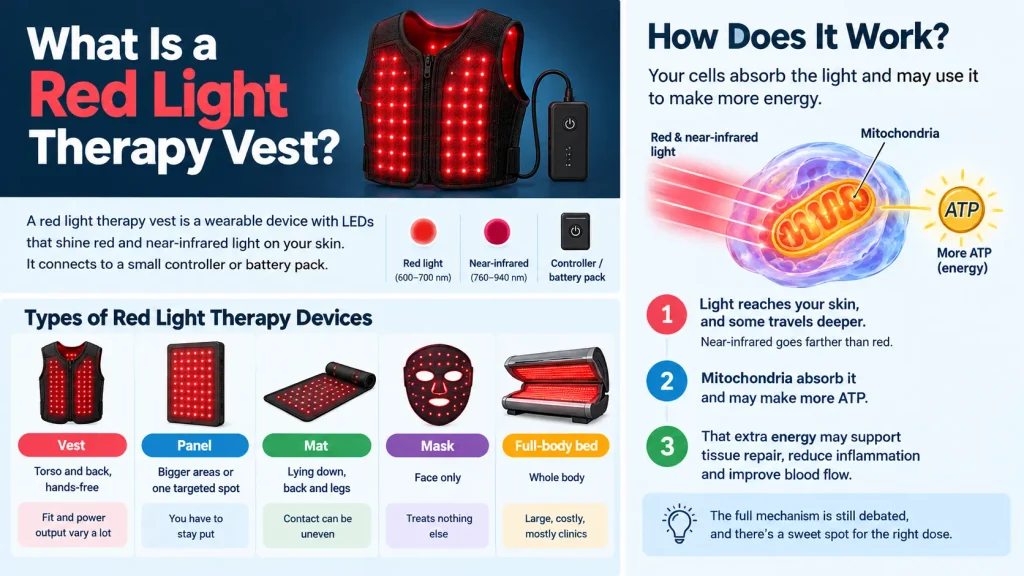
A red light therapy vest is a wearable device with LEDs built into a vest, wrap or flexible pad that sits against your chest, back or core. It shines red and near-infrared light onto your skin in timed sessions. Most connect to a small controller or battery pack.


Paid Links - As an Amazon Associate, I earn from qualifying purchases.
You’ll see red light therapy called other things too: low-level laser therapy, cold laser therapy, photobiomodulation. Cleveland Clinic and WebMD both list these names.
They all describe the same basic idea. Low levels of light nudge your cells without heating or burning the skin, and without the UV rays you get from the sun or a tanning bed.



Paid Links - As an Amazon Associate, I earn from qualifying purchases.
How does a vest compare with other devices? WebMD describes masks, beds, panels and wands as the main types. A vest is a newer, wearable option, which means independent testing is harder to find.
| Device | Best for | Main limit |
|---|---|---|
| Vest | Torso and back, hands-free | Fit and power output vary a lot |
| Panel | Bigger areas or one targeted spot | You have to stay put |
| Mat | Lying down, back and legs | Contact can be uneven |
| Mask | Face only | Treats nothing else |
| Full-body bed | Whole body | Large, costly, mostly clinics |
If face care is your goal, a red light therapy mask is the more targeted choice. A vest only makes sense when your goal sits on your torso.
Don’t mix it up with other “vests”
People confuse three different products all the time:
- Red light therapy vest: LEDs that emit red and near-infrared light.
- Weighted vest: Typically 2 to 10 pounds of added weight. Stanford Lifestyle Medicine says its calorie-burning effect is small, and it has nothing to do with light.
- Far infrared clothing: Fabric with fibers that absorb your body heat and send it back as far infrared. ACCAPI, which sells this kind of apparel, points out it works differently from LED red light because the garment makes the radiation itself.
If you landed on a weighted-vest article while searching, you’re not the first.


Paid Links - As an Amazon Associate, I earn from qualifying purchases.
How Does a Red Light Therapy Vest Work?
The short version: your cells absorb the light and may use it to make more energy.
The part of the cell doing the absorbing is the mitochondria, often called the cell’s power plants. Scientific American reports that red light around 600 to 700 nm and near-infrared around 760 to 940 nm line up with what a key mitochondrial enzyme, cytochrome c oxidase, absorbs best.
That enzyme helps produce ATP, the fuel your cells run on. If you’re curious about how light and heat relate in general, this explainer on infrared radiation gives helpful background.
The working theory goes like this:
- Light reaches your skin, and some travels deeper. Near-infrared goes farther than red.
- Mitochondria absorb it and may make more ATP.
- That extra energy may support tissue repair, change inflammation and improve blood flow in the treated area.
Stanford Lifestyle Medicine describes it the same way: better cellular energy, tissue repair and less inflammation in targeted areas. Cleveland Clinic adds that for skin, the light may boost collagen and fibroblast activity.
Two caveats are worth knowing. First, researchers still debate the full mechanism. One scientist told Scientific American that people still see a response even when a mitochondrial inhibitor is used, so mitochondria are probably not the whole story.
Second, dose is tricky. Scientists talk about a sweet spot between too little light and too much. Scientific American reports that researchers who test commercial devices often find they fall short of a therapeutic dose, and Stanford’s expert says the same about many consumer products. That’s the big reason a vest can look impressive and still do very little.
What Does the Research Actually Say?
Let’s separate what’s well supported from what’s hopeful.
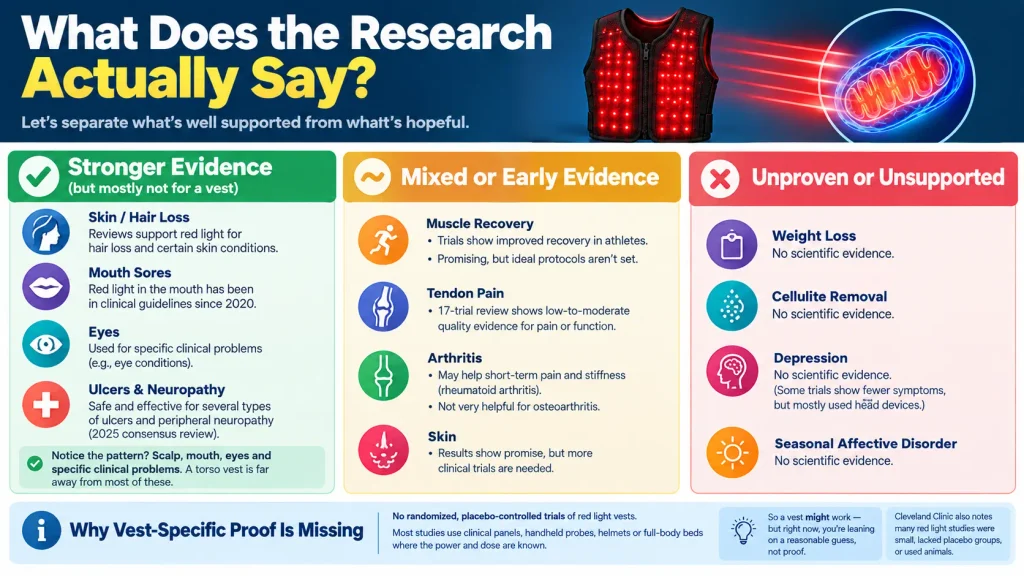
Stronger evidence (but mostly not for a vest). A 2025 consensus review involving more than 20 specialists concluded that red light therapy was safe and effective for several types of ulcers, peripheral neuropathy, acute radiation dermatitis and pattern hair loss, according to Scientific American.
Red light in the mouth has also been in clinical guidelines since 2020 for painful mouth sores from cancer treatment. WebMD adds that reviews of multiple studies support red light for hair loss.
Notice the pattern. Scalp, mouth, eyes, specific clinical problems. A torso vest sits far away from most of these.
Mixed or early evidence.
- Muscle recovery: Scientific American says trials report improved recovery in athletes. Stanford calls red light promising for recovery but says ideal protocols haven’t been set.
- Tendon pain: WebMD cites a review of 17 trials with low-to-moderate quality evidence that it can help pain or function.
- Arthritis: WebMD says it may help short-term pain and morning stiffness in rheumatoid arthritis but doesn’t seem very helpful for osteoarthritis.
- Skin: Cleveland Clinic says results show promise but more clinical trials are needed.
Unproven or unsupported. Cleveland Clinic says there’s no scientific evidence for weight loss, cellulite removal, depression or seasonal affective disorder. Scientific American does mention some trials reporting fewer depression symptoms, but those mostly used devices on the head.
Why vest-specific proof is missing
I couldn’t find randomized, placebo-controlled trials of red light vests. Most photobiomodulation studies use clinical panels, handheld probes, helmets or full-body beds where the power and dose are known.
That doesn’t mean a vest can’t work. It means you’re leaning on a reasonable guess: a vest that delivers a similar dose to the same area should do something similar. That’s logic, not proof.
Cleveland Clinic also reminds readers that many red light studies were small, lacked placebo groups, or used animals or cells instead of people. Its article dates back to 2021, but the call for bigger, better trials still shows up in 2026 coverage.
Red Light Therapy Vest Benefits and Uses
Muscle soreness and recovery
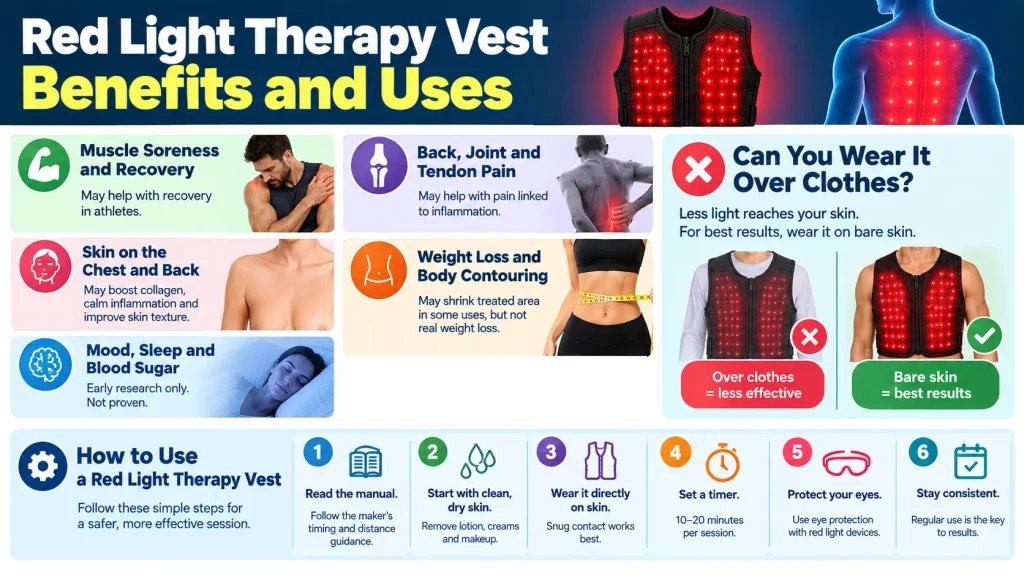
This is the most believable use. If you lift, run or play sports, a vest that covers your chest, shoulders and back could fit your training.
Scientific American points to trials with better muscle recovery in athletes. Keep your expectations modest, though. Nobody has nailed down the best timing or dose yet. If heat-based recovery interests you too, here’s how infrared sauna for muscle recovery compares.
Back, joint and tendon pain
WebMD reports mostly positive results in a review of studies on pain linked to inflammation. That’s encouraging for a sore back. But persistent pain deserves a proper diagnosis first. A vest shouldn’t stand in for a doctor who can rule out something serious.
Skin on the chest and back
Red light may boost collagen and calm inflammation, which is why it’s studied for wrinkles, scars and acne. WebMD says it may smooth skin and improve signs of sun damage. Most of that work focuses on the face, though. Using a vest on torso skin stretches the idea rather than proving it.
Weight loss and body contouring
Please don’t buy a vest to lose fat. WebMD says red light may shrink the measurement of a treated area in some body-contouring uses, but the effect is likely temporary and it isn’t real weight loss.
Cleveland Clinic agrees there’s no scientific support for weight loss. For a deeper look at how heat-based therapies stack up, see whether infrared sauna burns fat.
Mood, sleep and blood sugar
This area is early. Scientific American describes one researcher’s earlier finding that 15 minutes of red light on the back blunted blood sugar spikes after a meal.
That’s interesting, because a vest covers the back. But it comes from one lab, so it isn’t a reason to treat a vest like a blood sugar tool. For mood, treat vests as unproven. The studies showing benefit mostly used head-worn devices.
Can You Wear a Red Light Vest Over Clothes?
Light can pass through thin fabric, but less of it reaches your skin. For the best chance of results, wear the vest on bare skin. Scientific American notes that some near-infrared light can pass through clothing.
ACCAPI says thin, light-colored fabric lets a little through while thick, dark or tight fabric blocks most of it, and that no single number fits every fabric. Block Blue Light, a red light device seller, also says clothing reduces effectiveness.
Since you can’t measure what gets through, skip the shirt. If you have to wear one layer, pick something thin and light-colored and expect a weaker session. Most vests are designed to sit against skin anyway.
How to Use a Red Light Therapy Vest
Here’s a simple routine:
- Read the manual. Dose is device-specific, so follow the maker’s timing and distance guidance.
- Start with clean, dry skin. Block Blue Light suggests removing lotion, creams and makeup because they can reduce absorption.
- Wear it directly on skin. Snug contact beats a loose fit where light scatters.
- Set a timer. Block Blue Light recommends 10 to 20 minutes per session. More isn’t automatically better.
- Protect your eyes. Cleveland Clinic and WebMD both advise eye protection with red light devices.
- Stay consistent. Using it now and then is the easiest way to feel nothing.
How often and how long?
The experts don’t fully agree, which tells you the field hasn’t settled on a standard.
| Source | How often | How long |
|---|---|---|
| Stanford Lifestyle Medicine | 2 to 3 times a week | About 15 minutes |
| Block Blue Light (seller) | 3 to 5 times a week | 10 to 20 minutes |
| Cleveland Clinic (skin treatment) | 1 to 3 times a week for weeks or months | Not specified |
A sensible starting point is two to three sessions a week at around 15 minutes, unless your device says otherwise. That fits Stanford’s guidance and sits inside the other ranges. It’s a starting point, not a prescription.
How long until you notice anything?
There’s no reliable timeline for vests. Cleveland Clinic and WebMD both say most uses need ongoing sessions over weeks or even months.
Try this: pick one goal you can measure, like how sore you feel after workouts or how your back feels in the morning. Track it for a couple of months. If nothing budges, the vest probably isn’t worth keeping. That’s practical advice, not a study result.
Is a Red Light Therapy Vest Safe?
Red light therapy appears mostly safe when used as directed, especially short term. Cleveland Clinic says it isn’t associated with side effects under those conditions, while noting that long-term safety of home devices isn’t known. Unlike tanning beds, it doesn’t use UV rays, and WebMD says there’s no evidence it causes cancer.
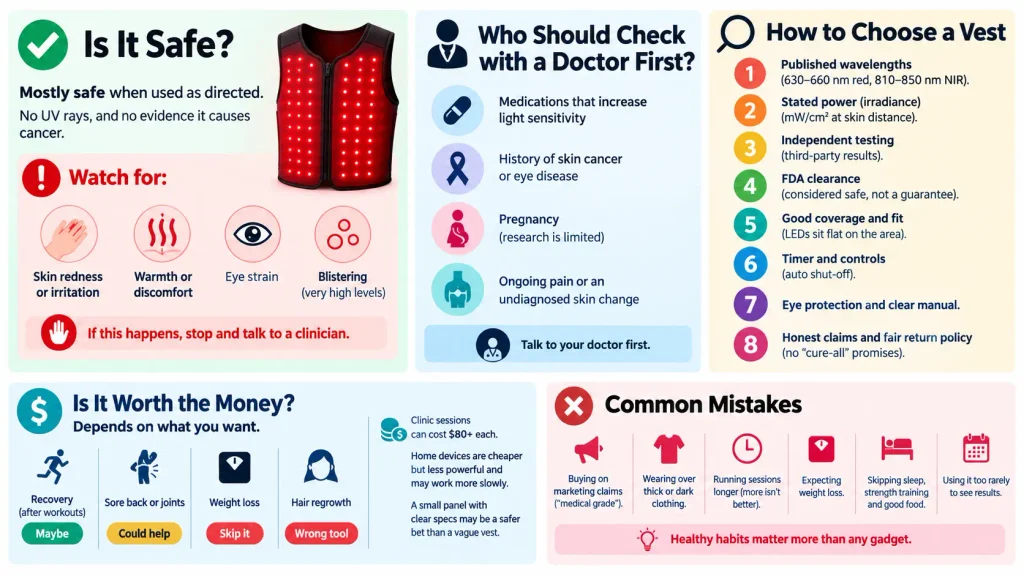
Still, use common sense. Watch for:
- Skin redness or irritation
- Warmth or discomfort at the LEDs
- Eye strain if you look at the light
- Blistering, which WebMD says showed up at very high light levels in one early trial
If any of these happen, stop and talk to a clinician.
Who should check with a doctor first
WebMD says people taking medications that make skin or eyes more sensitive to light shouldn’t use red light therapy. If you have a history of skin cancer or eye disease, talk to your doctor first.
Pregnancy is less clear. WebMD says research is limited but points to a study of 380 pregnant women who had laser light treatments and found it safe. That’s not about vests specifically, so ask your OB-GYN.
And if you’re using a vest for ongoing pain or a skin change nobody has diagnosed, get that checked first.
How to Choose a Red Light Therapy Vest
Both Scientific American and Stanford warn that many consumer devices fall short of a therapeutic dose. This checklist helps you weed out the weakest.
- Published wavelengths. Look for red around 630 to 660 nm and near-infrared around 810 to 850 nm. Block Blue Light lists those, and they sit within the ranges Scientific American reports.
- Stated power (irradiance). Good brands list mW/cm² at skin distance. If a company won’t share it, be wary.
- Independent testing. Scientists quoted by Scientific American want more independent testing and clearer standards. Favor brands that show third-party results.
- FDA clearance. WebMD says you can check whether a device is FDA cleared. That means it’s considered about as safe as similar devices already on the market. It doesn’t prove the device works for your goal.
- Coverage and fit. The LEDs should sit flat against the area you want to treat.
- Timer and controls. An auto shut-off keeps sessions from running long.
- Eye protection and a clear manual.
- Honest claims and a fair return policy. Skip anything that promises to fix everything. Scientific American notes that bold promises often rest on weak data.
Is a Red Light Therapy Vest Worth the Money?
That depends on what you want out of it.
If you want faster-feeling recovery after workouts, it’s a maybe. It’s plausible and low risk with a well-specified device. If you want help for a sore back or joints, it could be a supplement, but see a clinician first. If you want weight loss, skip it. If you want hair regrowth, a vest is the wrong tool entirely.
For context, WebMD says clinic-based red light therapy can run $80 or more per session, so some people see a home device as cheaper over time. WebMD also notes that home devices are usually less powerful than clinical ones and may work more slowly. If you’re on a budget, a small panel with published specs may be a safer bet than a vest with vague numbers.
Common mistakes
- Buying on marketing language like “medical grade” without wavelength and power numbers
- Wearing it over thick or dark clothing
- Running sessions longer, assuming more is better
- Expecting weight loss
- Skipping sleep, strength training and good food. Stanford’s experts stress those habits matter more than any gadget.
- Using it too rarely to judge results
FAQs
Does a red light therapy vest actually work?
It may, but proof is limited. Red and near-infrared light affects cells, and some uses are well supported. No strong vest-specific trials exist, and results depend heavily on the device’s dose.
Can you wear a red light vest over clothes?
You can, but it’s less effective. Thin, light fabric lets some light through, while thick or dark fabric blocks more. Bare skin is best.
How long should you wear one?
Follow your device’s manual. Sources here range from about 10 to 20 minutes per session, and Stanford’s expert cites about 15 minutes.
How often should you use it?
Stanford’s expert suggests two to three times a week. A seller’s guidance says three to five. Start lower and track how you feel.
Can a red light vest help with weight loss?
No. WebMD says any change in body measurements is likely temporary, and Cleveland Clinic says there’s no scientific evidence for weight loss.
Is it safe?
It appears safe when used as directed, especially short term. Protect your eyes, don’t overdo it, and keep in mind that long-term safety of home devices isn’t known.
Is it covered by insurance?
Usually not. Cleveland Clinic says red light therapy typically isn’t covered, so call your insurer to confirm.
Final Thoughts
So, does a red light therapy vest work? Sometimes, maybe, and not for everything. The light is real science. The proof that consumer vests deliver it well is still missing. If you want to try one, treat it like an experiment.
Pick a device with published wavelengths and power, wear it on bare skin, use it steadily for a couple of months, and measure one clear goal.
Protect your eyes, and see a doctor first if you have a medical condition, take light-sensitizing medication or have pain that won’t go away. And don’t skip the basics. Sleep, movement, strength training and good food still do most of the heavy lifting.