
An infrared sauna can be a calm, cosy part of family life. Many parents wonder whether their children can join them, and if so, how long they can stay in and how hot the cabin should be. It is a fair question, because a child is not simply a small adult in a hot room.
This guide covers infrared sauna for children and teenagers from the ground up. You will find out why children handle heat differently, what conservative session lengths and temperatures look like for each age band, how supervision should work, what to do if a child feels unwell, and how to build a simple family routine that keeps sauna time relaxed and safe.
There is no single official minimum age for sauna use, and guidance varies from one source to another. That is why this guide stays conservative throughout. Short sessions, lower temperatures, an adult present, and a clear stop signal matter far more than any one number on a dial.
Please note: This article is general information, not medical advice. Infrared saunas are wellness tools, not treatments. Children should never use a sauna unsupervised, and any child with a heart or circulation condition, asthma, epilepsy, diabetes, or another health condition should be checked by a doctor first. If you are unsure whether sauna use is right for your child, ask your paediatrician before the first session.


#Paid Links
The Short Answer for Busy Parents
Most families can enjoy an infrared sauna together if they keep it short, keep it cool, and keep an adult in charge. Younger children need very short sessions at the lowest heat, with an adult beside them the whole time. Teenagers can usually handle a little more, but they still need an adult nearby, a clear time limit, and water before and after.
The three rules that cover almost everything are simple. First, start low and start short, then build up slowly over weeks, not days. Second, never leave a child alone in a sauna, and never let a child fall asleep in one. Third, stop at the first sign of discomfort, and treat stopping as a success, not a failure.


#Paid Links
- Younger children need the shortest sessions, the lowest heat, and an adult sitting with them at all times.
- Pre-teens can take slightly longer sessions, but still at the lower end of the temperature range and always supervised.
- Teenagers can usually manage up to 15 to 20 minutes at a moderate setting, with an adult nearby and aware.
- Every age band needs water before and after, a cool down afterwards, and a stop signal agreed in advance.
Why Children Handle Heat Differently From Adults
A child heats up faster than an adult in the same sauna. Their body is smaller, so the same amount of heat raises their core temperature more quickly. Their sweat response is also less developed, which means they are less able to cool themselves down once they start to feel hot.
Children also find it harder to judge when they have had enough. An adult usually knows the feeling of being too hot and steps out. A younger child may not recognise the warning signs, or may not want to speak up because they are enjoying the novelty, competing with a sibling, or trying to impress a parent. That is why the adult in the room carries the responsibility for timing the session, not the child.
Infrared heat works differently from the heat in a traditional sauna. Infrared panels warm the body directly with radiant heat, while the air in the cabin stays cooler than a traditional sauna. Most home infrared cabins run at around 110 to 140 degrees Fahrenheit, or about 43 to 60 degrees Celsius, which is lower than a traditional sauna. That gentler air temperature is one reason families often choose infrared, but it does not remove the need for care. The body still warms up, fluid is still lost through sweat, and a child still needs limits.
It is also worth knowing that most sauna research has been done on adults, not children. The well known Finnish cohort studies that link regular sauna use with heart health were observational studies of adults using traditional dry saunas. They show an association, not proof of cause, and they say nothing directly about children in infrared cabins. So when this guide gives a number, it is a conservative planning range drawn from common safety guidance, not a result proven by a study on children.


#Paid Links
Is There a Minimum Age for an Infrared Sauna?
There is no established universal minimum age for sauna use. No major health authority has set a single age at which a child becomes safe to use a sauna, and the guidance that does exist varies. Some sauna makers suggest children over a certain age may use a sauna briefly with supervision, while health sources advise extra caution for younger children and for any child with a health condition.
That lack of one clear number is itself useful information. It means parents should not look for a birthday that makes sauna use suddenly safe. Instead, the decision should rest on the individual child, their health, their ability to say when they feel unwell, and the supervision in place. When in doubt, wait, ask your paediatrician, and start with the shortest, coolest session possible.
Babies and toddlers should not use a sauna. They cannot tell you they are too hot, they lose fluid quickly, and they cannot leave on their own. Older children who can walk, talk, and describe how they feel are a different case, but they still need very short sessions and constant adult supervision.
If your child has a health condition that affects how they handle heat, the answer is not in this article. Conditions such as heart or circulation problems, asthma, epilepsy, diabetes, or a fever on the day all change the picture. A doctor who knows your child can give advice that no general guide can, so check first and follow what they say.
Age-Band Guidance: Sessions, Temperatures and Supervision
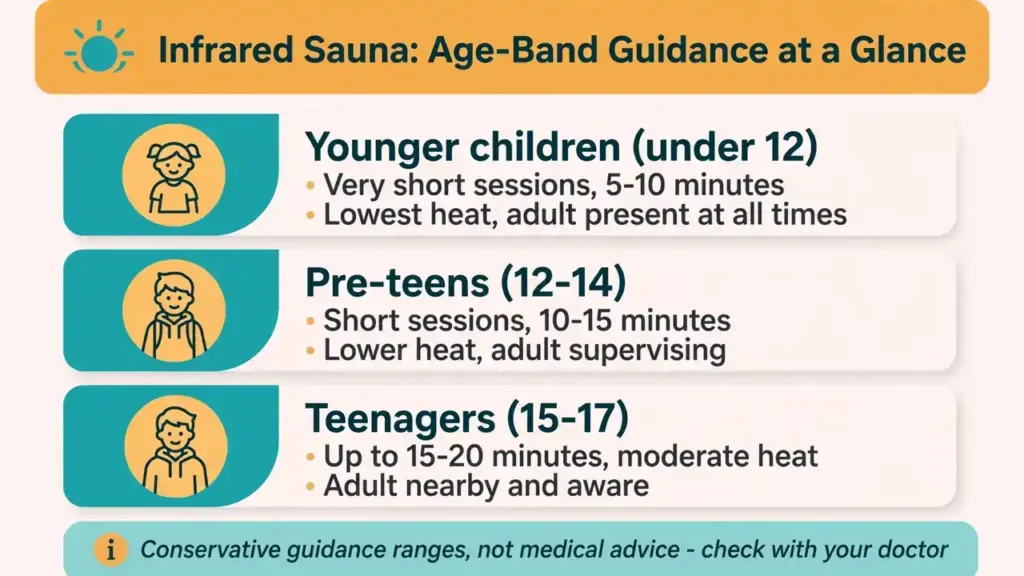
The table below gives conservative guidance ranges for three age bands. These are planning ranges, not medical rules, and they assume a healthy child and a home infrared cabin. If your child is unwell, tired, dehydrated, or has a health condition, shorten the session further or skip it entirely.
| Age band | Session length | Temperature | Supervision |
|---|---|---|---|
| Younger children, roughly under 12 | 5 to 10 minutes | Lowest setting, around 100 to 110 degrees Fahrenheit (about 38 to 43 degrees Celsius) | Adult sitting in the sauna with the child, whole session |
| Pre-teens, roughly 12 to 14 | 10 to 15 minutes | Lower end, around 110 to 120 degrees Fahrenheit (about 43 to 49 degrees Celsius) | Adult in the sauna or sitting right outside with the door in view |
| Teenagers, roughly 15 to 17 | Up to 15 to 20 minutes | Moderate, around 120 to 130 degrees Fahrenheit (about 49 to 54 degrees Celsius) | Adult nearby and aware, checking in during the session |
The temperature figures in the table are at the lower end of what most home infrared cabins offer, and that is deliberate. A child gains nothing from the hottest setting, and the risk rises faster than any benefit. If your cabin starts at a higher temperature, let it run for a shorter time or sit the child further from the panels, and keep the session short.
Younger Children: Under 12
For younger children, less is more. Five to ten minutes at the lowest setting is plenty for a first session, and many families find that five minutes is the right place to start. Sit with your child, talk with them, and watch how they look. A flushed face, sweating, or restlessness is a sign to wrap up, even if the time is not up.
Make the session feel like a shared activity, not a test of endurance. Bring a small towel, let the child sit on the lower bench where it is cooler, and keep the door unlocked and easy to open. Never lock a child in a sauna, and never leave the room while a younger child is inside. If you need to step away, the session ends.
Some children will ask to stay longer because they are having fun. That is a good sign that they enjoyed it, and it is also the moment to stop. Ending on a high note builds a healthy habit, while pushing on teaches a child to ignore their own body. A short, happy session beats a long one every time.
Pre-Teens: 12 to 14
Pre-teens can usually manage ten to fifteen minutes at the lower end of the temperature range. They are old enough to describe how they feel, but they still need an adult close by. Sit in the cabin with them for the first few sessions, then move to sitting just outside with the door in view once you are confident they will speak up and step out on their own.
This is a good age to start teaching sauna habits properly. Show them how to check the temperature, how to set a timer, and how to cool down slowly afterwards. Talk about why you stop when you feel dizzy, and why drinking water matters. These are habits that will serve them well as teenagers and adults.
Watch out for peer pressure at this age, especially if siblings or friends are involved. A pre-teen may try to match an older sibling or stay in longer to prove something. Keep the rules the same for everyone in the session, and make it clear that leaving early is the sensible choice, not a failure.
Teenagers: 15 to 17
Teenagers can usually handle up to fifteen to twenty minutes at a moderate setting. Their bodies are closer to adult size, and they can describe symptoms clearly. Even so, they still need an adult nearby and aware, and they should not use the sauna alone in the house. A teenager who feels faint needs someone close enough to hear them and help them out.
Teenagers also bring new risks that younger children do not. They may use the sauna after sport, when they are already hot and dehydrated, or after a long day without enough water. They may also be tempted to use the sauna to lose weight quickly, which is not a safe or sensible use of heat. Talk openly about both points, and make hydration and cooling down part of the routine rather than an afterthought.
Alcohol is a clear line for teenagers. No one should use a sauna after drinking, and that applies doubly to teenagers, whose bodies handle alcohol and heat poorly together. If a teenager has been drinking, the sauna stays off, with no exceptions and no debate.
For families with older children, the guide to infrared sauna use for seniors is a useful companion read. It covers how heat tolerance changes with age at the other end of life, and many of the same principles apply: start low, stay short, and listen to the body.
Session Length and Temperature: Getting the Details Right
Adults often use an infrared sauna for twenty to forty minutes. Children should not copy adult sessions. The table above gives the ranges, but a few practical details make them work in real life. First, the timer starts when the child sits down, not when the cabin reaches temperature. Second, the first three or four sessions should be at the short end of the range, even if the child feels fine. Third, only increase one thing at a time: a slightly longer session, or a slightly higher temperature, never both at once.
Cabin temperature readings can also mislead. The thermometer may sit near the ceiling, where the air is warmest, or near a panel that reads high. A child sitting on a lower bench, further from the panels, feels less heat than the display suggests. That is why how the child looks and feels matters more than the number on the screen. If you want to understand why readings vary, our guide to infrared sauna thermometer accuracy explains the common causes and how to check your own cabin.
Frequency matters too. Two or three short family sessions a week is a sensible rhythm for most children. Daily use is not needed, and it makes it harder to spot when a child is tired, unwell, or simply not in the mood. Treat the sauna as a treat to look forward to, not a daily chore, and skip it on days when the child is ill, has a fever, or has had a long hot day outside.
Cooling down is part of the session, not an optional extra. Step out slowly, sit somewhere comfortable for a few minutes, and let the body settle before showering or dressing. A lukewarm shower is fine. A cold plunge or a very cold shower is not suitable for younger children, whose bodies cool down quickly and who may find the shock unpleasant or frightening.
Hydration: The Rule That Holds Everything Together
Sweating is how the body cools itself, and children sweat less efficiently than adults while still losing fluid. That combination makes hydration the single most important safety habit for family sauna use. A child should drink water before the session, have water within reach during it, and drink again afterwards.
Do not rely on a child to ask for water. Offer it before they sit down, and hand it to them partway through the session. Plain water is the right choice. Sugary drinks, energy drinks, and caffeine do not help, and they can make a child feel worse in the heat. Our full infrared sauna hydration guide covers timing, amounts, and what to drink after longer sessions, and the same principles apply to children in shorter form.
Watch for signs of dehydration after the session as well as during it. A child who is unusually quiet, complains of a headache, or says they feel sick after a sauna may simply need water and rest. Give them a drink, let them sit in a cool room, and keep an eye on them for an hour or so. If symptoms persist or get worse, seek medical advice.
Supervision Rules That Never Change
Supervision is not a suggestion. It is the rule that makes all the other rules work. A child should never use an infrared sauna alone, and a teenager should not use one alone in the house either. An adult needs to be close enough to hear, see, and help within seconds.
- Stay in the room. For younger children, sit in the cabin with them. For older children, stay in the same room or just outside with the door in view.
- Keep the door unlocked. The child should be able to open the door and step out at any time, without help and without a latch they cannot reach.
- Set a timer you can hear. Do not guess the time. A kitchen timer or a phone alarm outside the cabin keeps everyone honest.
- Agree on a stop signal. Before the session, agree on a simple word or gesture that means stop right now, no questions asked.
- Never let a child fall asleep in a sauna. Drowsiness in the heat is a warning sign, not a sign of relaxation. Wake them and take them out.
- Check the cabin before every session. Make sure the panels, controls, and door all work as they should, and that nothing is blocking the heater or the ventilation.
Smart controls can help with supervision, but they are not a substitute for an adult. A WiFi connected cabin that lets you check the temperature or switch the heater off from another room is a useful safety net, and our guide to smart infrared sauna WiFi, app and remote start safety covers the risks of starting a cabin remotely when children are in the house. Never start a sauna remotely while a child is inside, and never rely on an app to watch a child for you.
What to Do If a Child Feels Unwell
Most family sauna sessions pass without any problem. Still, every parent should know what to do if a child feels unwell, because acting quickly and calmly makes all the difference. The first step is always the same: get the child out of the heat, right away.
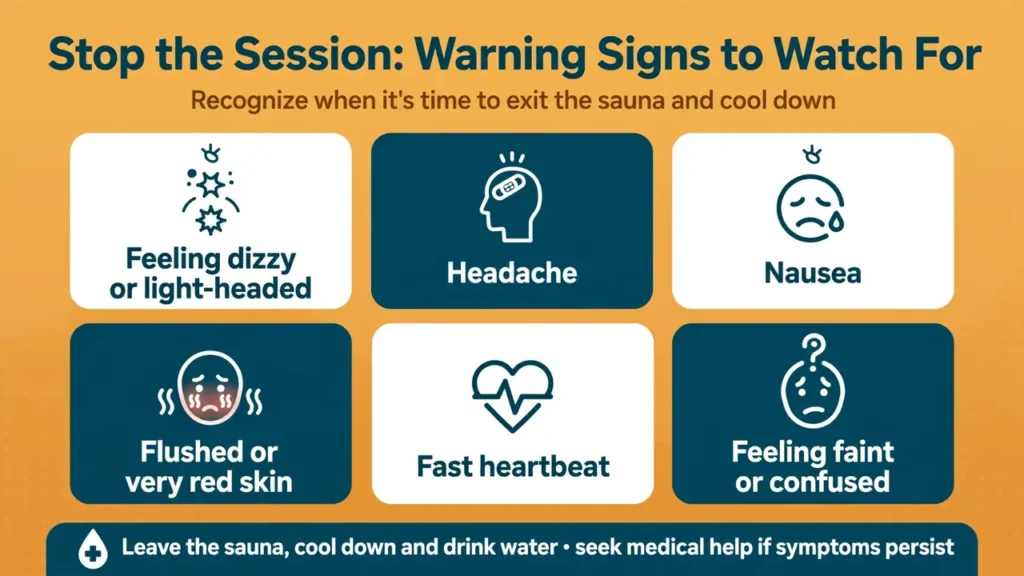
Signs to Stop the Session Immediately
- Feeling dizzy, light-headed, or faint
- Headache or nausea
- Flushed or very red skin that does not fade quickly
- Fast or pounding heartbeat
- Feeling confused, unusually quiet, or not quite themselves
- Muscle cramps, chills, or shivering after leaving the heat
If any of these appear, help the child out of the cabin, sit them in a cool room, and give them water in small sips. Loosen tight clothing and let them rest. Most mild symptoms ease within a few minutes once the child is out of the heat and drinking water. Stay with them and keep talking to them, so you can judge whether they are improving.
Seek medical help promptly if symptoms do not ease, if the child faints, vomits repeatedly, or seems confused, or if you are worried for any reason. Do not put a child who has fainted or feels very unwell back into the sauna, and do not wait to see if it passes on its own. When a child is involved, calling a doctor early is always the right call.
After an unwell episode, take a break from sauna use for at least a few days, and talk to your doctor before the next session. A single bad experience does not mean the sauna is never safe for your child, but it does mean something needs to change: a shorter session, a lower temperature, better hydration, or a longer gap between sessions.
A Family Sauna Routine, Step by Step
A simple routine takes the guesswork out of family sauna time. Once everyone knows the steps, children relax, parents relax, and the session runs itself. The routine below works for most families, and you can adjust the times to suit your child’s age band from the table above.
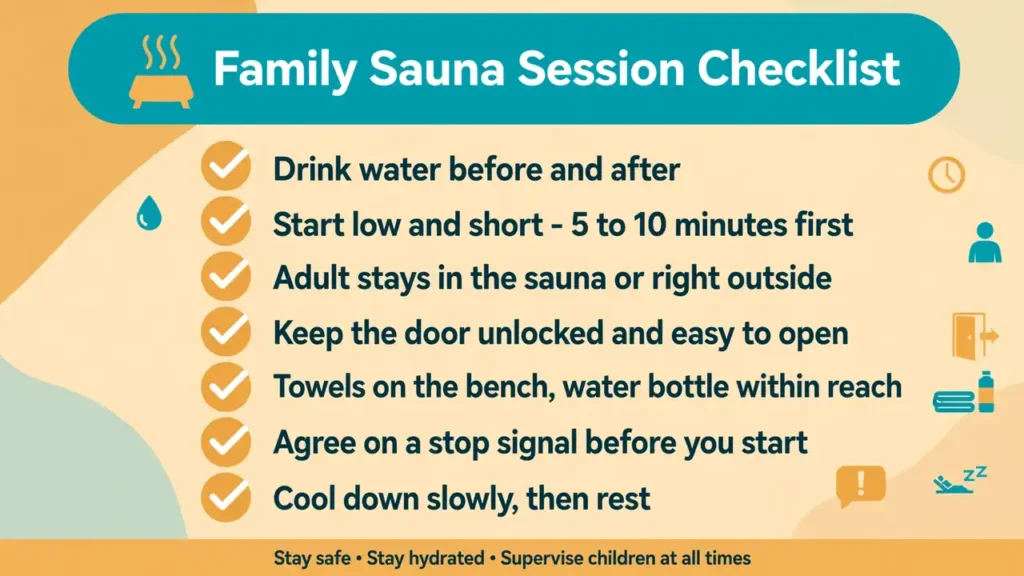
- Drink water first. Everyone has a glass of water before the session starts, and a bottle goes into the cabin.
- Check the cabin. Make sure the controls, door, and ventilation are working, and set the temperature to the low end for the youngest person in the session.
- Set the timer. Set it for the shortest session in the group, so the youngest child sets the pace for everyone.
- Agree on the stop signal. A quick word or a raised hand means stop, no questions asked, and the session ends.
- Sit down together. Children sit on the lower bench, towels underneath, and the adult sits where they can see every child.
- Talk and check in. Ask how everyone feels halfway through. A simple question is enough, and silence is a reason to check again.
- Step out when the timer goes off. No extra minutes, even if everyone feels fine. Ending on time builds the habit.
- Cool down slowly. Sit in a comfortable room for a few minutes, then take a lukewarm shower if you like.
- Drink water and rest. Another glass of water, a quiet activity, and no rushing off to sport or homework straight away.
Keep the routine the same each time. Children learn safety from repetition, and a familiar routine means they know what to expect and what is expected of them. If something in the routine slips, such as forgetting the water or the timer, treat it as a reason to shorten the session, not as a detail to ignore.
Teenagers, Sport and the Sauna
Teenagers are the age group most likely to use a sauna after sport, and that is also when the risks are highest. A teenager who has just finished training is already warm, already sweating, and often already short on fluid. Adding a hot cabin on top of that without water and rest is asking for trouble.
The safe order is simple: cool down first, drink water, eat something light, and rest for at least twenty to thirty minutes before the sauna. Then keep the session short, at a moderate temperature, with an adult nearby. After the sauna, more water, more rest, and no heavy training for the rest of the day.
Be honest with teenagers about weight. Some teenagers hear that saunas make you sweat and assume that means weight loss. Sweat loss is water loss, and it comes back with the next drink. A sauna is not a weight loss tool, and using it that way is unsafe. If a teenager is worried about their weight, that is a conversation for a parent and a doctor, not a reason to spend longer in a hot cabin.
Teenagers with low blood pressure or a heart condition need extra care, because heat lowers blood pressure further and can cause dizziness when standing up. Our guide to infrared sauna and blood pressure explains how heat affects blood pressure and why a doctor check matters, and the advice there applies to teenagers as well as adults.
Common Mistakes Families Make
Most family sauna problems come from small habits, not big errors. The list below covers the mistakes that turn up most often, and each one is easy to fix once you know to look for it.
Copying Adult Sessions
The most common mistake is letting a child stay in as long as an adult. A twenty or thirty minute adult session is far too long for a younger child, and even a teenager should not match an adult who has used saunas for years. Set the timer for the child, not for the adult, and let the adult have their own longer session another time.
Turning the Heat Up Too High
More heat does not mean more benefit, especially for children. The hottest setting on a home cabin is meant for healthy adults who have built up tolerance over time. Children do best at the lower end of the range, where they can sit comfortably, breathe easily, and enjoy the warmth without feeling overwhelmed.
Skipping Water
Children rarely ask for water until they are already thirsty, and by then they are already short on fluid. Build water into the routine so it happens without anyone having to remember. A bottle in the cabin and a glass before and after covers most situations.
Leaving a Child Unattended
Stepping out to answer the phone or fetch a towel feels harmless, but it leaves a child alone in a hot room with no one to notice if something goes wrong. If you need to leave, take the child with you and end the session. The sauna will still be there tomorrow.
Treating the Sauna as a Treatment
Infrared saunas are wellness tools, not treatments for illness, skin conditions, or weight. Using a sauna to try to treat a child’s health problem can delay proper care and put the child at risk. If your child is unwell, see a doctor first, and use the sauna only for relaxation once they are well again.
When to Skip the Sauna Entirely
Some days are simply not sauna days. Skipping the session is always the safe choice, and it teaches children that listening to the body matters more than keeping a routine. The list below covers the clearest cases, and parents should add their own judgement on top of it.
- The child has a fever, a cold, a stomach bug, or any illness that day.
- The child is tired, has not eaten, or has not drunk enough water.
- The child has a headache, feels sick, or says they do not want to go in.
- The child has a new health condition, a new medication, or a recent injury, and a doctor has not yet been asked.
- The weather has been very hot, and the child has already spent a long time in the sun or playing sport.
- The cabin is not working properly, the door sticks, or the controls do not respond as they should.
A child who does not want to use the sauna should never be forced or pressured into it. Some children love the warmth, and some simply do not, and both reactions are fine. Forcing a reluctant child into a hot room teaches them to ignore their own discomfort, which is the opposite of what sauna safety is about.
If your cabin develops a fault, such as panels that stay on when they should switch off, a control panel that does not respond, or a strange smell, stop using it until the problem is fixed. Our infrared sauna troubleshooting guide covers the common faults and what to check, and a fault that affects heat control should always be looked at by a qualified person before the next family session.
Families who also use a steam sauna should know that steam brings its own risks for children, including higher humidity and hotter air. Our guide to steam sauna safety for children, pregnancy and health conditions covers the steam side in detail, and the supervision rules there are the same: an adult present, short sessions, and stop at the first sign of discomfort.
Frequently Asked Questions
What age can a child start using an infrared sauna?
There is no established universal minimum age for sauna use, and guidance varies by source. Babies and toddlers should not use a sauna. Older children who can describe how they feel may use one for very short sessions at low heat, with an adult present at all times. If you are unsure, ask your paediatrician first.
How long can a child stay in an infrared sauna?
Keep it short. Younger children should stay in for five to ten minutes, pre-teens for ten to fifteen minutes, and teenagers for up to fifteen to twenty minutes. First sessions should be at the short end of each range, and only one thing should change at a time: a longer session or a higher temperature, never both.
What temperature is safe for children in an infrared sauna?
Children do best at the lower end of the range. Younger children should use the lowest setting, around 100 to 110 degrees Fahrenheit (about 38 to 43 degrees Celsius). Pre-teens can use around 110 to 120 degrees Fahrenheit, and teenagers around 120 to 130 degrees Fahrenheit. How the child looks and feels matters more than the number on the display.
Can a child use an infrared sauna on their own?
No. A child should never use a sauna unsupervised, and a teenager should not use one alone in the house. An adult needs to be close enough to hear, see, and help within seconds, and the door should always be unlocked and easy for the child to open.
What should a child drink before and after a sauna?
Plain water is the right choice. A child should drink water before the session, have water within reach during it, and drink again afterwards. Sugary drinks, energy drinks, and caffeine do not help in the heat.
When should a child not use an infrared sauna?
Skip the sauna if the child has a fever or any illness, is tired or dehydrated, has a headache or feels sick, has a new health condition or medication that a doctor has not been asked about, or simply does not want to go in. Also skip it after a long hot day outside or after intense sport without rest and water first.