
Quick answer: Most people feel calmer, warmer, and less tense after their very first infrared sauna session. Measurable changes like better sleep, less muscle soreness, and lower stress usually show up within 1 to 4 weeks of using the sauna 3 to 4 times per week. Deeper benefits, such as improved circulation and cardiovascular conditioning, typically take 1 to 3 months of consistent use to become noticeable.
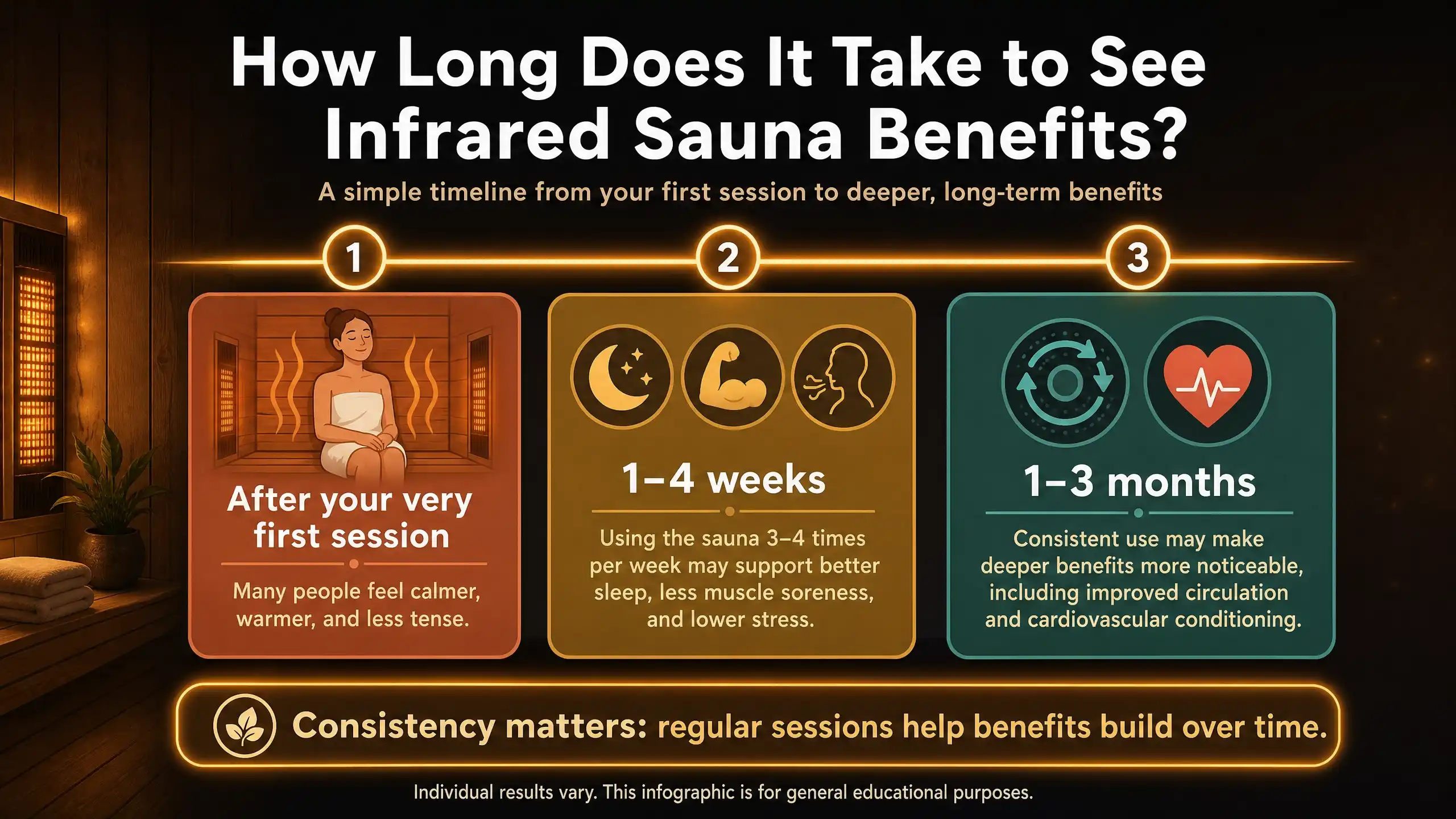
That’s the short version. Below is the realistic, stage-by-stage breakdown including what’s backed by research, what’s still unproven, and how to structure your own sessions so you’re not waiting longer than you need to.
Key Takeaways
- First session: calm, warmth, and possibly better sleep that night — no lasting physiological change yet.
- 1–2 weeks: reduced tension, mild stress relief, better circulation, if you’re using the sauna 2–3 times weekly.
- 3–4 weeks: more consistent sleep and noticeably faster recovery from workouts, especially at 3–4 sessions per week.
- 1–3 months: the strongest evidence for cardiovascular and inflammation-related benefits, with the caveat that infrared-specific research is still smaller in scale than traditional sauna research.
- Consistency matters more than intensity. A steady, moderate routine will get you results faster than infrequent, maximal sessions.
Infrared Sauna Benefits Timeline
| Timeframe | What you can typically expect | How you’ll know it’s working |
|---|---|---|
| During your first session (10–20 min) | Warmth, sweating, a slower breathing pattern | You feel physically calmer before you even step out |
| Same day, 2–4 hours later | Core body temperature drops, which can support sleep onset | You fall asleep more easily that night |
| Week 1–2 (2–3 sessions/week) | Less shoulder/neck tension, mild stress relief, better circulation to hands and feet | Daily tension feels more manageable |
| Week 3–4 (3–4 sessions/week) | Reduced post-workout soreness, more consistent sleep, early skin changes | Recovery between workouts feels faster |
| Month 2–3 (consistent use) | Cardiovascular conditioning effects, sustained stress reduction, skin tone changes | Resting heart rate and stress markers trend in a better direction |
This table gives you the shape of the timeline. The sections below explain the “why” behind each stage — and where the evidence is strong versus where it’s still thin.
What You’ll Feel in Your First Infrared Sauna Session
Infrared saunas don’t heat the air around you the way a traditional sauna does. Instead, infrared panels warm your body directly, which is why an infrared cabin can feel comfortable at 100–140°F, well below the 150–195°F range of a traditional sauna.


Paid Links - As an Amazon Associate, I earn from qualifying purchases.
Within the first 10 to 15 minutes, your heart rate rises slightly, blood vessels dilate, and your nervous system tends to shift toward its “rest and digest” mode. That’s the physiological basis for the sense of calm most first-time users report almost immediately — it isn’t a placebo effect, it’s a real, fast-acting response to heat exposure.
A few hours after you leave the sauna, your core body temperature drops as your body finishes cooling down. That post-heat temperature drop is one of the mechanisms your body uses to signal it’s time for sleep, which is why some people notice they fall asleep faster on the nights they use the sauna in the late afternoon or early evening.



Paid Links - As an Amazon Associate, I earn from qualifying purchases.
What does not happen in one session: meaningful fat loss, a “detox,” or lasting changes to blood pressure or cardiovascular health. Any weight you see drop on the scale right after a session is water loss from sweating, not fat it comes back as soon as you rehydrate.
Week 1–2: Short-Term Benefits Start to Build
If you use the sauna two to three times a week during this stretch, most people begin to notice:
- Less tension in the neck, shoulders, and lower back
- Steadier mood and an easier time winding down after work
- Warmer hands and feet between sessions, a sign of improved peripheral circulation
- Slightly better sleep quality, particularly if sessions are timed in the evening
This stage is really about your body learning the routine — figuring out your ideal session length, the time of day that works for your schedule, and how much water you need to feel good afterward rather than depleted.
Week 3–4: Recovery and Sleep Benefits Become More Consistent
By the three- to four-week mark, with three to four sessions a week, the benefits tend to move from “occasional” to “reliable.” This is the stage where infrared saunas show their strongest evidence, particularly for exercise recovery.



Paid Links - As an Amazon Associate, I earn from qualifying purchases.
A 2023 randomized study on post-exercise infrared sauna use in athletes found that a 20-minute session after resistance training reduced perceived muscle soreness and helped preserve performance measures compared with passive recovery alone. That doesn’t mean everyone gets an identical result — training load, sleep, hydration, and fitness level all affect how much any individual notices — but it’s one of the more concrete data points behind the “faster recovery” claim you’ll see in sauna marketing.
Around this stage, users typically also report:
- Noticeably reduced soreness after workouts
- More consistent, restful sleep
- Improved flexibility and joint comfort
- A more efficient sweat response (your body adapts to regular heat exposure)
Month 2–3: Where the Deeper, Longer-Term Changes Show Up
This is the stage most infrared sauna marketing jumps straight to — claims about detoxification, weight management, and major cardiovascular improvements. Some of this is supported by research; some of it is overstated. Here’s the honest breakdown.
Cardiovascular effects. Heating the body raises heart rate in a way that resembles moderate exercise, and repeated heat exposure over months has been associated with improved vascular function in sauna research generally. The strongest long-term cardiovascular data — including a well-known 2015 JAMA Internal Medicine study linking frequent sauna use to lower cardiovascular and all-cause mortality — comes from traditional Finnish sauna bathing studied over years, not infrared sauna specifically. Mayo Clinic notes that infrared saunas have been studied for conditions including high blood pressure, heart failure, and arthritis, with “some evidence” of benefit, but adds that larger, more precise studies are still needed before firm conclusions can be drawn.
Inflammation and pain. Some research on infrared-based heat and light therapy shows reduced markers of inflammation and pain in musculoskeletal conditions, but study sizes are often small and protocols vary widely, so results are promising rather than definitive.
Skin. Improved circulation and sustained sweating over weeks to months are commonly linked to better skin hydration and tone. If your sauna includes red or near-infrared light panels, any skin or collagen-related effects depend on direct light exposure to bare skin at a close distance — sitting across the cabin away from the panels won’t produce the same effect as sitting close to them.
What’s still unproven or overstated. Be skeptical of any specific “detox” percentage claims (like exact multiples of toxin concentration in sweat) — these numbers circulate widely in sauna marketing but aren’t backed by peer-reviewed, sauna-specific research. Sweating does eliminate some substances, but your liver and kidneys do the vast majority of the body’s actual detoxification work, sauna or not.
Infrared vs. Traditional Sauna: Why the Timeline Can Differ
| Infrared Sauna | Traditional Sauna | |
|---|---|---|
| How it heats you | Infrared panels warm the body directly | Heated air and rocks warm the surrounding air, which warms you |
| Typical temperature | 100–140°F | 150–195°F |
| Typical session length | 20–45 minutes | 5–20 minutes |
| Sweat onset | Slower, gentler | Faster, more intense |
| Best for | Longer, lower-intensity sessions; people sensitive to high heat | Shorter, higher-intensity heat exposure |
| Strongest research base | Growing, but smaller and newer | Larger body of long-term Finnish cohort research |
Because infrared sessions run at a lower temperature, some people can tolerate longer sessions, which may partly offset the lower heat intensity over time. But it also means the research base behind infrared-specific outcomes is younger and thinner than the decades of Finnish sauna data — worth keeping in mind when a specific claim sounds impressively precise.
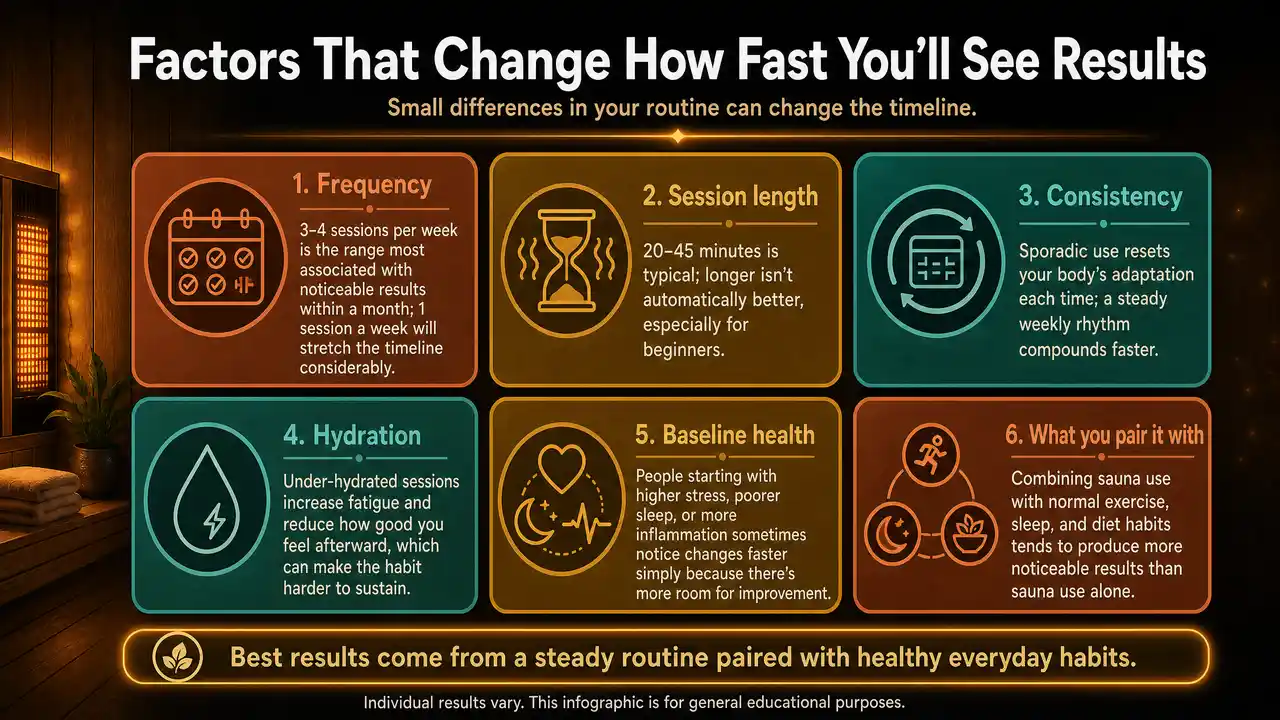
Factors That Change How Fast You’ll See Results
| Factor | Why it matters |
|---|---|
| Frequency | 3–4 sessions per week is the range most associated with noticeable results within a month; 1 session a week will stretch the timeline considerably |
| Session length | 20–45 minutes is typical; longer isn’t automatically better, especially for beginners |
| Consistency | Sporadic use resets your body’s adaptation each time; a steady weekly rhythm compounds faster |
| Hydration | Under-hydrated sessions increase fatigue and reduce how good you feel afterward, which can make the habit harder to sustain |
| Baseline health | People starting with higher stress, poorer sleep, or more inflammation sometimes notice changes faster simply because there’s more room for improvement |
| What you pair it with | Combining sauna use with normal exercise, sleep, and diet habits tends to produce more noticeable results than sauna use alone |
How to Get Results Faster (Without Overdoing It)
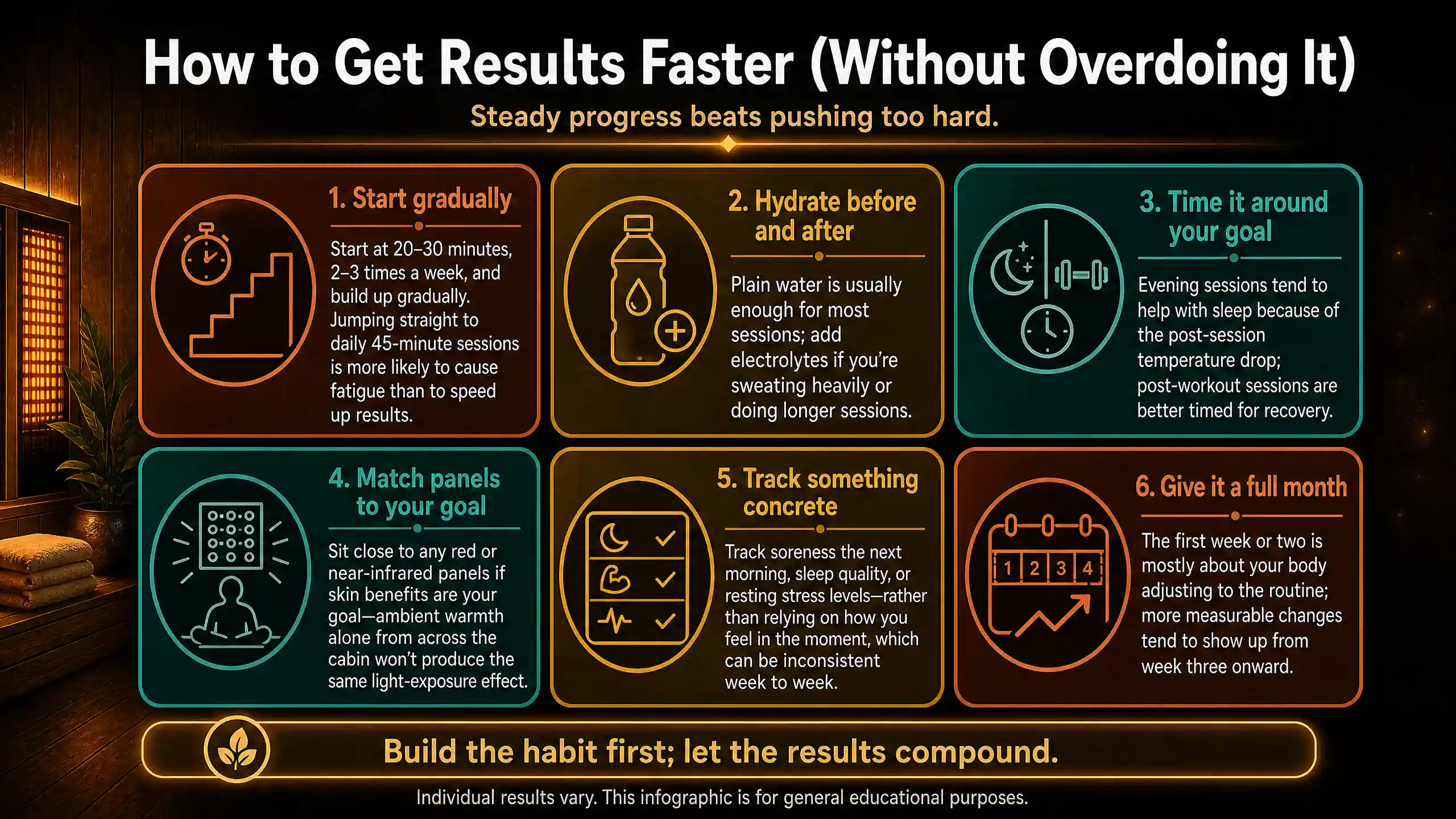
- Start at 20–30 minutes, 2–3 times a week, and build up gradually. Jumping straight to daily 45-minute sessions is more likely to cause fatigue than to speed up results.
- Hydrate before and after plain water is usually enough for most sessions; add electrolytes if you’re sweating heavily or doing longer sessions.
- Time it around your goal. Evening sessions tend to help with sleep because of the post-session temperature drop; post-workout sessions are better timed for recovery.
- Sit close to any red or near-infrared panels if skin benefits are your goal — ambient warmth alone from across the cabin won’t produce the same light-exposure effect.
- Track something concrete soreness the next morning, sleep quality, or resting stress levels — rather than relying on how you feel in the moment, which can be inconsistent week to week.
- Give it a full month before judging results. The first week or two is mostly about your body adjusting to the routine; the more measurable changes tend to show up from week three onward.
Common Mistakes That Delay Results
- Inconsistent use. One session every couple of weeks won’t produce the cumulative effects described above — the timeline resets each time you go too long between sessions.
- Skipping hydration. Dehydration makes sessions feel worse, which often leads people to quit before benefits appear.
- Expecting fat loss from sweating alone. The scale drop after a session is water, not fat, and it returns once you rehydrate.
- Sitting too far from red-light panels if skin or collagen benefits are the goal.
- Going too hot, too long, too soon. Overdoing session length as a beginner often causes people to feel drained rather than relaxed, which undermines the habit before it has time to pay off.
Who Should Talk to a Doctor Before Starting
Check with a healthcare provider before beginning regular infrared sauna use if you:
- Are pregnant
- Have unstable heart disease, very low or very high blood pressure, or a history of fainting
- Have kidney disease
- Take medication that affects hydration, blood pressure, or heat tolerance
- Have a fever or active illness
If you feel dizzy, nauseated, or lightheaded during a session, exit and cool down — these aren’t signs to push through.
FAQs
How long does it take to see benefits from an infrared sauna?
Sensory relief — feeling calmer, warmer, and less tense — happens within the first session. More measurable changes, like reduced soreness and better sleep, typically build over 1 to 4 weeks of regular use (3–4 sessions per week). Deeper effects, including cardiovascular conditioning, generally take 1 to 3 months.
How long should each session last?
20 to 45 minutes is typical. Beginners should start around 15–20 minutes and build up gradually rather than starting at the high end.
Can infrared saunas help with weight loss?
Not directly. The elevated heart rate burns some extra calories, but any immediate weight change is water loss. Meaningful changes in body composition require diet and exercise; the sauna can be a complement, not a substitute.
Does infrared sauna use help with sleep?
Many users report improved sleep, particularly when sessions are used in the late afternoon or evening. The mechanism is thought to involve the post-session drop in core body temperature, which supports the body’s natural sleep-onset process.
Is infrared sauna good for sore muscles after a workout?
This is one of the better-supported short-term benefits. Research on post-exercise infrared sauna use has shown reduced perceived soreness compared with passive recovery, though individual results vary with training load and other recovery habits.
Do infrared saunas actually detoxify the body?
Sweating removes a small amount of certain substances through the skin, but your liver and kidneys handle the large majority of detoxification regardless of sauna use. Treat “detox” claims with skepticism if they cite specific, precise percentages.
Is it safe to use an infrared sauna every day?
Daily use is generally considered safe for healthy adults when sessions are moderate in length and hydration is maintained, but check with a doctor first if you have any of the conditions listed above.
How is an infrared sauna different from a traditional sauna?
Infrared saunas heat your body directly using infrared light at 100–140°F. Traditional saunas heat the surrounding air, typically to 150–195°F, which warms you indirectly. Because of the lower temperature, infrared sessions are often longer and more tolerable for heat-sensitive users.
Can red light therapy in a sauna improve my skin?
Only if you’re sitting close enough to the panels typically within a few inches for the light to reach bare skin directly. Sitting elsewhere in the cabin provides ambient warmth but not the same targeted light exposure.
Are there people who shouldn’t use an infrared sauna?
Yes, pregnant people, those with unstable heart disease or blood pressure issues, kidney disease, fever, or certain medications should consult a doctor before starting.
Will I feel worse before I feel better?
Some people feel mildly fatigued after their first couple of sessions while their body adjusts to heat exposure and increased sweating. This usually resolves within the first week or two as hydration and session length are dialed in.
What’s the fastest way to notice a difference?
Consistency beats intensity. Three to four moderate 20–30 minute sessions a week for a full month will generally produce more noticeable results than occasional 60-minute sessions spread out irregularly.
Does hydration really affect how fast I see results?
Yes. Under-hydrated sessions leave you feeling drained rather than relaxed, which both blunts the immediate benefit and makes the habit harder to sustain long enough for the cumulative effects to show up.