
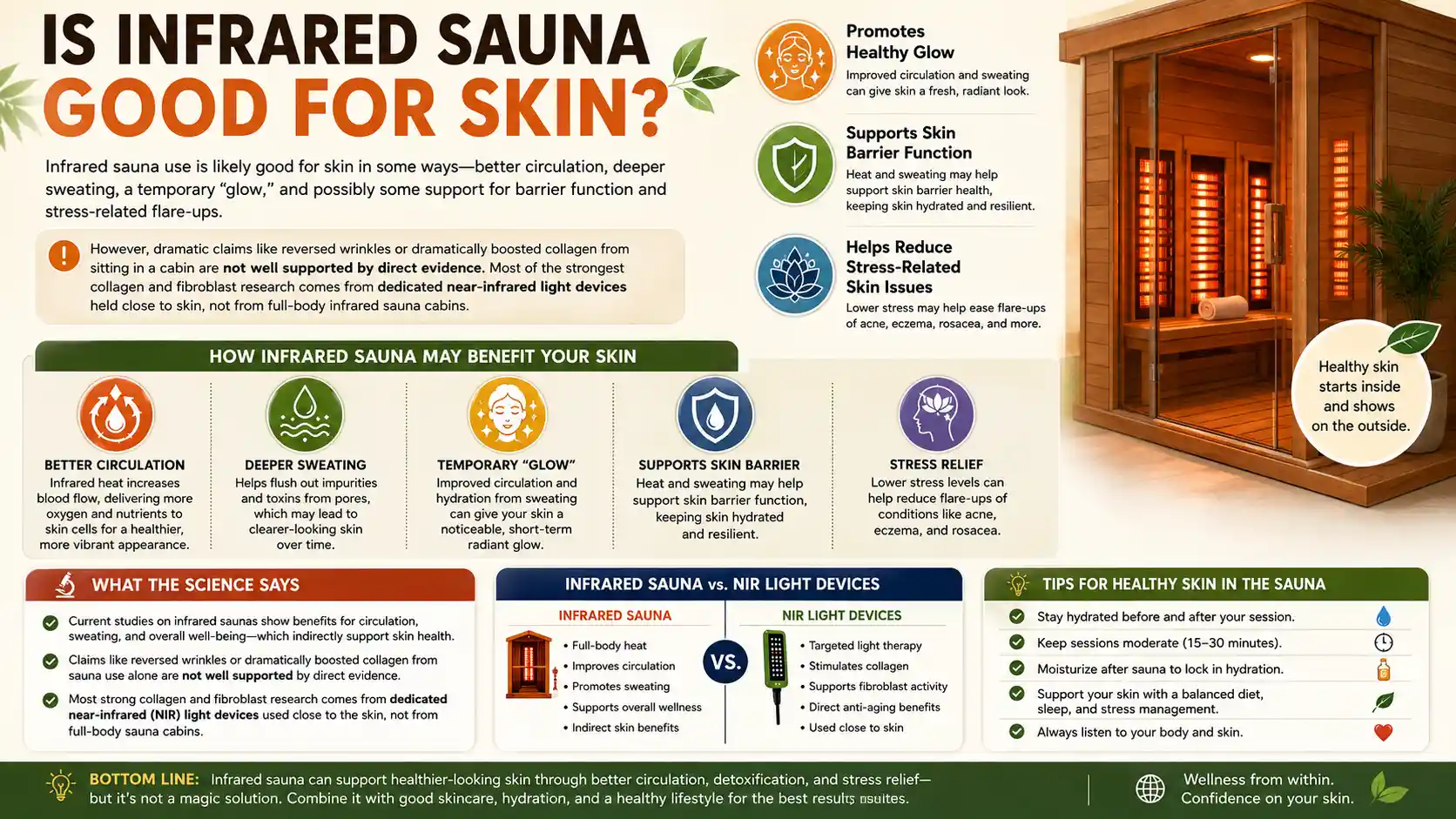
Infrared sauna use is likely good for skin in some ways better circulation, deeper sweating, a temporary “glow,” and possibly some support for barrier function and stress-related flare-ups but the more dramatic claims you’ll see online, like reversed wrinkles or dramatically boosted collagen from sitting in a cabin, are not well supported by direct evidence. Most of the strongest collagen and fibroblast research comes from dedicated near-infrared light devices held close to skin, not from full-body infrared sauna cabins, and it’s an important difference worth understanding before you buy a membership or a home unit.
Key Takeaways
- Infrared sauna use increases blood flow to the skin, which is the mechanism behind the well-known “sauna glow.” This effect is well documented and shows up within minutes.
- Deeper, gentler sweating at lower air temperatures than a traditional sauna can help clear pores and support the skin’s barrier when paired with proper hydration.
- Near-infrared wavelengths are studied for stimulating fibroblasts and collagen — but most of that research uses targeted light panels aimed directly at skin, not a sauna cabin, so extrapolating the benefit to full-body sauna sessions is reasonable but not proven.
- People with eczema or psoriasis sometimes report fewer flare-ups, likely tied to stress and cortisol reduction rather than a direct skin effect.
- Infrared saunas do not use UV light, so they don’t carry the skin cancer risk associated with sun exposure or tanning beds — but heat itself still requires precautions for certain skin conditions and medications.
- If you’re chasing collagen specifically, dedicated red/near-infrared light therapy panels have more direct supporting evidence than a sauna cabin session.
Infrared Sauna Skin Benefits: Quick Review
| Claim | Evidence strength | What’s actually shown |
|---|---|---|
| Improves circulation / “glow” | Strong | Vasodilation increases skin blood flow measurably and quickly |
| Supports skin barrier & hydration | Moderate, conditional | Benefit shown with regular use, but requires proper rehydration |
| Reduces acne | Weak to moderate | Plausible via sweating and stress reduction; not a direct acne treatment |
| Boosts collagen production | Weak-to-moderate for sauna specifically; stronger for dedicated NIR devices | Collagen/fibroblast research mostly used targeted light panels, not cabins |
| Calms eczema/psoriasis flares | Weak to moderate | Likely tied to cortisol/inflammation reduction, not a direct skin effect |
| Reverses wrinkles or age spots | Not supported | No dedicated sauna-cabin studies confirm this |
| Safer than UV tanning | Strong | No UV exposure, so no UV-related skin cancer risk from the light itself |
What Is an Infrared Sauna, and How Is It Different from a Regular Sauna?
A traditional sauna heats the air around you, usually to 150–195°F, and your body absorbs heat from that hot air. An infrared sauna works differently: it uses infrared light the same type of energy you feel as warmth from sunlight to heat your body directly, while the surrounding air stays much cooler, typically 120–150°F.
That lower air temperature is the main reason people who can’t tolerate traditional saunas often turn to infrared ones instead. Infrared light is different from UV light, so it doesn’t carry the same skin-damaging effects as sun or tanning-bed exposure. And because saunas trigger physical responses similar to moderate exercise — a faster heart rate and heavier sweating — infrared cabins can produce those effects at noticeably lower air temperatures than a traditional sauna.
Infrared light itself comes in three wavelength ranges, and they matter for the skin conversation:


Paid Links - As an Amazon Associate, I earn from qualifying purchases.
| Wavelength type | Range | What it’s associated with |
|---|---|---|
| Near-infrared (NIR) | ~700–1,400 nm | Shallowest penetration; most studied for fibroblast activity and collagen-related signaling |
| Mid-infrared (MIR) | ~1,400–3,000 nm | Deeper tissue penetration; associated with circulation and pain relief |
| Far-infrared (FIR) | ~3,000 nm–1 mm | Deepest heat penetration; most common in full-cabin home and spa saunas |
Most consumer “infrared sauna” cabins emphasize far-infrared heating elements, sometimes blended with some near-infrared. That matters because the skin research you’ll see cited most often the collagen and fibroblast studies was largely done with near-infrared—dominant devices, not far-infrared cabins.
Is Infrared Sauna Good for Skin? The Evidence, Benefit by Benefit
1. It boosts circulation and produces the “sauna glow” (proven)
This is the most reliably documented skin effect. Heat causes vasodilation — your blood vessels widen to help release heat — which sends more blood, oxygen, and nutrients to the skin’s surface. That’s what produces the flushed, dewy “glow” people notice right after a session. It’s a real, visible, short-term effect, though it fades within a few hours as your skin temperature normalizes.



Paid Links - As an Amazon Associate, I earn from qualifying purchases.
2. It supports the skin’s barrier and hydration if you rehydrate properly (likely, conditional)
Older sauna research found that regular heat exposure can train the skin to hold moisture more effectively over time. A frequently cited study on regular sauna bathing found improvements in epidermal barrier recovery and stratum corneum hydration with consistent use.
The catch: sweating pulls water out of your body, and if you don’t replace fluids before and after a session, you can end up with the opposite result — drier, more irritated skin. The barrier benefit really does depend on hydration; skip the water before and after your session and you risk undoing the very effect you’re after. This is likely the single most common reason people report “infrared sauna dry skin” as a complaint.
3. Deep sweating may help with clogged pores and acne (plausible, not conclusive)
Infrared sauna sessions produce meaningful sweat volume — often several hundred milliliters over a 30-minute session — which some people find helps flush debris from pores and reduces breakouts over time. This is a plausible mechanism, but it’s important to be precise about what’s actually proven versus assumed:
- Sweating itself does not “detox” the skin of acne-causing bacteria in a clinically validated way; acne is driven mainly by oil production, clogged follicles, bacteria, and inflammation, not by a lack of sweating.
- What is more defensible is the circulation and stress-reduction angle — better blood flow and lower cortisol can indirectly support skin that reacts to inflammation and stress hormones.
- If you have active acne, sweating without a prompt, gentle cleanse afterward can sometimes make breakouts worse rather than better, since sweat mixed with oil sitting on skin for too long can clog pores further.
4. Near-infrared light is studied for collagen support but mostly outside of sauna cabins (promising, needs a caveat)
This is the area where marketing claims run furthest ahead of the evidence. Near-infrared wavelengths have real, published research behind their ability to stimulate fibroblasts (the cells that produce collagen) and support skin firmness and elasticity. Lab research published in the Yonsei Medical Journal, for instance, found that far-infrared exposure increased microcirculation and supported collagen synthesis in human dermal fibroblasts.


Paid Links - As an Amazon Associate, I earn from qualifying purchases.
However, there’s an important distinction that most sauna marketing glosses over: the skin-texture studies most often cited used a dedicated near-infrared light device applied directly to facial skin — not a full-body sauna cabin. That’s encouraging for near-infrared technology generally, but extrapolating those findings to a sauna session means acknowledging a real difference in delivery method, distance, and dose.
In plain terms: sitting in an infrared sauna cabin is not the same dose or delivery method as holding a dedicated red/near-infrared light panel a few inches from your face. If collagen support is your main goal, a purpose-built photobiomodulation (red light therapy) device has more direct evidence than a sauna session does. The sauna may still help indirectly, through circulation and heat-shock-protein activation, but calling it a proven “collagen treatment” overstates the current science.
5. It may calm stress-related skin conditions like eczema and psoriasis (plausible, indirect)
Sauna use is associated with reduced cortisol and lower inflammatory markers like C-reactive protein. Because stress is a well-known trigger for both eczema and psoriasis flare-ups, this is a reasonable indirect pathway — calmer stress hormones may mean fewer flare-ups for some people. That said, this isn’t the same as infrared light directly treating these conditions, and results vary a lot between individuals. Anyone with an active flare or diagnosed skin condition should check with a dermatologist before adding regular heat sessions to their routine, since heat and sweating can aggravate some skin conditions rather than soothe them.
6. It’s not a treatment for wrinkles, scars, or age spots (overstated in most marketing)
You’ll find plenty of blog claims stating infrared saunas “reduce wrinkles,” “fade age spots,” or “improve scars.” These claims typically cite general far infrared or photo biomodulation research rather than studies on sauna cabins specifically, and no major dermatology body currently recommends infrared saunas as a treatment for these concerns. If a visible reduction in fine lines or pigmentation is your primary goal, established options retinoids, sunscreen consistency, in-office laser or light treatments, and dedicated red light therapy — have considerably stronger direct evidence.
Who Should Be Cautious or Avoid Infrared Sauna Use
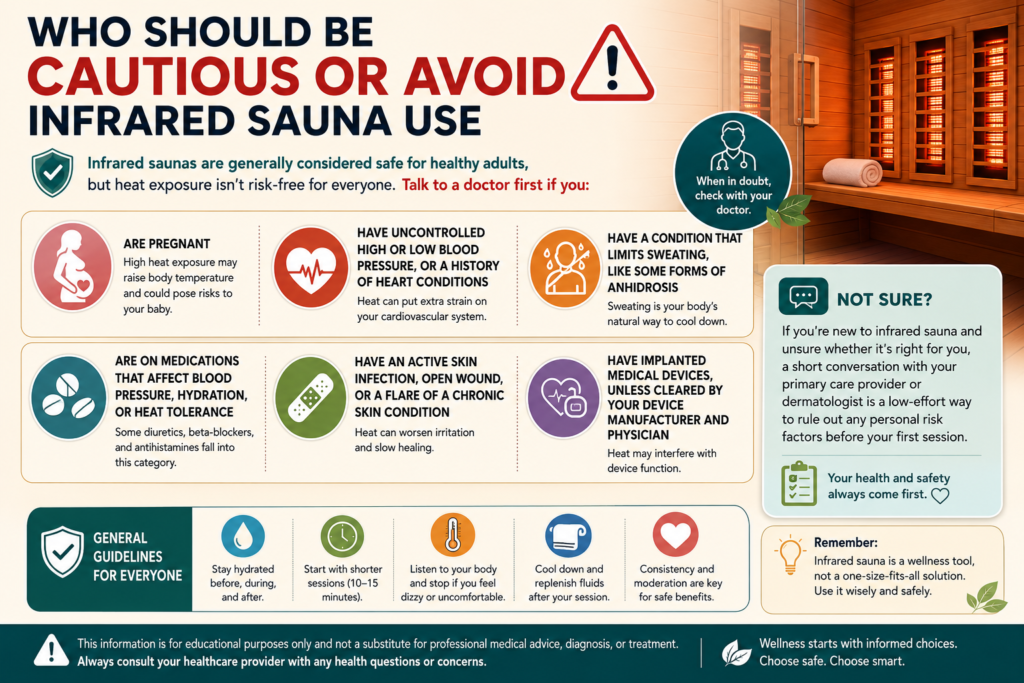
Infrared saunas are generally considered safe for healthy adults, but heat exposure isn’t risk-free for everyone. Talk to a doctor first if you:
- Are pregnant
- Have uncontrolled high or low blood pressure, or a history of heart conditions
- Have a condition that limits sweating, like some forms of anhidrosis
- Are on medications that affect blood pressure, hydration, or heat tolerance (some diuretics, beta-blockers, and antihistamines fall into this category)
- Have an active skin infection, open wound, or a flare of a chronic skin condition
- Have implanted medical devices, unless cleared by your device manufacturer and physician
If you’re new to infrared sauna and unsure whether it’s right for you, a short conversation with your primary care provider or dermatologist is a low-effort way to rule out any personal risk factors before your first session.
How to Use an Infrared Sauna for Skin Health (Without Overdoing It)
- Hydrate before and after. Drink water 30–60 minutes before your session and rehydrate afterward, ideally with some electrolytes if you sweat heavily. This single step prevents most of the “dry skin” complaints. You should also know what to avoid before and after an infrared sauna session?
- Start short. 15–20 minutes at a lower temperature setting is a reasonable starting point if you’re new to infrared sauna use; you can build up to 30–45 minutes as your tolerance increases.
- Cleanse skin before and shower after. Going in with clean skin (no heavy makeup or thick lotion) helps sweat exit pores rather than get trapped under product. Rinsing off after prevents sweat and oil from sitting on skin too long.
- Don’t exfoliate right before a session. Freshly exfoliated skin is more sensitive to heat; give it a few hours of buffer.
- Watch for lightheadedness or overheating. Step out if you feel dizzy, nauseated, or unusually fatigued. There’s no skin benefit worth pushing through genuine heat intolerance.
- Be consistent rather than intense. Most of the circulation and barrier benefits associated with regular sauna use come from consistency over weeks, not from one long, intense session.
- Pair it with proven skincare, not instead of it. An infrared sauna is a nice-to-have complement to sunscreen, a basic cleanser/moisturizer routine, and dermatologist-recommended treatments — not a substitute for any of them.
Infrared Sauna vs. Red Light Therapy for Skin: What’s the Difference?
This is one of the most common points of confusion, since both get marketed with similar skin claims.
| Infrared Sauna | Red/Near-Infrared Light Therapy Panel | |
|---|---|---|
| Primary goal | Whole-body heating, sweating, relaxation | Targeted light exposure to specific skin areas |
| Distance from skin | Several feet (cabin) | A few inches (direct exposure) |
| Session length | 15–45 minutes | Typically 10–20 minutes |
| Strongest evidence for | Circulation, relaxation, general heat-therapy benefits | Fibroblast activity, collagen-related signaling |
| Best for | Overall relaxation and stress-linked skin support | Targeted skin texture and tone goals |
If your main goal is skin-specific collagen support, a dedicated light panel used consistently is the better-evidenced choice. If your goal is general relaxation with skin as a secondary benefit, an infrared sauna is a reasonable option.
FAQs
Is infrared sauna good for skin?
It can support circulation, sweating, and barrier hydration when used consistently and with proper rehydration. Claims about reversing wrinkles or dramatically boosting collagen are not well supported by direct sauna-cabin research, even though related light-based technology shows promise.
Does infrared sauna help with acne?
It may help indirectly through improved circulation and lower stress hormones, but it isn’t a proven direct acne treatment. Cleansing before and showering promptly after a session matters more for preventing breakouts than the sauna itself.
Can infrared sauna cause dry skin?
Yes, if you don’t hydrate properly before and after your session. Sweating pulls water from your body, and without replacing it, skin can end up drier rather than more hydrated.
How often should I use an infrared sauna for skin benefits?
Most people who report noticeable skin changes use their sauna 3–4 times per week for several weeks. Frequency matters more than any single long session.
Is infrared sauna bad for aging skin?
There’s no evidence it damages skin the way UV exposure does, since it doesn’t emit UV light. It’s also not proven to reverse visible signs of aging on its own.
Does infrared sauna increase collagen production?
Near-infrared wavelengths are linked to fibroblast activity and collagen-related signaling in research, but most of that evidence comes from dedicated light panels, not full-body sauna cabins. The sauna may contribute indirectly, but it isn’t the primary evidence source for this claim.
Is infrared sauna safe for eczema or psoriasis?
It may help some people through stress and inflammation reduction, but heat and sweating can also aggravate active flares in others. Check with a dermatologist before adding regular sessions if you have a diagnosed flare-prone condition.
Does infrared sauna help with rosacea?
Heat is a known trigger for many people with rosacea, so infrared sauna use may worsen flushing and redness rather than help. This is a condition where caution is warranted.
How long does the “sauna glow” last?
The visible flush from increased blood flow typically fades within a few hours after a session, though regular users often report an improved baseline skin tone over time.
Is infrared sauna better than a traditional sauna for skin?
Neither has been shown to be clearly superior for skin specifically. Infrared saunas offer a lower-air-temperature option for people who find traditional saunas too intense, which may make consistent use easier.
Can I wear skincare products in an infrared sauna?
It’s best to go in with clean, product-free skin so sweat can exit pores properly, and to reapply skincare after showering post-session.
Is it safe to use an infrared sauna every day?
Many people tolerate near-daily use well, but it’s worth starting with 3–4 sessions per week and watching how your skin and body respond before increasing frequency.
Does infrared sauna help with cellulite or stretch marks?
There isn’t credible evidence that infrared sauna use reduces the appearance of cellulite or stretch marks specifically.
My Final Thoughts
Infrared sauna use is a reasonable, low-risk addition to a skin care routine for most healthy adults mainly through better circulation, a temporary glow, and barrier support when you hydrate properly. It is not a proven substitute for sunscreen, dermatologist-recommended treatments, or dedicated collagen-stimulating devices like red/near-infrared light panels, and it isn’t a direct treatment for acne, wrinkles, or chronic skin conditions.
If your goal is general relaxation with some skin perks along the way, it’s worth trying. If your goal is a specific, measurable skin outcome, pair it with rather than substitute it for treatments that have more direct evidence behind them.