
What is infrared radiation, and why does it make your face feel warm next to a campfire when the air around you is freezing?
The short answer: infrared radiation is invisible light with wavelengths a little longer than red light. You can’t see it, but your skin picks it up as heat. An infrared sauna is built on exactly this idea. Instead of blasting a room with hot air, it uses heaters that send infrared energy straight at your body.
That sounds simple, and the core physics really is. The confusing part is everything sauna brands layer on top: near, mid and far infrared, “deep penetration,” “detox,” “low EMF.” Some of it is solid science, and some is marketing running ahead of the evidence.
This guide sorts it out. You’ll learn what infrared radiation is, how it turns into heat, what happens in a session, and which claims hold up.


Paid Links - As an Amazon Associate, I earn from qualifying purchases.
Key takeaways
- Infrared (IR) radiation is part of the electromagnetic spectrum, just past visible red light.
- Everything warmer than absolute zero gives off IR, including you.
- Infrared saunas warm your body directly, so the air stays cooler than in a traditional sauna.
- Claims about deep penetration and detox go further than the research does.
- If you have heart, blood pressure, or pregnancy concerns, talk to a doctor first.
What Is Infrared Radiation?
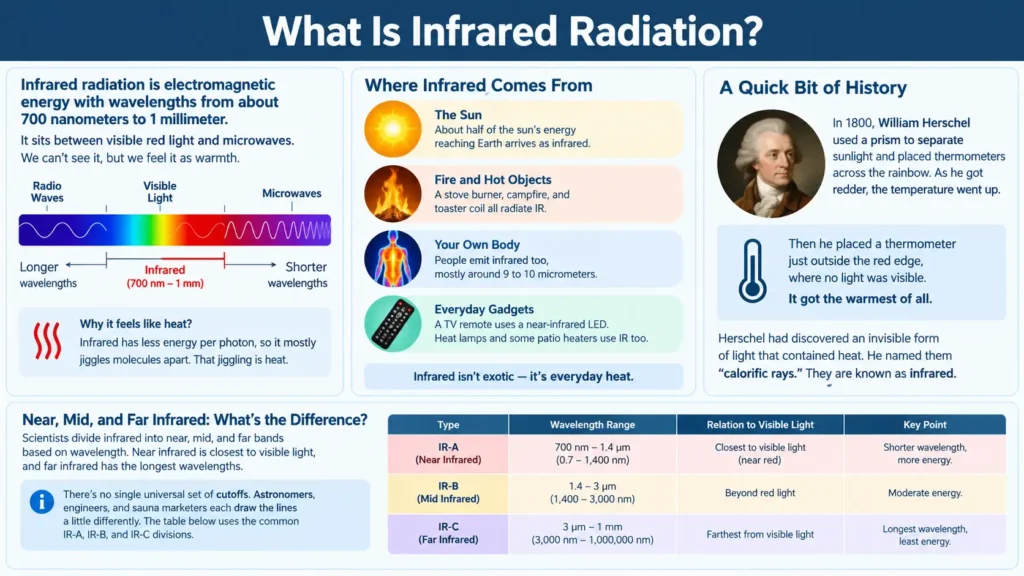
Infrared radiation is electromagnetic energy with wavelengths from about 700 nanometers to 1 millimeter. That puts it between visible red light and microwaves. We can’t see it, but we feel it as warmth.
Imagine that the electromagnetic spectrum is a long ladder. Radio waves are at the long-wavelength end. At the short end are the gamma rays. There is a small band in the middle, which is visible light. The name infrared comes from the fact that it is the rung just below red (“infra” means below).



Paid Links - As an Amazon Associate, I earn from qualifying purchases.
The wavelength is important because it determines the behavior of energy. The shorter the wavelength, such as X-rays and ultraviolet, the more energy it has to destroy cells. Infrared has a lot less energy per photon and so it mostly jiggles molecules apart. That jiggling is what we call heat.
Where infrared comes from
You’re surrounded by it. Here are the big sources:
- The sun. NASA notes that about half of the sun’s energy reaching Earth arrives as infrared. That’s the warmth you feel on your skin on a cool, sunny day.
- Fire and hot objects. A stove burner, a campfire, and a toaster coil all radiate IR.
- Your own body. People emit infrared too, mostly around 9 to 10 micrometers. Thermal cameras “see” you by reading it.
- Everyday gadgets. A TV remote sends signals with a near-infrared LED. Heat lamps and some outdoor patio heaters use infrared as well.
That last point is worth remembering. Infrared isn’t some exotic, lab-only thing. It’s the most ordinary kind of heat there is. Sauna makers just aim it on purpose.
A quick bit of history
Astronomer William Herschel wondered in 1800 about the amount of heat each color of sunlight contained. He used a prism to separate the sunlight and placed thermometers across the rainbow. As he got redder, the temperature went up. What he did next was ingenious: He placed a thermometer just outside the red edge, where no light was visible.



Paid Links - As an Amazon Associate, I earn from qualifying purchases.
It got the warmest of all. Herschel had discovered an invisible form of light that contained heat. He named them “calorific rays. They are known as infrared.
Near, Mid, and Far Infrared: What’s the Difference?
Scientists divide infrared into near, mid, and far bands based on wavelength. Near infrared is closest to visible light, and far infrared has the longest wavelengths.
Here’s the catch: there’s no single universal set of cutoffs. Astronomers, engineers, and sauna marketers each draw the lines a little differently. The table below uses the common IR-A, IR-B, and IR-C divisions.
| Band | Approx. wavelength | Also called | Typical sources |
|---|---|---|---|
| Near infrared | 0.7 to 1.4 µm | IR-A | Sun, hot filaments, remote controls |
| Mid infrared | 1.4 to 3 µm | IR-B | Very hot heating elements |
| Far infrared | 3 µm to 1 mm | IR-C | Warm objects, body heat, most sauna panels |
You’ll often see sauna companies using looser labels, and that’s fine as long as you know they’re marketing terms, not strict physics.
Then there’s the “full spectrum” pitch. A full spectrum infrared sauna combines far-infrared panels with lamps that add some near and mid infrared. It sounds like more must be better. But independent research hasn’t clearly shown that mixing bands gives you meaningfully better results than far infrared alone. Choose it if you like how it feels, not because of a proven advantage.
How Does Infrared Radiation Create Heat?
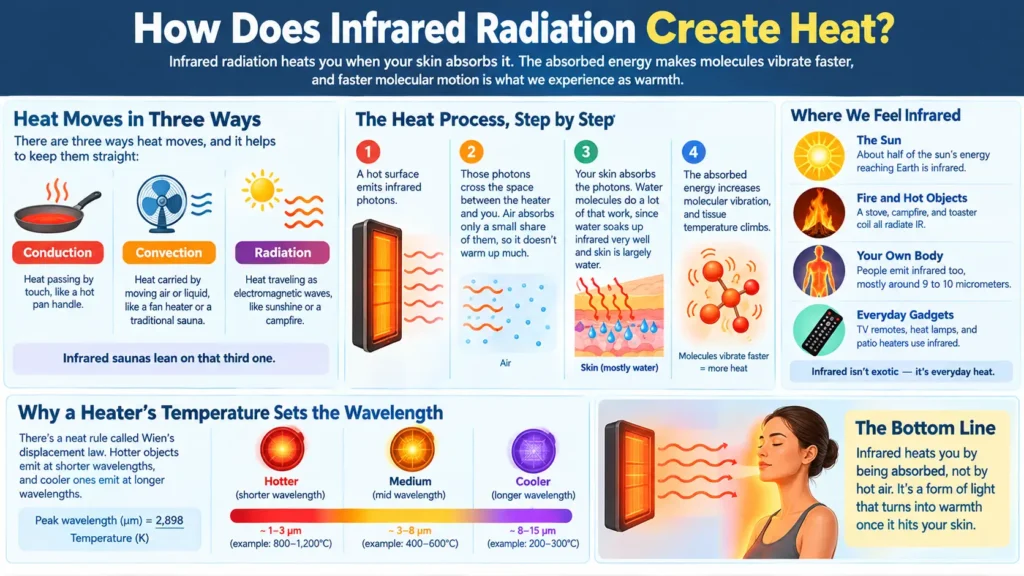
Infrared radiation heats you when your skin absorbs it. The absorbed energy makes molecules vibrate faster, and faster molecular motion is what we experience as warmth.
Heat moves in three ways, and it helps to keep them straight:
- Conduction is heat passing by touch, like a hot pan handle.
- Convection is heat carried by moving air or liquid, like a fan heater or a traditional sauna.
- Radiation is heat traveling as electromagnetic waves, like sunshine or a campfire.
Infrared saunas lean on that third one.
Emission, absorption, and molecular motion
Here’s how it plays out, step by step:
- A hot surface emits infrared photons.
- Those photons cross the space between the heater and you. Air absorbs only a small share of them, so it doesn’t warm up much.
- Your skin absorbs the photons. Water molecules do a lot of that work, since water soaks up infrared very well and skin is largely water.
- The absorbed energy increases molecular vibration, and tissue temperature climbs.
That’s the whole trick. No hot air needs to reach you first. It’s the same reason you can stand in the sun on a chilly day and feel toasty, then step into shade and feel the cold immediately. The air didn’t change. The infrared stopped hitting you.
Why a heater’s temperature sets the wavelength
There’s a neat rule called Wien’s displacement law. Hotter objects emit at shorter wavelengths, and cooler ones emit at longer wavelengths. You can estimate the peak wavelength in micrometers by dividing 2,898 by the temperature in kelvins.
| Surface temperature | Approx. peak wavelength |
|---|---|
| ~100°C (373 K) | ~7.8 µm |
| ~400°C (673 K) | ~4.3 µm |
| ~700°C (973 K) | ~3.0 µm |
| Sun’s surface (~5,800 K) | ~0.5 µm (visible light) |
That is why panels that operate at relatively low temperatures radiate primarily in the far-infrared, and a glowing-hot element radiates at shorter wavelengths. It also accounts for the fact that your own skin, which is at about 33°C, radiates at long wavelengths.
One additional detail: no heater produces only one wavelength. It produces a wide curve and the manufacturers typically specify where the peak occurs. Thus “far infrared only” is actually “mostly far infrared.
How Does an Infrared Sauna Use Infrared Radiation?
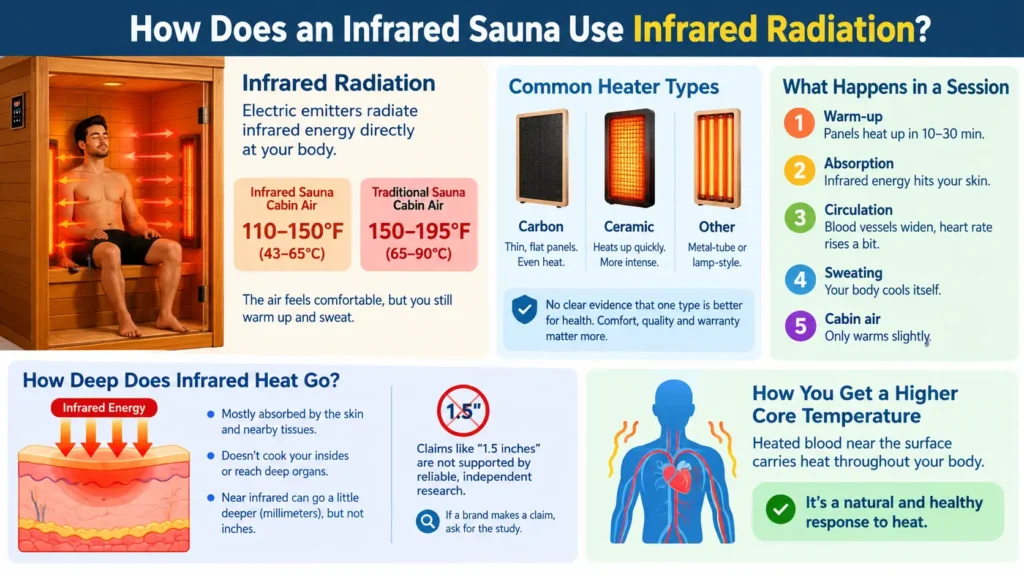
An infrared sauna uses electric emitters to radiate infrared energy directly at your body. Cabin air is usually about 110 to 150°F (43 to 65°C), while traditional saunas often run around 150 to 195°F (65 to 90°C) or hotter.
If you’ve only used a traditional sauna, this feels different. The air is comfortable, sometimes almost mild, but you still warm up and sweat. That’s because your body is absorbing energy directly from the panels rather than waiting for hot air to do the job.
Common heater types
Most home cabins use one of these:
- Carbon heaters. Thin, flat, carbon-based panels. They’re often marketed for spreading heat over a larger, more even surface.
- Ceramic heaters. Ceramic elements that get hotter and warm up quickly. They can feel more intense and concentrated.
- Other emitters. Metal-tube and lamp-style heaters exist too, and design varies a lot by brand.
Everyone loves to argue about which is best. Honestly, there’s no strong independent evidence that one heater type beats another for health outcomes. Comfort, build quality, and warranty matter more than the material.
If you want to go deeper into the panels themselves, this breakdown of a far-infrared sauna is a good place to start.
You’ll also see “low EMF” plastered on product pages. EMF refers to the electric and magnetic fields that electrical devices produce. A low EMF infrared sauna is designed to cut those fields down. If a brand makes the claim, ask to see independent test results rather than taking it on faith.
What happens in a session
Here’s a typical session from start to finish:
- Warm-up. The panels heat up, usually in 10 to 30 minutes depending on the model.
- Absorption. Infrared energy lands on your skin, and you start feeling a gentle warmth.
- Circulation. Blood vessels near the skin widen, and your heart rate rises a bit as your body handles the extra heat.
- Sweating. Your body starts sweating to cool itself. This is thermoregulation, not “purging” anything.
- Cabin air. The air warms slightly from the heaters and from you, but far less than in a traditional sauna.
Most people describe it as a softer heat that builds gradually. Some love that. Others miss the intense blast and steam of a classic sauna.
How Deep Does Infrared Heat Really Go?
The majority of the IR energy is absorbed by the skin and the underlying tissues. It doesn’t cook your insides, and it doesn’t reach deep organs directly.
You’ll see ads claiming infrared reaches “several inches” into the body. Be skeptical. Longer wavelengths are absorbed strongly at the surface, mostly because of all the water in skin. Near infrared can go somewhat deeper, into the range of millimeters, but that’s a long way from inches.
But how do you increase your core temperature? Blood does the job. When the blood is heated near the surface, it moves around in your body and brings heat along. It is a natural and healthy response to heat and the same thing that happens in any sauna or hot bath.
I don’t know of any reliable, independent information to support specific penetration-depth claims such as “1.5 inches” that are sometimes used in marketing. If a company does quote one, request the study.
Infrared Sauna vs. Traditional Sauna
The main difference is how they deliver heat. Infrared saunas radiate energy at your body, while traditional saunas heat the air and let convection do the work.
| Feature | Infrared sauna | Traditional sauna |
|---|---|---|
| Main heat transfer | Radiation | Convection (hot air) |
| Typical air temp | ~110 to 150°F (43 to 65°C) | ~150 to 195°F (65 to 90°C) or more |
| Humidity | Dry | Low, with optional steam from water on stones |
| Warm-up time | Often shorter | Often longer |
| Feel | Gentler air, body warms steadily | Intense, enveloping heat |
| Research base | Smaller, mostly short studies | Larger, including long-term Finnish studies |
Neither one is automatically better. Infrared suits people who find very hot air uncomfortable, or who want a quicker warm-up. Traditional suits people who like steam, ritual, and that big wave of heat when you toss water on the stones. If you’re still deciding, this side-by-side on infrared sauna vs. traditional walks through the trade-offs in more detail.
What the Research Does and Doesn’t Show
Traditional sauna has the stronger evidence base. Infrared sauna research exists, but it’s smaller and less consistent.
Here’s where things stand:
- Traditional sauna. Large Finnish population studies have linked frequent sauna use with better cardiovascular outcomes (Laukkanen and colleagues, JAMA Internal Medicine, 2015). These are observational studies, though, so they show an association, not proof of cause and effect.
- Infrared sauna. A systematic review of dry sauna bathing by Hussain and Cohen (2018) included infrared and found some signals for blood pressure and vascular function. The authors also flagged limits in study quality. An earlier review in Canadian Family Physician (Beever, 2009) looked at far-infrared saunas and cardiovascular risk factors and likewise called for larger trials.
- Where evidence is thin. Detoxification, weight loss, and pain relief are the big ones. Sweat is almost entirely water, and your liver and kidneys are the organs that filter your blood.
So what can you fairly say? Regular heat exposure looks promising for relaxation and possibly some cardiovascular markers. Beyond that, be cautious about anything sold as a cure or a cleanse.
Myth vs. Fact
| Myth | Fact |
|---|---|
| Infrared saunas give off harmful radiation like UV or X-rays. | Infrared is non-ionizing and doesn’t damage DNA the way UV does. Very intense sources can still burn skin. |
| Infrared “detoxes” your body. | Sweat is mostly water. Strong evidence for detox claims is lacking. |
| A lower air temperature means a weaker session. | You can still raise skin and body temperature substantially. |
| Far infrared heats your organs directly. | Most energy is absorbed near the surface, then spread by blood flow. |
| Pricier saunas work better. | No independent data links price to health results. |
| Sweating means you’re burning fat. | Sweating loses water, not fat. Any scale drop is mostly temporary fluid. |
Safety, Session Tips, and Common Mistakes
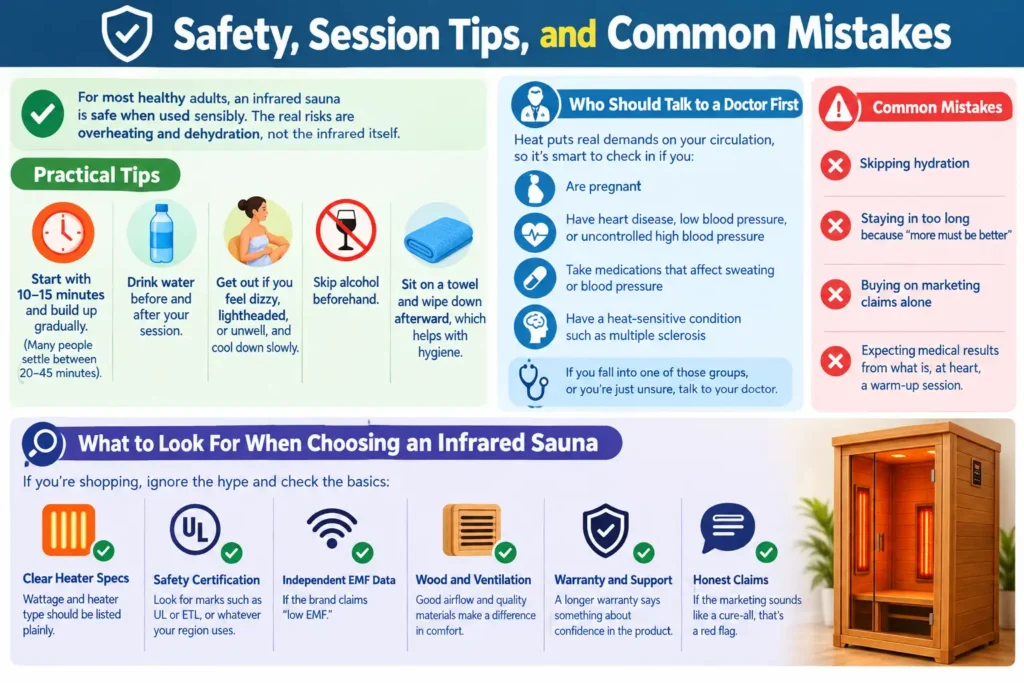
For most healthy adults, an infrared sauna is safe when used sensibly. The real risks are overheating and dehydration, not the infrared itself.
Practical tips
- Start with 10 to 15 minutes and build up gradually. Many people settle somewhere between 20 and 45 minutes.
- Drink water before and after your session.
- Get out if you feel dizzy, lightheaded, or unwell, and cool down slowly.
- Skip alcohol beforehand.
- Sit on a towel and wipe down afterward, which helps with hygiene.
Who should talk to a doctor first
Heat puts real demands on your circulation, so it’s smart to check in if you:
- Are pregnant
- Have heart disease, low blood pressure, or uncontrolled high blood pressure
- Take medications that affect sweating or blood pressure
- Have a heat-sensitive condition such as multiple sclerosis
If you fall into one of those groups, or you’re just unsure, this guide on whether an infrared sauna is safe for everyone covers the risks in more depth.
Common mistakes
- Skipping hydration
- Staying in too long because “more must be better”
- Buying on marketing claims alone
- Expecting medical results from what is, at heart, a warm-up session
What to Look For When Choosing an Infrared Sauna
If you’re shopping, ignore the hype and check the basics:
- Clear heater specs. Wattage and heater type should be listed plainly.
- Safety certification. Look for marks such as UL or ETL, or whatever your region uses.
- Independent EMF data, if the brand claims “low EMF.”
- Wood and ventilation. Good airflow and quality materials make a difference in comfort.
- Warranty and support. A longer warranty says something about confidence in the product.
- Honest claims. If the marketing sounds like a cure-all, that’s a red flag.
Frequently Asked Questions
What is infrared radiation in simple terms?
It’s invisible light with wavelengths longer than red light. We feel it as warmth.
How does an infrared sauna work?
Electric emitters radiate infrared energy. Your skin absorbs it and converts it to heat.
Is infrared the same as UV?
No. UV has shorter, higher-energy wavelengths that can damage skin cells. Infrared has longer, lower-energy wavelengths.
Does an infrared sauna heat the air?
Only a little. Most of the heating happens directly on your body, which is why the air is cooler than in a traditional sauna.
How deep does infrared penetrate?
Mostly into the skin and the tissue just below it. Large-depth claims in ads aren’t backed by strong independent evidence.
Do infrared saunas detox your body?
There’s no strong evidence that they do. Your liver and kidneys handle detoxification.
How long should a session last?
Beginners can start with 10 to 15 minutes. Many regular users stay 20 to 45 minutes.
What temperature do infrared saunas run at?
Usually about 110 to 150°F (43 to 65°C), though settings vary by model.
Can infrared saunas help with weight loss?
They make you sweat, but sweat is water, not fat. Any change on the scale is mostly temporary.
Is a carbon heater better than a ceramic one?
No strong independent evidence says so. They differ in feel and heat distribution.
Final Thoughts
Infrared radiation is simply energy at wavelengths just past red light. It’s the warmth of the sun, the glow of a fire, and the heat you give off right now. An infrared sauna takes that natural process and aims it at you on purpose, warming your body directly instead of heating a whole room of air.
The physics is correct: emission, absorption, then heat. Where things get shaky is the bigger promises. Deep penetration, detox, and miracle weight loss all outrun the research.
Therefore, use an infrared sauna for what it does well: to provide gentle heat, relaxation and a comfortable heat experience. Consider the health benefits as promising, but not proven, and consult your doctor if you have any health concerns. If you’re shopping, look at the specs, certifications, and warranties, rather than the buzzwords.