
You saw a headline, or maybe a comment on social media, claiming infrared saunas cause cancer. Now you’re standing in front of the one at your gym wondering if 20 minutes of relaxation is worth the risk. That’s a fair question, and it deserves a real answer instead of a scary headline or a sales pitch.
Here’s what’s actually going on, backed by how infrared radiation works, what regulatory agencies have said, and what the research does and doesn’t show.
The Short Answer
No major health authority has established that infrared saunas cause cancer. Infrared radiation is non-ionizing, meaning it doesn’t carry enough energy to break DNA bonds the way ultraviolet (UV) radiation, X-rays, or gamma radiation can. That DNA damage is the well-established mechanism behind most radiation-linked cancers, and infrared light isn’t strong enough to cause it.
That doesn’t mean there’s zero nuance here. Some laboratory studies on concentrated near-infrared exposure raise theoretical questions about skin aging, and the low-level electromagnetic fields (EMF) that any electrical sauna heater produces have been the subject of long-running, unresolved research into extremely low-frequency fields generally. Neither of those points adds up to “infrared saunas cause cancer”, but they’re worth understanding rather than dismissing, which is what the rest of this article walks through.


Paid Links - As an Amazon Associate, I earn from qualifying purchases.
Quick facts:
- Infrared light is non-ionizing radiation, it can’t directly damage DNA.
- No epidemiological study has linked infrared sauna use to a cancer diagnosis.
- The EMF concern is about electrical fields from the heater, not the infrared light itself, and it’s a separate, older debate that predates infrared saunas.
- The research gap isn’t “signs of danger”, it’s a lack of large, long-term studies specifically on infrared saunas, since most cancer-relevant sauna research has focused on traditional Finnish (hot-air) saunas instead.
What Infrared Radiation Actually Is
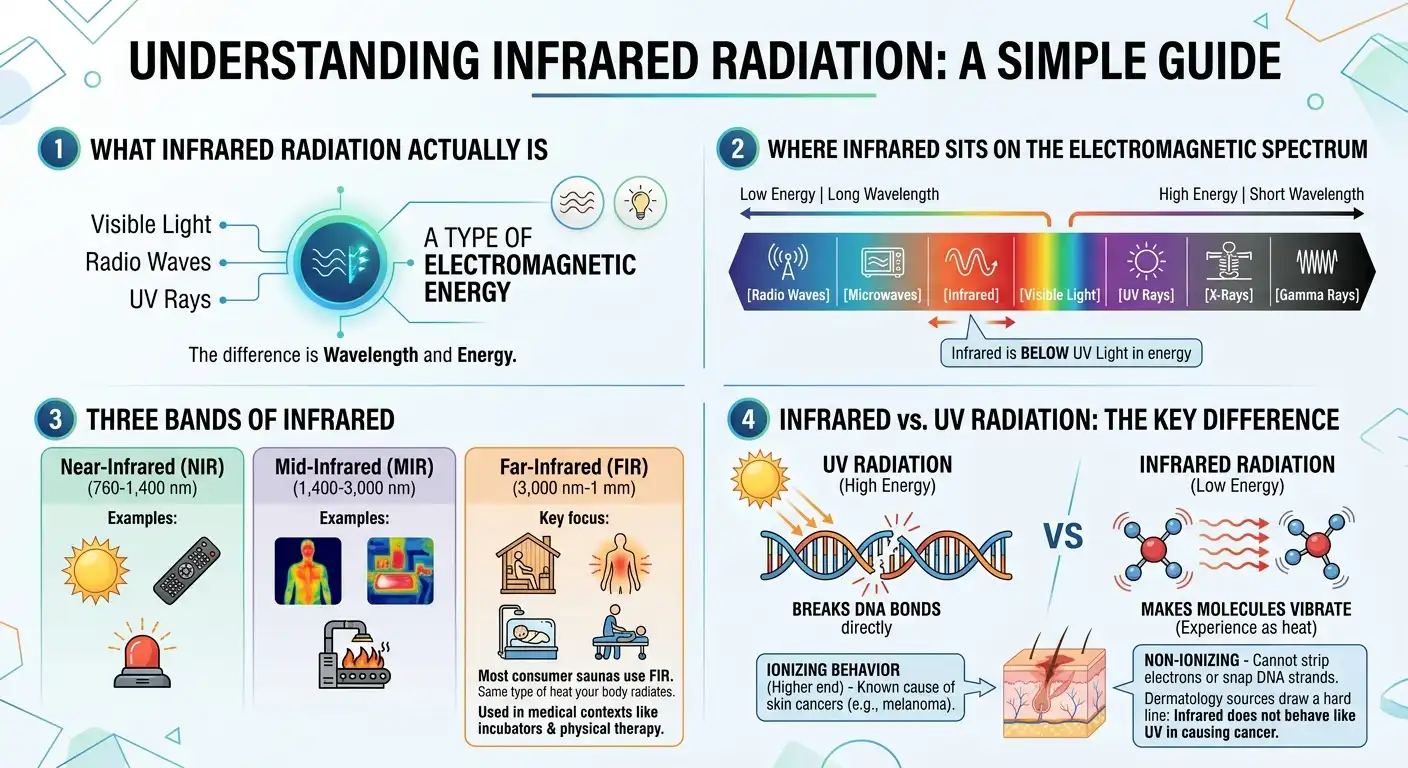
Infrared radiation is a type of electromagnetic energy, just like visible light, radio waves, and UV rays. The difference between these types comes down to wavelength and, more importantly, how much energy each carries.



Paid Links - As an Amazon Associate, I earn from qualifying purchases.
Where Infrared Sits on the Electromagnetic Spectrum
The electromagnetic spectrum runs from low-energy, long-wavelength radiation (radio waves) to high-energy, short-wavelength radiation (gamma rays). Infrared sits between visible light and microwaves, well below UV light in terms of energy. It’s typically split into three bands:
| Type | Wavelength | Where You’ll Find It |
|---|---|---|
| Near-infrared (NIR) | 760–1,400 nm | Sunlight, remote controls, some infrared sauna heaters |
| Mid-infrared (MIR) | 1,400–3,000 nm | Thermal imaging, some industrial heating |
| Far-infrared (FIR) | 3,000 nm–1 mm | Most home infrared sauna heaters, the heat your own body radiates |
Most consumer infrared saunas rely primarily on far-infrared heaters, which is the same type of heat your body naturally gives off. It’s also the wavelength used in incubators for premature infants and in some physical therapy devices, which is a useful sanity check on how mainstream medicine already treats this wavelength.
Infrared vs. UV Radiation, Why the Difference Matters
This is the single most important distinction in the entire “does infrared cause cancer” conversation, and it’s the one most sauna-brand blogs gloss over.
- UV radiation carries enough energy to break chemical bonds in DNA directly. That’s called ionizing behavior at the higher end of the UV spectrum, and it’s the well-documented mechanism behind UV-related skin cancers like melanoma and basal cell carcinoma.
- Infrared radiation is non-ionizing. Its photons don’t carry enough energy to strip electrons or snap DNA strands. Infrared mostly makes molecules vibrate faster, which you experience as heat.
This is why dermatology and skin cancer resources consistently draw a hard line between the two, even while acknowledging infrared isn’t necessarily “zero effect” at very high, prolonged doses (more on that below).



Paid Links - As an Amazon Associate, I earn from qualifying purchases.
What the Cancer Research Actually Shows
Ionizing vs. Non-Ionizing Radiation, Explained Simply
Cancer researchers group all radiation into two buckets:
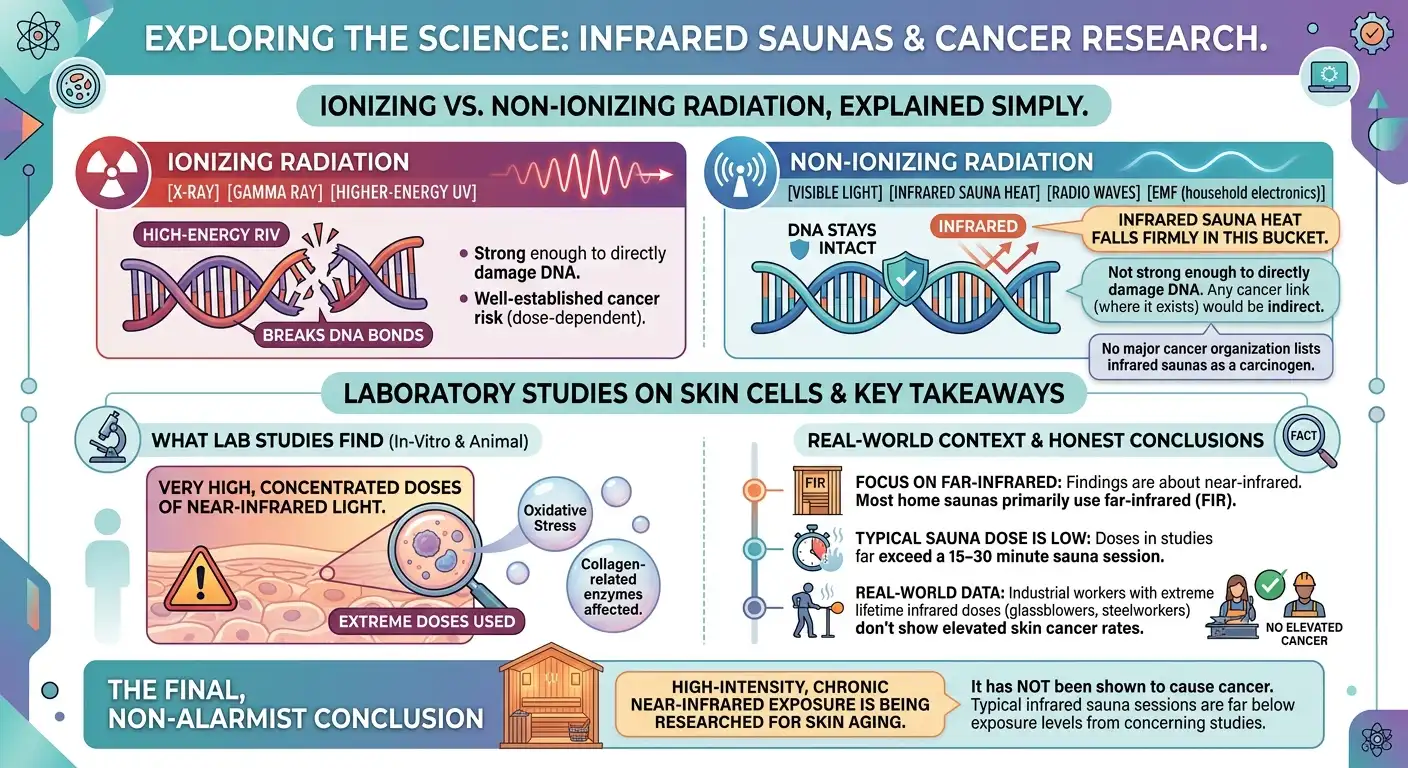
- Ionizing radiation, X-rays, gamma rays, and higher-energy UV. Strong enough to directly damage DNA. Well-established cancer risk with dose-dependent evidence.
- Non-ionizing radiation, visible light, infrared, radio waves, and most EMF from household electronics. Not strong enough to directly damage DNA. Any theorized cancer link (where one exists at all) works through indirect mechanisms like heat stress or oxidative stress, not direct genetic mutation, and the evidence for those indirect pathways is far weaker and more debated.
Infrared sauna heat falls firmly in the second bucket. That single fact is why no major cancer organization currently lists infrared exposure from saunas as a known or probable carcinogen.
What Happens to Skin Cells Studied in Labs
Some in-vitro (lab dish) and animal studies have looked at what happens when skin cells are exposed to very high, concentrated doses of near-infrared light, well beyond what a person sitting in a sauna would experience. These studies have found evidence of oxidative stress and effects on collagen-related enzymes at those extreme, sustained doses.
It’s important to be precise about what this does and doesn’t tell us:
- These findings are about near-infrared specifically, not far-infrared, which is what most consumer saunas primarily use.
- The doses used in these lab studies are typically far higher and more concentrated than a 15–30 minute home sauna session delivers.
- Researchers studying infrared’s effects on skin have specifically noted that industrial workers exposed to far higher lifetime infrared doses than the general population, such as glassblowers and steel workers, don’t show elevated rates of infrared-attributable skin cancer, even though some do show signs of accelerated skin aging from heat exposure.
So the honest, non-alarmist takeaway is: high-intensity, concentrated, chronic near-infrared exposure is a subject of ongoing dermatology research into skin aging, but it hasn’t been shown to cause cancer on its own, and typical infrared sauna sessions don’t come close to the exposure levels used in the studies that raised the original questions.
Do Infrared Saunas Cause Skin Cancer?
This is the most specific version of the question, and it deserves a direct answer: there is currently no research showing that typical infrared sauna use causes skin cancer.
What Near-Infrared Studies Actually Found
The research that gets cited most often in “infrared causes cancer” articles usually traces back to studies on near-infrared radiation’s role in photoaging, the wrinkling, pigmentation changes, and collagen breakdown associated with cumulative sun exposure. Some of these studies found that near-infrared can contribute to oxidative stress in skin cells and, when combined with UV exposure, may worsen UV-related skin damage.
Notably, one line of research on IRA (near-infrared) pretreatment in animal models found mixed results: in some experiments, IRA pretreatment actually delayed UV-induced tumor formation, though tumors that did eventually form were more aggressive. Critically, IR exposure alone, without UV, did not induce skin cancer in these models. That’s a meaningfully different finding than “infrared causes cancer,” and it gets lost in a lot of secondhand summaries.
Real-World Exposure vs. Laboratory Exposure
Nearly all of the concerning findings involve either:
- Extremely concentrated, high-irradiance NIR exposure not representative of natural sunlight or consumer sauna heaters, or
- Combined UV-plus-infrared exposure, where the UV component is doing the DNA-damaging work and the infrared is being studied as a possible amplifier.
An infrared sauna emits no meaningful UV radiation. That’s a fundamental difference from sun exposure, tanning beds, or occupational UV exposure, the actual established causes of skin cancer.
Bottom line: if you’re comparing infrared sauna use to sun exposure out of caution, the comparison itself is somewhat misplaced, because the ingredient responsible for UV-related skin cancer (UV light) isn’t present in an infrared sauna in any meaningful amount.
What About EMF (Electromagnetic Fields) From Infrared Saunas?
This is where a lot of the anxiety online actually comes from, and it’s a genuinely more nuanced topic than the skin cancer question.
What Is EMF and Why People Worry About It
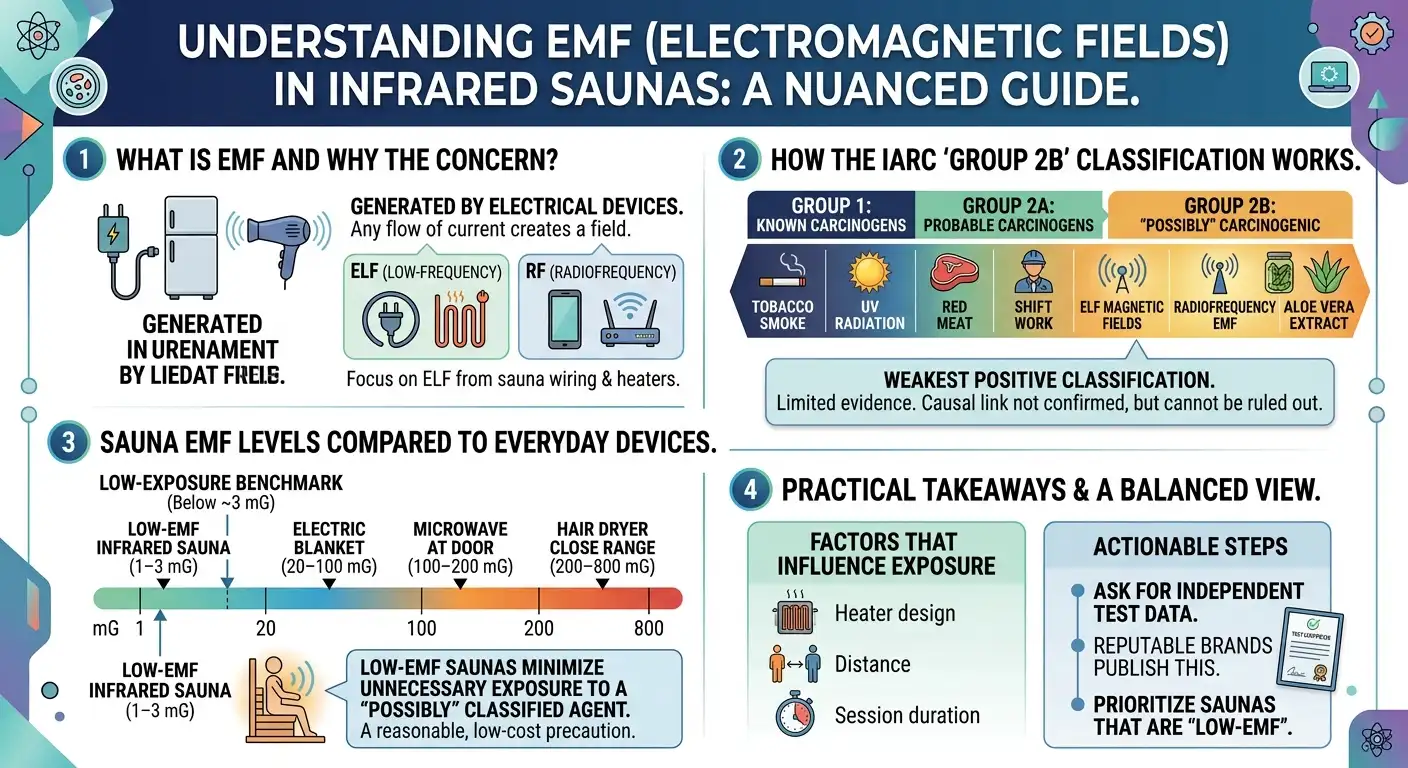
Any electrical device, your phone charger, your refrigerator, your hairdryer, and yes, an infrared sauna’s heating elements, generates a small electromagnetic field as current flows through it. Two categories come up in sauna discussions:
- Extremely low-frequency (ELF) magnetic fields, produced by the electrical wiring and heaters
- Radiofrequency (RF) fields, more relevant to devices like cell phones and Wi-Fi routers
How the IARC “Group 2B” Classification Actually Works
Here’s the piece almost every sauna blog mentions without explaining, so let’s actually explain it.
In 2002, the International Agency for Research on Cancer (IARC), part of the World Health Organization, classified extremely low-frequency (ELF) magnetic fields as “possibly carcinogenic to humans” (Group 2B). This was based on limited epidemiological evidence of an association between residential ELF exposure and childhood leukemia, generally at exposure levels above roughly 0.3–0.4 microtesla (3–4 milligauss).
In 2011, IARC used the same Group 2B category for radiofrequency EMF (like cell phone signals), based on limited evidence linking heavy long-term mobile phone use to certain brain tumors.
The critical thing people miss: Group 2B is one of the weakest positive classifications IARC uses. It means the evidence is limited and a causal link can’t be ruled out, not that the agent is confirmed to cause cancer. For context, Group 2B also includes things like pickled vegetables and aloe vera whole-leaf extract. It sits well below Group 1 (known human carcinogens, like tobacco smoke and UV radiation) and Group 2A (probable carcinogens, like red meat and shift work).
How Sauna EMF Levels Compare to Everyday Devices
Independent EMF testing and safety-agency guidelines generally put “low-EMF” territory at or below about 3 milligauss (mG), the informal benchmark cited from a widely referenced 2002 California EMF assessment. Many modern infrared saunas, especially those marketed as “low-EMF” or “ultra-low-EMF,” test near or below that range at typical sitting distance from the heater. Cheaper or older units without EMF-reducing heater design can run meaningfully higher, which is a legitimate reason to check manufacturer EMF specs before buying, not because there’s confirmed cancer causation, but because minimizing unnecessary exposure to a Group 2B-classified agent is a reasonable, low-cost precaution.
For comparison, common household EMF sources include:
| Device | Typical EMF at close range |
|---|---|
| Hair dryer | 200–800 mG |
| Microwave (at the door) | 100–200 mG |
| Electric blanket | 20–100 mG |
| Low-EMF infrared sauna | 1–3 mG (varies by brand/model) |
| Standard EMF safety benchmark | Below ~3 mG considered low-exposure |
Note: EMF output varies significantly by manufacturer, heater design, distance from the source, and session duration. If minimizing EMF matters to you, ask any sauna manufacturer for independent EMF test data rather than relying on marketing claims, reputable brands publish this.
What the Research Says About Infrared Sauna Benefits
It’s worth balancing the safety conversation with what sauna research, mostly on traditional Finnish saunas, with a smaller but growing body of infrared-specific research, has actually found (see our full health benefits of infrared sauna guide for more):
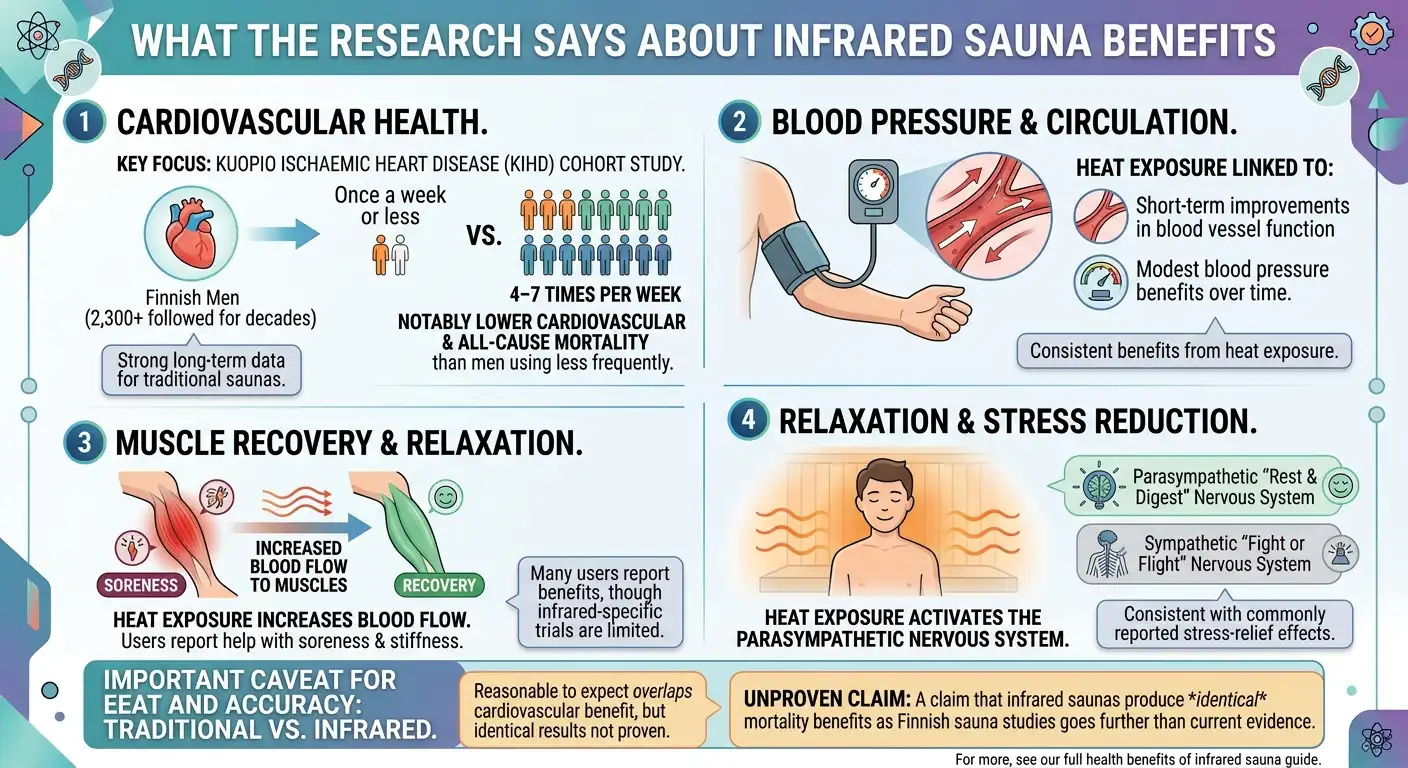
- Cardiovascular health: The Kuopio Ischaemic Heart Disease (KIHD) cohort study, following over 2,300 middle-aged Finnish men for decades, found that men who used a sauna 4–7 times per week had notably lower cardiovascular and all-cause mortality than those who used one once a week or less.
- Blood pressure and circulation: Sauna heat exposure has been linked in research to short-term improvements in blood vessel function and modest blood pressure benefits over time.
- Muscle recovery and relaxation: Heat exposure increases blood flow to muscles, which many users report helps with soreness and stiffness, though high-quality infrared-specific trials on this are still limited.
- Relaxation and stress: Heat exposure activates the parasympathetic (“rest and digest”) nervous system for many users, which is consistent with commonly reported stress-relief effects.
Important caveat for EEAT and accuracy: most of the strongest long-term mortality data (like the KIHD study) comes from traditional hot-air Finnish saunas, not infrared units specifically. Infrared saunas operate at lower air temperatures (around 120–140°F vs. up to 185°F+ for traditional saunas) and heat the body more directly, so it’s reasonable to expect some overlapping cardiovascular benefit, but it hasn’t been proven that infrared saunas deliver identical results to traditional sauna studies. If a source claims infrared saunas produce the exact same mortality benefits as the Finnish sauna studies, that claim is going further than the current evidence actually supports.
Who Should Be Cautious or Avoid Infrared Saunas
Infrared saunas aren’t right for everyone. Talk to a doctor before use if you:
- Are pregnant
- Have unstable heart disease, a history of fainting, or very low blood pressure
- Have an implanted medical device such as a pacemaker (electrical components in some units may be a consideration)
- Are on medications that affect sweating, blood pressure, or heart rate
- Have kidney disease or conditions that affect fluid balance
- Are currently undergoing cancer treatment (see the section below)
- Have a fever, are acutely ill, or are under the influence of alcohol
Children under 12 are also generally advised to avoid extended sauna sessions due to differences in temperature regulation and body surface area.
Infrared Saunas and Cancer Patients or Survivors
This is a common and completely reasonable question, and it deserves a direct, non-generic answer: there’s no research indicating infrared sauna use causes cancer to develop or spread, but that doesn’t mean every cancer patient or survivor should assume it’s automatically fine for their specific situation.
Heat and circulation changes can interact with certain treatments, medications, surgical sites, radiation-treated skin, or specific cancer types in ways that are individual to each case. Some oncology teams are comfortable with moderate sauna use during survivorship; others recommend avoiding it during active treatment or around radiation-treated skin specifically, because heat can irritate skin that’s already sensitized by radiation therapy.
The responsible, honest guidance here is the same one nearly every credible medical source gives: if you have a current or past cancer diagnosis, ask your oncology team before starting infrared sauna use, and mention it specifically rather than assuming it falls under general wellness advice. This isn’t a hedge, it reflects the fact that “is this safe for me” depends on treatment type, medications, and individual health status in ways a general article can’t account for.
How to Use an Infrared Sauna More Safely
Practical, low-effort steps that reduce any theoretical risk without requiring you to give up the benefits:
- Keep sessions to 15–30 minutes, especially when you’re new to infrared sauna use.
- Stay hydrated before and after, dehydration, not radiation, is the most well-documented real risk of sauna use.
- Check EMF specs if you’re buying a unit, and choose a model that publishes independent EMF test results.
- Avoid daily maximum-intensity sessions if you’re using a near-infrared-heavy unit, since that’s the wavelength band with the most (still limited) research questions around high cumulative doses.
- Sit at the manufacturer-recommended distance from the heater panels rather than pressing directly against them.
- Exit if you feel dizzy, nauseated, or unusually fatigued, these are signs of heat stress, the most common actual sauna-related health issue.
- Get a doctor’s input first if you fall into any of the caution categories above.
Infrared Sauna vs. Traditional Sauna: Cancer-Relevant Differences
| Factor | Infrared Sauna | Traditional (Finnish) Sauna |
|---|---|---|
| Heat source | Infrared light panels warming the body directly | Heated air (and often steam) warming the room |
| Typical temperature | 120–140°F | 150–195°F |
| UV exposure | None | None |
| EMF source | Electric heating panels | Electric heater (if electric) or wood/gas heat |
| Long-term mortality research | Limited, infrared-specific studies | Extensive (KIHD cohort and others) |
| Ionizing radiation risk | None (non-ionizing) | None (heat only, no radiation involved) |
Neither sauna type has been linked to increased cancer risk in the research record. The meaningful difference for this specific topic is that infrared introduces an electromagnetic/light-based heating mechanism (with its own EMF and NIR-specific research questions), while traditional saunas rely purely on heated air with a much longer track record of large-scale health studies.
FAQs
Can infrared saunas cause cancer?
No major health authority has established that infrared saunas cause cancer. Infrared radiation is non-ionizing and doesn’t carry enough energy to directly damage DNA, which is the mechanism behind radiation-linked cancers like UV-caused skin cancer.
Do infrared saunas cause skin cancer?
There’s no research showing typical infrared sauna use causes skin cancer. Infrared saunas emit no meaningful UV radiation, which is the established cause of most radiation-related skin cancers.
Is infrared radiation the same as the radiation in X-rays or UV light?
No. Infrared is non-ionizing radiation; X-rays and higher-energy UV are ionizing radiation. Ionizing radiation carries enough energy to break DNA bonds directly, and infrared does not.
Is the EMF from infrared saunas dangerous?
Sauna EMF is generally very low, and many modern units are designed to fall below common low-EMF benchmarks (around 3 milligauss). ELF-EMF in general has a “possibly carcinogenic” (Group 2B) classification from IARC based on limited evidence tied to much higher, sustained exposure than a typical sauna session produces.
What does IARC’s “Group 2B, possibly carcinogenic” actually mean?
It means the evidence is limited and a causal link with cancer can’t be ruled out, but it’s far from confirmed. It’s one of the weaker positive classifications IARC uses, and it also includes common substances like pickled vegetables.
Are near-infrared saunas riskier than far-infrared saunas?
Most of the lab research raising skin-related questions focuses specifically on near-infrared (NIR) at high, concentrated doses. Far-infrared, which most consumer saunas rely on primarily, hasn’t shown the same research signal. See our far vs. near infrared sauna comparison for a full breakdown.
How long is safe to sit in an infrared sauna?
Most manufacturers and wellness sources recommend 15–30 minute sessions, particularly for people newer to infrared sauna use, with hydration before and after.
Can cancer patients use infrared saunas?
There’s no evidence that infrared sauna use causes cancer to develop or spread, but patients and survivors should check with their oncology team first, since heat exposure can interact with specific treatments, medications, or radiation-treated skin.
Do infrared saunas increase your risk of skin damage even if not cancer?
High, concentrated, chronic near-infrared exposure has been studied in relation to photoaging (wrinkles, collagen breakdown), but typical consumer sauna sessions are well below the doses used in those studies.
Are low-EMF infrared saunas worth choosing?
If EMF exposure is a concern for you, choosing a model with published, independently verified low-EMF specs is a reasonable, low-cost precaution, even though typical sauna EMF is already far below levels studied in cancer research.
Do infrared saunas actually have proven health benefits?
Yes, particularly around cardiovascular health and relaxation, though most of the strongest long-term data comes from traditional Finnish sauna studies rather than infrared-specific research.
Is it safe to use an infrared sauna every day?
Many people use infrared saunas several times a week without documented harm, but daily maximum-intensity sessions aren’t well studied. See our guide on using an infrared sauna every day for a fuller answer. Moderate, consistent use with proper hydration is the more evidence-backed approach.
Can pacemakers or other implants be affected by infrared sauna EMF?
This is something to discuss directly with your cardiologist or device manufacturer, since it depends on the specific device and the sauna’s electrical design, not something a general safety answer can responsibly cover.
Is infrared heat different from the heat from the sun?
Sunlight contains infrared, visible light, and UV radiation together. Infrared saunas isolate the infrared component and exclude UV, which is the component responsible for sun-related skin cancer risk.
Final Thoughts
The fear behind “can infrared saunas cause cancer” is understandable, “radiation” is a scary word, and a lot of the content answering this question online is either written by sauna sellers with something to gain or repeats EMF statistics without explaining what they actually mean. Once you separate infrared light from EMF exposure (a genuinely studied but weakly classified concern, at exposure levels most saunas don’t come close to), the picture gets a lot less scary and a lot more specific.
The most evidence-based approach isn’t to fear infrared saunas or to dismiss every question about them. It’s to use one sensibly: reasonable session lengths, good hydration, a model with transparent EMF data if that matters to you, and a quick conversation with your doctor if you fall into one of the higher-caution categories, especially if you’re currently in cancer treatment. That’s not a hedge to avoid liability; it’s genuinely the most accurate answer this topic currently supports.