
If you’ve ever stepped out of an infrared sauna with flushed, glowing cheeks, you already know why people get curious about the benefits of infrared sauna for skin. That post-session glow feels like proof that something good just happened.
Some of it is real. Heat boosts blood flow, helps you relax, and may support hydration. But the louder claims, like erasing wrinkles or sweating out toxins, don’t have the research behind them that many sauna sites pretend they do.
This guide walks through what holds up, what doesn’t, and how to use a sauna without irritating your skin.
Key takeaways
- Infrared saunas run cooler than traditional ones, usually 110 to 135°F versus about 150 to 195°F. (Cleveland Clinic)
- The best-supported perks are better circulation, a short-term glow and stress relief.
- Collagen and wrinkle results come mostly from red and near-infrared light devices, not from far-infrared sauna sessions.
- Rosacea, eczema and pregnancy call for caution or a doctor’s okay first.
- Cleanse before, rinse after, and moisturize every time.
The Benefits of Infrared Sauna for Skin at a Glance
| Benefit | Evidence strength | The catch | |
|---|---|---|---|
| 1 | Brighter, glowing complexion | Good, but short-term | The glow fades within hours |
| 2 | Hydration and skin barrier | Moderate | Studied in traditional saunas |
| 3 | Firmer skin and collagen | Moderate for light devices, limited for saunas | Trials used red and near-infrared panels |
| 4 | Smoother texture and tone | Moderate for light devices | Same trials as above |
| 5 | Cleaner pores, fewer breakouts | Limited | Depends on your skin and aftercare |
| 6 | Calmer skin through stress relief | Indirect | Helps stress-linked flare-ups only |
| 7 | Help with some skin conditions | Limited and mixed | Can make eczema itchier |
What Is an Infrared Sauna, and How Does It Affect Your Skin?
An infrared sauna warms your body with infrared heaters instead of hot air or steam. Because the heat goes straight to you, you start sweating at a much lower room temperature. Your skin is the first thing that heat touches, which is why so much of the sauna conversation centers on complexion.


Paid Links - As an Amazon Associate, I earn from qualifying purchases.
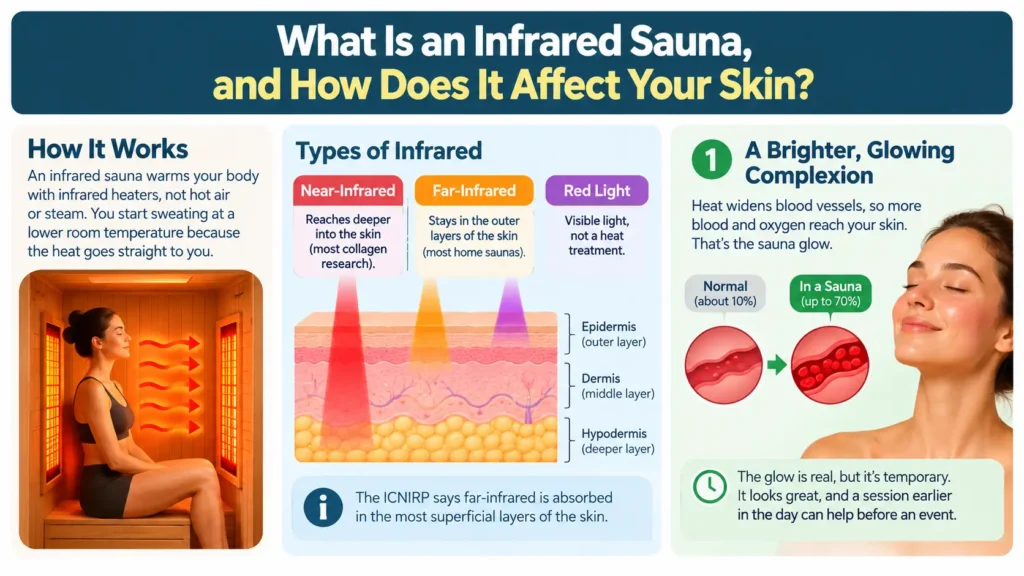
Here’s where it gets tricky. “Infrared” isn’t one thing. Near-infrared travels deeper into the skin and shows up in most of the collagen research. Far-infrared, the kind most home saunas use, mostly stays in the outer layers.
The international body that reviews this stuff, the ICNIRP, says far-infrared is absorbed in the most superficial layers of the skin.



Paid Links - As an Amazon Associate, I earn from qualifying purchases.
So when a brand tells you its heaters “penetrate deep,” take that with a grain of salt. If you’re shopping, it helps to understand the difference between far and near infrared before you trust any skin claim.
Red light is a third player. It’s a visible wavelength used in light panels, and it isn’t a heat treatment at all. Many “full spectrum” saunas bundle all three, so check what your unit actually gives off.
1. A Brighter, Glowing Complexion From Better Circulation
Short answer: Yes, this one is real. Heat widens the blood vessels in your skin, so more blood and oxygen reach the surface. That’s the “sauna glow.” It looks great, and it doesn’t last.
Finnish sauna researchers point out that at room temperature, only about 10 percent of the blood your heart pumps goes to the skin. In a sauna, up to 70 percent can flow through it. That’s a big shift, and it explains the rosy, warm look you see in the mirror afterward.


Paid Links - As an Amazon Associate, I earn from qualifying purchases.
Think of it like the color you get after a brisk walk in cold air. Your skin looks alive for a while, then settles back down. If you want a fresh look before an event, a session earlier that day can help. Just don’t expect it to rewrite your skin long term. Regular use may build on it a little, but the visible effect is mostly temporary.
2. Better Hydration and a Stronger Skin Barrier
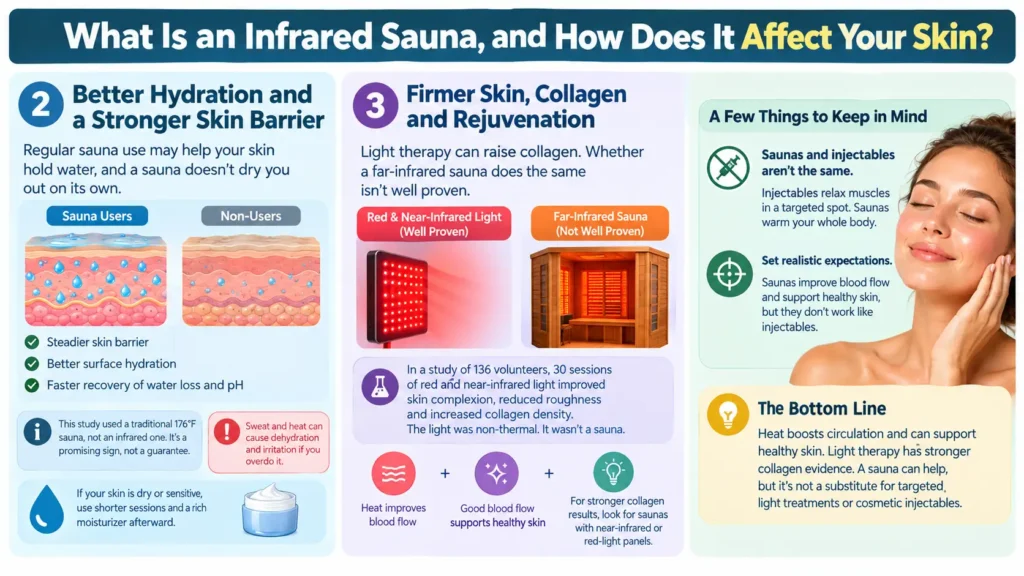
Short answer: Regular sauna use may help your skin hold water, and a sauna doesn’t dry you out on its own.
A controlled study of 41 healthy adults compared regular sauna users with people who didn’t use saunas. The regular users had a steadier skin barrier, better surface hydration, and faster recovery of skin water loss and pH after a session.
That’s encouraging. One honest note: those volunteers sat in a traditional 176°F sauna, not an infrared one. So it’s a promising sign, not a guarantee for every infrared cabin.
There’s another side to it. Sweat takes water out of your body, and hot air pulls moisture off your skin. A dermatologist quoted by Dermstore warns that overdoing it or skipping aftercare can lead to dehydration and irritation.
If your skin is already dry or sensitive, shorter sessions and a rich moisturizer afterward make a real difference. Hydration is about balance. A sauna can help your skin barrier or strain it, depending on how you use it.
3. Firmer Skin, Collagen and Rejuvenation
Short answer: Light therapy can raise collagen. Whether a far-infrared sauna does the same isn’t well proven.
This is the benefit people care about most, and it’s also the one that gets oversold. The best evidence comes from a randomized, controlled trial of 136 volunteers.
After 30 sessions, people treated with red and near-infrared light had better skin complexion, less roughness and higher measured collagen density than the control group. The light in that trial was non-thermal. It wasn’t a sauna.
So what does that mean for you? If you’re hoping a sauna can tighten skin, set your expectations kindly. Heat from a sauna improves blood flow, and good blood flow supports healthy skin.
But the strongest collagen results come from specific light wavelengths. A sauna that includes near-infrared or red-light panels has a better case than a far-infrared-only cabin.
One more thing worth saying plainly. Saunas and cosmetic injectables work in completely different ways. One relaxes muscles in a targeted spot. The other warms your whole body. They aren’t substitutes, so don’t pick a sauna because you expect injectable-style results.
4. Smoother Texture and a More Even Tone
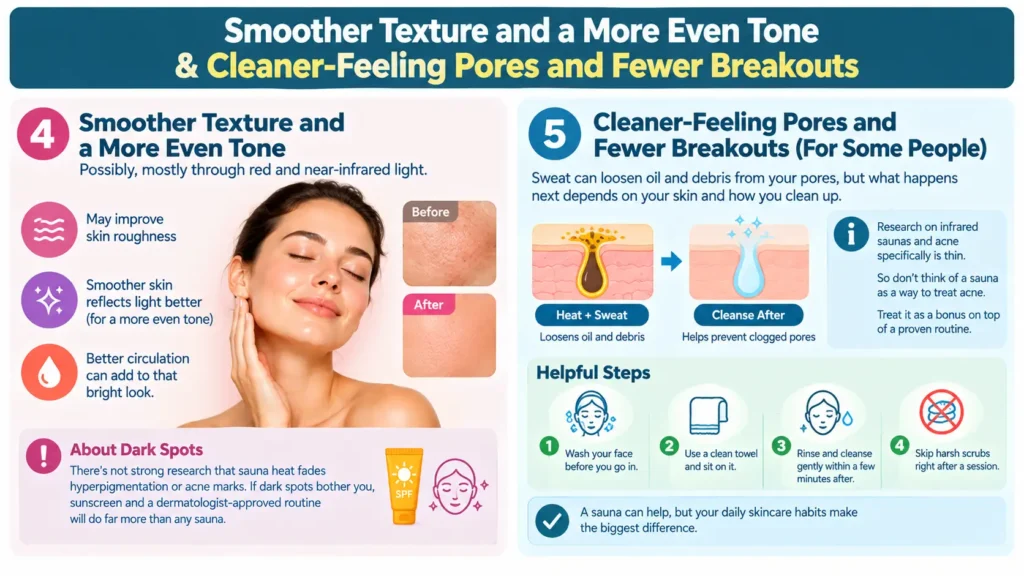
Short answer: Possibly, mostly through red and near-infrared light.
That same 136-person trial found meaningful improvements in skin roughness. Smoother skin also tends to reflect light better, which can make a dull complexion look more even. Better circulation may add to that bright look.
Where I’d stay cautious is dark spots. You’ll see sauna sites claim they fade hyperpigmentation or acne marks, but I haven’t found strong research that backs this up. If dark spots bother you, sunscreen and a dermatologist-approved routine will do far more than any sauna.
5. Cleaner-Feeling Pores and Fewer Breakouts (For Some People)
Short answer: Sweat can loosen oil and debris from your pores, but what happens next depends on your skin and how you clean up.
The same dermatologist told Dermstore that sauna heat can loosen trapped dirt and oil, yet sweat can clog pores again if you don’t cleanse afterward, especially on oily or acne-prone skin. In other words, a sauna sets the stage, and your washing habits decide whether the result is good or bad.
Research on infrared saunas and acne specifically is thin. So don’t think of a sauna as a way to treat acne. Treat it as a bonus on top of a proven routine. A few practical moves help:
- Wash your face before you go in so you aren’t baking makeup and sunscreen into your pores.
- Use a clean towel and sit on it.
- Rinse and cleanse gently within a few minutes of finishing.
Skip harsh scrubs right after a session. Your skin is warm and a little sensitive, and aggressive exfoliating can cause more irritation than it clears.
6. Calmer Skin Through Stress Relief
Short answer: Less stress and better sleep can mean fewer stress-triggered flare-ups. The benefit is indirect.
Plenty of people notice their skin acts up when life gets stressful. Cleveland Clinic notes that sauna time may help ease stress and anxiety, and that relaxation is tied to better sleep. A dermatologist adds that this kind of calm can indirectly help stress-related issues such as acne or eczema flare-ups.
This benefit won’t show up in a before-and-after photo, but it’s easy to feel. If your breakouts or irritation tend to follow rough weeks, a regular, relaxing session may help you manage the trigger itself.
Keep your expectations realistic, though. A sauna can take the edge off stress, but it won’t cancel out poor sleep or a stressful job.
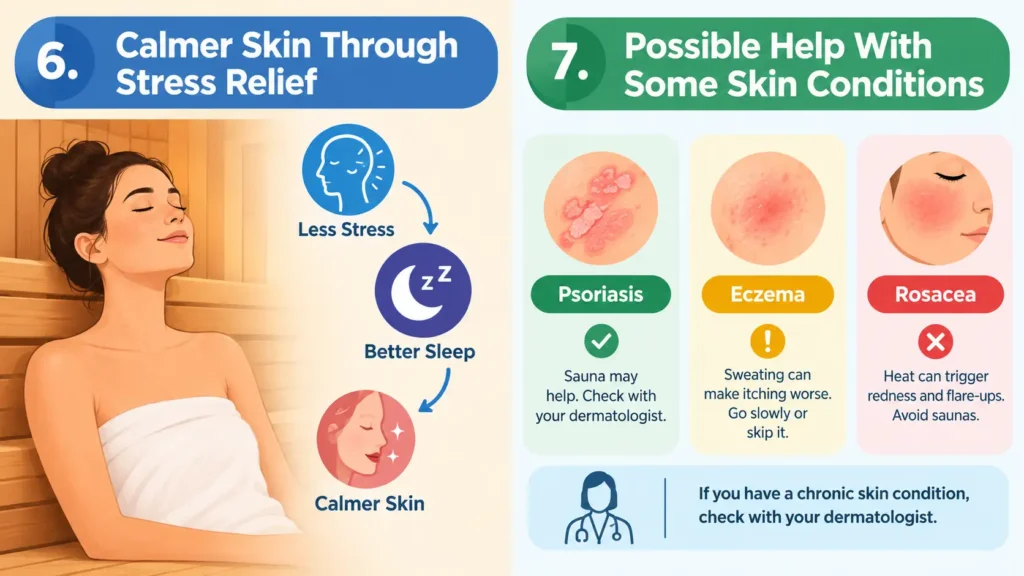
7. Possible Help With Some Skin Conditions
Short answer: It depends on the condition, and some people should avoid saunas entirely.
- Psoriasis: A review of sauna health effects says sauna bathing may benefit people with psoriasis. Check with your dermatologist before you try it.
- Eczema (atopic dermatitis): The same review found that sweating can make itching worse. If you have eczema, go slowly or skip it.
- Rosacea: Dermstore’s dermatologist advises that people with rosacea should avoid saunas, because heat can trigger redness and flare-ups.
If you live with any chronic skin condition, a quick chat with your dermatologist is worth more than any blog post, including this one.
Infrared Sauna vs Traditional Sauna vs Red Light Therapy for Skin
| Infrared sauna | Traditional sauna | Red light panel | |
|---|---|---|---|
| Typical temperature | 110 to 135°F | 150 to 195°F | Not a heat treatment |
| How it heats | Heaters warm your body directly | Hot air or steam | Light only |
| Best skin evidence | Limited and mostly indirect | Barrier and hydration study | Collagen and texture trials |
| Best for | Gentle heat, sweating, relaxation | A classic hot session | Rejuvenation goals |
| Watch out for | Lingering redness | Dry skin if overdone | No sweat session |
Temperature ranges come from Cleveland Clinic. If rejuvenation is your main goal, a red-light device or a sauna with near-infrared panels is the stronger bet.
Myth vs Fact
| Myth | Fact |
|---|---|
| Infrared sweats out toxins and clears your skin. | The evidence is early. Cleveland Clinic describes detox research as being in its infancy. |
| Infrared reaches deep into your skin. | Far-infrared stays in the outer layers. Near-infrared goes deeper. |
| Longer sessions mean better skin. | Long sessions can dry and irritate skin. |
| Saunas age your skin. | Not on their own, but overuse without hydration can leave skin dry. |
How to Use an Infrared Sauna for Better Skin
You don’t need a complicated routine. A few small habits protect your skin and help you get the most out of each session. If you want the full checklist, this guide on what to do before and after a session covers it step by step. Here’s the short version.
- Cleanse first. Remove makeup, sunscreen and any heavy products so nothing gets trapped in your pores.
- Start low and short. Begin around 110°F for 5 to 10 minutes and build from there. Cleveland Clinic suggests keeping sessions under 30 minutes and going no more than three to four times a week.
- Drink water. Have some before and after, and skip alcohol.
- Rinse and cleanse right after. This clears away sweat and oil before they settle into your pores.
- Moisturize while your skin is still slightly damp. A barrier-supporting cream or a simple hyaluronic serum works well.
- Stay consistent. Results, if you get them, build slowly over weeks.
Risks and Who Should Be Careful
Sauna use is considered safe for many people, but an infrared sauna isn’t safe for everyone, and your skin deserves a few honest warnings.
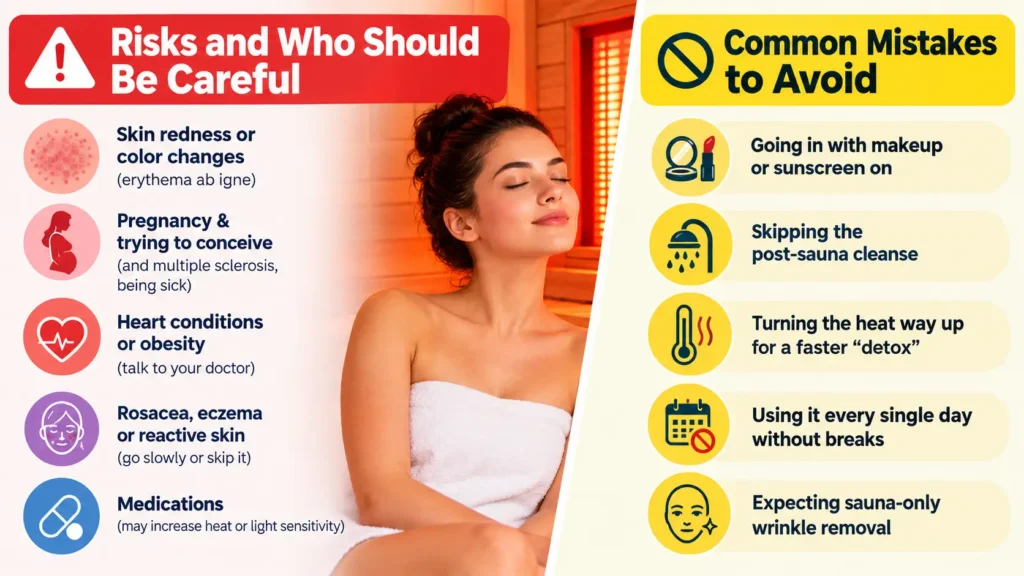
- Lingering redness or color changes. Repeated, very high skin temperatures can cause a condition called erythema ab igne, which shows up as a net-like, darker rash. The ICNIRP says if redness lasts more than a day, you should stop and get medical advice. A Health Physics Society expert notes that no cases have been reported from typical use, but controlled studies of infrared cabins are missing. So the risk looks low, but nobody can say it’s zero.
- Pregnancy and trying to conceive. Cleveland Clinic recommends avoiding saunas in both situations. It also lists multiple sclerosis and being sick as reasons to skip a session.
- Heart conditions or obesity. The ICNIRP recommends talking to a doctor before using an infrared cabin.
- Rosacea, eczema or reactive skin. Go slowly or skip it.
- Medications. If you take anything that makes you sensitive to heat or light, ask your pharmacist first.
Common Mistakes to Avoid
- Going in with makeup or sunscreen on
- Skipping the post-sauna cleanse
- Turning the heat way up for a faster “detox”
- Using it every single day without breaks
- Expecting sauna-only wrinkle removal
FAQs
Is an infrared sauna good for your skin?
Often, yes, for circulation, glow and relaxation. Bigger claims need more research.
Can an infrared sauna reduce wrinkles?
Red and near-infrared light have trial support for firmer-looking skin. Far-infrared saunas have less direct evidence.
Does infrared sauna help acne?
It might help some people, but sweat can clog pores if you don’t cleanse. Acne-specific research is limited.
Is an infrared sauna safe for eczema?
Be careful. Sweating can make itching worse in atopic dermatitis.
Can I use an infrared sauna with rosacea?
A dermatologist quoted by Dermstore advises avoiding it.
How often should I use an infrared sauna for skin?
Most people do well with two to four sessions a week, starting short.
Should I shower before or after?
Both. Cleanse before you go in, and rinse after.
Does an infrared sauna dry out your skin?
Not on its own, but long or very frequent sessions can.
Does an infrared sauna detox your skin?
The evidence is early, so don’t count on it.
How long until I see results?
The glow shows up right away. Any change in texture would take weeks.
Final Thoughts
An infrared sauna can be a nice addition to your skin routine. You’ll likely notice better circulation, a short-lived glow and a calmer mood. Anything beyond that, like firmer skin or clearer pores, depends on your skin, the type of infrared your sauna uses and how well you handle aftercare.
Treat it as a supplement to sunscreen and a solid routine, not a replacement. If you have a skin condition, ask a dermatologist before you start.
Your next step: Try 5 to 10 minutes at a low setting, cleanse and moisturize right after, and watch how your skin responds over the next two weeks.