
Choosing between an outdoor sauna and an indoor sauna is one of the first decisions any home sauna buyer faces, and it shapes almost everything that follows. It decides how much you spend, how long the sauna takes to heat, where it can sit, and how often you will actually use it. The two options look similar from the outside, since both give you a hot wooden room to sit and sweat in, but the day to day reality is very different.
This guide compares outdoor and indoor saunas side by side on the points that matter most: cost, heat, space, installation, upkeep and the experience itself. It uses planning ranges rather than fixed prices, because real prices vary by brand, size, heater type and where you live. By the end you should know which option fits your home, your budget and your habits, and what to check before you buy.
Please read first: This article is general information, not medical advice. Saunas are wellness tools, not treatments. If you are pregnant, live with a heart or circulation condition or low blood pressure, or take medication that affects heat tolerance, check with your doctor before using a sauna. Cost figures in this article are planning estimates, not quotes. Prices vary by region, brand and installer, so get local quotes before you buy. Build and installation guidance here is general only. Check your local permit and building code office and use licensed electricians and plumbers for installation work.


#Paid Links
The Short Answer: Which One Wins for Most Homes?
For most homes with a suitable spare room, garage or basement corner, an indoor sauna is the simpler and cheaper first sauna. It costs less to buy and install, heats faster, needs less weatherproofing and is steps away on a cold evening. That short walk matters more than most buyers expect, because the sauna you use three times a week is worth far more than the one you admire from the kitchen window.
An outdoor sauna wins when you want space, a view, a wood fired ritual or room for a larger group. It suits homes with a garden, a cabin or a yard where the sauna itself becomes a destination. It also suits buyers who want a traditional stove, a cold plunge nearby or a social space that an indoor room cannot offer. The trade off is a higher total cost, more planning and more upkeep through the year.
Neither choice is wrong in itself. The wrong choice is the one that does not fit your space, your climate or your routine. A compact indoor sauna used often beats a grand outdoor sauna used twice a year, and a well placed outdoor sauna beats an indoor unit squeezed into a damp corner with poor ventilation. The sections below work through each factor so you can judge the fit for your own home.
What Counts as an Outdoor Sauna, and What Counts as Indoor?
An outdoor sauna is a freestanding or garden based structure built to face the weather. Common forms include barrel saunas, cabin saunas, pod saunas and garden sauna kits. They are usually built from weather resistant timber such as cedar, spruce or thermowood, with a pitched or curved roof, insulation and a weatherproof outer layer. Heat comes from an electric heater or a wood fired stove, and many outdoor units include a small changing area or porch.
An indoor sauna sits inside the heated envelope of the home. It may be a kit built into a spare room, a converted closet or garage corner, or a portable cabin placed in a basement or large bathroom. Indoor saunas are almost always electric, because a wood stove indoors needs a chimney, clearances and approvals that most homes cannot easily provide. Infrared cabins are also common indoors, and they heat the body directly rather than heating the air to traditional sauna temperatures.
The line between the two can blur. A sauna in an unheated garage or an enclosed porch behaves more like an outdoor sauna in winter, even though it has a roof over it. A garden room with power and insulation behaves more like an indoor sauna. What matters is not the label but the conditions: how cold the space gets, how much moisture it must handle, and how far you must walk to reach it in bad weather.


#Paid Links
The Main Types at a Glance
- Outdoor barrel sauna: a round timber structure that heats quickly for its size and sheds rain well, usually for two to six people.
- Outdoor cabin sauna: a square or rectangular garden building, often with a changing room, porch and space for six or more people.
- Outdoor pod sauna: a rounded modern unit that suits smaller gardens and contemporary homes.
- Indoor traditional sauna: an electric heater and sauna stones in a timber lined room inside the home, built to classic Finnish style temperatures.
- Indoor infrared sauna: a lower air temperature cabin with infrared panels, popular where space is tight and quick sessions are wanted.
- Indoor portable sauna: a small tent or box unit that folds away, useful for renters or buyers testing the habit before committing.
Heater choice and sauna type interact with location. A wood fired stove gives the classic outdoor experience and works off grid, but it needs a chimney, ash care and constant attention while lit. An electric heater is simpler and easier to control in both locations, but it needs a suitable power supply and, for larger heaters, a dedicated circuit installed by a licensed electrician.
Cost Compared: Buying, Installing and Running
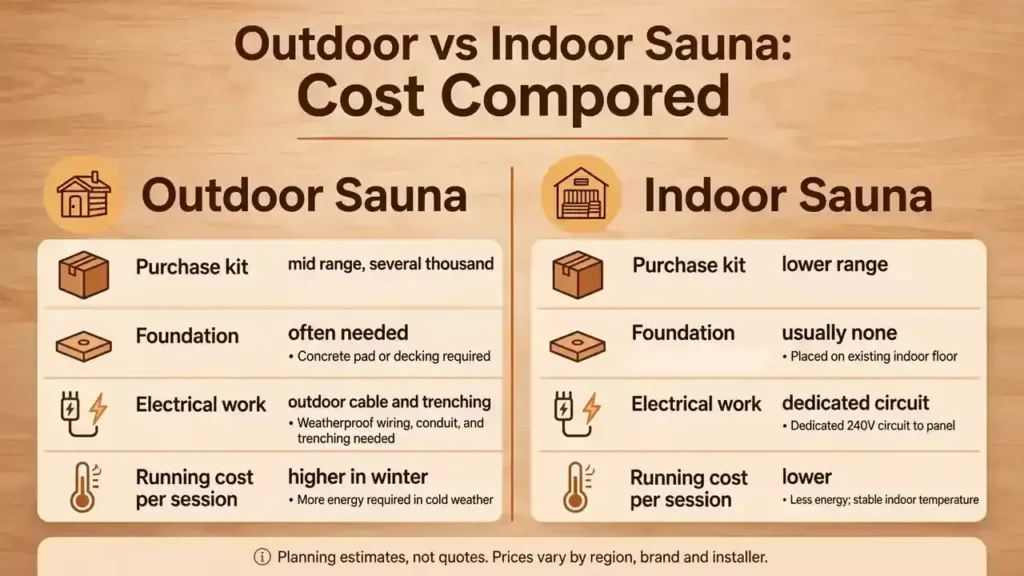
Cost is where the two options separate most clearly. An indoor sauna usually wins on purchase price and on installation, because the building already provides walls, a roof and a floor. An outdoor sauna needs all of those built to outdoor standards, plus a foundation, weatherproofing and a power or flue route from the house. The table below gives broad planning ranges for a typical two to four person unit, so you can see where the money goes.
| Cost item | Indoor sauna (typical range) | Outdoor sauna (typical range) |
|---|---|---|
| Basic kit or cabin, 2 to 4 person | Lower range, often a few thousand dollars | Mid range, often several thousand dollars |
| Foundation or base | Usually none, existing floor used | Often needed, from a simple slab to a deck or piers |
| Electrical work | Dedicated circuit in many cases | Dedicated circuit plus outdoor rated cable and trenching in some cases |
| Permits and approvals | Rarely needed for a kit, check local rules | Sometimes needed, depends on size and location |
| Delivery and assembly | Lower, fits through standard doors in panels | Higher, larger panels or crane access in some cases |
| Running cost per session | Lower, shorter heat up in a warm house | Higher in cold weather, longer heat up time |
Ranges above are planning estimates, not quotes. A small one person infrared cabin can cost far less than a large cedar outdoor cabin with a changing room, and a premium brand can cost several times a budget kit of the same size. Use the ranges to compare like with like, then get quotes for the exact models on your shortlist.
Worked Example: A Two Person Sauna, Two Locations
Imagine a household choosing a two person electric sauna. Indoors, the main costs are the cabin kit and a dedicated electrical circuit. The room already exists, the floor is level and dry, and no foundation is needed. Assembly takes a day or less in many cases, and the sauna is ready to use as soon as the electrician signs off the circuit.
Outdoors, the same size cabin needs a level base, which may mean a concrete slab, pavers or a treated timber deck. Power must reach the garden safely, which can mean armoured cable in a trench and an outdoor rated connection. Delivery may need clear garden access, and assembly takes longer because the roof, insulation and outer cladding must all be weather tight. The sauna itself may cost a similar amount to the indoor kit, but the site work around it adds a meaningful sum.
Over five years the running cost gap also adds up. An indoor sauna heats from room temperature, so a session uses less electricity. An outdoor sauna in winter heats from near freezing, so the heater works longer and harder before the first session starts. Our guide to outdoor sauna running costs per session explains the factors behind that gap, and our outdoor sauna cost guide breaks down purchase, installation and running costs in more detail.
Hidden Costs Buyers Often Miss
- Ventilation and moisture control indoors: a bathroom or basement sauna needs airflow and drying time, or damp and mould can follow.
- Weatherproofing outdoors: roof felt or shingles, wood treatment and seals need renewal over the years.
- Access paths: a muddy garden path in winter discourages use, so a paved or gravel path is a real cost, not a luxury.
- Heater replacement: elements and stones wear out, and a wood stove needs flue cleaning and firebox care.
- Insurance and value: check with your insurer before building, and do not assume a sauna adds resale value in every market.
Budget for the whole project, not just the cabin. A buyer who prices the kit alone and forgets the base, the power and the path is the buyer who runs out of money halfway through the garden work.
Heat and the Sauna Experience
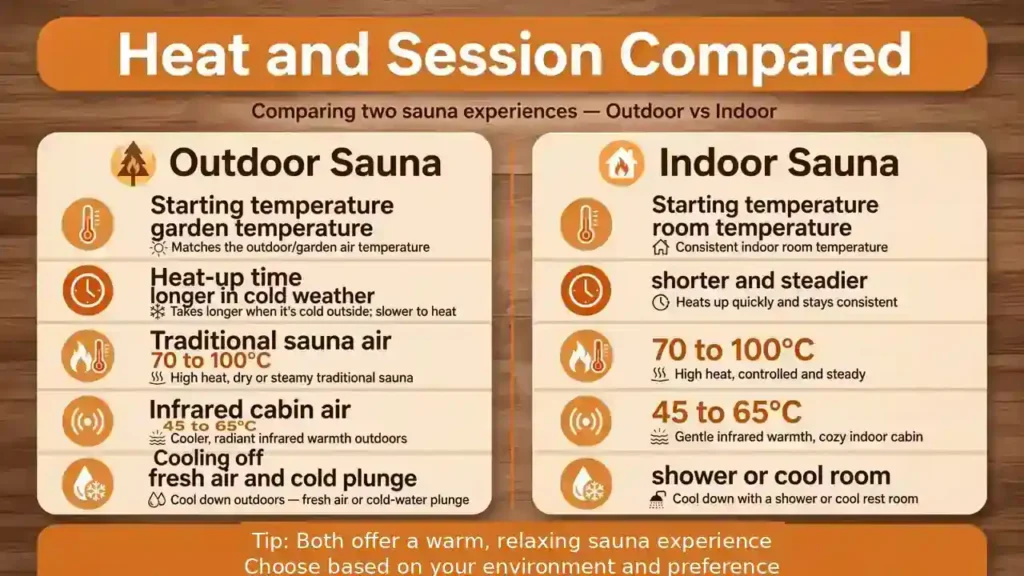
Heat is the heart of the comparison, and it is also where expectations most often go wrong. A traditional sauna aims for hot air, commonly in the region of 70 to 100 degrees Celsius, with water thrown on hot stones to create bursts of steam. An infrared sauna works differently, warming the body with radiant heat while the air stays cooler, often around 45 to 65 degrees Celsius. Both can feel deeply warming, but they feel different, and buyers should try both styles before choosing if they can.
Location changes how fast a sauna reaches temperature and how steady it stays there. An indoor sauna starts from a warm room, so heat up is usually quicker and more predictable. An outdoor sauna starts from the garden temperature, so a summer evening may need only a modest warm up while a frosty morning can double the wait. Good insulation narrows that gap, but it never closes it fully in cold climates.
| Heat factor | Indoor sauna | Outdoor sauna |
|---|---|---|
| Starting temperature | Room temperature, usually 18 to 22 degrees Celsius | Garden temperature, from below freezing to summer warmth |
| Heat up time | Usually shorter and steadier year round | Shorter in summer, clearly longer in cold weather |
| Temperature stability | Stable, sheltered from wind | Can vary with wind, rain and snow unless well insulated |
| Wood fired option | Rare, needs chimney and approvals | Common, with the classic stove ritual and crackle |
| Cooling off between rounds | Shower or cool room indoors | Fresh air, garden, cold plunge or snow in winter |
| Steam feel | Good with a stone heater and ventilation | Often excellent, with space for a larger stone mass |
Wind is the factor outdoor buyers underestimate most. A draughty door seal or a vent facing the prevailing wind can pull heat out of the room faster than the heater can replace it. Our guide to outdoor sauna ventilation covers vent placement, and our winter guide explains how to manage heating and snow around an outdoor sauna. Insulation matters just as much, and the options are compared in our guide to outdoor sauna insulation, foil and vapour barriers.
What the Heat Feels Like in Practice
Indoor sessions tend to feel controlled and repeatable. You set the heater, wait a known time, sit for a known length, then shower. That routine suits people who sauna before work, after training or as part of a short evening wind down. It also suits households where several people use the sauna at different times of day.
Outdoor sessions tend to feel more like an event. There is the walk through the garden, the sound of the stove, the cold air between rounds and the sky above you as you cool off. Many owners say the contrast between hot room and cold air is the best part, and that contrast is hard to copy indoors. The price is time: lighting a wood stove, waiting for heat and cooling off properly all take longer than an indoor session.
Neither heat style is medically better than the other in any proven sense. Research on sauna use, including the well known Finnish cohort studies, is observational, which means it shows links between sauna habits and health outcomes rather than proving cause. Those studies looked at traditional dry sauna use, and their findings should not be stretched into promises about any single product. Choose the heat style you enjoy and will use often, and keep sessions sensible.
Space, Placement and Privacy
Space decides the question for many buyers before cost does. An indoor sauna needs a room you can spare, with enough height for benches, enough floor area for the cabin footprint plus a step or two of clear space, and a door wide enough for the panels. A two person cabin often needs around two square metres of floor, while a four person unit needs roughly double that. Measure twice, including ceiling height and door swing, before ordering anything.
An outdoor sauna needs garden space plus clearances around it. The building needs room for airflow, for the roof overhang, for safe access to the door and, for a wood stove, for the flue and safe distances set by the manufacturer. It also needs a sensible spot for drainage, so rainwater runs away from the base rather than pooling under it. Our guide to how to size an outdoor sauna works through footprints for different household sizes, and our placement guide covers sun, wind, drainage and privacy for outdoor saunas.
Privacy and Neighbours
Privacy is easier indoors, where walls and a door do the work. Outdoors, the cooling off area is the weak point, because stepping outside in a towel or swimwear in view of neighbours puts many people off. A fence, a hedge, a screen or a cabin with a sheltered porch solves most of it, but each of those is a cost and a planning decision. Think about sightlines from upstairs windows as well as from the garden next door.
Noise and smoke matter too. An electric outdoor sauna is quiet, but a wood fired stove produces smoke on lighting and a crackle that carries on still evenings. Talk to neighbours before you build, especially if the flue will sit near a boundary. A little courtesy early saves a dispute later.
Access in Bad Weather
Ask yourself honestly how you will feel about the walk in January. An indoor sauna is ten steps away in slippers. An outdoor sauna is a walk across a cold garden, possibly in rain or snow, in a towel, twice per session. Many outdoor owners love that contrast and plan for it with a covered path, outdoor lighting and a warm changing area. Others find that after the first winter the walk becomes the reason they stop going.
If you choose outdoor, plan the route as carefully as the sauna itself. A lit, non slip path, a dry place to leave shoes and towels, and a changing area that stays warm make the difference between a sauna you use all year and one you use only in summer.
Installation, Permits and Professional Help
Installation is simpler indoors in almost every case. A kit arrives in panels, slots together in a day, and connects to a dedicated circuit fitted by a licensed electrician. The main checks are the floor, which must be level and able to handle moisture, the ventilation, which must let the room dry between sessions, and the power supply, which must match the heater size.
Outdoor installation adds groundwork. A level base is essential, and our guide to the best foundation for an outdoor sauna compares slabs, pavers, gravel and deck bases. Power must reach the building safely, often through buried cable, and a wood stove needs a flue fitted to the manufacturer instructions. Assembly takes longer, needs dry weather and usually needs two people for the roof and larger panels.
Permits depend on where you live, on the size of the structure and on how close it sits to a boundary. Some areas treat a small garden sauna as a minor outbuilding, while others need a permit, especially for larger cabins or permanent foundations. Our guide to whether you need a permit for an outdoor sauna explains the questions to ask your local office. Do not rely on a seller or a neighbour for this answer. Rules change between towns, and the permit office is the only source that counts.
- Always use a licensed electrician for the sauna circuit, indoors or outdoors, and for any outdoor cable run.
- Use a licensed plumber if the project adds a shower, drain or water supply near the sauna.
- Follow the manufacturer instructions for clearances, flue height and ventilation, and keep those documents after installation.
- Check local code before you build, not after the slab is poured.
Upkeep Through the Year
An indoor sauna lives a sheltered life. Its main upkeep is cleaning benches and floors, wiping down surfaces after sessions, letting the room dry fully and checking the heater and stones from time to time. Damp is the enemy indoors, so good ventilation and a drying routine matter more than any product. A quick wipe and an open door after each session prevents most problems.
An outdoor sauna needs all of that plus weather care. The roof needs checking after storms, wood treatment needs renewal on the schedule the maker recommends, seals and door gaskets wear faster outside, and snow and leaves must be cleared from the roof and base. In coastal or wet climates the timber faces extra strain from salt air and constant damp. A wood stove adds chimney sweeping, ash removal and firebox checks to the list, and a stove should never be left burning unattended.
| Upkeep task | Indoor sauna | Outdoor sauna |
|---|---|---|
| Cleaning after sessions | Wipe benches and floor, air the room | Same, plus sweep leaves and debris from the porch |
| Drying and ventilation | Open door or vent, let room dry fully | Same, plus check vents are clear of nests and debris |
| Wood care | Occasional oiling or sanding of benches | Regular exterior treatment, check for rot and splits |
| Roof and seals | Not applicable in most cases | Check yearly, repair felt or shingles, renew seals |
| Heater care | Check elements and stones yearly | Same, plus flue cleaning for wood stoves |
| Winter care | Minimal | Clear snow, check for ice on paths and steps |
None of this upkeep is hard, but it is regular. Buyers who enjoy garden work usually find outdoor sauna care satisfying. Buyers who want the lowest possible chore list will be happier indoors.
Safety Basics for Either Choice
Safety rules are the same indoors and outdoors, and they deserve a place in any comparison. Hydrate before and after a session, and keep water nearby. Start with short sessions, often 10 to 15 minutes for a beginner, and build up slowly. Leave the sauna at once if you feel dizzy, unwell or overheated, and cool down gradually.
Do not drink alcohol before or during a sauna session, and do not sauna alone if you have a health condition that could make you unwell in heat. Check with your doctor first if you are pregnant, live with a heart or circulation condition or low blood pressure, or take medication that affects heat tolerance. Children and older users should use shorter, cooler sessions with an adult present, and pets should never be left in or near a hot sauna.
For wood fired saunas, follow the maker instructions on clearances, never leave a lit stove unattended, keep flammable items away from the stove, and clean the chimney and remove ash on a regular schedule. For electric saunas, never pour water on a heater that is not built for it, and never cover a heater or block its vents.
Which Sauna Should You Choose?
The best way to decide is to score your own situation against the factors below, rather than copying someone else answer. A city flat with a spare room points one way. A rural home with a large garden and a love of wood fire points the other. Most buyers find the answer becomes clear after two or three factors, not after a long debate about brands.
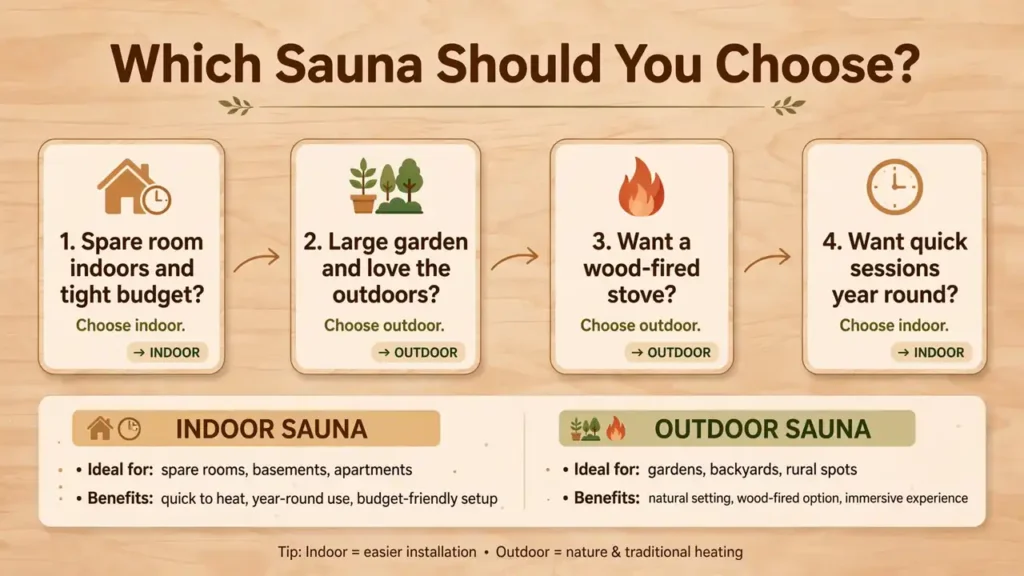
| Your situation | Best fit | Why |
|---|---|---|
| Spare room indoors, tight budget | Indoor sauna | Lowest total cost, fastest heat up, easiest install |
| Small garden, want year round use | Indoor sauna | No winter walk, no weatherproofing, steady use |
| Large garden, love the outdoors | Outdoor sauna | Space for a cabin, view and cooling off area |
| Want a wood fired stove | Outdoor sauna | Chimney and clearances are far easier outside |
| Want family or group sessions | Outdoor cabin sauna | More room for benches, a changing area and guests |
| Renting or testing the habit | Indoor portable sauna | Low commitment, moves with you, no building work |
| Cold climate, short winter days | Indoor sauna, or outdoor with good insulation | Heat up time and the cold walk matter most |
| Planning a garden retreat with plunge | Outdoor sauna | Contrast therapy and social space work best outside |
Five Questions to Ask Before You Buy
- Where will it sit, exactly? Measure the spot, check the door and delivery route, and stand there in bad weather to picture the walk.
- How will it be powered or fired? Get an electrician quote for the circuit, or price firewood and flue care for a wood stove.
- How often will you really use it? Be honest about your routine. A sauna you use three times a week is a good buy. One you use twice a year is not.
- Who else will use it? Size for the largest regular group, not for a party that may never happen.
- What will it cost over five years? Add purchase, installation, running costs and upkeep together before comparing models.
If you are still torn, try both. Many gyms, hotels and spa days offer indoor and outdoor saunas in the same visit, and a single afternoon of trying both styles tells you more than a week of reading. Pay attention to which one you want to return to, not just which one looks best in a photo.
Common Mistakes to Avoid
- Buying too big: a large sauna takes longer to heat, costs more to run and feels empty with one person in it. Size for your regular group.
- Buying too small: a cabin that fits on paper can feel cramped once two people, towels and a bucket are inside. Sit in the model before you buy if you can.
- Forgetting ventilation: poor airflow causes damp indoors and uneven heat outdoors. Plan vents from the start.
- Skipping the foundation: an outdoor sauna on uneven or soggy ground will shift, leak and rot. A level base is not optional.
- Ignoring the power supply: a heater that needs a larger circuit than your home can provide turns a simple purchase into a costly upgrade.
- Choosing on looks alone: a beautiful barrel that faces the prevailing wind and has thin insulation will disappoint in winter, while a plain cabin with good insulation will delight.
- Skipping local checks: building first and asking about permits later is the most expensive mistake on this list.
Frequently Asked Questions
Is an outdoor sauna more expensive than an indoor sauna?
Usually, yes. The sauna unit itself may cost a similar amount, but an outdoor sauna also needs a foundation, weatherproofing and a power or flue route, and it costs more to run in cold weather. An indoor sauna uses the building you already have, so the total project cost is normally lower. Always compare the full project cost, not just the kit price.
Which heats up faster, outdoor or indoor?
An indoor sauna usually heats faster because it starts from room temperature in a sheltered space. An outdoor sauna can heat quickly in summer but takes noticeably longer in cold weather, when the heater must warm cold timber and cold air. Good insulation narrows the gap but does not remove it.
Can I put an outdoor sauna indoors, or an indoor sauna outside?
No, not without problems. Outdoor saunas are built with weatherproofing, roofing and cladding that an indoor room does not need, and they may not fit through standard doors. Indoor kits are not built to face rain, wind and frost, and using one outside can void the warranty and damage the timber. Buy the type built for the location you have.
Do I need planning permission for an outdoor sauna?
It depends on where you live, the size of the sauna and how close it sits to a boundary. Some areas allow a small garden sauna without a permit, while others need approval, especially for larger cabins or permanent bases. Ask your local permit or planning office before you build, and get the answer in writing where possible.
Is a wood fired sauna better than an electric sauna?
Neither is better for everyone. A wood fired stove gives a classic ritual, strong radiant heat and off grid use, but it needs lighting, tending, chimney care and ash removal. An electric heater is simpler, easier to control and quicker to start, but it needs a suitable power supply. Wood fired suits outdoor saunas and owners who enjoy the process. Electric suits most indoor saunas and owners who want convenience.
Which sauna is best for small spaces?
An indoor infrared cabin or a one to two person indoor traditional sauna is usually the best fit for a small home, because it needs only a small floor area and no garden. For a small garden, a compact barrel or pod sauna can work well outdoors, as long as there is room for access, drainage and clearances around it.
The Bottom Line
An indoor sauna is the practical choice for most homes: lower cost, faster heat, simpler installation and a short walk on a cold night. An outdoor sauna is the experiential choice: more space, a garden setting, a wood fired option and a cooling off ritual that no indoor room can match. The right answer is the one that fits your space, your climate, your budget and the way you will actually use it week after week.
Start with the space you have, price the whole project honestly, and try both heat styles if you can before you commit. Then choose the sauna you will use often, keep your sessions short and safe, and enjoy the habit for years. If you want to go deeper on the numbers, read our outdoor sauna cost guide and our guide to sizing an outdoor sauna before you order.