
You set the control panel to your usual temperature, settle onto the bench, and glance at the thermometer on the wall. It says something very different from the number on the panel. One of them has to be wrong, but which one? And does it even matter?
It matters more than most sauna owners think. A thermometer you cannot trust turns every session into guesswork: you either sit in a cabin that never really warms up, or you push the heat higher than you planned because the display says you are still short. Learning how to check your infrared sauna thermometer accuracy, and where the sensor actually belongs, takes one afternoon and saves you months of second-guessing.
This guide walks through why built-in sauna thermometers read high or low, how to test one with simple reference checks, how to calibrate a digital control panel when your manual allows it, and the placement rules that keep readings honest. No special tools are needed beyond a second thermometer you can borrow from the kitchen drawer.
Please note: This article is general information, not medical advice. Saunas are wellness tools, not treatments. If you are pregnant, live with a heart or circulation condition or low blood pressure, or take medication that affects heat tolerance, check with your doctor before using a sauna. Hydrate before and after, start with short sessions, and leave immediately if you feel dizzy or unwell.


#Paid Links
Why Sauna Thermometer Readings Feel Wrong
Most infrared sauna owners discover the problem the same way: two thermometers in one small cabin disagree by a wide margin. That disagreement usually has a physical explanation, not a broken part. Heat behaves differently inside a sealed wooden box than it does in an open room, and the sensor only reports the air touching it.
Heat rises, so the ceiling is always hottest
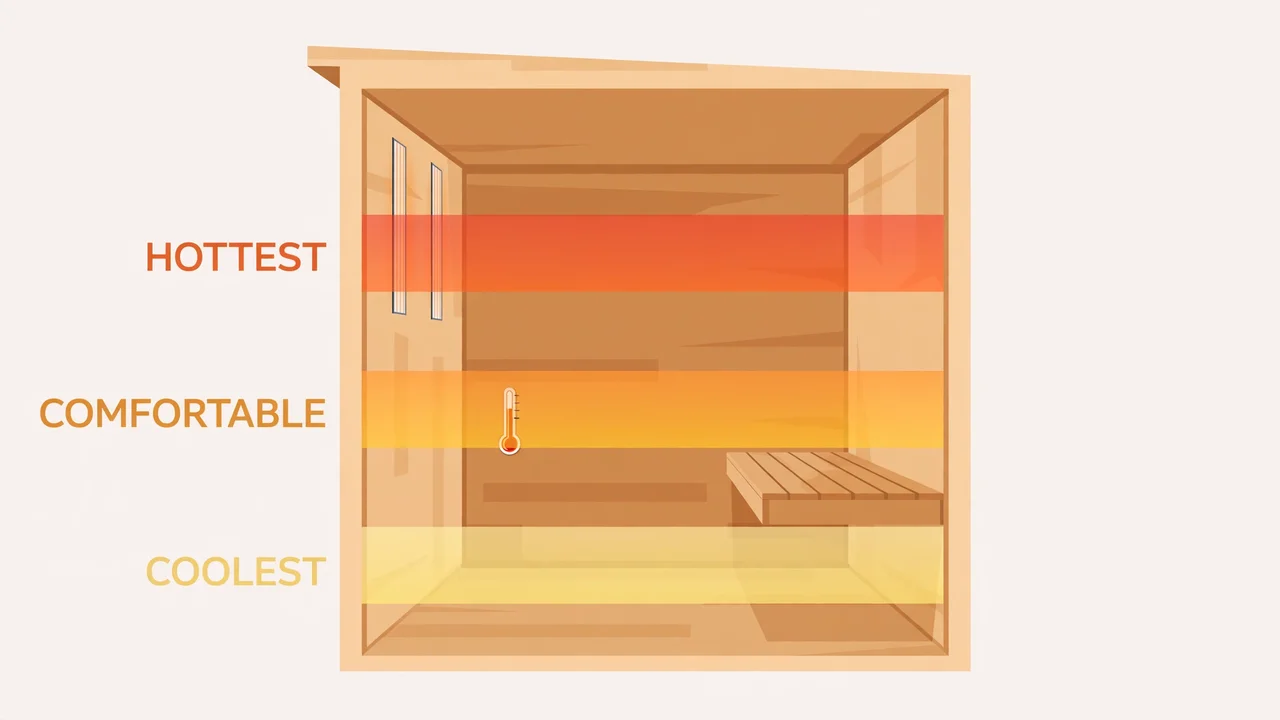
Warm air is lighter than cool air, so it collects near the ceiling while cooler air settles toward the floor. This layering is called stratification, and it happens in every heated room. In a sauna cabin it is stronger than in a normal room because the space is small, the heater output is high, and the air is barely moving.

#Paid Links
The result is a cabin with several temperatures at once. A sensor mounted near the ceiling can read far higher than one at bench height, and both can be “correct” for the spot they sit in. That is why two thermometers can disagree without either of them being faulty.
The sensor sits where the heat is, not where you sit
Manufacturers often mount the temperature sensor high on the wall, close to the ceiling, because that spot is easy to wire during assembly and keeps the probe out of the way. The trouble is that nobody sits at ceiling height. Your body experiences the air at bench level, which is cooler, so the number on the panel can describe a part of the cabin you never occupy.
Some cabins place the sensor inside the control panel housing itself. The panel generates a little of its own warmth, and the housing can trap it. A sensor in that spot reads the inside of a small plastic box as much as it reads the cabin, which pushes the number upward.
Panel proximity and radiant heat skew the reading
Infrared panels warm objects directly with radiant heat, not just by warming the air. A thermometer hung a few inches from a glowing panel absorbs that radiant energy and reports a temperature closer to the panel surface than to the cabin air. The same thing happens to a sensor mounted above a heater or beside a vent that leaks hot air.


#Paid Links
Drafts pull the reading the other way. A sensor near the door, a vent, or a gap in the seal catches cooler air every time the door opens or the vent draws. The display can dip sharply for a few minutes and then climb back, which looks like a fault but is really just a sensor in a draughty spot.
What “Accurate” Actually Means Inside a Sauna
Accuracy in a sauna is not the same as accuracy in a laboratory. A sensor can be perfectly calibrated and still show a number that surprises you, because the cabin air is not one uniform temperature. Before you decide your thermometer is broken, it helps to know which readings are normal and which point to a real problem.
| What you see | What it usually means | What to do |
|---|---|---|
| Wall thermometer and panel differ by a small amount | Normal: sensors sit at different heights | Compare both at bench height before worrying |
| Reading climbs fast, then holds steady | Normal: sensor near the ceiling heats first | Wait for the cabin to stabilise, then read again |
| Reading drops sharply when the door opens | Normal: cool air reaches the sensor | Close the door and give it a few minutes |
| Display stuck at one number for a whole session | Possible fault: sensor or wiring issue | Run the cross-checks below |
| Display jumps wildly with no pattern | Possible fault: loose connection or failing probe | Check connections, then contact the manufacturer |
| Panel shows an error code instead of a number | Fault: the controller cannot read the sensor | Follow the manual, then call the manufacturer |
The key point is that a single number never tells the whole story. A useful reading is one taken at bench height, after the cabin has had time to warm evenly, with the sensor away from panels, vents and the door. Everything in this guide builds toward getting that one honest number.
How to Check Your Thermometer in 5 Steps
You do not need a laboratory to test a sauna thermometer. You need two reference points you can trust, a second thermometer for comparison, and about half an hour. Work through the steps in order: the first two test a spare probe thermometer against known temperatures, and the last three test the sauna’s own sensor where it lives.
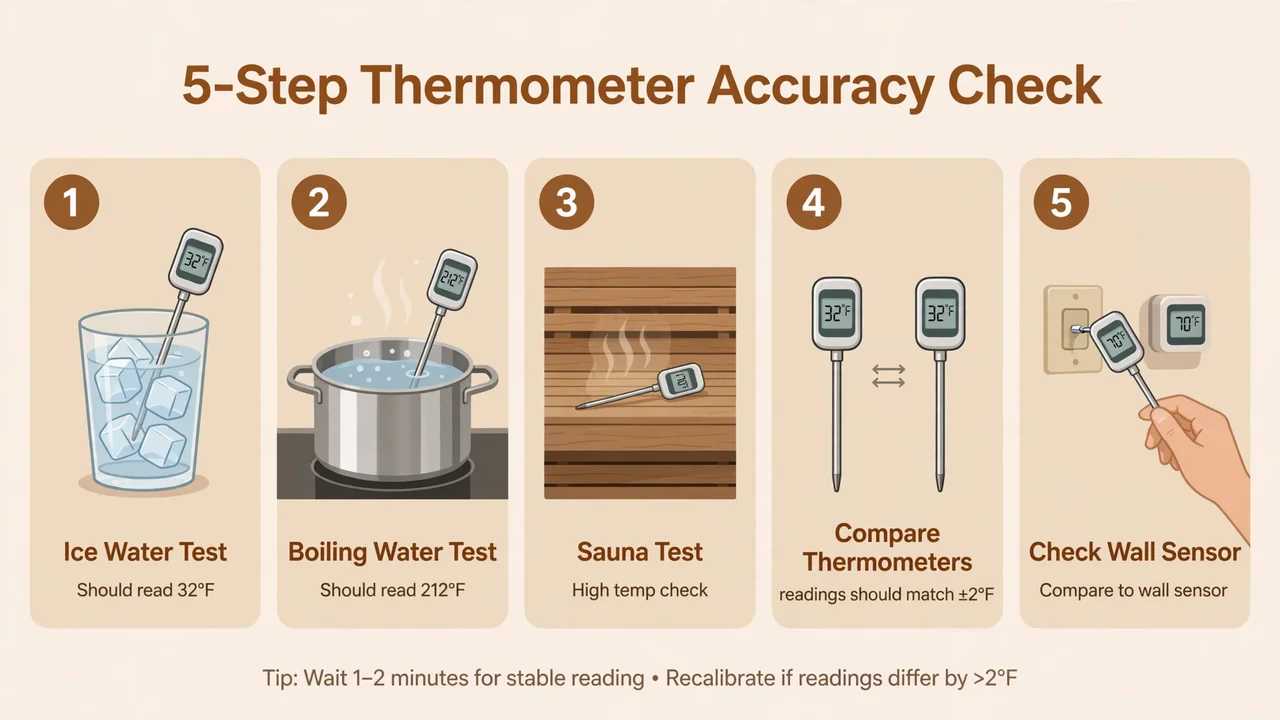
- Test your spare thermometer in ice water. Fill a glass with crushed ice, add cold water, stir, and wait a few minutes. A working probe should settle at 32°F (0°C).
- Test the same probe in boiling water. At sea level, water boils at 212°F (100°C). If you live well above sea level, expect a slightly lower reading. A probe that passes both tests is a trustworthy reference.
- Place the trusted probe at bench height. Put it where your chest sits when you are seated, away from panels and the door. Let the sauna run until the temperature stops climbing.
- Compare the two readings side by side. Note the panel number and the probe number at the same moment. A small gap is normal; a large, steady gap points to placement or calibration.
- Move the probe to the sensor’s height. Hold the trusted probe next to the sauna’s own sensor for a few minutes. If the two agree there, the sensor is fine and the gap was caused by height alone.
The ice-water check, step by step
Ice water is the easiest reference point in any kitchen. Fill a tall glass with crushed ice rather than cubes, because crushed ice packs tightly around the probe and leaves fewer warm pockets. Add just enough cold water to fill the gaps, stir for a minute, and let it sit for two or three minutes before you insert the probe.
Hold the probe in the middle of the glass, not touching the sides or the bottom, and wait until the number stops moving. A probe that reads within a degree or two of 32°F (0°C) is good enough to use as your reference. If it reads several degrees off, note the difference: that is the probe’s error, and you can allow for it in the sauna test. A probe that reads far off at both reference points, or that drifts while you watch it, belongs in the bin.
The boiling-point check
Boiling water gives you a second reference at the other end of the scale. Bring a pot of water to a rolling boil, hold the probe in the steam-free water (not touching the pot), and wait for the reading to settle. At sea level it should read 212°F (100°C). The reading drops slightly with altitude, so if you live in the mountains, look up your local boiling point rather than assuming 212°F.
Only use a probe thermometer rated for these temperatures, and never put a sauna’s built-in sensor in water. The boiling check is for a separate kitchen or oven probe only. If your spare probe passes the ice test but fails the boiling test by a wide margin, trust the ice result and treat the probe as a rough guide rather than a precise instrument.
The second-thermometer cross-check
The cross-check is the most useful test for a sauna owner, because it measures the thing you actually care about: the air where you sit. Place your verified probe at bench height, roughly where your chest is when seated, and let the sauna run through a full warm-up. Do not open the door during the test, since each opening floods the sensor with cooler air and restarts the settling process.
Once the panel number stops climbing, read both numbers at the same moment and write them down. Repeat the comparison once or twice across the session. A steady gap that repeats is information; a gap that changes every time you look is usually draughts or a sensor still settling.
A handheld infrared thermometer gun can add a useful extra check, because it measures surface temperatures rather than air. Point it at the bench, the back wall and a heater panel to see how hot the surfaces around you actually are. Keep in mind that it cannot measure air temperature, so it complements the probe rather than replacing it. If you want a closer look at these tools, our roundup of handheld infrared thermometers explains what they can and cannot do.
Can You Calibrate an Infrared Sauna Control Panel?
Some digital control panels let you adjust the temperature offset: the difference between what the sensor reports and what the display shows. If your panel has this setting, it is usually buried in a settings or installer menu, and the exact steps vary by brand. Your owner’s manual is the only safe source for the button sequence, so look there first and never guess at a hidden menu.
Before you change anything, finish the cross-check above and write down the gap. If the panel reads 8 degrees higher than your trusted probe at bench height, and the manual offers an offset setting, you can shift the display down by that amount. Change the offset once, then re-run the cross-check on another day to confirm the fix held. Changing it after every session, or chasing small day-to-day wobbles, makes the reading less reliable, not more.
Many panels offer no offset setting at all, and that is not a defect. In that case the honest fix is placement: move a separate wall thermometer to bench height and use it as your session reference, while the panel keeps doing its job of switching the heaters on and off. The panel’s job is control, and the wall thermometer’s job is information, and they do not have to agree to the degree.
Call the manufacturer when the display is stuck, shows an error code, jumps erratically, or reads far outside any plausible range. Those symptoms point to a failing sensor, a damaged wire, or a controller fault, and none of them are fixed by an offset adjustment. If your sauna is still under warranty, do not open the control housing or cut any wires yourself: that can void the warranty and, with mains-powered equipment, is a job for a licensed electrician. Our infrared sauna maintenance calendar shows which checks belong on your regular schedule and which ones mean calling a professional.
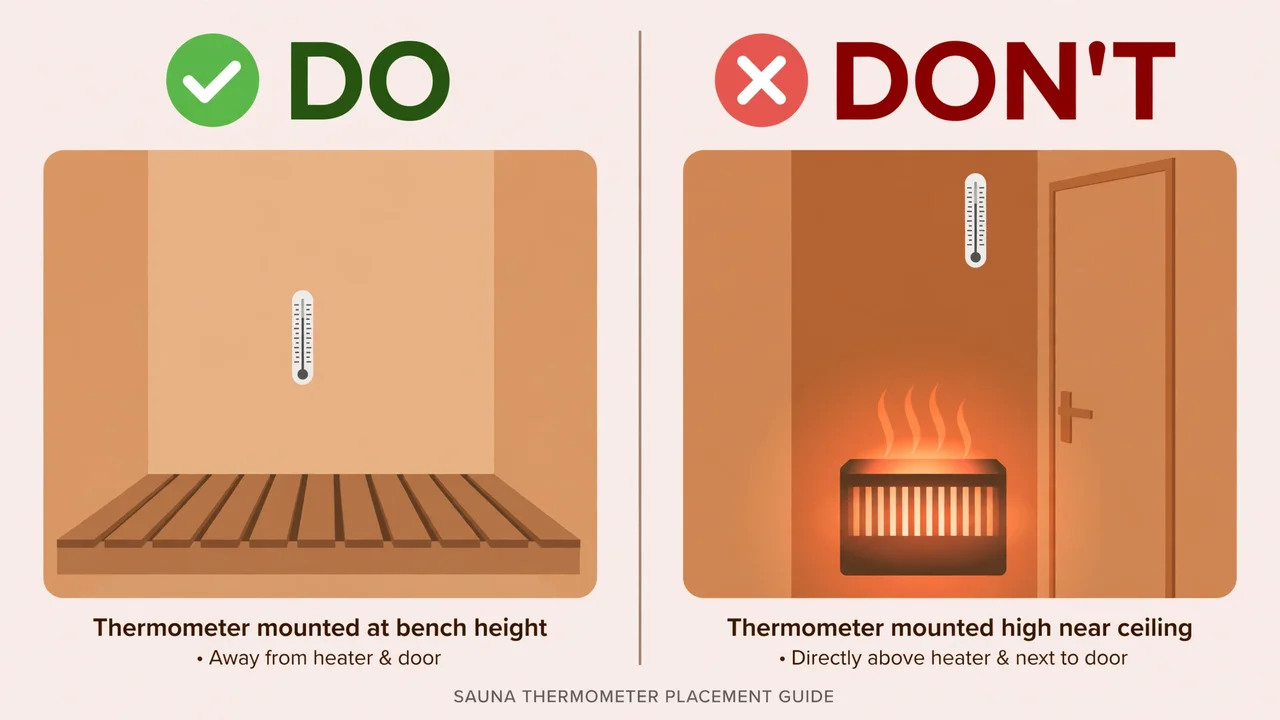
Where to Put a Sauna Thermometer
Placement is the single biggest influence on infrared sauna thermometer accuracy, and it costs nothing to fix. The goal is simple: measure the air your body actually sits in, away from anything that heats or cools the sensor directly. Most placement mistakes come from putting the thermometer where it looks tidy rather than where the air is representative.
| Do | Don’t |
|---|---|
| Mount at bench height, about chest level when seated | Mount near the ceiling, where the hottest air collects |
| Choose a wall opposite the heater panels | Hang it directly above or beside a heater panel |
| Keep it away from the door and vents | Place it where door draughts hit it every time someone enters |
| Leave a small air gap behind the thermometer | Press it flat against a hot wooden wall |
| Put it where you can read it from the bench | Hide it behind a backrest or a bucket |
| Check the reading after the cabin stabilises | Trust the first number you see during warm-up |
If your sauna has a built-in sensor you cannot move, add a separate thermometer at bench height and treat that as your reference. A simple analogue dial thermometer or a small digital probe works well, as long as it is rated for sauna temperatures. Check the rating before you buy: a kitchen thermometer with a low maximum can be damaged by sustained sauna heat.
Small cabins deserve extra care with placement. In a one-person cabin the panels are close to every wall, so there may be no spot that is fully clear of radiant heat. In that case, choose the spot farthest from the nearest panel, shield the thermometer from direct panel line-of-sight if you can, and compare its reading against a probe at bench height so you know how much to allow for. The same advice applies when a sauna shares a tight space with other equipment: our guide to an infrared sauna in a home gym covers airflow and clearance in rooms where the cabin sits close to walls and gear.
Fault or Normal? When a Wrong Reading Means a Repair
Not every odd reading is a fault, but some are. The difference is usually pattern: normal quirks are repeatable and tied to something you can see, like height or a draught, while faults are erratic, stuck, or wildly out of range. Use the table below to sort one from the other before you order parts or book a repair.
| Symptom | Likely cause | Next step |
|---|---|---|
| Panel and wall thermometer differ by a few degrees | Different heights or spots | Compare both at bench height |
| Reading rises very slowly or never reaches the setpoint | Panel fault, weak heater, or heat loss | Check the door seal and vents, then see the troubleshooting guide |
| Display frozen on one number | Sensor or controller fault | Power-cycle once per the manual, then contact the manufacturer |
| Reading swings up and down with no pattern | Loose sensor wire or failing probe | Do not open mains-powered housing; call the manufacturer or an electrician |
| Sauna trips a breaker or smells of burning | Electrical fault | Switch it off at the breaker and call a licensed electrician |
| Error code on the display | Controller cannot read the sensor | Note the code and follow the manual’s fault list |
A sauna that heats slowly deserves a look at the wider system before you blame the thermometer. A worn door seal, a vent left wide open, or a heater panel that has lost output can all keep the cabin below its setpoint while the sensor reports faithfully. Our infrared sauna troubleshooting guide walks through those checks in order, and if the problem looks electrical, the infrared sauna power requirements guide explains what the circuit should be delivering before you call an electrician.
What the Number Means vs How Your Body Feels
The thermometer measures air temperature at one spot. It does not measure how hot you feel, and the two can diverge. Infrared heat warms your skin directly, so you can feel thoroughly warm while the air temperature still looks modest. Humidity, hydration, how long you have been inside, and whether you just exercised all shift how the heat feels.
That is why the number should guide your session, not rule it. Use the bench-height reading to confirm the cabin is in its usual range, then listen to your body. If you feel dizzy, nauseous, unusually hot, or unwell, leave the sauna and cool down, whatever the display says. A thermometer cannot tell you that you have had enough; only you can.
Keep sessions short when you are starting out, and build up gradually. Drink water before and after, skip alcohol before and during a session, and talk to your doctor first if you are pregnant, live with a heart or circulation condition or low blood pressure, or take medication that affects how you handle heat. If you want to control the cabin from outside the room, a smart infrared sauna with Wi-Fi and app control can help you warm it up in advance, but the same placement and accuracy rules apply to its sensor.
Frequently Asked Questions
How accurate are infrared sauna thermometers?
A healthy sensor is usually accurate for the spot it sits in, within a few degrees. The reading feels wrong most often because the sensor is high on the wall, near a heater panel, or in a draught, so it measures hotter or cooler air than the air at bench height where you sit.
Why does my sauna thermometer read higher than the control panel?
The two sensors sit in different places. A wall thermometer near the ceiling reads the hottest layer of air, while the control panel sensor may sit lower or inside its housing. Move a trusted probe next to each sensor in turn to find out which one matches the air at bench height.
Where should I place a thermometer in an infrared sauna?
Mount it at bench height, about chest level when you are seated, on a wall opposite the heater panels and away from the door and vents. Leave a small air gap behind it so it reads the cabin air rather than the hot wall.
Can I calibrate my infrared sauna thermometer?
Some digital control panels offer a temperature offset setting that shifts the displayed number, and the steps are in your owner’s manual. Many panels offer no adjustment at all. In that case, add a separate thermometer at bench height and use it as your reference instead.
How do I test a sauna thermometer with ice water?
Fill a glass with crushed ice and cold water, stir, and let it sit for a few minutes. A working probe thermometer held in the middle of the glass should settle at 32°F (0°C). Only test a separate probe this way, never the sauna’s built-in sensor.
When should I replace a sauna temperature sensor?
Replace it when the display is stuck on one number, jumps erratically, shows an error code, or reads far outside any plausible range after you have ruled out placement. Contact the manufacturer first, especially while the sauna is under warranty, and leave any mains-powered work to a licensed electrician.
The Short Version
Most “inaccurate” sauna thermometers are not broken: they are measuring the wrong spot. Heat layers inside the cabin, so a sensor near the ceiling reads hotter than the air at bench height, and a sensor beside a panel reads the panel as much as the air. Test a spare probe in ice water and boiling water, cross-check it against the sauna’s sensor at bench height, and move a separate thermometer to chest level if the built-in sensor cannot move.
If your panel offers an offset setting, adjust it once using the gap you measured, then confirm it on another day. If the display is stuck, erratic, or showing an error code, that is a fault, not a placement quirk: contact the manufacturer and leave mains-powered work to a licensed electrician. Get the placement right, and the number on the wall finally means something you can trust.