
When you are choosing between an electric heater and a wood stove for an outdoor sauna, the purchase price is only part of the story. The cost you will feel week after week is the cost of each session. That figure decides whether a sauna becomes a daily habit or an occasional treat.
This guide breaks down outdoor sauna running costs per session, with worked examples you can redo using your own electricity tariff and your own firewood price. All money figures here are planning estimates based on clearly labelled illustrative example rates. They are not quotes, and they will vary by region, supplier, sauna size and weather.
Cost disclaimer: Use the formulas in this article with your local numbers. Electricity tariffs, firewood prices and service charges differ widely, so get local quotes and check current listings before budgeting. If a figure in this guide does not match your bill or your wood supplier, your local figure wins.


Paid Links - As an Amazon Associate, I earn from qualifying purchases.
What Counts in a Per-Session Cost
A per-session cost is not just the electricity or wood used while you sit in the heat. It has two main parts, plus a few smaller ones that are easy to miss.
First comes heat-up. This is the energy needed to bring a cold sauna up to bathing temperature. Heat-up is often the largest single cost in a session, especially in winter, because the heater works hard and the cold timber and stones absorb a lot of heat before the room feels ready.
Second comes holding heat. Once the sauna is hot, the heater only needs to top up the heat lost through walls, the door, vents and the roof. A well insulated sauna holds heat well, so this part costs less. A draughty or thin-walled sauna loses heat fast, so the heater cycles on more often.
Then there are the extras. Water for steam is usually a tiny cost, but it still counts if you pay for water. Consumables such as firelighters for a wood stove add a few cents. Wear and tear is the quietest cost of all, and it is covered later in this guide through simple amortised estimates for stones, chimney cleaning and heater parts.
The Simple Idea Behind Every Number Below
For electric saunas, the session cost is the energy used multiplied by your tariff. For wood-fired saunas, it is the price of the wood you burn in one session. Everything else in this guide is a variation on those two ideas, adjusted for sauna size, season and session length.
That simplicity is good news. You do not need a spreadsheet to get a useful answer. You need three things: your heater size or your wood load, your session pattern, and your local price. The rest of this guide shows you how to put them together.


Paid Links - As an Amazon Associate, I earn from qualifying purchases.
Electric Saunas: The Formula and Worked Examples
The electric formula is straightforward. Multiply the energy used in kilowatt-hours by the price you pay per kilowatt-hour.
Electric per-session formula
Session cost = total kWh used x your tariff per kWh
Total kWh = heater kW x (heat-up hours + session hours x cycling factor)
The cycling factor reflects that a heater does not run at full power all through a session. In the examples below it is set at 0.6, meaning the heater averages 60 percent of its rated power while holding temperature. Your sauna may cycle more or less, so treat 0.6 as an illustrative assumption, not a measured fact.
How to Read Your Bill and Find Your Tariff
Your electricity bill may show more than one rate. Look for the price per kilowatt-hour, often written as kWh, on the supply or usage part of the bill. That is the number to use in the formula.
Watch out for three common traps. First, a bill total divided by total usage gives an average that includes fixed daily charges, which do not change when you run the sauna. Second, some tariffs charge different rates at different times of day, so an evening session may cost more or less than a daytime one. Third, taxes and levies may already be included in the per-kWh rate or added separately, depending on your supplier.
If you are on a time-of-use tariff, run the formula twice, once with each rate, and you will see at a glance whether shifting your session time is worth it. If your tariff is flat, one calculation is enough.
Worked Examples at an Illustrative Tariff
The table below uses an illustrative example tariff of $0.20 per kWh. That rate is chosen only to make the maths easy to follow. It is not a market price, a national average or a quote. Replace it with your own tariff and the answers change in direct proportion.
Heat-up times below are also illustrative examples. A smaller, well insulated sauna heats faster than a large, poorly insulated one, and winter always takes longer than summer. The pattern matters more than the exact minutes: winter heat-up costs more, and a larger heater can partly offset that by heating faster.
| Heater size | Season | Heat-up (example) | Energy for 1-hour session | Cost at $0.20/kWh (example) |
|---|---|---|---|---|
| 6 kW | Summer | 45 minutes (0.75 hours) | 8.1 kWh | $1.62 |
| 6 kW | Winter | 75 minutes (1.25 hours) | 11.1 kWh | $2.22 |
| 8 kW | Summer | 40 minutes (0.67 hours) | 10.2 kWh | $2.03 |
| 8 kW | Winter | 60 minutes (1.0 hours) | 12.8 kWh | $2.56 |
| 9 kW | Summer | 35 minutes (0.58 hours) | 10.6 kWh | $2.12 |
| 9 kW | Winter | 55 minutes (0.92 hours) | 13.7 kWh | $2.74 |
Read the table row by row and one surprise stands out. A 9 kW heater does not cost half as much again as a 6 kW heater, even though its rating is 50 percent higher. The bigger heater finishes heat-up sooner, so it spends less time running at full power before the session starts. That is why heater size alone is a poor guide to running cost, and why the worked examples matter.
Winter is the other clear story. For the 8 kW example, winter adds about $0.53 per session compared with summer, purely because heat-up takes longer. Over three sessions a week, that winter difference alone is roughly $1.59 a week at the example tariff, or about $6 to $7 over a four-week cold stretch. The exact total depends on your climate and your sauna, but the direction is consistent: cold weather raises every session cost.

What Happens When the Tariff Changes
Because the formula is a simple multiplication, tariff changes scale the answer directly. Take the 8 kW winter example at 12.8 kWh. At an illustrative $0.15 per kWh it costs $1.92. At $0.20 it costs $2.56. At $0.30 it costs $3.84. If your tariff is high, the choice of heater and insulation matters far more than if your electricity is cheap.
Session length matters in the same straightforward way. Extending a session from one hour to 90 minutes adds half an hour of holding heat. For an 8 kW heater at the 0.6 cycling assumption, that is 2.4 kWh extra, or $0.48 at the example tariff. Long, slow evenings with friends therefore cost more than a quick solo session, but the extra cost is modest compared with heat-up.
That point is worth remembering when you compare saunas. Two people arguing about heater size may be missing the bigger lever, which is how long the sauna sits heating before anyone steps inside. A heater left running for an extra hour before a session can cost more than the whole session itself.
Wood-Fired Saunas: From Firewood Price to Cost Per Session
Wood-fired running costs work differently. There is no meter and no tariff. You pay for firewood in bulk, then burn a small part of that bulk in each session. The per-session cost is therefore a division problem, not a multiplication problem.
Wood-fired per-session formula
Session cost = price of the firewood load you bought divided by the number of sessions it provides
If you buy by the cord, that is: cord price divided by sessions per cord. If you buy by the cubic metre, bag or trailer load, use the same idea with that unit instead.
How Firewood Is Sold, and How to Convert It
Firewood is sold in several different units, and the unit changes the maths. In North America, a full cord is a stack measuring 4 feet by 4 feet by 8 feet. In many other regions, wood is sold by the cubic metre, stacked or loose, or by the bag, crate or trailer load. Loose volume is larger than stacked volume for the same amount of wood, because air gaps take up space, so always check whether a quoted volume is stacked or loose.
The conversion method stays the same whatever the unit. First, note the price and the unit. Second, count how many sessions you get from that unit. The easiest way to do this is to keep a simple tally for a few weeks: mark each session load as you take it from the stack, and see how many loads a cord, cubic metre or delivery provides. Third, divide price by sessions. That gives your real per-session wood cost, with no guesswork about weight or energy content.
Moisture matters too. Well seasoned, dry wood burns hotter and cleaner than green or damp wood, so you will generally need less of it to reach temperature. Buying cheap damp wood can therefore be a false economy, because you burn more of it per session and you create more smoke and creosote. If you are new to wood-fired heating, our guide to off-grid sauna wood stove use covers the practical side of stove care and water safety in more detail.
Worked Wood-Fired Examples
The examples below use an illustrative cord price of $300 per full cord. That price is an example only, chosen to show the calculation. Firewood prices vary sharply by species, region, season and whether the wood is delivered, split and seasoned. Use your own supplier price instead.
| Illustrative example | Sessions per cord | Wood cost per session |
|---|---|---|
| $300 cord, generous session loads | 60 | $5.00 |
| $300 cord, typical session loads | 80 | $3.75 |
| $300 cord, light session loads | 100 | $3.00 |
| $200 cord, typical session loads | 80 | $2.50 |
| $400 cord, typical session loads | 80 | $5.00 |
The table shows why two wood-fired sauna owners can quote very different running costs and both be right. At the same cord price, the owner who loads heavily pays $5.00 a session, while the owner who loads lightly pays $3.00. And a $200 difference in cord price moves the typical-load cost from $2.50 to $5.00. Local wood price is the single biggest lever in wood-fired running costs.
Winter changes the wood picture as well, though less neatly than the electric picture. A cold sauna needs more wood to heat up, and a longer session in deep winter may need an extra top-up load. If your winter sessions use, say, a quarter more wood than summer sessions, then a $3.75 typical session becomes about $4.69 in winter. Count winter loads separately for a few weeks if you want a precise winter figure.

Small Extras That Belong in the Wood Total
Firelighters, kindling and matches add only a small amount per session, but they are real costs. If you buy firelighters in bulk, divide the pack price by the number of sessions it covers and add that figure. For most owners this is a few cents, so it rarely changes a decision, but including it keeps the comparison with electric honest.
Delivery is a different matter. A cord price that includes delivery is not comparable with a collect-only price until you add transport. If you collect wood yourself, count fuel and time honestly. Free wood from your own land is not free if you spend hours cutting, splitting and stacking it, although many owners enjoy that work and count it as part of the sauna ritual rather than a cost.
Side-by-Side Comparison
Put the illustrative examples together and a clear pattern emerges. At the example rates used above, electric sessions cluster around $1.60 to $2.75, while wood-fired sessions cluster around $2.50 to $5.00. Electric looks cheaper per session at these example rates, but that conclusion flips quickly if your tariff is high or your firewood is cheap.
| Factor | Electric (illustrative examples) | Wood-fired (illustrative examples) |
|---|---|---|
| Typical summer session | $1.62 to $2.12 | $3.00 to $5.00 |
| Typical winter session | $2.22 to $2.74 | About a quarter higher than summer, if extra wood is needed |
| Main price driver | Your tariff per kWh | Your local firewood price |
| Heat-up effort | Switch on and wait | Light, tend and top up the fire |
| Cost control | Tariff choice, insulation, session timing | Wood source, seasoning, load size |
| Biggest hidden cost | Heater element replacement over time | Chimney cleaning and stove upkeep |
Remember that this comparison uses example rates, not your rates. A household on a $0.35 per kWh tariff would pay $4.48 for the 8 kW winter session above, which sits inside the wood-fired range. A household with cheap local hardwood at $200 a cord would pay $2.50 a wood session, which beats every electric example in the table. Run your own numbers before deciding.
For the full purchase and installation picture, which this per-session guide deliberately does not repeat, see our outdoor sauna cost guide. For a head-to-head look at heater types beyond running costs, including heat feel and maintenance, see our wood-fired versus electric heater comparison.
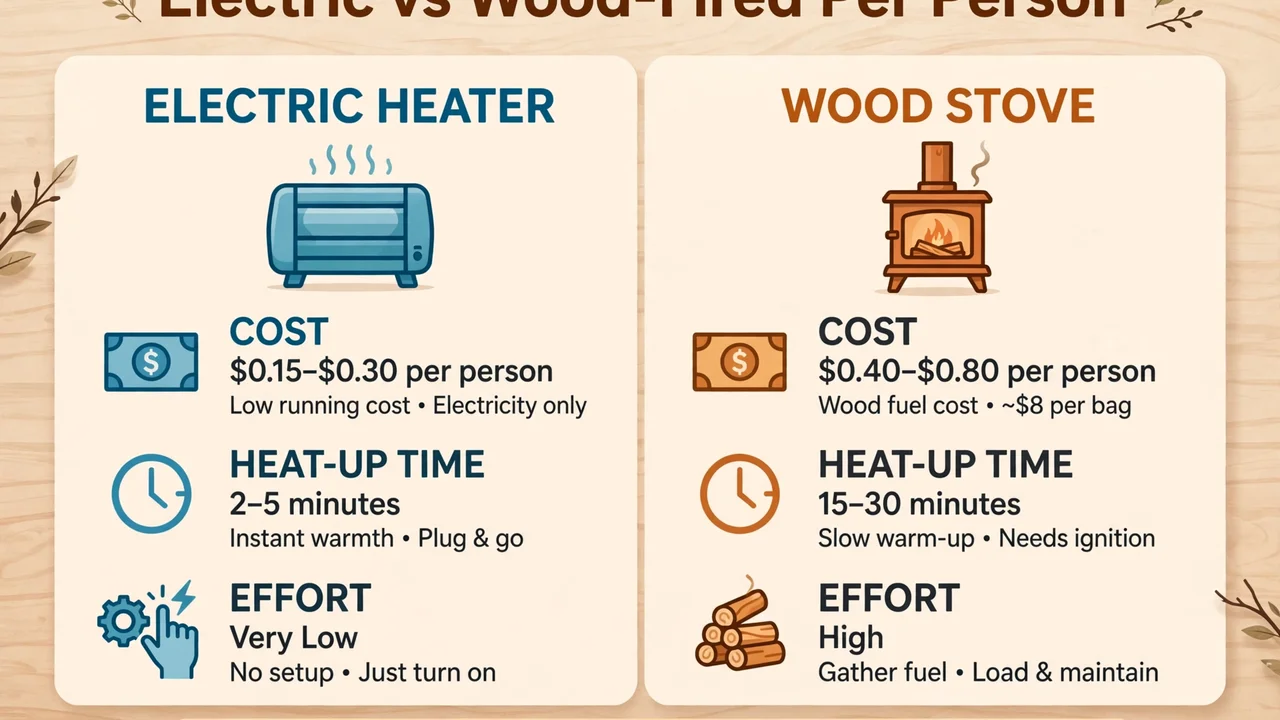
Cost Per Person: The Number That Changes the Decision
Heat-up cost barely changes whether one person or four people use the sauna. That makes cost per person one of the most useful figures in this whole guide, because it rewards sharing the sauna.
| Session cost (example) | 1 person | 2 people | 4 people |
|---|---|---|---|
| Electric 8 kW winter, $2.56 | $2.56 | $1.28 | $0.64 |
| Wood-fired typical, $3.75 | $3.75 | $1.88 | $0.94 |
For a family or a group of friends, the per-person cost drops below a dollar in both examples. For a solo user, the full heat-up cost lands on one person, which makes short, efficient sessions and good insulation especially valuable. If you mostly sauna alone, favour a smaller, well insulated room and a heater sized to it, rather than a large room you heat for one person.
Group sessions can also change session length. Four people may stay longer, chat more and use more steam, which adds holding-heat cost. Even so, the shared heat-up cost usually outweighs that extra holding cost, so group sessions remain cheaper per person in almost every realistic pattern.
What Changes the Number
Sauna Size and Insulation
A larger sauna needs more energy to heat, full stop. Doubling the volume does not always double the cost, because heat loss depends on surface area and insulation as well as volume, but a big room will cost more per session than a small one with the same heater and insulation. Insulation is the quiet hero here. Good wall and roof insulation, a well fitting door and minimal draughts all cut holding-heat cost, and they cut heat-up time too.
The base a sauna sits on also plays a part in heat loss and damp, which is why a sound foundation for an outdoor sauna is worth getting right before you worry about shaving cents off each session. A cold, damp floor will fight your heater every session.
Winter, Wind and Starting Temperature
Winter raises costs in two ways. The starting temperature is lower, so more energy is needed to reach bathing temperature, and heat loss during the session is higher, so the heater works harder to hold temperature. Wind adds to heat loss, especially around doors and vents. Sheltering the sauna from prevailing wind, where your site allows it, can therefore save real money over a season.
Our winter heating and snow tips cover practical steps for cold-weather use, including snow clearance and heat-up planning. The cost lesson from that guide is simple: in winter, start heating earlier, but do not start so early that the sauna sits hot and empty, burning energy for no one.
Session Length and Frequency
Long sessions cost more than short ones, but not in proportion, because heat-up is a fixed cost per session. Two short sessions on different days cost roughly twice the heat-up of one long session, even if total bathing time is the same. If you sauna most days, back-to-back sessions for family members, with the sauna staying hot between them, are far cheaper per person than reheating from cold each time.
Frequency also affects the amortised costs in the next section. A sauna used 200 times a year spreads fixed yearly costs, such as chimney cleaning, over many more sessions than a sauna used 30 times a year. Occasional users therefore face a higher true cost per session, even if their fuel cost per session looks the same.
Hidden and Periodic Costs Per Session
Fuel and electricity are the visible costs. The hidden costs are smaller per session, but they add up, and ignoring them makes wood look cheaper than it is and electric look cheaper than it is. The figures below are amortised estimates, meaning a lump cost spread over the sessions it covers. They are illustrative, not service quotes.
| Periodic item | Illustrative lump cost | Illustrative sessions covered | Cost per session |
|---|---|---|---|
| Sauna stones, replacement set | $40 | 200 sessions | $0.20 |
| Chimney cleaning, wood-fired | $150 per year | 100 sessions per year | $1.50 |
| Heater element, electric | $120 | 300 sessions | $0.40 |
| General upkeep, both types | Varies | Varies | Allow a small buffer |
Chimney cleaning deserves special attention for wood-fired owners. It is a safety cost first and a money cost second. A professional sweep removes creosote build-up that can otherwise become a chimney fire risk. How often it is needed depends on use, wood type and stove design, so follow your stove manufacturer guidance and local practice rather than any fixed schedule in a cost guide.
Electric owners face a different periodic cost. Heating elements wear out and eventually need replacement, and control parts can fail too. Spreading a $120 illustrative element cost over 300 sessions gives $0.40 per session, which is small but not zero. Add it to the electric examples above and the 8 kW winter session rises from $2.56 to about $2.96 before stones are counted.
Regular care keeps both types running efficiently, and a neglected sauna costs more to heat. Our outdoor sauna maintenance calendar sets out seasonal tasks, from cleaning to checking seals and stones, that help keep running costs from creeping up unnoticed.
Ways to Lower Per-Session Cost Without Unsafe Shortcuts
There are no safe shortcuts with fire or electricity, and any tip that asks you to bypass a safety device, overload a heater or burn unsuitable fuel should be ignored. The savings below are all safe, and they work by cutting wasted heat rather than cutting corners.
- Time your pre-heat. Start heating so the sauna reaches temperature just as you are ready, not an hour early. Every empty hot hour is wasted money.
- Insulate and seal. Check door seals, vents and any gaps where warm air escapes. Small draughts add up over a whole heating season.
- Use a cover or lid where your sauna design allows it. Keeping heat in between back-to-back sessions beats reheating from cold.
- Size the heater to the room. An undersized heater runs flat out for a long heat-up, while a wildly oversized heater may cycle awkwardly. Follow manufacturer sizing guidance for your room volume.
- Batch your sessions. If several people want to sauna, run one longer hot period rather than heating from cold twice.
- Keep stones in good condition. Cracked or crumbling stones heat less evenly, so replace them when the manufacturer guidance suggests it.
- Burn only dry, seasoned wood in a wood stove, and never burn treated timber, painted wood or household waste. Poor fuel costs more per session and creates safety and air-quality problems.
For electric owners, tariff timing is another safe lever. If your supplier offers a cheaper off-peak rate, and your routine allows it, shifting sessions to that window cuts cost with no change to the sauna at all. Check the rate details first, because peak and off-peak windows differ by supplier.
Safety Basics That Belong in Any Cost Decision
Cost should never override safety, and the cheapest session is not a good deal if it involves an unsafe practice. For wood stoves, always follow the stove and sauna manufacturer instructions, never leave a lit stove unattended, and keep up with chimney and ash care. Let ash cool fully before disposal, and store ash away from combustible materials.
For electric saunas, installation and any electrical work should follow local code and be carried out by a licensed electrician. This is general guidance only, not installation advice for your home. If you are unsure about wiring, heater capacity or protection devices, get a professional assessment before buying a heater.
For bathers, hydrate before and after a session, start with short sessions and build up gradually, and leave the sauna if you feel dizzy or unwell. Avoid alcohol before or during sauna use. If you are pregnant, or you have a heart or circulation condition, low blood pressure, or you take medication that affects heat tolerance, check with your doctor before using a sauna. This guide is about costs, not medical advice, and a doctor familiar with your health is the right person for personal questions.
Decision Guide: When Electric Wins, When Wood Wins
Electric Usually Wins When
- Your electricity tariff is low or you have cheap off-peak power.
- You sauna solo and want a quick, low-effort session with a switch instead of a fire.
- Firewood is expensive, hard to store or hard to source in your area.
- You value precise temperature control and minimal upkeep between sessions.
Wood Usually Wins When
- You have access to affordable, well seasoned firewood, or your own supply.
- You enjoy tending a fire and the slower ritual is part of the experience for you.
- Your electricity tariff is high, or your site has limited electrical capacity.
- You sauna off-grid or in a location where a strong electrical supply is impractical.
Many owners find the real answer is not purely financial. A wood-fired sauna may cost a dollar or two more per session at your local prices, and still be the right choice because you prefer the heat, the sound and the ritual. An electric sauna may cost less per session and still feel wrong if you wanted a traditional fire experience. Use the per-session figures to avoid surprises, then let preference decide a close call.
It also helps to think in yearly terms once you have a per-session figure. Three sessions a week at $2.56 is about $7.68 a week, or roughly $400 a year at that example rate, before periodic costs. Three sessions a week at $3.75 is $11.25 a week, or roughly $585 a year. Multiply your own per-session cost by your realistic weekly sessions and by 52, and you have a yearly running-cost budget you can actually plan around.
Conclusion
Outdoor sauna running costs come down to a simple trade. Electric sessions are priced by your tariff and your heater, wood-fired sessions are priced by your firewood and your load size, and in both cases heat-up is the cost to watch. Work the formulas with your own numbers, count your real wood loads for a few weeks, and check your tariff properly, and you will know within a dollar or so what each session truly costs.
That knowledge changes how you use the sauna. You will pre-heat smarter, insulate better, share sessions where you can, and stop guessing whether wood or electric is cheaper for your home. The cheapest sauna is not always the best sauna, but a sauna whose running costs you understand is one you will actually enjoy using, week after week, without an unwelcome bill at the end of it.
Frequently Asked Questions
How much does one electric outdoor sauna session cost?
At the illustrative examples in this guide, a one-hour electric session costs about $1.62 to $2.74, depending on heater size and season, at an example tariff of $0.20 per kWh. Use your own tariff in the formula to get your figure.
How much does one wood-fired outdoor sauna session cost?
At the illustrative examples in this guide, a wood-fired session costs about $2.50 to $5.00, depending on firewood price and load size. Divide your cord or delivery price by the number of sessions it provides for your real figure.
Is electric or wood-fired cheaper per session?
It depends on your tariff and your firewood price. At the example rates in this guide, electric is cheaper, but a high electricity tariff or cheap local firewood can reverse that result.
Why does winter cost more per session?
Winter starts colder, so heat-up takes longer and uses more energy or wood, and heat loss during the session is higher. Both effects raise the per-session cost.
How do I find my electricity tariff?
Look for the price per kilowatt-hour on the usage part of your electricity bill. Avoid using a bill total divided by total usage, because that includes fixed charges that do not change when you run the sauna.
How do I convert a firewood price to a per-session cost?
Divide the price of the unit you bought, such as a cord or cubic metre, by the number of sessions that unit provides. Count your session loads for a few weeks to get an accurate sessions-per-unit figure.
Does sauna size affect running costs?
Yes. A larger sauna needs more energy to heat, and poor insulation increases heat loss. A smaller, well insulated sauna generally costs less per session than a large, draughty one.
What hidden costs should I add per session?
Allow for sauna stones, heater element replacement for electric saunas, and chimney cleaning for wood-fired saunas. The illustrative amortised estimates in this guide are $0.20 for stones, $0.40 for an element, and $1.50 for yearly chimney cleaning spread over 100 sessions.
How can I lower my per-session cost safely?
Time your pre-heat so the sauna is ready when you are, improve insulation and door seals, batch sessions together, size the heater to the room, and burn only dry, seasoned wood in a wood stove. Never bypass a safety device or use unsuitable fuel to save money.
Is a solo session more expensive per person?
Yes, per person. Heat-up cost is almost the same for one person or four, so sharing a session divides that fixed cost and lowers the cost per person sharply.
References
All money figures in this article are worked examples using the illustrative rates stated in the text, not market data or quoted prices. Readers should use their own electricity tariff from their supplier bill and their own firewood price from a local supplier. Heater sizing, stove care and chimney maintenance should follow the specific manufacturer guidance for the equipment installed, and electrical work should follow local code with a licensed electrician. No external statistics or study results are relied on in this article.