
Last updated: November 4, 2026. If you are in perimenopause or menopause and wondering whether an infrared sauna could help you feel better, you are asking a fair question at exactly the wrong moment for simple answers. Your body is already more sensitive to heat, sleep is often broken, and joints and mood can feel unpredictable from one week to the next. Adding more heat on purpose sounds strange, and for some people it is the wrong move.
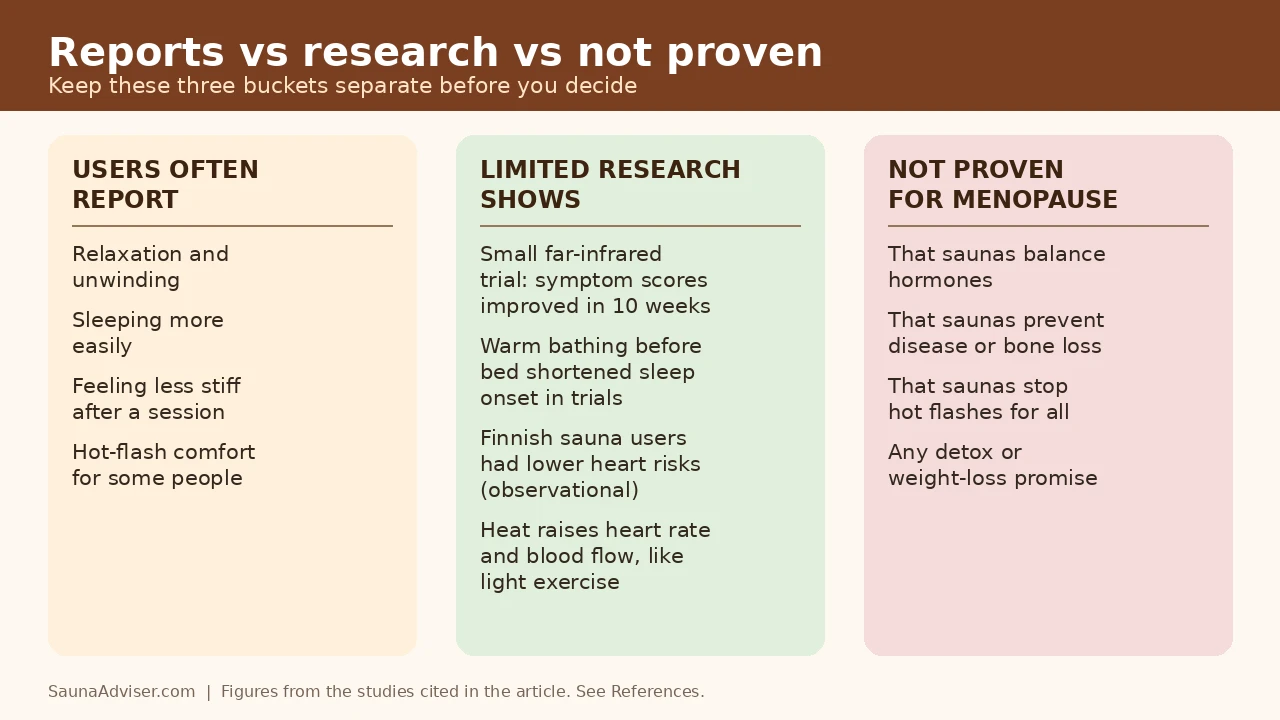
This guide separates three things that are often mixed together online. First, what users commonly report after regular infrared sauna sessions. Second, what limited research actually shows, including how small or indirect that research is. Third, what is not proven for menopause or perimenopause specifically, even when a seller or social post claims otherwise. Keeping those buckets apart is the whole point, because a relaxing routine can still be worth trying even when it is not a treatment.
An infrared sauna for menopause is best understood as a comfort and relaxation tool, not as hormone therapy and not as a replacement for medical care. Some people find it calming and sleep better after an evening session. Others find that heat triggers a hot flash or leaves them drained. Both reactions are plausible, and your own response matters more than any general claim in this article.
Important note, not medical advice: Saunas are wellness tools, not treatments. If you are pregnant, live with a heart or circulation condition or low blood pressure, or take medication that affects heat tolerance, check with a doctor first. Talk with a clinician before changing hormone therapy or any prescribed medication, and never use a sauna to replace care for a new or worsening symptom.


Paid Links - As an Amazon Associate, I earn from qualifying purchases.
Key takeaways
- Heat can trigger or worsen hot flashes for some people, so a lower setting and a shorter session is the safer starting point.
- One small far-infrared trial in postmenopausal women found symptom scores improved over 10 weeks, while hormone levels and bone density did not change.
- Most of the well known sauna research studied traditional Finnish sauna in men, not infrared sauna in menopausal women, so it cannot be copied across directly.
- Passive warming before bed is linked in trials to falling asleep faster, but those trials mostly studied warm baths, not sauna sessions.
- Stop right away if you feel dizzy, nauseous, or unwell, and cool down and drink water. A session that leaves you wiped out was too hot or too long.
Why menopause changes the way heat feels
Perimenopause is the transition before periods stop, when hormone levels swing and cycles become irregular. Menopause is confirmed after 12 months without a period. Postmenopause is the time after that point. Symptoms do not follow one timetable, and two people in the same stage can feel very different.
Hot flashes and night sweats are the best known symptoms, and they come from a thermostat problem rather than a simple feeling of warmth. As estrogen falls, the brain region that controls temperature becomes more sensitive to small changes in core temperature. A rise that once passed unnoticed can now trigger sudden sweating, flushing, and a racing heart. That is why a warm room, a hot drink, stress, or a sauna can all set off a flash in someone who is prone to them.


Paid Links - As an Amazon Associate, I earn from qualifying purchases.
Sleep often suffers at the same time, partly because night sweats wake people up and partly because anxiety and low mood make it harder to settle. Joint aches, muscle stiffness, brain fog, and vaginal dryness can also appear, though not everyone gets every symptom. When several symptoms stack up, a single wellness tool will rarely fix the whole picture, and that is an important limit to keep in mind before buying any sauna.
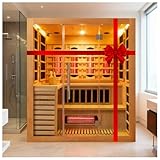
Infrared saunas heat the body differently from a traditional sauna. Instead of heating the air to a very high temperature, infrared panels warm the body more directly, and many users run them at a lower air temperature. That gentler feel is one reason people with heat sensitivity try infrared first. It does not remove the risk of a hot flash, and it does not make a long, hot session safe by default.
What users commonly report
User reports are not proof, but they are useful for setting expectations and for knowing what to watch for in your own sessions. The reports below come up again and again in owner forums, sauna communities, and product reviews. Treat them as experiences to test carefully, not as outcomes you are promised.
Deeper relaxation after a session
Relaxation is the most consistent report, and it is also the easiest to believe. A quiet, warm, phone-free 20 minutes gives the nervous system a break, especially in the evening. Many users say they feel calmer and looser afterward, and that the calm lasts into the night. That may come from the routine itself as much as from the heat, and both parts count when sleep and stress are the problem.

Paid Links - As an Amazon Associate, I earn from qualifying purchases.
Easier sleep on sauna nights
Many users report falling asleep more easily after an evening session, often when the session ends an hour or two before bed. The usual explanation is that warming up and then cooling down mimics the natural drop in core temperature that helps the body prepare for sleep. Some users report the opposite, that a late or very hot session leaves them wired or sweaty at bedtime. Timing and temperature seem to decide which way it goes, so an early evening session is a better test than a session right before lights out.
Looser muscles and joints
Stiffness after sitting all day is a common midlife complaint, and warm muscles tend to feel looser. Users often say a sauna session helps them stretch more comfortably afterward or eases the ache after light exercise. That is a short term comfort effect, not evidence that a sauna repairs a joint or reverses arthritis. If a joint is swollen, hot, or newly painful, heat and rest are questions for a clinician, not a home routine.
Mixed reports about hot flashes
Hot flash reports split in both directions, and that split is honest. Some users say their flashes became less frequent or less intense after several weeks of regular, gentle sessions. Others say the sauna itself caused a flash during the session or in the hour after it. A third group notices no change at all. If you are prone to flashes, plan for the second outcome on your first few sessions, and judge the routine by a simple log rather than by hope.
Mood and a sense of routine
Some users value the sauna mainly as a daily anchor, a fixed point that is not work, not caregiving, and not a screen. That structure can help mood on its own, especially when menopause has disrupted sleep and confidence. It is worth naming this plainly, because a routine that you enjoy and can keep is more useful than a perfect protocol that you abandon after a week.
What the research actually shows
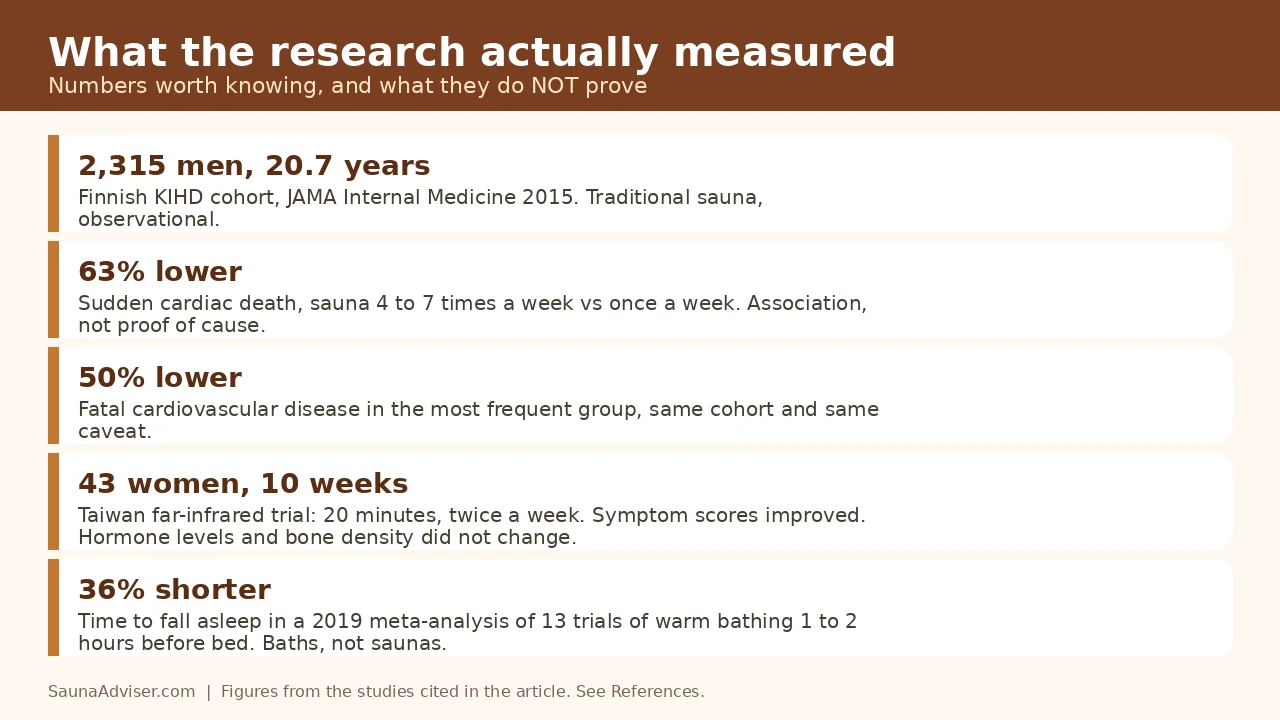
The research picture is uneven, and the gaps matter more than the headlines. There is no large, long term trial of home infrared sauna use in menopausal women that proves it relieves menopause itself. What exists is a small trial of local far-infrared therapy, broader sauna research in other groups, and sleep research on passive warming. Each piece has limits, and the table below keeps those limits visible.
The small far-infrared trial in postmenopausal women
The most directly relevant trial is a small randomized study from Taiwan. In that study, 22 postmenopausal women received local far-infrared therapy for 20 minutes, twice a week, for 10 weeks, while 21 women served as a no treatment control group. Symptom scores improved in the treatment group across several areas, including vasomotor symptoms such as hot flashes and night sweats, musculoskeletal symptoms, urologic symptoms, and psychological symptoms.
The same study found no significant change in estradiol levels, osteocalcin, or bone mineral density over that short period. That result is useful because it corrects two common sales claims at once. Symptom scores can improve without hormones changing, and a 10 week trial cannot show a bone benefit. It is also important to note what the treatment was. The study used local far-infrared therapy applied to the body, not a full home infrared sauna cabin, so it does not prove that a cabin session gives the same result.
The Finnish sauna research, and why it does not transfer neatly
The most cited sauna research comes from Finland, where the Kuopio Ischemic Heart Disease Risk Factor Study followed 2,315 middle aged men for a median of 20.7 years. Men who used a sauna four to seven times per week had a 63 percent lower risk of sudden cardiac death, a 50 percent lower risk of fatal cardiovascular disease, and a 40 percent lower risk of death from any cause, compared with men who used a sauna once a week. A 2018 review in Mayo Clinic Proceedings summarized similar links between sauna bathing and lower risk of high blood pressure, cardiovascular disease, and other conditions.
Those numbers are striking, and they are also easy to misuse. The Finnish cohort was observational, which means it shows an association, not proof that sauna use caused the lower risk. People who sauna often may also exercise more, eat differently, or have other habits that affect health. The participants were middle aged Finnish men, and the saunas were traditional dry saunas, not infrared cabins. None of that makes the research worthless, but none of it proves that an infrared sauna will protect a menopausal woman from heart disease.
The honest use of the Finnish work is narrower. It supports the idea that regular, tolerable heat exposure is linked with better cardiovascular markers in the studied group, and it gives researchers a reason to study heat more carefully. It does not set a dose for menopause, and it does not override the need for blood pressure checks, cholesterol care, and other heart health steps that a clinician recommends.
Sleep and passive warming
Sleep is the area where the evidence is most practical, even though it is indirect. A 2019 systematic review and meta-analysis in Sleep Medicine Reviews pooled 13 trials of water based passive body heating, such as a warm bath or shower. It found that heating at 40 to 42.5 degrees Celsius was linked with better self rated sleep quality and sleep efficiency, and that heating for as little as 10 minutes, scheduled 1 to 2 hours before bedtime, significantly shortened the time taken to fall asleep. A later summary of that work put the shortening at about 36 percent.
That finding is about baths and showers, not saunas, so it should not be quoted as a sauna result. The mechanism is still relevant. Warming the body and then letting it cool increases blood flow to the hands and feet and helps core temperature fall, and that fall is part of how the body prepares for sleep. If you test an evening sauna for sleep, the same timing logic applies. Finish well before bed, cool down properly, and keep the bedroom cool and dark afterward.
Heat shock proteins and the thermostat theory
You will often read that sauna heat trains the thermostat by boosting heat shock proteins, which help cells cope with heat stress. Heat exposure does raise heat shock protein levels in humans, and estrogen deficiency has been linked with lower levels of one such protein in reviews of menopause physiology. That chain of reasoning is interesting, and it may explain why some people adapt to heat over time.
It is still a theory for menopause, not a proven treatment path. Much of the direct work on heat and hot flash like episodes comes from animal studies, and human trials in menopausal women are too small and too few to confirm the effect. A plausible mechanism is not the same as a proven benefit, and any article that presents it as settled science is overstating the case.
| Evidence source | Who was studied | What was found | Limit for menopause readers |
|---|---|---|---|
| Taiwan far-infrared trial, 10 weeks | 43 postmenopausal women | Symptom scores improved. Hormones and bone density unchanged. | Small trial. Local therapy, not a home sauna cabin. |
| Finnish KIHD cohort, JAMA Internal Medicine 2015 | 2,315 Finnish men, median 20.7 years | Frequent sauna use linked with lower sudden cardiac death and fatal cardiovascular disease. | Observational. Men only. Traditional sauna, not infrared. |
| Sleep meta-analysis, Sleep Medicine Reviews 2019 | 13 trials, mostly adults in general | Warm bathing 1 to 2 hours before bed shortened time to fall asleep by about 36 percent. | Studied baths and showers, not sauna sessions. |
| Mayo Clinic Proceedings review 2018 | Summary of sauna studies to early 2018 | Links between sauna bathing and better cardiovascular and other outcomes. | Review of mostly Finnish traditional sauna evidence. |
The hot flash paradox, and how to handle it
Heat is both the trigger and, for some people, the training tool. That contradiction confuses a lot of buyers, so it helps to state it plainly. A hot flash is an overreaction of the temperature control system. Deliberate heat exposure can provoke that overreaction in the moment, especially at a high setting or after a long session. Over weeks, regular gentle exposure may help some bodies tolerate temperature shifts better, possibly through improved sweating and blood flow responses. The second effect, if it happens for you, is slow and partial, while the first effect can happen on day one.
Practical tips if heat triggers your flashes
- Start at the lowest comfortable setting, not the highest setting you can tolerate. Comfort is the dose.
- Keep early sessions short, around 10 to 15 minutes, and build up only if you recover well.
- Sit near the door or keep it slightly open if your model allows it, so you can step out fast.
- Keep cold water within reach, and place a cool towel and a fan nearby for the cooldown.
- Try a morning or afternoon session first, so a flash does not ruin a whole night of sleep while you are still testing.
- Wear light, breathable clothing or a towel, and avoid heavy layers that trap heat against your skin.
- Skip the session on days when flashes are already frequent or severe, and try again on a calmer day.
Track your sessions for at least three weeks before judging them. Note the time of day, the setting, the length, and whether a flash followed within two hours. A simple paper log beats memory here, because flashes vary with stress, alcohol, spicy food, and sleep anyway. If flashes clearly get worse and stay worse, stop the routine and talk with a clinician. Persistence is not a virtue when the signal is negative.
When to stop and check with a doctor
Stop the session at once if you feel dizzy, faint, nauseous, confused, or unusually short of breath, or if your heart races in a way that feels wrong. Cool down, drink water, and sit or lie down until you feel normal. Seek medical advice promptly if symptoms do not settle, or if you notice chest pain, new severe headaches, or vaginal bleeding after menopause, which always needs medical review and has nothing to do with sauna use.
Also check with a doctor before starting if you have new or unexplained symptoms, if you are starting or changing hormone therapy, or if you take blood pressure medication, diuretics, or any drug that affects sweating or heat tolerance. Hormone therapy and other medications are individual decisions, and a sauna article cannot adjust them for you. Bring your session log to the appointment if you can, since it helps a clinician see the pattern.
Sleep, mood, joints, and bones: a realistic scorecard
Sleep
Sleep is the most promising everyday target, because the bath research and user reports point the same way. An evening sauna that ends 1 to 2 hours before bed, followed by a cool shower and a cool bedroom, is a reasonable test. Keep the session gentle, since a very hot late session can raise core temperature too much and delay sleep instead of helping it. If night sweats are your main sleep problem, treat those first with your clinician, since no sauna timing trick fixes a sweat soaked night on its own.
Mood and stress
Relaxation and routine can support mood, and heat itself tends to lower stress hormones in the short term for many people. That is not the same as treating depression or anxiety, and low mood that lasts more than two weeks, or that affects work and relationships, deserves proper care. Think of the sauna as one small part of a wider plan that may include movement, daylight, social contact, and medical support where needed.
Joints and muscles
Warmth can ease stiffness and make gentle stretching feel better, which is why many midlife users keep a sauna for this reason alone. Keep expectations modest and short term. A sauna does not rebuild cartilage, and it does not replace strength work, which matters far more for long term joint health. If pain is sharp, swollen, or getting worse, get it checked rather than heating it repeatedly.
Bones
Bone health deserves a blunt paragraph, because it is often oversold. Estrogen loss after menopause speeds bone loss, and that risk is managed with calcium and vitamin D adequacy, weight bearing exercise, fall prevention, and medical review where indicated. The Taiwan trial found no bone density change in 10 weeks, and no sauna trial has shown that heat builds bone in menopausal women. Do not buy a sauna for bone protection, and do not delay a bone health conversation because you own one.
Weight, skin, and detox claims
Sweating in a sauna loses water weight, which returns when you rehydrate, so it is not fat loss. Any lasting weight change comes from food, movement, sleep, and medical factors, not from sweating. Skin may look flushed and briefly plumper after heat and hydration, but a sauna is not a proven treatment for acne, wrinkles, or pigmentation. The word detox is best ignored in sauna marketing. Sweat does carry small amounts of waste products, but the liver and kidneys do the real clearance work, and no sauna session detoxes hormones or chemicals in a meaningful clinical sense.
Safety basics for every session
Most sauna problems come from simple mistakes: too hot, too long, too dehydrated, or alone without an easy exit. The basics below apply whether you use a cabin, a dome, or a blanket, and they matter more during menopause because blood pressure and temperature control can already be less stable.
- Drink water before and after, and keep water in the sauna. Do not wait until you feel thirsty.
- Start with short sessions and build up slowly over weeks, not days.
- Leave at once if you feel dizzy, nauseous, or unwell. Do not push through to finish a timer.
- Do not drink alcohol before or during a session. Alcohol widens blood vessels and raises dehydration risk.
- Do not sauna alone on your first sessions if you have a heart condition or fainting history, and tell someone nearby what you are doing.
- Cool down gradually with a lukewarm shower, then rest for a few minutes before driving or exercising hard.
- Keep the sauna clean and dry between uses, and follow the maker instructions for your model.
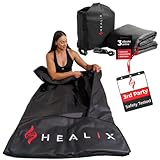
If you use a sauna blanket, be extra careful about overheating, because you cannot step out as quickly and the heat wraps the whole body. Keep your head and face outside the blanket, keep the setting low at first, and stop if you feel trapped, panicky, or overheated. A dome or cabin that lets you sit up and open a door is easier to exit, which is a real safety advantage for heat sensitive users. Our comparison of infrared sauna domes, cabins, and blankets covers space, heat feel, and ease of exit in more detail.
A gentle starter routine you can actually keep
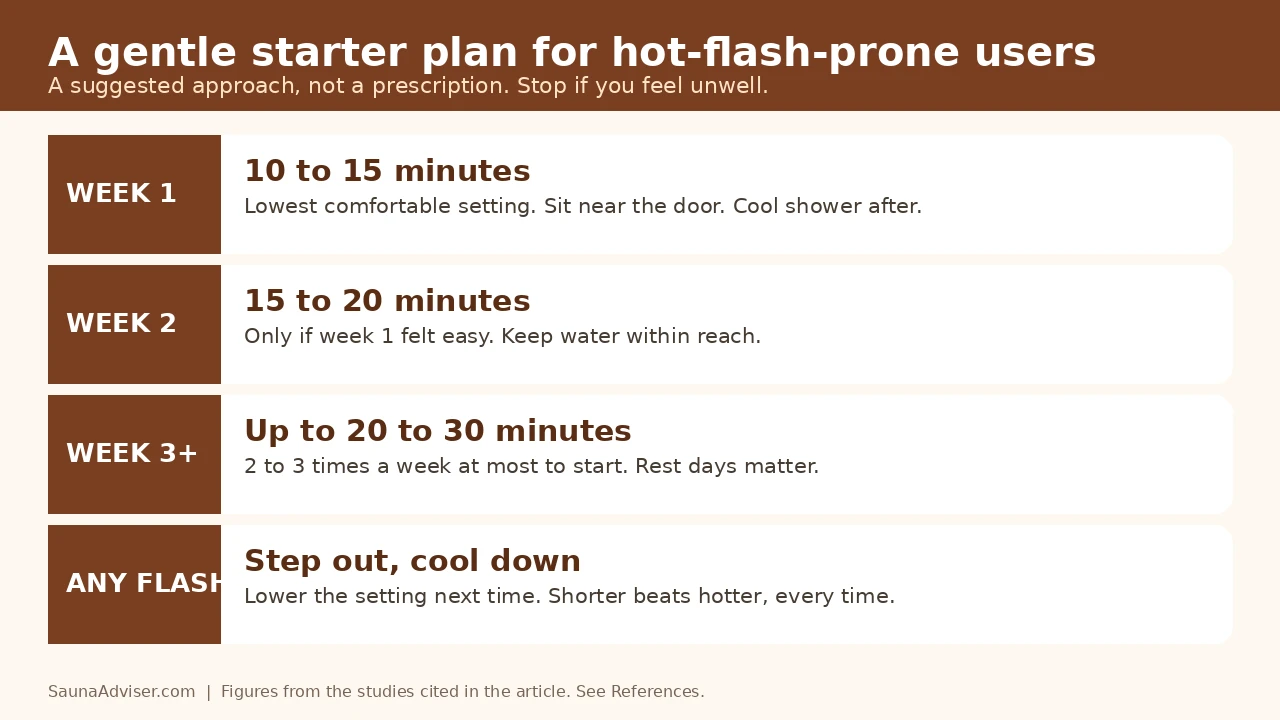
Week one is a test, not a program. Try two sessions of 10 to 15 minutes at a low, comfortable setting, with water nearby and a cool down planned afterward. Note how you sleep that night and whether a flash follows. If both are fine, week two can stretch to 15 to 20 minutes. From week three, many users settle at 20 to 30 minutes, two to three times a week, but that is a ceiling to grow toward, not a target to hit at once. Rest days matter, and a missed week is not a failure.
Preparation makes the session safer and more pleasant. Drink water beforehand, avoid a heavy meal right before, and shower if you can so sweat and skin products do not sit on heated skin. A light towel, a second towel for the bench, and a hair tie if needed will cover most sessions. For a fuller checklist, see our guide on how to prepare for an infrared sauna, which covers timing, hydration, and what to bring.
Timing deserves its own decision. Morning sessions suit people who flash at night, since any triggered flash happens during the day. Evening sessions suit people chasing better sleep, as long as they finish 1 to 2 hours before bed and cool down well. Try one timing for two weeks, log the result, and then try the other if needed. Changing both timing and temperature at once makes it impossible to know what helped.
Pair the sauna with movement rather than replacing movement with it. A short walk, gentle strength work, or stretching on non sauna days does more for bones, mood, and sleep than extra sauna time. If you sauna around workouts, keep the session short and hydrate well. Our guide on infrared sauna use before or after a workout explains the timing trade offs without overstating recovery claims.
Choosing a format: cabin, dome, or blanket
The best format is the one you can exit easily, control precisely, and use regularly without dread. A cabin gives full body heat, room to sit upright, and the easiest exit, but it needs floor space and a power supply. A dome focuses heat on the body while the head stays out, which some heat sensitive users prefer, though lying still for 30 minutes does not suit everyone. A blanket is the cheapest and most portable option, but it traps heat closely and is the hardest to escape quickly, so it needs the most caution.
Check the controls before you buy. A clear temperature display, a timer you can set from inside, and a setting that starts low are more useful than extra programs you will never use. If you share the sauna with a partner, agree on a maximum setting and session length in advance, since heat tolerance differs widely. A model that forces a long preheat or a fixed high program is a poor fit for someone still learning their flash triggers.
Tracking what actually changes
A four week log turns guesses into evidence about your own body. Record the date, session length and setting, time of day, sleep quality that night on a simple 1 to 5 scale, flash count the next day, and a one line mood note. After four weeks, look for patterns rather than single good or bad days. A wearable can help here if you already own one, since resting heart rate and sleep timing are easier to compare than memory. Our guide to sauna wearables for heart rate, sleep, and recovery tracking explains what those numbers can and cannot tell you.
Stop the experiment if the log shows a clear worsening trend, if sleep gets worse for two weeks running, or if you start dreading sessions. A wellness tool should feel like a small pleasure, not a chore you endure for a promised benefit that never arrives. Bring the log to a clinician if you are unsure, since it gives them far more to work with than a general statement that saunas help or do not help.
What not to do
- Do not start at the maximum setting to get it over with faster. Heat dose is not a race.
- Do not combine a sauna with alcohol, a very hot bath, and vigorous exercise in one evening.
- Do not stop or change hormone therapy, blood pressure medication, or any prescribed drug because of sauna marketing.
- Do not use a sauna to treat vaginal bleeding after menopause, chest pain, severe headaches, or a new lump. Those need medical review.
- Do not buy a sauna as a bone, hormone, or disease prevention device. No study supports that purchase reason.
Frequently asked questions
Can an infrared sauna stop hot flashes?
No, it cannot be relied on to stop hot flashes. Some users report fewer or milder flashes after weeks of gentle sessions, while others find heat triggers a flash. The human evidence is too small to promise either outcome.
Is an infrared sauna safe during perimenopause?
For most healthy adults, short and gentle sessions are generally considered low risk, but perimenopause does not change the basic safety rules. Check with a doctor first if you have a heart or circulation condition, low blood pressure, or take medication affecting heat tolerance, and stop at once if you feel dizzy or unwell.
How often should I use an infrared sauna in menopause?
Start with two short sessions a week and build up only if you recover well and sleep is not disturbed. Many users settle at two to three sessions a week, but frequency should follow your log, not a fixed schedule.
What temperature and length are best?
There is no proven best temperature for menopause. Start at the lowest comfortable setting for 10 to 15 minutes, and increase length before increasing heat. Shorter and cooler beats longer and hotter when hot flashes are a concern.
Can I use a sauna while on hormone therapy?
Many people on hormone therapy do use saunas, but this is an individual medical question, not a general yes. Ask the clinician who manages your therapy, especially if your dose has recently changed or your blood pressure is unstable.
Will an infrared sauna help me sleep better?
It may help, and the timing matters most. Finish 1 to 2 hours before bed, cool down properly, and keep the bedroom cool. Warm bathing trials shortened time to fall asleep, but those trials did not study saunas directly, so treat sleep gains as a testable hope, not a guarantee.
Does infrared sauna use change hormone levels?
No good evidence shows that it does in menopausal women. The small Taiwan far-infrared trial found symptom scores improved while estradiol levels did not change. Do not buy a sauna expecting it to balance hormones.
Is a sauna blanket safe if I get hot flashes?
A blanket needs extra caution because heat wraps the body and exit is slower. Keep your head outside, start low and short, and stop at once if you feel overheated or panicky. A cabin or dome with an easy exit is usually a safer first choice for heat sensitive users.
The bottom line
An infrared sauna for menopause is worth considering as a comfort routine, not as a cure. The most honest summary is this: relaxation and sleep are plausible everyday gains, hot flash effects are mixed and personal, and hormone, bone, and disease prevention claims are not supported. A gentle start, a simple log, and a willingness to stop if flashes worsen will tell you more in a month than any marketing page can.
If you try it, keep the rest of your menopause care in place. Movement, sleep habits, nutrition, and medical review do the heavy lifting, and a sauna at best adds a calm, warm half hour to that plan. If you do not try it, you are not missing a proven treatment. The best routine is the one that leaves you rested, steady, and able to keep going, with or without extra heat.
References
- Laukkanen T, Khan H, Zaccardi F, Laukkanen JA. Association between sauna bathing and fatal cardiovascular and all-cause mortality events. JAMA Internal Medicine, 2015, 175(4), 542 to 548. Observational Finnish cohort study of 2,315 men.
- Laukkanen JA, Laukkanen T, Kunutsor SK. Cardiovascular and Other Health Benefits of Sauna Bathing: A Review of the Evidence. Mayo Clinic Proceedings, 2018, 93(8), 1111 to 1121.
- Chien LW and colleagues. Local thermal therapy effects on menopausal symptoms and bone mineral density in postmenopausal women. Randomized trial in Taiwan, far-infrared therapy 20 minutes twice a week for 10 weeks. Summary: local thermal therapy and menopausal symptoms summary.
- Haghayegh S, Khoshnevis S, Smolensky MH, Diller KR, Castriotta RJ. Before-bedtime passive body heating by warm shower or bath to improve sleep: A systematic review and meta-analysis. Sleep Medicine Reviews, 2019, 46, 124 to 135. PubMed record and related sleep and thermoregulation review.