
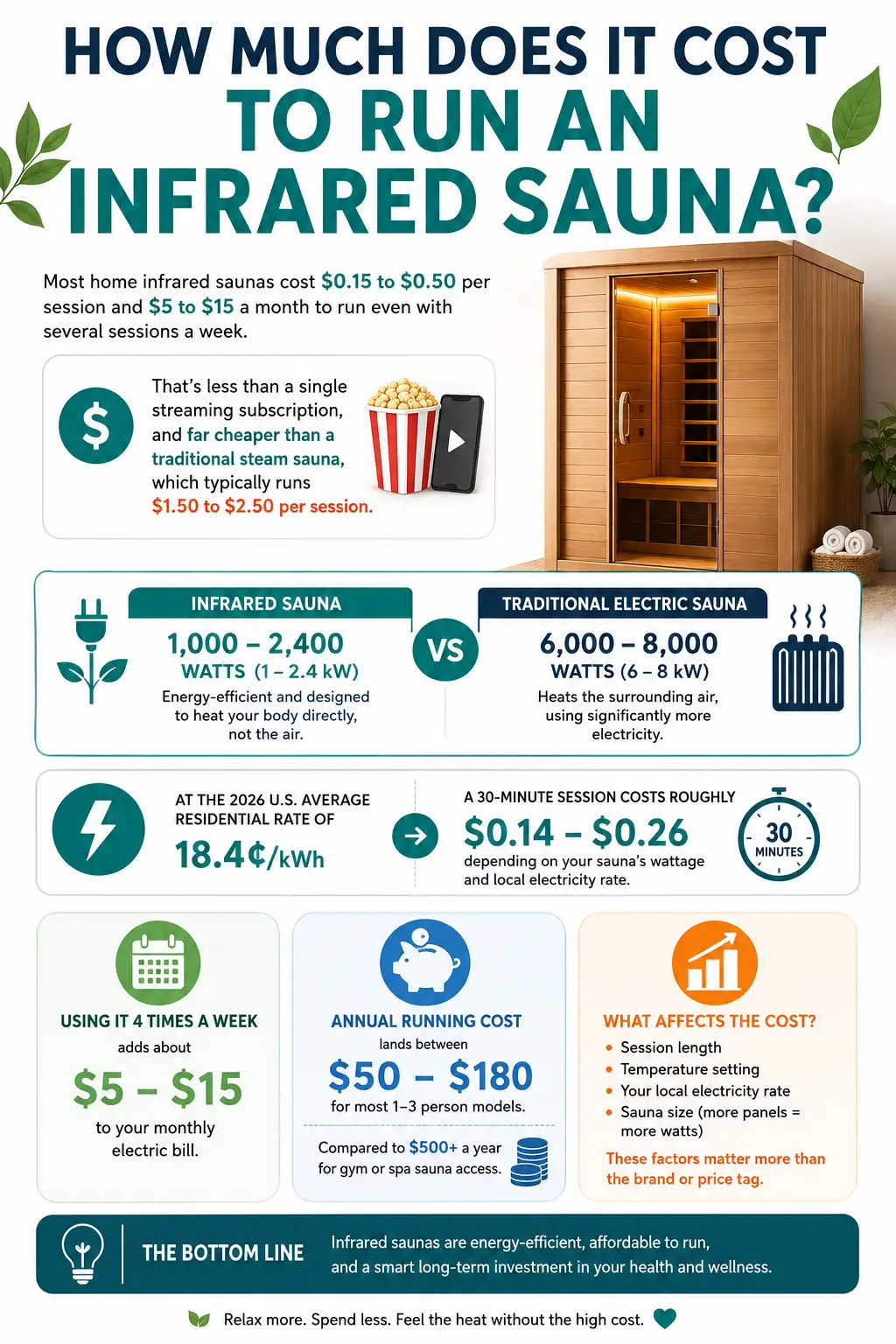
Most home infrared saunas cost $0.15 to $0.50 per session and $5 to $15 a month to run even with several sessions a week. That’s less than a single streaming subscription, and far cheaper than a traditional steam sauna, which typically runs $1.50 to $2.50 per session.
Here’s the exact math, plus how to calculate your own cost using your local electricity rate.
Key Takeaways
- Infrared saunas use 1,000–2,400 watts (1–2.4 kW), compared to 6,000–8,000 watts for a traditional electric sauna.
- At the 2026 U.S. average residential rate of 18.4¢/kWh, a 30-minute session costs roughly $0.14–$0.26.
- Using it 4 times a week adds about $5–$15 to your monthly electric bill.
- Annual running cost lands between $50 and $180 for most 1–3 person models — compared to $500+ a year for gym or spa sauna access.
- Session length, temperature setting, and your local electricity rate matter more than the sauna’s brand or price tag.
Infrared Sauna Runing Cost Calculator
Infrared Sauna Running Cost Calculator
Estimate what your infrared sauna really costs to run — per session, per month, and per year.
Your Estimated Running Cost
How to Calculate Runing Cost of Infrared Sauna
You don’t need a calculator app for this — the math is one line:


Paid Links - As an Amazon Associate, I earn from qualifying purchases.
Heater wattage (kW) × session length (hours) × your electricity rate ($/kWh) = cost per session
For example, a 1.7 kW infrared sauna run for 30 minutes at the national average rate of 18.4¢/kWh:


Paid Links - As an Amazon Associate, I earn from qualifying purchases.
1.7 kW × 0.5 hours × $0.184 = $0.16 per session
To find your own rate, check the “price per kWh” or “supply charge” line on a recent electric bill. If you can’t find it, the U.S. average is a safe stand-in — but rates vary enormously by state, from about 12¢/kWh in Idaho and North Dakota to over 45¢/kWh in Hawaii.
What Infrared Saunas Actually Use in Electricity
Heater wattage is the single biggest factor in your running cost, and it scales with the size of the sauna. Based on manufacturer specs across the market, here’s the typical range:
| Sauna Size | Typical Heater Wattage | Cost per 30-Min Session* | Monthly Cost (4x/week)* |
|---|---|---|---|
| 1-Person | 900W – 1,200W | $0.08 – $0.11 | $1.30 – $1.75 |
| 2-Person | 1,500W – 1,800W | $0.14 – $0.17 | $2.20 – $2.70 |
| 3-Person | 1,800W – 2,200W | $0.17 – $0.20 | $2.70 – $3.25 |
| 4–6 Person | 2,200W – 2,800W | $0.20 – $0.26 | $3.25 – $4.15 |
Calculated at the 2026 U.S. average residential rate of 18.4¢/kWh. Your actual cost will shift with your local rate — multiply the wattage column by your rate to get a precise number.



Paid Links - As an Amazon Associate, I earn from qualifying purchases.
A few things worth noting about these numbers:
- They already account for the fact infrared saunas need little to no preheating. Because infrared panels heat your body directly rather than warming a room full of air, most units reach usable temperature in 10–15 minutes and don’t need a separate “warm-up” cost added on.
- Full-spectrum models (which combine near, mid, and far infrared wavelengths) sometimes draw a bit more power than far-infrared-only units of the same size, but the difference is usually under 20 cents a month.
- Real-world draw tends to run slightly higher than spec-sheet numbers, since most people don’t run heaters at 100% output the entire session — thermostats cycle the heaters on and off once your set temperature is reached, which actually keeps costs on the lower end of these ranges.
Infrared vs. Traditional Sauna: Cost Comparison
This is where infrared saunas pull ahead by a wide margin. Traditional (rock-and-steam) saunas rely on high-wattage heaters that must run for 30–45 minutes before you even step inside, then keep running throughout your session.
| Infrared Sauna | Traditional Electric Sauna | |
|---|---|---|
| Heater wattage | 1,000W – 2,400W | 6,000W – 8,000W |
| Preheat time | 10–15 min (often skippable) | 30–45 min, required |
| Cost per session | $0.10 – $0.30 | $1.50 – $2.50 |
| Monthly cost (4x/week) | $5 – $15 | $25 – $50 |
| Annual cost | $50 – $180 | $300 – $600 |
| Electrical requirement | Standard 15A/20A outlet (most 1–3 person units) | Dedicated 240V circuit |
Traditional saunas also run hotter (typically 150–195°F versus 120–140°F for infrared), which is part of why they need so much more power to operate — they’re heating the entire room’s air rather than radiant panels aimed at your body.
What Factors influence Infrared Saun Running Cost
If two people buy the identical infrared sauna model, their monthly bills can still look different. Here’s why.
1. Session length. Stretching a session from 30 to 45 minutes doesn’t just add proportional cost — it can increase total energy use by close to 50%, since the heater has to work to maintain temperature for longer against natural heat loss.
2. Temperature setting. Running at a higher set point (say 140°F instead of 120°F) makes the heater cycle on more frequently to hold that temperature, which can raise consumption by roughly a third. If you’re new to infrared sauna use, starting around 120–125°F is both more comfortable and cheaper to run.
3. Your local electricity rate. This swings your cost more than almost anything else. The same sauna costs about 3x more to run in Massachusetts or California (30¢+/kWh) than in Idaho or North Dakota (12¢/kWh).
4. Frequency of use. Obvious, but worth stating plainly: 3 sessions a week costs roughly 25% less than daily use. Most people find 3–4 sessions weekly delivers the wellness benefits they’re after without meaningfully denting the electric bill either way.
5. Insulation and placement. A sauna installed in an unheated garage or an outdoor space that gets cold works harder to reach and hold temperature than one in a climate-controlled room. Well-insulated cabins with tight door seals lose less heat and cycle their heaters less often.
How to Lower Your Infrared Sauna’s Running Cost
- Skip unnecessary preheating. Most infrared panels warm up fast enough that you can start your session within a few minutes, unlike traditional saunas.
- Turn it off as soon as you’re done. Leaving a sauna idling on standby after a session adds cost with zero benefit.
- Keep sessions to 20–30 minutes. This is also the range most sauna-use research points to for cardiovascular and relaxation benefits, so it’s a win on both fronts.
- Run it during off-peak hours if your utility uses time-of-day pricing. Many utilities in deregulated states charge less overnight or midday; check your plan.
- Choose a well-insulated cabin. Solid wood construction with tight seals holds heat better than thinner panel construction, meaning less energy to maintain temperature.
Beyond Electricity: Other Costs to Budget For
Running cost is only part of total ownership cost. If you’re comparing infrared saunas as a purchase, keep these in mind too:
- Upfront price: Home infrared saunas range from roughly $1,500 for a basic 1–2 person unit to $8,000–$15,000+ for larger, full-spectrum, or custom-built models.
- Electrical installation: Most 1- and 2-person units plug into a standard 15A or 20A 120V household outlet with no electrician needed. Larger 4+ person units, or any hardwired install, typically need a dedicated 240V circuit — budget $150–$500 for an electrician to run one if your panel doesn’t already have capacity.
- Maintenance: Wiping down wood surfaces and checking wiring periodically is typically all that’s needed. There’s no water, filters, or chemicals to budget for, unlike a hot tub.
- Heater replacement (rare): Quality heaters are generally rated for well over a decade of regular use; budget saunas with lower-grade heating elements may need panel replacement sooner.
Infrared Sauna Cost vs. Other Wellness Options
For context, here’s how home infrared sauna ownership stacks up against the alternatives people usually compare it to:
| Option | Monthly Cost | Annual Cost |
|---|---|---|
| Home Infrared Sauna (electricity only) | $5 – $15 | $50 – $180 |
| Gym Membership with Sauna Access | $40 – $80 | $480 – $960 |
| Spa/Studio Sauna Visits (1x/week) | $120 – $300 | $1,440 – $3,600 |
Electricity is a small line item compared to the upfront purchase — but for anyone already deciding between building a home sauna habit versus paying per visit elsewhere, the running-cost gap closes the price difference faster than most people expect, often within the first one to two years of ownership.
Read More:
FAQs
How much does it cost to run an infrared sauna per hour?
Between roughly $0.15 and $0.45 per hour, depending on the heater’s wattage and your local electricity rate. A typical 2-person unit at the U.S. average rate costs about $0.30–$0.35 per hour.
Do infrared saunas raise your electric bill a lot?
No. Most households see less than $15 added to their monthly bill even with regular use of 3–4 sessions a week.
Are infrared saunas cheaper to run than traditional saunas?
Yes, significantly. Infrared saunas use roughly a quarter to a third of the wattage traditional saunas require, and they skip the mandatory 30–45 minute preheat, cutting typical running costs by 80–90%.
What size breaker or outlet does an infrared sauna need?
Most 1- to 3-person units run on a standard 15A or 20A, 120V household outlet — no electrician required. Larger 4+ person or full-spectrum units may require a dedicated 240V circuit.
Does the temperature setting affect running cost?
Yes. Running at a higher temperature makes the heater cycle on more often to maintain that heat, which can raise energy use by around a third compared to a lower, still-effective setting.
Does session length matter for cost?
Yes, going from a 30-minute to a 45-minute session can increase energy use by close to 50%, not just 50% more time, since the heater works harder to hold temperature over a longer stretch.
Is it cheaper to use an infrared sauna daily or a few times a week?
Cost scales roughly with frequency, so daily use costs more than 3–4x weekly use — but the difference is usually only a few dollars a month either way.
How much does electricity cost for a 2-person infrared sauna specifically?
At the national average rate, expect roughly $0.14–$0.20 per 30-minute session and $2–$3 a month with regular use — details vary by heater wattage and your local rate.
Do full-spectrum infrared saunas cost more to run than far-infrared-only models?
Slightly. Full-spectrum heaters can draw a bit more power, but the difference typically amounts to well under a dollar per month for most home units.
Will running an infrared sauna trip my breaker?
Unlikely for standard 1–3 person units on a dedicated 15A/20A outlet, as long as nothing else heavy is running on the same circuit. Larger units on a shared circuit are the more common cause of tripped breakers.
How can I calculate the exact cost for my own sauna?
Multiply your sauna’s heater wattage (in kW) by your session length in hours, then by your electricity rate in dollars per kWh. You can find your rate on a recent electric bill.
Do infrared saunas need to preheat, and does that add cost?
Most infrared saunas need only 10–15 minutes to reach a usable temperature, and many people start their session as it warms up rather than waiting so preheating adds little to no extra cost compared to traditional saunas’ mandatory 30–45-minute warm-up.