If you have ever stepped into a gym locker room or scrolled through wellness social media, you have likely faced the great debate: which type of sauna is best for health? With options ranging from the scorching heat of a Finnish sauna to the gentle glow of an infrared cabin, the choice can feel overwhelming.
The short answer? The healthiest type of sauna is the one you will use consistently. However, when we dig into the research from 2024 and 2025, distinct winners emerge depending on your specific goal—whether that is heart health, brain function, or weight management.
In this complete 2026 guide, we will Find Which Type of Sauna Is Best for Health?. We will analyze the infrared vs traditional sauna research to give you a clear, evidence-based roadmap. By the end, you will know exactly what type of sauna is best for you.
Disclaimer: This article is for informational purposes only and does not constitute medical advice. Always consult with a qualified healthcare professional before starting any new health therapy, especially if you have pre-existing medical conditions.
Key Takeaways
- For Heart Health: Traditional Finnish saunas have the strongest long-term data, showing reduced risks of cardiovascular disease and hypertension.
- For Tolerability: Infrared saunas operate at lower air temperatures, making them ideal for those who find traditional heat overwhelming.
- For Weight Loss: Neither type burns significant calories; saunas shed water weight, not fat. However, heat therapy can complement exercise.
- For Detox: Both induce sweating, which helps excrete heavy metals, though infrared is often preferred for deep tissue penetration.
- The Bottom Line: Consistency trumps modality. The best sauna is the one you can access safely 3-4 times per week.
Main Types of Saunas Explained: A Comparison Chart
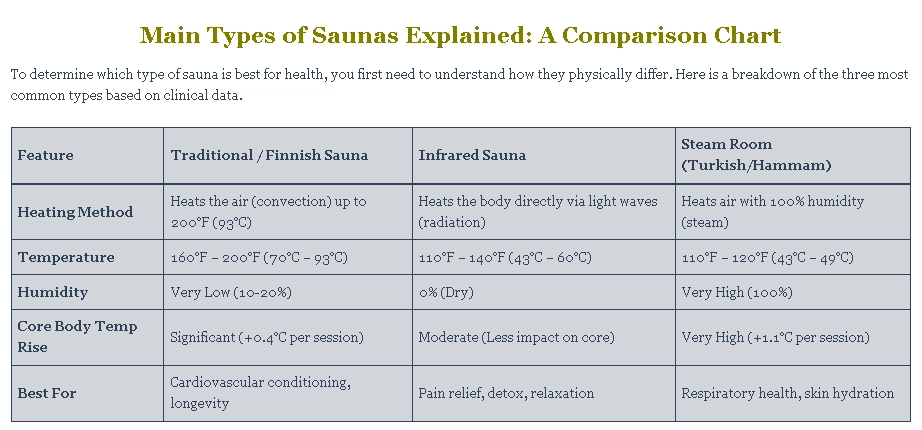
To determine which type of sauna is best for health, you first need to understand how they physically differ. Here is a breakdown of the three most common types based on clinical data.
| Feature | Traditional / Finnish Sauna | Infrared Sauna | Steam Room (Turkish/Hammam) |
|---|---|---|---|
| Heating Method | Heats the air (convection) up to 200°F (93°C) | Heats the body directly via light waves (radiation) | Heats air with 100% humidity (steam) |
| Temperature | 160°F – 200°F (70°C – 93°C) | 110°F – 140°F (43°C – 60°C) | 110°F – 120°F (43°C – 49°C) |
| Humidity | Very Low (10-20%) | 0% (Dry) | Very High (100%) |
| Core Body Temp Rise | Significant (+0.4°C per session) | Moderate (Less impact on core) | Very High (+1.1°C per session) |
| Best For | Cardiovascular conditioning, longevity | Pain relief, detox, relaxation | Respiratory health, skin hydration |
The Research Breakdown: Infrared vs Traditional Sauna Benefits
When people ask what type of sauna has the most health benefits, they are usually comparing the traditional Finnish model against the modern infrared cabin. Both have merits, but the mechanisms of action are different.
The Case for Traditional Finnish Sauna
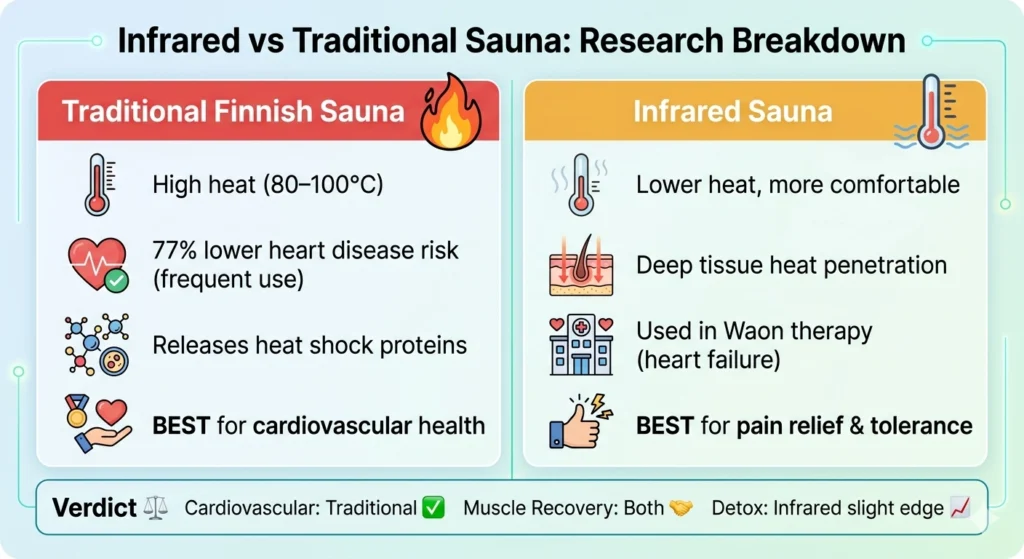
In Finland, sauna bathing is a national pastime. It is also the subject of the most robust research available. A landmark 15-year study found that men who used a traditional sauna 4-7 times per week had a 77% lower risk of dying from heart disease compared to those who used it once a week.
The high heat (80-100°C) causes a hormetic stress response. This means the brief stress of the heat makes your body stronger, releasing “heat shock proteins” that repair damaged cells and improve the elasticity of blood vessels. For those asking which type of sauna is best for cardiovascular health, the research heavily favors traditional Finnish saunas due to the intensity of the thermal stress.
The Case for Infrared Sauna
Infrared saunas are the new generation. Because they use light to heat you directly without warming the air much, they are more tolerable for people with low heat tolerance. Infrared vs traditional sauna huberman discussions often note that infrared allows you to achieve a deep, detoxifying sweat at a fraction of the heat.
Infrared has shown promise in specific medical contexts. Waon therapy, a specific type of far-infrared sauna, is used in Japan to treat patients with chronic heart failure, improving their symptoms and quality of life. Furthermore, for those with chronic pain or fibromyalgia, infrared is often superior because the gentle heat penetrates joints more deeply without causing respiratory distress.
The Verdict on Health Outcomes
- Cardiovascular: Traditional wins. The high heat forces a greater increase in heart rate (similar to moderate exercise) and lowers blood pressure more effectively long-term.
- Muscle Recovery: Tie. Both increase blood flow and reduce inflammation, aiding recovery.
- Detoxification: Infrared may have a slight edge due to deeper tissue penetration, releasing fat-soluble toxins stored in fat cells.
Which Type of Sauna Is Best for Specific Health Goals?
What Type of Sauna is Best for Cardiovascular Health?
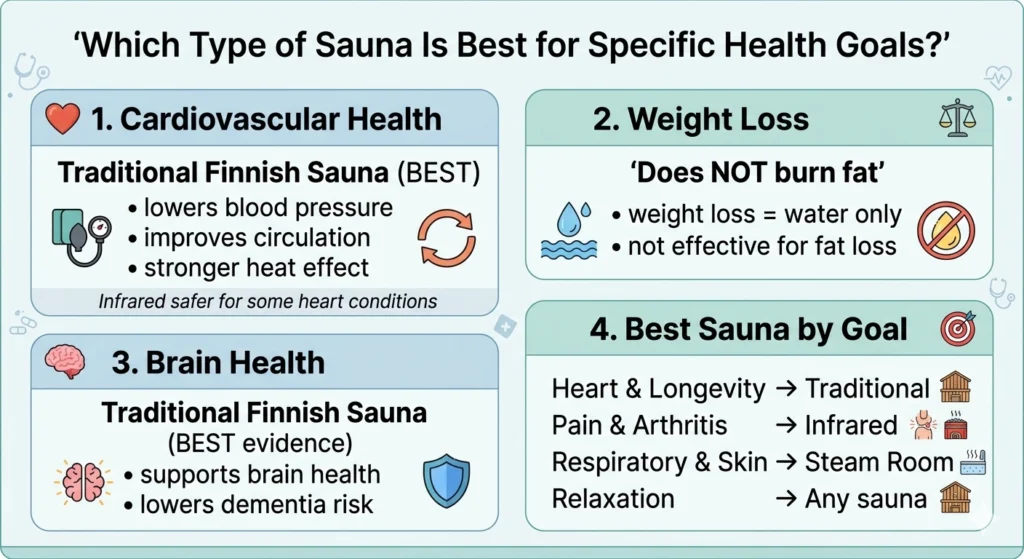
If your primary concern is preventing high blood pressure or improving arterial function, the data is clear: Traditional Finnish sauna. Studies show a direct dose-response relationship; the more you use the hot, dry sauna (in 15-20 minute sessions), the more your systolic blood pressure drops over time. The elevation in core body temperature required for vascular benefits is achieved more quickly in a traditional setting than in infrared.
However, if you have uncontrolled high blood pressure or unstable angina, you must ask your doctor first. For those with stable heart failure, Waon therapy (infrared) is a safer, proven alternative.
Which Type of Sauna is Best for Weight Loss?
Let’s bust a myth immediately. Which type of sauna is best for weight loss is a tricky question because saunas do not burn fat. The weight lost during a session is water weight.
A study cited by experts notes that a 10-minute sauna session might burn roughly 73 calories—far less than a brisk walk. The person who perspires heavily in a sauna is losing water, not adipose tissue. While the cardiovascular strain of a traditional sauna mimics exercise (raising heart rate), it does not engage the metabolic pathways required to burn fat. Therefore, neither sauna is a valid weight loss tool. Use heat therapy for recovery, not calorie burning.
Which Type of Sauna is Best for Brain Health?
This is where the research gets exciting. Which type of sauna is best for brain health? A 2024 comprehensive review published by the NIH found that regular Finnish sauna use is linked to a reduced risk of dementia and Alzheimer’s disease. The theory is that the improved vascular function protects the blood-brain barrier and reduces systemic inflammation.
While infrared saunas are also anti-inflammatory, the specific epidemiological studies on dementia prevention have been conducted using traditional Finnish saunas. For protecting your brain as you age, the traditional method has the strongest evidence.
What Is the Healthiest Type of Sauna?
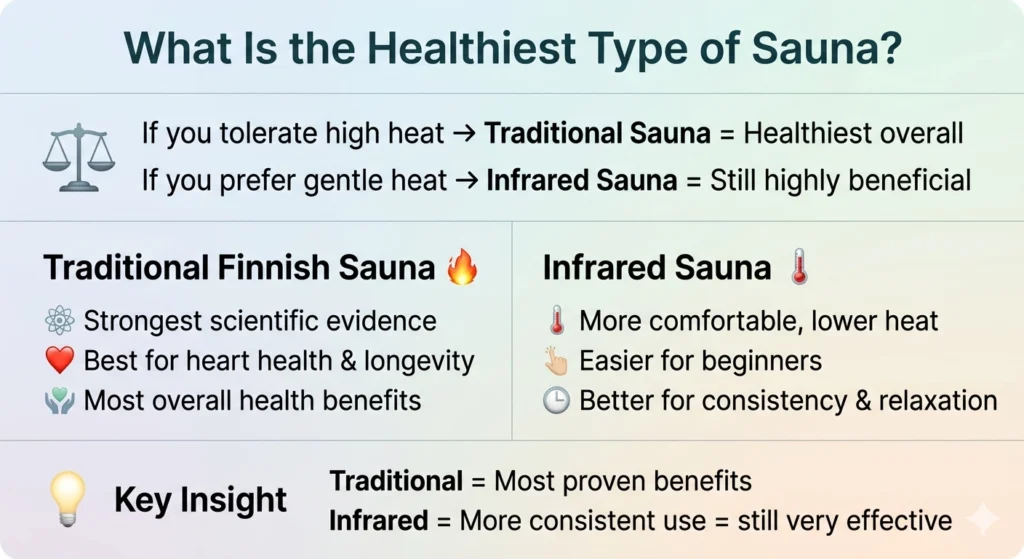
1. Traditional Finnish Sauna (Best Overall for Health Outcomes)
- Strongest evidence base
- Best for heart and longevity benefits
2. Infrared Sauna (Best for Comfort and Consistency)
- Easier for beginners
- Good for recovery and relaxation
Final Answer:
If you tolerate heat well → traditional sauna may be the healthiest overall
If you prefer gentle heat → infrared sauna is still highly beneficial
What Type of Sauna Has the Most Health Benefits?
When considering what type of sauna has the most health benefits, traditional saunas currently lead due to:
- Large population studies (Finland)
- Strong cardiovascular data
- Long-term usage evidence
However, infrared saunas are gaining popularity due to accessibility and comfort, which can lead to more consistent use—arguably just as important.
Which Type of Sauna is Best for Home Use?
Choosing a sauna for your house involves space, electrical work, and ventilation.
For convenience, infrared saunas are usually the best choice for homes. Most are “plug-and-play” (standard 110v outlet), are constructed as modular boxes, and do not require the extreme ventilation needed for a wood-burning or electric traditional stove. If you are looking for the answer to which type of sauna is best for home and you live in an apartment or a modern insulated home, infrared is the practical winner.
If you have outdoor space and want the maximum health “hit,” a traditional barrel sauna offers a superior social and physiological experience but requires more maintenance and a higher electrical capacity.
Simple Decision Guide
Choose Traditional Sauna if:
- You want maximum cardiovascular benefits
- You tolerate high heat well
- You aim for longevity-focused wellness
Choose Infrared Sauna if:
- You prefer lower heat
- You want muscle recovery support
- You plan frequent, longer sessions
A Note on Safety and Hydration
Regardless of which type of sauna you choose, safety is paramount. Passive heat therapy puts stress on the heart—the same way jogging does. Always start with short sessions (5-10 minutes) to see how your body reacts.
Do not drink alcohol before or during a sauna session. You must rehydrate with water containing electrolytes afterward to prevent dizziness. People who are pregnant, have fever, or are on medications that affect blood pressure should consult a physician before beginning any heat therapy regimen.
You May Also Like To Read:
FAQs
Infrared vs traditional sauna: which is better?
Is it safe to use a sauna every day?
What is the healthiest type of sauna?
The healthiest type is the one you can tolerate and will use consistently. If you hate humidity, don’t buy a steam room. If you miss the “scalding” feeling, infrared might feel too weak. All produce the core benefit: raising heart rate and inducing sweat.
Can I use a sauna if I have high blood pressure?
Final Thoughts
After reviewing the sauna types and benefits from 2024 and 2025 clinical data, we return to the central question: which type of sauna is best for health?
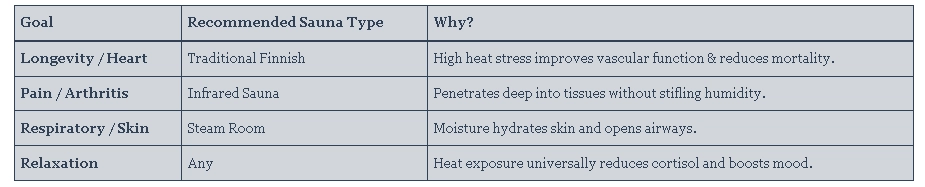
- For the Athlete or Biohacker: Choose Traditional Finnish. The intensity provides the greatest cardiovascular adaptation.
- For the Chronically Ill or Heat-Sensitive: Choose Infrared. It offers healing without the suffocating air temperature.
- For the Spa Lover: Choose Steam. It is unmatched for respiratory health and skin hydration.
But for the average person asking what kind of sauna is the best? The best sauna is the one you walk into. Whether it’s the 180-degree heat of a wood-fired Finnish room or the 130-degree light of an infrared cabin, the act of raising your core temperature and sweating regularly is a powerful longevity tool.
So, stop worrying about the perfect modality and start sweating. Your heart, brain, and muscles will thank you.