
A portable steam sauna tent looks simple: a folding tent, a small steamer, and a hose between them. That simplicity is part of the appeal, but it is also why safety deserves a proper look before the first session. Live steam, hot surfaces, and a damp, enclosed space combine risks that a dry sauna does not have, and most of them are easy to prevent once you know where they hide.
This guide is a safety article, not a buying guide. It covers the burns that actually happen with steam tents, how ventilation really works in head-out and fully enclosed designs, the setup mistakes that cause most problems, and the session habits that keep a relaxing routine safe. If you are still choosing a tent, start with our broader overview of portable steam saunas and come back here before you set yours up.
Disclaimer — please read first: This article is general information only and is not medical advice. A steam sauna tent is a wellness product, not a treatment, and it cannot detox your body, cure any condition, or guarantee weight loss. If you are pregnant, live with a heart or circulation condition or low blood pressure, or take medication that affects heat tolerance, check with your doctor before using a steam sauna tent. Always follow your manufacturer’s manual — it overrides any general guidance here.


Paid Links - As an Amazon Associate, I earn from qualifying purchases.
Why a Portable Steam Tent Deserves Extra Care
A traditional steam room is built into a tiled, ventilated space with fixed plumbing and professional installation. A portable tent is the opposite: lightweight fabric, a freestanding electric steamer, and a flexible hose, all sitting on your living-room or bedroom floor. Nothing about that is wrong, but it means you are the installer, the ventilation engineer, and the safety officer all at once.


Paid Links - As an Amazon Associate, I earn from qualifying purchases.
Three things make steam tents different from other home saunas. First, the heat arrives as wet steam through a nozzle, so contact burns and scalds are a real risk, not a theoretical one. Second, the tent traps moisture as well as heat, so the room and the fabric need drying after every session or mold and musty smells follow. Third, the steamer combines water and electricity in one small appliance, so cord routing, water levels, and surface choice all matter more than they would for a dry heater.
The good news is that none of this is complicated. The same handful of habits — steamer outside the tent, hose routed safely, fresh air in the room, short sessions, and a proper dry-out afterwards — prevent nearly every common problem. The rest of this guide turns those habits into a checklist you can run through in two minutes before each session. For the bigger picture on how these tents work, see The Ultimate Guide to Portable Steam Saunas.
The Four Burn Risks to Know Before Your First Session
Burns from a steam tent rarely come from one dramatic failure. They come from ordinary contact: a hand brushing the nozzle while adjusting the hose, a bare foot stepping in a hot puddle, or a steamer grabbed too soon after switch-off. Knowing the four hot zones in advance is the simplest protection there is.
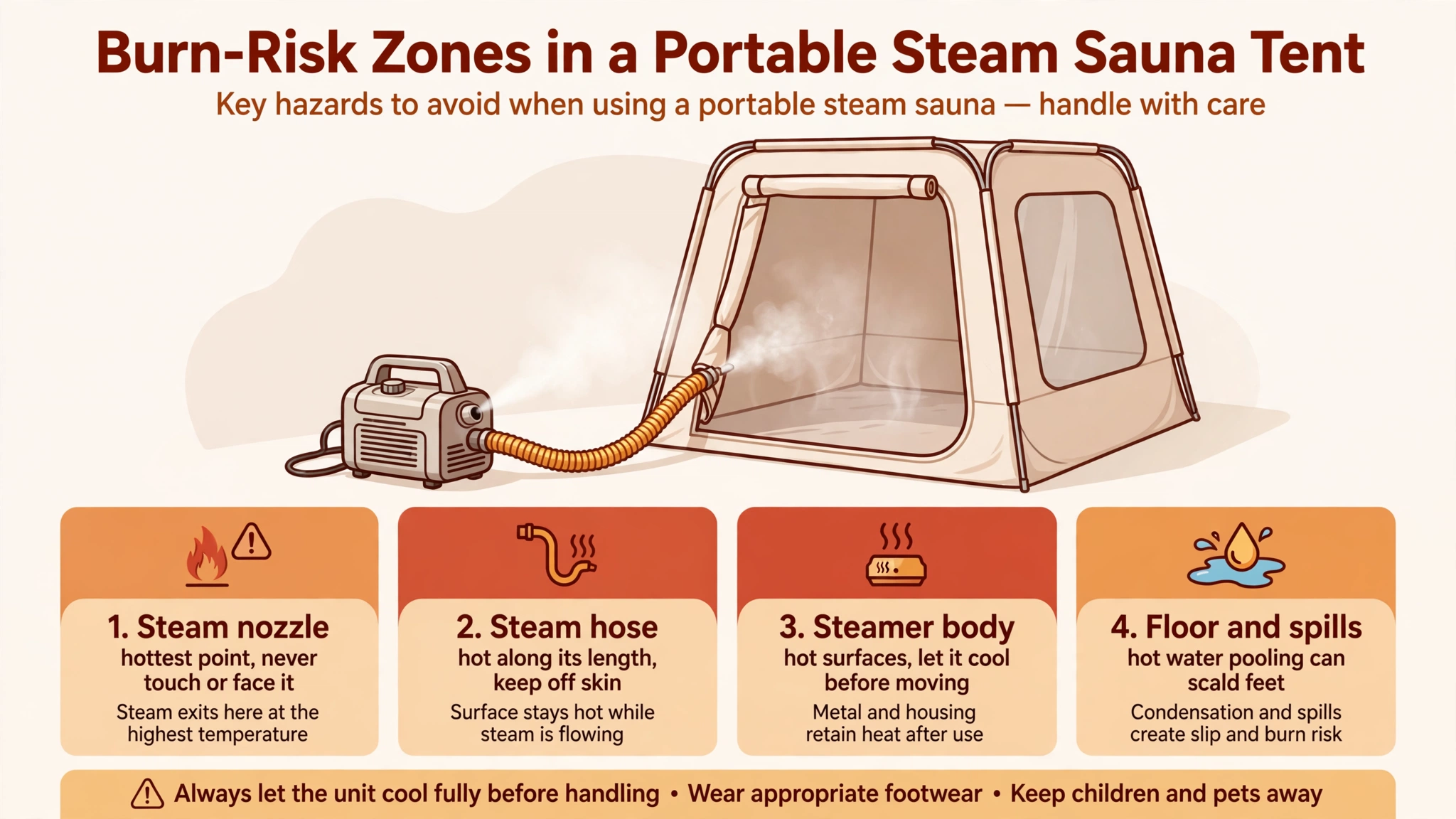
1. The steam nozzle: the hottest point in the whole setup
Steam leaves the nozzle at its hottest, and it is invisible enough at the edges of the plume that people misjudge where it ends. Never put your face, hands, or any bare skin near the nozzle, and never aim it at yourself to “get more steam.” Position the nozzle so it points into open tent space, away from where you sit, and set that position before you switch the steamer on — not while steam is flowing.
If your tent lets you adjust the nozzle angle from outside, use that feature rather than reaching inside a steaming tent. And if you need to reposition anything mid-session, switch the steamer off first and wait for the steam to clear. A few seconds of patience beats a scald every time.
2. The steam hose: hot along its whole length
The hose carries live steam, so its surface stays hot while steam is flowing and for a while afterwards. Keep it off your skin, off your lap, and out of the path your feet take when you step in or out of the tent. Route it in a gentle curve with no kinks, pinches, or sharp bends, and never trap it under the tent frame, a chair leg, or a door.


Paid Links - As an Amazon Associate, I earn from qualifying purchases.
A kinked hose does more than reduce steam. It can stress the connection points, cause steam to escape at a joint, or pull the steamer out of position. Check the full hose run before every session, and keep children and pets away from it entirely — a dangling hose is exactly the kind of thing a curious child or dog will grab.
3. The steamer body: hot surfaces that stay hot
The steamer’s housing, lid, and metal fittings heat up during use and retain heat after switch-off. Treat the whole unit as hot until it has cooled, and never move, refill, or open it while it is running or still hot. Let it cool fully before emptying leftover water or packing it away.
This is also why the steamer belongs outside the tent, on a flat, stable, heat-resistant surface. Inside the tent it would sit inches from your skin, add its own heat to an already hot space, and risk tipping if bumped. Outside, it is easier to reach the controls, easier to check the water level, and far away from bare feet.
4. Spills, condensation, and the tent floor
Steam condenses constantly inside a tent, so water pools on the floor and drips from the ceiling fabric. That water is hot, and a bare foot stepping into a puddle can scald before you realise what happened. Wear suitable footwear or a towel underfoot inside the tent, mop up visible pooling between sessions, and step in and out slowly rather than rushing.
Spills outside the tent matter too. A knocked-over steamer or a disconnected hose can dump hot water across the floor in seconds, which is a scald risk and a slip risk at once. Keep the steamer where nobody will trip over it or its cord, and wipe up any spill immediately — after switching the steamer off, and with a towel rather than bare hands if the water is still hot.
Ventilation: Why a Steam Tent Is Not a Sealed Box
It is tempting to seal a steam tent as tightly as possible to keep the heat in. Resist that temptation. A steam tent needs fresh air: for your comfort, for the room’s sake, and because a stuffy, oxygen-poor-feeling space is what makes people dizzy. Ventilation in a portable tent is not one big vent — it is the combination of the room’s airflow and the tent’s own openings.
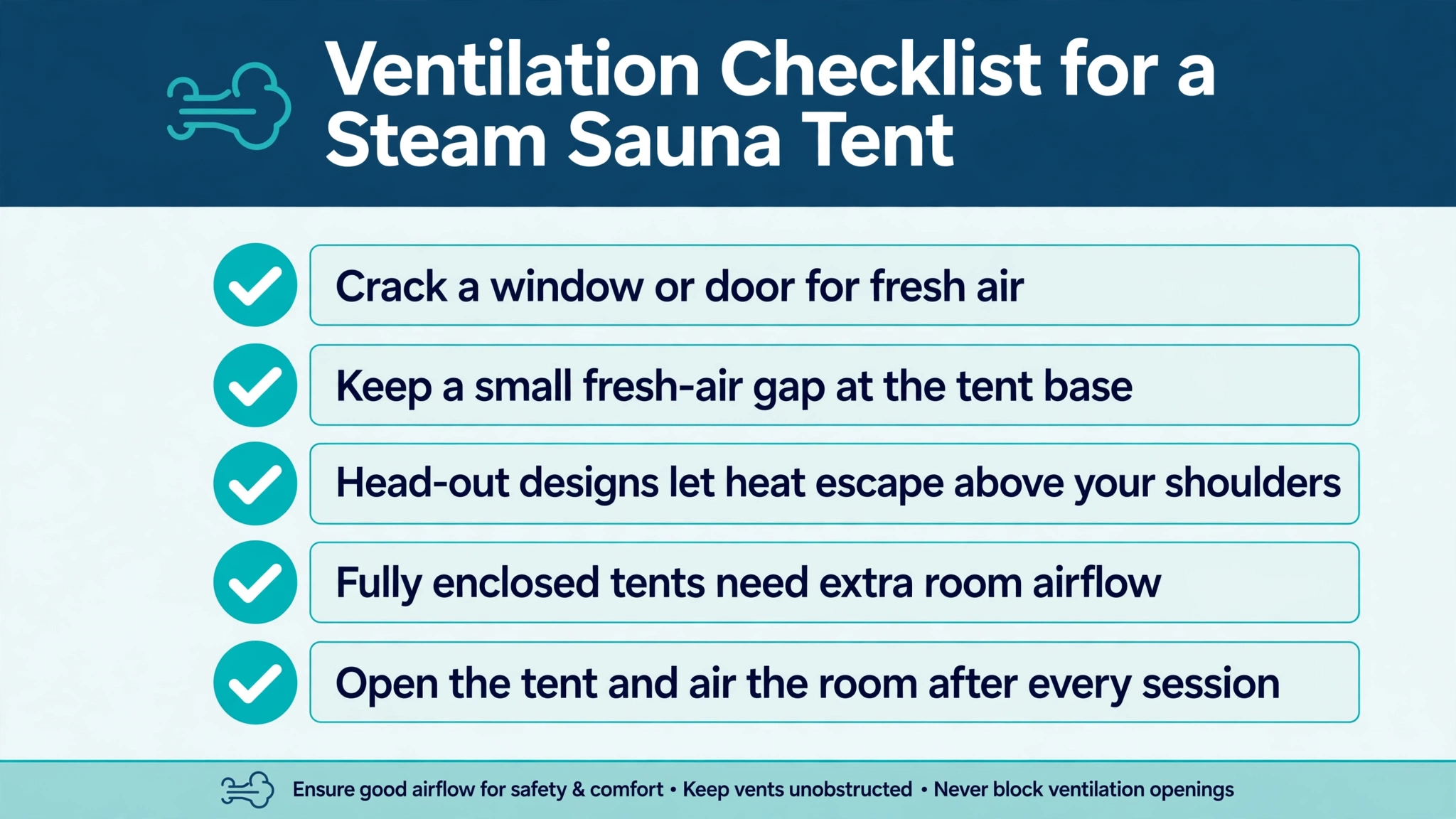
Head-out designs vs. fully enclosed tents
Most portable steam tents are head-out designs: you sit inside with your head through an opening at the top. That opening is a built-in ventilation feature. Heat escapes above your shoulders, you breathe room air rather than tent air, and the session feels far less oppressive. If you use a head-out tent, keep the neck opening as the manufacturer intends it — do not tape, seal, or drape towels over it to trap more heat.
Fully enclosed tents, where your whole body including your head sits inside the steam, need more attention. The room itself must supply the fresh air, so crack a window or door, and be stricter about short sessions and getting out the moment you feel uncomfortable. If a fully enclosed tent feels stifling even with the room ventilated, that is the tent telling you the session should be shorter, not hotter.
Room airflow: the part people forget
The tent sits in a room, and that room absorbs every session’s moisture. Before you start, crack a window or leave the door ajar so fresh air can move. Avoid running a tent in a tiny, windowless room with the door shut — humidity builds fast, condensation forms on walls and furniture, and the air quickly feels heavy. A small fan moving air in the room (not blowing directly into the tent’s steam inlet) helps more than most people expect.
After the session, ventilation matters just as much. Open the tent fully, leave the room window open for a while, and let both the tent fabric and the room dry. A tent folded away damp is a mold problem waiting to happen, and no portable tent is maintenance-free — drying is part of owning one, not an optional extra.
The Setup Mistakes Checklist
Most steam-tent incidents trace back to setup, not to the session itself. Run through this checklist before your first use, and again whenever you move the tent to a new spot. Each item takes seconds, and each one closes off a real failure mode.
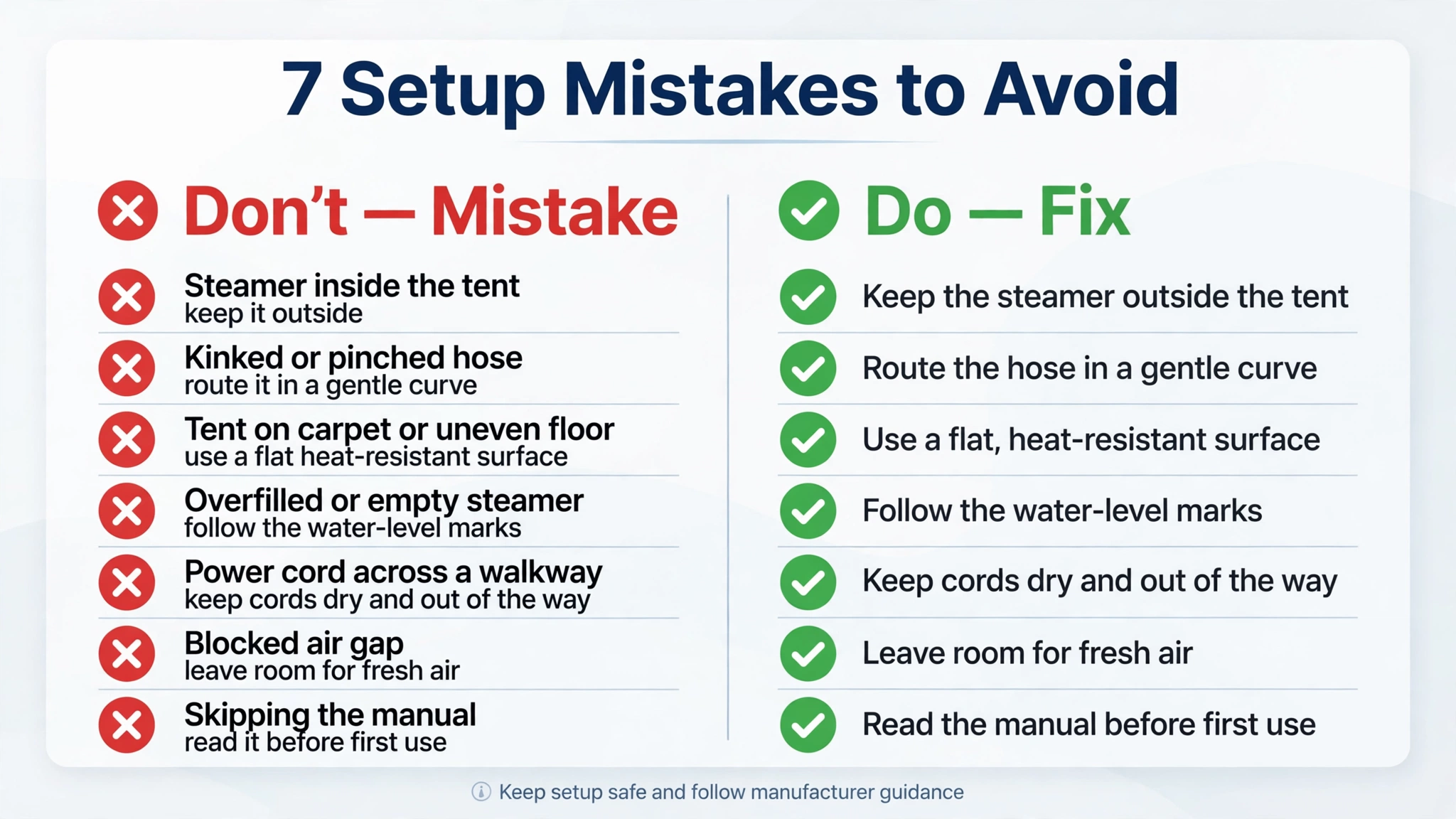
- Steamer outside the tent, always. On a flat, stable, heat-resistant surface, with clear space around it. Never inside the tent, never on carpet, and never balanced on an uneven surface where it could tip.
- Hose in a gentle curve, no kinks. Check the full run from steamer to tent before switching on. Keep it off walkways, off skin, and away from anything that could pinch or crush it.
- Tent on a flat, heat-resistant floor. A hard floor with a towel or mat underneath protects flooring from heat and moisture. Avoid thick carpet, which traps damp and can shift under the tent frame.
- Water level checked, every time. Fill only between the manufacturer’s minimum and maximum marks, using the water type your manual recommends. Running a steamer dry can damage the unit, and overfilling can push hot water out of the unit.
- Power cord dry, visible, and out of the way. Plug directly into a suitable outlet where the cord will not cross a walkway, sit in pooled water, or get pinched under furniture. Never use a damaged cord, and never run power and water together in a tangle.
- Fresh-air gap left open. Do not seal every tent opening or block the room’s airflow. Leave the ventilation your manual describes, and keep the room’s window or door cracked.
- Manual read before first use. Every model differs — fill levels, heat-up behaviour, cleaning intervals, and safety cut-outs are model-specific. The manual is the authority for your tent; this guide is general background, not a replacement for it.
One more setup habit pays for itself: do a dry run. Set the tent up, run the steamer with nobody inside, and watch how the hose behaves, where condensation collects, and how hot the steamer’s outer surfaces get. You will learn more in ten minutes of observation than from any amount of guessing during your first real session.
Electrical and Water Safety Basics
A portable steamer is an electrical appliance that boils water, so it deserves the same respect as a kettle — plus the extra care that comes from using it in a damp environment. Keep the steamer’s plug, socket, and cord completely dry, and never handle the plug with wet hands. If any water reaches an outlet or power strip, switch the power off at the socket before touching anything, and do not use the outlet again until it is fully dry.
This guide gives general guidance only. It is not a substitute for your local electrical code, and a portable tent does not need fixed wiring — if you ever plan a permanent steam installation, that is a different project, and it needs a licensed electrician and a check with your local code or permit office. For the full picture on fixed steam installations, see our guide to Steam Sauna Electrical and Plumbing Requirements.
On the water side, follow your manual on water type and descaling intervals, especially in hard-water areas. Scale build-up is a performance and safety issue: it can clog outlets and strain the heating element. Regular descaling keeps steam output steady and predictable, which is itself a safety measure.
Session Safety: Short, Hydrated, Sober, and Listening to Your Body
The session rules for a steam tent are simple, and they are the same ones that apply to any sauna. Drink water before and after your session, and keep water within reach. Start with short sessions and build up gradually over days and weeks rather than pushing for a long session on day one. If you feel dizzy, nauseous, unusually uncomfortable, or unwell in any way, get out immediately, sit down, cool off, and drink water — do not try to push through it.
Never use a steam tent after drinking alcohol, and do not drink during a session. Alcohol impairs your judgement about heat and increases dehydration, which is exactly the wrong combination in a hot, humid tent. The same caution applies if you are already dehydrated, overheated from exercise, or unwell: skip the session and try another day.
Never fall asleep in a steam tent, and never use one alone if you have a condition that could make you faint or unable to get out quickly — or at least make sure someone nearby knows you are in it. A tent zip or flap that sticks could turn a dizzy moment into a real problem, so check before each session that you can open the tent quickly and easily from inside.
Who Should Be Extra Cautious
Some people need to be more careful than others around steam tents, and a few should not use one without medical advice first. This is general information, not a personal medical assessment — when in doubt, ask your doctor.
- Pregnant users: check with your doctor first. Heat tolerance changes during pregnancy, and a steam tent is a poor place to discover that.
- Heart or circulation conditions, or low blood pressure: heat dilates blood vessels and drops blood pressure further. A doctor’s advice is essential before regular use.
- Medication affecting heat tolerance: some medicines change how your body handles heat or sweating. If you take any, ask your doctor or pharmacist whether steam heat is safe for you.
- Children and teenagers: keep sessions short, supervised, and well below adult intensity, and follow your manufacturer’s age guidance. Never leave a child unsupervised in or near a running steam tent.
- Older users: heat tolerance and balance both change with age. Shorter sessions, a stable chair or support inside the tent, and someone nearby are sensible precautions.
- Pets: keep pets out of the tent and away from the hose and steamer. Animals cannot tell you they are overheating, and a steam tent is far too hot for them.
- Anyone with open wounds, skin conditions, or reduced feeling in their skin: steam and heat can worsen irritation, and reduced sensation means burns may go unnoticed. Get medical advice first.
After Every Session: Drying, Cleaning, and Storage
The session is not over when you step out. What you do in the next twenty minutes decides whether your tent stays fresh or develops mold, smells, and fabric damage. Open the tent fully, wipe down the inside with a clean towel, and leave it open in a ventilated room until it is completely dry before folding it away. Empty the steamer once it has cooled, following your manual, and leave its lid or cap off briefly so the inside can dry too.
Regular cleaning is part of safe ownership, not just cosmetics. Wipe the tent fabric as your manual directs, keep the hose free of standing water, and descale the steamer on the schedule your manual gives — more often in hard-water areas. Our guides to How to Clean a Steam Sauna and Steam Generator Maintenance: Descaling and Hard Water Care walk through both jobs in detail.
For storage, fold the tent only when fully dry, and store the steamer, hose, and tent somewhere dry and out of reach of children. Check the hose and cord for cracks, kinks, or wear before each reuse — a damaged hose or cord should be replaced, not patched, and only with parts your manufacturer approves.
If Something Goes Wrong
For a minor steam burn or scald, the standard first-aid response is to cool the area with cool (not ice-cold) running water, remove jewellery or tight clothing near the burn if it comes off easily, and cover it loosely with a clean, non-stick dressing. Do not apply butter, toothpaste, or other home remedies, and do not burst any blisters. Seek medical help promptly for burns that are large, deep, blistered, on the face, hands, feet, or genitals, or if the person feels unwell, and call emergency services for any serious burn.
If the steamer malfunctions — strange smells, tripped breakers, leaking joints, or steam escaping somewhere it should not — switch it off at the unit and at the socket, let it cool, and do not use it again until you have checked the manual or contacted the manufacturer. A tripped breaker is a warning, not an inconvenience: find out why it tripped before resetting and reusing the unit.
If you feel dizzy or faint during a session, get out, lie or sit down in fresh air, sip water, and do not go back in. If symptoms do not pass quickly, or if you fainted, seek medical attention. Feeling unwell after a sauna session is not something to sleep off without a second thought.
Frequently Asked Questions
Can a portable steam sauna tent burn you?
Yes. Live steam from the nozzle, the hot hose, hot steamer surfaces, and pooled hot water can all cause burns or scalds. The risk is manageable: keep the steamer outside the tent, never touch the nozzle or hose while steam is flowing, wear footwear inside the tent, and let the unit cool fully before handling it.
Should the steamer go inside or outside the tent?
Outside the tent, always. Place it on a flat, stable, heat-resistant surface with the hose routed in a gentle curve into the tent. Putting the steamer inside the tent puts hot surfaces and boiling water inches from your skin and risks tipping the unit.
Do I need to ventilate the room when using a steam tent?
Yes. Crack a window or leave the door ajar so fresh air can move, and keep the tent’s own ventilation openings unblocked. Head-out tents vent naturally through the neck opening, while fully enclosed tents rely more on room airflow, so they need extra attention to ventilation and shorter sessions.
How do I stop my steam sauna tent from getting moldy?
Dry it after every session. Open the tent fully, wipe the inside down, and leave it open in a ventilated room until completely dry before folding it away. Never store a damp tent, and air the room after each session so moisture does not settle into walls, flooring, or furniture.
How long should a session in a portable steam sauna tent last?
Start short and build up gradually, and always follow your manufacturer’s guidance for your model. Leave immediately if you feel dizzy, nauseous, or unwell, and never fall asleep inside the tent. Short, comfortable sessions are safer and more enjoyable than long ones you have to endure.
Is it safe to use a steam sauna tent if I am pregnant or have a heart condition?
Check with your doctor first. Pregnancy, heart or circulation conditions, low blood pressure, and medication that affects heat tolerance all change how your body handles heat, so get medical advice before using a steam sauna tent. This article is general information only and is not medical advice.