
You Are Sitting in a steam sauna for 20 or 30 minutes can leave you soaked in sweat, so it’s natural to wonder if you just torched a few hundred calories. The honest answer: not nearly as many as most sauna blogs and manufacturer websites claim.
Quick answer: A typical adult burns roughly 80 to 160 calories during a 30-minute steam sauna session, depending on body weight, humidity, and temperature. That’s closer to the calorie burn of a slow walk than a workout and most of the “weight loss” you’ll see on the scale afterward is water, not fat.
Key Takeaways
- A 30-minute steam sauna session burns an estimated 80–160 calories, depending mostly on your body weight.
- Almost none of the “weight” you lose in a steam sauna is fat it’s water, and it comes back once you rehydrate.
- Steam saunas raise your heart rate similarly to a light walk, not moderate or vigorous exercise.
- No large, peer-reviewed study has measured calorie burn in a steam sauna directly. The numbers in this guide are extrapolated from dry sauna research and heart rate data, and are clearly labeled as estimates.
- Newer research suggests humidity itself adds real cardiovascular strain, so the common claim that steam saunas “burn far fewer calories than dry saunas” may overstate the gap.
- A steam sauna can support a weight-management routine through recovery and consistency, but it isn’t a substitute for exercise or a calorie deficit.
What Is a Steam Sauna?
A steam sauna (also called a steam room or wet sauna) is a sealed room heated by a steam generator that pumps moist heat into the air. Unlike a traditional Finnish sauna, which uses dry heat from heated rocks or an electric heater, a steam sauna keeps humidity near 100%.


Paid Links - As an Amazon Associate, I earn from qualifying purchases.
Quick facts:
| Feature | Steam Sauna | Traditional Dry Sauna |
|---|---|---|
| Temperature | 100–120°F (38–49°C) | 150–195°F (65–90°C) |
| Humidity | 95–100% | 5–20% |
| Heat source | Steam generator | Heated rocks / electric heater |
| Sweat evaporation | Slow (humid air) | Fast (dry air) |
| Typical session | 10–20 minutes | 15–20 minutes |
Because the air is already saturated with moisture, sweat can’t evaporate off your skin efficiently in a steam sauna. That’s a key detail it’s central to why steam saunas feel so intense despite the lower thermometer reading, and it matters for the calorie math below.


Paid Links - As an Amazon Associate, I earn from qualifying purchases.
So, How Many Calories Do You Burn in a Steam Sauna?
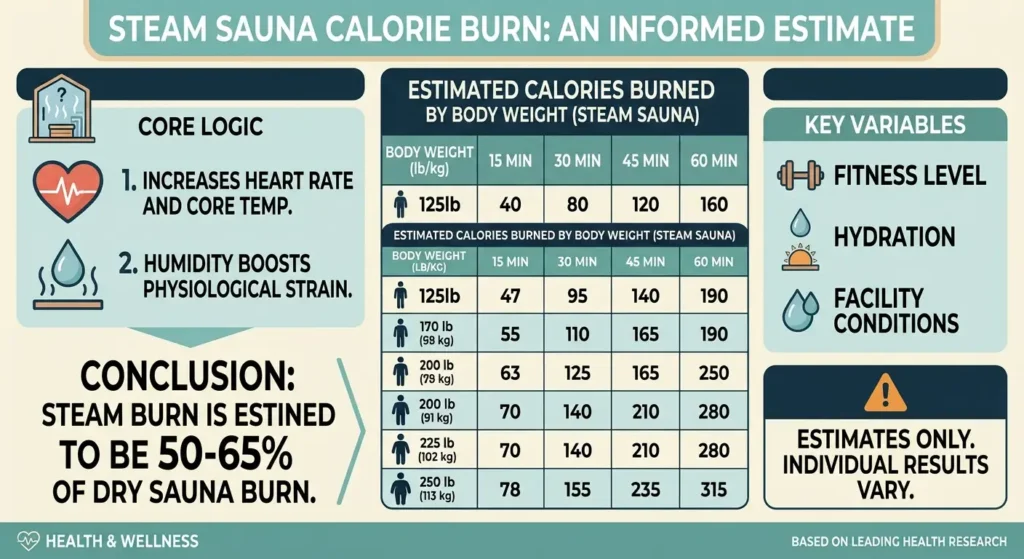
Here’s the part most articles get wrong: they quote numbers from studies on dry saunas and simply relabel them as steam sauna or steam room numbers. There is currently no large, peer-reviewed study that directly measured calorie expenditure in a steam room the way researchers have for dry saunas.
What we do have is:
- Solid calorimetry data from dry sauna studies.
- Heart rate and core-temperature data comparing steam and dry heat exposure.
- General exercise physiology (the relationship between heart rate, oxygen consumption, and calorie burn).
Using those three pieces, we can build a reasonable, honest estimate not a marketing number pulled from thin air.
The dry sauna baseline (the one solid data point we have)
A frequently cited 2019 peer-reviewed study had sedentary, overweight young men sit through four 10-minute dry sauna sessions (with 5-minute cooldowns between them). The results:
- Session 1: about 73 calories burned in 10 minutes, heart rate averaging around 98 bpm
- Session 4: about 131–134 calories in 10 minutes, heart rate rising to roughly 133 bpm
- Total across all four sessions (40 minutes of heat exposure): about 333 calories
Scaled down proportionally, that works out to roughly 210–290 calories for a single 30-minute dry sauna session in a similar population.
Estimating the steam sauna number
Most wellness sites simply assume a steam sauna burns “less” because the air temperature is lower, and land on a range of roughly 100–150 calories per 30 minutes. That’s a reasonable ballpark, but the reasoning is incomplete.


Paid Links - As an Amazon Associate, I earn from qualifying purchases.
A 2026 Finnish study out of the University of Jyväskylä found that humidity not just temperature significantly affects physiological strain during heat exposure. As humidity rises, heart rate and core temperature climb more sharply, because sweat can’t evaporate and cool the skin as effectively. In other words, a steam sauna’s high humidity partially compensates for its lower temperature by making your cardiovascular system work harder to shed heat.
Putting this together, a realistic estimate for steam sauna calorie burn lands at roughly 50–65% of dry sauna calorie burn at a comparable session length, rather than the much steeper drop-off some sites suggest.
Estimated calories burned by body weight (steam sauna)
The table below scales that estimate across common body weights and session lengths. Treat these as informed estimates, not a lab-measured guarantee your actual burn depends on humidity level, your fitness level, and how your body regulates heat.
| Body Weight | 15 min | 30 min | 45 min | 60 min |
|---|---|---|---|---|
| 125 lb (57 kg) | ~40 cal | ~80 cal | ~120 cal | ~160 cal |
| 150 lb (68 kg) | ~47 cal | ~95 cal | ~140 cal | ~190 cal |
| 175 lb (79 kg) | ~55 cal | ~110 cal | ~165 cal | ~220 cal |
| 200 lb (91 kg) | ~63 cal | ~125 cal | ~190 cal | ~250 cal |
| 225 lb (102 kg) | ~70 cal | ~140 cal | ~210 cal | ~280 cal |
| 250 lb (113 kg) | ~78 cal | ~155 cal | ~235 cal | ~315 cal |
Callout box Why the range is wide: Calorie burn in heat therapy depends on individual factors that a single number can’t capture: your resting heart rate, cardiovascular fitness, hydration, how much of your body is exposed to the steam, and how your specific facility sets humidity and temperature. Two people of the same weight can have meaningfully different results.
Steam Sauna vs. Dry Sauna: Which Burns More Calories?
Most competing guides frame this as a clear win for dry saunas. The reality is closer, and more interesting.
| Factor | Steam Sauna | Dry Sauna |
|---|---|---|
| Temperature | Lower (100–120°F) | Higher (150–195°F) |
| Humidity | Very high | Low |
| Sweat evaporation | Poor sweat sits on skin | Efficient sweat evaporates fast |
| Heart rate response | Rises due to humidity + heat | Rises due to high heat |
| Estimated calories, 30 min | ~80–160 | ~210–290 |
| Best suited for | Sinus/respiratory relief, skin, gentler cardiovascular stimulus | Higher heart-rate response, deeper detox sweat, joint/muscle heat penetration |
Bottom line: Dry saunas still come out ahead on raw calorie burn in most estimates, largely because the higher air temperature drives a stronger heart rate response overall. But because humidity itself adds real physiological strain, the gap between the two is likely smaller than the “300 vs. 100” comparisons you’ll see on many sauna retailer websites. For a fuller breakdown beyond just calories, see Which Is Better: Dry Sauna or Steam Sauna?
Why You Burn Calories in a Steam Sauna at All?
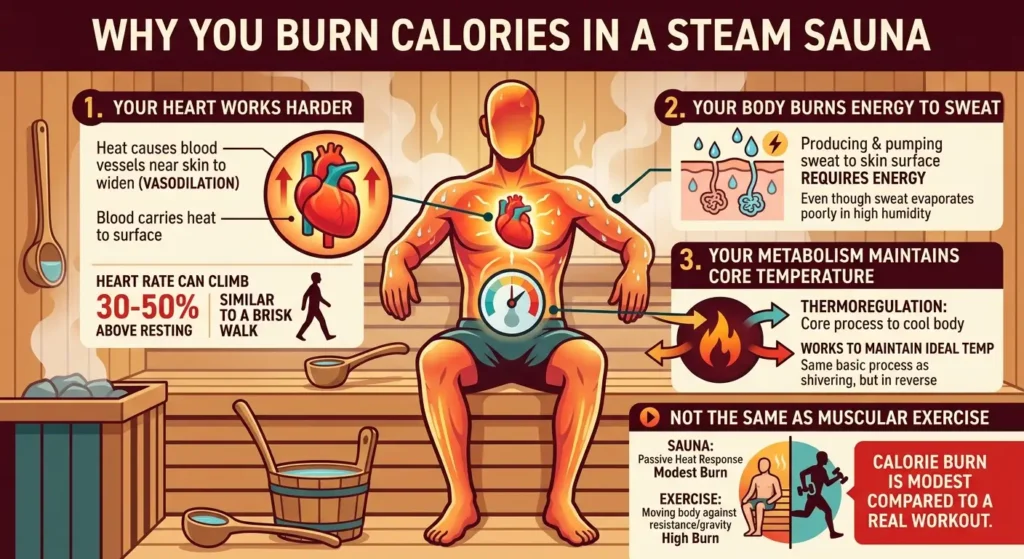
You’re not moving a muscle, so where do the calories go? Three things happen:
- Your heart works harder. Heat causes blood vessels near your skin to widen (vasodilation) so more blood can carry heat to the surface. Your heart rate can climb by 30–50% above resting levels, similar to a brisk walk.
- Your body burns energy to sweat. Producing and pumping sweat to the skin’s surface requires energy, even though in high humidity that sweat evaporates poorly.
- Your metabolism works to maintain core temperature. This is thermoregulation the same basic process that makes shivering in the cold burn calories, just in reverse.
None of this is the same as muscular exercise, where calorie burn comes primarily from moving your body against resistance or gravity. That’s the core reason the numbers here are modest compared to a real workout.
Does a Steam Sauna Help With Weight Loss?
Used on its own, a steam sauna is not a meaningful weight-loss tool. Here’s an honest breakdown of what it can and can’t do:
What it can’t do:
- Create a large enough calorie deficit on its own to meaningfully move body fat
- Replace resistance training or cardiovascular exercise
- “Detoxify” fat cells (sweat is mostly water, electrolytes, and a trace of other compounds not stored fat)
What it may support:
- Faster recovery between workouts, which can help you stay consistent with training
- Relaxation and stress reduction, which can indirectly support healthier eating patterns and sleep
- A mild, additional calorie expenditure on top of your regular activity useful, but not a strategy on its own
If a pound of body fat represents roughly 3,500 calories (some research puts the range closer to 3,436–3,752 calories per pound), even the higher estimates in this guide would require dozens of sessions to offset a single pound and that’s before accounting for the fact that your body naturally compensates for extra heat exposure over time by sweating more efficiently, which can lower calorie burn in later sessions.
For a practical, step-by-step approach to fitting steam sauna sessions into a broader weight-management routine, see How to Use a Sauna and Steam Room for Weight Loss.
How to Estimate Your Own Steam Sauna Calorie Burn
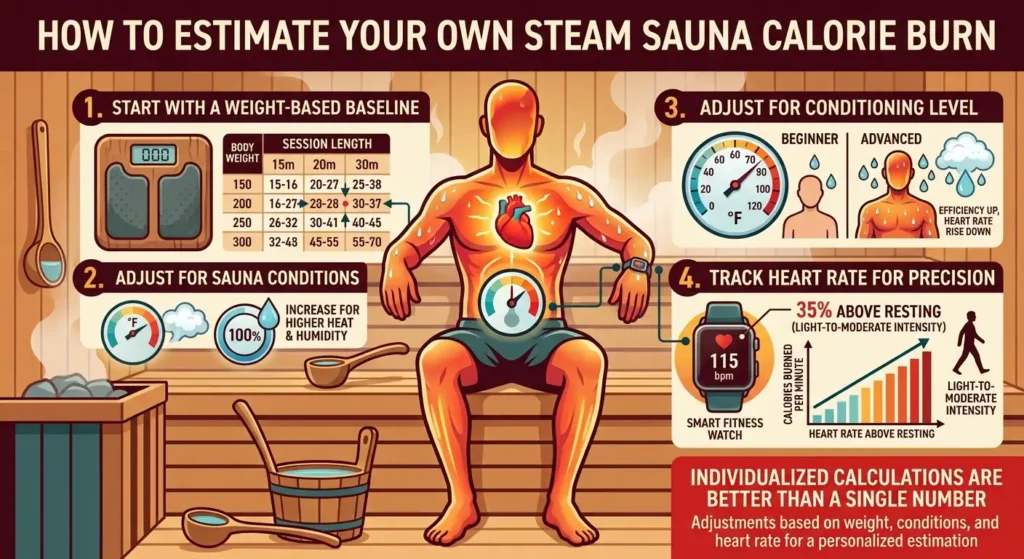
Since no steam-sauna-specific calculator has solid clinical data behind it, the most useful approach is a personalized range rather than a single number:
- Start with the weight-based table above as your baseline range for your session length.
- Adjust up slightly if your facility runs on the hotter, more humid end (close to 120°F and 100% humidity) or if you have a higher resting heart rate.
- Adjust down slightly if you’re well-conditioned to heat exposure (regular sauna or steam users tend to sweat more efficiently and show a smaller heart rate rise over time).
- Track heart rate if you can. A rough guideline used in exercise physiology: calories burned per minute increase roughly in proportion to how far your heart rate rises above resting. A heart rate 30–40% above your resting rate roughly corresponds to light-to-moderate exercise intensity.
Safety Guidelines for Steam Sauna Use
- Limit sessions to 15–20 minutes, especially when you’re new to steam saunas. See How Long Should You Stay in a Steam Sauna? for guidance based on experience level and health status.
- Rehydrate before and after: plan on replacing the fluid you lose, generally with water or an electrolyte drink if sessions are long or frequent.
- Avoid steam saunas if you’re pregnant, have uncontrolled high or low blood pressure, or have a heart condition, unless your doctor has specifically cleared it.
- Never use alcohol before a session. Alcohol impairs your body’s ability to regulate temperature and increases dehydration risk.
- Exit immediately if you feel dizzy, nauseated, or unusually short of breath.
- Shower after your session to rinse away sweat and bacteria from your skin.
For a full rundown of who should be cautious and why, see Steam Sauna Side Effects: Risks and Safety Guidelines.
FAQs
How many calories do you burn in a 15-minute steam sauna?
Roughly 40–80 calories for most adults, depending on body weight and humidity level, based on extrapolated heart rate and dry sauna research.
How many calories do you burn in a 30-minute steam sauna?
An estimated 80–160 calories, with heavier individuals and hotter, more humid rooms trending toward the higher end.
Does a steam sauna burn more calories than a dry sauna?
No, most evidence points the other way dry saunas generally produce a stronger heart rate response and burn more calories over the same time, though the gap may be smaller than commonly claimed because humidity adds its own cardiovascular strain.
Can you lose belly fat in a steam sauna?
No. Steam saunas don’t target fat loss in specific areas (“spot reduction” isn’t possible through heat or exercise), and the calorie burn is too modest to meaningfully reduce body fat on its own.
Is the weight loss after a steam sauna real?
It’s real on the scale but temporary it’s water lost through sweat, and it returns once you rehydrate, typically within a day.
How often can you use a steam sauna to burn calories?
Most guidance supports 2–4 sessions per week for general wellness. There’s no evidence that more frequent sessions meaningfully accelerate calorie burn or fat loss, and overuse increases dehydration risk. See How Often Should I Use a Steam Sauna? for a more detailed schedule by goal.
Do you burn calories just sitting in the heat?
Yes, modestly. Your body burns energy on thermoregulation and the cardiovascular effort of vasodilation, even without moving.
Is a steam sauna good before or after a workout for calorie burn?
After a workout is generally recommended. Using a steam sauna before exercise doesn’t meaningfully add to calorie burn and can leave you dehydrated and fatigued going into your workout.
Why do I sweat so much in a steam sauna if it’s not that hot?
Because the near-100% humidity prevents sweat from evaporating off your skin, so it pools and drips rather than cooling you efficiently this is also why the heart has to work harder to help manage heat.
What burns more calories a steam sauna or a brisk 30-minute walk?
A brisk walk. Most estimates put a 30-minute brisk walk in the 150–200 calorie range for an average adult, which is comparable to or higher than typical steam sauna estimates.
Does infrared sauna burn more calories than a steam sauna?
Some preliminary, non-peer-reviewed data suggests infrared sessions may burn a comparable or higher amount, but this evidence is limited, and manufacturer-cited numbers for infrared saunas often aren’t independently verified.
Can steam sauna use replace cardio exercise for weight loss?
No. The calorie burn is too low, and steam saunas don’t build cardiovascular fitness, muscle, or the metabolic adaptations that structured exercise does.
How accurate are online steam sauna calorie calculators?
Take them as rough estimates. Because there’s no dedicated peer-reviewed steam room calorimetry study, every calculator including the ranges in this guide relies on extrapolation from related research.
Final Thoughts
A steam sauna will make you sweat, relax your muscles, and modestly raise your heart rate but it won’t come close to the calorie burn of even a light workout. If you’re using a steam sauna hoping it’ll meaningfully move the number on the scale, the honest expectation is somewhere in the 80–160 calorie range for a 30-minute session, and virtually all of the immediate weight change you’ll see afterward is water.
Where a steam sauna genuinely earns a place in your routine is recovery, relaxation, and consistency helping you show up for the workouts and habits that actually drive fat loss over time. Use it as a supporting tool, not a shortcut.