
A portable steam sauna vs built-in steam room is one of the most practical choices in home wellness, because the two options solve the same wish in very different ways. One folds away into a closet and plugs into a normal outlet. The other becomes a permanent, tiled room that adds real value to a home and real work to a build. Both can give you warm, humid steam sessions at home, yet they differ sharply on cost, space, installation, upkeep and the feel of the session itself.
This guide compares the two side by side so you can choose with your eyes open. You will find planning-estimate cost ranges, space and power requirements, honest notes on moisture and mold, and a simple decision guide at the end. Every cost figure here is a planning estimate, not a quote, and every health note is cautious on purpose. Steam is relaxing and enjoyable, but it is heat and humidity, and both deserve respect.
Health note: this article is not medical advice


#Paid Links
Steam saunas are wellness tools, not treatments. Hydrate before and after, keep sessions short, leave right away if you feel dizzy or unwell, and do not drink alcohol before or during a session. Check with a doctor first if you are pregnant, live with a heart or circulation condition or low blood pressure, or take medication that affects heat tolerance.


#Paid Links
The Short Answer
A portable steam sauna is a tent or box with a small steam generator, a folding chair and a fabric enclosure. It sets up in minutes, costs far less up front, needs only a standard power outlet and a little floor space, and packs away when you are done. A built-in steam room is a sealed, tiled room with a plumbed steam generator, a bench, a glass door and proper drainage and ventilation. It costs far more, needs licensed tradespeople to install, and cannot move with you, but it offers more space, a more even steam experience and a finished feel that a tent cannot match.
For most renters, apartment dwellers and first-time buyers, the portable option is the sensible starting point. It lets you learn whether you enjoy steam sessions several times a week before committing thousands to a build. For homeowners planning a bathroom remodel or a long-term wellness space, the built-in room is the better end goal, provided the budget, the space and the maintenance commitment are all realistic.
What a Portable Steam Sauna Really Is
A portable steam sauna is a self-contained kit. The usual setup is a foldable fabric tent or a rigid box, a compact steam generator that holds a few litres of water, a hose that carries steam into the enclosure, and a folding chair inside. Your head often stays outside the tent through a collar opening, which many beginners find more comfortable, while your body sits in warm steam.
Most portable units run on a standard household outlet, typically drawing around 800 to 1,500 watts, and heat up in roughly 10 to 20 minutes depending on the model and the starting water temperature. The steam is real, but the enclosure is fabric, so some heat and moisture escape around seams and zips. That is normal for the design, and it is one reason the experience feels gentler and less enveloping than a sealed tiled room.
Portable units are best understood as personal wellness appliances rather than rooms. They suit one person at a time, they fold down for storage, and they travel well to a new home. If you want to learn more about using one safely, read our guide to portable steam sauna tent safety, which covers placement, water handling and the warning signs that mean you should step out.
What a Built-In Steam Room Really Is
A built-in steam room is a permanent wet room. The enclosure is usually tiled floor to ceiling with a sloped ceiling so condensation runs down the walls instead of dripping on you, a sealed glass door, a built-in bench, and a steam generator mounted nearby, often in a closet, vanity cabinet or ceiling void. The generator connects to the water supply and a drain, and the room needs an extractor fan or a window arrangement that moves moist air out after each session.


#Paid Links
Built-in rooms need proper planning. The generator must be sized to the room volume, the enclosure must be fully waterproofed behind the tiles, and the electrical work must suit the generator load. This is not a weekend project for most people. A licensed electrician and plumber should handle the connections, and your local permit or code office can confirm whether approval is needed in your area.
The reward for that effort is a room that feels calm, solid and spa-like. Steam fills a sealed space evenly, the bench lets you lie down or sit with a companion, and the room is always ready. If you are planning the technical side, our guide to steam sauna electrical and plumbing requirements explains what to discuss with your tradespeople before work starts.
Portable vs Built-In at a Glance
The table below gives the quick comparison. The sections that follow unpack each row, because the headline differences hide important details, especially around moisture, running costs and what happens when something breaks.
| Factor | Portable steam sauna | Built-in steam room |
|---|---|---|
| Up-front cost | Low, a planning estimate of a few hundred for a good kit | High, a planning estimate of several thousand including build and labour |
| Space needed | About 1 square metre while in use, folds away after | A dedicated room, usually at least 2 to 4 square metres |
| Installation | Minutes, no tradespeople, standard outlet | Days to weeks, licensed electrician and plumber |
| People per session | One person, seated | One to four, seated or lying down |
| Steam feel | Warm and gentle, some steam escapes | Dense and even, fully sealed room |
| Moisture risk | Low, dries quickly, ventilate the room | Higher if ventilation and drying are neglected |
| Maintenance | Rinse and dry the tent, descale the generator | Regular cleaning, descaling, grout and seal checks |
| Moves with you | Yes, packs into a bag or box | No, it stays with the house |
| Best for | Renters, small homes, trying steam first | Homeowners, daily users, shared family use |
Cost: Up Front, Running and Hidden
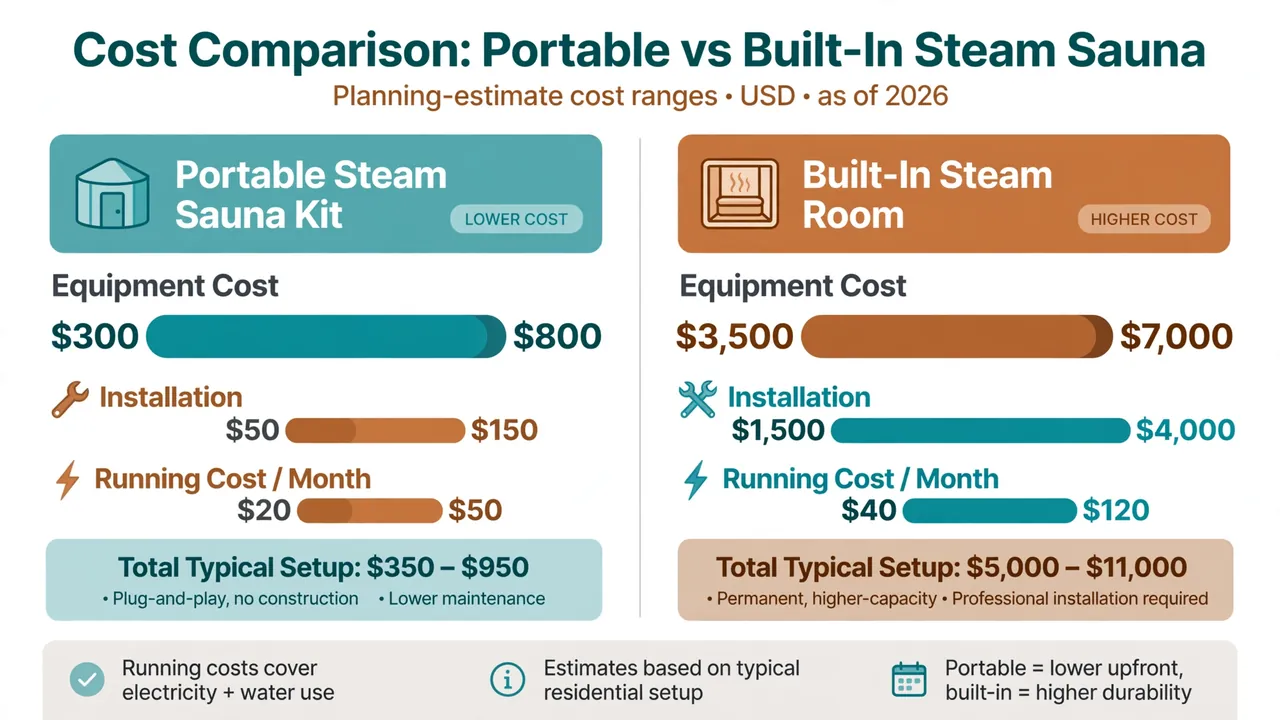
Cost is where the two options diverge most, and it is also where planning estimates matter most. Prices vary widely by region, brand, size and installer, so treat every figure in this section as a planning estimate to help you budget, not as a quote. Get local quotes and check current listings before you buy or build anything.
What a portable steam sauna costs
A decent portable steam sauna kit usually falls in a planning range of roughly $100 to $500 in most markets, with basic tent kits at the low end and sturdier box-style units with better generators at the high end. There is little or no installation cost, because you set it up yourself in minutes. The main extras are a waterproof mat for the floor, a towel or two, and possibly distilled water if your tap water is very hard.
Running costs stay modest. A small generator uses about 1 to 1.5 kilowatts while heating, and a typical session lasts 20 to 30 minutes, so the electricity per session is a fraction of a kilowatt-hour plus the heat-up time. Water use is small, usually a few litres per session. Over a year of regular use, most owners will find the running cost easy to overlook, though your exact electricity tariff decides the real number.
What a built-in steam room costs
A built-in steam room is a construction project, and its cost reflects that. As a planning estimate, a small conversion of an existing shower area often lands in the range of roughly $3,000 to $8,000 including the generator, waterproofing, tiling, glass door, bench and labour, while a larger custom room with premium tile, lighting and seating can run well above $10,000. These are broad ranges, and local labour rates move them a lot.
The generator itself is only part of the bill. Waterproofing and tiling usually cost as much as the equipment, and the electrical and plumbing work adds more. If your home needs a panel upgrade or a new water line run, add that too. Always get at least two or three itemised quotes from licensed professionals, and ask each one what is included, because a low headline price often excludes tiling or ventilation.
Running costs are higher than portable, mainly because the generator is larger and the room is bigger. A generator sized for a small room may draw 4 to 9 kilowatts, and heat-up takes 10 to 20 minutes before your session even starts. Our guide to the cost to run a steam sauna breaks down the electricity and water side in more detail, and our look at steam shower costs is useful if you are weighing a steam shower conversion instead of a full room.
| Cost item | Portable (planning estimate) | Built-in (planning estimate) |
|---|---|---|
| Equipment | Roughly $100 to $500 for the kit | Roughly $800 to $3,000 for generator and controls |
| Build and labour | None, self-assembly in minutes | Roughly $2,000 to $7,000 or more for waterproofing, tiling, glass and trades |
| Power per session | About 1 to 1.5 kW generator | About 4 to 9 kW generator for a small room |
| Yearly upkeep | Low, descaling and occasional parts | Moderate, cleaning, descaling, seal and grout care |
| Resale effect | None, it moves with you | Can add appeal, but rarely repays the full build cost |
All figures are planning estimates, not quotes. Prices vary by region, brand and installer, so get local quotes and verify current listings before buying.
The hidden costs worth budgeting for
Built-in rooms carry hidden costs that portable kits avoid. Ventilation upgrades, a new extractor fan, mould-resistant paint or materials, and repairs if waterproofing fails can all add up over the years. A small leak behind tiles can stay hidden for months, so the quality of the original waterproofing matters far more than the brand of the generator.
Space, Power and Plumbing
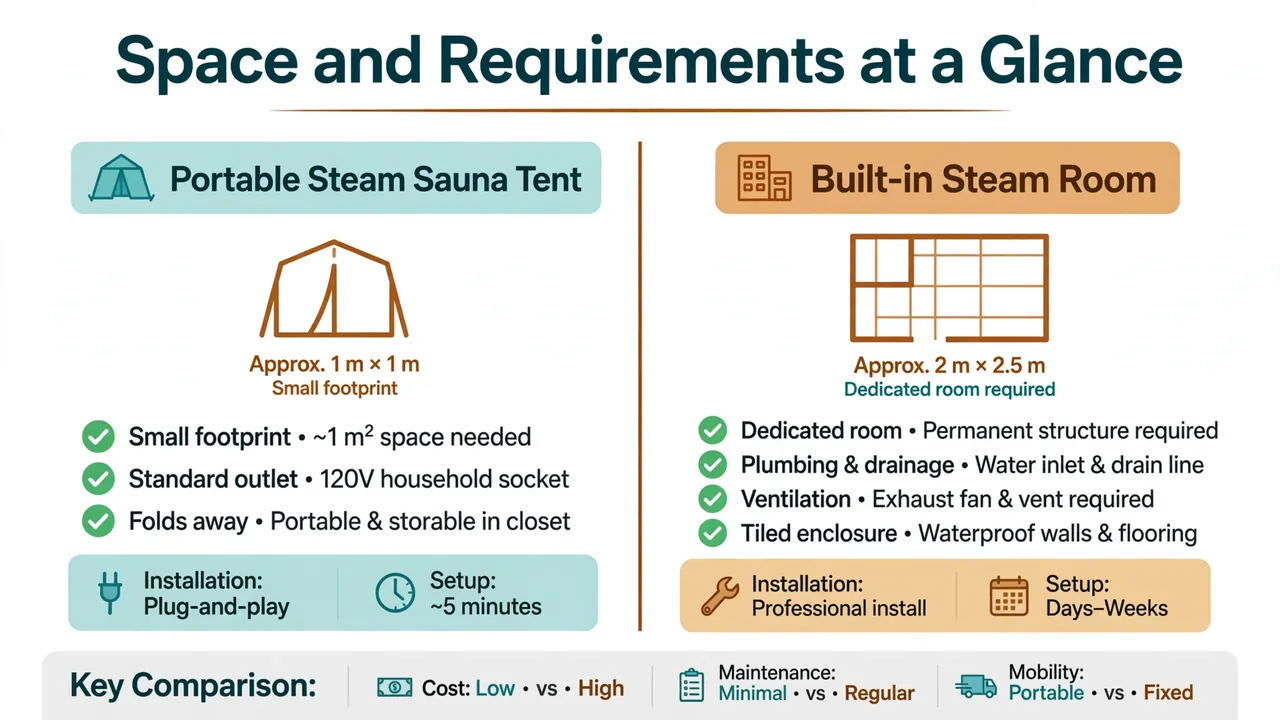
Space decides the question for many households before cost does. A portable unit needs a patch of floor about the size of a small armchair, a nearby outlet, and enough headroom to sit upright. When the session ends, it folds down and slides into a closet, under a bed or behind a door. That flexibility is the whole point, and it is why portable units work in flats, spare rooms and even large bathrooms.
A built-in room needs a dedicated space that you are willing to give up permanently. A small steam room for one or two people usually needs at least 2 to 4 square metres of floor, plus space nearby for the generator and access panels for servicing. Ceiling height matters too, because a ceiling that is too high makes the generator work harder and the steam feel thin at bench level. Most guides suggest keeping the ceiling modest, but your installer should size the generator to your actual room volume.
| Requirement | Portable steam sauna | Built-in steam room |
|---|---|---|
| Floor space | About 1 square metre in use, folds away | At least 2 to 4 square metres, permanent |
| Power | Standard outlet, about 1 to 1.5 kW | Dedicated circuit, about 4 to 9 kW or more |
| Water | Manual fill, a few litres per session | Plumbed supply plus drain |
| Drainage | None, empty the generator by hand | Floor drain and sloped floor or tray |
| Ventilation | Open a window or run a fan after use | Extractor fan, drying routine after every session |
| Permissions | Usually none, check rental rules | Check local code and permit office first |
Power and plumbing in plain terms
Portable generators plug into a normal socket and fill by hand, so there is no plumbing and no electrician visit. Keep the generator on a stable, level surface, keep the power lead dry, and never use an extension lead that is not rated for the load. If your home has older wiring, ask an electrician whether the circuit you plan to use is sound, even for a small appliance.
Built-in generators are a different job. They need a dedicated electrical circuit, a plumbed water feed, a drain for the generator flush cycle, and a safe location with access for servicing. Generator sizing depends on room volume, wall materials and ceiling height, so a unit that is too small will struggle and one that is too large will cycle on and off. Our guide on how to size a steam generator explains the volume calculation your installer will use.
General guidance only applies here, and it is not a substitute for local code or a licensed professional. Rules for wet rooms, electrical work near water and ventilation vary by area, so check with your local permit or code office and use licensed electricians and plumbers for the installation. A short conversation before work starts is far cheaper than fixing a non-compliant build later.
The Steam Experience: Heat, Humidity and Comfort
Both options produce steam, but the feel is not the same. A built-in room fills with dense, even humidity because the space is sealed and the generator is powerful. The air feels soft and enveloping, the bench stays warm, and you can lie down, stretch or share the session. Most people who love steam rooms love this feeling, and it is hard to reproduce in a fabric tent.
A portable unit feels lighter. Steam rises around your body while your head stays out in cooler air, which many beginners prefer, and the temperature inside the tent is usually gentler. Some people find that more comfortable and easier to tolerate for a full session. Others find it less immersive and miss the feeling of being fully inside warm, humid air.
Session length and routine
Keep sessions short, especially at first. A common beginner pattern is 10 to 15 minutes, then a cool-down and a drink of water, with longer sessions only once you know how your body responds. There is no benefit in pushing through discomfort, and the risks rise with heat and dehydration. If you feel dizzy, nauseous, short of breath or unwell in any way, leave the steam at once and cool down.
Children, older adults and anyone with a health condition need extra care. Conservative guidance is the right approach: shorter sessions, lower heat, adult supervision for children, and a doctor’s advice before regular use for anyone who is pregnant, lives with a heart or circulation condition or low blood pressure, or takes medication that affects heat tolerance. Pets should never be put in a steam sauna.
Sharing the session
A portable unit is a solo experience, and that suits many people. It is quiet, private and easy to fit around a busy day. A built-in room can be shared, which matters for couples and families who want to steam together or take turns without waiting for a reheat. If shared use is a priority, that alone can tip the decision toward built-in, even before cost is considered.
Moisture, Mold and Maintenance: The Honest Part
Steam is water in the air, and water goes somewhere. This is the part of the comparison that sellers rarely emphasise, and it is the part that decides whether a steam room stays pleasant or becomes a problem. Neither option is maintenance-free, and pretending otherwise is how damp, mould and damaged finishes start.
Portable units are the easier case. The tent itself dries quickly if you leave it open and aired after use, and the generator only needs emptying, rinsing and regular descaling. The main risk is the room around it: steam escapes from the tent, so the room needs ventilation after each session. Open a window, run a fan, and avoid setting up pressed against soft furnishings or unpainted plaster that stays damp.
Built-in rooms need a real routine. After every session, the room should be aired and dried, the bench and floor wiped or squeegeed, and the extractor fan left running long enough to clear the humid air. Tiles and grout need regular cleaning, seals and silicone need checking, and the generator needs descaling on the schedule its maker recommends, especially in hard-water areas.
Hard water is the quiet enemy of every steam generator. Limescale builds up on heating elements, reduces steam output, and shortens the life of the unit. In hard-water areas, descaling matters more, and some owners use filtered or softened water for the generator. Our guide to steam generator maintenance, descaling and hard-water care covers the routine in detail, and it applies to portable and built-in generators alike.
A simple after-session routine
- Step out, drink water, and cool down before doing anything else.
- Leave the door open and run the extractor fan or open a window.
- Wipe or squeegee wet surfaces so water does not sit and pool.
- Empty and rinse a portable generator, or let a built-in unit run its flush cycle if it has one.
- Leave the tent open or the room door ajar until everything is fully dry.
- Check seals, grout and silicone monthly, and descale on the maker schedule.
Safety Basics for Both Options
Steam sessions should feel relaxing, not punishing. The safety basics are the same for portable and built-in units, and they are worth repeating here because they are easy to forget once steam becomes a habit. If you take one section of this article seriously, make it this one.
- Hydrate before and after every session, and keep water nearby.
- Start with short sessions of 10 to 15 minutes and build up slowly.
- Leave immediately if you feel dizzy, nauseous, faint or unwell.
- Do not drink alcohol before or during a steam session.
- Check with a doctor first if you are pregnant, live with a heart or circulation condition or low blood pressure, or take medication that affects heat tolerance.
- Supervise children at all times and keep sessions short and gentle for them.
- Never fall asleep in a steam sauna, and never use one alone if you have a condition that could make you faint.
- Keep electrical parts dry, follow the maker instructions, and stop using any unit that smells of burning, leaks or behaves oddly.
Health claims about steam deserve the same caution. Steam can feel relaxing, ease stiff muscles after a long day, and make a shower afterwards feel wonderful, but it is not a treatment for illness and it does not detox the body in the way some marketing suggests. Research on sauna bathing, including the well-known Finnish cohort studies, is observational, which means it shows an association rather than proof of cause, and most of that research studied traditional dry sauna rather than steam rooms. Enjoy steam for comfort and relaxation, and treat any bigger health claim with healthy doubt.
Pros and Cons Side by Side
Portable steam sauna: strengths
- Low up-front cost and no installation bill
- Sets up in minutes and folds away
- Works in rented homes and small spaces
- Easy to try steam before committing
- Simple drying and descaling routine
- Moves with you to a new home
Portable steam sauna: limits
- One person only, seated
- Fabric tent lets steam escape
- Less immersive than a sealed room
- Tent and generator wear out sooner
- Feels temporary rather than spa-like
Built-in steam room: strengths
- Dense, even steam in a sealed room
- Space to lie down or share a session
- Finished, spa-like feel every day
- Durable materials when built well
- Can add appeal to a home
Built-in steam room: limits
- High build cost and long install time
- Needs licensed electrician and plumber
- Permanent, cannot move with you
- Needs a strict drying routine
- Mould and waterproofing risks if neglected
Read the two columns together and the trade-off becomes clear. Portable wins on flexibility, cost and simplicity. Built-in wins on experience, space and permanence. There is no column that wins on everything, which is why the right answer depends on your home, your budget and how often you will actually steam.
Which One Should You Choose?
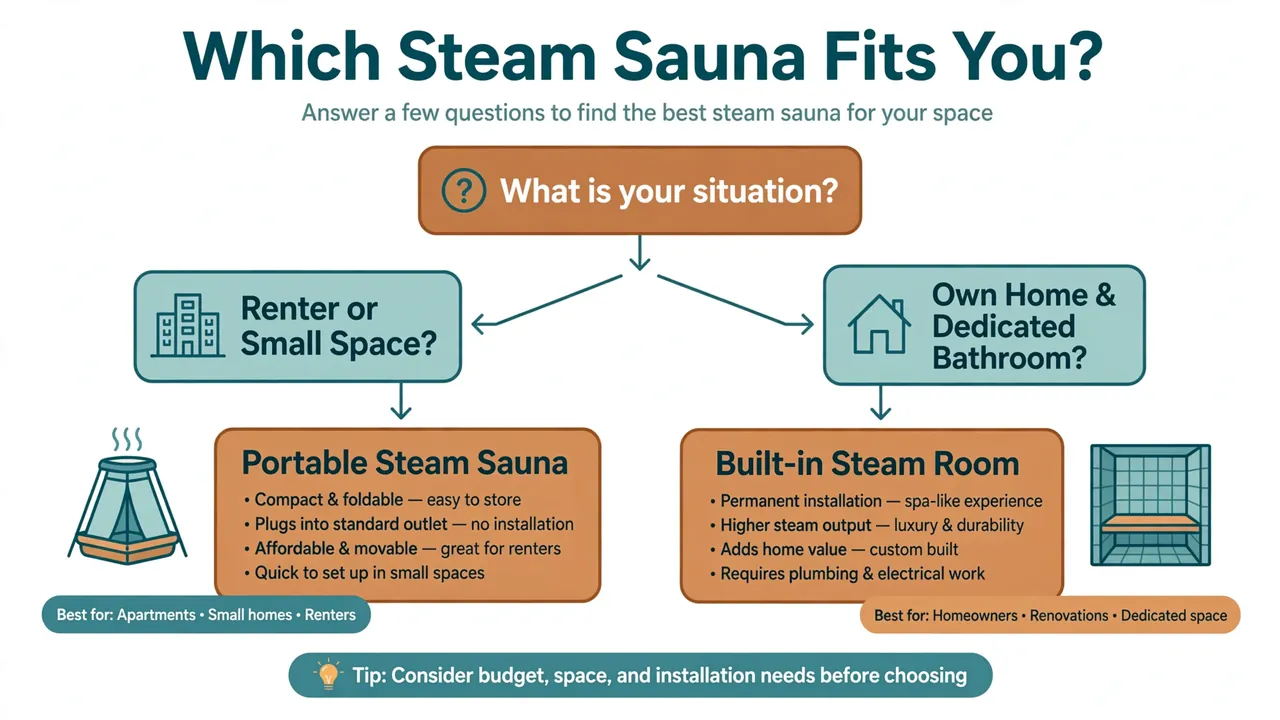
Work through the questions below in order. The first one that gives you a clear answer is usually the right one, and you rarely need to reach the end of the list. Be honest about your home, your budget and your habits, because the best steam sauna is the one you will use three times a week, not the one that looks best in a brochure.
| Ask yourself | If the answer is yes |
|---|---|
| Do you rent, or might you move within two years? | Choose portable. A built-in room stays with the house. |
| Is your spare budget under roughly $500? | Choose portable. A built-in build costs several times more. |
| Have you never used a steam sauna regularly? | Start portable. Learn your routine before spending thousands. |
| Do two or more people want to steam together? | Choose built-in. Portable units seat one person. |
| Are you already remodelling a bathroom? | Consider built-in. The trades are already on site. |
| Do you steam at least three times a week? | Built-in starts to earn its cost at this frequency. |
| Will you keep up a drying routine after every session? | If not, choose portable. Its routine is far simpler. |
| Do you own your home and plan to stay for years? | Built-in becomes a realistic long-term choice. |
Buying a Portable Unit: What to Check
- Generator power and tank size, and whether the tank is easy to fill and empty.
- Temperature and timer controls, and whether they are easy to reach from inside.
- Tent material, zip quality and seam strength, which decide how long it lasts.
- Chair comfort and weight rating, because you will sit on it for every session.
- Folded size and weight, if you plan to store it or take it when you move.
- Warranty length and spare-part availability for the generator.
- Descaling guidance from the maker, especially if your water is hard.
Box-style portable units deserve a look too. They tend to feel sturdier than tents, hold heat a little better, and suit people who dislike fabric enclosures. Our roundup of the best portable steam sauna boxes compares the main options, and it is a useful next read if you have decided to go portable.
Building a Steam Room: What to Check
A built-in room is only as good as its waterproofing, so that is where your attention and your budget should go first. Tiles are the visible finish, but the membrane behind them is what keeps water out of your walls. Ask every contractor how they waterproof, what products they use, and what warranty they offer on that work specifically.
- Generator sizing based on your actual room volume, wall materials and ceiling height.
- Full waterproofing behind tiles, including the ceiling and bench areas.
- A sloped ceiling so condensation runs to the walls instead of dripping.
- A sealed glass door that fits properly and closes fully.
- A floor drain, a sloped floor and a generator flush drain.
- An extractor fan sized for the room and a habit of running it after sessions.
- Access panels for the generator so servicing does not mean breaking tiles.
- Written confirmation of what the quote includes, and who handles electrical and plumbing work.
This is general guidance only, not a substitute for local code or a licensed professional. Check with your local permit or code office before work starts, and use licensed electricians and plumbers for the installation. Building rules for wet rooms and electrical work near water vary by area, and a short check at the start saves expensive rework later.
Mistakes to Avoid With Either Option
The most common mistake is buying for a fantasy routine instead of a real one. A beautiful built-in room that gets used twice a month is a poor investment, and a portable tent bought on impulse and never unfolded is a waste of a smaller sum. Track how often you actually steam for a few months before upgrading, and let that record decide.
Another common mistake is skipping descaling. Limescale builds quietly, steam output fades slowly, and by the time the generator struggles, the damage is done. Put descaling on a calendar reminder and follow the maker schedule, not your memory. In hard-water areas this matters more than any other maintenance task.
Frequently Asked Questions
Is a portable steam sauna as good as a built-in steam room?
A portable steam sauna gives you real steam and a relaxing session, but it is not the same experience as a built-in room. The steam is gentler, some escapes from the fabric enclosure, and you sit alone with your head outside the tent. A built-in room offers denser, more even steam, space to lie down or share, and a finished feel. For trying steam or using it solo on a budget, portable is very good, while a built-in room is better for a daily shared ritual.
How much does a built-in steam room cost?
As a planning estimate, a small conversion of an existing shower area often falls in the range of roughly $3,000 to $8,000 including the generator, waterproofing, tiling, glass door, bench and labour, while a larger custom room can run well above $10,000. These are broad estimates, not quotes. Prices vary by region, brand and installer, so get at least two or three itemised local quotes before you commit.
Can I use a portable steam sauna in an apartment?
Yes, in most cases a portable steam sauna is the best steam option for an apartment, because it needs only a square metre of floor and a standard outlet, and it folds away after use. Check your rental agreement first, since some landlords restrict appliances that produce steam or moisture. Always ventilate the room after a session, keep the unit away from soft furnishings, and dry the tent fully before storing it.
Do built-in steam rooms cause mold?
They can, but they do not have to. Mold grows where moisture sits, so the risk comes from poor waterproofing, weak ventilation or a neglected drying routine rather than from steam itself. A well-built room with full waterproofing, an extractor fan and a habit of airing and drying after every session stays fresh. A room that is closed up wet after every session will develop musty smells and mold sooner or later.
How long should a steam session last?
Beginners should start with 10 to 15 minutes and build up slowly once they know how their body responds. Hydrate before and after, leave immediately if you feel dizzy or unwell, and do not drink alcohol before or during a session. Check with a doctor first if you are pregnant, live with a heart or circulation condition or low blood pressure, or take medication that affects heat tolerance.
Is a built-in steam room worth it for resale value?
A well-built steam room can add appeal for buyers who value wellness features, but it rarely repays the full build cost at resale. Treat it as a lifestyle investment for your own daily use rather than a financial one. If you steam several times a week for years, the value is in the use you get from it, not in the sale price of the house.
The Bottom Line
A portable steam sauna vs built-in steam room is not a contest with one winner. Portable wins on cost, flexibility and simplicity, and it is the right choice for renters, small homes, cautious first buyers and anyone who is still learning whether steam fits their life. Built-in wins on experience, space and permanence, and it is the right choice for homeowners who steam often, share sessions and are ready to pay for a proper build and keep up with its care.
If you are unsure, start portable. A year of honest use will tell you everything you need to know, and the money you save by waiting is money you can put toward a better build later. If you already steam three times a week in a portable unit and wish for more space, denser steam and a room that feels like a spa, you have earned the upgrade. Either way, ventilate, dry, descale and keep your sessions short and safe, and your steam habit will serve you well for years.