
If you’ve spent any time scrolling wellness content lately, you’ve probably seen someone step out of a little tent or unzip themselves from what looks like a padded sleeping bag, dripping in sweat and grinning like they just discovered fire.
That’s a Portable Infrared Sauna in action, and no, it’s not just a trend riding on the coattails of cold plunges and red-light panels. It’s a genuinely useful piece of home wellness equipment, as long as you understand what it actually does and how to use it properly.
A Portable Infrared Sauna is a compact heat-therapy unit usually a tent, a wearable blanket, or a small pop-up cabin that uses infrared light instead of steam or superheated air to warm your body directly.
It plugs into a regular wall outlet, doesn’t need plumbing or ventilation work, and can go up in a bedroom corner, a home gym, or even a walk-in closet in well under an hour.


Paid Links - As an Amazon Associate, I earn from qualifying purchases.
If you’ve been weighing whether to get one, this guide walks through everything that actually matters: how the heat works, which format fits your space and budget, exactly how to set one up without frying a circuit, and just as important, and something a lot of buying guides gloss over, who really shouldn’t be using one.
What Is a Portable Infrared Sauna, Exactly?
Let’s start simple. A Portable Infrared Sauna is a self-contained heating unit built around infrared emitters rather than a wood stove, electric rock heater, or steam generator.



Paid Links - As an Amazon Associate, I earn from qualifying purchases.
Where a permanent cedar cabin usually means an electrician, a dedicated room, and a few weekends of your life, a portable unit ships flat, assembles with minimal (often zero) tools, and can be folded up and moved if you switch apartments or just want your living room back on a Tuesday.
Most portable models fall into one of three camps: a zip-up fabric tent you sit inside with your head poking out the top, a wearable blanket you climb into while lying down, or a rigid pop-up cabin that looks like a scaled-down version of a traditional sauna.
They all lean on the same basic idea infrared heating elements placed close to your skin but the experience, comfort, and price tag differ quite a bit between them, which we’ll get into shortly.
How It Stacks Up Against a Traditional Sauna
The real difference between infrared and traditional sauna comes down to how the heat reaches you. A classic Finnish sauna heats the air in the room, and that hot air then heats your body which is exactly why those rooms need to run at 160 to 195°F to feel effective.

Paid Links - As an Amazon Associate, I earn from qualifying purchases.
Infrared skips that middleman entirely. The light waves are absorbed directly by your skin, so a portable unit can raise your core temperature at a noticeably gentler ambient temperature, usually somewhere between 120 and 140°F.
| Feature | Portable Infrared Sauna | Traditional Sauna |
|---|---|---|
| Heat source | Infrared light panels | Heated air (wood, electric, or steam) |
| Typical temperature | 120–140°F (49–60°C) | 160–195°F (71–90°C) |
| Humidity | Low, dry heat | Variable, often higher |
| Installation | Plugs into a standard outlet | Usually needs dedicated wiring and ventilation |
| Setup time | 30 minutes to a couple of hours | Days to weeks for a permanent build |
| Space needed | A few square feet | An entire dedicated room or structure |
| Portability | Foldable or disassemblable | Fixed structure |
Neither one wins outright. A traditional sauna gives you a more intense, humid, centuries-old ritual. A portable infrared unit trades some of that intensity for something a lot of us actually need more: accessibility, a lower price tag, and zero installation headaches.
How Does a Portable Infrared Sauna Actually Work?
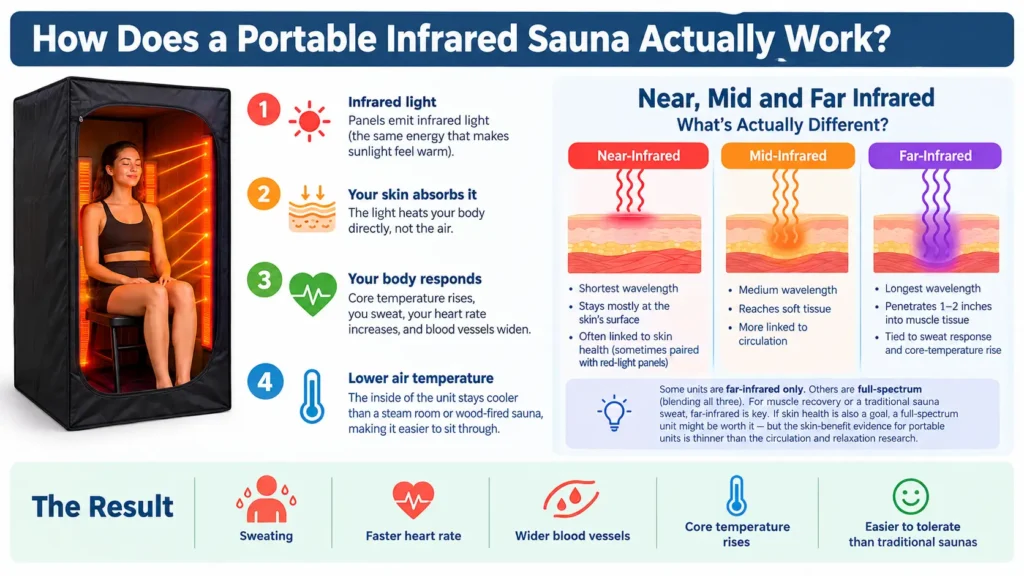
Here’s the short version: a Portable Infrared Sauna works by emitting infrared light the same kind of energy that makes sunlight feel warm on your skin from panels positioned around your body.
Your skin absorbs that light directly, which nudges your core temperature upward and kicks off sweating, a faster heart rate, and widened blood vessels. It’s a physiological response that’s often compared to what you’d get from a brisk, moderate workout.
Because the light is heating you rather than the air surrounding you, the inside of the unit stays at a lower, far more tolerable temperature than a steam room or wood-fired sauna.
That’s part of why so many first-timers find infrared sessions easier to sit through, especially in those early, “am I really doing this” minutes.
Near, Mid, and Far Infrared: What’s Actually Different
Infrared light sits on a spectrum, and where a heater falls on that spectrum changes how deep the heat actually goes:
- Near-infrared has the shortest wavelength and mostly stays at the skin’s surface. It’s often associated with skin-related effects and sometimes gets paired with red-light panels for that reason.
- Mid-infrared goes a bit deeper, into soft tissue, and is more linked to circulation.
- Far-infrared has the longest wavelength and penetrates the deepest roughly one to two inches into muscle tissue. This is the range most tied to the classic sauna-style sweat response and core-temperature rise.
Some infrared sauna units are far-infrared only. Others are full-spectrum, blending all three ranges together. If your main goal is muscle recovery or a real, traditional-feeling sweat, far-infrared coverage is what matters most.
If skin health is part of the appeal too, a full-spectrum or hybrid unit might be worth the extra cost though it’s fair to say the skin-benefit evidence specifically for portable units is thinner than the circulation and relaxation research.
The Three Types of Portable Infrared Saunas
Not every “portable” unit is built the same way, and honestly, this is where a lot of buying guides fall short. Here’s an honest breakdown of the three common formats.
Infrared Sauna Tents
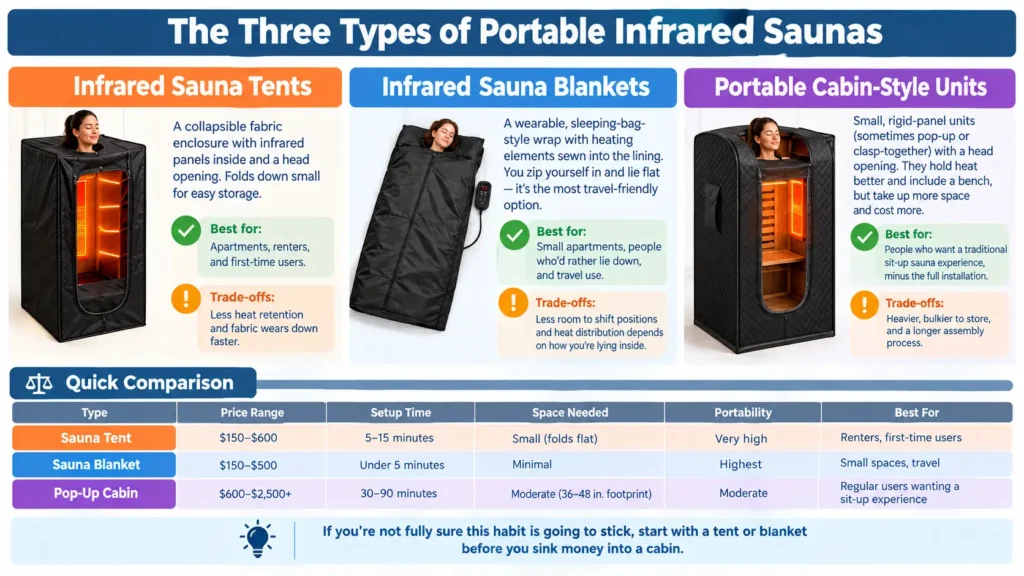
A sauna tent is a collapsible fabric enclosure, usually zippered shut, with one or more infrared panels mounted on the inside walls and a hole or flap for your head to poke through above the heated zone. It’s the cheapest and most space-efficient option by a good margin, and it folds down small enough to slide into a closet shelf when you’re done.
This is the format I’d point most beginners toward. It’s not fancy, but it does the job, and it doesn’t ask you to commit real floor space to something you’re not sure will stick.
Best for: apartments, renters, and anyone testing whether infrared sauna use actually fits into their week. Trade-offs: less heat retention than a rigid unit, and the fabric interior wears down faster with frequent use.
Infrared Sauna Blankets
A sauna blanket is a wearable, sleeping-bag-style wrap with heating elements sewn right into the lining. You zip yourself into it while lying flat, so it barely takes up any floor space at all, and it’s genuinely the most travel-friendly option on this list plenty of people toss theirs in a gym bag or suitcase.
Learning how to use an infrared sauna blanket properly matters more than you’d think, since your positioning inside it directly affects how evenly the heat reaches you.
Best for: small apartments, people who’d rather lie down than sit up, and travel use. Trade-offs: less room to shift positions, and heat distribution depends a lot on how you’re lying inside it.
Portable Cabin-Style Units
These are small, rigid-panel units sometimes marketed as pop-up or clasp-together cabins that you sit inside with your head exposed through an opening near the top. They hold heat far more consistently than fabric options and usually come with a proper bench, but they take up more floor space and cost more.
Best for: people who want something closer to a traditional sit-up sauna experience, minus the full built-in installation. Trade-offs: heavier, bulkier to store, and a longer assembly process.
Quick Comparison
| Type | Price Range | Setup Time | Space Needed | Portability | Best For |
|---|---|---|---|---|---|
| Sauna Tent | $150–$600 | 5–15 minutes | Small (folds flat) | Very high | Renters, first-time users |
| Sauna Blanket | $150–$500 | Under 5 minutes | Minimal | Highest | Small spaces, travel |
| Pop-Up Cabin | $600–$2,500+ | 30–90 minutes | Moderate (36–48 in. footprint) | Moderate | Regular users wanting a sit-up experience |
If you’re not fully sure this habit is going to stick, start with a tent or blanket before you sink money into a cabin.
What a Portable Infrared Sauna Can Actually Do for You
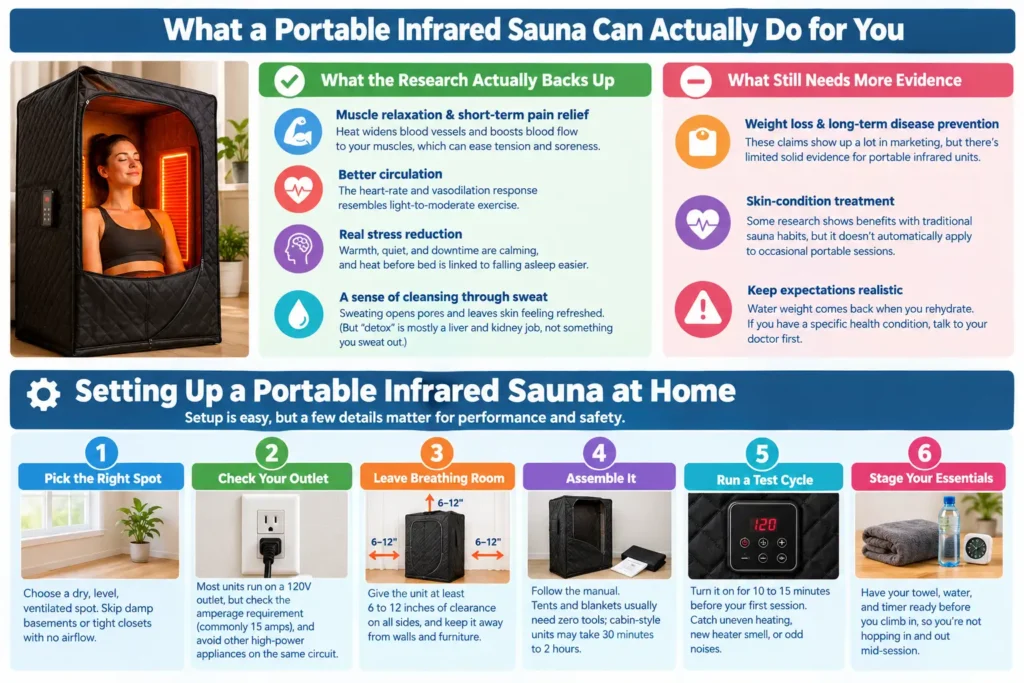
Here’s where I want to be straight with you, because a lot of marketing around this stuff overpromises. Let’s separate what’s genuinely well-supported from what still needs more evidence before you treat it as a guarantee.
What the Research Actually Backs Up
- Muscle relaxation and short-term pain relief. Heat widens blood vessels and boosts blood flow to your muscles, which a lot of people genuinely feel as relief from tension and soreness after a session.
- Better circulation. The heart-rate and vasodilation response you get from sauna heat resembles what happens during light-to-moderate exercise.
- Real stress reduction. Warmth, quiet, and forced downtime add up to something that reliably feels calming, and using heat before bed is commonly linked to falling asleep more easily.
- A sense of cleansing through sweat. Sweating opens pores and leaves skin feeling refreshed, but be a little skeptical of “detox” language actual detoxification, in the medical sense, is mostly a liver and kidney job, not something you sweat out.
What Still Needs More Evidence
Weight loss, long-term disease prevention, and skin-condition treatment claims show up constantly in sauna marketing copy.
Some population-level research on traditional Finnish sauna use multiple sessions a week, sustained over years has found associations with lower cardiovascular mortality.
That’s a real and interesting body of research, but it’s specific to traditional sauna habits and populations, and it doesn’t automatically carry over to occasional sessions in a portable infrared unit.
Any water weight you lose from sweating comes right back the moment you rehydrate. If you’re hoping to use one for a specific health condition, loop your doctor in first and keep your expectations grounded.
Setting Up a Portable Infrared Sauna at Home
Setup is dramatically easier than anything involving a built-in sauna, but a handful of details actually matter for both performance and safety.
A Step-by-Step Walkthrough
- Pick a dry, level, ventilated spot. Skip damp basements or tight closets with no airflow. A bedroom corner, home gym, or finished garage all work well.
- Check your outlet and circuit. Most units run on a standard 120V household outlet, but check the manufacturer’s amperage requirement (commonly 15 amps), and try not to run other power-hungry appliances on the same circuit while you’re using it.
- Leave breathing room. Give the unit at least 6 to 12 inches of clearance on all sides, and keep the fabric or panels away from walls and furniture.
- Assemble it following the manual. Tents and blankets usually need zero tools; cabin-style units may involve clasping panels together, which can take anywhere from 30 minutes to two hours depending on complexity.
- Run an empty test cycle. Turn it on for 10 to 15 minutes before your first real session. This lets you catch uneven heating, a lingering “new heater” smell, or odd noises before you’re actually inside.
- Stage your towel, water, and timer before you climb in, so you’re not hopping in and out mid-session hunting for things.
Power and Space at a Glance
| Requirement | Typical Spec |
|---|---|
| Voltage | 120V standard household outlet |
| Circuit | 15–20 amp dedicated circuit recommended |
| Footprint | 3–4 sq. ft. (tent/blanket) up to 12–16 sq. ft. (cabin) |
| Clearance | 6–12 inches on all sides |
| Flooring | Flat, dry surface (a towel or mat underneath works fine) |
Using It Safely: What Actually Matters
How Long and How Often
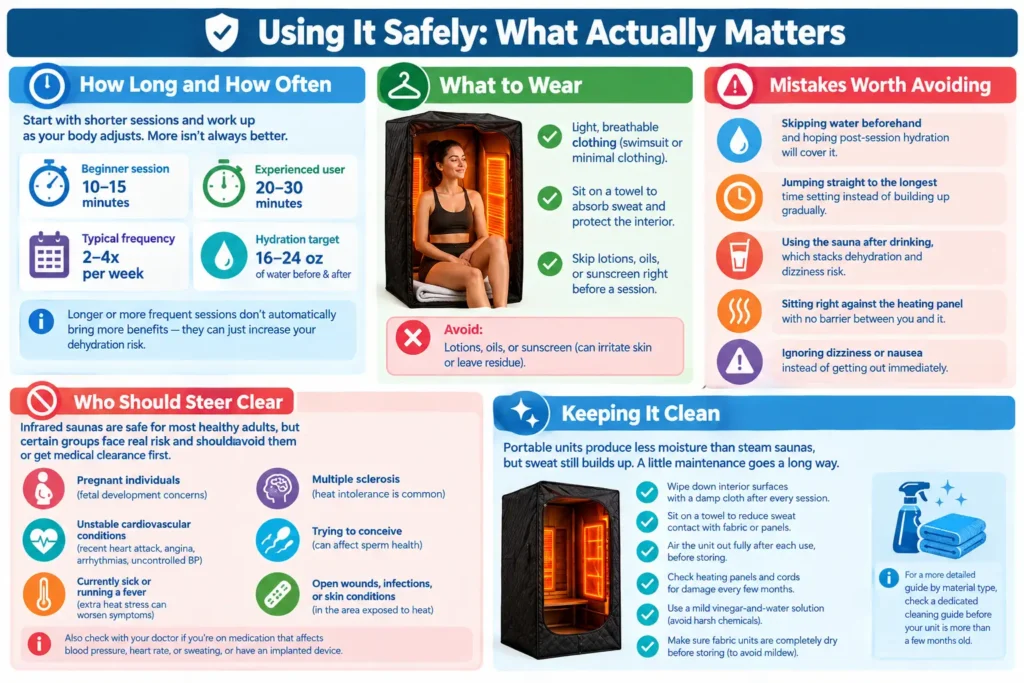
Most manufacturers, and most credible health sources, recommend starting with 10 to 15 minute sessions and gradually working up to 20 or 30 minutes as your body adjusts. A pretty common frequency for general wellness use lands at two to four sessions a week, though plenty of experienced users go more often once they’re acclimated.
Honestly, there’s not much solid evidence that longer or more frequent sessions produce proportionally bigger benefits pushing past your comfort zone mostly just raises your dehydration risk without unlocking some hidden upside.
Quick facts:
- Beginner session: 10–15 minutes
- Experienced user session: 20–30 minutes
- Typical frequency: 2–4x per week
- Hydration target: 16–24 oz of water before and after
What to Wear
Light, breathable clothing works best a swimsuit, or minimal clothing while sitting on a towel since you want enough skin exposed for the infrared light to actually reach it, while still absorbing sweat and protecting the interior. Skip lotions, oils, or sunscreen right before a session, since heat can make certain products irritate skin or leave residue behind on interior surfaces.
Mistakes worth avoiding:
- Skipping water beforehand and hoping post-session hydration will cover it
- Jumping straight to the longest time setting instead of building up gradually
- Using the sauna after drinking, which stacks dehydration and dizziness risk
- Sitting right against the heating panel with no barrier between you and it
- Ignoring dizziness or nausea instead of getting out immediately
Who Should Steer Clear
Infrared saunas are considered safe for most healthy adults, but certain groups face genuine risk and should either avoid them entirely or get medical clearance first. Based on guidance from the Cleveland Clinic and other medical sources, this includes:
- Pregnant individuals — heat exposure, particularly early in pregnancy, has been linked to fetal development concerns by the American College of Obstetricians and Gynecologists.
- People with multiple sclerosis — heat intolerance is common with MS, and sauna use is generally discouraged.
- Anyone with unstable cardiovascular conditions — including a recent heart attack, unstable angina, uncontrolled arrhythmias, or uncontrolled high blood pressure.
- Anyone currently sick or running a fever — extra heat stress can make symptoms worse.
- People actively trying to conceive — heat exposure can affect sperm health.
- Anyone with open wounds, active infections, or significant skin conditions in the area that would be exposed to heat.
Before you assume you’re in the clear, it’s worth reading through a broader rundown of whether an infrared sauna is safe for your specific situation, especially if you’re on medication that affects blood pressure, heart rate, or sweating, or if you have an implanted medical device. This list covers the common contraindications, but it isn’t exhaustive when in doubt, just ask your doctor.
Keeping It Clean
Portable infrared units produce a lot less moisture than steam saunas, so mold risk is fairly low, but sweat still builds up on interior surfaces the more you use it.
A simple maintenance routine:
- Wipe down interior surfaces with a damp cloth after every session
- Sit on a towel to cut down on direct sweat contact with the fabric or panels
- Air the unit out fully after each use, before folding it up or storing it
- Check heating panels and cords for damage every few months
- Skip harsh chemical cleaners, since residue can vaporize during the next session and end up in your lungs a mild vinegar-and-water solution usually does the trick
- Make sure fabric units are completely dry before storing to avoid mildew
For a more detailed walkthrough of cleaning routines by material type, it’s worth checking a dedicated guide on cleaning an infrared sauna before your unit is more than a few months old.
What You’ll Actually Pay
| Tier | Price Range | What You Get |
|---|---|---|
| Entry-level (tent/blanket) | $150–$600 | Basic far-infrared heating, digital timer, fabric build, limited or no warranty |
| Mid-range (tent/blanket, upgraded) | $400–$900 | Multiple heating panels, better temperature control, sturdier materials |
| Premium pop-up cabin | $1,000–$2,500+ | Full-spectrum or shielded low-EMF heating, more interior room, longer warranty |
Ongoing electricity costs are minimal a typical 20 to 30 minute session uses roughly the same power as running a hair dryer for the same stretch of time.
Some purchases may even qualify for HSA or FSA reimbursement with a Letter of Medical Necessity from your doctor, though approval varies by plan administrator, so it’s worth confirming eligibility before you buy if that factors into your decision.
If you’re comparing full-spectrum against far-infrared-only models and trying to weigh whether the EMF shielding on premium units is worth the price jump, it helps to read up on what makes a low EMF infrared sauna different before you commit to a tier.
Portable Infrared Sauna vs. Blanket vs. Steam Sauna
| Feature | Portable Infrared (Tent/Cabin) | Infrared Sauna Blanket | Steam Sauna |
|---|---|---|---|
| Heat type | Infrared light | Infrared light | Humid heated air |
| Position | Sit or lie | Lie down, wrapped | Sit |
| Typical temp | 120–140°F | 120–150°F | 110–120°F, high humidity |
| Best for | General heat therapy, more room to move | Convenience, travel, tight spaces | Respiratory comfort, humid-heat preference |
| Setup effort | Low to moderate | Very low | Moderate to high, often needs plumbing |
Mistakes People Make More Than You’d Think
- Buying purely on price. A rock-bottom tent might lack even heat distribution or a reliable timer.
- Skipping the test cycle. Running it empty first catches problems before you’re actually inside sweating.
- Overdoing session length right out of the gate. Build tolerance slowly instead of starting at 30-plus minutes.
- Forgetting about the room itself, not just the unit. A stuffy room makes sessions feel far more intense than they should.
- Taking “detox” claims literally. Sweating feels cleansing, sure, but your liver and kidneys are doing the actual work.
Myth vs. Fact
| Myth | Fact |
|---|---|
| “You’ll lose real weight from sweating in an infrared sauna.” | You lose water weight temporarily, and it comes right back once you rehydrate. |
| “Portable units are too weak to do much.” | Far-infrared portable units reach roughly the same temperature range as many built-in cabins — the real difference is size and materials, not necessarily heat quality. |
| “Infrared saunas are safe for absolutely everyone.” | Certain groups, including pregnant individuals and people with specific cardiovascular conditions, should avoid or limit use. |
| “More time inside means more benefit.” | Longer sessions raise dehydration and overheating risk without clear evidence of proportionally bigger payoff. |
Frequently Asked Questions
What is a Portable Infrared Sauna?
It’s a compact heating unit — usually a tent, blanket, or pop-up cabin — that uses infrared light to warm your body directly, without needing the electrical or ventilation work a built-in sauna requires.
How does a Portable Infrared Sauna work?
It uses infrared light panels that your skin absorbs directly, raising your core temperature and triggering sweating and increased blood flow, similar to the response you’d get from light exercise.
Are portable infrared saunas as effective as traditional saunas?
They work differently rather than being “weaker.” Infrared units heat you directly at a lower ambient temperature, while traditional saunas heat the air around you at a much higher one. Each delivers a different experience and sits on a slightly different research base.
How long should I sit in a Portable Infrared Sauna?
Most sources recommend 10 to 15 minutes for beginners, working up to 20 to 30 minutes as your tolerance builds.
How often can I use a Portable Infrared Sauna?
Two to four sessions a week is a common general-wellness frequency, though some experienced users go more often. Listen to your body, and check with a doctor if you have any health conditions.
What’s the difference between near, mid, and far infrared?
Near-infrared penetrates the skin surface, mid-infrared reaches a bit deeper into circulation, and far-infrared goes deepest into muscle tissue — the range most associated with core-temperature elevation.
Do I need special wiring to set up a Portable Infrared Sauna?
No. Most portable units plug into a standard 120V household outlet and don’t require an electrician, unlike many built-in saunas.
Who should not use a Portable Infrared Sauna?
Pregnant individuals, people with multiple sclerosis, those with unstable cardiovascular conditions, anyone currently ill, and people with certain skin conditions or implanted medical devices should avoid use or get medical clearance first.
What should I wear in a Portable Infrared Sauna?
Light, breathable clothing like a swimsuit, or minimal clothing while sitting on a towel, works best. Skip heavy fabrics that trap heat unevenly.
Do portable infrared saunas actually help with detox?
Sweating can make skin feel cleaner, but the actual medical process of detoxification happens mainly in your liver and kidneys, not through sweat. Treat “detox” marketing claims with a healthy dose of skepticism.
Final Thoughts
A Portable Infrared Sauna isn’t going to replicate a full Finnish sauna ritual, and it’s not a miracle cure for anything but it’s a genuinely accessible way to build regular heat therapy into your routine without construction crews, permits, or a five-figure budget.
The right format for you really comes down to your space and how committed you already are: grab a tent or blanket if you’re just testing the waters or working with a small footprint, and step up to a cabin-style unit once you know you’re actually going to use it consistently.
Whichever one you choose, treat the safety guidance in this guide as non-negotiable rather than optional. Start with shorter sessions, hydrate properly, and check in with a doctor first if you fall into any of the higher-risk categories above.
Used consistently and sensibly, a Portable Infrared Sauna can be a genuinely low-effort addition to a bigger recovery and relaxation routine no cedar cabin or backyard construction required.