
What is the best water to use in a steam sauna? Distilled water. It has almost no minerals, so it won’t leave scale on your sauna stones or heating coils, and it produces the cleanest steam.
Filtered water is a solid second choice. Regular tap water can work if your water isn’t very hard, but it will shorten the life of your heater over time. Never use chlorinated water from a pool or hot tub.
Key takeaways
- Distilled water protects your heater and stones the longest.
- Tap water is acceptable short-term but causes mineral scale in hard-water areas.
- Never pour pool water, chlorinated water, or scented liquids straight onto stones.
- A little water goes a long way — about a half cup per ladle is plenty.
Why the Type of Water You Use Actually Matters
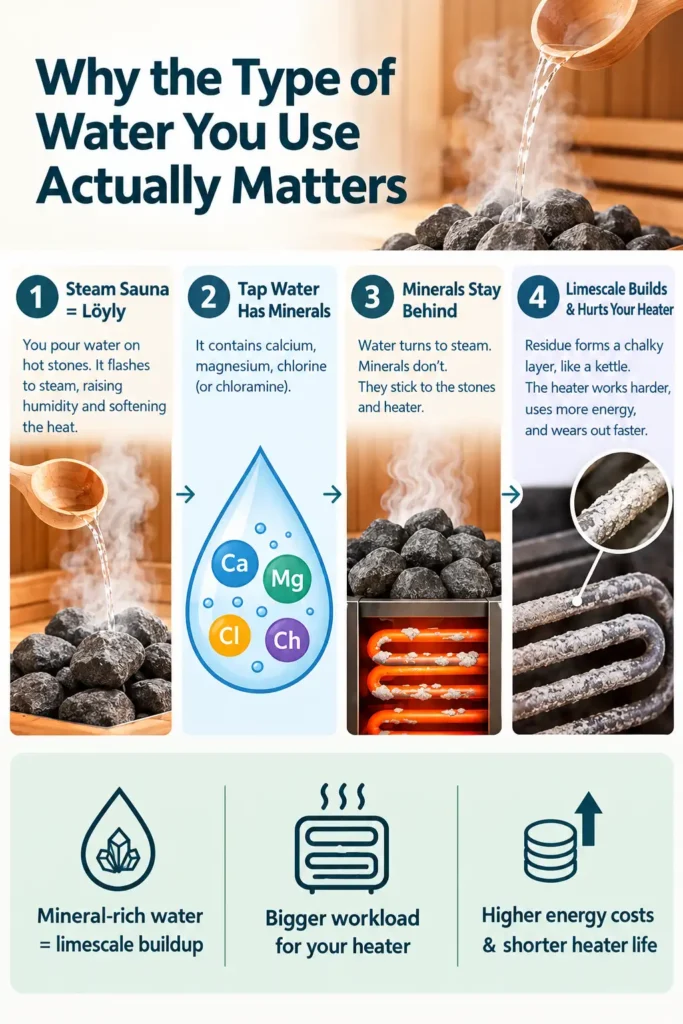
A steam sauna works by pouring small amounts of water onto heated stones, which instantly flashes into steam. This is called löyly in Finnish sauna tradition, and it’s what raises the humidity and makes the heat feel softer on your skin.


Paid Links - As an Amazon Associate, I earn from qualifying purchases.
The problem is that water is never just water. Tap water carries dissolved minerals — mostly calcium and magnesium — along with chlorine or chloramine used for disinfection.


Paid Links - As an Amazon Associate, I earn from qualifying purchases.
When that water turns to steam, the water itself leaves as vapor, but the minerals don’t. They stay behind on the stones and on the heating element underneath them.
What Happens When Water Hits Hot Sauna Stones
The stones absorb heat and release it quickly when water touches them, which is why you hear that sharp hissing sound. Over hundreds of sauna sessions, anything dissolved in the water gets left behind on the surface of the stones and, more importantly, on the metal heating coils just beneath them.
How Minerals Build Up and Damage Your Heater
That leftover residue is limescale — the same chalky white buildup you’d see in a kettle. On a sauna heater, limescale acts like a layer of insulation around the coils.
The heater has to work harder to reach the same temperature, your energy bill creeps up, and the element wears out faster than it should. In hard-water regions, this can happen within a single season.
Best Water To Use in a Steam Sauna
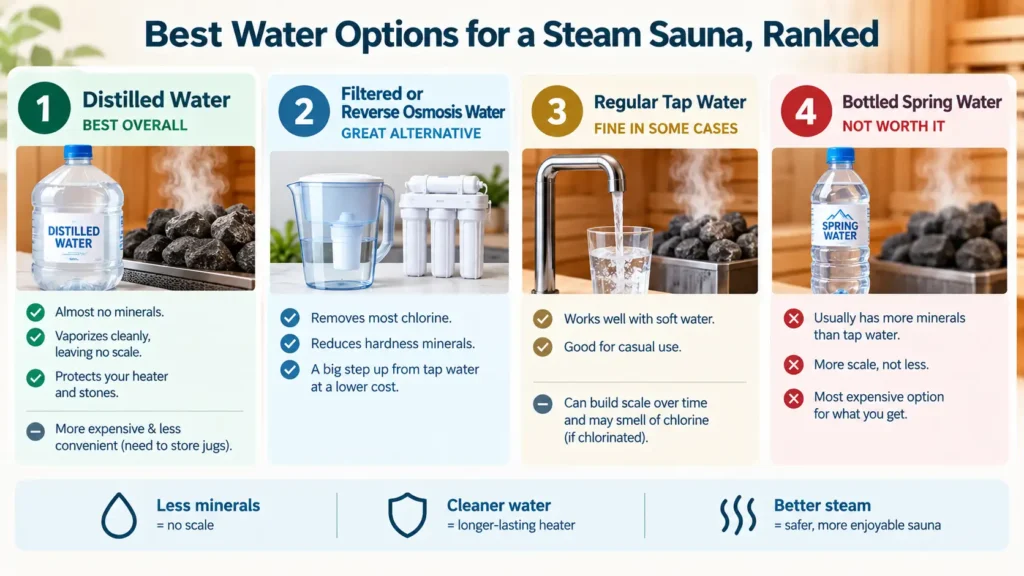
Distilled Water (Best Overall)
Distilled water has had almost all of its minerals removed through a boiling-and-condensing process, so it’s about as close to pure H2O as you can buy.
When it hits hot stones, it vaporizes cleanly and leaves nothing behind. That means no scale, no rusting, and stones and heating elements that last longer.


Paid Links - As an Amazon Associate, I earn from qualifying purchases.
The only downside is cost and convenience — you’ll need to keep jugs on hand, and it’s a recurring expense. For a home sauna used a few times a week, this is a small trade-off for a heater that lasts years longer.
Filtered or Reverse Osmosis Water (Great Alternative)
If buying distilled water isn’t practical, a basic carbon filter (like a pitcher filter) or a reverse osmosis system removes most chlorine and a meaningful portion of hardness minerals.
It won’t get you to zero minerals like distillation does, but it’s a big step up from straight tap water and is far cheaper long-term if you already have a filter at home.
Regular Tap Water (Fine in Some Cases)
If you live somewhere with naturally soft water, plain tap water is a reasonable option, especially for casual or occasional sauna use.
The trade-off is scale buildup over time, and if your municipal water is chlorinated, you’ll also smell a faint chemical note in the steam. If you’re not sure how hard your water is, most water utilities publish an annual water quality report you can check.
Bottled Spring Water (Not Worth It)
Spring water is marketed as “pure,” but it typically contains more dissolved minerals than tap water, not fewer — that mineral content is often part of the marketing appeal for drinking. For sauna use, that means more scale, not less. It’s also the most expensive option on this list for what you get. Skip it.
Water You Should Never Use in a Sauna
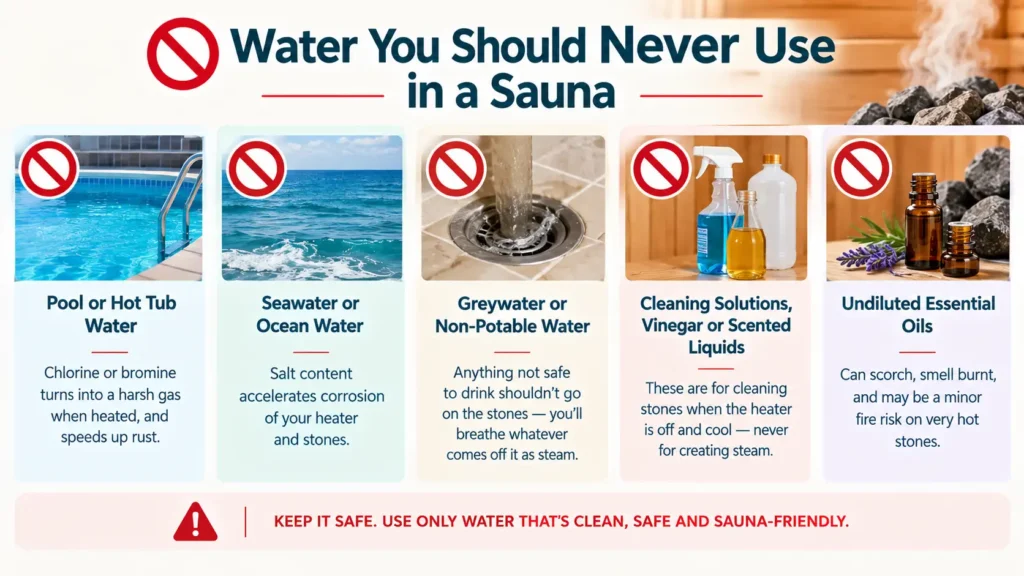
- Pool or hot tub water — the chlorine or bromine used to sanitize pools turns into a harsh, corrosive gas when heated, which is unpleasant to breathe and speeds up rust on metal parts.
- Seawater or ocean water — the salt content accelerates corrosion of your heater and stones.
- Greywater or non-potable water — anything not safe to drink shouldn’t go on the stones either, since you’ll be breathing whatever comes off it as steam.
- Cleaning solutions, vinegar, or scented liquids poured directly on hot stones — these are for cleaning stones when the heater is off and cool, never for creating steam.
- Undiluted essential oils poured straight on the stones — this can scorch, smell burnt, and in some cases is a minor fire consideration on very hot stones.
Tap Water vs. Distilled Water: Side-by-Side Comparison
| Factor | Tap Water | Distilled Water |
|---|---|---|
| Mineral content | High (varies by region) | Almost none |
| Scale buildup on stones/heater | Yes, over time | No |
| Cost | Free / very low | Ongoing cost per gallon |
| Convenience | Always available | Requires buying or making |
| Effect on heater lifespan | Shortens it in hard-water areas | Extends it |
| Steam smell | May carry a faint chlorine note | Neutral, clean |
| Best for | Soft-water areas, occasional use | Frequent use, any water hardness |
Does the water hardness in your area affect the answer?
Yes — this is the information that the majority of articles miss. Water hardness is measured in grains per gallon (GPG) or parts per million (ppm) of dissolved calcium and magnesium.
With soft water (less than approximately 3.5 GPG), tap water will not cause as much buildup as it would in a hard water area (more than 10.5 GPG).
The hardness number for your area is typically available in your consumer confidence report from your water utility or by using a low-cost home test strip. Distilled or filtered water is the safer option to use, no matter where you live, when in doubt.
How to Pour Water on Sauna Stones the Right Way
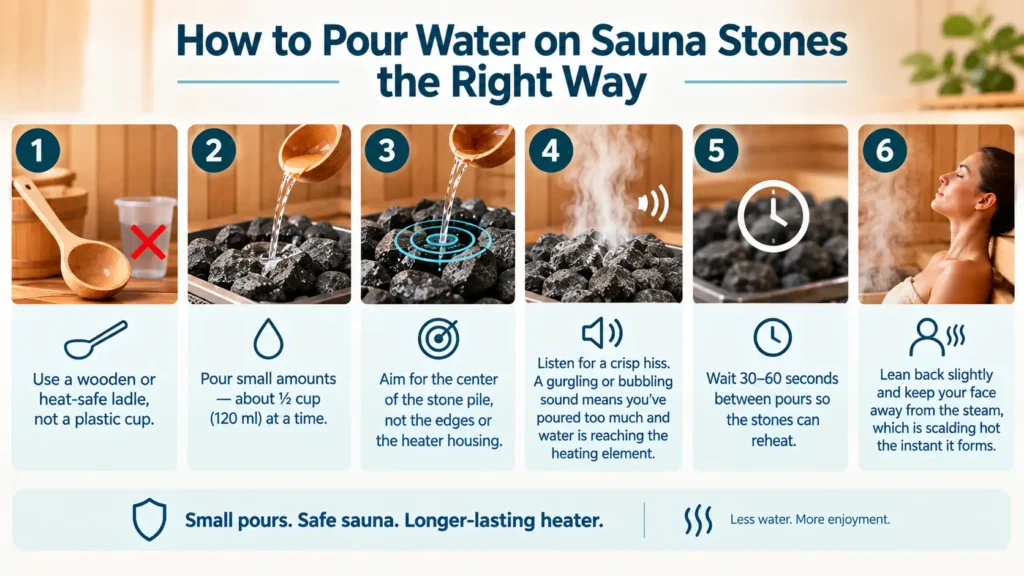
- Use a wooden or heat-safe ladle, not a plastic cup.
- Pour in small amounts — about a half cup (roughly 120 ml) at a time.
- Aim for the center of the stone pile, not the edges or the heater housing.
- Listen for a crisp hiss. A gurgling or bubbling sound means you’ve poured too much and water is reaching the heating element directly, which isn’t good for the unit.
- Wait 30–60 seconds between pours so the stones can reheat.
- Lean back slightly and keep your face away from the rising steam, which is scalding hot the instant it forms.
Can You Add Essential Oils or Herbs to Sauna Water?
Yes, but always diluted, never poured directly onto the stones undiluted. A common approach is 3–5 drops of a sauna-safe essential oil (eucalyptus, lavender, pine, or cedarwood are popular choices) mixed into a full ladle or bucket of your chosen water.
Herbal infusions work the same way — steep a mild herb like mint or chamomile, strain out the solids completely, and use the liquid the same way you’d use plain water. Straining matters, since any leaves or plant matter left in the liquid can scorch on contact with the stones.
Signs Your Sauna Water Is Damaging Your Heater
- A white, chalky crust forming on top of the stones
- Stones that look dull or crusted rather than clean and dark
- A burning-dust or metallic smell during heat-up
- The sauna taking noticeably longer to reach temperature than it used to
- Visible white residue at the base of the heater housing
If you notice any of these, it’s worth switching to filtered or distilled water going forward and giving the stones a clean.
How to Clean Mineral Buildup Off Sauna Stones
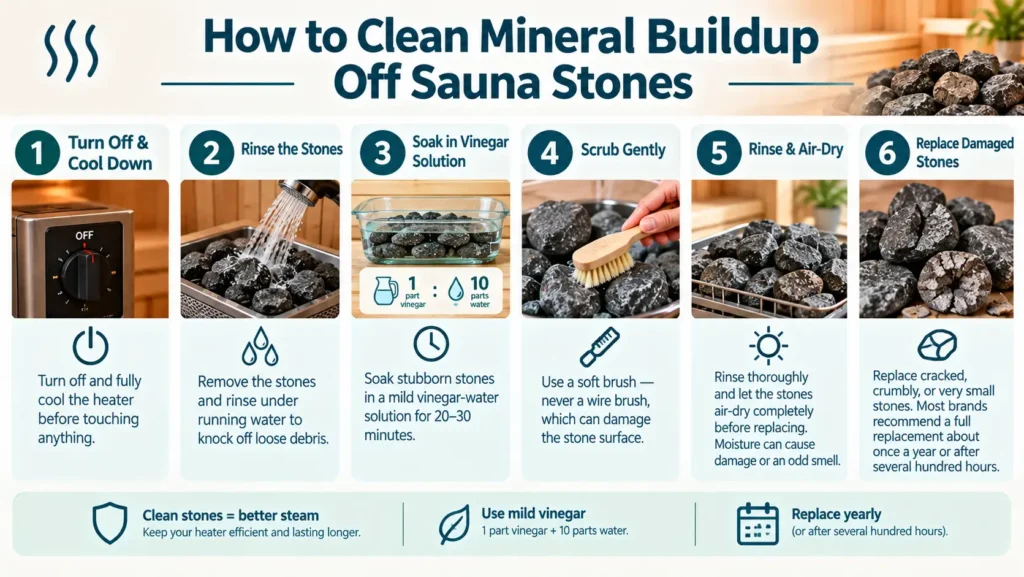
- Turn off and fully cool the heater before touching anything.
- Remove the stones and rinse them under running water to knock off loose debris.
- Soak stubborn, scale-covered stones in a mild vinegar-and-water solution (roughly 1 part white vinegar to 10 parts water) for 20–30 minutes.
- Scrub gently with a soft brush — never a wire brush, which can damage the stone surface.
- Rinse thoroughly and let the stones air-dry completely before placing them back in the heater. Any lingering moisture can cause damage or an odd smell on first use.
- Replace any stones that are cracked, crumbling, or unusually small — most manufacturers recommend replacing sauna stones roughly once a year or after several hundred hours of use.
Water for Electric Saunas vs. Wood-Burning vs. Infrared
- Electric saunas: Designed and sealed so water poured onto the stones can’t reach you as an electric shock, but the heater still needs mineral-free water to avoid coil damage. Always check your specific heater’s manual, since a small number of electric models aren’t built for water at all.
- Wood-burning saunas: The same rules apply — the stones sit above an open firebox rather than an electric element, but limescale and cracked stones are still a concern, and pouring technique matters just as much.
- Infrared saunas: Never pour water on an infrared sauna’s heating panels. Infrared saunas heat your body directly with light rather than heating the air with steam, and their electrical panels aren’t built to handle moisture.
Is it Better to Drink Water Before, During, and After Sauna?
It’s a different question from what you put on the stones, but it’s important to answer because there is actual fluid loss during the sauna session through sweating.
Drink a glass of water before entering; during longer sessions, have a bottle of water handy and rehydrate after. You don’t need distilled water for your water, just plain water is good.
Common Mistakes to Avoid
- Dumping a full cup of water on the stones at once instead of small amounts
- Using pool, hot tub, or ocean water because “it’s just water”
- Pouring undiluted essential oils directly onto hot stones
- Never checking or cleaning stones, letting scale build up for years
- Ignoring the sauna manufacturer’s specific water guidance in the owner’s manual
Myth vs. Fact
| Myth | Fact |
|---|---|
| “Any water is fine for a sauna.” | Chlorinated, salty, or very hard water causes real damage over time. |
| “Distilled water is required by law or by every manufacturer.” | It’s a best practice, not a universal requirement — check your specific heater’s manual. |
| “Bottled spring water is purer, so it’s better for saunas.” | Spring water often has more minerals than tap water, not fewer. |
| “You can pour oils straight on the stones for a stronger scent.” | Undiluted oils can scorch and damage stones; always dilute in water first. |
FAQs
What is the best water to use in a steam sauna?
Distilled water is the best overall choice because it contains almost no minerals, so it won’t leave scale on your sauna stones or heating element.
Can I use regular tap water in my sauna?
Yes, especially if you live in a soft-water area. In hard-water regions, tap water will cause mineral buildup faster, which can shorten your heater’s lifespan.
Is bottled water good for saunas?
Not particularly. Standard bottled spring water often contains more dissolved minerals than tap water, so it doesn’t offer an advantage and costs more.
Can you use filtered water instead of distilled water in a sauna?
Yes. Filtered or reverse osmosis water removes most chlorine and a good share of hardness minerals, making it a solid middle-ground option.
Why does my sauna smell like chlorine after I add water?
This usually means your tap water is chlorinated. Switching to filtered or distilled water removes that smell.
Can you put ice on sauna stones instead of water?
Small amounts of ice can be used and will create a slower, gentler release of steam, but the same water-quality rules apply — use distilled or filtered ice, not water with high mineral content.
Does hard water actually damage a sauna heater?
Yes. Over time, the calcium and magnesium in hard water build up as scale on the heating coils, which forces the heater to work harder and wears it out faster.
Is it safe to pour pool water on sauna stones?
No. Chlorinated or bromine-treated pool water releases harsh fumes when heated and will corrode your heater faster than plain water.
Can you pour water on an infrared sauna?
No. Infrared saunas heat your body with light panels rather than creating steam, and pouring water on the panels can cause damage or create a safety hazard.
Final Thoughts
The water you pour on sauna stones isn’t an afterthought — it’s one of the simplest things you can control to protect your heater and stones for years instead of months.
Distilled water is the safest default no matter where you live, filtered water is a practical middle ground, and plain tap water can work fine if your local water is naturally soft.
What matters most is avoiding chlorinated, salty, or otherwise contaminated water entirely, pouring in small amounts, and keeping an eye on your stones for early signs of buildup. Get that right, and the rest of your sauna routine — the steam, the scent, the heat — takes care of itself.