
If you’ve ever used a traditional sauna and felt like you couldn’t breathe through the heat, you’ve probably wondered about the infrared version down the hall the one that looks like a wooden phone booth and runs at a much gentler temperature. So what actually makes a sauna “infrared”?
Short answer: An infrared sauna uses infrared light to heat your body directly, instead of heating the air around you like a traditional sauna does. That single difference changes everything about how it feels, how hot it gets, and how your body responds.
Disclaimer: The content provided on this blog is for educational and informational purposes only and is not intended to be a substitute for professional medical advice, diagnosis or treatment.
Key Takeaways
- Infrared saunas use infrared light waves, not heated air, to warm your body directly that makes a Sauna Infrared.
- There are three types of infrared wavelength used in saunas: near, mid, and far infrared, each penetrating the skin to a different depth.
- Infrared saunas typically run 100–150°F (38–65°C), much lower than a traditional sauna’s 150–195°F (65–90°C).
- Research shows infrared saunas can support cardiovascular health, muscle recovery, and relaxation, but larger, more rigorous studies are still needed to confirm many claimed benefits.
- No harmful effects have been consistently reported in infrared sauna research, according to Mayo Clinic, but people with certain conditions should check with a doctor first.
What Is an Infrared Sauna?
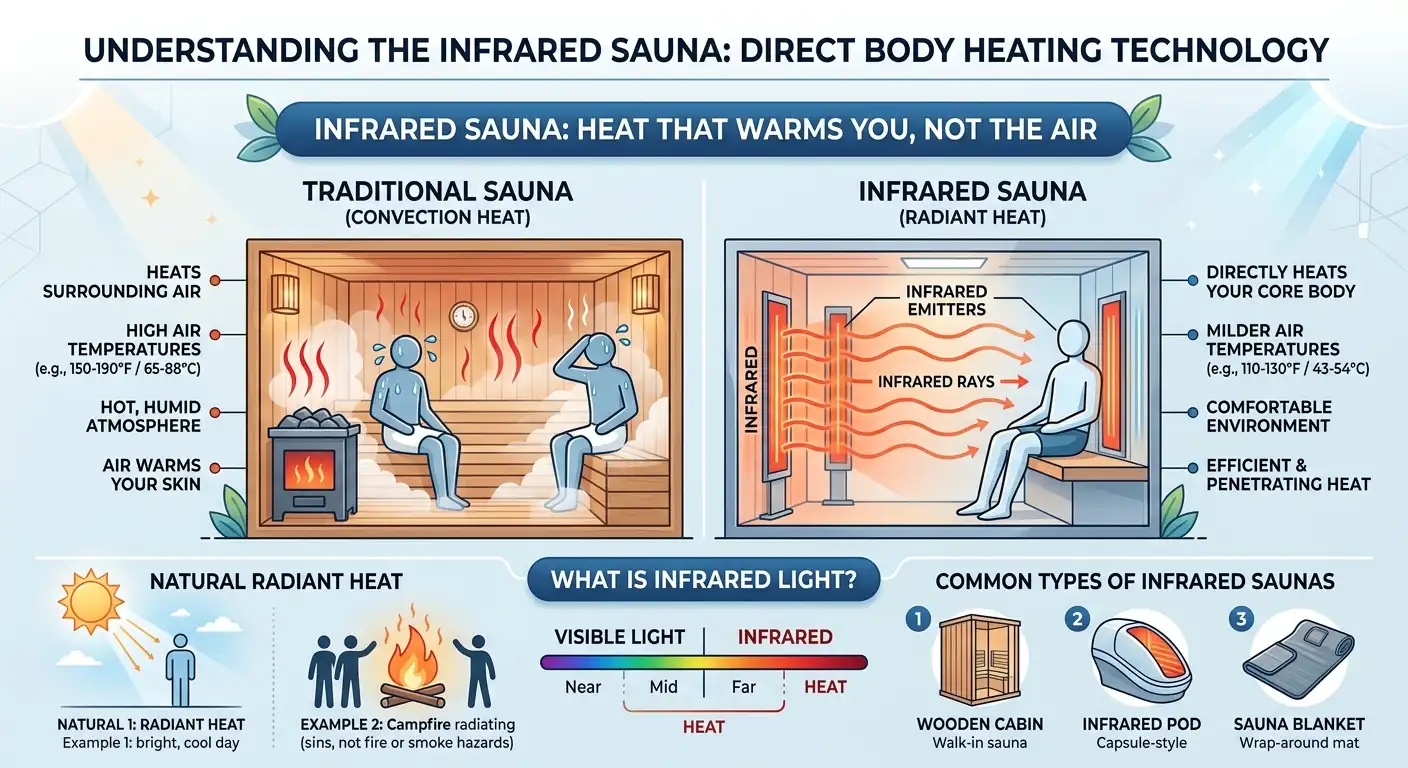
An infrared sauna is an enclosed space a cabin, pod, or blanket that uses infrared emitters instead of a wood or electric heater to warm your body. Rather than heating the room’s air and letting that hot air warm your skin, infrared panels emit light energy that’s absorbed directly by your skin and tissue, raising your core temperature while the surrounding air stays relatively mild.
That’s the core distinction: a traditional sauna heats the environment; an infrared sauna heats you.


Paid Links - As an Amazon Associate, I earn from qualifying purchases.
Infrared light itself isn’t unusual or exotic it’s the same kind of radiant heat you feel from the sun on your skin on a cool day, or the warmth radiating off a campfire once you step back from the smoke and flames. Saunas simply concentrate it using electric heating elements tuned to specific wavelengths.
How Infrared Heat Actually Works
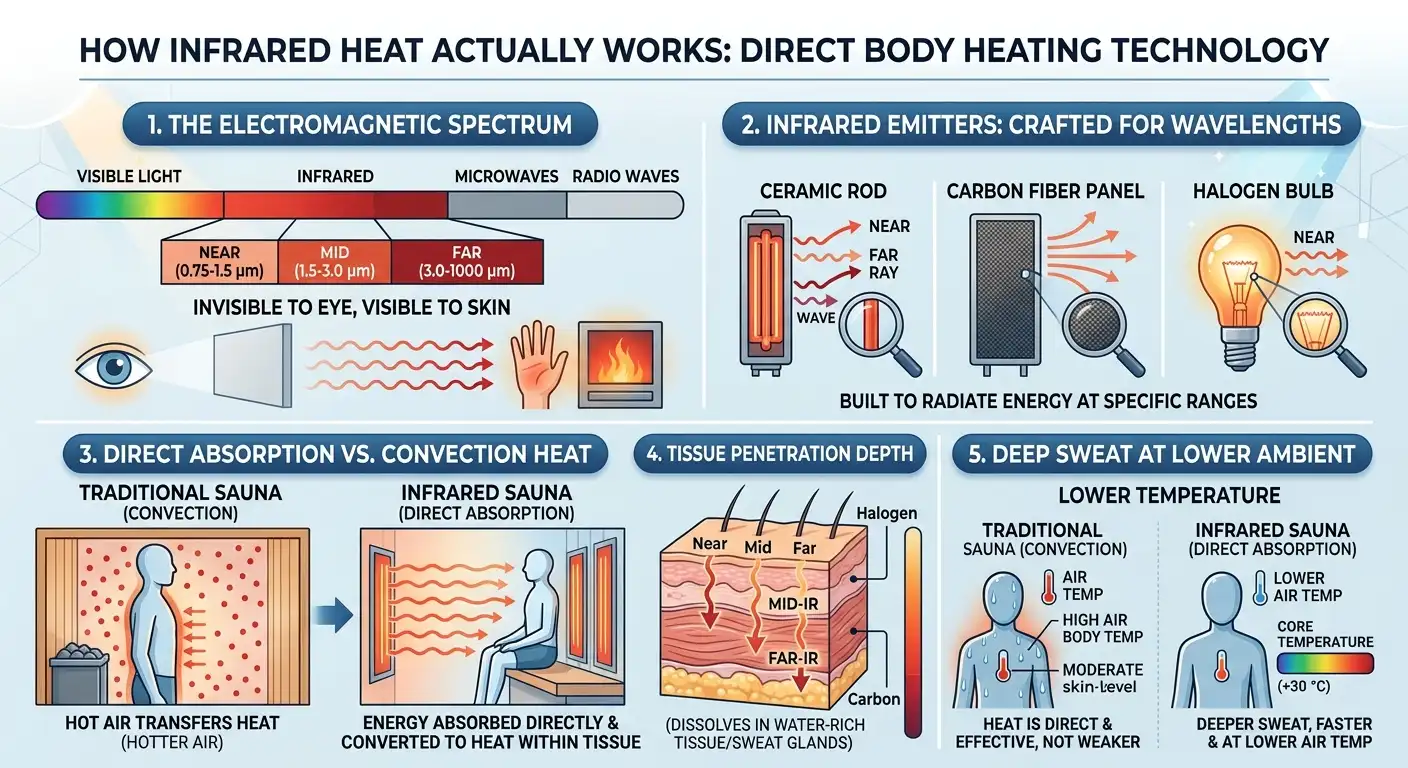
Infrared is a band of the electromagnetic spectrum, sitting between visible light and microwaves. It’s invisible to the human eye, but your skin can absolutely feel it as heat.



Paid Links - As an Amazon Associate, I earn from qualifying purchases.
Infrared sauna emitters are typically ceramic, carbon-fiber, or halogen-based heating elements built to radiate energy at specific wavelength ranges. When that energy hits your skin, it’s absorbed and converted into heat within your tissue rather than needing hot air to transfer warmth to you first.
This is why infrared saunas can produce a deep, sweat-inducing heat experience at a much lower ambient air temperature than a traditional sauna. The heat isn’t “weaker” it’s just delivered differently, more directly, and to a shallower or deeper layer of tissue depending on the wavelength used. For a more technical walkthrough, see how an infrared sauna works.
The Three Types of Infrared Wavelength
Not all infrared is the same. Sauna manufacturers typically use one, two, or all three of the following wavelength bands, and this is genuinely the most important technical distinction to understand if you’re comparing sauna models.
| Type | Approximate Wavelength | Penetration Depth | Primary Effect |
|---|---|---|---|
| Near-Infrared (NIR) | ~0.7–1.5 microns | Shallowest – skin surface | Associated with skin-level effects and light-based skin therapies |
| Mid-Infrared (MIR) | ~1.5–5.6 microns | Mid-depth – soft tissue | Associated with circulation and muscle-level warmth |
| Far-Infrared (FIR) | Roughly 5.6 microns and up | Deepest – core body warming | Associated with the strongest core-temperature rise and sweat response |
Quick fact: The exact boundaries between near, mid, and far-infrared aren’t universally standardized in physics – different manufacturers and researchers draw the lines slightly differently. Treat the numbers above as general reference points, not rigid cutoffs.
Full spectrum infrared saunas combine all three wavelength types in one unit, aiming to deliver the shallow-skin effects of near-infrared, the circulatory effects associated with mid-infrared, and the deep core warming associated with far-infrared, all in a single session.



Paid Links - As an Amazon Associate, I earn from qualifying purchases.
Which Type Is “Best”?
There isn’t a single correct answer it depends on your goal:
- Want the deepest sweat and core-temperature effect? Far-infrared is generally the primary driver.
- Want a broader, more well-rounded session? A full spectrum unit covers all three bands.
- Care mainly about skin-level exposure alongside heat? Look for a unit that includes a near-infrared component.
Most consumer infrared saunas sold today lean toward far-infrared or full spectrum, since far-infrared is what produces the classic “sauna sweat” most people are looking for. If you’re looking and understanding wavelength types for a purchase, our comparison of far vs. near infrared saunas goes deeper into which suits different goals.
Infrared Sauna vs. Traditional Sauna: What’s Actually Different
| Feature | Traditional Sauna | Infrared Sauna |
|---|---|---|
| Heat source | Heated rocks or electric heater warms the air | Infrared emitters warm the body directly |
| Typical temperature | 150–195°F (65–90°C) | 100–150°F (38–65°C) |
| Humidity | Can be dry or steam-based (with water on rocks) | Typically dry, low humidity |
| Warm-up time | 30–45 minutes | 10–15 minutes |
| How the heat feels | Surrounds and envelops you through the air | Feels like direct, penetrating warmth on the skin |
| Session length | Typically 5–15 minutes | Typically 20–45 minutes |
| Energy use | Generally higher due to heating a whole room | Generally lower, since less air needs heating |
Neither is objectively “better” they’re different tools. People who find traditional sauna heat overwhelming often prefer infrared because it delivers a similar sweat response at a temperature that’s easier to sit in for longer. We cover this trade-off in more depth in Infrared Sauna vs. Traditional: Which Is Better For You, and if you’re weighing a steam room instead, see Which Is Better: Steam or Infrared Sauna?
What Temperature Does an Infrared Sauna Reach?
Most infrared saunas operate between 100°F and 150°F (38–65°C), well below the 150–195°F range typical of a traditional Finnish-style sauna. Because the heat is absorbed directly by your body rather than needing hot air to do the work, you can still reach a strong sweat and an elevated heart rate similar to the physiological response of moderate exercise without the room itself feeling unbearably hot.
Session lengths are usually longer than a traditional sauna, commonly 20 to 45 minutes, since the lower ambient temperature makes it more comfortable to stay in longer.
What Happens to Your Body in an Infrared Sauna
During a session, several things typically happen:
- Core temperature rises as infrared energy is absorbed by tissue.
- Heart rate increases, similar in pattern to light-to-moderate physical activity.
- Blood vessels dilate, increasing blood flow to the skin.
- Sweating begins, usually within the first several minutes.
- Muscles relax as blood flow increases and body temperature climbs.
This cluster of responses or reaction is why infrared sauna use is often compared to a passive cardiovascular workout your heart and circulatory system respond to the heat stress even though you’re sitting still.
Infrared Sauna Benefits: What the Evidence Actually Shows

It’s important to separate what’s well-supported from what’s still being studied. According to Mayo Clinic, research has explored infrared sauna use for several conditions, with some encouraging findings but the institution is clear that larger, more rigorous studies are still needed to confirm many of these effects, and some existing research was actually conducted using traditional saunas rather than infrared ones specifically.
Conditions and outcomes that have been studied include:
- High blood pressure
- Heart failure
- Dementia and Alzheimer’s disease risk
- Headache
- Type 2 diabetes
- Arthritis-related symptoms
- General relaxation and stress reduction
- Muscle recovery and soreness
What’s well-established: Infrared sauna use reliably produces sweating and a moderate cardiovascular response, and Mayo Clinic notes that no harmful effects have been consistently reported with infrared sauna use. For a deeper look at each condition studied, see our full guide to the health benefits of infrared sauna.
What’s still uncertain: Specific claims like exact calories burned, precise detox mechanisms, or guaranteed disease prevention are not yet backed by strong, consistent clinical evidence. Be skeptical of any source citing a very specific calorie-burn number for a sauna session this is commonly overstated in marketing content and not well substantiated by rigorous research.
Safety, Side Effects, and Who Should Be Cautious
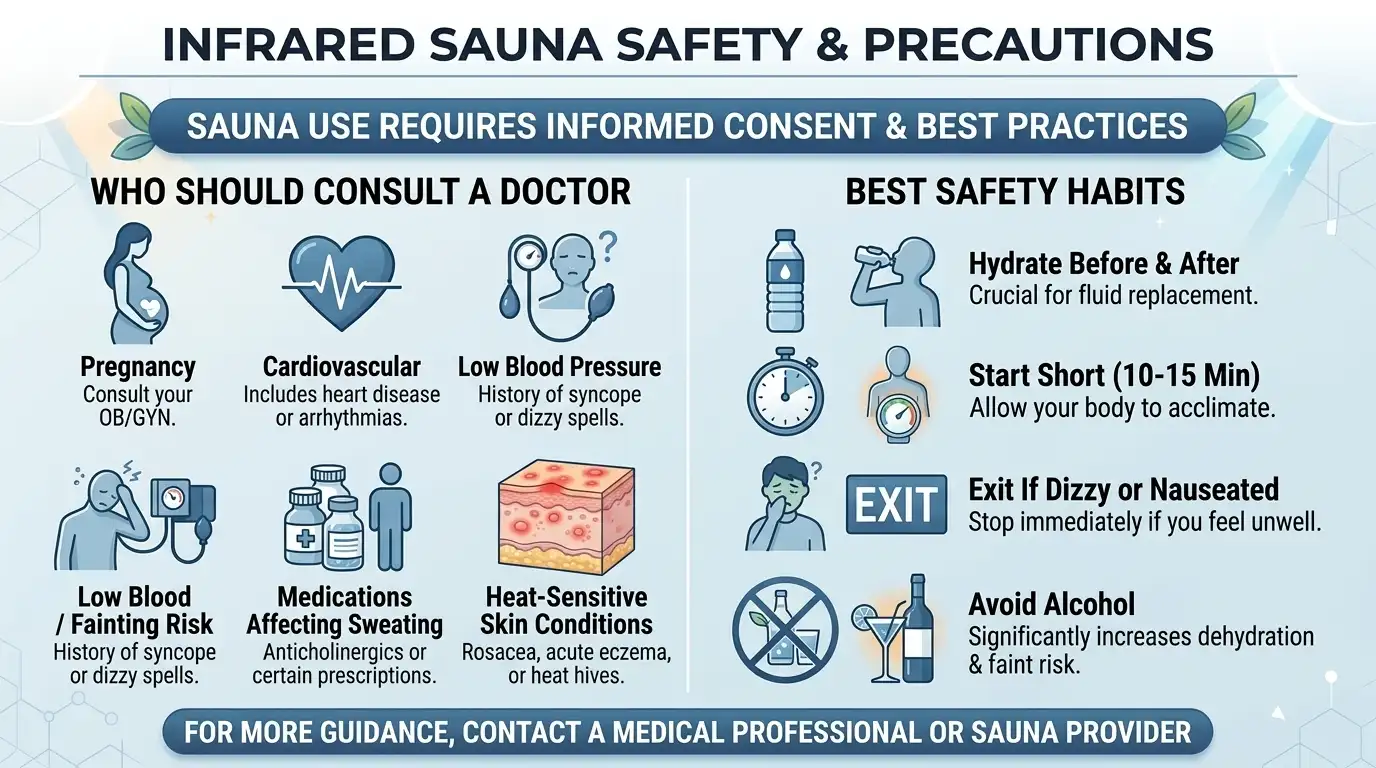
Mayo Clinic reports that no harmful effects have been consistently associated with infrared sauna use in the research reviewed. Still, heat exposure of any kind isn’t right for everyone. It’s reasonable to check with a doctor before use if you:
- Are pregnant
- Have a cardiovascular condition
- Have low blood pressure or are prone to fainting
- Are taking medications that affect sweating, blood pressure, or body temperature regulation
- Have a heat-sensitive skin condition
For a full rundown of infrared sauna who should be extra cautious and why, see Is Infrared Sauna Safe for Everyone?
General safety habits worth following regardless of health status:
- Stay hydrated before and after a session.
- Start with shorter sessions (10–15 minutes) if you’re new to it.
- Exit the sauna if you feel dizzy, nauseated, or unusually fatigued.
- Avoid alcohol before a session.
A Common Hidden Concern: EMF Exposure
Because infrared saunas works on electric heating elements, some people worry about electromagnetic field (EMF) exposure. Reputable manufacturers design emitters to minimize EMF output, and this is a reasonable question to ask directly when comparing products look for published EMF test results rather than just marketing claims.
How to Choose an Infrared Sauna
If you’re deciding between options, here’s a practical checklist:
Sauna Type Decision Checklist
-
Do you want a full cabin, a smaller pod, or a portable infrared blanket?
-
Do you prefer far-infrared only, or a full spectrum unit with near/mid/far combined?
-
Is low EMF output independently documented by the manufacturer?
-
Does the space you have fit a 1-person, 2-person, or larger unit?
-
What’s your realistic session length do you want faster warm-up or a longer, gentler session?
-
Are you comparing total cost including electricity use, not just the upfront price?
Cost Considerations
Home infrared saunas typically cost more upfront for full-spectrum, multi-person cabins rooms, and less for single-person pods or portable infrared blankets. Studio or spa sessions are billed per visit or by membership. Exact pricing varies widely by brand, size, and region, so we won’t cite specific figures here compare current listings directly when shopping.
Step-by-Step: What a Typical Infrared Sauna Session Looks Like
- Hydrate beforehand. Drink water in the hour before your session.
- Set the temperature. Most sessions run 100–150°F depending on the unit and your tolerance.
- Enter and settle in. Warm-up is much faster than a traditional sauna often 10–15 minutes.
- Sit for 20–45 minutes, adjusting time based on comfort and experience level.
- Exit gradually and allow your body to cool for a few minutes before showering.
- Rehydrate with water or an electrolyte drink after your session.
FAQs
What makes a sauna infrared instead of a regular saunas?
An infrared sauna uses infrared light emitters to heat your body directly, while a traditional sauna heats the surrounding air first, which then warms you.
Is infrared heat safe?
Infrared heat itself is a normal part of the electromagnetic spectrum, similar to the radiant warmth of sunlight. Mayo Clinic reports no consistently documented harmful effects from infrared sauna use, though anyone with a heat-sensitive health condition should check with a doctor first.
Do infrared saunas help you lose weight?
Infrared saunas can raise heart rate and cause sweating, similar to light exercise, but sweating is mostly water loss, not fat loss. Specific calorie-burn claims tied to sauna sessions are often overstated and not strongly supported by rigorous evidence.
Can infrared saunas help with pain or arthritis?
Some studies have looked at infrared sauna use for arthritis-related symptoms with encouraging early results, but Mayo Clinic notes larger, more precise studies are still needed to confirm these findings.
Are infrared saunas better than traditional saunas?
Neither is universally “better” infrared saunas run cooler and may suit people who find traditional sauna heat overwhelming, while traditional saunas offer a more intense, faster heat exposure that some people prefer.
Do infrared saunas emit harmful radiation?
No. Infrared and ultraviolet are separate, non-overlapping parts of the electromagnetic spectrum. Reputable infrared saunas are built to emit essentially no UV light.
Is it normal to feel dizzy in an infrared sauna?
Mild lightheadedness can happen due to heat exposure and fluid loss. If you feel dizzy, nauseated, or unwell, exit the sauna, cool down, and rehydrate. Recurring dizziness should be discussed with a doctor.
Can you use an infrared sauna every day?
Many people use infrared saunas several times a week without issue, but there’s no universal daily-use standard backed by strong research. Start conservatively and pay attention to how your body responds.
What should I wear in an infrared sauna?
Light, breathable clothing or a towel is typical. Since the panels emit direct radiant heat, avoid anything that traps excess heat against the skin uncomfortably.
Is an infrared sauna the same as red light therapy?
No, though they’re related. Red light therapy (photobiomodulation) uses specific visible and near-infrared light wavelengths for targeted skin or tissue effects, and it’s sometimes built into infrared sauna units as an additional feature but it’s a distinct technology from the heat-generating infrared wavelengths used for full-body warming.
Final Thoughts
What makes a sauna infrared really comes down to one core idea: it heats you, not the room. Instead of relying on hot air to transfer warmth to your skin, infrared saunas use near, mid, or far-infrared light to warm your body directly which is why you can get a strong sweat response at a noticeably lower, more comfortable air temperature.
The science on specific health claims is still developing. Some benefits, like a moderate cardiovascular response and relaxation, are well documented. Others, like precise detox or weight-loss claims, are overstated more often than the evidence supports. If you’re curious, an infrared sauna is a low-risk way to explore heat therapy just go in with realistic expectations, stay hydrated, and check with a doctor first if you have an underlying health condition.